
Targeting Refugeehood: Urban Genocide and the Heritage of Palestinian Camps
Introduction
Gaza is being systematically dismantled as an urban world. Neighbourhoods are reduced to rubble, infrastructures collapse under sustained assault, and sites of collective memory are rendered unrecognisable. Homes that anchor extended families are destroyed, community organisations are fragmented, and the social networks that sustain everyday life are disrupted. The scale and patterns of this destruction raise fundamental questions about how violence reorganises space and what happens when the material foundations of existence are targeted. Nowhere is this more visible than in Gaza’s refugee camps, whose urban formations concentrate histories of displacement, kinship continuity, and unresolved political claims.
International reports document the destruction of housing, infrastructure, public buildings, and cultural institutions, alongside the forced displacement of nearly the entire population (OHCHR, 2023; OCHA oPt, 2024). UNESCO has verified damage to historic and religious sites (UNESCO, 2024; 2025). Yet these assessments privilege monuments and formally recognised sites, leaving refugee camps largely absent from accounts of cultural loss. Recent efforts to safeguard UNRWA’s threatened archival collections (Kelcey & Irfan, 2024) further show that what is targeted extends beyond buildings to the documentary infrastructures that sustain historical, social, and legal continuity.
More than 80 percent of Gaza’s population descends from refugees. Camps are not temporary shelters, but dense urban formations shaped by expulsion, kinship, labour, and political mobilisation. As scholars of protracted displacement note, this refugee condition is intergenerational rather than temporary (Citino et al 2023). Camps embody displacement while sustaining memory and the right of return, and can be understood as cultural heritage producing urban formations. With this shift in the analytical frame, the systematic destruction of camps constitutes an assault on the spatial infrastructures that sustain refugeehood as a collective political condition. In this context, genocide can be approached as an urban process, not only as mass killing but as a struggle over the spatial reproduction of collective existence.
This article examines how genocidal processes reconfigure urban life in Gaza and how forcibly displaced Palestinians continue to shape urban existence in camps. Palestinian urban life emerges through a dialectic of destruction and resistance: while Israeli violence seeks to erase spatial worlds, Palestinians sustain urban imaginaries grounded in sumud (steadfastness)and the right of return. Methodologically, the article adopts a spatial and historical approach, drawing on settler colonial theory, refugee studies, urban scholarship, and critical heritage research. It draws on historical analysis of displacement alongside contemporary documentation of destruction (OHCHR, 2023; OCHA oPt, 2024; UNESCO, 2024; 2025) to examine genocide as a process of spatial reconfiguration. The analysis is further informed by long-term engagement with refugee camps in the West Bank, combining lived experience, academic research, and professional work on heritage and planning. It also includes growing up in proximity to the Askar refugee camp, as well as subsequent research and fieldwork on cultural heritage and settler-colonial spatial practices (Hammami 2012; 2023). These engagements provide situated insight into camps as urban formations shaped by political exclusion, social organisation, and everyday practices of survival.
The targeting of camps renders the spatial logic of the genocide visible. When residents return to flattened camps, they encounter not only destroyed homes but erased urban worlds. Gaza increasingly resembles a refugee camp in its entirety. Since 1948, cycles of displacement and partial return have reshaped its urban spaces. The distinction between city and camp has collapsed, revealing how protracted displacement has restructured the broader urban field. The current destruction must therefore be situated within a longer history of spatial reorganisation. Since 1948, expulsion and land confiscation have systematically restructured Palestinian space. Genocide operates here as a long-term spatial project, reflecting what Patrick Wolfe (2006) describes as the settler-colonial logic of elimination: the removal of Indigenous presence to secure land for the settler polity through the reorganisation of space.
Against this background, this article makes a specific intervention in debates on urban genocide by demonstrating that refugee camps constitute key spatial infrastructures through which Palestinian collective existence is reproduced and therefore systematically targeted. It argues that the destruction of camps must be understood not only as urbicide, but as an assault on the conditions that sustain refugeehood. By foregrounding cultural heritage as both a target and a practice of survival and liberation, the article shows how genocidal processes in Palestine operate through the reorganisation and fragmentation of refugee space.
Settler-Colonial Urbanism and the Preconditions of Genocide
The genocide unfolding in Gaza is rooted in the spatial project of Zionist settler colonialism that took shape in late nineteenth-century Palestine. From the First Aliyah[1] in 1882 onward, settlement functioned not merely as migration but as a strategy of territorial transformation. Agricultural colonies, exclusive enclaves, and later kibbutzim were established to restructure land ownership, reorganise labour, produce new communal formations, and redefine political belonging (Masalha 2012; Pappé 2006). European Jewish immigrants were to be rooted as natives of the land, while Indigenous Palestinians were progressively displaced. These processes were fundamentally spatial and urban, reshaping settlement patterns, infrastructures, and the organisation of the built environment while creating ruptures in the Palestinian society, history, and geography.
This transformation combined material acquisition and epistemic control. Land was enclosed through purchase, legal mechanisms, and military force. At the same time, Zionist planners and paramilitary organisations systematically documented Palestinian villages, land ownership patterns, agricultural systems, and strategic infrastructures (Khalidi 1992; Masalha 2012). Such mapping later informed Plan Dalet[2] and the ethnic cleansing of Palestine in 1948 (Pappé 2006). Knowledge production and territorial reorganisation were inseparable.
The Nakba displaced more than 750,000 Palestinians from over 550 villages and urban neighbourhoods (Khalidi 1992). This process of dispossession was subsequently incorporated into a Zionist founding narrative that celebrated Israeli independence and Jewish statehood while obscuring the violence, displacement, and spatial reorganisation through which that state was violently established.

As shown in Figure 1, the targeting of the built environment can be situated within a longer history of colonial spatial violence. This pattern extends beyond 1948 through systematic destruction and restructuring of Palestinian built environments. Figure 1 shows the destruction of Al-Manshiya neighbourhood in Jaffa. Similar images have been reported during the ongoing genocide in Gaza. These processes can be understood as the combined logics of urbicide and memoricide. While the former refers to the dismantling of the material conditions of collective life (Coward 2009; Abujidi 2014), the latter targets the historical and cultural memory embedded in space (Abujidi 2014). When villages, neighbourhoods, and commemorative sites are destroyed, what disappears are the mnemonic infrastructures that sustain continuity.
Since the imposition of the blockade on Gaza in 2007, military assaults have repeatedly targeted refugee camps and surrounding urban areas, fragmenting infrastructure, destroying housing, and reconfiguring dense residential environments. These interventions operate cumulatively, reinforcing spatial fragmentation and containment. Refugee camps emerged and expanded as structural outcomes of this spatial reorganisation. Forced displacement after 1948 produced camps along the edges in Gaza, the West Bank, and neighbouring countries. In Gaza, approximately 200,000 refugees were compressed into a narrow coastal strip (UNRWA 2024). Figure 2 shows the original villages that Gaza’s refugees were forcibly displaced from, illustrating the scale of spatial compression through which refugee camps emerged as dense urban formations. Conceived as temporary humanitarian responses, these camps were administered through emergency logics rather than urban planning. Yet they endured and expanded.
Camps spatialised displacement by concentrating expelled populations within bounded territories under enforced temporariness. This temporariness functioned as containment. As Citino et al. (2023) demonstrate, displacement became intergenerational. Camps evolved into dense urban formations shaped by dwelling, kinship, labour, and political mobilisation. These spatial conditions sustain collective life and political continuity, helping explain why camps become central targets of spatial violence.

However, camps did not remain static. Hilal and Petti (2023) show how roads, water networks, shelter typologies, and public institutions in camps are repeatedly reconfigured through cycles of humanitarian provision, informal construction, and political negotiation. Camps thus materialise protracted displacement both socially and in infrastructural form. They became sites where urbicide and memoricide converge. Their destruction fragments not only housing but the relational landscapes that sustain refugeehood as a collective political condition. For this reason, genocide in Gaza, as well as ongoing processes of displacement in the West Bank operate through the systematic dismantling of camps’ spatial infrastructures.
Refugee Camps and the Production of Urban and Cultural Life in Gaza
Gaza’s urban landscape and spatial infrastructures are defined by compression, proximity, political mobilisation, and layered histories of forced expulsion and resistance. Years of siege and infrastructural restriction have intensified life in public spaces, including streets and thresholds, transforming everyday visibility into a form of collective presence. Electricity shortages and infrastructural fragility further push social life outward, rendering streets extensions of domestic space. Figures 3 and 4 provide examples from Jabalya Refugee camp, where narrow alleys function as playgrounds and extension of indoor space. These spatial configurations illustrate how urban form sustains everyday life and how camps function as infrastructures of social and political continuity.
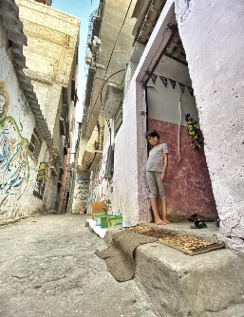

The morphology of refugee camps plays a central role in shaping Gaza’s broader urban life. Vertical self-building and incremental extensions have blurred formal boundaries between camp and non-camp areas, producing what Ramadan (2013) describes as hybrid urban formations suspended between autonomy and incorporation. By the 1970s, as camps transitioned from emergency shelters into more “permanent” forms of urban environments, refugees were already informally exchanging and modifying shelters, reflecting both adaptation and a refusal to remain confined to purely humanitarian space.
Totah (2014) conceptualises camps as relational urban formations co-constitutive with surrounding cities. In Gaza, this relationality is evident in the broader urban field, where the distinction between camp and city becomes analytically unstable, as conditions historically associated with camps extend across the territory.
These transformations extend beyond the boundaries of the camps themselves, reshaping the wider urban field of Gaza. Gaza’s Old City anchors this urban field historically and culturally, yet its role cannot be understood in isolation from the surrounding camp-based urban formations. Sites such as Al-Omari Mosque, St. Porphyrius Church, and Hammam Al-Samra operate not only as architectural landmarks but as spaces of socialisation, pedagogy, and intergenerational continuity that connect camp-based communities with wider urban networks. In this sense, camps are not marginal to the city but actively participate in and reshape its cultural, social and political life.
Refugee Camps as Collective: Beyond Materiality and Exception
Refugee camps transformed displacement into durable collective political life. As Arendt (2007 [1943]) argued in We Refugees, exile produces a population excluded from the political order, yet capable of forming collective political consciousness (Flohr 2024). Palestinian refugee camps exemplify this dynamic. While born from expulsion, they became spaces in which shared origin, memory, and political aspiration have been reorganised into enduring forms of collective life. Following the exclusion of the right of return from the Oslo Accords, bottom-up mobilisation for return has been triggered and sustained within camp spaces.

Palestinians are governed under a distinct international regime that reinforces their exceptional legal and political status (Akram 2002). The refugee question was deferred in the Oslo Accords, institutionalising a prolonged condition of political suspension. This structural exclusion has reinforced camps as sites where refugeehood is not merely a legal category but a lived and collectively organised identity. The coexistence of temporary and permanent structures, as shown in Figure 5, reflects how displacement and political mobilisation are materially embedded in urban form and sustained across generations.
Much refugee scholarship has interpreted camps through Giorgio Agamben’s concept of the state of exception (Agamben 2005). While this concept captures legal marginality, it risks understating the dense political and social infrastructures that camps actively sustain. In the Palestinian camps, popular committees coordinate services, mediate disputes, and organise collective action. Political factions, youth organisations, women’s committees, and neighbourhood networks operate within camp space, shaping everyday governance beyond formal state structures (Ramadan 2013; Abourahme 2020). Historically, camps have been central nodes of mobilisation. They have played sustained roles in uprisings, labour organising, commemorative rituals, and education initiatives that transmit claims to return across generations (Peteet 2005). These activities underscore that camps are not merely sites of political suspension, but arenas of collective articulation and strategic organisation.

The conditions visible in Figure 6 show how violence operates within dense urban environments where everyday life, survival, and political mobilisation are closely intertwined. This collective dimension is crucial for understanding their targeting. Camps sustain refugeehood as a collective political condition, even under repeated forms of disruption and violence. They materialise the continued presence of communities whose displacement was intended to be final. Their destruction therefore seeks not only to dismantle physical structures, but to fragment these formations.
Refugee Camps as Living Archives: Heritage and Urban Life
Camps function as living archives of displacement. Memory is embedded in murals, commemorations, spatial practices, collective organisation, and other forms of everyday heritage that sustain historical continuity (Peteet 2005; Smith 2006). Alongside these lived and spatial archives, institutional repositories such as UNRWA’s records preserve refugee registration files, property claims, and oral histories. As Kelcey and Irfan (2024) argue, these archives constitute critical documentary infrastructures of displacement, making their targeting a threat not only to historical memory but also to the evidentiary foundations of return.
Moreover, narrow alleys named after destroyed villages, incremental housing built over former tent plots, schools telling stories of expulsion and reminding refugees about their right of return, murals commemorating martyrs, and memorial plaques marking sites of past incursions embed displacement within everyday urban form (Peteet 2005). Maps of historic Palestine, keys symbolising return, and the names of villages depopulated in 1948 decorate most camp public spaces. Annual Nakba Day commemorations transform streets into processional spaces where elders recount expulsion and younger generations reenact village names through banners and chants.
Homes are frequently adorned with photographs of pre-1948 villages, embroidered textiles that reproduce village specific motifs, framed land deeds, and iron keys passed down through generations. Oral histories circulate through family gatherings and public commemorations, reinforcing intergenerational continuity. Children often grow up knowing the names, landscapes, and agricultural patterns of villages they have never physically seen. In this way, camps function as mnemonic infrastructures, where memory is spatially anchored rather than abstractly recalled.
Through these spatial and cultural practices, camp space itself becomes a pedagogical environment and space of heritage production. Heritage in this context does not conform to dominant frameworks that privilege antiquity, monumentality, or state recognition. Camp heritage is improvised, relational, and embedded in everyday life. It is produced through rebuilding after demolition, repainting murals after raids, reconstructing homes after incursions, and maintaining commemorative rituals despite recurrent destruction. Yet, camp heritage remains largely absent from international assessments focused on registered monuments (UNESCO 2024; 2025). The erasure of camps thus constitutes memoricide (Abujidi 2014).
Refugee Camps as Urban Resistance
The same spatial conditions that sustain collective memory also shape resistance. Camps emerged within a spatial order that sought fragmentation and containment (Wolfe 2006; Pappé 2006; Abujidi 2014). This enforced compression intensified density (UNRWA 2024) and foregrounded a mechanism of control for collective proximity.

The scale of destruction visible in Figure 7 demonstrates how urban space itself becomes the direct target of violence, rather than a collateral outcome. Density structures political life, even as it becomes a condition targeted through destruction. Self-building and rooftop extensions express refusal of disappearance and a refusal to accept temporariness as permanent settlement. Narrow alleys serve not only as circulation routes but as stages for funeral processions, commemorations, and political gatherings and mobilisation. Graffiti and murals inscribe counter memory.
Camps develop governance infrastructures beyond formal authority (Ramadan 2013; Weizman 2017; Abourahme 2020). In Jenin, Balatah, Askar, and other camps that I witnessed during the Second Intifadah (2000-2005) in the West Bank, resistance was embedded within camp morphology. Narrow alleys, interconnected rooftops, and close- knit housing complicated military movement and enabled defensive societal organisation (Weizman 2017). Their morphology and self- organised governance continue to resist camp incorporation into a normalised urban order. Attempts to “improve” or integrate camps through redevelopment are often perceived as strategies to dissolve the political claim of return (Hanafi 2008; Abourahme 2020). Even if camps appear to have been spatially integrated in their adjacent cities, everyday spaces remain unique. The camp’s unfinished condition continues to be social, economic and spatial expressions of political insistence.
The destruction of their “urban” might therefore be viewed as a strategy of elimination (Abujidi 2014; Weizman 2017). At the same time, it produces renewed forms of organisation as a form of urban resistance. In this sense, camps reveal a central contradiction of settler-colonial violence: the more they are attacked and destroyed, the more visibly they assert their role as infrastructures of political continuity and spaces of resistance.
Urbanity, Heritage, and the Struggle for Liberation
This study demonstrates how settler colonial strategies of urbicide and memoricide render refugee camps primary targets of spatial elimination. In doing so, it has shown that Gaza’s refugee camps function as spaces through which continuity, political mobilisation, and collective life are organised and sustained. Far from humanitarian residues, camps are central urban formations produced through expulsion, containment, and political mobilisation, and aspirations for more hopeful future. Emerging from the Nakba and maintained within a regime of enforced temporariness, camps have evolved into dense urban environments shaped by dwelling, labour, kinship, and everyday practices of care. Their morphology registers both constraint and persistence, reflecting how displacement and struggle for return are spatially organised over time. In this sense, genocide reconfigures urbanity not only through destruction, but through the production of space as terrain of containment, fragmentation, and suspended futurity.
At the same time, camps function as living archives of that displacement. Rather than monumental or state-sanctioned heritage, they materialise the Nakba through oral histories, commemorative rituals, spatial practices, and social organisation. This repositions heritage from the domain of officially-recognised historic sites to the lived landscapes through which exile is remembered and politicised. Such a perspective challenges frameworks that privilege official recognition while obscuring the relationship between heritage, refugeeism, and return. It is the same dominant perspective that most of the reporting on genocide from Gaza fails to recognise: that the destruction of camps exceeds material demolition. Their destruction targets the mnemonic and social infrastructures through which the Palestinian identity, cause, and return-oriented political claims are sustained.
From this perspective, the annihilation of camps signifies not only material destruction, but an assault on the spatial, social, and mnemonic conditions through which refugeehood is reproduced as a collective political condition. Genocide in Gaza can thus be understood as a spatial process aimed at dismantling refugeehood itself. This process operates not only through the destruction of buildings, but through the fragmentation of community infrastructures, including social networks, commemorative and healing spaces, schools and other spaces of reconstructive learning, and everyday circuits of care through which political and cultural continuity is sustained. Yet it is precisely through these infrastructures that Palestinians continue to shape urban life, reproducing social relations, memory, and political claims under conditions of extreme violence.
A central contradiction emerges from this dynamic. The more camps are attacked and destroyed, the more visibly they assert their role as infrastructures of political continuity and resistance. In Gaza, where distinctions between camp and city have collapsed, this contradiction extends to the entire urban field. The territory itself assumes camp like characteristics, revealing the generalisation of containment, density, and suspended temporariness across urban space. Camps thereby expose the incompleteness of settler colonial elimination (Wolfe 2006), as return-oriented claims continue to be materially and socially reproduced through urban life itself.
Read against the longer trajectory traced throughout this article, the repeated targeting of refugee camps in Gaza and in the West Bank, including in Jenin, Tulkarm, and Nablus, cannot be reduced to isolated military episodes. It forms part of a longer spatial project in which destruction, fragmentation, and reorganisation work together to make refugee space governable, vulnerable, and disposable. Foregrounding refugee camps within this process shows that urbanity, heritage, and political struggle are co-produced, and that genocide operates through attempts to interrupt spatial reproduction. Camps are not residual humanitarian spaces. They are central terrains through which Palestinian continuity is materially organised and therefore systematically targeted.
References
Abourahme, N. (2020). Assembling and spilling-over: Towards an ethnography of cement in a Palestinian refugee camp. International Journal of Urban and Regional Research, 44(2), 200–217.
Abujidi, N. (2014). Urbicide in Palestine: Spaces of oppression and resilience. Routledge.
Agamben G 2005 State of exception University of Chicago Press, Chicago IL
Akram S M 2002 Palestinian refugees and their legal status: rights, politics, and implications for a just solution Journal of Palestine Studies 31 36–51
Arendt, H. (2007 [1943]), “We Refugees,” in The Jewish Writings, eds. Jerome Kohn and Ron H. Feldman (New York City: Schocken Books).
Citino, N., Martín Gil, A., & Norman, K. P. (2023, May 3). Generations of Palestinian refugees face protracted displacement and dispossession. Palestine Quest. https://www.palquest.org
Flohr, M. (2024). Beyond the Nation State: Rereading Hannah Arendt’s “We Refugees” Eighty Years Later. New Political Science, 46(1), 6–20. https://doi.org/10.1080/07393148.2024.2303223
Hammami, F. (2012). Conservation Under Occupation: Conflictual Powers and Cultural Heritage Meanings. Planning Theory & Practice, 13(2), 233–256. https://doi.org/10.1080/14649357.2012.669977
Hammami, F. (2023). Rupture in heritage: strategies of dispossession, elimination and co-resistance. Settler Colonial Studies, 13(1), 3–29. https://doi.org/10.1080/2201473X.2021.2019371
Hilal, S., & Petti, A. (2023). Evolving infrastructure of Palestinian refugee camps. Palestine Quest. Retrieved on the 11 of December 2025 from https://www.palquest.org/en/highlight/22473/evolving-infrastructure-palestinian-refugee-camps
Kelcey, J., & Irfan, A. (2024). Rescuing the UNRWA archive: Saving Palestinian history amidst the Gaza genocide. [Open access publication details]
Khalidi, R. (1997). Palestinian identity: The construction of modern national consciousness. Columbia University Press.
Khalidi, W. (Ed.). (1992). All that remains: The Palestinian villages occupied and depopulated in 1948. Institute for Palestine Studies.
Masalha, N. (2012). The Palestine Nakba: Decolonising history, narrating the subaltern, reclaiming memory. Zed Books.
Office of the High Commissioner for Human Rights. (2023, November). Gaza: Destroying civilian housing and infrastructure is an international crime. https://www.ohchr.org/en/press-releases/2023/11/gaza-destroying-civilian-housing-and-infrastructure-international-crime
United Nations Office for the Coordination of Humanitarian Affairs oPt. (2024). Humanitarian situation updates: Gaza Strip. https://www.ochaopt.org/
Pappé, I. (2006). The ethnic cleansing of Palestine. Oneworld.
Peteet, J. (2005). Landscape of hope and despair: Palestinian refugee camps. University of Pennsylvania Press.
Smith, L. (2006). Uses of heritage. Routledge.
Totah, F. M. (2014). Palestinian refugees between the city and the camp. International Journal of Urban and Regional Research, 38(1), 22–39.
UNESCO. (2024). Impact on cultural heritage in the Gaza Strip. https://www.unesco.org/en/gaza/assessment
UNESCO. (2025). Impact on cultural heritage in the Gaza Strip: Updated verified damage figures. https://www.unesco.org/en/gaza/assessment
United Nations Relief and Works Agency for Palestine Refugees in the Near East. (2024). Situation reports: Gaza Strip. https://www.unrwa.org/resources/reports
Wolfe, P. (2006). Settler colonialism and the elimination of the native. Journal of Genocide Research, 8(4), 387–409.
[1] The First Aliyah (c. 1882–1903) marked the beginning of sustained Zionist immigration and land acquisition in Ottoman Palestine, contributing to early transformations in land ownership and rural society affecting the indigenous Arab population (Khalidi 1997, 98–105).
[2] Plan Dalet (Plan D), adopted by the Haganah in March 1948, outlined operations to secure and consolidate territorial control in Palestine. Although presented as a defensive military framework, its execution has been interpreted by several scholars as enabling the systematic depopulation of Palestinian villages and mass displacement, forming a central component of the 1948 Nakba (Pappé, 2006; Khalidi, 1992).