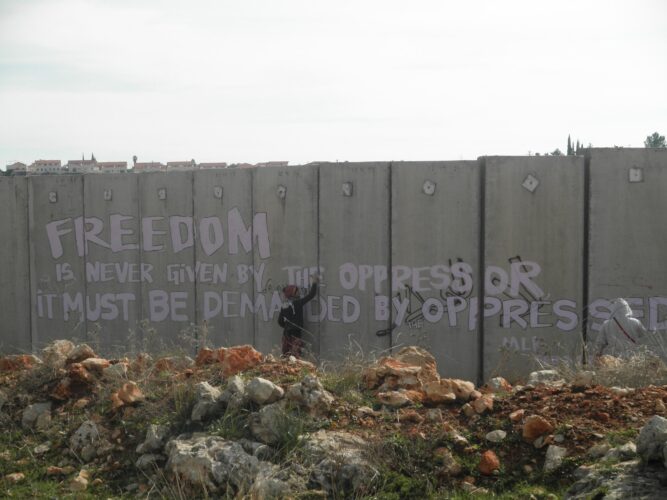
Short-Term Solidarity: Airbnb and the Rise of Episodic Protective Presence Volunteering in the West Bank
Introduction
For more than two decades, anti-occupation activism in the occupied West Bank has relied on a strategy known as protective presence: the physical accompaniment of Palestinian communities by Israeli and international activists. These activists observe demonstrations, accompany shepherds and farmers to their fields, document attacks, and intervene during arrests, home demolitions, or settler assaults. The tactic emerged from the legal asymmetry of occupation. Palestinians in the West Bank are governed by Israeli military law and face extremely high conviction rates in military courts, while Israeli citizens and foreign nationals operate under different legal regimes and enjoy far greater mobility and procedural protections (Bureau of Democracy, Human Rights and Labor, 2022; Esveld et al., 2010). Their presence has therefore functioned, at least partially, as a deterrent. Cameras and foreign passports can raise the political cost of violence for IDF soldiers and settlers.
Protective presence has historically been organized through formal volunteer infrastructures. Palestinian-led initiatives such as the International Solidarity Movement (ISM), alongside Israeli groups like Ta’ayush and other accompaniment organizations, coordinated volunteers, trained them, and connected them with local communities. In ISM’s case, volunteers usually arrived through activist networks, committed for more than a month, paid their own expenses, completed a two-day training in Bayt Sahur, and were then sent to different parts of the West Bank according to local need (Seitz, 2003: 51–52). The training prepared volunteers to navigate the legal, tactical, cultural, and political demands of accompaniment before entering the field (Dudouet, 2006: 2–3). These programs transformed solidarity into a coordinated political practice.
Interviews with Palestinian Airbnb hosts conducted after October 2023 suggest that this model is being bypassed. Instead of entering the West Bank through activist networks, volunteers arrange travel and accommodation through short-term rental platforms such as Airbnb and coordinate their activities informally once they arrive. Earlier forms of accompaniment were mediated through activist organizations, but Airbnb turns accommodation into a market route into solidarity work.
The shift changes the political economy of solidarity activism. Organized protective presence programs historically cultivated what I call collective political capacity: the practical ability to act with discipline, judgment, and accountability in coordination with Palestinian communities. This capacity weakens when participation is reorganized around individualized and short-term volunteering rather than collective movement practice (Beck, 1992; Hustinx, 2010a, 2010b). Protective presence has depended not only on physical presence, but on shared experience accumulated and transmitted through activist networks. Platform-mediated participation makes engagement more flexible, but it also weakens the social and political conditions through which this capacity is sustained.
Collective political capacity is practical. Post-2000 Israeli anti-occupation groups developed specialized field knowledge, with different organizations becoming “very good at what they do” and accumulating knowledge about how to carry out particular actions effectively (Fleischmann, 2019: 79). These networks accumulated the practical knowledge of struggle. Bypassing these networks also means bypassing accumulated knowledge about coordination, risk, and accountability.
Protective presence now operates under intensified settler and state violence. Settlers have been further armed and incorporated into local “security” units, while an increasingly hardline Israeli government has emboldened attacks on Palestinian communities. Activists now debate whether international accompaniment can still deter violence, yet the demand for protective presence has not disappeared. This article examines how short-term rental platforms are transforming protective presence activism by enabling more individualized short-term participation. It also argues that this shift has intensified after October 7, as protective presence has become more necessary under conditions of heightened violence and more precarious under expanding regimes of mobility restriction and political repression. Focusing on the perspectives of Palestinian Airbnb hosts, the article shows how Airbnb has become part of the logistical infrastructure through which international activists reach Palestinian communities.
History of Protective Presence
Protective presence in Palestine draws on earlier international accompaniment initiatives such as those pioneered by Peace Brigades International in Central America during the 1980s. These efforts sought to protect activists and communities by leveraging the visibility of foreign witnesses and the political costs attached to harming them. Similar strategies emerged in Palestine in the mid-1990s following the 1994 Hebron massacre, when Israeli settler Baruch Goldstein killed twenty-nine Palestinian worshippers at the Ibrahimi Mosque. The massacre intensified existing fears among Palestinian communities living in close proximity to settlements and underscored the need for protective accompaniment. In the years that followed, solidarity organizations such as Ta’ayush, the ISM, and Rabbis for Human Rights developed forms of protective presence that brought Israeli and international activists into Palestinian villages threatened by settler expansion.
Despite operating under the broad umbrella of solidarity, these initiatives emerge from different political traditions. Palestinian-led networks such as the ISM frame their work explicitly as support for Palestinian popular struggle. ISM volunteers typically join actions initiated by Palestinian communities and operate within a loose non-hierarchical movement structure that emphasizes Palestinian leadership, opposition to Zionism, racism, antisemitism, and Islamophobia (Dudouet, 2006; Seitz, 2003). In ISM’s model, international activists are not protagonists but supporting actors whose role is to amplify and help protect Palestinian resistance.
Israeli-led organizations operate from a different position. Ta’ayush mobilizes Israeli citizens through direct acts of solidarity with Palestinian communities (Simons, 2016). Ta’ayush is also a “school for activists” that shaped later forms of direct action and contributed to the emergence of organizations such as Anarchists Against the Wall and Tarabut-Hithabrut (Fleischmann, 2019: 61). Protective presence was an infrastructure of political learning as much as a tactic of accompaniment. Other organizations, including Rabbis for Human Rights or Achvat Amim, approach accompaniment through liberal Zionist frameworks that opposes settlement expansion and the occupation specifically in the West Bank (Fleischmann, 2019). These political differences shape how activists relate to Palestinian communities. A principle frequently emphasized by Palestinian organizers needs to be reiterated here: protective presence helps Palestinians only when it remains grounded in Palestinian leadership rather than substituting for it. ISM training therefore instructed volunteers to avoid imposing cultural, political, or strategic judgments and to understand themselves as “here to learn, not to teach,” since foreign-led proposals about Palestinian resistance can reproduce colonial relations even when framed as solidarity (Dudouet, 2006: 4). Courage and visibility are not enough. When communication with Palestinian actors breaks down, international activists can misread local priorities and reproduce the substitutionary politics they claim to oppose (Seitz, 2003: 58–59). Palestinian leadership and organizational accountability determine whether accompaniment becomes solidarity or substitution.
These tactics rest on the legal asymmetries embedded in the occupation. Palestinians in the West Bank are governed by Israeli military law and face military courts with extremely high conviction rates. Israeli citizens and foreign nationals, by contrast, fall under Israeli civilian law and generally enjoy greater procedural protections. Their citizenship also connects them to foreign governments and media networks capable of generating political costs for Israeli authorities. In practice, accompaniment means joining shepherds grazing livestock near settlements, walking children to school, staying overnight in villages vulnerable to raids, documenting demolitions, demanding legal orders from soldiers, and attempting to de-escalate settler or military violence. Documentation is central to this practice, but its effects are uneven. Ta’ayush’s videos and reports create an extensive archive of settler and military violence, yet often circulate within a small counter-public rather than generating widespread outrage among Jewish-Israeli audiences (Simons, 2016: 5–7).
Since October 2023, the conditions have become more precarious. Israeli authorities have intensified efforts to remove or deter foreign activists through deportations, entry bans for up to ten years, and the widespread declaration of “closed military zones” around Palestinian communities including during periods such as the olive harvest (Golan, 2025). Several international activists have been detained or expelled after accompanying Palestinian farmers or staying in communities facing settler harassment, while others have faced settler attacks or lethal force from Israeli security forces. International citizenship no longer offers the protection it once appeared to provide. As settlement violence and repression intensify, protective presence persists as a fragile tactic that remains politically significant precisely because Palestinian communities continue to call for it.
Short-Term Volunteering
Scholarship on volunteering describes a shift from long-term civic association to episodic and flexible participation (Cnaan and Handy, 2005; Hustinx and Lammertyn, 2003; Wuthnow, 2002). What Putnam (2001) once called “serious volunteering,” meaning sustained involvement in civic institutions, has gradually been displaced by looser and more individualized participation. This shift is often explained through volunteer preference. Younger generations are said to prefer autonomy, flexibility, and opportunities aligned with personal interests or résumé-building (Brudney, 2010; Katz and Rosenberg, 2005). Yet such explanations risk reducing a structural transformation to a matter of individual preference. Beck (2007) argues that individualization is not simply a cultural preference for autonomy, but a macro-institutional process through which modern institutions increasingly address individuals rather than collectives as the basic unit of social organization. Institutions increasingly offer participation as a set of flexible individual choices, narrowing the space for collective organization.
Platform-mediated activism amplifies these solidarity work conditions. Digital platforms reorganize the logistics of participation. My findings show that Airbnb functions as an informal infrastructure for activists participating in protective presence initiatives in Palestine. By allowing accommodation to be booked instantly and individually, the platform enables volunteers to insert themselves into local political contexts without passing through the organizations that historically structured solidarity work.
This resembles what scholars describe as “episodic” or “plug-in” volunteering which is characterized by limited duration, weak organizational ties, and individualized motivations (Hustinx, 2010a; Macduff, 1991). These arrangements may increase participation while weakening organizational ties. Hustinx (2010b) argues that contemporary volunteering increasingly takes the form of individuals providing one-to-one service rather than acting collectively through organizations. Volunteers often act alongside one another rather than building durable relationships or shared political strategy.
For protective presence in Palestine, the tension between flexibility and accountability is not new. ISM’s flexibility allowed it to respond quickly to Palestinian needs, but when communication between internationals and local communities broke down, that same flexibility could produce instability and missed opportunities (Seitz, 2003: 64). Shorter-term ISM direct action also differed from longer-term accompaniment models such as IWPS and CPT, where smaller groups of trained volunteers stayed in particular areas for several months and developed projects more closely aligned with local needs and customs (Dudouet, 2006: 7–8). Recurring coalitions around actions such as the olive harvest helped transform informal networks into a durable activist community able to mobilize experienced participants when needed (Fleischmann, 2019: 63). Platform-mediated participation intensifies this older tension by expanding access to protective presence while weakening the local knowledge, cultural sensitivity, and accountability that organized accompaniment was designed to cultivate.
Historically, protective presence depended on sustained engagement: volunteers embedded themselves in Palestinian communities, developed relationships with residents, and participated in organizational networks built through years of collective struggle. Platform-mediated participation encourages shorter stays and weaker social ties. Activists may arrive with genuine commitment, but the infrastructure enabling their participation is increasingly designed for temporary involvement and individualized coordination. Short-term rental platforms do not cause this transformation on their own. They express and intensify a broader shift from long-term collective commitment to a short-term engagement (Hustinx, 2010b; Macduff, 1991). Eliasoph (1998) helps explain the political stakes of this shift: when participation is reframed as service rather than collective struggle, civic action can lose its explicitly political content. Platforms such as Airbnb may therefore simultaneously expand access to participation while reshaping the forms in which solidarity is organized.
Methods and Research Context
This article draws on ten semi-structured interviews with Palestinian Airbnb hosts located in the West Bank. All interviews were conducted after 7 October 2023, during an ongoing period of heightened political violence. This timing shaped both participants’ reflections on hosting practices and the broader contextual frame through which questions of property, security, and mobility were discussed. Recruitment and data collection were approved by York University’s Research Ethics Board (Certificate # STU 2024-106).
Participants were recruited directly through the Airbnb platform using the “Contact host” function available at the bottom of each listing page. Invitations briefly described the research project and requested voluntary participation. Interviews were held remotely via Zoom and lasted between 30 and 60 minutes. All interviews were conducted in English. With informed consent, all interviews were audio-recorded and transcribed. All identifying information, including names and location details, was removed during transcription; pseudonyms were assigned to every participant.
Hosting as Protective Infrastructure
Most Palestinian Airbnb hosts I interviewed were middle-class professionals with full-time jobs, including engineers, accountants, sales workers, and municipal employees. Airbnb hosting rarely replaced their full-time job – it only supplemented it. Only a small minority ran guesthouses or hostels on a full-time basis. Most had started hosting between 2018 and 2021 in order to earn an additional income or diversify household earnings within an already unstable Palestinian economy. Airbnb hosting turned domestic space into an income-generating asset because the broader political economy left households few stable alternatives.
The platform also imposes major restriction for Palestinian hosts. Palestinian hosts receive no state support, and Airbnb does not permit payouts to Palestinian bank accounts. Income must be routed through foreign accounts or improvised through informal practices. Some rely on relatives abroad to receive payments on their behalf; others, lacking that option, go as far as opening Israeli bank accounts in order to access the platform’s financial system at all. As Hossam explained, some ask guests to bring cash and then cancel the reservation through Airbnb, a practice that allows the stay to proceed but shifts all financial risk onto the host. Palestinian hosts operate within a platform infrastructure that extracts value from their listings while denying them full access to its financial systems.
Hosts overwhelmingly preferred diasporic Palestinians and foreign guests, particularly foreigners affiliated with pro-Palestinian volunteer or activist networks. Hosts described these guests as more respectful and more likely to return. As Mostafa explained, Palestinian visitors from nearby towns could sometimes be “more demanding,” whereas international guests often returned repeatedly and developed longer-term relationships with hosts. Several hosts described how these relationships extended beyond accommodation. Mostafa, for instance, recalled helping foreign visitors connect with families seeking assistance during the olive harvest.
Some connections were organized before guests arrived. Mohamed, who operates a small hostel, explained that he regularly receives large groups of German guests who stay together while participating in solidarity activities in the West Bank. These bookings are often arranged through protective presence organizations, though Mohamed deliberately chose not to disclose their names in order to protect the privacy of his guests. Hossam was aware of these arrangements and expressed the hope that his own Airbnb might eventually become a regular destination for similar group bookings, which he viewed as a more stable and reliable source of income than sporadic tourism.
Hosts were clear that most international visitors did not arrive politically neutral. They came already informed, already oriented. “It’s not even something we need to talk about – it’s already understood,” as Mostafa put it. The platform allows individuals to insert themselves into a conflict zone through short-term, self-directed engagements. Their travel follows the episodic model described in the volunteering literature. The older form of protective presence emphasized long-term embedding and organizational continuity, but platform-mediated participation produces something looser. Participation becomes easier to initiate and easier to exit. Solidarity remains, but it is reorganized around shorter stays and weaker obligations.
After October 7, this arrangement became more fragile. Bookings collapsed. Intensified military operations, expanded checkpoints, and travel warnings made entry into Palestinian areas both difficult and risky. Wael described those who still came as “brave.” Wael and others mentioned how their guests faced hours of questioning at checkpoints, with Israeli soldiers routinely advising tourists to avoid Palestinian cities and stay in nearby settlements instead. Tourism declined because mobility itself was under military control. Several hosts also experienced direct material damage from military incursions. Mohamed described a raid in which Israeli soldiers tore down every door in his Ottoman-era home. Although he was relieved that no guests were staying at the time, he was left to cover the full cost of repairs himself. For hosts, such incidents are part of the ordinary insecurity of hosting under occupation.
What Airbnb offers is a narrow corridor of possibility carved out within constraint. It enables hosts to monetize space, to connect with visitors, to participate in a particular form of international solidarity. Those terms are set by financial exclusion, military regulation of movement, and the threat of violence against the home.
Conclusion
For Palestinians in the West Bank, hosting is a survival strategy. When wages are unstable, movement is further restricted, and property is exposed to destruction, the home is drawn into the market out of necessity. Short-term rental platforms transform protective presence by making it easier for international and Israeli activists to enter Palestinian communities through individualized arrangements. Airbnb can facilitate politically committed travel, and in some cases it connects guests to accompaniment or harvest support. Yet this ease of entry also changes the structure of solidarity. Participation becomes easier to initiate and easier to exit, while the organized networks that historically provided training, coordination, accountability, and shared strategy become less central. The erosion occurs at the level of collective political capacity: the training, accountability, and shared strategy that organized accompaniment once provided.
Since October 2023, this transformation has intensified. In the West Bank, Israeli forces and armed settlers have killed more than 1,000 Palestinians, while military operations, settler violence, demolitions, and movement restrictions have produced large-scale displacement (Hardman and Jones, 2025). Under these conditions, protective presence has become both more necessary and more precarious. The platform that enables international visitors to arrive still depends on mobility governed by military power. Airbnb does not operate outside the conditions of occupation but monetizes space within them. Recent Israeli measures making it easier for settlers to purchase the West Bank land and expanding Israeli enforcement powers over Palestinians deepen the insecurity in which Palestinian hosting takes place (Freiberg, 2026). So too does Israel’s 2026 death penalty law, which has been described as a discriminatory capital punishment regime effectively directed at Palestinians (Bedard, 2026). This is the terrain of Palestinian hosting. When land can be appropriated, homes can be demolished, and punishment distributed unequally, the apparent neutrality of Airbnb collapses.
References
Beck U (1992) Risk Society: Towards a New Modernity (trans. M Ritter). Theory, Culture & Society. London: SAGE Publications Ltd.
Beck U (2007) Beyond class and nation: reframing social inequalities in a globalizing world. The British Journal of Sociology 58(4): 679–705.
Bedard H (2026) Israel Passes Mandatory Death Penalty for Palestinians Convicted of Terrorism, Flouting International Law and Drawing Widespread Condemnation. Washington, DC. Available at: https://deathpenaltyinfo.org/israel-passes-mandatory-death-penalty-for-palestinians-convicted-of-terrorism-flouting-international-law-and-drawing-widespread-condemnation (accessed 13 April 2026).
Brudney J (2010) A Cross-cultural Examination of Student Volunteering: Is it all about Rsum Building? Nonprofit and Voluntary Sector Quarterly. All Maxine Goodman Levin School of Urban Affairs Publications. Epub ahead of print 1 August 2010.
Bureau of Democracy, Human Rights and Labor (2022) West Bank and Gaza Human Rights Report. Country Reports on Human Rights Practices. Washington, DC: United States Department of State. Available at: https://www.state.gov/reports/2022-country-reports-on-human-rights-practices/israel-west-bank-and-gaza/west-bank-and-gaza/ (accessed 8 May 2026).
Cnaan R and Handy F (2005) Towards understanding episodic volunteering. Vrijwillige Inzet Onderzocht 2: 29–35.
Dudouet V (2006) Cross-border non-violent advocacy during the second Palestinian intifada: the case of the International Solidarity Movement. Unarmed Resistance: the transnational factor, 13 July. Coventry University: Centre For Peace and Reconciliation Studies. Available at: https://civilresistance.info/sites/default/files/V%C3%A9ronique%20Dudouet_0.pdf.
Eliasoph N (1998) Avoiding Politics: How Americans Produce Apathy in Everyday Life. Cambridge Cultural Social Studies. Cambridge University Press.
Esveld BV, Malkin N and Hijazi S (2010) Separate and Unequal: Israel’s Discriminatory Treatment of Palestinians in the Occupied Palestinian Territories | HRW. 19 December. Human Rights Watch. Available at: https://www.hrw.org/report/2010/12/19/separate-and-unequal/israels-discriminatory-treatment-palestinians-occupied?
Fleischmann L (2019) The Israeli Peace Movement: Anti-Occupation Activism and Human Rights since the Al-Aqsa Intifada. London New York, NY: I.B. Tauris.
Freiberg N (2026) Security cabinet okays deepened Israeli control of West Bank; Hamas urges ‘escalation’. The Times of Israel, 8 February. Available at: https://www.timesofisrael.com/security-cabinet-okays-dramatic-west-bank-policy-overhaul-deepening-israeli-control/ (accessed 18 February 2026).
Golan M (2025) Israel set to deport 32 foreign activists who helped Palestinians harvest olives in a West Bank village. Haaretz, 18 October. Available at: https://www.haaretz.com/israel-news/2025-10-18/ty-article/.premium/israel-set-to-deport-32-foreign-activists-who-helped-palestinians-harvest-olives/00000199-f8b2-d3e1-adfd-feb3294c0000?utm_source=chatgpt.com (accessed 8 May 2026).
Hardman N and Jones S (2025) “All My Dreams Have Been Erased”: Israel’s Forced Displacement of Palestinians in the West Bank. 20 November. Human Rights Watch. Available at: https://www.hrw.org/report/2025/11/20/all-my-dreams-have-been-erased/israels-forced-displacement-of-palestinians-in-the.
Hustinx L (2010a) I Quit, Therefore I Am?: Volunteer Turnover and the Politics of Self-Actualization. Nonprofit and Voluntary Sector Quarterly 39(2). SAGE Publications Inc: 236–255.
Hustinx L (2010b) Institutionally individualized volunteering: Towards a late modern re-construction. Journal of civil society 6(2). Taylor & Francis: 165–179.
Hustinx L and Lammertyn F (2003) Collective and Reflexive Styles of Volunteering: A Sociological Modernization Perspective. Voluntas: International Journal of Voluntary and Nonprofit Organizations 14(2). Springer: 167–187.
Katz E and Rosenberg J (2005) An economic interpretation of institutional volunteering. European Journal of Political Economy 21(2): 429–443.
Macduff NL (1991) Episodic Volunteering: Organizing and Managing the Short-Term Volunteer Program (eds J Ricketts and J Millgard). Walla Walla, WA: MBA Publishing. Available at: https://ellisarchive.org/sites/default/files/2022-06/Episodic-Volunteering.pdf.
Putnam RD (2001) Bowling Alone: The Collapse and Revival of American Community. London: Simon and Schuster.
Seitz C (2003) ISM At the Crossroads: the Evolution of the International Solidarity Movement. Journal of Palestine Studies 32(4). Routledge: 50–67.
Simons J (2016) Fields and Facebook: Ta’ayush’s Grassroots Activism and Archiving the Peace that Will Have Come in Israel/Palestine | Article | Media and Communication. Epub ahead of print 18 February 2016.
Wuthnow R (2002) Loose Connections: Joining Together in America’s Fragmented Communities. Cambridge, Mass.: Harvard University Press.