Visualising martyrs in contemporary urban Palestine
For a first-time visitor to Palestine, it is difficult not to notice all the portraits, mostly of boys and young men, that are displayed on walls in urban areas. It doesn’t take long to understand that the wall paintings and posters mostly depict recent Palestinian martyrs, i.e. people who have been killed by Israel, either as bystanders, as targeted activists, or as militants attacking Israelis. Soon enough, one will also realise that there are streets named after well-known martyrs, monuments in martyrs’ honour, and, in some areas, special graveyards for those who Palestinian society considers to have sacrificed their lives for national independence, resisting Israeli dominance. In relation to martyrs during the Al-Aqsa intifada (2000-2005), Allen (2008: 465) noted that martyr posters with their ‘predictable repetitiveness […] visually subsume[d] each individual death into the common stream of intifada martyrdom, only add[ing] to their normalcy.’ Palestinian society is indeed marked by extensive deadly violence. At times and in certain areas, like in refugee camps and villages close to Israeli settlements as during the genocidal war on Gaza, violent death becomes something expected and uncannily ’normal.’
Simultaneously, those Palestinians killed in relation to Israeli dominance and aggression are nothing but ordinary (Gren 2015). On the contrary, violent death is socio-culturally accentuated and martyrs are celebrated and commemorated in numerous ways, which leaves marks in the urban landscape. Palestinian fatalities are made sense of when interpreted collectively as politically meaningful. The tradition of celebrating martyrs goes back to the Palestinian peasant revolt against British colonial rule in the 1930s (Swedenburg 2003: 107f). Moreover, during the first intifada in the 1980s, the local nationalist leadership proclaimed general strike days as a gesture of mourning for recent martyrs (Khalili 2007). This is a practice that is still upheld and that I experienced during my most recent fieldwork in the West Bank in early 2023.
Aside from these strike days, resembling national days of mourning, Palestinian society has several ways of symbolically marking those who died in relation to the Israeli occupation as martyrs. I have written elsewhere about the complexities of the social making of martyrs in a West Bank refugee camp in the early 2000s (Gren 2015). For instance, the bodies of martyrs did not need to be ritually washed, as their blood was said to wash them. Often, their faces were displayed during funeral marches as opposed to the covered faces of other dead ones. Something supernatural might also occur in relation to the death of a martyr, like the smell of jasmine from the body. There was also a need to continuously confirm the authenticity and patriotic intent of martyrs and thus distinguish between different degrees of martyrdom. Authenticity is, for instance, verified by mass attendances at martyrs’ funeral processions and the mere number of portraits highlighting specific martyrs in Palestinian urban spaces. Some martyrs contributed themselves to their status by recording or writing testimonies before their deaths (Hamamra 2018).
During the genocide in Gaza, the display and commemoration of martyrs and the telling of their stories on walls has partly been transferred to social media accounts, and thus globally distributed (Masharqa 2025). Since the urban landscape in many parts of Gaza has been completely ruined, earlier murals and other visual forms of commemoration have probably been wiped out. Moreover, there may be few standing walls on which to paint or hang a poster. That does not mean that people in Gaza have given up on visually commemorating all those killed. The French historian Filiu (2025), the only scholar who has been to Gaza since the start of the genocide, reports for instance that people have written the names of those killed on the rubble of their houses.
Aside from its patriotic dimension, Palestinian martyrdom has religious connotations. Most Palestinians in the occupied territories are Sunni Muslims, and many are to some extent religious practitioners. ‘[D]ying for the sake of others, particularly other Muslims, is greatly respected and admired’ writes Dabbagh (2005: 44) about views on martyrdom in Arab countries, which also holds true in the Palestinian discourse. The discourse about martyrdom is influenced by Sunni Muslim beliefs, although many Christian Palestinians, like the famous journalist Shireen Abu Akleh, have been martyred over the years.
This photo essay builds on my long-term ethnographic engagement with the occupied West Bank. The photos were taken by me during my two most recent fieldwork visits in 2022 and 2023, and they display graves, monuments, wall paintings, and street signs that relate to Palestinian martyrdom. I don’t take photos of people anymore during fieldwork, since it has become increasingly difficult to safeguard my interlocutors’ anonymity. Instead, I have taken photos of street art, landscapes, and murals. The photos are only from the areas of Ramallah and Bethlehem, since the political situation was volatile, meaning that army invasions, closed checkpoints, and Palestinian armed resistance made travelling difficult and at times dangerous.
The aim with this photo essay is to show how Palestinian urbanity is visibly marked by attempts to create meaning from violent death and to resist erasure and forgetfulness. Urban spaces remind us of martyrs, while the frequency of portraits, murals, and monuments has a simultaneously normalising effect. There is thus a tension between accentuating and normalising violent death. Moreover, some martyrs are more visible in urban areas than others, hinting at hierarchies between martyrs of different status.
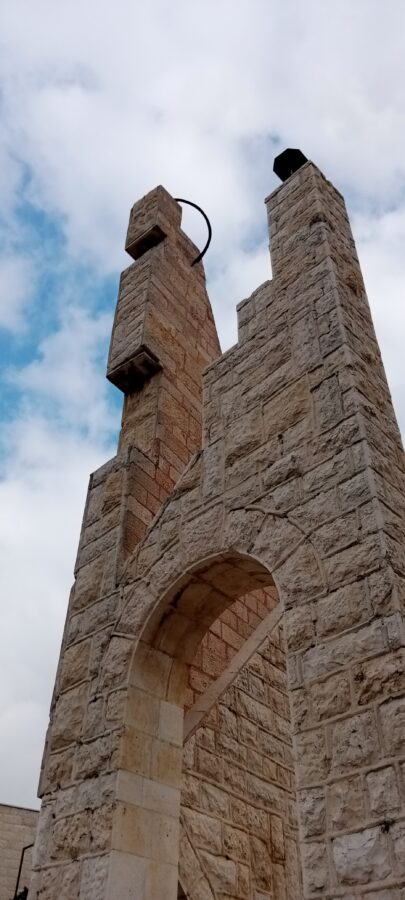
In the refugee camp Dheisheh outside Bethlehem, there is a huge sandstone monument by the main entrance in the form of a map of Palestine. It is called sarh al-shahid, literally the martyr’s release, and was erected to remember those camp residents killed in the 1990s and earlier.

Dheisheh is situated on a hillside. If you walk uphill through the camp’s alleys, you will arrive to the village of Artas. Here, the refugees from Dheisheh established a special graveyard for martyrs during the Al Aqsa Intifada when it was too dangerous to bury killed camp residents at the ordinary graveyard in Bethlehem. The graveyard is continuously filled with new graves for martyrs from Dheisheh. Two places related to martyrs, the graveyard and the monument at the entrance on Image 1, enclose and mark off the camp from its surroundings, emphasising its inhabitants’ view of the camp as a place of suffering, struggle, and losses.
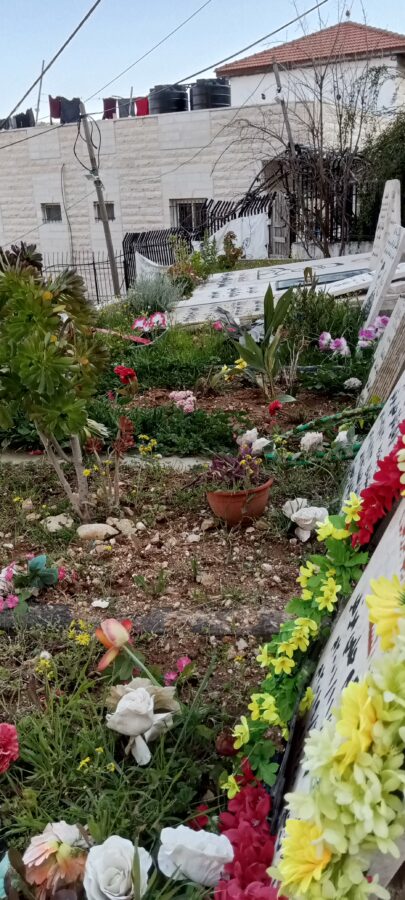
Some tombs at the martyrs’ graveyard in Artas as seen from the side. Close by is a family house in the village.
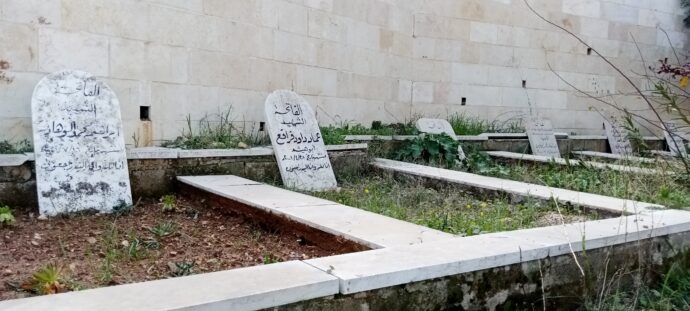
Tombs from the early 2000s at the martyrs’ graveyard.

At another of the three refugee camps in the Bethlehem governorate, ‘Aida camp, there is a monument in the form of a key with portraits on it, commemorating local martyrs. The key is, in the Palestinian context, a symbol for the refugees’ right to return to their original homes in villages and towns inside present-day Israel. The refugees often refer to the UN Assembly Resolution 194 taken in 1948, just months after the refugees’ flight, that established the right of return.

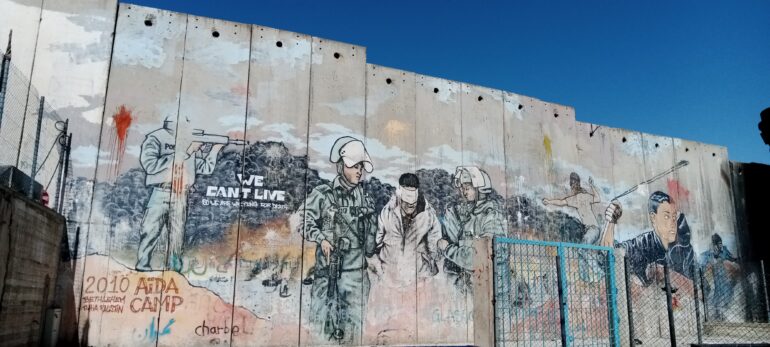
On the wall that Israel constructed next to the refugee camp ‘Aida, there are murals showing a Palestinian guy throwing a stone, aiming for a heavily armed Israeli policeman, and a blindfolded Palestinian man taken away by two Israeli soldiers. Another boy is launching a slingshot. Further away, one can distinguish a woman being attacked by an army dog. Among all these visualisations of violent interactions with the Israeli army, a text in English reads ‘We can’t live so we are waiting for death.’ In this case, violent death has not yet materialised, but is expected.
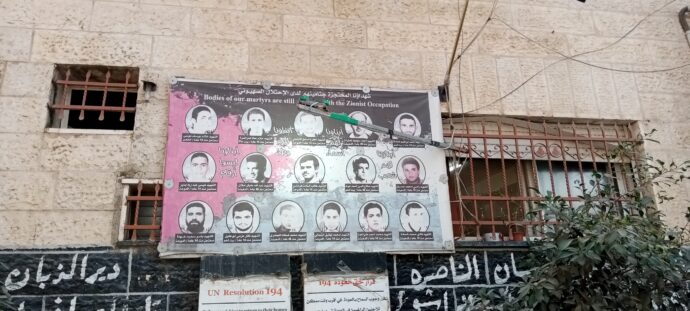
On the wall of a cultural centre in Dheisheh, a big sign has been put up, displaying portraits of martyrs whose bodies the Israeli authorities still hold. Israel is sometimes refraining from releasing martyrs to their families and local communities as a way of collectively punishing them for violent acts of the martyrs. Some bodies are only released if the family promises to hold the funeral at night without a public funeral march. Other martyrs are stored in morgues for extensive periods of time, while others are eventually buried in Israeli-controlled military areas which Palestinians are not allowed to visit.
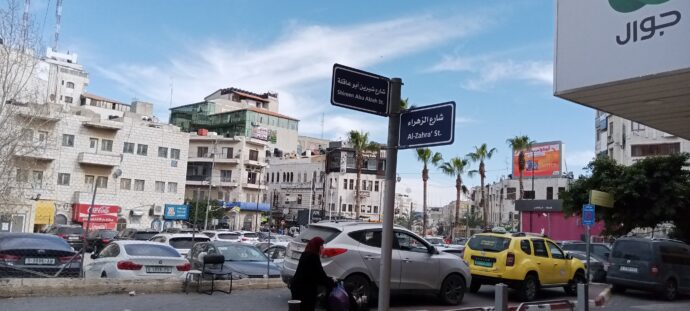
In the centre of Ramallah, a street has been renamed after the journalist Shireen Abu Akleh. Abu Akleh was a prominent TV journalist, reporting from the Palestinian occupied territories for Al-Jazeera for 25 years. In 2022, she was shot to death by an Israeli sniper while wearing a press vest and reporting on an IDF raid on the Jenin refugee camp in the north of the West Bank.
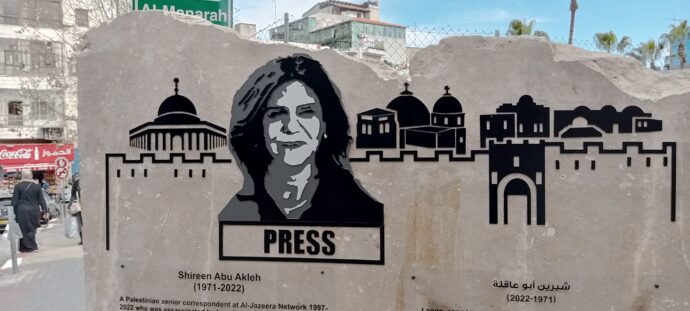
Close to the street carrying her name, there is also a monument commemorating Shireen Abu Akleh, underlining her work as a journalist both by marking her with the word ‘press’ and with texts in English and Arabic.
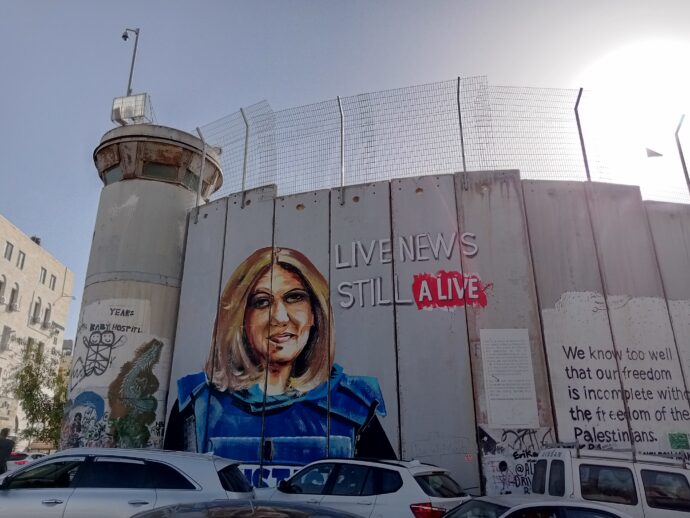
Shireen Abu Akleh has become an iconic martyr who stands out among the hundreds of thousands of Palestinians killed by Israel. This image of her is painted on the Apartheid wall, close to the main checkpoint between Bethlehem and Jerusalem.
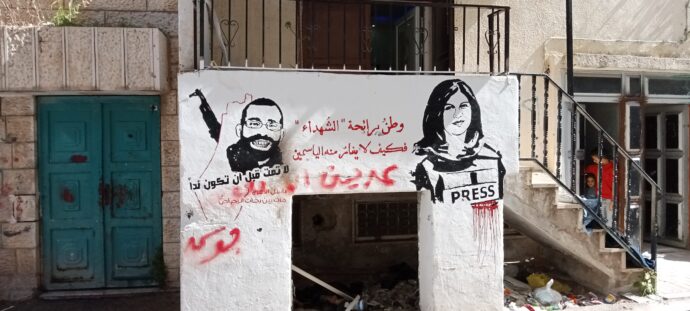
Another wall painting depicting Shireen Abu Akleh next to another famous martyr, Bassel Al-Araj. Al-Araj is sometimes called the ‘educated martyr’ since he was both an activist and a writer. He was, for instance, one of the organizers of the Freedom Rides Campaign in 2011, which included Palestinians riding on Israeli-only buses to protest the Israeli apartheid policies. In 2017, Al-Araj, wanted by Israel, had gone into hiding and was eventually killed by the Israeli army after a gunfight.

An empty grave is waiting for a martyr whose body has not been released to his family. In this case, the body has been buried by the Israeli authorities in a so-called numbers graveyard where the tombs are marked by numbers, not names. The mother of this martyr told me that she regularly visits the empty grave to clean it and place flowers. In the background, you can see houses in a refugee camp.
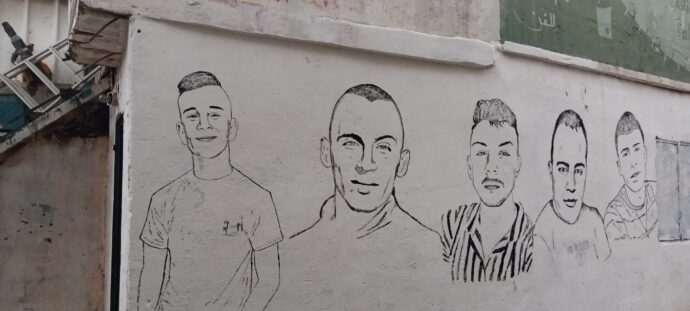
A wall painting of young men and boys in Dheisheh who were killed in the camp in 2022.
References
Allen, Lori 2008, Getting by the Occupation: How Violence Became Normal during the Second Palestinian Intifada, Cultural Anthropology, 23(3): 453-487.
Dabbagh, Nadia Taysir 2005, Suicide in Palestine –Narratives of Despair, London: Hurst & Company.
Filiu, Jean-Pierre 2025, A Historian in Gaza, C Hurst Co Publishers Ltd.
Gren, Nina 2015, Occupied Intimacies -Maintaining Integrity in a Palestinian Refugee Camp in the West Bank, New York & Cairo: American University in Cairo Press.
Hamamra B.T. 2018, Witness and martyrdom: Palestinian female martyrs’ video-testimonies, Journal of Cultural Research, 22 (3): 224-238.
Khalili, Laleh 2007, Heroes and Martyrs of Palestine –The Politics of National Commemoration, Cambridge: Cambridge University Press.
Masharqa, S. 2025, Gazan digital storytellers: popular micronarratives confronting genocide, Journal of Genocide Research, 1-24.
Swedenburg Ted, 2003 (1991) Memories of Revolt –The 1936-1939 Rebellion and the Palestinian National Past, Fayetteville: The University of Arkansas Press.