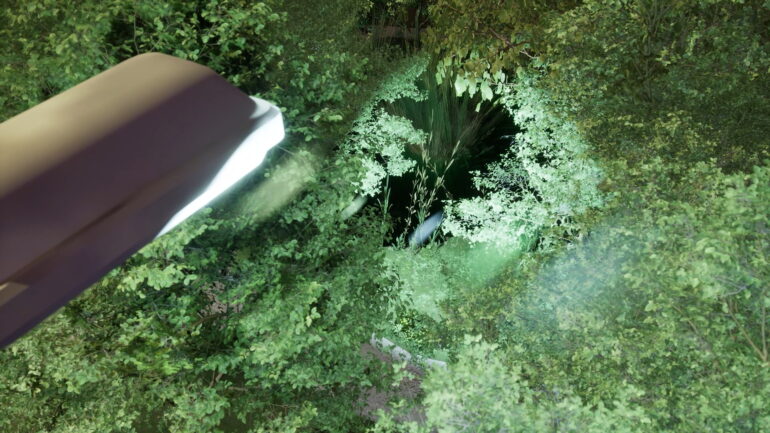
Governing ‘Görli’ lightly? A scotopic speculation about a notorious night-time park
In recent years, Görlitzer Park has gained the reputation as Berlin’s number one problem park, a ‘crime-burdened place’ that calls for policing and stricter governance. With the express goal to turn ‘Görli’ into a ‘model park’ (Musterpark), the current conservative Berlin government enhanced its lighting and decided to enclose the park with a fence to lock it at night. Based on our multi-modal ethnographic and artistic engagement with the park, we critically explore this particular notion of a model park. Our point of departure is a little pond in the park’s north-eastern corner. It forms a quiet and green oasis for wildlife and humans and stands in stark contrast to the ‘crime scene’ and ‘place of fear’ as which the park is often portrayed in public discourse. Historically, the pond emerged in the 1980s when the area became a model case for participatory urban planning and what urban ecologists described as ‘ruderal’ flora and fauna. The possibility of alternative models builds the conceptual focus of this multimodal paper. We show how the pond escapes the current panoptic approach that is designed to police the night-time park, but also a more liberal oligoptic regime of social control. As both these governance models depend on photopic vision; that is, seeing with light, they clash with ecologically-minded approaches that acknowledge the negative impacts of artificial light at night on urban ecosystems, including life in and around the pond. From an ecological perspective, governing with light does not constitute a light, but an intrusive intervention. By taking a ‘more-than-human-safety’ perspective and by listening to a fictional night pond, we propose an alternative, speculative model that builds on a reduced mode of seeing in the dark: scotopic vision. We conclude our critical, multimodal speculation with a reflection on how a scotopic model of night-time governance might differ from panoptic and oligoptic models that rely on the governance of public spaces through light.
The pond, the park and the model
At nightfall, the atmosphere changes in Görlitzer Park. The park is still busy with foot and bicycle traffic, but we see less and hear more: pockets of partially overheard conversations, mechanical whooshes from bikes, and rounds of “alles gut?” from dealers. Everyone familiar with the park knows these busy scenes around its entrances, the traffic and drug trafficking. Yet, only one turn towards the park’s north-east corner unlocks its wild, quiet heart: a tear-shaped pond teeming with biodiversity and textured sounds at the intersection of wildlife and the city.
As the light fades and day turns into night, we become more sensitive to the many sounds perceptible on the banks of the pond. A whistle comes from the direction of the main pathway – a group of people are drinking and chatting on a bench in the low light in a language we do not speak. Then, the unmistakable song of a nightingale can be heard from somewhere overhead, mixing with the dealers’ whistles to form an ad-lib, inter-species duet. It is still bright enough to see several ducks dart across the pond, flapping their wings excitedly and beating the water’s surface like a drum. A heron is standing motionless, waiting for its prey.
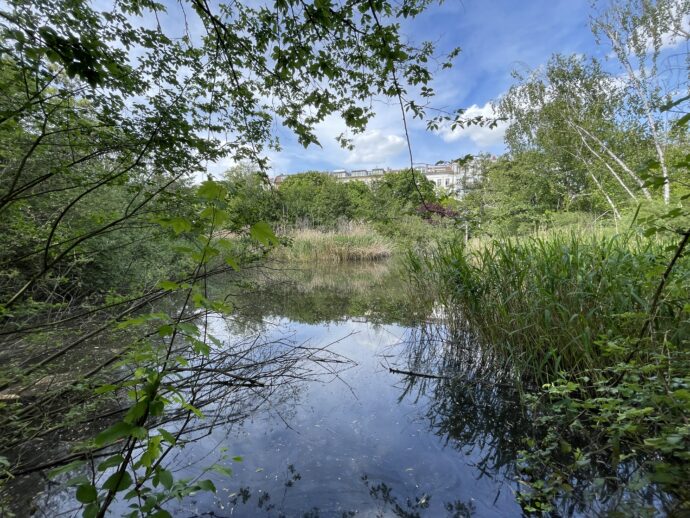
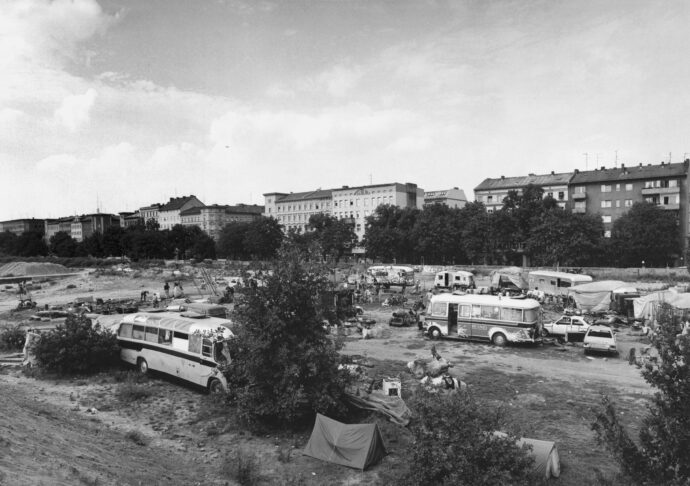
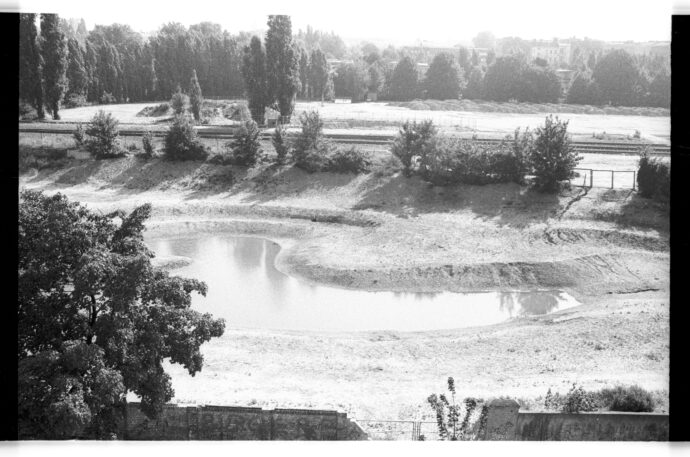
The pond in Görlitzer Park bears witness to Berlin’s turbulent post-war history (Förster and Escher 2017). The former station area leading to Görlitzer Bahnhof was once the eastern gateway to the city for goods and people, but gradually lost its connecting function. The station was destroyed during the Second World War, and train services ended in 1951. In 1961, the Berlin Wall transformed the site into a fenced-off wasteland on the edges of West-Berlin’s Kreuzberg (Kleinbauer 2018). A remarkable ruderal flora and fauna (Matthes and Sukopp 1979) took over the railway tracks, while other alternative life forms – squatters, artists, and bon vivants – appropriated the area with temporary art installations and housing arrangements.
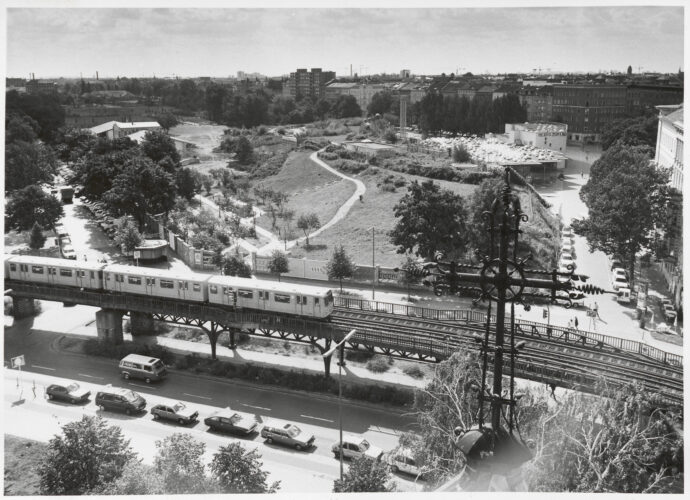
Meanwhile, Berlin Kreuzberg decayed and attracted the attention of urban planners. In 1979, the International Building Exhibition (IBA Altbau) set out to ‘rescue the broken city’ in response to a housing shortage, illegal squats, and ruination in the district, in which one third of the population had no German citizenship (Förster and Escher 2017). Ideas to ‘green’ Kreuzberg and create ‘a park for everyone’ began to materialise in the aftermath of the IBA in the mid-1980s.
The construction of Görlitzer Park was shaped by strong local engagement but was far from smooth. Protesters opposed the remodelling of their wasteland. In the south-east corner, contaminated soil had to be removed. In their historical review of Görlitzer park, Kim Förster and Cornelia Escher (2017) critically observed that the “postmodern” design vision and its strong pictorial elements were difficult to realise. Around the pond, “hidden pathways and their playful bridges, did not generate picturesque images as intended, but instead turned into uncanny spaces hidden away from the public eye that took on a swamp-like appearance” (ibid., p. 169). Indeed, Berlin’s Zitty magazine quoted the district’s park administrator Dagmar Elbrandt in 1993 as follows: “Let’s not fool ourselves, nightingales will never breed here in the park” (quoted in Förster and Escher, p. 169).
The park administrator was mistaken. Today, three decades later, the nightingale has found a home in the park. At the same time, however, the park has made headlines as Berlin’s number one ‘problem park’ and a ‘no-go area’. Residents report that ‘Görli’, as locals call the park, not without affection, has lost its quality of stay, especially for elderly people and women (Becker 2016). The park fosters fear, not because it is an abandoned green space after dark, but because it is so populated by dubious night-time users. The negative public image of the park is shaped by complaints, media reports, and stories about violent assaults, crime and the 24/7 presence of drug dealers (Becker 2016). The scene is also closely entangled with the nearby Berlin club culture and international night-time tourism.
In light of the high crime rates, the Berlin government has seen a need to act. In 2014, the park was categorised as a “crime-burdened place” (kriminalitätsbelasteter Ort, URO 2016: 7). In 2023, Görlitzer Park was high on the agenda during the Berlin Senate’s security summit and Berlin’s Senator for the Interior, Iris Spranger (from the social democratic party SPD), told the press that they planned to “make Görlitzer Park a ‘model park’”, or Musterpark in German (Berliner Zeitung 2023, translation by authors). A fence should allow for closing the park at night. Entrances should be monitored by video cameras, and more lighting should make women and children in particular feel safer. Tests by the Berlin police with strong floodlights, explained the senator, had been “well received” by the residents (ibid.).
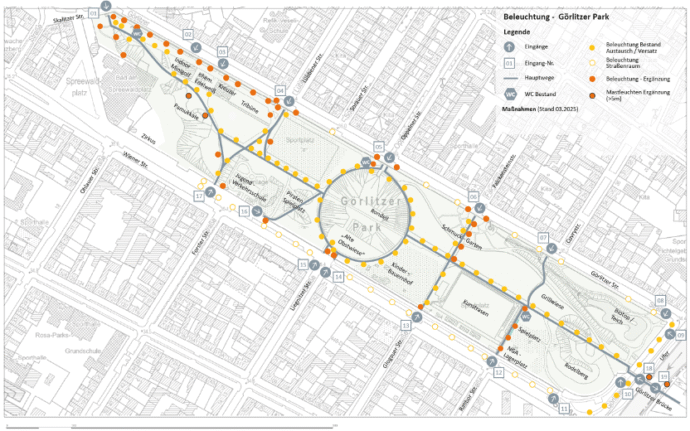
In June 2025, construction works began to eventually build the fence. The enclosing of the park has sparked ongoing public debate and protest by local groups. While it seems to be common sense that the fence will only relocate the drug and crime problems to adjacent areas, the Berlin Senate has clung to its plans. New lighting has already been installed in 2024 (SenMVKU 2025-04-04). The newly installed LED lights are not floodlights but dimmed. However, if the police demand it, they can be turned up immediately.
The government’s vision of Görlitzer Park as a fenced and floodlit model park has puzzled us. This model seems preoccupied with the night-time park, although the crime and safety problems are structural, and it only responds to Görli as a crime-burdened place, whereas the park is much more than just that. Yet, to govern Görli otherwise, we might have to also think, speak, and write differently about the night-time park, its light/ness and dark/ness, its human and non-human users. Seeking to develop a transdisciplinary ‘more-than-human-safety’ perspective, this paper focuses on the darkest corner of the park at night, the pond, and presents a multimodal approach combining social-scientific and artistic research and modes of expression.
A more-than-human-safety perspective
We discovered the pond in May 2025 as a stark and quiet contrast to the busy entrance areas in the park, where glances are exchanged with suspicion or fear. None of us were previously aware of the fairly hidden biotope near the main traffic route through the park. Our ignorance is surprising, even slightly embarrassing, given that two of us lived or are living in the direct vicinity of the pond. We thought that we knew the area, but in reality, we had only been familiar with the popular and populated areas of the park: the busy traffic routes, the grassy areas which dry out in summer, the garbage bins in which animals and people rummage, the barbecuing that is no longer allowed, the drug dealers and their clients, and the public debate and rumours that increasingly mark Görli as a ‘no-go area’ at night.
The focus on the pond opens up a new and different perspective on the park. It allows us to speculate about a different model park through a ‘more-than-human-safety’ lens and inspires us to try to catch “glimpses of seemingly disparate worlds – to imagine urban ecologies otherwise” in an urban ecology that also raises questions of racism, migration, and social justice (Stoetzer 2022, p.5).
From this ‘more-than-human-safety’ perspective, and with reference to this special issue, we can see very clearly that governing Görlitzer Park with light is all but governing it lightly. Instead, using artificial light at night is a highly disruptive way of governing a nocturnal urban green space. Against this backdrop, we first set out to explore – conceptually and historically – the model park vision or, quite literally, the visual regimes that undergird Berlin Senate’s notion of Görli as a Musterpark and the panoptic governance that comes with it. Drawing on recent research on artificial light at night, we argue that a scotopic approach – i.e., dark seeing – would be more suitable for a nocturnal park. We then describe our transdisciplinary collaboration, research methods, and perspectives, which combine social-scientific research on urban night-time governance (Nona), artistic investigations into light pollution and the night-time city (Jeremy) and theoretical and practical experience with models in architecture and urban planning (Jorge). In the subsequent artful scotopic speculation, we give voice not only to human interview and conversation partners who can speak about the pond, but also to the dreaming night pond itself to imagine “more-than-human socialities” (Tsing 2013). We conclude by outlining how the currently dominant panoptic governance regime can still relate to the ruderal flora and fauna in the park, the dreaming night pond, and the nightingale that has found a home in the park against all odds.
Görlitzer Park: A model for governing nightly
The governmental vision to turn Görli into a model park leaves room for interpretation and raises questions: a model of what, for whom, in whose name, and in what sense? In urban planning practice, the notion of the ‘model’ evokes an interesting tension between models as yet-to-be-built, scalable prefigurations (e.g., Halpern et al 2013, Batty 2015) and already built one-to-one prototypes as exemplary solutions that work and can then be replicated elsewhere as standardised, prefigured design patterns (Corsín Jimenez 2013, Wilson 1968, Alexander 1977). The double meaning is no coincidence, as urban design models inevitably oscillate between experimental and exemplary functions. Urban experiments are publicly showcased, flagship projects turned into real-world experiments (Evans, Karvonen, Raven 2016; Schulte-Römer 2015).
In this sense, the making of Görlitzer Park in the 1980s can be considered a model for participatory, user-centred urban planning that assembles multiple actors with conflicting interests. It has also been a model of urban nature conservation (Lachmund 2019). Already in the late 1970s, the pioneering urban ecologist Herbert Sukopp and his team at the Technical University of Berlin highlighted the ruderal flora and fauna on the site and supported its preservation (Matthes and Sukopp 1979). Since German reunification, the railway-to-park model has been implemented in several other Berlin parks and is also internationally known and popular in various other cities (Jasper 2021, p.62).
However, the model park envisioned by the Berlin Senator breaks with this experimental-exemplary history of the park, or at least with one that is participatory and built from bottom-up practices. Still highly contested, the vision of a fenced-in and floodlit Musterpark appears to be part of a top-down governance pattern that is designed to gain back control over the ruderal park and can be replicated elsewhere, e.g., at Leopoldplatz in Berlin Wedding (Abgeordnetenhaus Berlin 2024-10-10).
Panoptic and oligoptic models
Interestingly, the envisioned model only focuses on the park at night and thereby mobilises governance styles that are all but experimental, subtle or ‘light’. Locking and lighting urban spaces are the oldest and most standard techniques of night-time governance, while more liberal, experimental, and ecological approaches fade into the background. Curfews and closed city gates were standard measures for securing medieval cities (Ekirch 2005). Fixed artificial lighting systems entered the European city in the second half of the 17th century. “Lanterns became beacons in the city, representing law and order” writes lighting historian Wolfgang Schivelbusch (1987, p. 64). He also highlights the close connection between public lighting and the police: “Surveillance and light, visibility and control: these pairs complement each other…” (ibid., p. 65). As a means of governance, public lighting facilitated panoptical state surveillance, including its self-disciplining effects, as famously outlined by Michel Foucault (1975).
In contemporary cities, the panoptic model of police control is still in place. When the Los Angeles Department of Street Lighting deployed area-wide LED lighting around 2010, they not only highlighted that the new technology saved a lot of energy, but also that the brighter and whiter lights made it easier for the police to control the streets (Schulte-Römer 2023). However, the ways in which artificial light at night can increase public safety go beyond panoptical state control. In urban theory, the positive effects of social control are well-established through the “broken windows theory” (Kelling and Wilson 1982) and the notion of “eyes on the street” that was coined by Jane Jacobs (1961). Focusing on Victorian London under the influence of British liberalism, historian Chris Otter (2008) highlights how bringing more light into the city – during the day and at night – was a key to modern, liberal urban governance based on both institutional inspection and individual introspection. According to Otter, lighting promoted the emergence of an oligoptic – not just panoptic – governance regime.
Bruno Latour and Emilie Hermant (2006) describe the difference between the panoptic and oligoptic model as follows: “As their name indicates, ‘pan-opticons’ make it possible to see everything. Oligopticons, in contrast, from the Greek oligo meaning little, are selective, deliberately blind in some regards and thus ‘partially intelligent, temporarily competent and locally complete’” (ibid., p. 68). They only seize one particular aspect of the social. Otter (2008, p. 74) further outlines how the two models promote different agencies in public spaces:
“The panopticon provides the total, permanent, and architecturally enclosed overview of a single space and its occupants. By contrast, an oligoptic space lacks a central, dominant vantage point. […] [I]t is a place in which mutual oversight takes place. Moreover, looks, gazes, and glimpses are distributed relatively symmetrically. […] Finally, the panopticon deprives the fixed subject of privacy, while oligoptica, local points (streets, parks, offices) where the few see the few, function as heterogeneous, interlinked outsides of multiple private spaces. Freedom of public perception is paralleled by a freedom to withdraw from view when one chooses, behind a locked door if necessary.”
In Görlitzer Park, however, the oligoptic model of mutual gazes and social control might be problematic. Ethnographer Franziska Becker (2016) gives numerous examples of how park users, especially women, monitor their environment or avoid eye contact with strangers to avoid interaction. She further quotes a local resident who describes “an aggressive mood, a strange atmosphere of mutual observation. Many here observe each other, the drug people, the police, the consumers, the parents fearfully look aground, women lower their gaze.” (2016, p. 14, translation by authors). Becker concludes that the public park that was supposed to “offer relaxed recreation has turned into some sort of panopticon” that is inherently structured by surveillance and mistrust (ibid.). Against this backdrop, the governance strategy to illuminate Görlitzer Park at night seems a logical step, as it facilitates the policing of at least certain parts of the park and enhances a not-further-specified sense of security.
Towards a scotopic model of night-time governance
It is significant that both panoptic and oligoptic models are based on a photopic vision, the Greek term for ‘seeing with light’. In a night-time park, this will inevitably involve artificial lighting. It is therefore not surprising that the illumination of public spaces as if it were daytime is a highly popular and widely accepted governance measure. Ironically, however, governing with light is all but governing lightly in more-than-human terms. Research has shown that artificial light at night (ALAN) is all but a subtle intervention (Gaston et al. 2015).
Since life on earth is sensitive to light, ALAN inevitably disrupts the day-and-night rhythms of ecosystems and their various metabolisms. It produces environmental stress and disturbs living species and ecosystems. Migrating birds lose their orientation and blackbirds in urban parks change their reproductive and foraging behaviour (Russ et al. 2015). Plants cannot discriminate between long summer days and illuminated winter nights and continue to photosynthesise into winter, with damaging effects when temperatures fall below zero (Wang, et. al 2025). In green areas, illuminated streets and bridges function like immaterial barriers as insects, amphibia, and fish get caught in the light and are unable to leave. Aquatic ecosystems, too, are heavily affected by ALAN as small fish, invertebrates, and insect larvae have optimised their reproductive and foraging behaviours. In order to not get eaten by predators and to provide their offspring with the greatest chances to survive, they only graze on the water surface when it is dark, and they look for the brightest surface – the moon-lit water surface under natural conditions – when they lay their eggs (video interviews 2025). For all these reasons, biologists and ecologists are sounding the alarm (Schroer et al. 2020).
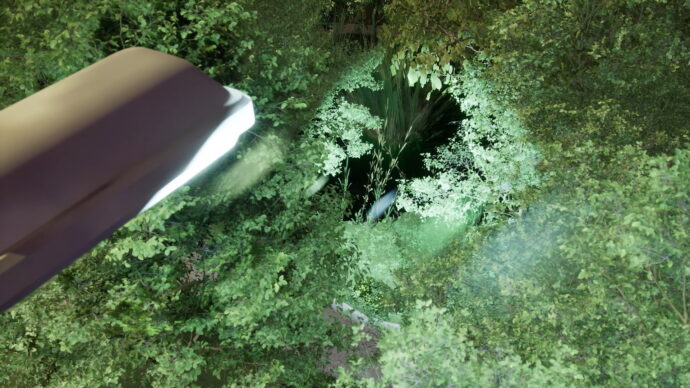
These more-than-human concerns have also found their way into urban planning, where they compete with aesthetic and security-oriented goals of light planning as a means of urban regeneration. In recent years, designers, planners, social scientists, and philosophers have discovered the night-time city and are highlighting the needs to reconsider the value of darkness (Stone 2019), to appreciate and restore dark urban spaces (Dunn and Edensor 2023), and to acknowledge urban day-and-night rhythms (Meier 2018; Henckel 2019) despite the idea that 24/7 cities never sleep (Crary 2013).
In Berlin, urban planning and the city’s lighting strategy have been exposed to and affected by this research very early, as a pioneering federally-funded transdisciplinary research cluster began to study the ecological, economic, and societal effects of the ‘Loss of the Night’ (Hölker et al. 2010). The project not only transformed Berlin and Brandenburg into a field site for ecological experiments on the effects of ALAN on flora and fauna, including an aquatic laboratory in Lake Stechlin, but also generated enormous media attention for the emerging topic of light pollution, as well as numerous publications, policy recommendations and local expertise (ibid.; Meier et al. 2014), and several transdisciplinary spin-offs and follow-up projects, including citizen science (Schroer et al. 2018; Kyba 2023).
Shaped by this local expertise, the first Berlin light plan refrained from illuminating Berlin’s parks in order to minimise disturbances for flora and fauna (Schulte-Römer 2015). In Görlitzer Park, however, lighting was installed in response to human concerns about their night-time safety. The artificial lighting contradicts non-human sensitivities and human modes of seeing that work with less light. Hence, let us speculate about an alternative model for governing night-time parks.
Scotopia – from the Greek skotos, meaning ‘darkness’, and –ōpia, meaning ‘a condition of sight’ – draws attention to an impressive evolutionary achievement, namely the capacity of the human eye to not only see in bright sunlight, but also under the dim light of the moon or even the stars (Barbur and Stockman 2010). To accomplish this feat, the eye has colour-sensitive cone cells that are perfectly adapted to full-spectrum daylight and an even greater number of rod cells at the edges of the retina. During the day, these rods allow peripheral vision, but it is in the dark when they come to show their full potential.
Scotopic vision has three characteristics: First, it is much more sensitive to brightness and contrasts than photopic vision. Second, it is almost colour blind, as it is most sensitive to short bluish wavelengths around 507 nm, but insensitive to the longer wavelengths of visible light in the red spectral range. Third, scotopic vision is not absolute, but a temporal condition that gradually takes over when photopic vision reaches its limits, after an intermediary stage of mesopic vision during twilight.
To conclude, we see that artificial light at night can be deployed in the service of panoptic as well as oligoptic models. Yet, these photopic regimes are increasingly criticised for their disruptive ecological effects. Accordingly, we wonder: How could urban night-time governance allow for a more-than-human-safety perspective? How could we account for “more-than-human sociality” (Tsing 2013) in an urban park? Could a scotopic model of urban lighting facilitate a more inclusive form of governing lightly? A scotopic model, which can only emerge in darkness, seems to be an adequate starting point to speculate about this lighter, more subtle, and less intrusive way of governing Görli (and other parks) at night.
A Multimodal Transdisciplinary Collaboration
This paper emerges from a multimodal collaboration between a visual artist (Jeremy), an architect (Jorge), and a social researcher (Nona) in the context of the ERC-funded WAVEMATTERS project. Following Jeremy’s previous work on moths (https://openthenight.de/), our joint multimodal Görli project started focusing on the ecological effects of light at night, trying to move beyond mainstream positions about security and control. The hidden pond in the park prompted our multi-layered, transdisciplinary investigation into the ecological, historical, and cultural life of this overlooked body of water. Site visits to the pond in May, June, and July 2025 during the day, evening, and night inspired the artistic experiment. Team conversations were key in aligning our multidisciplinary backgrounds and developing our more-than-human-safety perspective, multimodal engagement. Desktop research and archival work allowed us to understand the emergence and the different versions of Görlitzer Park – as a model or a problem – in urban planning and public discourses. Several conversations with experts of the park, from environmental and Flinta* groups to the Berlin Senate Administration offered additional insights. Moreover, Jeremy conducted two video interviews (Knowles & Weïv Mæt-ers 2025) next to the pond with scientists who are internationally renowned for their research on the effects of artificial light at night on aquatic ecosystems. Archival research into the Landesarchiv Berlin and FHXB Friedrichshain-Kreuzberg Museum provided insight into Görlitzer Park’s development as a man-made landscape, revealing the pond not as a natural given, but rather as a constructed feature embedded within urban planning, ecological intervention, and social policy.
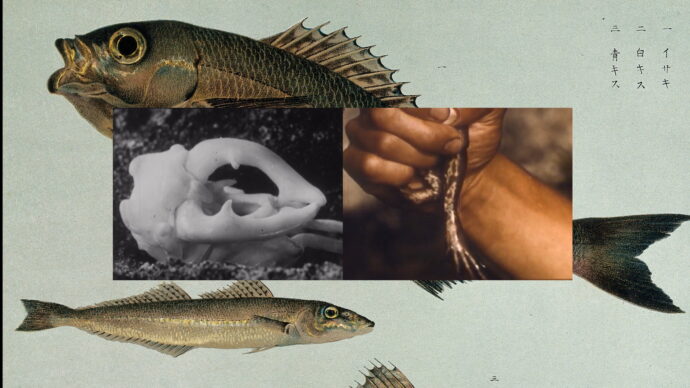
As a result, Jeremy produced an experimental short film titled Glōm, an old English/Scottish word for twilight, that was fed with all such material, resisting the urge to categorise or to separate fact from fiction, and keeping the pond, its story, and ecosystem open to interpretation. For its production, we asked: Who is defending the pond? Could the pond defend itself? These questions prompted Jeremy to adopt a narrative strategy through which the pond – specifically, the night pond – was given a humanised voice that addressed its counterpart – the day pond. While dreaming, the night-time pond assesses artworks and digital archives to speculate about life in the water and about the pond at daytime. The day pond, conversely, speaks through subtitles and sound.
As a result of this multilayered exploration, we have moved from a multispecies-oriented focus on fish or birds to a more-than-human perspective of a night-time pond. Jeremy’s video piece allows for myth, science, and fiction to coexist. This paper complements the audiovisual work with an artful, social-scientific speculation about alternative modes of urban night-time governance. The following section presents our multimodal experiment in a speculative form. Instead of only drawing on interviews and conversations with humans, as social scientists commonly do, it brings them into dialogue with the voice of the night-time pond that Jeremy developed as a fictional persona in his short film. In their distinct languages, both artwork and article aim to ‘let the pond speak’ as an object of imagination. In contrast to multispecies work in the social sciences that refrains from anthropomorphising non-human species (van Dooren 2012), we deliberately let the pond monologue with a rather human mindset, which allows us to give our speculation an ironic and critical touch.
Listening to the night-time pond and making it speak
The pond in Görlitzer Park escapes the panoptic model of night-time governance. It is no coincidence that we had not been aware of it. The biotope lies hidden from view between bushes and trees. From the main route through the park, which is elevated, a staircase leads down to the water. Removed from the park trouble and Trubel (German for hustle and bustle) entering the pond area feels like entering an oasis, or a different world. In the entrance areas of the park and on the main paths, one cannot rest, sit, or stand without being approached by dealers – “do you need something?” or “are you police?”. In contrast, at the edges of the pond, everyone – human and non-human creatures – seem to be with themselves, minding their own business.
Is the world of the pond acknowledged and supported by the fenced and floodlit ‘model’ park? So far, the pond seems rather minimally affected. Path lighting was first installed by the district in 2011 on one short walking passage. In the subsequent years, the lighting scheme was expanded throughout the park (Abgeordnetenhaus Berlin 2024-10-10). In 2023, the Berlin Senate Administration took over and refurbished the light points with LED technology. The light temperature of the park is 2700 Kelvin, which is whiter than in the 2030 biodiversity strategy that the Berlin Senate Administration proposes for “sensitive areas” (SenMVKU 2025). The Berlin Senate claims that the measures “lead to a greater sense of security in the evening” (Abgeordnetenhaus Berlin 2025-04-11, p.7, translation by authors). The new LED lights in the park are constantly dimmed, unless the police call the energy provider to increase the level of light. In the case of a police raid, the park can be floodlit bright within seconds. The pond is exempt from this lighting scheme. In our conversations with local stakeholders, we learned that installing lights around its edges was “out of the question” for those who spoke in the pond’s name (Nona’s fieldnotes).
Spokespeople of the pond
So, who speaks for the pond? Who defends it? First, there are nature conservation groups that protect the legacy of the ruderal park. The Berlin-based BUND, the German version of Friends of the Earth, has criticised the governance measures as potentially harmful to species in the park. On their website, the conservationists map different habitats in the park, where 24 bird species have been counted. BUND not only highlights the wildlife but challenges the idea of gaining visual control over the space at night: “The floodlighting […] at the entrances to the park creates even more dark spaces. Anyone wishing to pass through the park would be blinded for the rest of the way through the park. […] Potential criminals in the park, on the other hand, would be able to see perfectly well who is entering the park thanks to the strong lighting at the entrances” (BUND 2024). The paper explicitly mentions the possibility of developing scotopic vision in the park at night – “it takes half an hour for the eyes to fully adapt to darkness” – and rejects photopic fantasies, both panoptic or oligoptic: “Despite the presence of police and park rangers, drugs are now being dealt and consumed in the park in full view of everyone” (ibid.).
The biotope and wildlife in the park also have ‘spokespeople’ on the district level and in the city-state Senate Administration. A lighting expert reported that they recommended to illuminate the stairs leading down to the pond, but their nature conservation colleagues at the district level did not approve it in order to protect the wildlife. We also learned that in the course of refurbishing the park lighting, the police had called for more lights in order to conduct their raids more effectively. However, the Senate Administration talked them out of it. “It is still a green space”, the lighting expert observed (Nona’s fieldnotes). To have full oversight, one would have to erase the shrubs and trees as well.
Since public lighting has become relatively cheap with energy-efficient LED technology, municipal and environmental groups need better arguments against illuminating green spaces in the name of human safety and security. Scientific insights into the negative effects of ALAN on ecosystems, wildlife, and humans are therefore important.
To learn more about urban water bodies, Jeremy invited two internationally renowned light pollution experts and scientific spokespeople for aquatic wildlife from the Leibniz Institute of Freshwater Ecology and Inland Fisheries (IGB) to the pond. Biologist Sibylle Schroer used to live next to the park as a student. In the interview, she recalls how she enjoyed sunsets with friends “in this great oasis within the city”. She highlights the importance of an urban water body like this pond not only for wildlife, but also for urban microclimates. Water bodies absorb sun heat and CO2. They also generate food in the form of fish and insects that breed in the water, and feed terrestrial wildlife including bats, herons and frogs.
Unfortunately, all these species are incredibly sensitive to artificial light at night. Interviewee Franz Hölker reports that he and his team were “a bit shocked” by an experiment on light exposure and melatonin production in fish. The experiment showed that the hormone, which puts the bodies of many living species, including humans, into night mode, was suppressed even at light levels far below moonlight. Hölker explains that artificial light can even impact the immune systems of fish species. Another experiment with aquatic insects in the larval stage showed that light negatively affected the emergence rate, that is, the transformation of larvae into flying insects. “In this pond”, Hölker says, “I would expect 500 to 1000 larvae per square metre in the sediment.” Effects on their life cycle directly affect the food chain in and around the pond. Sibylle Schroer concludes that switching on one light would already have a major impact on the world around the pond. “We should always be aware of this. We need light, but we only need it at this footpath. And we can leave a pond like this just in the dark.” So, what if we allow scotopic vision to take over?
Speculating with the pond
When we first arrived at the pond, on a long summer evening in June, it was still bright enough to discover the area with our eyes in the fading daylight. We admired an unexpected idyll: ducks, plants, people, and the shimmering water surface.
A hydrophone tossed into the middle of the pond would reveal the mosaic of sounds occurring underwater beyond the reach of terrestrial ears, from the sounds of a school of fish rising to the cooling upper layers of the pond to the constant trickling of an electric pump. The surrounding urban space also makes its own presence known. Even underwater, the oscillating sirens from emergency vehicles occasionally break moments of near silence. Even the deep rumble of the subway lines U1/3 makes its way into the recording.
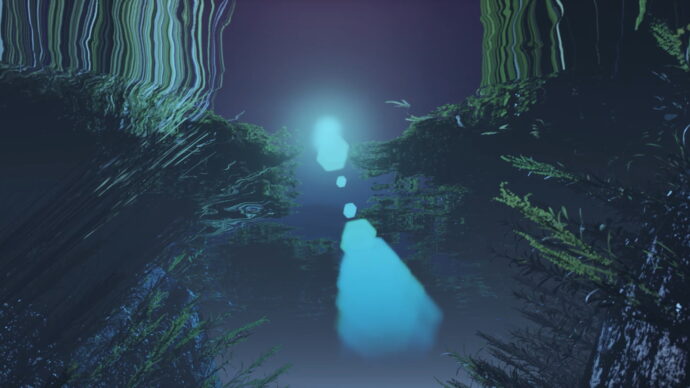
At twilight, we sharpen our ears as our vision slowly shifts to scotopic seeing. All shades are blue and grey now. We no longer see colours, but contrasts. Our senses focus on sounds. The air cools down quickly in the absence of the sun. It is time for us to go, but the pond still lies there, stimulating our imagination. “How can we study social worlds of beings that can’t talk to us?”, asks anthropologist Anna Tsing (2013, p. 31). Tsing outlines how we can focus on assemblages and forms to trace “more-than-human sociability”. She also proposes to ally with natural scientists who, like ethnographers and artistic researchers, are interested in descriptive accounts of multi-species worlds. However, most social scientific concepts, Tsing notes (2013, p. 33), still describe non-human entities in relation to human society and human projects: “None allow things to have their own socialities.” In contrast, in the approach that Tsing proposes, “humans would have to join more-than-human socialities. We might not always be in charge.”
So, let’s listen to the pond itself as part of a multimodal speculation developed by Jeremy: “My ears are many, listening in the darkness,” gurgles the pond. “My eyes see long after human rods and cones capitulate.” The pond senses and speaks of the many species that are its ‘guests’:
So many depend on me
On us.
I feel them within me, even now.
They scurry and drift and flutter and fall.
Rising with the release of our air at day’s close…
Retreating to our blackest enclaves at the sun’s zenith
Our fictional pond speaks about itself (or themselves) like a divided identity – day pond and night pond. “One body, separated merely by light.” The night pond can only “feel” its daytime counterpart during twilight and starts a dialogue with it:
Those moments, when I feel you, pass so suddenly.
Yet, from time to time, I am convinced I see you wake.
Dull though you appear…
Far from your shining excellence when you are at your fullest, I fancy
Your cruel brightness
Dazzling and noxious.
I can scarcely imagine how it must feel…
To be penetrated by the sun.
Exposing our furthest nooks,
Heating our coolest layers.
Photosynthesising our algal blooms,
Raising oxygen and methane to our surface.
The voice of the night-time pond is poetic, yet it also dwells on a kind of dark delight:
You shine all the brighter because I exist.
Please, do not pity me.
I have grown quite content with my time.
While you share your waking hours with humans who discard waste on your shores
And cast objects across you for sport.
I, on the other hand, host a program of delights…
Ensembles of mating rituals
Lovemaking, spawning, foraging, satiating!
My waters alone excite the wildest lust and hunger
[…]
Your humans take pleasure in lying beside you…
They admire your dappled light, the cooling effect you have on them.
The quaintness of observing wild animals in the city, free from laws and taxes.
They do not wish to see my innards:
The nameless larvae and leeches that slide down my canals, blind and ravenous.
The spiders that scale my roots
The colonies of rats that scuttle through my undergrowth, feasting on the detritus I wash ashore.
Nor the bottom feeders or blood suckers
The cleaners or harvesters, who manage my slippery parts.
The night pond also senses and comments on the increased illumination of the park. It ponders the intrusion and, from there, begins to fantasise about its spatial expansion:
Vexing the sleeping swimmers who drift wide-eyed in my bowels,
Keeping away my nightly visitors.
Pulsing over me with a beam more erratic than the sun’s…
[…]
What if we were to let our waters flow?
Break our banks and fill this place to the brim!
We could swell over the pathways,
Torrent through the gates and fences built to contain us.
Submerge the cables and wires beneath us that course with the grid’s electric current
Until all is dark
And all is us.
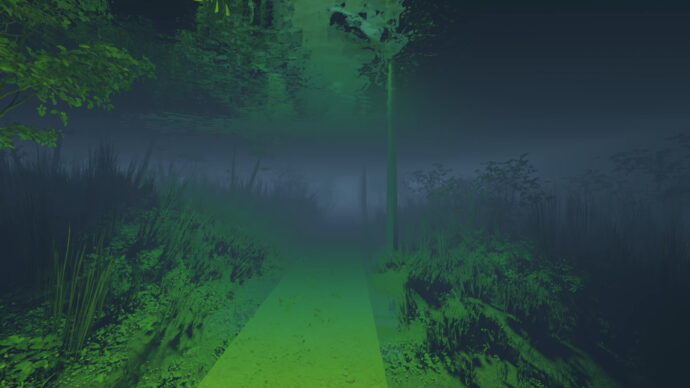
However, environmental change has already transformed the night pond. While attempting to gain back agency, it first tells its daytime self (you) to speak with the humans (them), but then, surprisingly, embraces the artificial light exposure as a welcome transformation, a temporal expansion and opportunity to become one with the day pond:
I need you to tell them that I’m not their problem to solve.
That, try as they might, I’ll always be wilder than they desire,
Even behind a fence and exposed from all sides.
They can’t control what they don’t understand.
And yet…
If we could only be together
Imagine how that will feel…
How we will look
What we will see!
Imagine what will happen to us if I become even brighter […]
we would be together!
One body, draped in iridescence
Neither night nor day
But something in between!
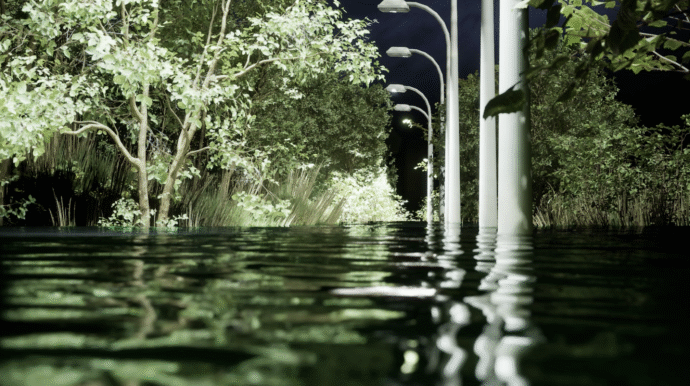
This is the moment in the speculation when the day pond responds (see the full video Glōm in this link: wavematters.eu/glom/). Of course, this voice of the pond is still anthropocentric. In particular, the ironic and critical plot twist turns the water surface of the speaking night pond into a black mirror. The anthropogenic light leads the pond to dream like a human, to develop fantasies of expanding its territory throughout the park and its time into the day. Jeremy’s artistic fantasy of the pond thus deliberately differs from techno-feminist, multispecies “speculative philosophies” (Altrudi and Kelty 2022, p. 524). Our listening to our fictional night pond is not “prefigurative in the sense that it focuses on hopeful forms of entanglement” (ibid., p. 525) as a desirable alternative. Our night pond’s soliloquy ends in a dystopian dialogue with its daytime self and the entirely undesirable idea of an illuminated pond that never sleeps and exposes its critters to extinction. What is lost are the contrasts in the park as well as the shades of grey and blue that make all species the same under the stars.
“Are we not limited to human knowledge?”, asks Anna Tsing. Yes, we are, but we also create worlds through our engagements and entanglements with the worlds that surround us. We might as well consider our humanness as more than a limitation. It can also be “a starting point, an opening for getting involved in multispecies worlds.” (2013, p. 34) In line with this, our listening to the pond is a proposition to explore “new and varied social arrangements, human and otherwise” that hopefully allows us to develop our interspecies sensibilities and a more-than-human-safety vision for Görlitzer Park.
Towards a scotopic night-time governance
While publishing this essay, the construction of the fence around Görlitzer Park is ongoing. It could be a nice punchline to our story if the night-time closure of the park would eventually have positive effects for the pond and its wildlife: less recreational noise, less litter, and less artificial light. After humans have vacated the area for the day, it would be technically possible to switch off or dim the park lighting. But this political decision has not yet been taken, and our idea of a positive outlook is therefore purely speculative.
Lighting a park at night, as we have shown, can be ecologically unfriendly and constitutes an “arbitrary domination” (Altrudi and Kelty 2022) of the wildlife within it (for a discussion of context-specific lighting, see also Litsmark, Tsiakiris and Landau-Donnelly in this issue). What could a more subtle governance look like? What would it mean to move from a light-demanding panoptic or oligoptic model to a darkness-permitting scotopic model park? In line with the characteristics of scotopic seeing, we envision this mode of governance as sensitive to three aspects: First, scotopic governance is sensitive to temporalities. Luc Gwiadzinski (2015) speaks of “chrono-urbanism”. After it has been widely acknowledged that replicating urban models in different places can be problematic, as one size does not fit all places, we acknowledge that one time state also does not fit all (urban) rhythms. Human and non-human night-time activities differ considerably within and across cities, countries – which also include rural and peri-urban regions – and the globe. Second, scotopic vision is colour blind, but still sensitive to contrasts. Scotopic governance could thus present a relational more-than-human model that facilitates kinship relations between companion species (Haraway 2020). Rather than generalising on the basis of ethnic, biological or governmental categories and classifications, a scotopic model would acknowledge diversity and contrasting needs against the canvas of specific urban ecologies. Third, and finally, scotopic governance challenges the optic conditions of every urban vision and widens the scope of what we can sense and know beyond human vision and optical apparatuses, including microscopes, X-rays, and remote sensing satellites. It challenges dominant modes of governing at a distance and invites more synaesthetic, caring responses to conflicts in night-time cities. Human-centred examples of such mediation can be found in and around Görlitzer Park and include mediation-oriented approaches to settling conflicts (Gwiadzinski 2015). In this regard, the ecologists’ and nature conservationists’ multisensorial appreciation of the “oasis” in the park and their commitment to protecting the pond can be understood as a multispecies model of mediating photopic and scotopic urban visions. Precisely where these visions will lead the park and all its visitors is yet to be seen.
References
Abgeordnetenhaus Berlin 2024-10-10. Schriftliche Anfrage im Abgeordnetenhaus Berlin (19. Wahlperiode). ‘Umsetzungsfortschritt Sicherheitsgipfel’. Drucksache 19/20631. https://pardok.parlament-berlin.de/starweb/adis/citat/VT/19/SchrAnfr/S19-20631.pdf Last access 2025-08-19.
Abgeordnetenhaus Berlin 2025-04-11. Schriftliche Anfrage im Abgeordnetenhaus Berlin (19. Wahlperiode). ‘Projektitis bei den Geldern aus dem Sicherheitsgipfel?’. Drucksache 19/22328. https://pardok.parlament-berlin.de/starweb/adis/citat/VT/19/SchrAnfr/S19-22328.pd Last access 2025-08-19.
Alexander, Christopher 1977. A Pattern Language: Towns, Buildings, Construction. With Sara Ishikawa and Murray Silverstein. Oxford Univ. Press.
Altrudi, Soledad, and Christopher M Kelty 2022. ‘Animals, Angelenos, and the Arbitrary: Analyzing Human-Wildlife Entanglement in Los Angeles’. Environmental Humanities 14 (3): 522–42.
Barbur, JL, and A Stockman 2010. ‘Photopic, Mesopic and Scotopic Vision and Changes in Visual Performance’. Encyclopedia of the Eye 3: 323–31.
Batty, Michael 2015. ‘Models Again: Their Role in Planning and Prediction’. Environment and Planning B: Planning and Design 42 (2): 191–94. https://doi.org/10.1068/b4202ed.
Berliner Zeitung 2023-08-22. ‘Wird der Görlitzer Park zum „Musterpark“?: Das sind die Pläne der Innensenatorin’. Berliner Zeitung. https://www.berliner-zeitung.de/news/goerlitzer-park-soll-zum-musterpark-werden-das-sind-die-plaene-der-innensenatorin-li.381094. Last access 2025-08-19.
BUND 2024. ‘Position des BUND Berlin zum Maßnahmenplan Görlitzer Park’. Written by Schäuble, Dirk & Andrea Gerbode. Berlin: https://www.bund-berlin.de/service/publikationen/detail/publication/position-des-bund-berlin-zum-massnahmenplan-goerlitzer-park/. Last access 2025-08-19.
Corsín Jiménez, Alberto 2013. ‘Introduction: The Prototype: More than Many and Less than One’. Journal of Cultural Economy 0 (0): 0.
Crary, Jonathan 2013. 24/7: Late Capitalism and the Ends of Sleep. Verso Books.
Dunn, N., & Tim Edensor 2024. Dark skies: Places, practices, communities (p. 294). London: Taylor & Francis.
Ekirch, Roger 2005. At Day’s Close: A History of Night-time. WW Norton & Company.
Evans, James, Andrew Karvonen & Rob Raven 2016. ‘The Experimental City: New Modes and Prospects of Urban Transformation’. In The Experimental City. Routledge.
Förster, Kim & Cornelia Escher 2017. ‘Revisiting Görlitzer Park: Material Practices and the Postmodern Landscape’. In Landscript 5. Jovis Verlag.
Foucault, Michel 1975. Discipline and Punish. Translated by T Sheridan. Gallimard.
Gaston, Kevin J., Marcel E. Visser, and Franz Hölker 2015. ‘The Biological Impacts of Artificial Light at Night: The Research Challenge’. Philosophical Transactions of the Royal Society B: Biological Sciences 370 (1667): 20140133. https://doi.org/10.1098/rstb.2014.0133.
Gwiazdzinski, Luc 2015. ‘Introduction. The Urban Night: A Space Time for Innovation and Sustainable Development’. Articulo-Journal of Urban Research, no. 11.
Halpern, Orit., J. LeCavalier, N. Calvillo, and W. Pietsch 2013. ‘Test-Bed Urbanism’. Public Culture 25 (2 70): 272–306. https://doi.org/10.1215/08992363-2020602.
Haraway, Donna J. 2020. Staying with the Trouble: Making Kin in the Chthulucene. Duke University Press.
Henckel, Dietrich 2019. “The 24/7 City-a Myth.” Zugriff: http://unsichtbare-stadt. de/category/die-zeitlichkeiten-der-stadt/ Last access 2022-09-04.
Hölker, F., T. Moss, B. Griefahn, W. Kloas, C. Voigt, and et al. 2010. ‘The Dark Side of Light: A Transdisciplinary Research Agenda for Light Pollution Policy’. In Ecol Soc, vol. 15. no. 4. http://www.ecologyandsociety.org/vol15/iss4/art13/.
Jacobs, Jane 1961. Life and Death of Great American Cities. Random House.
Jasper, Sandra 2021. ‘Traversing Wastelands: Reflections on an Abandoned Railway Yard’. In O’Callaghan, Cian & Cesare Di Feliciantonio. The New Urban Ruins. Bristol University Press, 53-71.
Kelling, George L., and James Q. Wilson 1982. ‘Broken Windows’. U.S. The Atlantic, March 1. https://www.theatlantic.com/magazine/archive/1982/03/broken-windows/304465/.
Krause, Monika 2021. Model Cases: On Canonical Research Objects and Sites. The University of Chicago Press.
Kleinbauer, Anne 2018. ‘Kleine Archäologie Des Görlitzer Parks’. In Gefährliche Orte: Unterwegs in Kreuzberg. Autor*innenkollektiv Gras & Beton (Eds.). Assoziation A.
Kyba, Christopher. C., Altıntaş, Y. Ö., Walker, C. E., & Newhouse, M. 2023. Citizen scientists report global rapid reductions in the visibility of stars from 2011 to 2022. Science, 379(6629), 265-268.
Lachmund, Jens 2019. Regimes of Urban Nature: Organic Urbanism, Biotope Protection, and Civic Gardening in Berlin. MIT Press.
Latour, Bruno, and Emilie Hermant 2006. Paris: Invisible City. Translated by Liz Carey-Libbrecht. Virtual Book.
Matthes, Hermann & Herbert Sukopp 1979. ‘Anmerkungen Zur Ökologischen Bedeutung des Geländes Am Görlitzer Bahnhof in Berlin’. Bauwelt 70(33).
Meier, Josiane M. 2018. ‘Temporal Profiles of Urban Lighting: Proposal for a Research Design and First Results from Three Sites in Berlin’. In International Journal of Sustainable Lighting, vol. 20.
Meier, Josiane, Ute Hasenöhrl, Katharina Krause & Merle Pottharst (Eds.) 2015. Urban lighting, light pollution and society. New York: Routledge.
Otter, Chris. 2008. The Victorian Eye: A Political History of Light and Vision in Britain, 1800-1910. University of Chicago Press.
Russ, Anja, Annika Rüger & Reinhard Klenke 2015. ‘Seize the Night: European Blackbirds (Turdus Merula) Extend Their Foraging Activity under Artificial Illumination’. Journal of Ornithology 156 (1): 123–31.
Schivelbusch, Wolfgang 1987. ‘The Policing of Street Lighting’. Yale French Studies, no. 73: 61–74.
Schroer, Sibylle, Benedikt John Huggins, Clementine Azam, and Franz Hölker 2020. ‘Working with Inadequate Tools: Legislative Shortcomings in Protection against Ecological Effects of Artificial Light at Night’. Sustainability 12 (6): 2551.
Schroer, Sibylle. et al. 2018. Citizen science to monitor light pollution – a useful tool for studying human impacts on the environment. (24) In Hecker, S., Haklay, M., Bowser, A., Makuch, Z., Vogel, J., & Bonn, A. (Eds.). Citizen Science: Innovation in Open Science, Society and Policy. University College London, 353-365.
Schulte-Römer, Nona 2015. Innovating in Public. The Introduction of LED Lighting in Berlin and Lyon. Doctoral Thesis. Technical University Berlin. https://depositonce.tu-berlin.de/handle/11303/5211.
Schulte-Römer, Nona 2023 ‘Better Safe than Sorry?: A Social-Scientific Reflection on Light, Safety and Security’. Berlin: WAVEMATTERS: https://wavematters.eu/better-safe-than-sorry/. Last access 2025-08-19.
SenMVKU 2025-04-04. Neubau und Ertüchtigung von Beleuchtungsanlagen im Görlitzer Park (03-2025. Berlin: Senatsverwaltung für Mobilität, Verkehr, Klimaschutz und Umwelt. https://www.berlin.de/sen/uvk/mobilitaet-und-verkehr/infrastruktur/oeffentliche-beleuchtung/goerlitzer-park/. Last access 2025-08-19.
SenMVKU 2025. Berliner Strategie zur biologischen Vielfalt 2030+. In Zusammenarbeit mit GruppeF. Berlin: Senatsverwaltung für Mobilität, Verkehr, Klimaschutz und Umwelt
Stoetzer, Bettina 2022. Ruderal City: Ecologies of Migration, Race, and Urban Nature in Berlin. Duke University Press.
Stone, Taylor 2018. ‘The Value of Darkness: A Moral Framework for Urban Night-time Lighting’. Science and Engineering Ethics, vol. 24. no. 2.
Tsing, Anna 2013. ‘More-than-Human Sociality: A Call for Critical Description’. Anthropology and Nature. Routledge.
URO 2016. Governing the Narcotic City. Discourses on Drug Use, Dealers and Migration around the Görlitzer Park in Berlin-Kreuzberg. 2nd Urban Orders Research Network URO LAB Report. https://uro.au.dk/uro-reports. Last access 2025-08-19.
Van Dooren, Thom, and Deborah Bird Rose 2012. ‘Storied-Places in a Multispecies City’. Humanimalia 3 (2): 1–27. https://doi.org/10.52537/humanimalia.10046.
Wang, Lvlv, Lin Meng, Andrew D. Richardson, et al. 2025. ‘Artificial Light at Night Outweighs Temperature in Lengthening Urban Growing Seasons’. Nature Cities 2 (6): 506–17. https://doi.org/10.1038/s44284-025-00258-2.
Wilson, A.G. 1968. ‘Models in Urban Planning: A Synoptic Review of Recent Literature’. Urban Studies 5 (3): 249–76. https://doi.org/10.1080/00420986820080511.