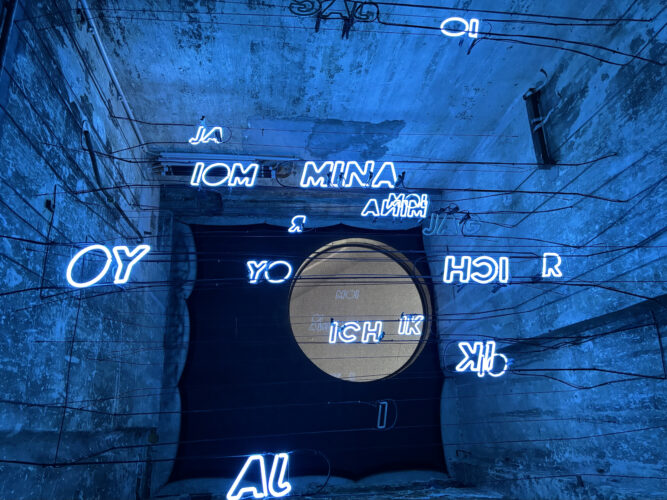
Governing Light in Unna’s Centre for International Light Art
Introduction: More Light
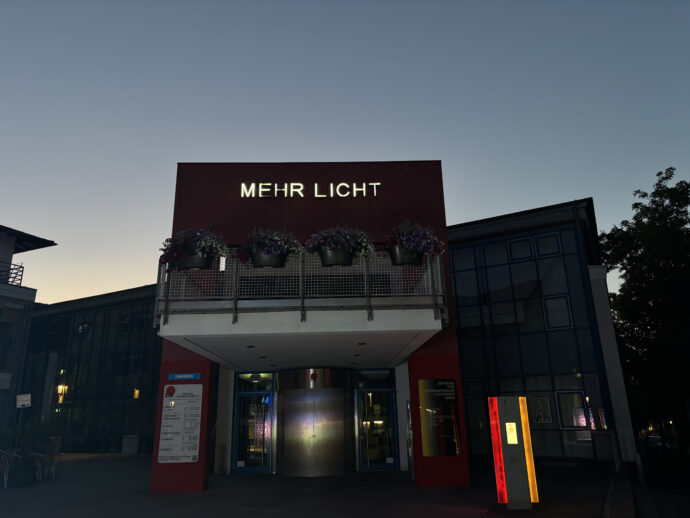
“Mehr Licht” (More Light) is written in large capital letters on the facade of a former beer brewery in Unna, a small town on the eastern edge of Germany’s so-called Ruhrgebiet. The phrase is a claim, an offer, and a metaphor at the same time: a plea for illumination, for transformation, for an enlightened presence. In a region that has long been shaped by the physical darkness of coal mining and the metaphorical darkness of a declining steel industry, light seems to have a special meaning. This photo essay will explore what light means for Unna and how an old brewery is an illuminating example for the structural changes of the famous Ruhrgebiet. It explores the appropriation of (post-industrial) space through (light) art by focusing on the city’s unique Center for International Light Art (Zentrum für Internationale Lichtkunst) in Unna.
To understand the significance of light in the context of the Ruhrgebiet, it is first necessary to introduce the region itself. This essay asks the questions: Why has this cultural institution specializing in light art been placed in the Ruhrgebiet? How can light art serve as a tool for the activation of urban and/or cultural spaces? And what impact does this light-full institution have on governing the city of Unna and its people light/ly?
Note: All the photographs were taken in June 2025 by myself.
Darkness During Lighter Times – A Story of the Ruhrgebiet
The Ruhrgebiet is one of the best-known regions in Germany, first for its industries of coal and beer and second because of structural changes entering a post-industrial era. The region is located in the west of the country, in the federal state of North Rhine-Westphalia, and includes cities such as Dortmund, Essen, Duisburg, Bochum, and Gelsenkirchen, all connected by the river Ruhr. Around 5.1 million people live in this region, covering a relatively small area of 4,500 square kilometers, making the Ruhrgebiet one of the largest conurbations in Europe (Berger 2019, Regionalverband Ruhr n.d., Rezende 2025).
Back in the 19th century, the Ruhrgebiet was the center of heavy industry, first in Germany and later in Europe. As soon as the coal deposits in the underground were discovered, the coal industry started to boom. Coal mining in the underground, collieries, steelworks, and factories above ground shaped the lives of the people (Berger 2019). In just 50 years, the area grew from a small population of a few thousand to millions by the end of the 19th century (Neumayer 2020). As the industry thrived, beer consumption also increased. Breweries in the Ruhrgebiet expanded their production, and, for example, Dortmund, which is located next to Unna, was known as “BeerCity” (Schmitz 2018). To keep up with the booming economy, workers and their families from across Germany and Europe came to the Ruhrgebiet to work in the mines. Due to ongoing labor shortages, the recruitment of so-called foreign guest workers began in the late 19th century. Many Polish-speaking workers migrated to the area during this time (Berger 2019, Schmitz 2016).
At the beginning of the 20th century, the Ruhrgebiet underwent significant changes that led to the growing politicization of the population. Workers faced harsh working conditions such as long working hours, unsafe workplaces, and economic insecurity, highlighting the deep social inequalities of the times. In response, they began to organize themselves through trade unions and political movements, demanding better wages, safer workplaces, and political rights. A striking example of their collective power was the miners’ strike in 1905, when over 200,000 miners (around 80 percent) stopped working. But the bourgeoisie did not want to negotiate with the workers, resulting in government action and new regulations. This was a small but important step to improve workers’ rights. Mass demonstrations and strikes became common as workers fought for their rights and better living standards. The rise of socialism and labor parties gave many people a voice and helped channel their frustrations into collective action (Berger 2019, Lehmkühler 1952).
During the 1930s, the Ruhrgebiet was a centrer of social and political resistance against the rise of the Nazi regime. Opposition came from a wide range of groups: Catholic, Communist, and Socialist workers, women’s organizations, and youth movements (Berger 2019). The Edelweißpiraten, active in cities like Dortmund, resisted the Nazis by spreading leaflets, supporting the persecuted, and protesting against the Hitler Youth (Högl 1992). Another expression of resistance was the so-called workers’ opposition, a spontaneous and non-organized form of protest by socialist and communist-minded workers. These workers openly criticized Nazi ideology and methods, and showed solidarity and friendship towards those persecuted by the Nazis, including so-called “foreign guest workers”. This everyday defiance was a quiet but powerful form of resistance to fascism (Klönne 1989). After the National Socialist Party (Nationalsozialistische Deutsche Arbeiterpartei, or NSDAP) took over in 1933, this resistance was brutally suppressed. Tens of thousands of workers involved in these movements were arrested, deported or killed by the Nazi regime between 1933 and 1945 (Berger 2019, Klönne 1989).
During World War II (1939-1945), the Ruhrgebiet was heavily bombed due to its industrial importance. Cities like Essen, Dortmund, and Gelsenkirchen lay in ruins by 1945. After the war, the region became central to West Germany’s economic and cultural recovery. Coal and steel drove the so-called economic miracle, and the Ruhrgebiet became a symbol of rebuilding (Berger 2019).
At the same time, cheaper oil became available and, respectively, demand for coal declined. Despite ongoing economic uprisings, first mines in the Ruhrgebiet were shut down, revealing cracks beneath the surface of the economic miracle. By the 1960s, it became clear that the waning end of the coal era was structural rather than temporary. Even in times of general prosperity, the Ruhrgebiet experienced mass layoffs, which showed a striking contradiction to the national image of growth and stability (Czierpka 2019, Küpper 2018). Nevertheless, Germany continued to recruit foreign workers, most notably through the 1961 recruitment agreement with Turkey, which marked the beginning of a major influx of Turkish workers into the Ruhrgebiet. From the German perspective, these “guest workers” were expected to work in Germany temporarily and then return to their home countries. However, many of them stayed, building lives, relations, and communities in the Ruhrgebiet. Their contributions, alongside those of other so-called “guest workers,” were crucial not only to the region’s economic success but also to the development of its multicultural identity, which has been shaped by struggles surrounding racism and discrimination (Berger 2019, Schmitz 2016). Yet, structural shifts in an industrialized Germany were already underway. The physical darkness, caused by with coal dust, industrial grime, and the lingering remnants of war, was supposed to give way to light/ness through progress of transformation.
Structural Changes, Ontological Insecurity, and Governing Light/ly
After decades of prosperity built on coal and steel, the Ruhrgebiet entered a long and painful period of transformation in the 1950s. The so-called “coal crisis” of 1958 marked the beginning of the structural change in the Ruhrgebiet: cheaper imported coal, rising oil use, and overproduction made domestic coal increasingly unprofitable. The first mines began to close, and over the following period, closures accelerated throughout the 1970s.
The decline of coal mining in the Ruhrgebiet was not a sudden rupture but a slow, drawn-out process that stretched over decades. One by one, mines, factories, and breweries closed, leaving behind empty buildings and rising unemployment. In many towns, nearly every family had someone working in the coal or steel industries. As the collieries shut down, many people found themselves facing an uncertain economic future. The economic consequences were serious, but the emotional impact was just as intense: a sense of loss, insecurity, and fear became part of everyday life. Especially during the 1980s, protests and anxiety about what lies ahead marked the atmosphere of the region (Berger 2019, Küpper 2018).
Thus, structural change marked not only an economic challenge, but also enacted a cultural and identity-shaping rupture. It had far-reaching consequences for people’s sense of security and marked an existential turning point in their lives. Anthony Giddens (1991) proposed the concept of “ontological security” to describe humans’ fundamental trust in their identity, environment, and surrounding built and material worlds in order to feel secure (Helbrecht 2025, Rezende 2025). For decades, industrial labor had provided this foundation in the Ruhrgebiet. Both the industrial work and even the physical darkness of coal and steel formed a core part of people’s ontological security. As the physical darkness began to lift, it was not replaced by the anticipated light/ness of renewal, but rather by a different kind of darkness: existential uncertainty and ontological insecurity. For many, the loss of work meant the loss of orientation, everyday life, and a sense of belonging. The closures of mines marked the onset of a profound disruption to ontological security. Helbrecht (2025) notes that structural transformation, regardless of context, can trigger existential uncertainty by unsettling people’s internal sense of stability. As Rezende (2025, p.7) states: “The relationship between a region’s historical heritage, memory, and collective identity cannot be understood as mechanical, static, or unilateral. It is a continuous feedback process that involves individuals, collectivities, time, and space.” The historical heritage of the Ruhrgebiet is not only found in the coal-dusted mines but, above all, in the pride in industrial work, strong solidarity, and a sense of prosperity, as well in what others might label as “darkness.” In the Ruhrgebiet, ontological security and identity formation appear closely linked to collective memories of having lived more light/ly in the past. Although structural change gradually reduced the physical darkness, the hoped-for light/ness did not immediately follow.
This emotional attachment to the region and its industrial legacy is well-captured in Herbert Grönemeyer’s 1984 song “Bochum” in which the singer describes the city with both honesty and affection: “Du bist keine Schönheit, vor Arbeit ganz grau” (“You’re no beauty, grey from all the work”) and “Du hast ‘n Pulsschlag aus Stahl, man hört ihn laut in der Nacht” (“You have a heartbeat of steel, you can hear it loudly in the night,” translated by author). Grönemeyer’s lyrics reflect both the tough, working-class character of the Ruhrgebiet and the deep sense of belonging people feel toward it. The song became an anthem, capturing the bittersweet pride and quiet resilience of a region in transition.
For many, December 21, 2018 marked the symbolic end of the coal era, as the final shift in the Bottrop mine brought coal mining in the Ruhrgebiet to a close. In nearby Gelsenkirchen, the football club FC Schalke 04 organized a farewell ceremony, bringing together not only former miners but also younger generations who knew the mining era only from stories, which shows how deeply coal had shaped the region’s identity. In this way, the memory of mining seems to remain more than just nostalgia; it continues to influence how the Ruhrgebiet understands itself today (Land 2018, Rezende 2025).
Becoming Light/er through Change: Structural Changes and Revitalization
The changes went beyond job losses and collective insecurity. A new question quickly emerged: What should happen to the empty industrial sites left behind? This transformation is still ongoing. Some former mines and steelworks have been repurposed as cultural spaces, museums, and landmarks of industrial heritage. Zeche Zollverein in Essen, now a UNESCO World Heritage Site, is one such example. Landschaftspark in Duisburg has turned a former steel plant into a multifunctional public space, combining history with new uses. Similarly, the Dortmunder U, once a large brewery complex, has been transformed into a center for art and creativity. These symbolic reinventions reflect the revitalization of the Ruhrgebiet, moving away from coal and steel to culture and art, while embracing its history. Let us now turn to a small town on the outskirts of the Ruhrgebiet, where a former industrial complex may have brought new ontological security and, above all, light.
Illuminating the City of Unna
Now that I have painted a picture of the Ruhrgebiet and its diverse industrial and post-industrial memories and markers, I would like to introduce Unna. Unna is my hometown, which gives me a strong sense of belonging and a deep understanding of the area. In the following, I don’t rely only on my personal impressions and experiences, but rather engage with resources and an interview I conducted specifically for this essay with Christine Hahn, who is in charge of PR and education at the Center for International Light Art Unna.
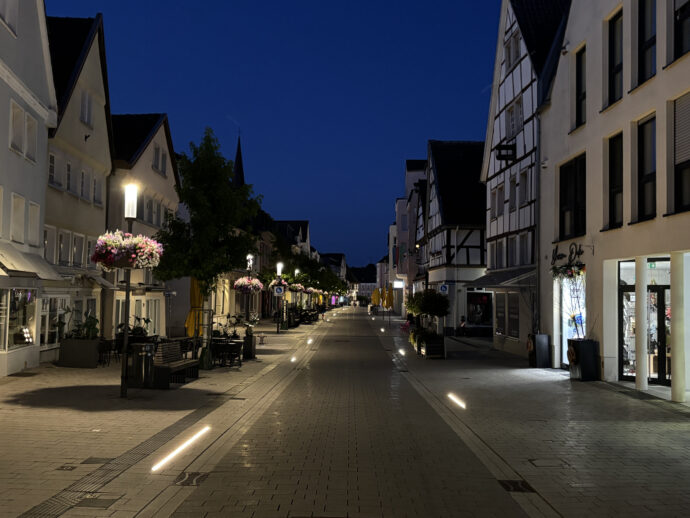
Describing Unna is not easy, especially knowing that most people have never been to Unna or even heard of it. Still, I think Katharina Cichosch (2018), a journalist, captured it well when she described Unna as “Ruhrgebiet light,” not as rough and tough as other parts of the region, but rather marked by a “gentle urbanity.” Situated on the edge of the Ruhrgebiet and bordering the more rural region of Westphalia, Unna is indeed an interesting blend of rough industrial charm and idyllic old town (Figure 2). Around 65,000 people live here nowadays. Like most of the region, Unna experienced both industrialization and the later structural change.
As part of the Ruhrgebiet, Unna once had 21 coal mines operating from the mid-19th century until the “coal crisis,” during which the mines closed one by one. The decline of the mining industry and the subsequent changes were clearly felt here as well. The last coal extraction in the district ended in 2010 (Knappenverein Glückauf-Südkamen n.d.).
As mentioned earlier, coal mining in the Ruhrgebiet is closely connected with brewing beer. Unna was no exception. The city had its own brewery, the so-called Lindenbrauerei, built in several phases starting in 1859. It produced Linden beer, which was well known even beyond the city. In 1979, the brewery closed, leaving behind an empty industrial space in the heart of the city. Inspired by similar projects in the region, the non-profit association Lindenbrauerei e.V. was created with the goal to transform the former brewery into a socio-cultural center. After lengthy negotiations with the city of Unna, the Kultur- und Kommunikationszentrum Lindenbrauerei e.V. opened in May 1992. The association renovated the buildings above ground and established a vibrant space, hosting concerts, gastronomy, and exhibitions. As a result, part of the brewery was revitalized. Once threatened with demolition, the brewery was given new life as a public cultural space.
However, the large underground cellar buildings remained unused. It is important to mention that the brewery’s history spans more than 100 years. The 2,600 square meters of cellars were built over time in various stages, which made them architecturally and structurally diverse and therefore complicated any plans for their reuse. As a result, discussions about their future extended over two decades. The city initiated a public competition to determine this future. The winning concept proposed repurposing the space for something both contemporary and suitable: light. The vision came from Uwe Rüth, an artist from Marl, a nearby city. Light art was still an emerging artistic field with no established and/or institutional focus. The concept relied on activating the space, since without light, the space would only be an empty cellar.
The initiative reached out to leading light artists of the time to share their visions. Each artist was invited to choose one of the cellars and create a site-specific work for that unique space. Unlike the typical “white cube,” the former brewery’s rooms were rich in history and character, each one different in size, architecture, and atmosphere. All of them were dark, and using light art as a tool to revitalize was new and different. The involvement of well-known artists such as Mario Merz and James Turrell marked the beginning of what would become a permanent exhibition dedicated to light art. In 2001, the International Museum for Light Art opened in the cellar of the abandoned Linden brewery, right underneath the socio-cultural center. What was once a space for production and heavy labor became home to the world’s first and only museum dedicated entirely to light art. Light art and the exhibition is described as “a dynamic dialogue between past and future” (Zentrum für Internationale Lichtkunst Unna n.d.-c).
Peeking into a Collection of Light/ness
To make light art and the museum more accessible, the following section offers an insight into the collection on display. The selection of artworks is based on my personal experience during a visit to the museum, combining both older works (Figures 3 and 4) and more recent ones (Figures 5 and 6).
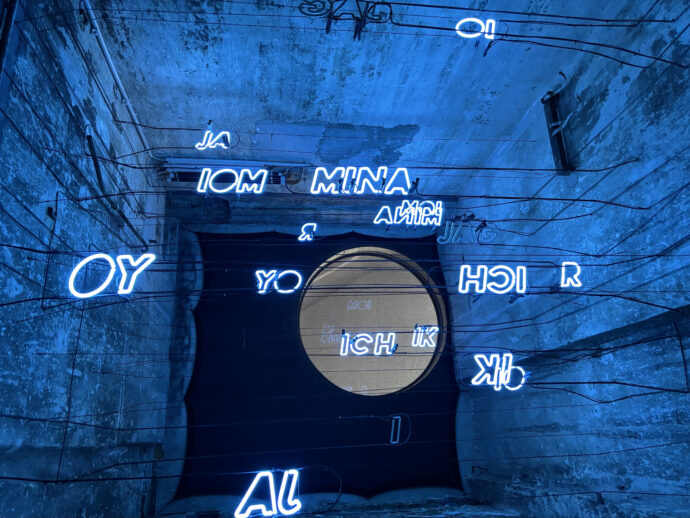
In the old elevator shaft, Jan Van Munster (1939-2024), an artist from the Netherlands, created an installation titled Ich im Dialog (“I in Dialogue”) (Zentrum für Internationale Lichtkunst Unna n.d.-b). From above, in the entrance area, or from below (Figure 3), the word “I” can be read in 10 languages. The languages represent those spoken by the workers who were last employed at the brewery: German (ich), Dutch (ik), Spanish (yo), English (I), Italian (io), Swedish (jag), French (moi), Tamazight (anim), Russian (я), and Polish (ja).
Standing in the dark, old shaft, one is immediately overcome by a feeling of darkness and confinement. As a small group of visitors, one can imagine the factory’s atmosphere, filled with strong smells and constant noise. Thinking about the harsh working conditions, a slight unease arises when picturing the workers being lowered down through the narrow shaft. At the same time, the irregular lighting draws one’s attention. The light seems to almost shout the word “I,” emphasizing that there were many individuals with different backgrounds and stories who worked here. Despite the darkness, their presence remains light/ly.
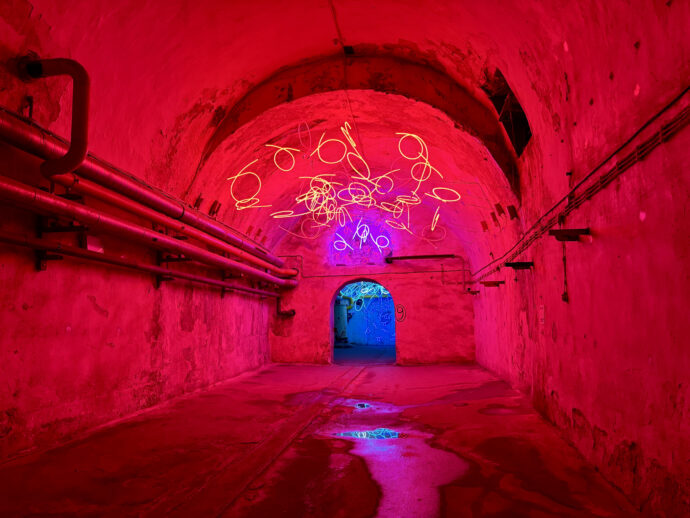
In two connected but very different rooms, Keith Sonnier (1941-2020), an American artist, created the “Tunnel of Tears.” The neon tubes reflect in the groundwater, which was present when the artwork was installed over 20 years ago. The use of color, red and blue neon lights as warm and cold, creates a sense of tension between the two differently-sized rooms and the visitor. While the red room feels warm and welcoming, the blue, much smaller room, feels cold and unwelcoming. The artist plays with light to clearly convey to the viewer that light governs both light/ness and dark/ness. Moreover, in these two otherwise completely dark cellar rooms, the unique spatial characteristics become visible (Zentrum für Internationale Lichtkunst Unna n.d.-b).

In the current exhibition Light Land Spaces (June 7, 2025 to January, 4 2026), Jeongmoon Choi (*1966), a Korean artist, uses fluorescent threads that become visible under black light, forming a three-dimensional drawing of a horizon (Zentrum für Internationale Lichtkunst Unna n.d.-a). The viewer’s perspective plays a crucial role in experiencing the horizon. While music plays and the end of the installation cannot be seen, one’s perception gently shifts when moving through the space. It creates the sensation of not walking on solid ground, but rather feeling as if the floor is slowly moving. Moreover, as one enters the artwork, the person seems to disappear to the viewer outside. Through indirect lighting, the artist creates a fascinating optical illusion.
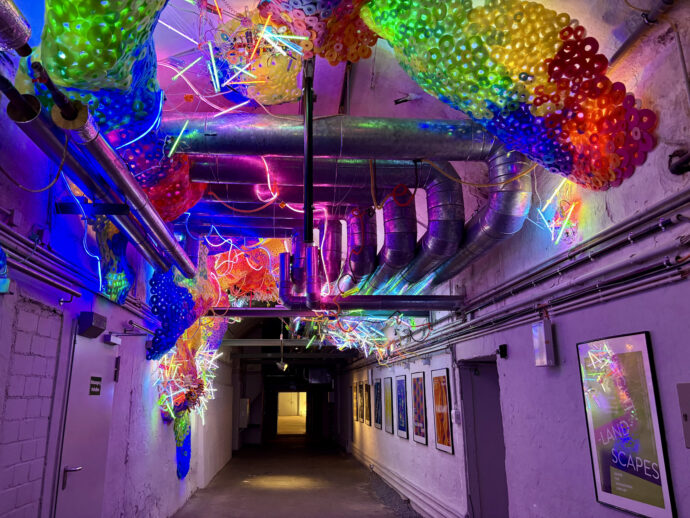
In this case, Adela Andea (*1976), an artist from Romania, did not use a typical cellar room, but rather a transitional space within the basement. Around the existing industrial pipes, she created a “technological chaos” using a mix of geometric and organic elements (Zentrum für Internationale Lichtkunst Unna n.d.-a). First, the space reveals that light is not static, but colorful, diverse, and light/ly. The artwork appears different depending on which of the two possible perspectives one chooses. From one perspective (Figure 6), bright and vibrant colors dominate, symbolizing light/ness and vitality. From the opposite perspective, the colors are darker and less cheerful. Perhaps the artist is conveying a warning about the relationship between nature and technology. Second, just as nature reclaims space, like plants wrapping around old pipes, here, the light art seems to reclaim the old building, bringing back light/ness. Therefore, it symbolizes the demand for more light.
Beyond the light art museum, there are many emerging artists exploring the medium of light. The unique, atmospheric underground spaces of the Linden Brewery offer them an exciting platform for exhibitions and experimentation, helping to establish a permanent space for light art and turning the cellars into transformative cultural experiences. The museum consists of a permanent collection and rotating exhibitions. Each year, the museum welcomes approximately 20,000 to 25,000 visitors from around the world as well as from the local community.
The museum is supported by a broad network of partners and sponsors and actively engages in regional collaborations, particularly within the Ruhrgebiet, as well as international collaborations. Examples include the RuhrKunstMuseen, a network connecting 21 art museums with a focus on contemporary art, and the Route der Industriekultur, a tourism project that presents historical industrial sites from 150 years of industrialization as vibrant cultural venues. These cultural networks play a key role in shaping the museum’s visibility, impact, and outreach.
Light, Darkness, and Light Art in Unna’s Urban Space
Light art as a museum experience is not only significant in the cellars. It has also come to shape a new sense of identity in the urban area of Unna since 2001. Light art is not exclusively confined to the large, dark basement spaces, but it can also be found throughout the city in public spaces. In the following section, I will explore how light has played a role in the appropriation and transformation of urban space in Unna, illustrating a broader cultural shift.
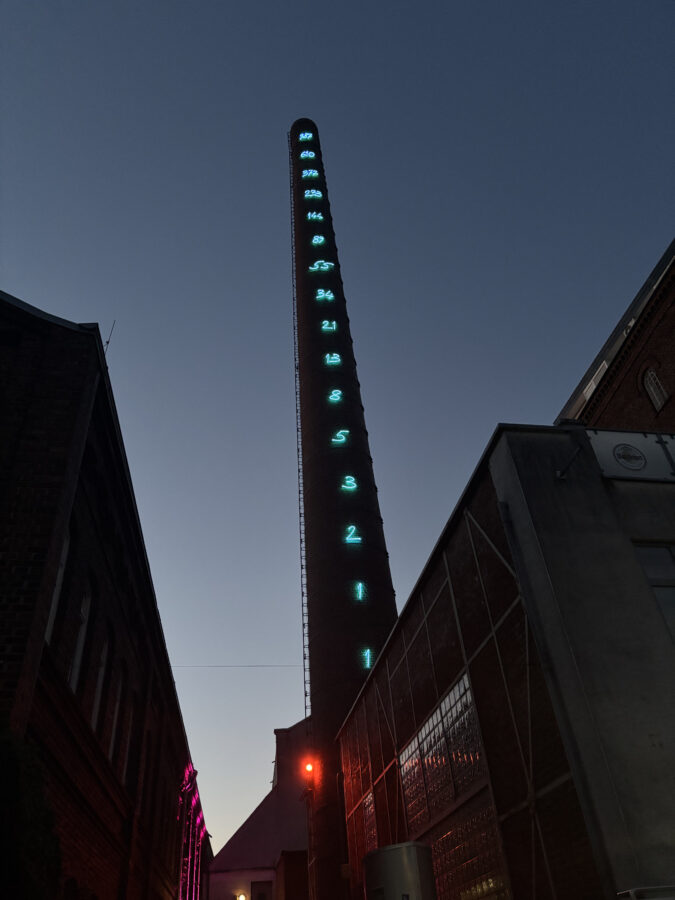
The chimney, which is a protected historic monument (“Denkmalschutz”), was transformed from an industrial remnant into a piece of light art in 2001 by Mario Merz with his series Fibonacci, named after the Italian mathematician Leonardo Fibonacci and referring to a sequence of numbers where each number is the sum of the two preceding ones (0,1,1,2,3,5,8,13,21…). A local newspaper writes: “It seems to lead straight into space, into dream worlds, into infinity. Each digit is a unique piece, a brushstroke by the Italian artist Mario Merz, who was always in search of the intersection between nature and intellect as the place of art” (Westdeutscher Rundfunk 2009). Creating a work of light art right next to the museum, in the heart of Unna’s city center, the artist establishes a connection between the urban space and the cellar, a link between inside and outside, between darkness and light/ness, and thereby creating access for everyone (mind you, those who have the ability to see).
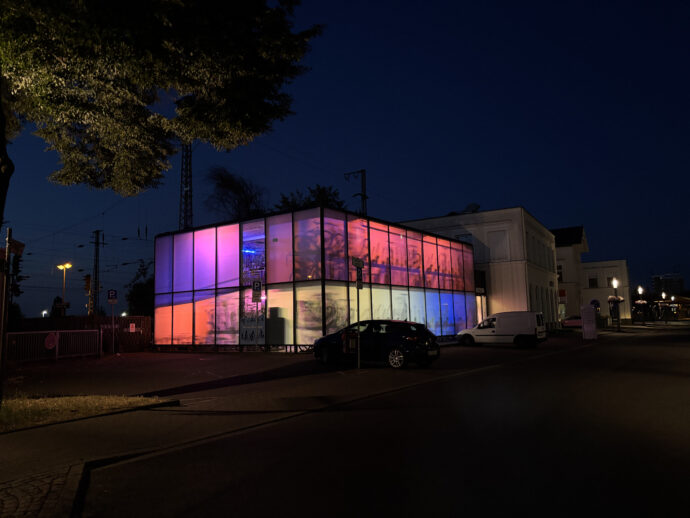
Speaking of identity, just a few years after the Center for International Light Art opened, another striking addition appeared in Unna’s urban landscape: the Radstation, a public bicycle garage located right next to Unna’s central station, which opened in 2009 (Allgemeiner Deutscher Fahrrad-Club Kreisverband Unna e.V. n.d.). By day, the glass-and-steel structure functions as a modern and practical bicycle garage and repair center. But by night, it transforms into a striking piece of light art, bringing light/ness to the urban space. The large purple box enriches the city through its atmospheric presence. Here, light functions not only as an artwork but also plays an important function in the urban space. It can strengthen people’s sense of security and orientation. By subtly transforming the dark corner next to the train station, perceived as unsafe, into a brighter, more welcoming space, it opens up the area and invites people to stay. From an infrastructure perspective, the Radstation also plays an important role in tourism for visitors arriving by train and/or bicycle. Unna is not typically a place people visit by chance, thus coming to Unna is usually a conscious decision, as I learned in the interview with Christiane Hahn from the Center for International Light Art (June 30, 2025). At the same time, the Radstation reflects Unna’s effort to integrate light art into everyday urban infrastructure. People seem to identify with light art, which fosters a shared sense of belonging and may also benefit the town’s tourism and economy. Moreover, this sense of belonging creates a new ontological security.
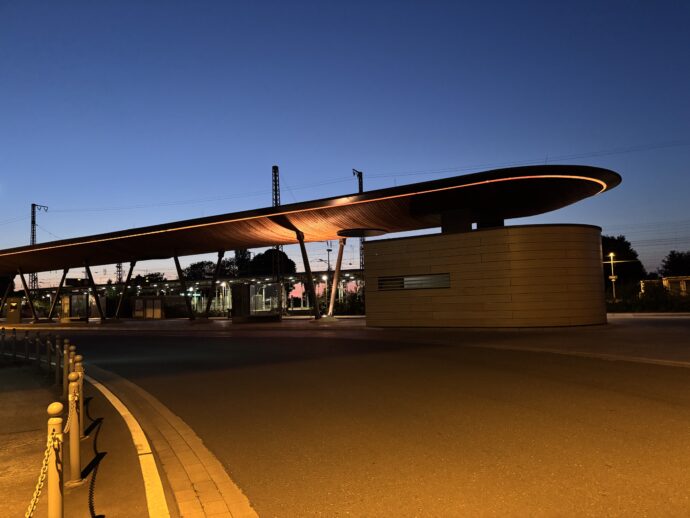
Similar to the bicycle station, the renovation of the bus station in 2010 also placed an emphasis on light installations. The bus station’s redesign aimed to reduce the feeling of fear and make the space more welcoming. By eliminating dark corners, which are often associated with danger and a sense of unsafety, through using light, the station offers a “warm welcome” and a clear sense of arrival in the “light art” city. This approach to urban design was recognized in 2015 with the “Exemplary Buildings in North Rhine-Westphalia” award (Dartenne 2021).
From another perspective, Unna’s train and bus station is often the first point of contact for visitors to Unna and/or the Center for International Light Art, particularly those arriving via the Route of Industrial Heritage from neighboring cities like Dortmund. A visually appealing and thematically matching station may help in creating a first impression and strengthening Unna’s tourism economy.
For local residents who use the station daily, the redesign may represent more than just a visual improvement, as it transforms a transit space into a recognizable, reassuring part of everyday life. Notably, engaging with light art in Unna does not require a visit to the underground exhibition at the Lindenbrauerei. Instead, light is integrated into the urban space itself: it appears at the bus station, the Radstation, the city center (Figure 2), and at the Fibonacci installation (Figure 7). These everyday encounters with light/ness appear to normalize a subtle yet profound sense of ontological security and may also contribute to shaping a local identity of light (art).
Light (Art) as Urban Matter (of fact and concern)
In the following, light will be examined both as a matter of fact and as a matter of concern. Bruno Latour said that “a matter of concern is what happens to a matter of fact when you add to it its whole scenography, much like you would do by shifting your attention from the stage to the whole machinery of a theatre” (Latour 2008, p.38). Latour shows that phenomena change their significance once we look beyond their factual existence to also include their staging and effects. As a matter of fact, light is a physical phenomenon that simply illuminates space. However, when considering light as a matter of concern, its role becomes far more profound and complex at the same time. Beyond its natural and functional properties, light has the power to emotionally move us. It shapes atmospheres, evokes feelings of comfort and safety and, in the case of Unna, even a collective feeling of belonging. Light as a matter of concern ensures that our experience is never “just” about light, but societal, affective, and memory-related aspects too.
When light art is approached as a matter of concern, it can dissolve the symbolic boundaries between darkness and lightness. At the Center for International Light Art in Unna, light art transforms not only how we perceive space physically, but also how we experience it emotionally. Light art can make spaces appear both expansive and isolated, creating a dialogue between viewer and the space. In the old cellar of the Lindenbrauerei, light becomes a medium that shapes how we navigate and feel within an industrial space. The work Ich im Dialog (Figure 3) powerfully addresses themes of collective history of Unna and its past by remembering the brewery and its workers, and in general the times of industrialization. While the cellar remains in its original industrial condition and the light interacts with the features of the space, the museum honors the history of the rooms and the region’s industrial heritage. Here, light (art) serves as a tool for remembrance. The museum’s offer of more light can symbolize visibility and brightness after a time of darkness during the end of the industrial era, meaning there is light, and with light, there is hope for remembrance and change. “More light” can also be understood as a metaphor, not only for hope, but also for transformation. It reflects the revitalization of the former brewery in Unna, symbolizing not only the successful renewal of an industrial space, but also the broader socio-economic and structural changes in the Ruhrgebiet. In this context, “more light” can be seen as a metaphor for new beginnings in the post-industrial Ruhrgebiet. One might say that the world’s only museum dedicated exclusively to light art also marks a transformation within the art world itself, opening up to new media and practices.
Moreover, light (art), as (urban) matter of concern, can contribute to strengthening a community’s sense of ontological security, a feeling of continuity, stability, and trust in one’s environment. In Unna, light art extends beyond the Center for International Light Art and spills variously into public space. By making memories of the industrial era in the Ruhrgebiet visible and lit and a cause for celebration in Unna, it ensures that the past is not forgotten. At the same time, by embedding this memory in shared urban spaces, light art in Unna seeks to connect the darkness of the past with the light of the present. In doing so, it strengthens a sense of community rooted in history while also creating new forms of belonging. Art becomes part of daily life, reshaping the city’s image in a long-lasting way. Light art shapes the city’s identity and offers both residents and visitors not only quantitatively more light, but also more diverse perspectives on light and darkness in urban space.
In conclusion, light as a matter of concern can shape space, light can create identity, and light can redefine how we experience the city. In this context, the phrase “Mehr Licht” (More Light) looming over the museum is a claim, an offer, and a metaphor for illumination, for transformation, and for presence of a future that is just arriving.
References
Allgemeiner Deutscher Fahrrad-Club Kreisverband Unna e.V. (n.d.) Anno 2009: Neue Radstation in Unna. https://unna.adfc.de/artikel/anno-2009-neue-radstation-in-unna last seen 11.07.2025
Berger, S. (2019). Was ist das Ruhrgebiet? Bundeszentrale für politische Bildung. https://www.bpb.de/shop/zeitschriften/apuz/283260/was-ist-das-ruhrgebiet/ last seen 11.07.2025
Cichosch, K. (2019). Unna: Himmel unter den Füßen. ZEIT Online.
https://www.zeit.de/entdecken/reisen/2016-09/unna-nordrhein-westfalen-unterschaetzte-stadt last seen 11.07.2025
Czierpka, J. (2019). Der Ruhrbergbau: Von der Industrialisierung bis zur Kohlekrise. Bundeszentrale für politische Bildung. https://www.bpb.de/shop/zeitschriften/apuz/283262/der-ruhrbergbau/ last seen 11.07.2025
Dartenne, S. (2021). Unna: Neugestaltung Busbahnhof. MOVEforward. https://move-forward.eu/2021/11/17/unna-neugestaltung-busbahnhof/ last seen 11.07.2025
Helbrecht, I. (2025). Geographien der Verunsicherung. In: J. Kibel, N. Meier, S. Steets & G. Weidenhaus (Eds.), Figuring out space: Über die Sozialität von Räumen und die Räumlichkeit des Sozialen (pp. 217–233). transcript Verlag.
Högl, G. (1992). Widerstand und Verfolgung in Dortmund 1933-1945: Katalog zur ständigen Ausstellung des Stadtarchivs Dortmund Mahn- und Gedenkstätte Steinwache.
Klönne, A. (1989). Die deutsche Arbeiterbewegung: Geschichte, Ziele, Wirkung. Deutscher Taschenbuch Verlag.
Küpper, M. (2018). Steinkohle-Bergbau im Ruhrgebiet: Schicht im Schacht. Deutschlandfunk Kultur. https://www.deutschlandfunkkultur.de/steinkohle-bergbau-im-ruhrgebiet-schicht-im-schacht-100.html last seen 17.08.2025
Land, U. (2018). Das Ende des Ruhrkohlebergbaus: Der letzte Deckel auf’m Pütt. Deutschlandfunk Kultur.
https://www.deutschlandfunkkultur.de/das-ende-des-ruhrkohlebergbaus-der-letzte-deckel-auf-m-puett-100.html last seen 11.07.2025
Latour, B. (2008). What is the Style of Matter of Fact? Department of Philosophy of the University of Amsterdam, Amsterdam: Van Gorcum. https://www.negrophonic.com/pdfs/Latour%20-%20What%20Is%20the%20Style%20of%20Matters%20of%20Concern.pdf last seen 17.08.2025
Lehmkühler, M. L. (1952). Streik als soziale Krise des Großbetriebes—Eine historisch-soziologische Studie über den Ruhrbergbau. Soziale Welt, 3(H. 2), 143-155. https://www.jstor.org/stable/40875055 last seen 14.08.2025
Neumayer, I. (2020). Nordrhein-Westfalen: Ruhrgebiet. Planet Wissen.
https://www.planet-wissen.de/kultur/nordrhein_westfalen/ruhrgebiet/index.html last seen 11.07.2025
Ruhr Regionalverband. (n.d.). Flächennutzung. Statistikportal Ruhr.
https://statistikportal.ruhr/#Fl%C3%A4chennutzung last seen 11.07.2025
Rezende, R. (2025). Industrial heritage, identity, and memory: The case of the Ruhr Valley. Cadernos Metrópole, 27(34). DOI: 10.1590/2236-9996.2025-6265884.en last seen 11.07.2025
Schmitz, A. (2016). Das Ruhrgebiet – seit 200 Jahren permanent im Wandel. Deutschlandfunk. https://www.deutschlandfunk.de/neuere-und-neueste-geschichte-das-ruhrgebiet-seit-100.html last seen 11.07.2025
Schmitz, A. (2018). Bier: Dortmund – die Bierstadt im Pott. Planetwissen.
https://www.planet-wissen.de/gesellschaft/trinken/bier/pwiedortmunddiebierstadtimpott100.html last seen 11.07.2025
Westdeutscher Rundfunk (2009). Mario Merz: Fibonacci-Reihe – Zentrum für Internationale Lichtkunst in Unna. WDR Kultur. https://www1.wdr.de/kultur/kunst/west-art-meisterwerke/Zahlenmystik100.html last seen 11.07.2025
Knappenverein Glückauf-Südkamen. (n.d.). Die ehemaligen Bergwerke im Kreis Unna
https://www.glueckauf-suedkamen.de/kreisunna.shtml last seen 11.07.2025
Zentrum für Internationale Lichtkunst Unna (n.d.-a). Ausstellungen. https://www.lichtkunst-unna.de/de/ausstellungen last seen 11.07.2025
Zentrum für Internationale Lichtkunst Unna (n.d.-b). Sammlung. https://www.lichtkunst-unna.de/de/sammlung last seen 11.07.2025
Zentrum für Internationale Lichtkunst Unna. (n.d.-c). Über das Museum. https://www.lichtkunst-unna.de/de/zentrum#ueber-das-museum last seen 11.07.2025
ALL IMAGES BY THE AUTHOR.