Feel the Heat of Lampolitics – Governing Light/ly in Malmö’s Folkets Park
Writing as [Artist] Residency
As a writer, I crave to create a home on a page. This goes hand in hand with the fact that pages have already offered me so much relief, release, revelation, healing. Temporary homes, temporary pages. I can [re]turn to pages in the most absurd times in life. I can find type-written sense in and on pages. Pages do not speak to you (and me) unsolicitedly; they bite your finger upon your own request; you can keep them at bay by snapping a book closed at your own convenience. If the textuality, or book-ability of a text, always-already lives outside of itself, this text longs to live out there, too.
Writing is traveling and residing at the same time; traveling is writing life into the worn-out soles of your shoes. This dwelling about writing, pages, homes and residencies softly emplaces itself in the time-space-continuum that this essay seeks to illuminate: the one-month artist residency I conducted at the Institute for Urban Research at Malmö University, split into two stays in February and June 2025. The following pages contain a selective selection of observations, thoughts, experiences, insecurities – offering you a suitcase full of (dis)regarded ideas about agents, affects, subjects and objects that meander between light and darkness in Malmö’s public space.
The attempt to write about this residency experience is tied to wanting to hold on to all the thoughts and sensory impressions I experienced whilst traveling-residing there. Yet, this ever-fragmented archive of experiences is overruled by the fallacy of believing that a sentence is anything but a fragment. The first time this hits me, I am eating a halloumirulle at a corner bistro of Folkets Park, the space I investigated throughout the artist residency. The woman who made the halloumi for me showed surprise (without using words) to see me sit down in the bistro to eat my sandwich. We shared some silent moments together, me chewing and thinking about writing; her watching news videos on her phone in Arabic on speaker phone. I was immediately saddened that my mouth would not be able to fully remember the taste of this sandwich as soon as I would start describing how much I appreciated sharing this space with this woman. Perception running dry as soon as a pen hits a page. The next bite feels floury and heavier than the last one; I am going to have to get going soon. What else is writing but chewing a halloumi that is becoming bigger and bigger in your mouthbrain?
Bi-Seasonal Spotlights: Landing Light/ly with Lamps
When I arrived in Malmö for the residency in early February 2025, I had already heard and read about Folkets Park – about political rallies, human rights and anti-fascist protests over multiple centuries, and more recently, about legalized graffiti walls, and the contested Eurovision Song Contest in 2024. Folkets Park had aroused my interest to explore its many appearances of making space for culture and art in a place that was created for the public. Folkets Park, which literally translates to People’s Park, is the oldest public park in Sweden, erected in 1891 by the Malmö Social Democratic Association, making it the first public green space of its kind. Situated in the working-class neighborhood of Möllevången, the political connotation of the park was tangible early on – providing a platform for political rallies, strikes, and demonstrations, including the major general strike in 1909, when over 13,000 workers gathered at Folkets Park. Throughout history, the park has served as arena for political mobilization and protest, but also as socio-cultural hub for leisure and relaxation for people of Malmö from different walks of life, offering green and white spaces (turning into an ice-skating rink in the winter, see below), restaurants, cafés, a mini golf court, a skate park, concert venues, playgrounds – and, strikingly to me, many different types of lamps. This variety of artificial light ignites the focus of this essay. Let us switch on the lights and see what the different sources of human-produced light can make us see (or not) about the inclusionary and exclusionary dynamics of values such as security, (public/personal) safety, sustainability, city image, and diverse usages of public space.
Reset. In the winter months (i.e., between December and February), Folkets Park is themed Vinterdröm, Winter Dream. The inside of the park is covered in sparkling fairy lights, white net lace garlands, illuminated paper mâché sculptures of fable-like snow creatures and trees, fake snow, an ice-skating rink playing music, attracting young and old, fast and slow, laughing and scared-looking skaters onto the wide central surface in the park. The decor felt ‘loaded’ to me during my initial walks, as if the park had geared up to speak back against the long and dark winter times.
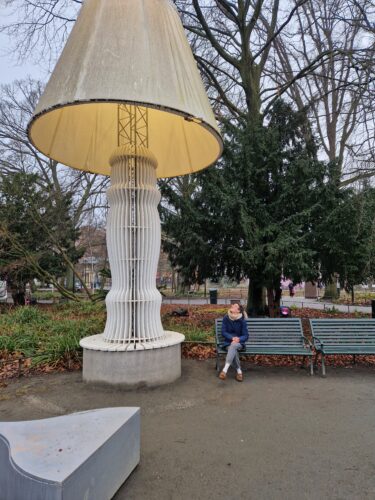
Put differently, there is an immensely seasonal element not only to my personal experience and sensation of Folkets Park, but also to its logi(sti)cs of light and darkness through ever-ongoing oscillations between natural and artificial light/ness. During February, gently moving towards the end of winter, the park’s artificial lights came on in the afternoon, around four or five o’ clock, depending on the location within the park; some sources of light were lit almost all day. It dawned on me then, sitting under a brightly-lit more-than-life-size lamp at ten in the morning (Fig. 3) that light has more-than-functional purposes – yet, what exactly is political about light?
When I returned to Malmö in June 2025, the seasonality of Folkets Park had drastically changed: There was natural light until after 10 pm, groups of people such as students, couples, and families scattered lounging in the grass, eating lunch or dinner, enjoying lots of ice cream, smoking, listening to music, dancing, drinking alcohol, on wooden picnic furniture, on benches, or in the commercial beer garden. People with business attire were mixing with sporty-looking soccer or frisbee players, parents entertaining their children, people on dates, in deep conversation. I saw dwellers by themselves with cellphones, headphones, books, or just staring into the park, as well as people who probably live without a fixed home, those using substances or being intoxicated.
The days in and around Folkets Park are longer, the nights are shorter this time around, which has a significant impact on the liveliness and live-ability of the park. Also, the nocturnal seasonal life of the park changes – the beer garden, visibly sponsored by the Danish brewery Mikkeller, is open until 10 pm on weekdays, and midnight on the weekend. When I cycle through the park after midnight one weekend evening after karaoke (psst, don’t tell anyone I cycled, which is not allowed in the park), I visit the lamps I studied in February (see below). I find some of them in well-deserved sleep, others are still shining – for no apparent users. Rabbits usher by, and I am not sure whether they appreciate the nocturnal lightness? Moreover, I wonder about both the financial and ecological costs of illuminating the park to this degree at night. How are public ownership, public agency, and public investment of lighting the park managed, who decides on the degrees of lightness and darkness in the park, and in whose interest is it light or dark? What kind of, and how much, light does the park need? How do we determine the need, let alone the political capacity of and for light and darkness? In sum, who and what governs the light/ness of the park?
(Dis)Locating this Essay
This is a text intentionally produced without academic references and footnotes (some links smuggled their way in). Still, you will find gestures towards other people’s work in this text. The ambition to produce a text without a long list of references dangling at the bottom is not merely an aesthetic choice, but an intentional question mark to rigidly formalized forms of academic publishing. Inspired by Luke Fischer’s (2014) Poetic Phenomenology of the Seasons, this text materializes as an incomplete, bi-seasonal, place- and light-sensitive essay that captures the time I spent with different types of lamps in a public park. Fischer argues that seasons are phenomena of natural time, and that poetry helps us to embrace the seasonality of time. In the context of this text and my residency (ad)venture, I add that seasons are phenomena that embody and poeticize relations with light and darkness, too.
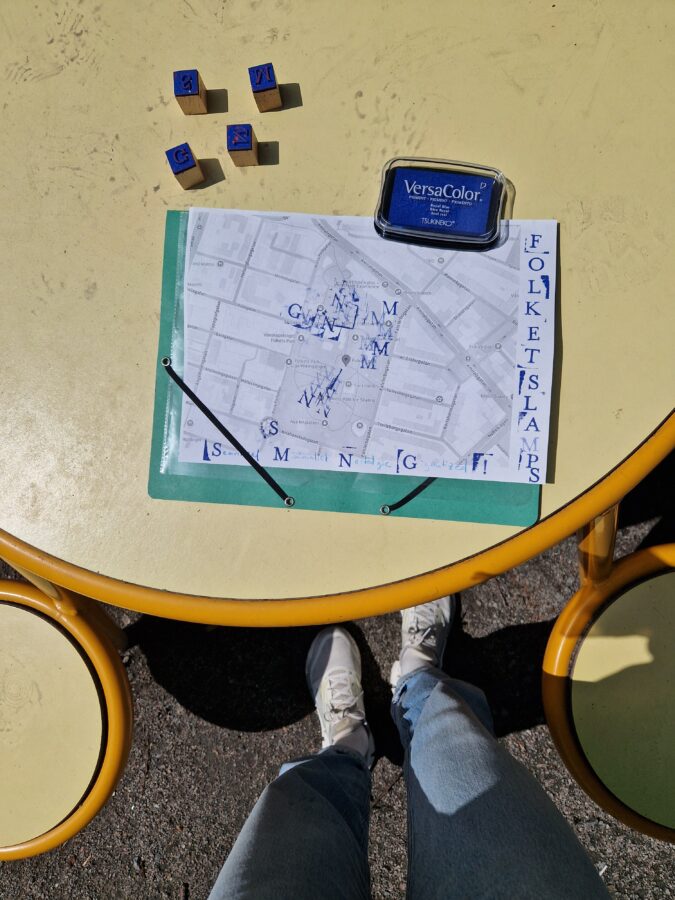
So, here I am, allowing myself to be(come) obsessed with the amount and variety of lamps that illuminate Folkets Park. While, in February, I was reluctant to do the “proper” spatial researcher thingy – i.e., to count, quantify, or otherwise map the quantity, density and location of different lamps in the park – when I returned in June, I opted for what I would now call a “messy mapping”: stamping the spatial distribution and frequency of different lamp types onto a DinA4 print-out map of the park (Fig. 1).
Now, let us get carried away in the spirit of poetic-practical “lunar-resonance” to lights in public spaces – opening opportunities to be more sensitive and empathic to difference with our (tired) eyes. I acknowledge the ride towards light/ness is not easy in politically dark times (see editorial), but let us try to turn on some lights against all odds?!
Typologizing Lamps
As a trained academic who is only slowly getting over their impulse to analyze socio-spatial entanglements by means of categorization, what I ended up with is what I call a typology of light (Fig. 2). The purpose of this typology is to illuminate (pun intended!) the park’s spatially dispersed approach to governing light/ness and darkness. In the following, I unpack how (1) the gigantic/ized lamp stands for design-led upscaling and aestheticization of public space, (2) the minimal/ist lamp embodies a functional/ist approach to public lighting and furniture, (3) the nostalgic lamp serves to remind of the park’s historicity which interconnects contemporary and bygone usages of the park, and finally, (4) the securitized lamp, which is located just outside the park at a significant roundabout, illustrates the increasing socio-technological surveillance through light/ness in one of Malmö’s most contested public spaces. The roundabout, with various names such as Knarkrondellen (drug roundabout), or its more recent nickname, Gazarondellen (Gaza roundabout), constitutes a crucial nodal point within the socio-political ecosystem of the park, as it serves as a site for public protest, organizing, and solidarity, especially in light of the ongoing war and genocide in Gaza (see editorial).
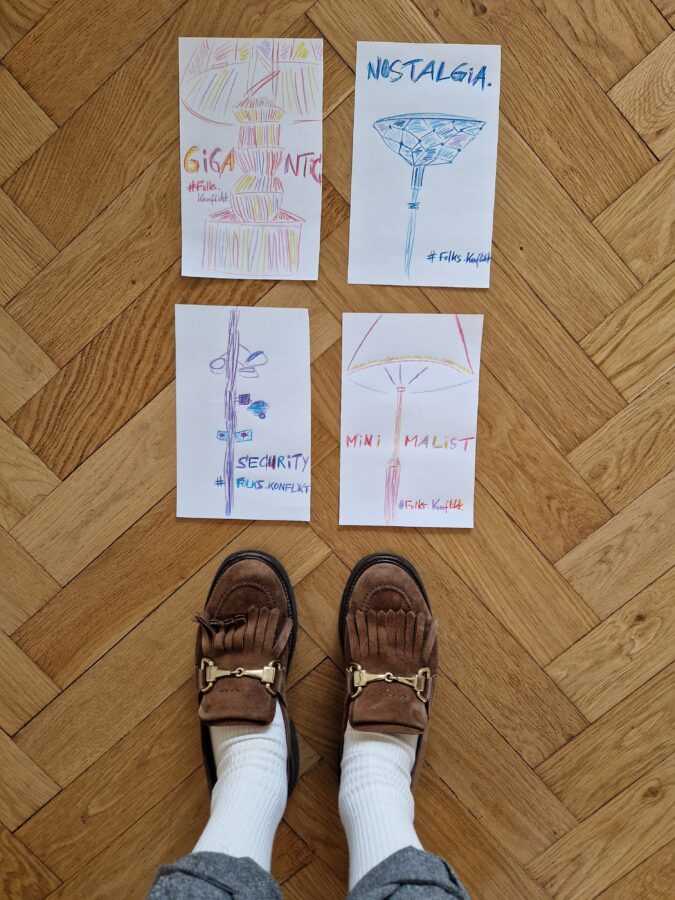
While these four types of lamps stand schematically for respective foci of governing light/ly, there are other lamps scattered throughout the park, which I subsume as siblings or cousins of the four discussed lamps. For example, there is one cluster of 12 art déco-style lamps hemming the main entrance gate with the water basin around the place called Vänskapstorget (Place of Friendship), which I subsume as a sibling to the nostalgic lamp. Now, let me first introduce each type of lamp, and then discuss their interrelations, or inter-illuminations. As in every typology, the four selected types illustrate archetypes of critical insight into function, aesthetics, design, purpose- and playfulness, but are certainly not conclusive to explain the political governance of light in Folkets Park.
The gigantic/ized lamp
This object got the critical urban researcher in me asking: Who would deliberately place such an object in public space, and whyyyy? Isn’t this easily read as a signifier for and of gentrification that aims to brighten up/lighten up/beautify the space for more affluent communities? Have scholars discussed the relation between socio-economic status and light in critical gentrification research? Put more simply, do the incoming yuppies always want/need more light, and does increased illumination always signify displacement? idkidkidk but I’d like to know.
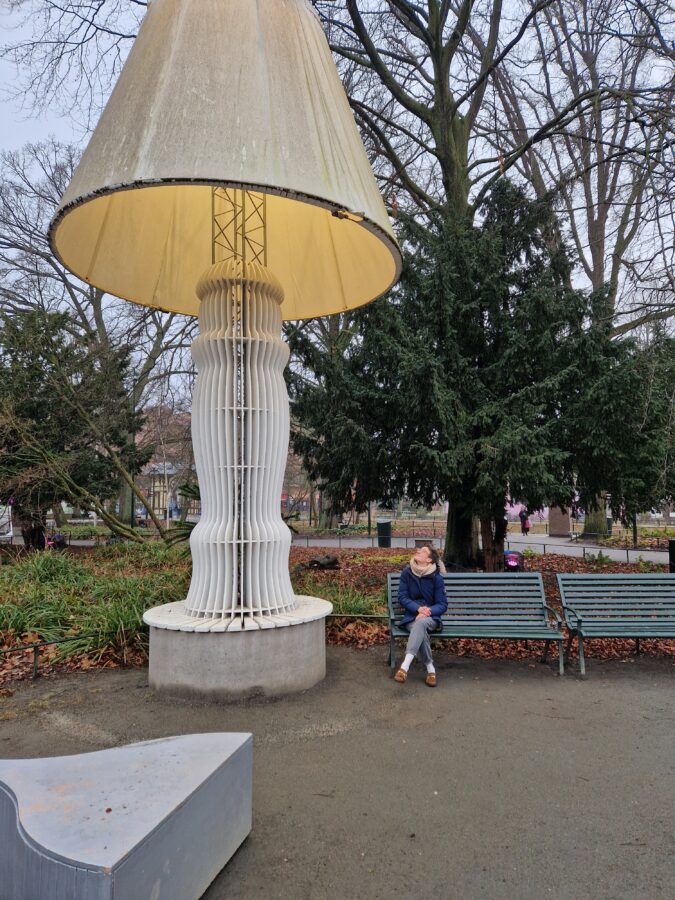
This lamp can be found twice within Folkets Park, and once just outside, at the corner of Friisgatan facing the Möllevångsskola school yard. Hence, it is the least numerically present lamp but it makes up for that in size. It evokes a living room lamp with its elaborate shade, usually set indoors. Thus, is the lamp displaced, unfit to survive in the public realm? However, if you do think of Folkets Park as a “public living room,” as a city employee suggests to me over coffee, the scale of this big lamp shrinks again? In such a vast urban living room, it might actually feel cozy or relatable in relation to the big space of the park, or the city altogether – or small, subdued, infantilized idkidkidk.
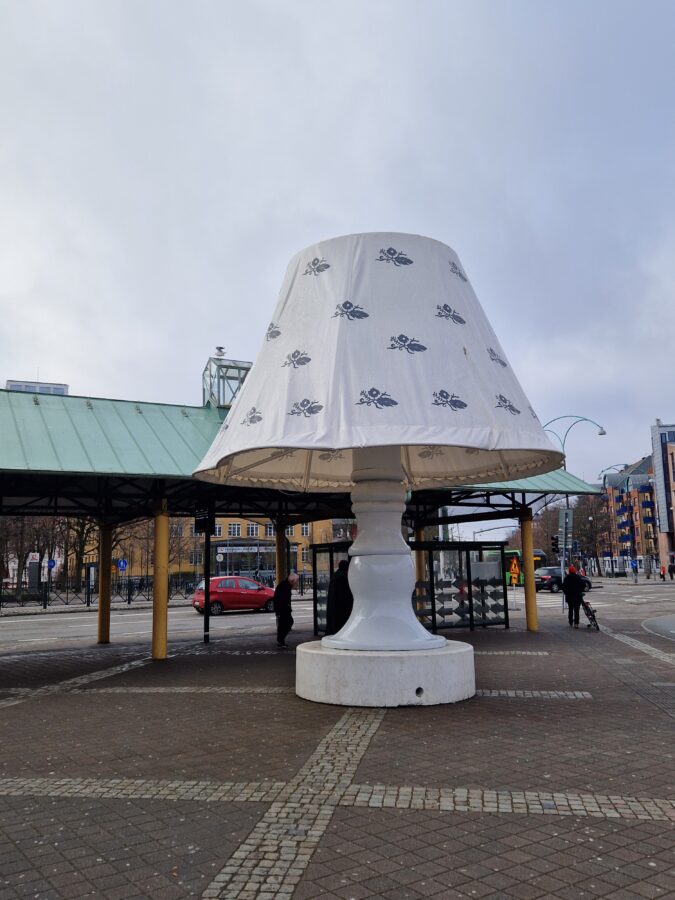
A researcher colleague with whom I discuss the lamps finds the look of one lamp to not only resemble an inside lamp. He offers the Swedish saying “Det går inte att ha dig i möblerade rum”, roughly translating to “We can’t have you in furnished rooms” or “You cannot be in furnished rooms” – which means that some people cannot behave “properly” indoors, yet I still wonder: Who can/should be in a furnished room anyways? These associations bring up questions and concerns about the oft-implicit or unclear distributions of public and private (space) in Folkets Park – some areas are rented out by the city to private businesses such as restaurants and kiosks; others are maintained and to be cared for directly by the city. Coming back to the questions of indoor and outdoor (dis)placements, I wonder: Is an interior design object placed outdoors supposed, and succeeding, to create a homey, hygge feeling of light/ness even when you are outside? Are we invited to feel hygge (can hygge be a verb)?
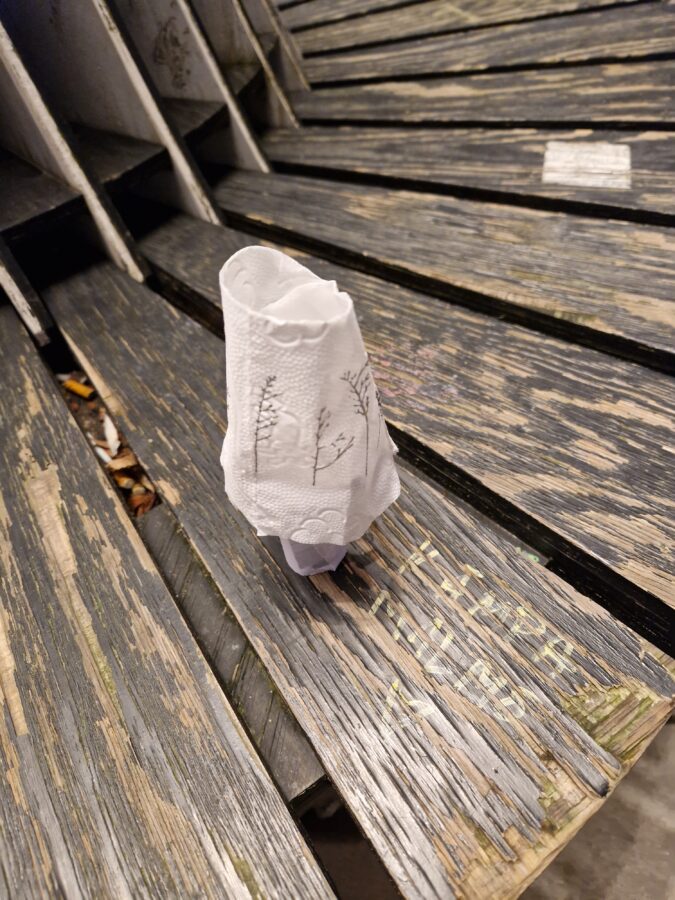
Looking at the material reality of placing an indoor lamp outside, the large white tissue lamp shades of these gigantic objects look quite weathered. The outdoor muck of rain residue, storm, and forms of pollution inhabit the shades. The plinth of this big source of light provides an opportunity to sit, directly under the light. In the Friisgatan location, I find cigarette butts, empty bottles, and a hand-written Kämpa Malmö (Fight Malmö) tag on the wooden pedestal. Is she an art object, is she street furniture, or is she a functional service to the neighborhood? Is she all or none of the above? Interestingly, this lamp type is also to be found in other neighborhoods of Malmö. In 2015, a similar lamp was placed in Lindängen to “shine a light” on this residential, less central neighborhood. When strolling Södervärn on a Sunday afternoon, I find another lamp cousin to the gigantic/ized lamp (Fig. 4). The trope of the living room seems scattered across the city.
Poem for the gigantic/ized lamp: Pastel patrolling
luxury of illumination
leftover luxury or legacy of an undelightful Enlightenment?
What does your enlightenment do for you at the end of the day?
When does the park go to sleep?
Who sleeps in it?
When do lamps go to sleep?
they keep standing there – against the odds
it’s raining lamps
lamp rain
light rain
light reign
who governs with light?
lit 24/7
light/ness
let’s afford light pollution
to alleviate the casual-causalconnections between safety and light
When do you have to count something to make it credible?
deterrrrrrrr
slurrsssss
how cheap is to claim investment à la safety follows light
light/ness isn’t always affordable
The minimal/ist lamp
I am probably not doing justice to this lamp. I am sorry, lamp, my pal, lampal. Can you befriend a lamp? Did I have a favorite lamp?
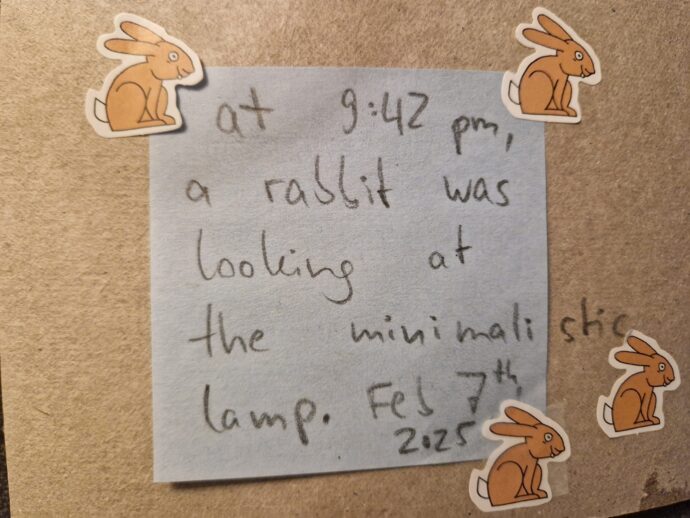
The minimal/ist lamp did not stand out to me on its own, but rather in relation to, or as derivative to, its aforementioned comrade, the gigantic/ized lamp. The minimal/ist lamp exudes mere simplicity: It is sleek, modest, straightforward, doing its job without frills – a bit boring? Function seems to outweigh aesthetics, function first, function forever. But there is no pure or innocent function(ality). Function is aesthetic, too, as fellow contributor to this special issue Nona Schulte-Römer argues. The minimal/ist lamp appears ageless; I assume its lighting sources are fairly sustainable and energy-efficient. Over coffee with a local lighting designer, I learn that the lighting in Folkets Park is regulated centrally via light-sensitive sensors programmed in relation to the ‘need’ for light. Yet, when I visit the park one evening in February, and I see a rabbit hanging around the lamp at night, I get a bit worried about this non-human park user (Fig. 6 and 7). How does the lit park feel to this little rabbit? Doesn’t s/he need a good night’s sleep in good old darkness?
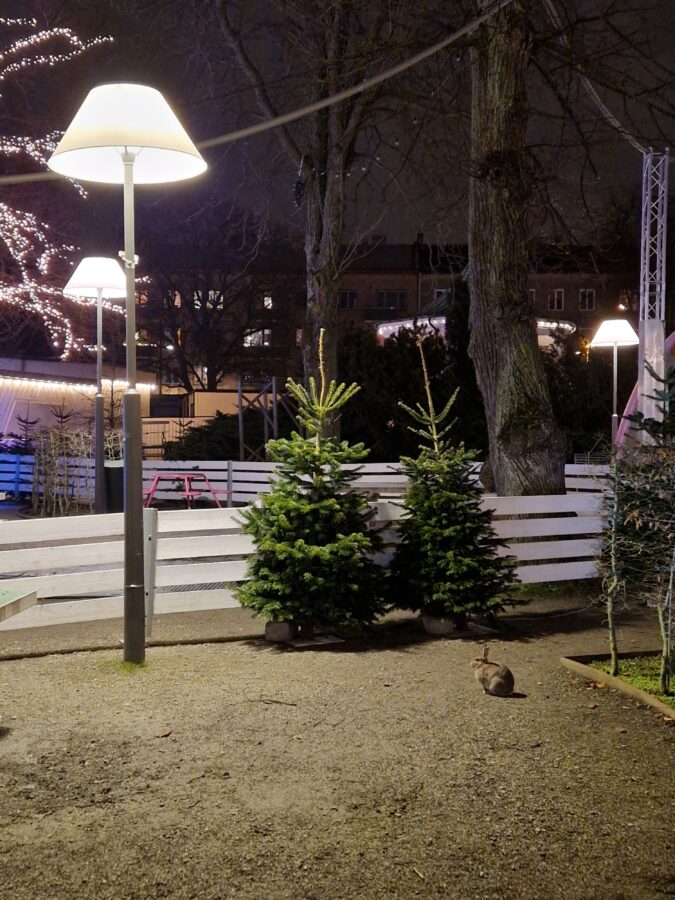
There are (at least) eleven minimalist/ic lamps, lumped together in two ‘hotspots’ with four and seven lamps in close proximity of each other, respectively – one at the northeast corner of the park at the intersection of Amiralsgatan and Falstergbogatan. It felt like a little lamp forest where the minimal/ist/ic lamp featured most prominently, peppered between ping pong tables and trees. Besides reflections on the implicit relations between functionality and design/aesthetics, the spatial concentration of the minimalist/ic lamp in two areas materializes different waves of park development and renovation, bringing forth a new lamp type as a new face of the remodeled, even more densely illuminated park for and of the people.
Poem for the minimalist/ic lamp: Who has ever hugged a lamp?
You’ve got nothing on me, baby
I’ve got nothing on you, baby
minimal love hurts so much
How many arguments and kisses did it witness?
How often has its bulb been replaced?
Does a lamp feel alone when most of the humans have left? Do the lamp and rabbit say good night when we have all gone home, do they ever cuddle?
light bulb
light pulp
bursting light
crushing skull
not its fault to burst in these times
the light bulb is the heart of a lamp
in heated times, bulbs burst
hazardous waste
day and night are not in our hands
better lit than sorry
capitalization of darkness
munchmunchmunchdisenchanted night
make it dark girl make it dark
nightlife
lifenight
daylight
daylife
lifenight
daydeath
deathnight
lifeday
How old is the night?
How does darkness age?
The nostalgic lamp
When Folkets Park was first opened in 1891 by the labor union movement, lamps in the park were lit by oil. In 1900, then run by the local municipality, electric lamps were installed, extending into the nearby neighborhood of Möllevången, and its famous square Möllevångstorget, which did not have municipal streetlamps at the time. Archival material praises the park as modern, providing unique services and amenities to the local population. An urban historian colleague I take a walk with draws a parallel between the park branding itself as an actor in the transition “from darkness to light,” which is a reference to The International. Initially, I thought that the nostalgic lamp might have been around for decades, and previously could have held a gas light instead of an electric light bulb, but (hu)man was I wrong.
Nostalgia might not have been the most adequate term for this lamp, but since I am a nostalgic bitch, I saw the presence of the past through this design. Naming this lamp nostalgic serves as a conceptual placeholder to acknowledge the park’s long past, and the design features invoking, maybe, a lingering sense of the past in the present. As Wen and Peng (2025, p. 3) point out, nostalgia is “not merely a personal, psychological state, but rather a product of the dynamic interplay between our sensory perceptions and the materiality of the surrounding environment.” In the multi-layered environment of Folkets Park, maybe the art déco-inspired design sparked nostalgia in me.
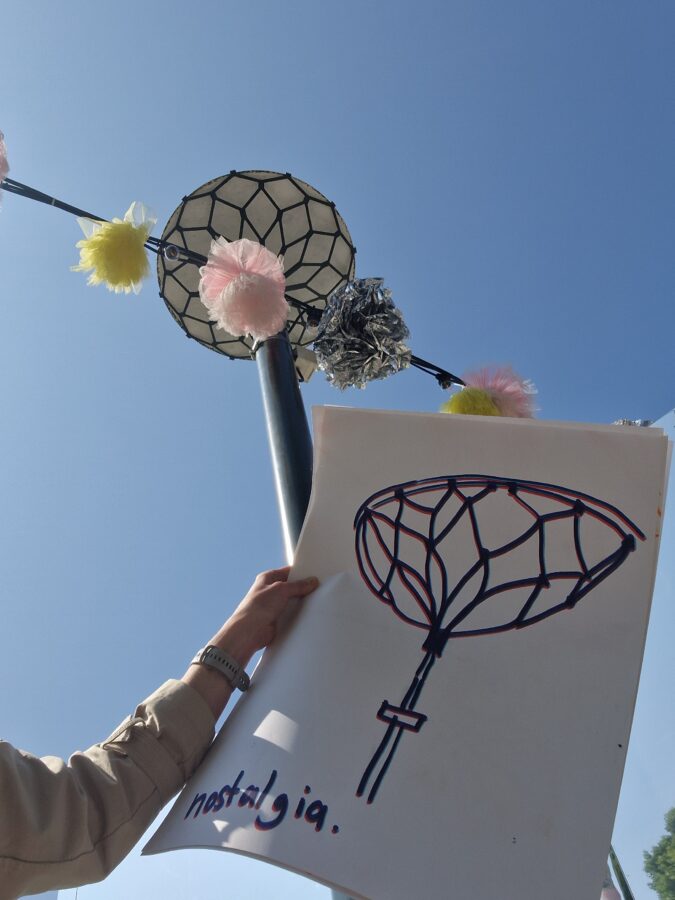
In an interview with a city employee of the urban planning department, I learn that, matter-of-factly, the nostalgic lamp has only been around since the 2010s. I would still love to know more about the first historical lamps in Folkets Park, but who archives the life cycle and decay of lamps? At the nearby City Archive, located just a stone’s throw away from Folkets Park, I do not have any luck with my keyword “lamp + Folkets Park” – this knowledge stays in the dark.The lamp is by far not unique to Folkets Park. Designed by the famous Danish lamp designer corporation Louis Poulsen, the model LP nest, colloquially referred to as “birds nest,” can be found in other outdoor settings around the world. Following the company website, you can see what I named the nostalgic lamp inside of airports, in front of skyscrapers, next to boats and bodies of water. Designer Erik Bystrup describes the model with the following words: “The lamp shade grows out of the cool steel trunk like a stylistic tree crown.” In Folkets Park, the nostalgic lamp is by far the most frequent, hemming most of the main walkways. The lamp posts that measure about 4 meters in height are often used to string together dangling fairy lights (often illuminated throughout the day) and, seasonally, colorful pompoms (Fig. 9). In sum, the nostalgic lamp offers a blend of functional and aesthetic value, spreading a sense of bright stability and reli(ght)ability in the park’s overall appearance.
Poem for the nostalgic lamp: How do you burn?
How long do you last when you burn? How long do you burn?
the bone marrow of nostalgia is the same everywhere
gelatinous nostalgia
Where has LED led us?
what aboutism is out of town
grandparentalism of light
I used to get lit by gas
now gas lighting has its own currency
The securitized lamp
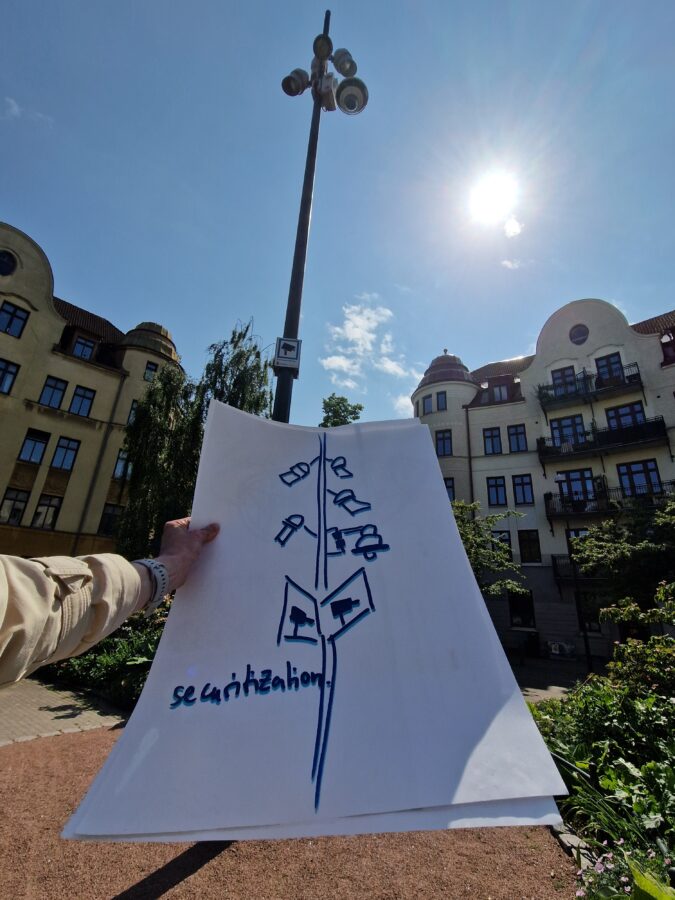
This lamp is possibly the most contentious lamp within the political typology of light, located in the middle of the roundabout between Kristianstadsgatan and Södra Parkgatan opposite a wall that was legalized for graffiti writing in 2009. Besides painting and spraying graffiti, the roundabout has been (in)famous for drug selling for over a decade, leaving residents and parents worried about the open sales and consumption of drugs. Drug Use Disorder (DUD) has been found to be persistently high in Malmö as Sweden’s third-largest city after Stockholm and Göteborg, with young males between 15 and 35 being the main user group.
At first glance, the securitized lamp fuses design and function, with a twist of surveillance exuding a shimmering promise of security. The bubbly-looking spotlights themselves, installed at about four meters height, are not very conspicuous. The erect stele is simple, similar to its minimal/ist/ic sibling (see above). What inflames this particular lamp in the political typology of light is that, besides the four literal spotlights, a static 360-degree-surveillance camera is installed. This non-light source gathers footage on people’s movements around the roundabout for the Malmö Police, and subtly but determinedly enforces a security state. At half-mast of the stele, a small plaque informs you that you are being filmed (no opt-out possible). Notably, the securitized lamp and security camera stele was only installed in 2017, responding to the peak of drug trafficking at Knarkrondellen in the 2010s. Ironically, there is a light sculpture called Inside out, installed in 2004 and consisting of steles with 20 light panels, hemming the roundabout, which technically is to be illuminated – even though I never saw the installation lit up. The attempt to regulate drug trafficking via arts-led urban planning, or ‘creative’ urban furniture like the light sculpture, embodies a shift towards focused public space design – via politically controlled exposure to light, literally imposed in a top-down manner, throwing light down onto the public ground.
Furthermore, the governance of light comes to the fore in the 24-page lighting strategy from the City of Malmö, published in 2008. The policy document outlines causal connections between safety (trygghet), (natural) light (ljus) and human-made lighting (belysning). “A lit space is a safe space” is a credo multiply repeated by policymakers and administrators while empirical evidence about the logic of more safety equaling more light remains contested, and highly dependent on context (see Tsiakiris, Litsmark, and Landau-Donnelly in this issue). “Increasing the feeling of security is worth every penny,” says an administrator from Malmö’s local Technical Committee. He might be right, but I am still wondering about how many pennies need to be spent to accomplish a changing sense of security – not sure money can buy feeling safe and secure.
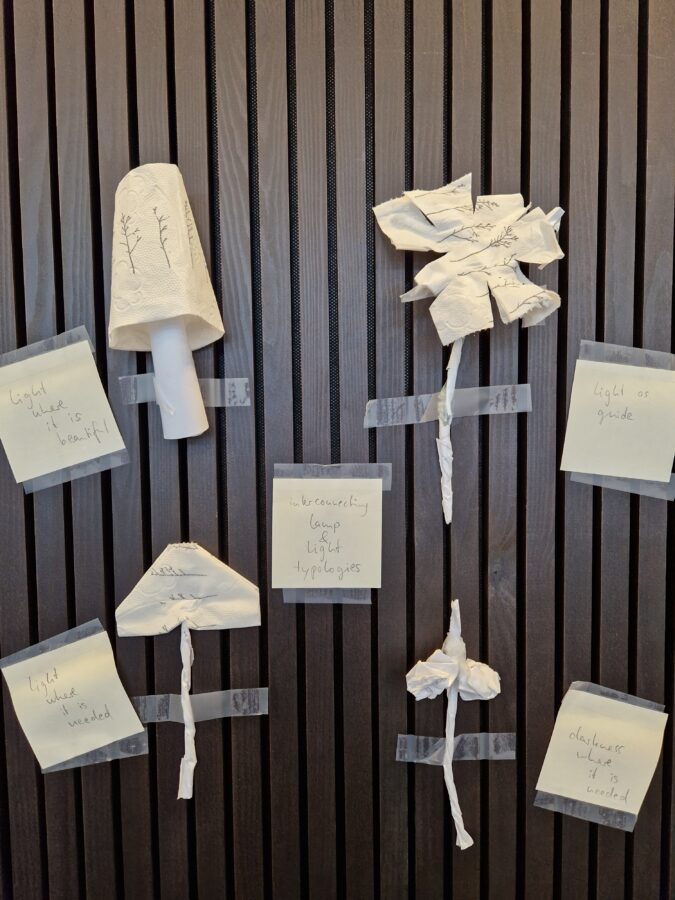
The City of Malmö’s highlights (pun intended) four goals for lighting in Malmö:
- (1) Light as a guide (Ljuset som vägvisare)
- (2) Light where it’s needed (Ljus där det behövs)
- (3) Light where it’s beautiful (Ljus där det är vackert)
- (4) Darkness where it’s needed (Mörker där det behövs)
Besides the highly normative framing of light as functionally (and aesthetically?) desirable and/or preferable over darkness, the lighting strategy offers insight into multiple technical aspects of illuminating Malmö. Put differently, light is used to occupy space of both need (i.e., function) and beauty (i.e., aesthetics). Despite the nod to the value of darkness in its own right, light appears as the hegemonic medium that can achieve public values such as safety, security. To govern public space is to govern through (human-made) light.
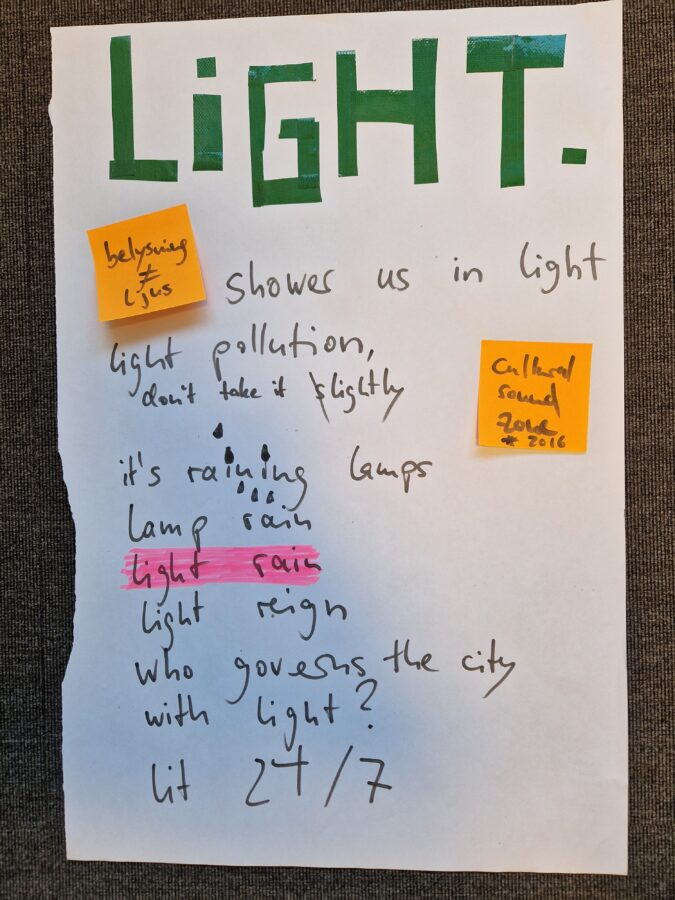
Poem for the securitized lamp: Lightweight Governance
Shower us in light
light pollutionlawlight and order
don’t take itslightly
it’s raining lamps
lamp rain
light rain
light reign
who governs the city with light?
who’s afraid again?
lit 24/7
burning light
light burn
heavy burn
lukewarm democracy
trygghet
o-trygghet
oh, trygghet
what a difference a letter makes
OooooOOooooOOOOOO
Lights out! A Synthesis of a Light Typology
From my messy mapping (Fig. 1), I found that the nostalgic lamp is the most frequent and far-spread in Folkets Park. In contrast, the minimalist/ic lamp humbly hovers in only two places; the gigantic/ized lamp is prominently placed in three locations across the park. The securitized lamp unrulily displays between two and ten light bulbs (and except for the one at the Rondellen, featuring no security camera!) all over the park. There is another static security camera within the park, just left of the entrance gate, however, not cushioned by sources of light.
After all, what do these numerical and spatial references tell us? Which currencies matter to understand the political underpinnings of light and darkness – is it the frequency of lamps, their density, height, price, lumen, monumentality? Do they complement each other or stand in rivalry?
In a speculative attempt to interconnect the city’s official lighting framework with my four-fold typology of light, I realized the multi-scalar glitch: the city’s lighting framework is situated on the meso level of the whole city, whilst my self-developed typology of light is situated on the micro level of Folkets Park and its immediate surroundings. The city’s lighting priorities are indicative of a needs-based approach; “need” (behövs) is used twice within the formulation of four policy goals. On the one hand, this signals that light (ljus) is needed to produce safe outdoor environments for (the humans of) Malmö; on the other hand, the strategy argues that darkness (mörker) is needed somewhere. The former might be easier to verify, the latter remains murkier – how does the city identify when and where darkness is needed by whom – needed to do what?
I think back to the rabbit that was staring at the bright minimalist/ic lamp at 10 pm in the park, and that the encompassing light strategy might not have had in view all actual users of the park – human, or more-than-that. Drawing this to a close, I remain somewhat in the dark about political rationales, and potential democratic deficits of lighting urban public spaces. In the case of Folkets Park, I can however safely say that it lit up my heart to be in this place – and experience both light and darkness.
References
“Instead of your typical reference list, in this unique space of a special issue that meanders between research output and creative project, I choose to offer references to external texts and documents via in-text links only. This is not merely an aesthetic choice but a (however subtle) critique of the standardized ways of academic writing and publishing. Does a (potentially intimidating) list of references serve every piece of writing? What if we opted out sometimes?”