A Street Otherwise- Migration and Contested Livelihoods in a Post-industrial City
If you take a cab in Malmö and you ask the driver to take you to Shari’e al-Jam’iyat (شارع الجمعيات: Street of Associations), they will drive you here. Some of us did not even know the official name of the street Norra Grängesbergsgatan because we never used it. The majority of the people working here are from the Middle East. I speak in Arabic almost all the time. Even if I don’t know the person I meet, I first start the conversation in Arabic. This street is fantastique and unique. Have you been to the areas where the Middle Easterners live in Stockholm? They don’t have anything like Norra Grängesbergsgatan. Also, the greatest thing about the street is respect of all religions: Atheist, Muslim, Buddha… We all respect each other’s beliefs. On the other hand, I am concerned about the future of the street. It is going to be beautiful, but people will not get jobs easily like today. I try to explain this upcoming gentrification to others, but they don’t listen to me. They don’t want to fight with the government because they have done it in their home countries. They are tired of conflicts, they want peace. I think one of the reasons the authorities are on top of the people working here is the officials’ claim that we do not pay taxes. Yeah! Maybe everyone doesn’t fully pay taxes. There are almost thirteen car services in Norra Grängesbergsgatan and minimum three to five people are working in each. This is the way that they can earn a livelihood and take bread to their children every day. The authorities need to have eyes on big and rich companies, not us!
Interview with Tareq, 2018
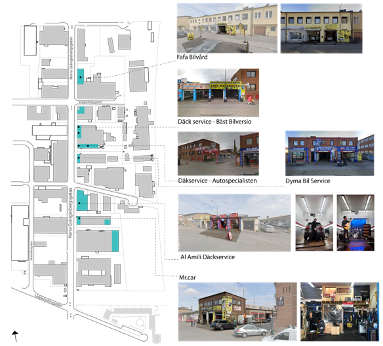
The street Tareq described above is the one-kilometre-long street Norra Grängesbergsgatan (or NGBG in local diction). It is located in the Sofielund area, in the eastern parts of Malmö (Figures 1&2). The area is categorised in public administrative and policing discourse as a “vulnerable area” (utsatt område) of Malmö and a “land of illegal clubs” since 1999 (Sydsvenskan, 2010-02-09). It consists of low-income residential neighbourhoods, as well as small to medium size industrial buildings and infrastructures. Geographically central yet peripheral due to its industrial background, the street has primarily functioned as a site of manufacturing. Excluded from the post-industrial urban development of Malmö for decades, Sofielund became a hub for immigrants’ self-established livelihoods in insecure urban labour markets. Today, NGBG is characterised by low density and poor maintenance after the de-industrialisation of the area in the 1980s.
This photo essay illustrates the transformation of NGBG in the nexus of de-industrialisation, migration, and urbanisation. In the pursuit of their livelihood practices, the revitalisation of this area was largely carried out through the unrecognised labour of displaced and precarious populations, remaking its spaces as part of a survival economy. Meanwhile, the area has been exceptionalised as a vulnerable target for disciplining, control and thus regeneration. Providing a closer look at the garage spaces, which are the most predominant features of the street, the essay displays the socio-material infrastructural support system that has been (re)produced by migrants at an informal level to ensure inhabitation on NGBG, traversing the official, institutional, or regular infrastructure systems.
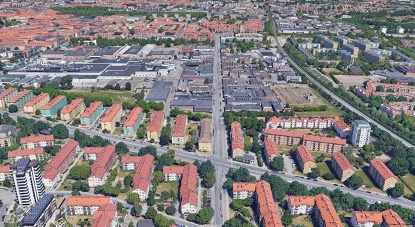
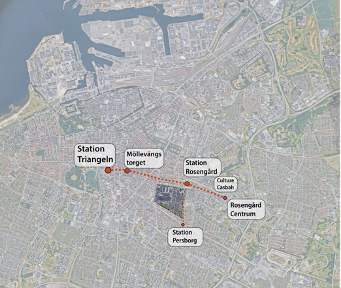
Figure 2. The location of Sofielund industrial area and NGBG in Malmö. NGBG was built in 1932 on the farmland named Annelundsgården, creating a significant connection in the working-class neighbourhood of Sofielund. Illustrated by Parto Jahangiri.
The emergent post-industrial labour market has been characterised by high competence and skill thresholds in which Malmö was re-imagined as a “knowledge city”, which boosted service and tourist economies. Abandoning large scale industries, Malmö was shifting from an industrial to a post-industrial city (Holgersen, 2014; Mukhtar-Landgren, 2009, 2012) in the pursuit of economic recovery from the 1990’s crises, hence devaluing the industrial workforce (Holgersen, 2015, p. 13). Accordingly, NGBG has become one of the most important streets for hosting working class migrants in Malmö, whose aspiration to enter the job market and earn a livelihood in Sweden has resulted in the production of new modes of socio-material and spatial (re)production. The displaced population that settled in Sweden faced particular difficulties in entering the labour market. Many of them needed to adjust to the service-oriented economy, usually with lower wages, or self-employment, driving processes of exclusion and socio-economic othering. The garages represented the first step in a complete make-over of the street over the last two decades. From the 1990s, the low land value and partly industrial character of Sofielund stimulated the establishment of migrant-run businesses, car repair and wash shops, cultural-religious associations, mosques, as well as art studios used by artists and freelancers.
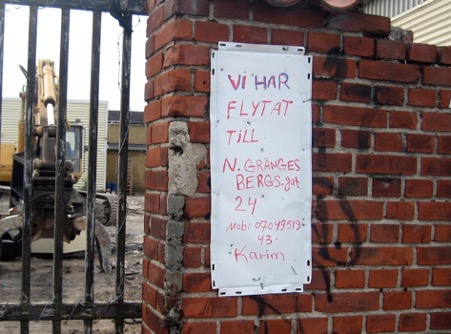
In 2004, the Kvarnby scrapyards of Husie, east-side Malmö, received an evacuation notice. Known colloquially as ‘Gaza Strip’ (Gazaremsan), local media had described the scrapyards as sites of clutter and chaos associated with questionable migrant enterprises and were finally shut down by the authorities. In addition, several car repair garages from Sorgenfri also had been forced to leave due to the new developments (Figure 3). Several displaced scrappers and mechanics thus relocated to NGBG. Its spacious, affordable, and defunct industrial buildings provided a place of refuge – and functional physical infrastructure – for the banished workers. In the process, the garages modified the architecture of the defunct buildings remarkably, and thus the street itself (Figures 4, 5, 6 & 7).
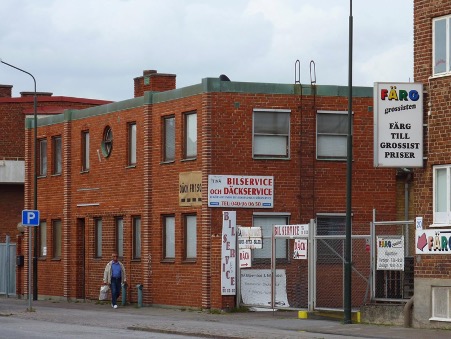
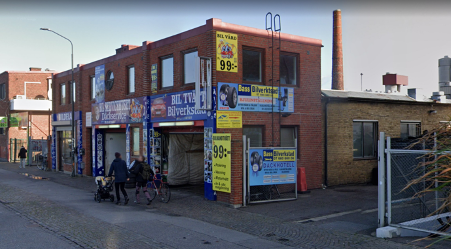
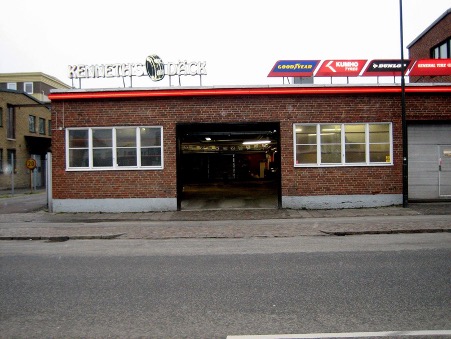
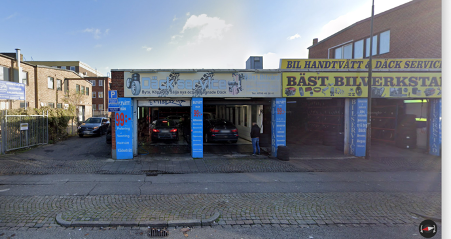
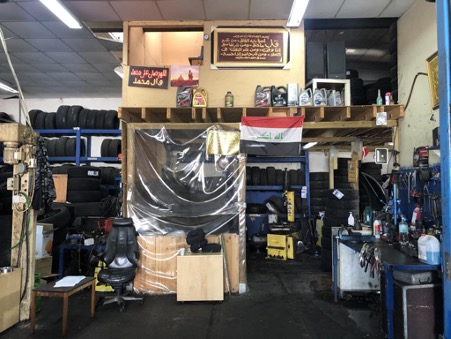
This is illustrated in the photo at the outset of this essay. Spare tires are placed carefully on the shelves around the garage space. Orderly rows of tools cover the working surfaces and walls. The small corner office is constructed with unassuming materials, furnished with a table, a few chairs, and a plastic curtain separating the office from the garage space. Quran-quotations, images of religious sites, and an Iraqi flag adorns the corner office. Splashing water resounds from the next-door carwash throughout the day. This is the interior arrangement of one of the many garages along NGBG, well-known for its modest pricing. Despite their unassuming character, garages are among the most predominant features of the street, shaping its visual profile and soundscape. The re-configuration of garages represents the current global-spatial restructuring of hegemonic modes of production, and disadvantaged people’s struggle in building lives at the margins. They show how the street has been repaired and remade through migrants’ labour and skills, becoming a hub for everyday provisioning of livelihood, care, and networking. It provides an example of a (re)production of spatial infrastructures, through modification, repair, and maintenance of the existing and broken industrial infrastructure, converting the defunct industrial architecture into a site of livelihoods (and support networks) otherwise.
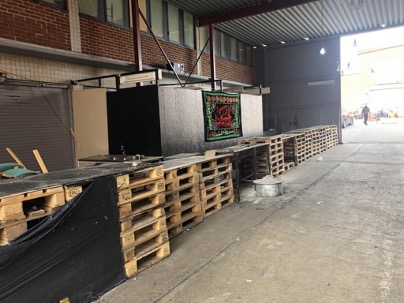
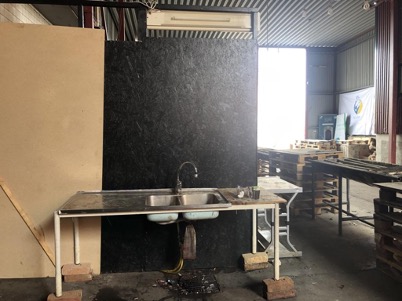
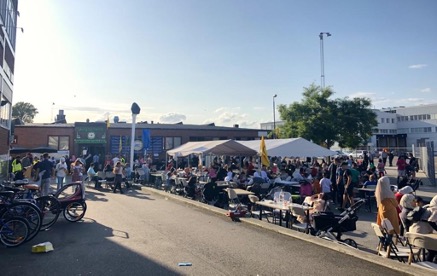
With their spacious and furnished places, the car service premises occasionally turn into an infrastructure providing for community needs, and the function of the garages extends beyond a mere place of livelihood. Here, the NGBG garages play an important role in creating a space of belonging and care for the community. Every year during the annual Shi’a-Islamic rituals of Muharram, some of the garages turn into a scene for votive food preparation for anyone attending the ceremonies in the vicinity. Equipped with water pipes, electricity, and on account of the spatial flexibility, they provide a base for activities beyond bread earning. During this ritual fixture, NGBG converts transforms for a solemn, sonic, performative, and visually colourful public commemoration, for which several garages are converted into temporary kitchens for the preparation of votive food.
The production of such ritual infrastructure is not limited to the garages only. As NGBG used to be a core space accommodating various socio-cultural associations (kulturföreningar), several community places including religious associations and mosques still remain in the vicinity. With their inward spatiality and usual absence of guiding signage from the street, these places provide a support infrastructure for the rituals (Figures 9, 10 & 11). One of my interlocutors, Saeed, working in a toy store and a volunteer in the musalla Imam Hussein (prayer hall), describes the chores of collective labour of decorating the mosque, shopping for the necessary ingredients, and cooking the votive food, in both challenging and rewarding terms in the service of God:
We can never predict how many guests we might have when we are planning, no one knows! People come from other places and even other cities to our musalla, so we should always be prepared for receiving many guests but also for unpredictable things which might happen. We are preoccupied with the Muharram rituals for about two months, from the planning days until the 40 days after Ashura, which is called Arbaʽeen.
Interview with Saeed, 2020
Life in NGBG has thus relied on a system of support that can negotiate the multidimensional precarity of such a marginal space, excluded from the development efforts of the city. Being classified as ‘industrial’ in planning documents, however, means most of the retail amenities in NGBG lack building permits and are thus hampered by limitations to otherwise transforming the industrial buildings. To stabilise and extend the life of inherently temporary socio-spatial practices in the street, the retail owners thus applied various tactics of permanence, despite the existing uncertainties about the future of NGBG (Foroughanfar, 2022). Such tactics comprised:
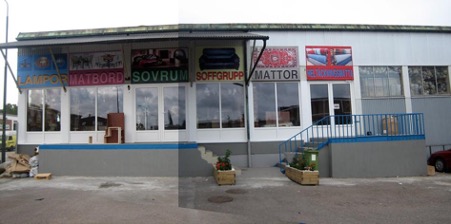
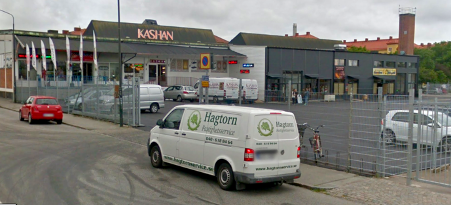
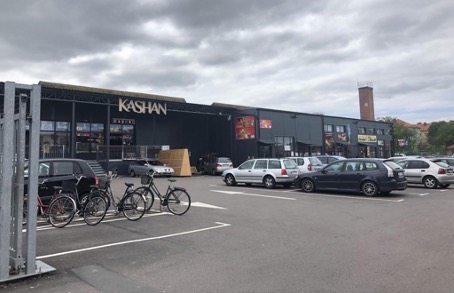
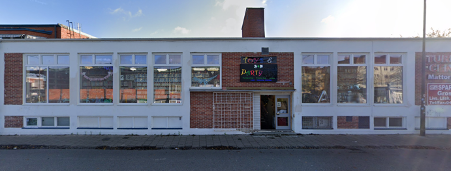
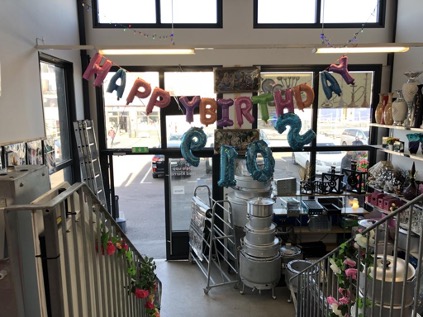
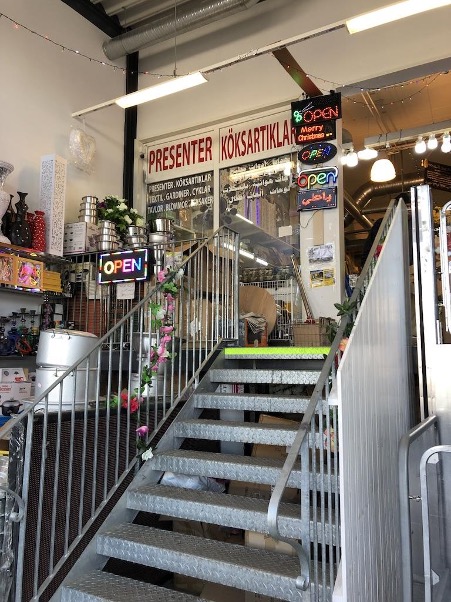
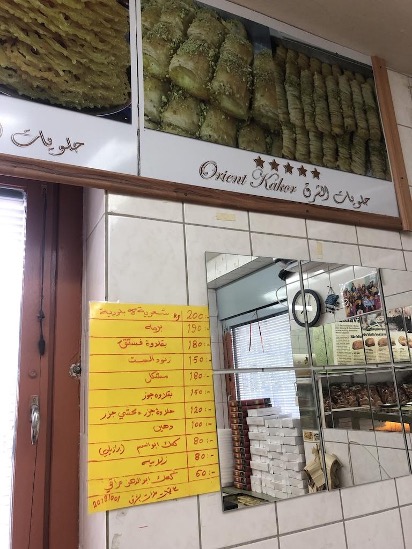
- A transformation from wholesalefication to boutiquefication. The former was applied by changing the signage of the shops to denote wholesale, which could be considered ‘light industry’ by the authorities (Sydsvenskan, 2010-02-09). This has taken place since 2010, following the reduction of the industries’ risk zone which thus relaxed the building regulations for retail units considered ‘light industry’. This implied a shift in the retail landscape of the street, towards what I call a boutiquefication of the retail architecture from below, transgressing the ambiguous planning regulations (Figures 12, 13 & 14).
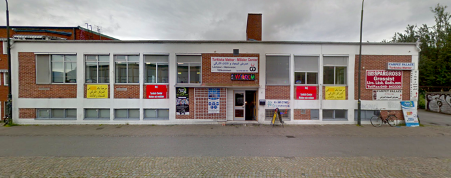
- A dynamic of invisibility within visibility, that is to render invisible activities and transactions not considered as ‘serious’, ‘appropriate’, or ‘sound’ by authorities. The defunct industrial buildings with brick walls and small openings afford such constant tactical (in)visiblisations. This tactic counteracts the growing monitoring and policing in the street. With the growing interest among the property owners and authorities in transparency and commercialisation of the stores, the enlargement of the facade windows was part of the renovation requirements (Figures 15 & 16).
- Kinship networks and translocal social support, built on communal-symbolic values, which provide means, tools, and resources to facilitate socio-economic transactions. Reciprocity, kinship, or friendship, as well as sharing a common language or nationality are all involved in the activation of such an ecology among the merchants, workers, and retailers of the street, binding them together and interconnecting NBGB with other geographies and temporalities.
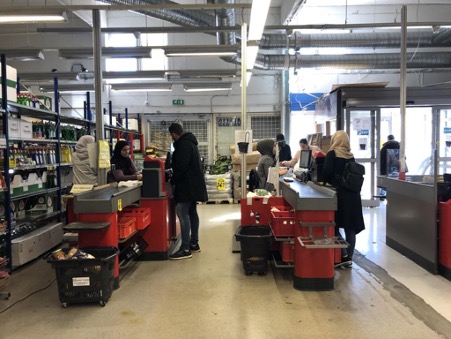
- A negotiation of multi-scalar borders and boundaries, in relation to more profound surveillance, enforcing broader mechanisms of differentiation and estrangement through everydayness of border regimes. Facing extra regulations and procedures for importing merchandise from outside EU borders, long waiting periods in receiving approvals, as well as constant monitoring by authorities on a daily basis, have been among the experiences of the retailers of NGBG. These tactics are among the main efforts of coping with the unstable condition of absent building permits in the industrial zone, which has kept retailers in a permanent condition of temporariness for decades (Figures 17&18).
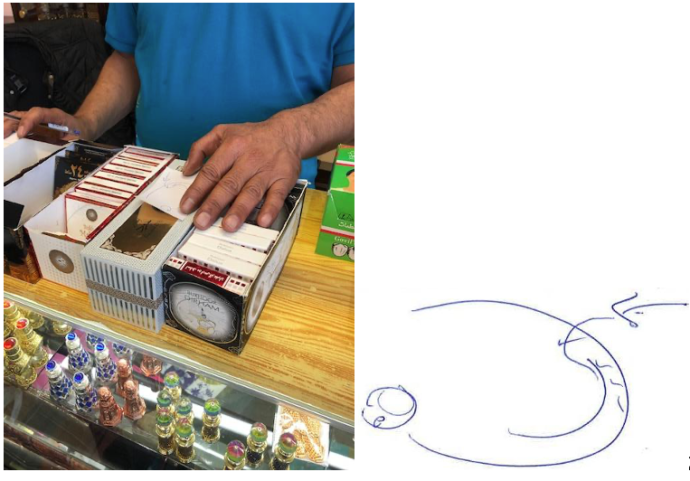
Figure 18 (Right). Ahmad’s drawing, 2020. Photograph by the author.
Through architectural, economic, and social alteration and care, the migrant entrepreneurs that inhabit NGBG have reinvigorated the area gradually to sustain their livelihoods at the city’ margins. The socio-material infrastructural system provides durability and possibility for such precarious practices and holding bodies together, what AbdulMaliq Simone (2004) refers to as ‘people as infrastructure’. As Simone defines, it constitutes “complex combinations of objects, spaces, persons, and practices… a platform providing for a (re)producing life in the city” (Simone, 2004, p. 408). Such assemblages of things are relational, entangled, and interwoven, affecting one another, yet vulnerable and still to be completed. It traverses the official, institutional, or regular infrastructure systems. It also rests on people’s agency, knowledge, skills, trajectories, and imaginaries, through which they can navigate and negotiate their means of survival. In doing so, they have been a significant part of the revitalisation process of the area for decades, providing a bridge between industrial past and post-industrial regeneration, locally and translocally, within and across national borders.
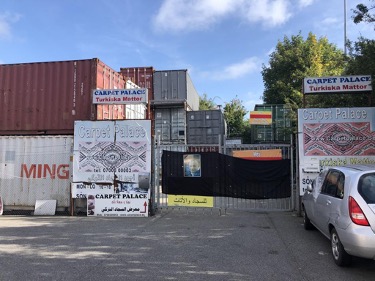
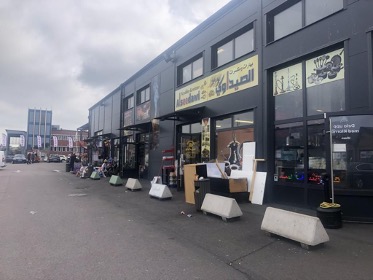
The radical changes have generated an ambiguous revalorisation of the street. It has spurred public as well as commercial-oriented urban development schemes. In 2014, a Business Improvement District (BID) model was established in the area. It had the aim of ‘uplifting the distressed neighbourhood of Sofielund’ and restructuring the so-called ‘vulnerable area’, by monitoring and restricting the ‘unserious’ and ‘unsound’ business activities. One such endeavour is the annual NGBG street festival, launched in 2016 by a local non-profit association in collaboration with several public-private actors (Figures 25, 26, 27 & 28). While conceived of and publicised as a ‘dialogue-based’, inclusive event, and hugely popular among visitors, there is little participation of the (migrant) working-class population of the street. While the street is facing spatial stigma enacted through devaluation of the place (and thus its people), such measures were geared at revalorising the area through a cultural and economic upgrading. As Paton, McCall and Mooney (2017) noted, spatial or territorial stigma are forms of symbolic violence which can be internalised by residents. This can justify keeping an area deprived and disinvested, and it pathologises the problems as related to particular places and people (Paton, McCall and Mooney, 2017, p. 584). Consequently, NGBG has increasingly become the target of the development of recreational activities, readying it for the future investment of capital.
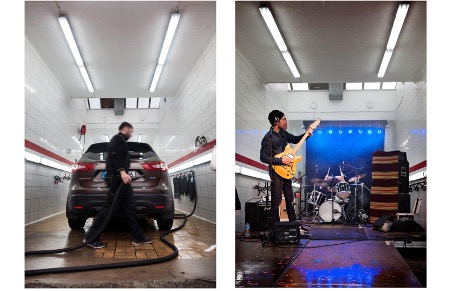
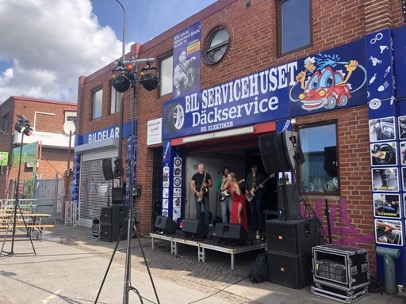
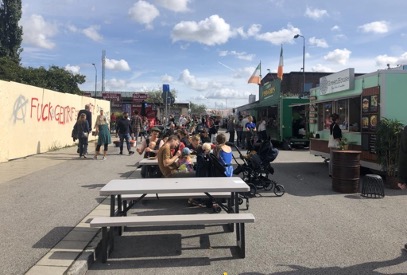
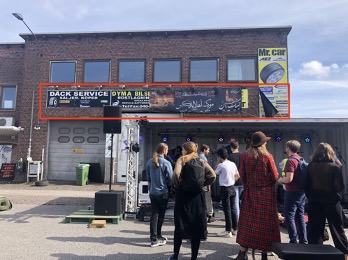
Malmö municipality has even taken the unprecedented step of establishing a “cultural sound zone” (kulturljudzon) based on visions produced by the public-private actors, circumscribing existing sound-level regulations for inner city areas. In the proposed cultural sound zone, activities are allowed sound levels up to 85 DBA, which will assist and accelerate the transformation of the area from a deprived and stigmatised de-industrial street into a hub for celebrating cultural events and leisure activities (Figure 29). As an effect of the altered sound regulations in the new programme, one of the former illegal clubs, Plan B, received permanent building permits and an instrument for avoiding complaints from residents. Since receiving a licence to serve alcohol in 2018 and moving into the new and larger premises – where they could creatively expand their activities – Plan B has turned into an important formalised player in the process of street’s transformation. Despite being marginal at the beginning, Plan B today finds itself at the centre, symbolically, materially, as well as socially, as the venture now fulfils the criteria as a player in the imagined future of the street. Thus, in complying with dominant values, Plan B is being “pushed into the centre” (Hall, 2021, p. 119), while several other cultural religious associations fear displacement (Figures 30 & 31).
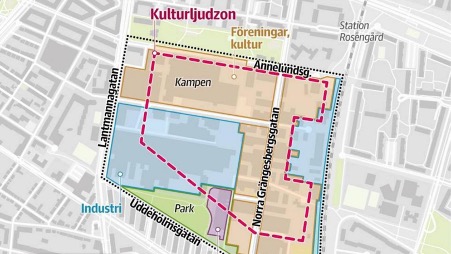
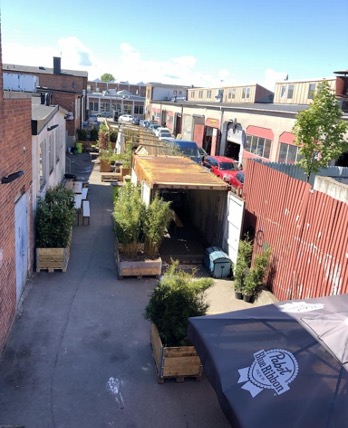
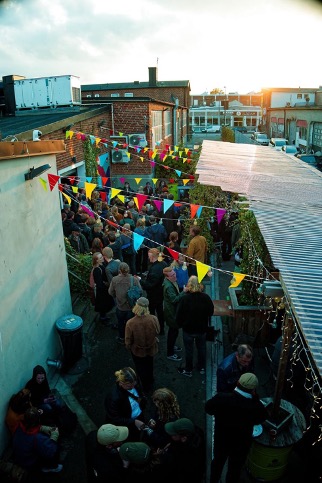
Figure 31. Plan B hosting an event, 2022. Source: Plan B Facebook page
As concluded in my previous study (Foroughanfar, 2022), there is (as of yet) no clear evidence of gentrification and displacement of the working-class from the area, and central actors have spoken out against potential gentrification, aiming to preserve the area’s “diversity”. Yet the steady upgrading and upscaling of local stores and services are indicative of ongoing retail gentrification, conditioning the prospective users and workers in the area’s retail-scapes. In other words, while the ‘exotic atmosphere’ of NGBG is currently embraced by planners and developers in terms of its market value, it remains unclear to what extent the working-class migrants, whose labour has created its distinct character, have any future in the street, or what kind of adjustment they are required to undergo in order to stay.
Conclusions
The images in this photo-essay illustrate how material and symbolic value have been produced by working-class migrants, and the paradoxical mechanisms of downgrading and upgrading; of stigmatisation and recognition; of socio-cultural centrality and marginality; of devaluation and revalorisation. NGBG provides vital resources and (trans)local assets through which working-class migrants have been able to navigate opportunities and resist everyday conditions of economic, social, racial/religious discrimination and injustice. The essay also illustrates that despite being considered a defunct, disorderly, oily and polluted space defined by ‘illegal’ activities, NGBG is no less a place of livelihood, community, and refuge, a part of the everyday life of its traders as well as their customers. It is also a place of central symbolic and ritual practice, if concealed and invisible. Nonetheless – or precisely as an effect of the resettlement of the certain bodies (at the intersection of race and class) – until recently NGBG has been a place ‘off the map’, beyond the gaze and involvement of planning discourse and practice.
Even though the future of the street remains uncertain at this point, the existing tendencies in urban renewal and revitalisation are signalling commodification and profit extraction, while local attachments to the place are devalued and stigmatised. The value(s) produced by the migrant working-class population and their socio-material infrastructures remains unrecognised. The street hence continues to harbour conflicts of visions, entitlement, and class struggle. The value NGBG represents and produces for migrants’ livelihoods does not sit well with the vision for the street formulated from above: a future hub for cultural life and prosperous (‘sound’) business, as imagined by public-private developers. Amenities created and run by migrants, and the dwellings otherwise they represent, tend to be considered as ‘uncivilised’ and not-modern-enough, in contrast with the rationalistic and regulated Swedish ways of dwelling. This becomes even more accentuated in relation to the current racialisation of Muslim populations and their social and ritual spaces in the increasingly xenophobic and Islamophobic political realities of Sweden. As a sum effect, the extension of ‘white space’ has become a (perhaps unintended) core mechanism of such speculative visions, predicated on an aestheticised valorisation of street life. In the efforts of reconstituting and disciplining the street as proper, aestheticised, and sellable, a process of gradual displacement and banishment appears as the likely future scenario for NGBG.
References
Foroughanfar, L. (2022) The Street of Associations: Migration and the Infrastructural (Re)Production of Norra Grängesbergsgatan, Malmö. Department of Architecture and Built Environment, Faculty of Engineering (LTH) Lund University. Available at: https://search.ebscohost.com/login.aspx direct=true&AuthType=ip,uid&db=cat07147a&AN=lub.7180723&site=eds-live&scope=site (Accessed: 27 March 2023).
Hall, S. (2021) The migrant’s paradox. Street livelihoods and marginal citizenship in Britain. University of Minnesota Press (Globalization and community: volume 31).
Holgersen, S. (2014) The rise (and fall?) of post-industrial Malmö: investigations of city-crisis dialectics. Department of Human Geography, Lund University.
Holgersen, S. (2015) ‘Crisis and the post-industrial city. Or: Is Malmö building yesterday’s city tomorrow, again?’, Tijdschrift Voor Economische en Sociale Geografie, 106(3), pp. 231–245. doi:10.1111/tesg.12115.
Mukhtar-Landgren, D. (2009) The City (as) Exhibition, Urban Regeneration and City Marketing in Malmö During two Fin de Siecles. In I. Elander, & F. Eckardt (Eds.) Urban Governance in Europe – Future Urban Research I Europe 2 (pp. 249–272). Berlin: Berliner Wissenschaftsverlag BWV.
Mukhtar-Landgren, D. (2012) Planering för framsteg och gemenskap: om den kommunala utvecklingsplaneringens idémässiga förutsättningar. Statsvetenskapliga institutionen, Lunds universitet (Lund political studies: 167). Available at: https://search-ebscohost-com.ludwig.lub.lu.se/login.aspx?direct=true&AuthType=ip,uid&db=cat07147a&AN=lub.2228059&site=eds-live&scope=site (Accessed: 27 March 2023).
Paton, K.( 1 ), McCall, V.( 2 ) and Mooney, G.( 3 ) (2017) ‘Place revisited: Class, stigma and urban restructuring in the case of Glasgow’s commonwealth games’, Sociological Review, 65(4), pp. 578-594–594. doi:10.1111/1467-954X.12423.
Simone, A. (2004) ‘People as infrastructure: Intersecting fragments in Johannesburg’, PUBLIC CULTURE, 16(3), pp. 407–429. Available at: https://search-ebscohost-com.ludwig.lub.lu.se/login.aspx?direct=true&AuthType=ip,uid&db=edswss&AN=000224442500004&site=eds-live&scope=site (Accessed: 27 March 2023).
Sydsvenskan (2010-02-09). Kreativiteten gror i gamla industrikvarter. https://www.sydsvenskan.se/2010-02-09/kreativiteten-gror-i-gamlaindustrikvarter [last accessed: 2022-05-10].