The Clash of the Ephemeral: Collective Action in Disputed Spaces During Lima’s 2020 Social Uprising
This article situates its attention on the November 2020 protests in Peru, with particular emphasis on the events in Lima, following the controversial appointment of congressman Manuel Merino as interim president. Merino’s ascension to power was widely perceived as a parliamentary coup and triggered widespread civil unrest, which was marked by brutal crackdowns by state security forces, highlighting deep tensions between the government and the people.
In this context, I will shed light on the tensions that emerged from the spontaneous actions of civilians as they sought to make their concerns visible, transforming public space into a contested arena for dissent and resistance. By occupying and reshaping these public spaces, protesters not only expressed their discontent but also redefined the symbolic meaning of these spaces amidst the political turmoil.
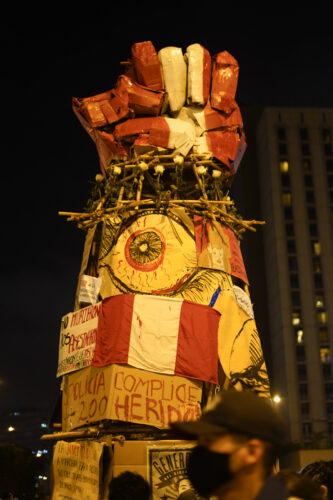
Specifically, this article explores the role of El Puño Vigilante (The Vigilant Fist), an ephemeral monument constructed by a group of artists during the protests with active contributions from the public. The monument represented a symbol of collective resistance and a shared sense of purpose during the civil unrest. As a temporary structure, El Puño Vigilante offered a counter-narrative to the dominant state-sponsored narratives represented by more permanent monuments, which often serve to reinforce an artificial collective memory designed to sustain official notions of national identity.
Despite its brief existence, El Puño Vigilante became a focal point for the protest movement and embodied the voice of dissent. Its eventual destruction by far-right sympathizers highlights the ongoing struggle over public space and memory, as well as the clash between competing historical narratives and visions of national identity.
This analysis operates within the broader context of public spaces, especially in moments of political crisis, as mediums for generating collective memory through innovative social practices. Drawing on the case of El Puño Vigilante, I will demonstrate how ephemeral monuments reflect grassroots resistance to state-imposed historical narratives. Through this lens, I will explore how contested spaces became platforms for resistance in the 2020 protests in Lima and discuss the critical role that temporary acts of collective memory played in shaping these social uprisings.
Building on monuments
The tradition of placing monuments saw a significant increase in the 19th century and was closely linked to the reconceptualization of urbanism and the consolidation of nation-states (Vargas, 2021). Monuments, deeply rooted in modern thought emphasizing evolutionary progress, were designed to focus on key historical milestones with the intent of enduring through time and presenting a unilinear version of history (Riegl, 2019 [1903]). Citizens were expected to remember these monumental narratives, which served to reinforce a national identity.
In the aftermath of World War II, global policies emerged that were aimed at preserving monuments and elevating them to symbols of heritage and patrimony. Monuments began to be classified according to their historical relevance, with preservation efforts focusing on safeguarding both their physical integrity and the collective memory they represent (Niel, 2015). However, over time, the role of monuments in society has evolved.
In contemporary contexts, monuments no longer evoke the same collective enthusiasm or reverence as they once did, or at least not in their originally intended manner. Critics of monument preservation argue that their value is often reduced to their aesthetic representation of the past, rather than their ability to engage with contemporary citizens or reflect the complexities of modern societal issues.
This growing disregard, whether due to public indifference or to evolving interpretations, has placed monuments in a state of vulnerability (Echevarria, 2020, p. 97). Hence, the resurgence of iconoclasm in various countries. Monuments, particularly those linked to colonialism and oppression in the Global South, have become focal points. Their capacity to monopolize collective narratives has turned them into symbols of contested histories.
While this shift might initially seem detrimental, it opens new avenues for examining the impact of monuments on citizens’ lived experiences and historicity of citizens (Bevan, 2023). Thus, the debate surrounding monuments today reflects a broader struggle over whose history is being preserved, how it is remembered, and who gets to shape collective memory in the space of a citizen’s transit.
These tensions surrounding monuments are closely mirrored in the contested use of public spaces. The state’s excessive use of force in response to the civilian-led reassessment of monuments exposes the limitations of those in power. This heavy-handed approach, rooted in over-regulation and strict control over the use of the space, underscores the disconnect between the government’s policies and citizens’ rights to reinterpret and engage with shared public spaces.
Public spaces
Just as monuments can be sites of renegotiation over historical narratives, public spaces themselves become arenas where social, economic, and political inequalities are exposed (Borja, 2003), reflecting the broader dynamics of power and identity. Due to their openness, visibility, and multifunctionality (Diaz-Albertini 2016, p. 38), these spaces hold the potential to challenge imposed boundaries and to foster new forms of social interaction, identity formation, and cultural expression, even in the face of systemic restrictions (Delgado, 2010), providing opportunities for resistance and collective expression.
According to Capron and Monnet (2003, p. 105) the systemic restriction contentions in Latin American cities are fed by the burden of the colonial urban model, which imposed a spatial dualism that segregated Creole and Indigenous populations. This dichotomy manifested in a sharp division between centralized zones of power, embodied by monumental architecture and monuments, and the peripheral areas where power is merely exercised. The city centre thus emerges as a symbolic site in which monuments play a crucial role in shaping national identity.
In that sense, the establishment reinforces the idea of public spaces as being places where only a “benevolent” togetherness happens, diminishing the actions that aim to transgress this order.
In Lima, key public spaces like plazas[1] have historically served as central sites for protests and civil gatherings, often featuring monuments that symbolize ideals of free speech and revolution, which aligns with the collective demands of civil society. These monuments, as cultural touchstones, play a significant role in shaping collective memory by reviving and sustaining shared narratives (Jelin, 2001). However, despite their symbolic importance, such spaces are frequently subjected to heavy police surveillance aimed at controlling demonstrators, which raises critical questions about the state’s selective endorsement of symbols of freedom. If access to these monuments is restricted by the same power structures they supposedly challenge, what does this reveal about the authenticity of civil liberty in public spaces?
Collective memory
Collective memory is a continuously evolving process and is shaped by the interactions between individuals, societies, and their spaces. National traditions, as Schwarzstein (2002, p. 480) suggests, leave uneven imprints on this collective memory, influencing how societies view and interpret the past. Symbols and monuments play a central role in reinforcing these narratives (Auge, 1996; Banchs, 2000). However, this dynamic process is constrained when access to symbolic spaces is restricted or controlled. Consequently, civil society must explore alternative forms of expression to challenge state authority and reconfigure public memory, especially within spaces intended to reinforce dominant narratives.
The following case study exemplifies how societies repurpose existing spaces to reflect contemporary needs and experiences. These transformations, though often gradual, reshape spatial meanings, as Lefebvre (2013) suggests. In some cases, drastic shifts occur when traumatic events radically alter both the physical space and the collective memory associated with it. This process reflects the concept of the “anthropological place,” where identity, relationships, and history are embedded within the spatial landscape (Auge, 1996, p. 98).
Related to that, shared memories are fundamental to group recognition, in what Jelin (2001, p. 88) calls “foundational myths.” These myths provide temporal continuity and stabilize collective identity, essential for civil society initiatives. When groups organize themselves around these shared narratives, they can legitimize their objectives and make their purpose visible. However, these collective identities are also shaped by individual memory, resulting in constant revisions and redefinitions. This fluidity of memory mirrors the adaptability of spaces themselves, as they are reshaped by social and cultural practices (Auge, 1996).
In sum, memory is not a fixed construct; it evolves with both the individuals who hold it and the spaces in which it is anchored. Collective memory, public spaces, and monuments are thus dynamic and are continually redefined through interaction, conflict, and the ongoing negotiation of historical narratives.
Context
In 2020, Peru experienced a convergence of crises that led to a widespread civil uprising. Already weakened by high-profile corruption scandals, particularly the Odebrecht[2] and Cuellos Blancos[3] cases, the country was further destabilized by the COVID-19 pandemic, which exposed deep social and political vulnerabilities. The situation reached a critical point on November 9th, when Congress ousted President Martín Vizcarra under claims of “moral incapacity.” This move, widely seen as a coup d’état orchestrated by Congress, installed Manuel Merino as president and sparked mass protests nationwide. Between November 9th and 17th, over 100 demonstrations erupted[4], marking one of the most intense periods of political unrest in recent Peruvian history[5].
In Lima, the scale of the mobilizations was particularly striking, as the capital is typically detached from the national grievances that often fuel protests in the country’s interior. Unlike the rural protests often dismissed by Lima’s media and elites, these demonstrations unified many citizens across the city. The last time such collective action occurred was during the 2000 Marcha de los Cuatro Suyos [6], when Peruvians rallied against the corrupt dictatorship of Alberto Fujimori. The 2020 protests not only rejected political manipulation but also represented a rare moment of unity in Lima, challenging its usual detachment from national issues.
State violence in Lima brought back painful memories of Peru’s internal armed conflict. The Grupo TERNA, a specialized unit of the National Police, employed intimidation tactics, including forced disappearances, to suppress public dissent. These oppressive measures deepened public discontent, as many citizens saw parallels with the authoritarian practices of the past.
In an effort to discredit the protests, members of the Fujimorist party, including congressional pre-candidates, launched the #yoprotestocontralaviolencia (I protest against violence) campaign. In a widely circulated video[7], they were shown cleaning graffiti from walls and statues near the Palace of Justice, claiming the messages were from terrorist groups. However, activists and journalists quickly debunked this narrative[8], revealing that the same group responsible for cleaning the graffiti had been involved in creating it. This was an example of terruqueo[9]—a tactic used to discredit protesters by falsely associating them with terrorism, particularly with the Shining Path.
Drawing on Foucault’s (1980) concept of power and memory, this falsification of protest messages reflected an effort to maintain dominant narratives and defend the status quo. For example, pre-candidate Rosangela Barbarán, during an interview[10] with journalist Laura Grados in January 2021, was criticized for focusing on the graffiti rather than addressing the systemic police brutality and abductions carried out by Grupo TERNA. Barbarán’s response was seen as an attempt to deflect attention from the more serious issue of state violence.
In response, civil society groups acted by covering statues[11] (fig. 1) in the city centre to prevent them from being used to stigmatize protesters by claiming vandalism, thereby shielding the monuments from being manipulated to suppress the movement and reinforce societal complacency. This effort sought to protect public spaces from being co-opted to undermine the protests and maintain the status quo.
Social media platforms like TikTok played a crucial role in documenting these events in real time. Videos showing protesters being chased by state forces under the cover of darkness with limited public lighting were broadcast live, amplifying public outrage. The tragic deaths of Bryan Pintado[12] and Inti Sotelo[13] on November 14th, both shot in vital areas by police in violation of protocols, marked a critical turning point. Their deaths galvanized widespread condemnation of the government’s excessive use of force, further fuelling the protests and highlighting the deep rift between state authority and civil society.
Study case: El Puño Vigilante
In that context of grievance, a wave of local artists’ participation emerged depicting the protesters’ sentiment. Their creations blended with the regular protest’s banners across the city, particularly in public spaces. In this specific context, Lima’s public spaces were transformed into platforms of resistance, serving as stages where citizens could physically and symbolically challenge the dominant power structures.
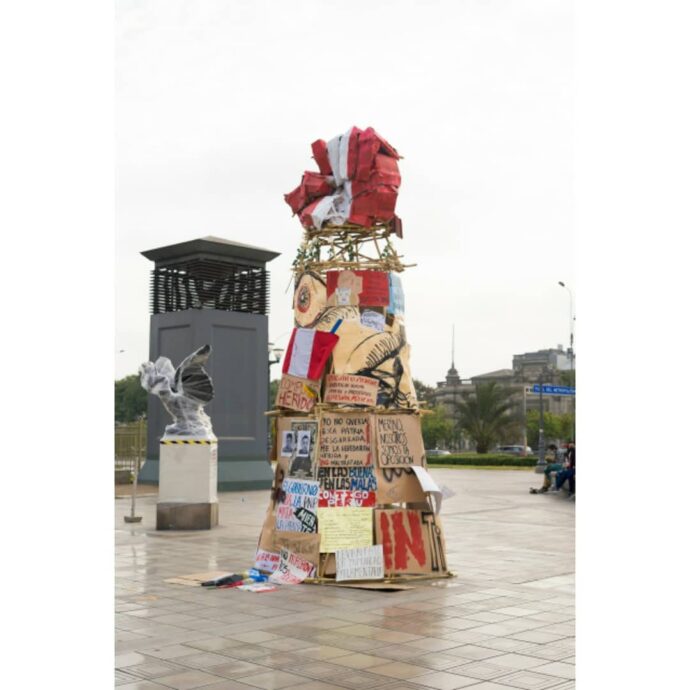
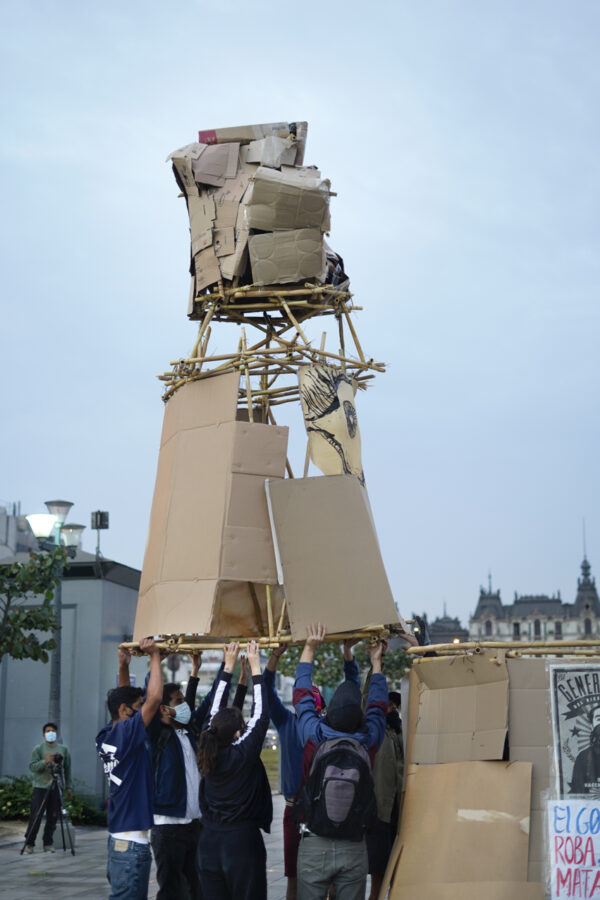
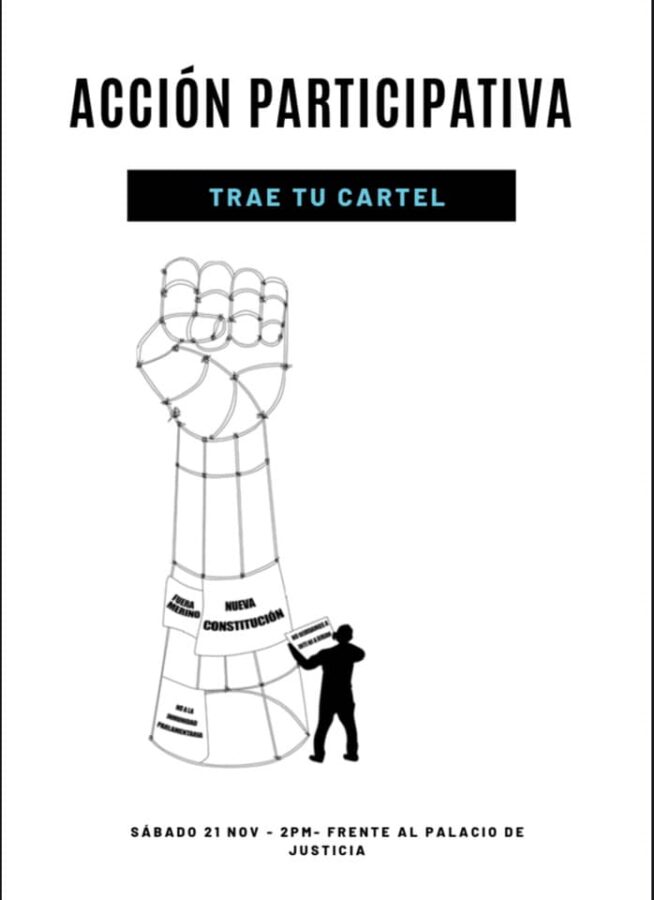
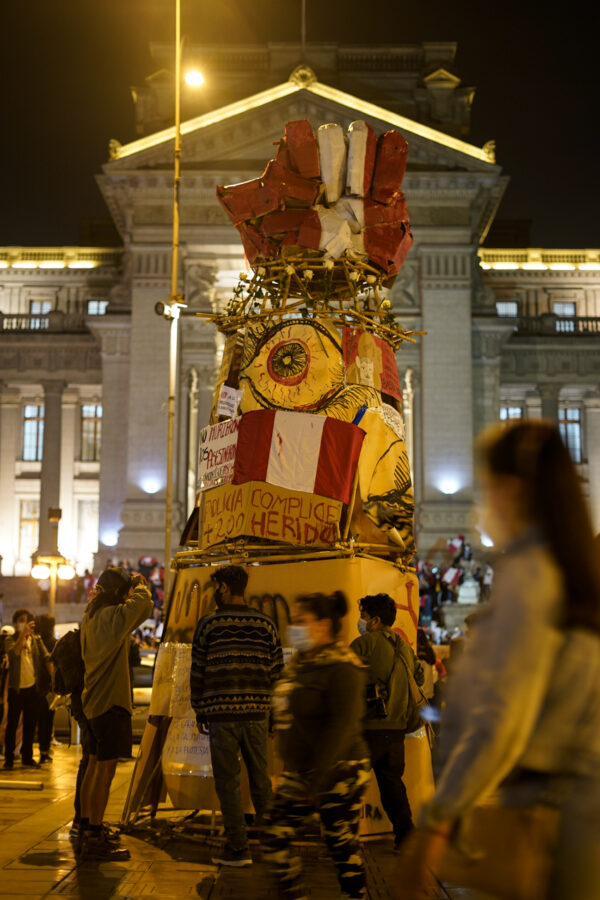
El Puño Vigilante (fig. 2), a collaborative effort by seven artists[14], as consequence of the intensity of the political crisis that compelled them to engage with the moment through their art. A key element of El Puño Vigilante was its unfinished design (fig. 3). Through Fisura Galería[15] social media (fig. 4), the public was welcomed to complete the piece by attaching protest signs and symbols. This participatory aspect transformed the artwork into a dynamic and evolving symbol of collective memory and resistance.
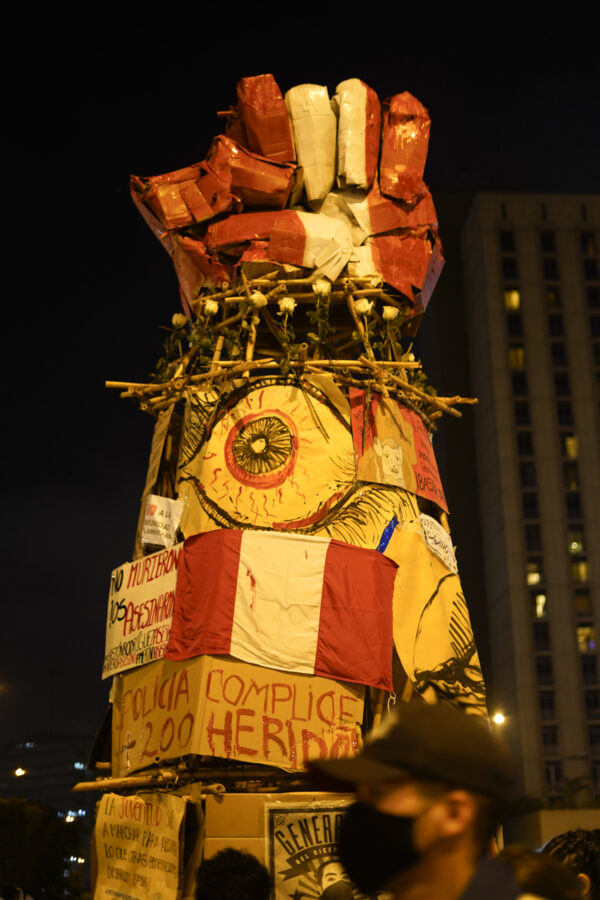
The placement of El Puño Vigilante in front of the Palace of Justice was highly symbolic (fig. 5). According to Samuel Chambi [16], one of the artists involved, this site represented “a place where a monument needs to be put,” underscoring the need for a public space that could visually manifest the collective demands for justice. The deliberate choice of this location connected the work to the heart of institutional power and positioned it as a focal point for civic protest and expression. According to Longhi[17], the concept behind El Puño Vigilante drew inspiration from the fist emoticon commonly employed by the 2020 protesters in online communications as a symbol of solidarity, struggle, and resistance.
In this way, El Puño Vigilante offered an alternative account of history, directly challenged state-sanctioned memories, and reshaped the socio-political landscape. It subverted the traditional top-down approach to monumentality by foregrounding civic engagement as a driving force in shaping public spaces and the historical narratives embedded within them. When the sculpture was destroyed by far-right sympathizers on November 25, 2020[18], its materiality, or lack thereof, acquired more meaning. This destruction was one of many attempts to erase any form of remembrance of the murders of Inti Sotelo and Bryan Pintado, actions seen as a defence of the Peruvian National Police. On one hand, El Puño Vigilante symbolized the protesters’ resistance against a state apparatus unwilling to confront the systemic violence carried out by its security forces. On the other hand, it posed a threat to groups invested in preserving existing power structures, who sought to maintain “civil order” by labelling protesters as “terrucos[19].” The deliberate destruction of El Puño Vigilante was an act of resistance aimed at reinforcing their narrative.
For artist Chambi[20], the creation of El Puño Vigilante represented a form of popular visual resistance and embodied the defiance and resilience of those who demanded justice and accountability. Its destruction only reinforced the ongoing struggle between competing memories and the power dynamics that seek to control how history is remembered and retold.
Final thoughts
The 2020 protests in Peru illustrate a significant turning point in the nation’s socio-political landscape and reveal the intricate interplay between public spaces, collective memory, and political power. Driven not by a singular national identity but rather by various “imagined communities” (Ryan, 2010), these protests were rooted in shared experiences that fostered a collective sense of purpose. This solidarity allowed for the emergence of “foundational myths” (Jelin, 2010), or temporary narratives that provided stability and cohesion around specific causes.
The destruction of El Puño Vigilante by far-right sympathizers serves as a poignant example of this struggle. Initially conceived as an ephemeral monument, it allowed civilians to actively challenge dominant historical narratives. As a site of open participation, the artwork represented a form of civic engagement that articulated an autonomous political discourse (Ilizarbe, 2021). Its transient nature not only denied the state-sanctioned permanence often associated with monuments but also aligned with the fluid, self-constructed perceptions of social reality.
The events surrounding El Puño Vigilante demonstrate the fluidity of collective memory and highlight the power struggles that underpin its preservation. The monument’s destruction by those aligned with existing power structures reflected an attempt to suppress dissenting voices and maintain a narrative favourable to the status quo. This reflects a broader trend in which public spaces become arenas for negotiating national identity and memory, where competing narratives vie for recognition and legitimacy.
Ultimately, the 2020 protests meant more than a rejection of political manipulation; they represent a moment of unity and collective resistance against systemic violence and oppression. The narrative of resistance articulated through the protests and the temporary monument not only contests official histories but also opens up possibilities for reimagining the social realities of the nation.
In conclusion, the case of El Puño Vigilante and the protests surrounding it highlight the crucial role of civic engagement in reshaping public memory and identity. As societies navigate moments of crisis, the reclamation of public spaces for collective expression becomes essential in the struggle for recognition and justice. The events of 2020 serve as a reminder that memory is not merely a reflection of the past; it is an active, contested space that continues to shape the present and future of national identity.
References
Auge, Marc (1996). El sentido de los otros. Actualidad de la antropología. Barcelona: Ediciones Paidós.
Augé, M. (1995). Non-places. Introduction to an Anthropology of supermodernity. London; New York: Verso.
Banchs, M. (2000). Representaciones sociales, memoria social e identidad de género. Akademos, 2(1), 59-79.
Bevan, Robert (2023). Mentiras monumentales. La guerra cultural sobre el pasado.Valencia: Barlin Libros.
Borja, Jordi (2003). La ciudad es el espacio público. In P. Ramirez (cord). Espacio Público y reconstrucción de ciudadanía (pp. 59-89). Mexico D.F.: FLACSO; UAM-I.
Capron and Monnet (2003). La protección de los centros históricos en Latinoamérica. In Ramirez (cord). Espacio Público y reconstrucción de ciudadanía (pp. 105-136). Mexico D.F.: FLACSO; UAM-I.
Delgado, Manuel (2010). La ciudad levantada. La barricada y otras transformaciones radicales del espacio urbano. Arquitectonics, 137-153.
Díaz-Albertini, Javier (2016). El feudo, la comarca y la feria. La privatización del espacio público en Lima. Lima: Fondo Editorial Universidad de Lima.
Echevarría, Priscilla (2020). La invisibilidad del monumento, el archivo y la memoria del olvido. Rev. Rupturas 10(2):69-99.
Foucault, Michel (1980). Power/knowledge: Selected interviews and other writings, 1972- 1977 New York: Pantheon Books
Ilizarbe, Carmen (2021). Poder de veto popular. Revuelta social y elecciones en el Perú del bicentenario republicano. In B. Bringel, et al. Desbordes. Estallidos, sujetos y porvenires en América Latina. Quito: Fundación Rosa de Luxemburgo
Jelin, E. (2001). Historia, memorial social y testimonio o la legitimidad de la palabra. Iberoamericana, 1(1), 87-97. Retrieved from http://www.jstor.org/stable/41673837
Lefebvre, H. (2013). La producción del espacio. Madrid: capitán Swing.
Niel, Paul (2015). Urban Space as Heritage in Late Colonial Cuba. Classicis, and Dissonance on the Plaza de Armas of Havan, 1754-1828. Austin: University of Texas Press
Ryan, L. (2010). Memory, power and resistance: The anatomy of a tripartite relationship. Memory Studies, 4(2), 154-169.
Riegl, Alois (2019[1903]). El culto moderno a los monumentos. Caractéres y origen. A. Pérez López (trad.). Titivillus. ePub
Schwarzstein, Dora (2002). Memoria e Historia. Desarrollo Económico 42 (167): 471-482.
Vargas Álvarez, Sebastián (2021). Atacar las estatuas. Vandalismo y protesta social en
América Latina. Bogotá: Fundación publicaciones La Sorda.
NOTES:
[1] Spanish for square.
[2] For more details about this case: https://www.nytimes.com/es/2019/04/17/espanol/america-latina/peru-expresidentes-corrupcion-odebrecht.html
[3] For more details about this case: https://www.idl.org.pe/los-cuellos-blancos-quienes-son-los-principales-involucrados-y-cual-es-el-estado-de-su-proceso-judicial/
[4] To find out more about this data: https://acleddata.com/2021/04/09/political-instability-and-demonstration-trends-in-peru/
[5] A compilation of the events can be found here: https://investigacion.pucp.edu.pe/grupos/gico/noticia-evento/ano-del-estallido-peruano-una-recopilacion-fuentes-bibliograficas-audiovisuales-lo-vivido-noviembre-2020/
[6] English translation: March of the four territories or regions.
[7] The link to be video can be found here: https://www.youtube.com/watch?v=Ce-MYf-sSLI
[8] To see some examples: https://x.com/hurgamemoriaPE/status/1327587289762050048?t=G-n2nZvSG0va3yNaOy9owA&s=09; https://x.com/EddyMartin1976/status/1327609772057763845 and, https://x.com/hurgamemoriaPE/status/1535419440375992324
[9] To know more about the terruqueo: https://larepublica.pe/domingo/2020/12/06/noelia-chavez-el-terruqueo-busca-negar-o-cancelar-a-todo-aquel-que-critique-este-sistema
[10] The interview can be found in the following link: https://www.youtube.com/watch?v=DiPSRPZzTbA
[11] In the future, this action will be appropriated by the Municipality of Lima and used strategically in subsequent protests under the pretext of protecting the physical integrity of statues. This reflects a broader trend in the city’s urban landscape, where memory is aestheticized through territorialization (Murri, 2019). While framed as preservation, the municipal intervention serves a dual purpose: not only safeguarding monuments but also reinforcing a sense of “normalcy.” This normalcy implies that public spaces should be depoliticized, limiting their function to predefined roles and suppressing their potential as platforms for social engagement and political dissent.
[12] A compilation of Jack Bryan Pintado’s death: https://www.idl-reporteros.pe/la-muerte-de-jack/
[13] A compilation of Inti Sotelo’s death: https://www.idl-reporteros.pe/la-muerte-de-inti/
[14] The artists who created The Watchful Fist were (in no particular order): Natalia Documet; Yen Plasencia; Ian Tevo; RIchard Arevalo; Juan Carlos Huincho; Emilio Longhi; y Samuel Chambi.
[15] Fisura Galería is a project created by artists Samuel Chambi and Natalia Documet, designed as both an art gallery and a cultural space aimed at fostering the work of emerging young artists. The gallery serves as a platform for artistic production and cultural engagement. In the creation of El Puño Vigilante, the gallery’s social media channels played a pivotal role in disseminating information and promoting the initiative.
[16] Personal communication 18/06/2024.
[17] Longhi’s Instagram publication on the 11th of December 2020. https://www.instagram.com/p/CIq6VJNp_Nv/?igsh=YzhnOHllcDBuajZl
[18] Images of the destruction: https://x.com/MarialeBernedo/status/1331663528177119236?t=uTN64678OQ5JC6KfZUAFkw&s=19
[19] See footnote 9.
[20] Personal communication 18/06/2024
ACKNOWLEDGEMENTS-
Samuel Chambi, Karlen Mamio, Aldo Accinelli, Fernando Reátegui.