Monuments as Catalysts for Conflict: The Fight for Hegemony
If I draw on my humble memory, I could point out that the most significant global mo(nu)ments produced in recent years are mostly acts of destruction, whose memory seems to be embedded, and that remain more present even than what we have understood as traditional monuments. Unforgettable events are etched in memory, such as the fall of the Berlin Wall, the televised demolition of Saddam’s statues, the collective experience of the fall of the Twin Towers in New York, the recent toppling of the Lenin statues in Ukraine, or the attacks on colonial statues in the United States.
All of these point to the monument as a problematic axis of representation of dominant hegemony. They are images of violence against an artifact that itself is also established and instituted from violence. The Iranian artist Siah Armajani stated that it is an anomaly in a democracy to celebrate with monuments. A true democracy should not seek heroes, as it requires every citizen to fully participate in everyday life and contribute to the public good. Numerous contemporary artists have contemplated this issue, and in this article, we will attempt to present some of the possible critiques of both monumental construction and its destruction.
Introduction
This text is, if anything, a sum of contextual, personal, and temporal concerns that seek to materialize what has been sensed in recent decades as a fundamental issue in understanding both the construction and destruction of monuments today.
I also consider it important to point out that besides being a sculpture professor, I am a plastic artist and regularly work in the sculptural format; therefore, I maintain a certain complicity with the medium in question. Without exceeding the scope of my experiences, I must highlight some occurrences from recent decades that, undeniably, have impacted the body of my work.
If I rely on my humble memory, I could point out that the most relevant global moments produced in recent years are mostly acts of destruction, whose memory seems to be embedded, and that remain more present even than what we have understood as traditional monuments.
As a starting point, I will go back to the fall of the Berlin Wall on the night of November 9, 1989, not because it was (far from it) the first iconoclastic act, but rather because it is a globally recognizable symbol (of its destruction), and its demolition was massively broadcast by international mass media. These broadcasts inevitably became monumental “acts of memory,” difficult to forget.
The fall of the wall also triggered a domino effect on numerous statues located in the former republics of the USSR. Statues representing the main capitals of the former Soviet republics fell, from Tallinn to Riga, from Bucharest to Baku, even reaching countries that had Soviet influence, such as the People’s Democratic Republic of Ethiopia, where Lenin’s statue in Addis Ababa was toppled on May 23, 1991.
It was the same year that the first (televised) war in Iraq began, where strange and unforgettable lines and yellow-greenish points of light confirmed the bombings over the city of Baghdad in the so-called Operation Desert Storm.
The beginning of the century brought one of the most emblematic monumental images, centered around the capital of the global imaginary, which was the attack on the World Trade Center in New York City on September 11, 2001. The echo of that attack would lead to the Second Gulf War, which a few months later left another memorable image. This was the overthrow of Saddam’s statue in Firdos Square in Baghdad in 2003, whose significance seemed to announce the victory and subsequent occupation by U.S. troops. The very image of the monument’s demolition, with a chain around the statue’s neck, also seemed to foreshadow the death of Hussein himself, which would occur three years later through hanging with a noose around his neck, the filming of which was leaked to the international press via a (snuff) video recorded with a mobile phone.
In these years, Spain began the withdrawal of some statues of the dictator Francisco Franco, that, after the dictatorship and the subsequent regime change, had not undergone any alterations and continued to occupy their locations in most provincial capitals. Thus began a debate around a possible Historical Memory Law that materialized in 2007, and whose issues continue to provoke controversial political and social reactions.
2011 was a year filled with intense events, a year in which public squares were filled with people. The various Arab Springs, the Spanish 15-M movement, and the different Occupy movements (NY, London, Sydney, etc.) seemed to establish an internal link to the crisis in a “global” manner, with these movements sharing common demands across the different epicenters of protest (regime crisis, representation crisis, exhaustion of the hegemonic system, which seemed to herald a subsequent wave of power changes, etc.).
That same year, the announcement of Osama bin Laden’s death took place on May 1, 2011, whose staging in the media left a striking lack of images.
In 2013, echoing the previous protests and similar aesthetics, the Euro-Maidan emerged, yet with a fundamental difference: unlike the aforementioned movements, the mobilizations in Ukraine, with a nationalist and pro-European character, had the support of the far-right and neo-Nazi ideological groups (Svoboda and Pravy Sektor), and the permissiveness (funding) and media support of the main Western powers, which led to the downfall of President Yanukovich. In the months following the mobilizations, hundreds of monuments to Vladimir Lenin, as well as other symbolic elements of the socialist past, were systematically removed, toppled, and destroyed under the spotlight of the media, which incessantly reported on a new attack.
It was in 2013, too, that the civil war in Syria intensified, and we received images of self-proclaimed groups toppling statues of Syrian President Bashar al-Assad. All of these cases (and there could be others) are well known, disseminated, and placed in the forefront of history by mass media, forming an undeniable context for this research. Therefore, I find it appropriate to recount them here as evident proof of the relevance of the object of study that I intend to approach.
Imposition Always with Violence
I would like to begin by addressing the nomenclature that we commonly use to refer to that problematic artifact known as a monument, which Martin Wanke defined as a “catalyst and reflection of social conflicts.” The word monument comes from the Latin terms monere (memory) and mentum (to remember), forming the whole monumentum, which could be translated as “that which is worth preserving in memory.”[1]
On the other hand, if we stop to observe the word statue, we see that it possesses the preffix sta-, present in numerous words that give us a clue. All of them refer to the immovable (static), to what is taken for granted (state), to what is subject (stake), to what marks limits and frames (stadium, stall), to social imposition (establishment), to that which is presumed (statistics), to the immovable (stable), and to the voice of consensus (standard).
The monument presents itself in public space in an imposing manner. It occupies the space that is supposedly common with a problematic desire: to represent everyone. This produces the conflict of the “unrepresented,” those for whom those memories “do not represent” and therefore feel confronted.
W. Benjamin’s idea about the construction of history always being done by the victors resonates: those who construct memory build history (and forget the stories). In the matter at hand, which is the construction of commemorative monuments, this is a fundamental issue. Likewise, we consider it a capital note the way W. Benjamin alludes to the inherent violence in “cultural goods” and in their processes of transmission:
“(…) The increasingly powerful are the heirs of those who have always won. Empathy with the victors always benefits the increasingly powerful. (…) Whoever, therefore, has achieved victory to this day marches in the triumphal procession in which those who are powerful today walk over those who lie on the ground today. Just as it was customary, the spoils are dragged in the midst of the triumphal parade. And they call it cultural goods. (…) There is no document of culture that is not at the same time a document of barbarism. And as it is not free from barbarism, neither is the process of transmission in which it has passed from one to another.”[2]
This issue, which is almost embryonic in our field of study, prevents us from looking away and compels us to think about commemorative monuments, undoubtedly as transmitters of certain historical components, always with implicit violence.
Reducing the (Apparent) Violence
The triumphalist exaltation of victory in most traditional commemorative monuments that have been erected by some regimes in the past century has been questioned and confronted in recent decades. In the realm of monumental production, numerous efforts have been made throughout the 20th century to create monumental artifacts with different functionalities, more horizontal, more intimate, etc.
These types of productions have been critically referred to as the phenomenon of counter-monument[3], and have been frequently viewed from a protective angle against that foundational and inherent violence that Benjamin speaks of. A paradigmatic and well-known case study of a counter-monument is the (American) Vietnam Veterans Memorial by artist Maya Lin[4] from 1982. It is true that the formal approach of Maya Lin’s construction inspired later memorials, such as the Memorial to the Victims of State Terrorism in Buenos Aires. However, in our view, the innovation in the process of commemorating the fallen (from one side only) does not differ much from other similar manifestations that have occurred throughout history, from
the memorial plaques of the ancient world to the plaques for those who fell for God and for Spain after the Spanish Civil War.
Similarly, the construction of the rarely-mentioned and little-recognized My Lai Memorial from 1971 in Vietnam, intended to remember one of the most brutal cases of the Vietnam War, in which the U.S. military executed over four hundred civilians en masse, and whose commemorative device (a black granite memorial plaque listing the fallen) was similar to the American memorial executed eleven years later by Maya Lin. However, we cannot dismiss that discussing memorials and exemplifying with particular cases, such as Maya Lin’s American memorial, is still a political decision and a (concrete and particular) shaping of history.
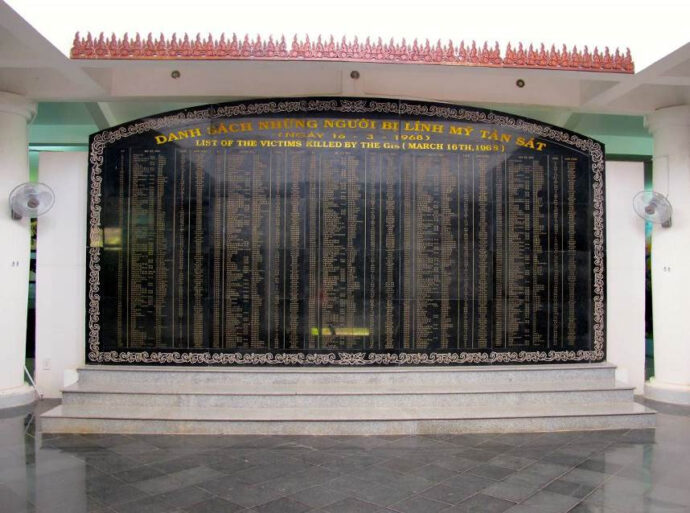
Monumentalized history tends to be asymmetric and intentionally disproportionate concerning the events that occurred. The well-known memorial by Maya Lin, which remembers the (almost sixty thousand) Americans fallen in the conflict, contrasts with its forgotten Vietnamese counterpart, the Hanoi memorial, which remembers the Vietnamese fallen (almost a million), and serves as evidence of the asymmetry practiced from the historical and academic terrain.
“Therefore, despite the formal changes proposed in the counter-monument, they maintain the criticism that W. Benjamin suggested having empathy for the ‘increasingly powerful’.
At this point, we can enumerate a series of questions: Which histories are recorded, and which are not? What form do commemorative monuments take today? Should we rethink the process of commemorative monumentalization? How do we coexist with the historical forms of commemoration and how are these read in the present? What happens to others, to those who do not feel represented in the official history (monuments)? Furthermore, is it possible to commemorate without always leaving a trace of violence, without displacing many others in the construction of memory? What is it that we choose to commemorate today? We could ask ourselves, does the monumental format have any possibility in a society with democratic or egalitarian pretensions? Or has the multiplicity of its forms banished it in favor of a new streaky historical construction?
Iranian artist Siah Armajani shared a reflection on public art, stating that it should not be monumental. According to Armajani, public art should be low, common, and close to the people. It is an anomaly in a democracy to celebrate with monuments. A real democracy should not seek heroes, as it requires every citizen to fully participate in everyday life and contribute to the public good[5]. Armajani’s sculptural production often proposes spaces for use (libraries, benches, meeting or transit places, etc.) far from unidirectional representation.
If we analyze the fundamental vectors that are inherently proposed in traditional monumental sculpture, we observe that all of them have been systematically dismantled one by one in the field of artistic production throughout the 20th century (the colossal scale versus minimal scales, the occupation of centers versus the search for peripheries, noble materials versus production from precariousness, the desire for representation versus its questioning, or the aspiration to endure versus temporality and event).
Emergence of the Monument
So far, we have thought about monuments usually produced by the establishment, from above, by the dominant hegemony, but there are moments when monuments emerge from other places.
At times, monumental production channels particularly grave events that assault the stage of reality and shock the status quo of the population. This is well illustrated in the film Lapidari (Viktor Gjika and Esat Ebro. Albania. 1986). Terrorist attacks, accidents of special gravity, natural disasters, and deaths of well-known leaders or agents of special public notoriety could be some of the numerous examples that generally pose this type of traumatic shock scenario.
The examples are as diverse as they are dispersed across the global geography, from the nearby attacks in Madrid on the Atocha trains on March 11, 2004, where 192 people died and 1,858 were injured, to the Boston Marathon bombings in 2013, in which three people died and another 282 were injured. From the Charlie Hebdo attacks in 2015 in Paris to the Aurora (Colorado) massacre in 2012 in a movie theater, where a young man shot seventy-one people, causing twelve deaths and fifty-nine injuries, the largest shooting in the United States to date; or more media-driven cases like the funeral of Lady Di or the death of Michael Jackson, which mobilized thousands of people after their deaths.
All of them, in their diversity and particularity, contain a common element that brings them closer, an element that makes them converge. In all of them, following their traumatic eruption, memorial devices emerged from a situation of urgency to remember and manifest the trauma of what happened. Places were filled with candles, written papers, flowers, and other elements that expressed condolences for the victims.
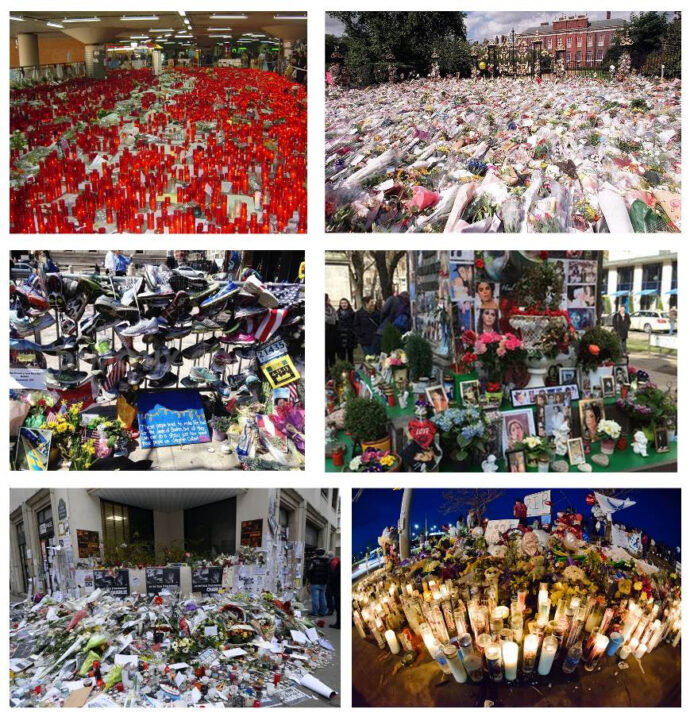
All of them were created in the heat of shock, in a closeness to what occurred that hardly allows for distance or detachment, so the resulting memorials obey more to a visceral response and need for the monument. In that dawn, desperate for formalization, it seems interesting to pause on the elements, processes, and common formalization that are so particular to these spontaneously emerged memorials.
If we attempt to completely empty these memorials of content, we find devices that could well remind us of numerous devices of contemporary art today. Red plastic-encased candles of liturgical appearance, colorful sticky post-its, various photocopied images, writings, balloons, stuffed animals, plastic flowers, flags, scarves, and a countless array of elements that, with speed and virality, lend themselves to constituting the memorial.
Piled up and expanded, these elements aptly create an aesthetic of collapse, of the climate of oversaturation that fills the void of recent loss. All of them are chosen in an immediacy that does not aspire to the eternity and material permanence of traditional monuments, but rather to the intention of establishing themselves in collective memory and remembrance. They aspire to be a monument.
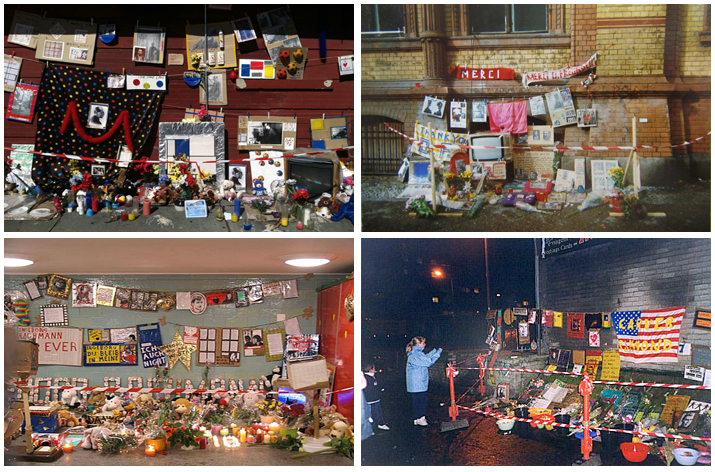
One of the artists who best embodies these concerns is Thomas Hirschhorn (Bern, 1957); within his extensive production, there are several groups of works that show a special interest in commemorative and cult processes. Hirschhorn outlines three different formal strategies in this matter: altars, then kiosks or pavilions, and finally monuments.
Hirschhorn’s altar series seems to be interventions created spontaneously, or at least, they acquire the aesthetic of commemoration or devotion that has arisen from a popular manner. In many of his works, the author accumulates numerous “banal” memory objects: candles, found photographs, flowers, stuffed animals, scarves, banners, patchwork flags, personal belongings, etc.
The appropriation of these elements, such as the scarves (which the author decorates with the names of the honorees), refers to the soccer fans used to raise the cult of their team. The candles allude to numerous commemorations of a ritual or sacred nature, the stuffed animals to compulsive collector worship, or the banners and flags in which the fan phenomenon resonates.
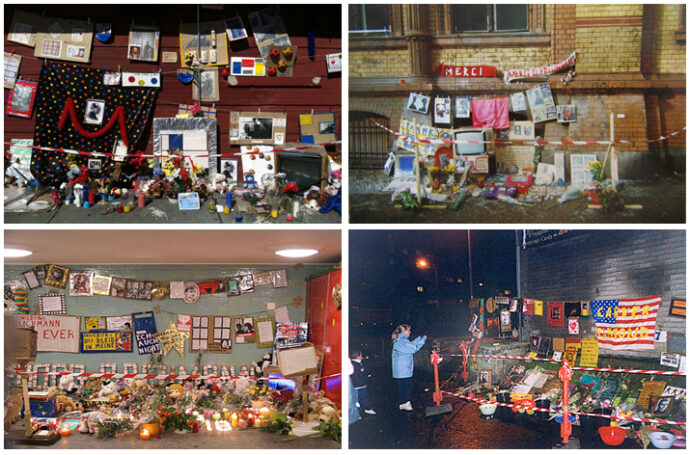
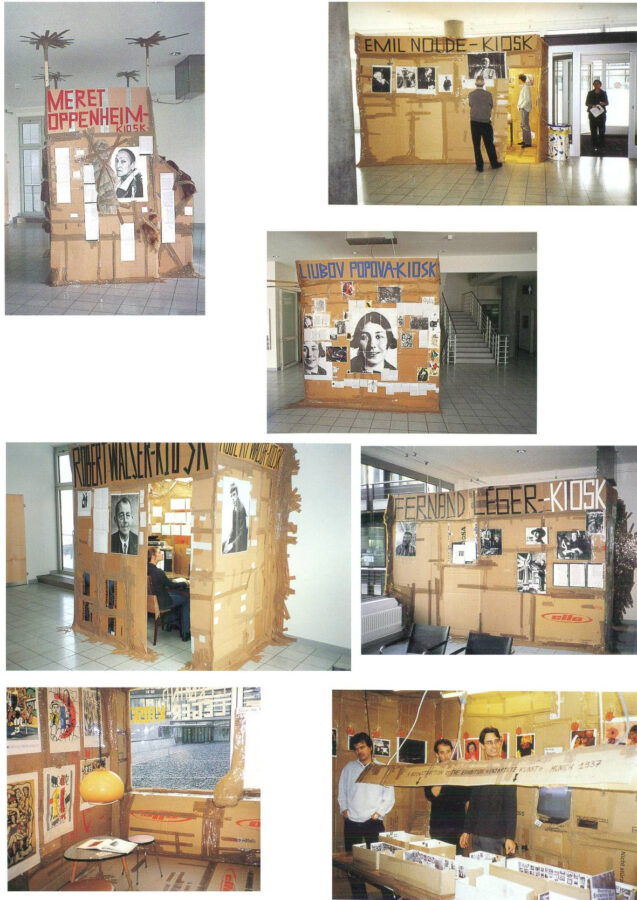
This amalgamation of elements composes a strategic decision and represents a vast array of materials with commemorative connotations. Hirschhorn not only expands his constructive possibilities as an artist but also expands the concept of the monument, of the commemorative, for the viewer. He also created kiosks or pavilions that were ephemeral architectural structures, built precariously, with wooden, cardboard, and adhesive tape structures. Inside, they housed spaces for accommodation, gathering, and reading, as well as numerous images and texts of information about the honoree that were displayed throughout the construction.
The kiosks proposed by Hirschhorn undoubtedly recall some models of the so-called reklame-architektur[6] of the 1920s, which understood architecture as a sign or advertisement. The influence of Hirschhorn’s proposals, with some projects from that era, such as Lissitzky’s “Pressa” pavilion of 1928 in Cologne, is more than evident.
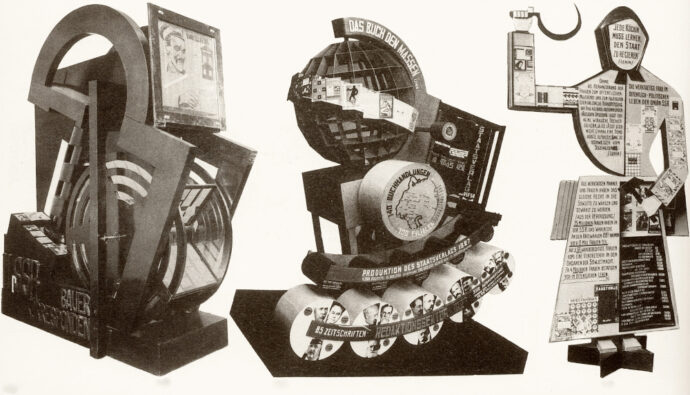
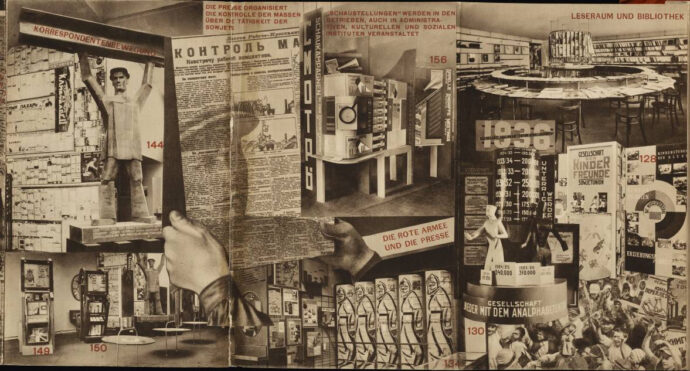
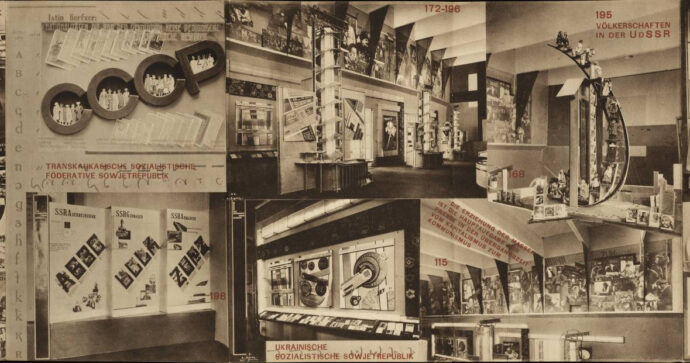
This sense of saturation is usually present in most of the Swiss artist’s works. In his displays, there is often excess – too much to see, too much to read; he himself comments:
“I WANT TO SUPERINFORM AND SUPERDETAIL IN ORDER NOT TO INFORM OR DETAIL. I DO NOT WANT TO COMMUNICATE.”[7]
The author himself states that “monuments require popular participation and the involvement of the place where they have been built. My monuments are temporary, but they can be rebuilt at any time with the help of the same people who built them for the first time. My monuments produce something; they are not just to be contemplated; people can use them as meeting places, and only if they are used will they be understood for me, sculpture is an event, an experience, not a spectacle”.
The dimension of spectacle operates when someone presumes that there are two groups: those who produce and those who are passive receivers.”[8]
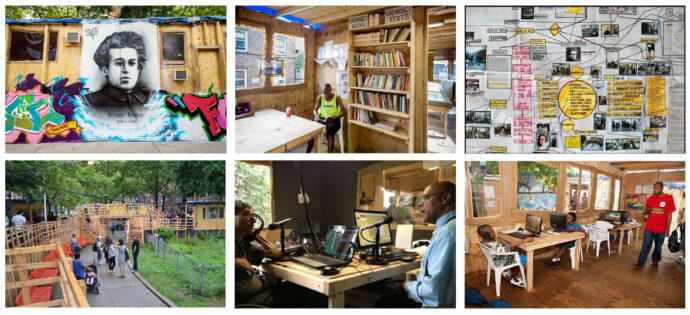
First, we would like to point out that the locations of almost all of the discussed proposals are in peripheral places, as a counterpoint to the selection of a strategic, relevant, and central location for most traditional monuments. Hirschhorn places his monuments in humble neighborhoods, like the Bronx, Avignon, or Siedlung Friedrich Wöhler.
On the other hand, he takes as a central axis of the monuments the idea of the monument as an experience, as an event, in which the participation of the communities where he executes his projects is fundamental.
The utopian idea that appears in Campanella’s text The City of the Sun, in which citizens coexist with the images that appear in murals throughout the city, and which represent a method of learning, seems to take shape in Hirschhorn’s tributes, where viewers/participants are part of and coexist within the monument. This situation is not without criticism from some intellectuals who argue that it is a cultural bravado and interpret it as a gesture of audacity, claiming that “Bataille or Deleuze is too much for a suburb of immigrants.” Hirschhorn’s goal is not to educate; on the contrary, he exposes himself as being among the crowd with them.
“I WANT TO GIVE OF MYSELF, TO ENGAGE MYSELF TO SUCH A DEGREE THAT VIEWERS CONFRONTED WITH THE WORK CAN TAKE PART AND BECOME INVOLVED BUT NOT AS ACTORS.”
Hirschhorn activates that Gramscian idea that “all men are intellectuals, but not all men have the function of intellectuals in society,” and therefore operate a sort of class conflict and hegemonic struggle that limits their possibilities.
At times, Hirschhorn’s monumental proposals seem to refer to the early Popular Ateneo, which arose from the labor movement, a place to gather communities from the composition of a countercultural sphere that emerged from the grassroots.
The author seeks to articulate a place (the monument) in which a series of events (talks, concerts, readings, etc.) take place in public space, whose function seems to dissolve the limitations referred to by Gramsci.
Empathy for Vandalism
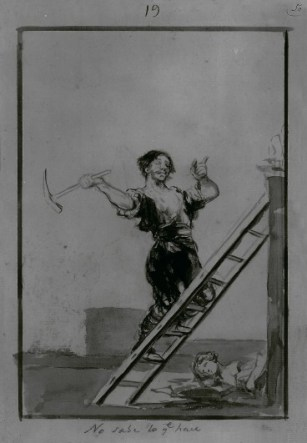
Last, I would like to offer a brief reflection on those who do not feel represented by the monument. In one of the engravings from Goya’s Los caprichos, titled “He Doesn’t Know What He’s Doing,” a character is depicted on a ladder, disturbed as if intoxicated, lacking balance and with closed eyes, a metaphor for the blind. The man holds a pickaxe in his hand with which he has just struck a classical statue lying broken on the ground.
The feature film Hate (1995) by Mathieu Kassovitz tells the story of a day in the life of three inseparable young men: Hubert, Saïd, and Vinz. It depicts twenty-four hours in the Muguets neighborhood, a Parisian suburb, where the three friends try to escape an escalation of violence that seems inevitable. We also remember Made in Britain, a film by Alan Clarke from 1983, in which a sixteen-year-old skinhead named Trevor gradually falls into marginality and an incessant escalation of violence. In both films, it is the very contextual climate surrounding the characters that seems to shape their behaviors, presenting no other possible way out. In some ways, their behaviors, despite their violence, rejection of the established order, or marginality, become understandable in light of the situation surrounding them.
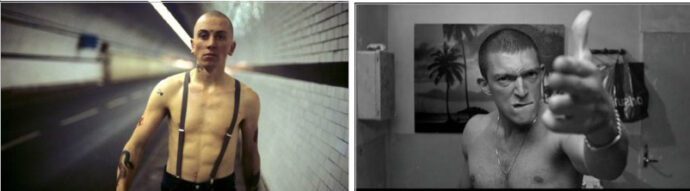
In all three examples, we find analogies of the vandal, the iconoclast who does not respect images and the status quo. Dario Gamboni reminds us that the main difference between vandalism and iconoclasm lies in intent; while vandalism is characterized by violent and gratuitous (unleashed, vehement) actions, iconoclasm involves a will, a purpose, a (reasoned) ideology[9].
A monument, as we saw at the beginning, is a construct that aggregates collective memory, assuming to represent the memory of “everyone.” Those who do not feel represented are neither worthy of being treated as the public nor as a collective that forms part of that memory; thus, they are labeled as excluded, dehumanized, and unworthy of assuming the status of citizens. They are unrepresentable.
Consequently, both the blind man and the images of unleashed beings embody the intention to ridicule and distance that “other” who is unrepresented. In these cases, violence does not typically stem from pathology, as some of these authors try to make us see, but rather from the conditions of oppression that lead some individuals to identify with the monument, the symbols, or the artwork as representations of a consensus to which they do not belong. A minority consensus, privileged, which turns hegemonic through the appropriation of public discourses, incorporating policies to manage the collective imaginary that render a high percentage of the population excluded.
These conditions, rather than being considered external to the monument, are inherent in it. Possibly, Martin Wanke, in the late seventies, was one of the first authors to point out that we cannot evade the political, social, economic, etc., conditions in which public monuments are situated. These relationships are fundamental conditioning factors that articulate a relationship beyond what is programmed in the field of the artwork as aesthetic value and its understanding.
In our view, the monument is (always) an imposing and problematic artifact, always forgetting the memories of some in favor of others.
References
BENJAMIN, WALTER (2008) Obras. Libro I. Vol.2. Adaba Editors. Madrid.
BUCHLOCH, BENJAMIN H. D. (2004) Thomas Hirschhorn. Phaidon. New York.
COULTER-SMITH, GRAHAM (2009) Deconstructing Installation Art. Ed. Brumaria. Madrid.
FOSTER, HAL (2013) El complejo arte-arquitectura. Turner. Madrid.
GAMBONI, DARIO (2018) The destruction of art : iconoclasm and vandalism since the French Revolution. Reaktion. London.
HIRSCHHORN, THOMAS; LEE, LISA; FOSTER, HAL (Ed.) (2013) Critical Laboratory. The Writings of Thomas Hirschhorn. MIT Press. London
MADERUELO, JAVIER (2008) La idea del espacio en la arquitectura y el arte contemporáneo 1960-1989. Ed. Akal. Madrid.
MOCK, FREIDA LEE (Dir.) (2003) Maya Lin. A strong clear vision : the story of the Vietnam Veterans Memorial and its inspiring creator. New Video. New York.
YOUNG, JAMES E. (1992) ‘The Counter-Monument: memory against itself in Germany today’ In: Critical Inquiry, Vol 18 nº2 (Winter 1992). Chicago University Press.
WANKE, MARTIN (1973) Bildersturm: die Zerstörung des Kunstwerks. Ed. Hanser. Munich.
NOTES-
[1] WANKE, MARTIN (1973) Bildersturm: die Zerstörung des Kunstwerks. Ed. Hanser. Munich.
[2] BENJAMIN, WALTER (2008) Obras. Libro I. Vol.2. Adaba Editors. Madrid. (Pg. 309)
[3] See the documentary film about the work and its author: MOCK, FREIDA LEE (Dir.) (2003) Maya Lin. A strong clear vision : the story of the Vietnam Veterans Memorial and its inspiring creator. New Video. New York.
[4] Countermonument is a term coined from criticism by James E. Young, and is used by numerous authors to allude to monumental proposals that in their processes seek to avoid some of the traditional logics of monumental construction. It began to be used mainly when describing certain memorials created in Germany in the early 1990s, such as the Harburg Monument by Jochen Gerz or the Aschrott-Brunnen Monument by Horst Hoheisel. Nowadays, there is a proliferation of terms such as ‘Anti-monuments’, ‘Low-budget monuments’, ‘Non-monuments’, ‘invisible monuments’, ‘Countermemorials’, etc. YOUNG, JAMES E. (1992) ‘The Counter-Monument: memory against itself in Germany today’ In: Critical Inquiry, Vol 18 nº2 (Winter 1992). Chicago University Press. (pp. 267-296)
[5] MADERUELO, JAVIER (2008) La idea del espacio en la arquitectura y el arte contemporáneo 1960-1989. Ed. Akal. Madrid. (Pág. 240)
[6] FOSTER, HAL (2013) El complejo arte-arquitectura. Turner. Madrid. (Pág. 291)
[7] United Nations Miniature.Thomas Hirshhorn.Ed. CAC Málaga. Málaga (Pp 53)
[8] BUCHLOCH, BENJAMIN H. D. (2004) Thomas Hirschhorn. Phaidon. New York. (pp 65)
[9] GAMBONI, DARIO (2018) The destruction of art : iconoclasm and vandalism since the French Revolution. Reaktion. London.