Sifting Through the Noise: Navigating Expectations for Local Music in the Kulturljudzon
Introduction
Between noise complaints in densifying cities, building regulations and police scrutiny, and the observation that several aspects of urban living seem to get harder to afford with each day that passes, navigating a place in the city as a member of its music scene can present a challenge. How I viewed my prior city’s do-it-yourself (DIY) and underground music scene when I began going to shows a decade or so ago was not with an academically conscious picture of “the urban” or with a particularly political conscience. The inexpensive, local, interesting thing to do, where I could hang out and watch my friends play music, was just that. However, urban phenomena have a curious way of entangling with some less obvious aspects of living, creating, and partying in a city, and indeed, “music finds itself caught up in broader struggles over the transformation of cities” (Straw, 2018, p. 29).
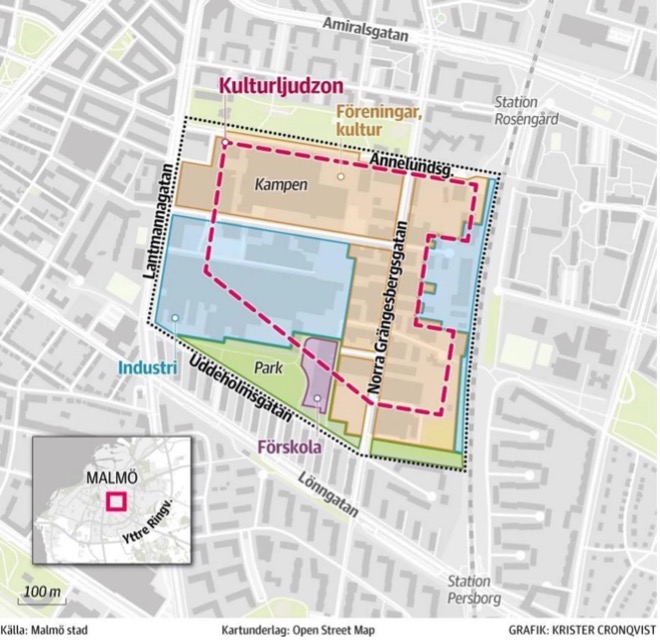
After expressing a shared interest in the state of local DIY music forms with master’s program classmate, festival organizer, and fellow (relative) Malmö newcomer Alice Porsfelt in 2023, we created our fanzine You bend it and you tend it and you do as you want!1,an investigation of Malmö’s underground music scene history from recent decades. We conducted interviews and gathered artifacts from informants who gave shape to a cultural scene in Malmö that we had limited background knowledge of and had found to be under-researched, particularly within the lens of its urban influences such as tenancy, spatiality, and local identity. We asked informants to describe their recollections of Malmö when they started making music, performing music, or organizing events, and whether/how the city and its music scene(s) had changed over the time that they had been involved. During these interviews, we asked informants for their thoughts on the kulturljudzon, or cultural sound zone, that the municipality announced in 2021 for a section of Sofielund, a formerly heavily industrial neighborhood in eastern Malmö, where sounds associated with culture, such as from music and gatherings of people, are permitted alongside preexisting noise from industry and transport up to a higher volume of 85 decibels outdoors (Sofielunds verksamhetsområde år 2040, 2021). New residences are not to be planned or built inside the zone or within a 100-meter distance from its perimeter, an effort to protect the area’s boisterous industrial and cultural heritage that can make it unsuitable for dense housing (see Figure 1). When speaking with our informants, many expressed a lack of familiarity with the kulturljudzon, uncertainty about what it would entail for their version of cultural life, and cited difficulties with finding suitable, affordable spaces in present-day Malmö. The timing of this plan also seemed curious. In 2017, the city piloted a multi-authority initiative called Tryggare Malmö, or Safer Malmö, in a stated effort to halt unserious, unscrupulous, or hazardous activities in the city. The initiative named both illegal nightclubs and Norra Grängesbergsgatan, a main street in Sofielund and a known center of underground music activity, as two of its nine focus areas during the year 2018. By the time that the report for 2019 was published, it stated that the police were not aware of any recurring underground clubs anymore following the work of the initiative (Samordnad tillsyn 2018; Samordnad tillsyn inom Tryggare Malmö 2019). The number of illegal club spaces that were shut down between 2018 and 2020 was estimated by police to be 15 (Irebring, 2020a).
I found the introduction of an area planning initiative involving culture and nightlife difficult to reconcile with the recent efforts to shut down forms of cultural expression and consumption that, while unauthorized, made substantial contributions to that same area’s heritage. As the kulturljudzon was newly introduced, the first of its kind in a Swedish city, and bold in its intentions to preserve cultural activity amid densification efforts, overall news coverage and published commentaries seemed rather ecstatic (Apak, 2021; Hansson and Hansson, 2023; Thomasson and Lönnaeus, 2021). The purpose of my master’s thesis2, upon which this article is based, was thus to offer a critical examination of the kulturljudzon by investigating what I had experienced as a discrepancy between this plan’s emergence and the either silence or indifference that I’d encountered from actors in the area’s grassroots music scene. The discussion results from a functional documentary analysis of the 2021 neighborhood plan for Sofielund and of the Noisy Neighbours exhibition3 that explored the processes and ideas involved in the plan’s development, as well as nine qualitative, semi-structured interviews. Participants included five actors that were involved in DIY music production or cultural association life with connections to Sofielund, and four representatives of other stakeholders in the area’s cultural landscape, with varying degrees of influence on its operations: three people who worked for the municipality in a capacity related to cultural planning or the kulturljudzon, and one who worked for a property management company with holdings in Sofielund. The research questions were threefold and asked how the Sofielund neighborhood plan had been presented in public communications, how those communications compared to perspectives within Malmö’s music scene, and what the lived realities of DIY cultural actors were in connection to the kulturljudzon. However, the clarity of time and the will to reexamine my thesis work has perhaps brought forth a truer and simpler purpose: to examine the considerations of grassroots musicians and organizers in the time and place of the (relatively) new kulturljudzon, and how those fit amongst other goals or priorities from stakeholders involved in the area’s cultural ecosystem.
Notes, background, and placing Malmö
This text will at times use the terms “DIY” and “grassroots” interchangeably to communicate a similar idea: people creating and sharing creative work in smaller-scale, self-organized ways, without a focus on profit-making or commercial appeal. In musical terms, the DIY ethos, while easily associated with a punk-related sound and aesthetic, has evolved beyond the genre that contributed to its global spread in the 1970s and is presently reflected in practices across genres and subcultures (Bennett and Guerra, 2018). An evident connection to the field of urban studies lies in built space for production and performance: studios and rehearsal spaces, but also venues and clubs in which musicians can share their work in the forms of shows, gigs, and parties. The performance spaces tend to mirror the smaller scale and anti-commercial nature of DIY musicians and can vary by geography but tend to be found in warehouses, galleries, homes, bars, and skate parks, and in buildings that are abandoned, repurposed, or converted into venue operations (Easthope, 2020). Oral history accounts of DIY scenes in the Midwestern United States draw parallels between the availability of physical space in former industrial areas and opportunities for fringe culture to thrive (Ensminger, 2017; Sandy, 2022). Depending on local and national regulations regarding building capacity, noise limits, or alcohol sales, these spaces can be of varying legitimacy and operate legally, illegally, or in a gray zone. While operating a music space illegally can leave organizers vulnerable to action from law enforcement and other authorities, the benefits are apparent: abstention from bureaucracy such as alcohol licensing, inspections, and staff payroll keeps operation costs down and thus reduces the need to think in terms of a profit-based model, allowing organizers to maintain greater freedom with booking and lower-priced entry for showgoers. Keeping a lower profile can also serve to maintain a smaller audience that is interested in preserving the space’s reputation and longevity. In many cases, if DIY is the ethos, the underground is where it thrives.
While not the sole location for underground music spaces in Malmö’s history, Sofielund has been at times blamed and at times lauded for its close connection to Malmö’s culture and subcultures. As many of the larger industrial activities moved out of the neighborhood in the past half century, the empty or underutilized spaces were repurposed largely by immigrant communities in the form of small businesses and cultural associations, especially on the main street of Norra Grängesbergsgatan (Foroughanfar, 2022). Relatively inexpensive rents in combination with the volume of available space also made the area popular for DIY cultural production and events, and Norra Grängesbergsgatan was noted for its illegal club activity by police in 1999 and for being “easily Malmö’s coolest street” in the 2000s by blogger Oskar Ponnert, with a reputation that has persisted (Höök, 2010; Nilsson, 2010). On the street, one then-underground yet popular club that was affected during the late 2010s efforts of Tryggare Malmöwas Plan B, who has since met permit requirements, been established as a business, and reopened in a new venue after being highlighted as a source of local value and attractiveness (Gillberg, 2018; Gillberg, 2019; Irebring, 2020b). Today, Plan B can arguably be considered a flagship establishment in Malmö’s cultural offerings, though its valorization has not occurred without criticism (Gillberg, 2024). The side-by-side expansion of some parts of the city’s commercial cultural life, closing of other longtime venues, and narrowing of grassroots and DIY options has resulted in some frustration. Editorials in the newspaper Sydsvenskan argued for the city to take an active stance in preserving culture for culture’s sake, rather than letting it be controlled by private economic interests or used to market Malmö (Johansson, Mahdi, and Skans, 2024; Katsler et al., 2024).
The stigmatization that stems from operating cultural spaces with tenuous or nonexistent legal status, in combination with a lower likelihood that these activities will extract a profit, can lead to an insecure position for DIY and grassroots music scenes as the cities around them transform to house expanding populations or pursue opportunities for economic growth, such as tourism and newsworthy infrastructure projects. Some urban scholars who have researched Malmö’s post-industrial transition strategies have remarked that development projects intended to boost the city’s attractiveness and value have occurred simultaneously with markedly poorer social and economic conditions for the city’s marginalized residents (Holgersen and Baeten, 2016). The kulturljudzon plan can nearly be thought of as the antithesis of development-based planning, in that it highlights the area’s preservation and the value of maintaining non-residential space over its development. However, it can still be added to the city’s project portfolio and facilitate its marketing of an innovative “flagship” concept, particularly in its incorporation of creative activity and industrial site reuse (Hutton, 2006; Listerborn, 2017). Additionally, a vibrant music scene can contribute to a city’s appeal, even while its unauthorized activities can create a nuisance in the eyes of landlords, neighbors, and law enforcement. Though cities and neighborhoods can utilize the aesthetics and the excitement generated by local music scenes to communicate a certain hipness and market themselves accordingly, other studies of Montréal and Hamburg observe that music scenes have taken a spatial backseat to other lifestyle markers and centers of consumption unrelated to music, such as restaurants and cafes; or been made to relocate after operation and housing costs in the area became unaffordable (Kuchar, 2014; Straw, 2018). Thus, authorities choosing to embrace aspects of grassroots cultural practices or create interventions in them can feel unwelcome to practitioners themselves.
The kulturljudzon’s creation is not the first time that the city has responded to an unauthorized or frowned-upon cultural activity by trying to make space for it within its legal parameters. The municipality has opened legal graffiti walls to promote street art and creativity in a more controlled manner and has earned a status as a skate-friendly city, hosting several skate parks (Malmö stad: Mer gatukonst med fler lagliga graffitiväggar, 2024; Will, 2024). The kulturljudzon can be related to this type of initiative, and preserving the right of culture to “sound” and protecting neighbors from the nuisance of “noise” can be considered a shared victory for densification-weary Malmö residents on both sides of the fence. However, an attempt to examine this narrative of the kulturljudzon necessitates some intentional inclusion of those who represent more informal or stigmatized stakeholder groups, who operate under the radar either by principle, strategy, or necessity.
Communicating the kulturljudzon
Introducing a plan type that had not been implemented elsewhere in Sweden involved a balance of describing its experimental nature yet grounding it in the will of the locals. Both the neighborhood plan and exhibition asserted the credibility of the kulturljudzon by referring to the participatory and cooperative nature of its creation while placing a spotlight on the exploratory processes involved and the uniqueness of the project, using terms such as “co-creation,” “participatory,” and “bottom-up” (Sofielunds verksamhetsområde år 2040, 2021, pp. 4-18; Centrum för studier av markanvändning, et al., 2023-2024). As the kulturljudzon was indeed a novel concept, it is true that incorporating local perspectives to create a designated area with cultural noise in mind has not been a standard response from planners. However, utilizing participation as an instrument to brand projects, bolster their attractiveness, and communicate a benevolent or innovative image has been noted as a strategy in other plans, including when the breadth of that citizen participation can be questioned (Kuchar, 2014, p. 555; Listerborn, 2017, p. 18). In studying the planning dynamics of cultural clusters, or areas that blend “cultural functions and activities, from production to presentation and consumption,” Mommaas (2004, pp. 515-516) asserts that these districts tend to develop in a more three-dimensional, complex nature than merely top-down or bottom-up, as residents, municipal actors, and economic interests negotiate with one another, aligning with or clashing against others’ priorities and visions. Whether the kulturljudzon is a true case of participatory planning or not, promoting the plan as such through references to its innovation and creativity facilitates its construction as a flagship project, or an example of progressive processes that can be marketed to and replicated in other cities (Gainza, 2016, p. 954; Listerborn, 2017, p. 5). Indeed, there have been calls for similar legislation elsewhere in Malmö and in the neighboring municipality of Lund, demonstrating some effectiveness in spreading the excitement of the idea (Lavonius, 2024; Strand, 2023).
Another theme apparent in how the kulturljudzon has been communicated is in the linking of culture to business growth in the stated goals for the area. The neighborhood plan identifies a goal of Sofielund becoming “Malmö’s most significant and dynamic cultural, leisure, and business life center,” identifying reuse of already-existing built environments and community networks as a key step toward achieving that goal. The focus on entrepreneurship and cultural business owners is present, highlighting a commitment to keep area rents low to allow for the activities of “newly established cultural producers” and entrepreneurs to flourish (Sofielunds verksamhetsområde år 2040, 2021, pp. 4-6). While culture-based businesses and non-commercial, grassroots cultural practices can exist alongside one another, the emphasis on business activity in relation to culture creates a certain vagueness as to how independent or association-based cultural actors can expect to fit in. Adapting their practices to create a profit and support themselves economically has been proposed as a survival tactic for artists navigating the modern economy, though it can require a compromise with value systems and a de-prioritization of the existing benefits of more DIY-based cultural forms (Bennett and Guerra, 2018, pp. 12-13; Essig, 2020, pp. 15-16). Indeed, written text from Noisy Neighbours identifies the complexity of navigating redevelopment elsewhere in Malmö by warning of culture’s vulnerability to economic interests, and encourages those who want to protect culture to take responsibility for the city’s future (Centrum för studier av markanvändning, et al., 2023-2024). The implications for how grassroots cultural actors with small, minimally or non-commercial practices can share this responsibility are unclear. The neighborhood plan acknowledges the existence of temporary and illegal activities in some of the area’s buildings, even asserting that “some of these temporary activities contribute to attraction values for the city” (Sofielunds verksamhetsområde år 2040, 2021, p. 8). How this attractiveness is determined, though unstated, further relates to the “exoticization” of the Sofielund area and the ability of unauthorized activities to generate buzz or a hipster credibility, which can in turn be instrumentalized by cities to increase their appeal (Foroughanfar 2022, pp. 17-19). Through increasing the popularity and amount of travel to a neighborhood, DIY musicians and underground organizers can generate a benefit to the city or area businesses that is only mutual if they are permitted (or ignored) in their activities. As stakeholder relationships in cultural clusters can indeed be complex, cultural operations that may lack economic or political power can gain leverage by others finding them palatable or agreeable. Independent cultural practitioners are thus placed in a difficult position to weigh the value of their work as a commodity, understand how to demonstrate it to a layperson, and know exactly how much resistance to legislative and economic powers is possible in this process if they are all participants in this same ecosystem.
Adding in other perspectives
In the interviews, some cultural actors expressed hesitation toward the kulturljudzon and the idea that a district with higher tolerances in the name of culture would accurately include their interests. After stating “you can’t do that [legislation] with culture, because that’s not the meaning. The meaning is to be a reflection or a voice against something, I think” one participant likened their feelings on the idea to how they felt about sanctioned graffiti walls, in that the legislation of culture can remove a feeling of purpose from acts meant to be spontaneous in nature (Informant 1, 2024). Therein lies a key complexity in examining the kulturljudzon: how incorporating the perspectives of DIY-based practitioners in cultural planning would look in reality, and how willing either side of the table would be to hear the other or make concessions. What are the limits to Lefebvre’s (1968) idea of the right to the city? To apply it rigidly, one would not forfeit their right to shape the urban landscape after their vision of an ideal or just society because they had broken a regulation against building use or capacity, nor would their apathy or obstinance toward the municipality make them less legitimate. To view the right to the city flexibly is more complex, and requires an understanding of whose power, whether political, economic, or social, allows them the largest opportunity to place their values and their priorities into the area’s landscape.
Another participant mentioned initially hearing the news with a mixed-positive reaction, while also weighing how much of the effort was due to the “city rebranding itself” or prioritizing other types of involvement in the area that were not purely cultural, stating that “that’s sort of the never-ending contradiction in a sense, when something sounds pretty good, then in practice there are other interests and entities and individuals and actors involved that may want to profit from it or that type of thing” (Informant 6, 2024). One participant interpreted the news of the kulturljudzon more positively and that they thought it could “entail an effort on the kommun level, at least to try to make sure that there will be a diversity, like that this is not gonna be an entertainment hub in that sense, where we will only have one kind of output” (Informant 3, 2024). However they interpreted the planinitially, ultimately, the interviewed cultural actors expressed feelings of disillusionment or even alienation, seeing the kulturljudzon as an empty gesture, unsure of how to engage the institutions within it or how to react to the mixed response that culture seems to have received from the city in the recent years. Highlighting the example of formerly underground club Plan B’s reopening as a commercial venue, one referred to a challenge to “grow or die” or “compromise” with a profit-based model, if able to access a rentable space and keep it open at all (Informant 6, 2024). Their difficulty in parsing the purpose of the kulturljudzon highlights the ambiguous nature of 21st century cultural policy, where artists become caught in the ever-blurring relationship between creativity and economy (Essig, 2020; Mommaas, 2004). Expanding beyond the documented shutdowns of unauthorized cultural spaces between 2018 and 2020, one participant reported their knowledge of other small groups being asked to leave their rented spaces in 2024, and their own conflict with whether to take their practice outside of the area or outside of Malmö altogether.
Those who were interviewed as economic and municipal actors spoke of the kulturljudzon with more hope attached to the intention of the plan and what it could represent down the line. The interviewed property manager mentioned that others had a potential misunderstanding of what the kulturljudzon actually does, and that regulations, though adjusted, have to apply in this district in the way that they do in any other part of the city. This participant stated that “I would be interested to see more if the culture can see to add so much value to the area that nobody wants them to move,” clarifying that this value can be economic, cultural, or interpersonal, while not creating disruption or conflict that makes cooperation difficult (Informant 4, 2024). While not entirely unexpected, the strings attached to current participation in an area can leave artists feeling exposed or discouraged, having to make their practices and lifestyles acceptable to those who act as gatekeepers and grant their access to physical space. This exemplifies the arguably disproportional effect of economic interests on “community relations and collective identity” in transforming cultural districts, allowing those who have the most financial influence, whether it comes from their positions as property owners or commercial cultural operators, to decide the direction in which these districts move into the future (Gainza, 2016, p. 955). One participant from the municipality stated that the kulturljudzon has representative power in attracting the type of investment that would allow them to increase the district’s cultural programming, thus allowing Sofielund to be considered a hub for Malmö’s cultural scene in the future (Informant 7, 2024). This identifies a complexity for occupants who had been making creative and opportunistic use of its structures for some decades, in some cases experiencing shutdowns of their activities or having to cede space for the area’s speculative appeal and temporary activities, such as the annual NGBG street festival (Foroughanfar, 2022). Though there could be a blueprint left by Plan B for how DIY organizers can demonstrate value and cooperate to achieve formal status, that map may not be accessible, or even desirable, to all. If grassroots cultural actors wait out the time it may take to attract investments to the area, there is still a question of whether they would be able to rent a space, gain permits, or operate venues independently in an investor’s vision of this future cultural hub.
Concluding remarks
Can musicians, showgoers, venue operators, and policymakers come to an agreement on what they want for cultural life in Malmö? While to some, the kulturljudzon is a hopeful gesture toward the city’s commitment to its own cultural production, a positive step in the direction of the development (or lack thereof) that they want for the area, the interviewed grassroots musicians and organizers have been left discouraged by their current conditions and skeptical of their prospects. The city has communicated an interest in preserving and promoting cultural activities, while the DIY scene has seen their spaces and opportunities shrink. While DIY and grassroots cultural activities operate both legally and illegally, and there have been instances in Malmö of underground venues gaining legitimacy, additional inroads and policy considerations may need to be made to include spaces that do not wish to operate illegally but are less willing or able to monetize their operations. This is a tough ask when considering existing regulations and the more spontaneous, anti-authoritarian attitudes present within DIY scenes, and it makes cooperations challenging. Municipal support can be viewed simultaneously as a helping hand and an implicit threat of encroachment or co-optation. With 15 years left in the neighborhood plan that gave Malmö a kulturljudzon, there is a great deal of time to see how the conversations progress.
Notes
1 Though it has since been updated, the zine is available in a digital form of its first edition here.
2 The full thesis is available here and was completed at the Urban Studies department at Malmö University.
3 Noisy Neighbours was created by think tank Centrum för studier av markanvändning (Center for Studies in Land Use) and several collaborating artists and was hosted at Malmö’s Form/Design Center during the fall and winter of 2023 and 2024. Collaborating artists were credited as Karin and Tomas Auran Frankenstein, Matti Sumari, Adriana Seserin, Ikram Abdulkadir, Ida Persson, and Potato Potato (NOISY NEIGHBOURS | Form/Design Center, n.d.).
References
Apak, D. (2021, October 9) KRÖNIKA: Ett högljutt Sofielund är Malmö när staden är som bäst,
Sydsvenskan. Available at: https://www.sydsvenskan.se/2021-10-09/ett-hogljutt-sofielund-ar-malmo-nar-staden-ar-som-bast/.
Bennett, A., & Guerra, P. (Eds.). (2018). DIY Cultures and Underground Music Scenes. (First
edition.) Routledge. Available at: https://doi.org/10.4324/9781315226507.
Centrum för studier av markanvändning, et al. (2023). Noisy Neighbours [Exhibition]. Exhibited at
Form/Design Center September 5 2023 – January 14 2024.
Easthope, V. (2020). DIY Music Spaces: An Origin Story and Tour of the Underground. Teen Dance
Ordinance. 1. Available at: https://scholarworks.seattleu.edu/teen-dance-ordinance/1
Ensminger, D.A. (2017). Out of the Basement: From Cheap Trick to DIY Punk in Rockford, Illinois,
1973-2005. Microcosm Publishing (Punx Series).
Essig, L. (2022). Creative infrastructures: Artists, money and entrepreneurial action. Intellect,
Limited.
Foroughanfar, L. (2022). The Street of Associations: Migration and Infrastructural (Re)Production of
Norra Grängesbergsgatan, Malmö. [Doctoral Thesis (monograph), Department of Architecture
and Built Environment]. Architecture and built environment, Faculty of Engineering, Lund
University, Lund.
Gainza, X. (2016). Culture-led neighbourhood transformations beyond the revitalisation/gentrification
dichotomy. Urban Studies, 54. https://doi.org/10.1177/0042098016630507.
Gillberg, J. (2018, May 4). Rockklubben som ska rädda gatan. Sydsvenskan. Available at:
https://www.sydsvenskan.se/2018-05-04/rockklubben-som-ska-radda-gatan/.
Gillberg, J. (2019, December 8). Plan B öppnar med tre scener. Sydsvenskan. Available at:
https://www.sydsvenskan.se/2019-12-08/plan-b-oppnar-med-tre-scener/.
Gillberg, J. (2024, March 26). Vad är det som pågår på NGBG? Vi reder ut. Sydsvenskan. Available
at: https://www.sydsvenskan.se/2024-03-26/vad-ar-det-som-pagar-pa-ngbg-vi-reder-ut/.
Hansson, T. and Hansson, A. (2023, September 11) I Sveriges första kulturljudzon får kulturen låta
högt, DN.se. Available at: https://www.dn.se/kultur/i-sveriges-forsta-kulturljudzon-far-kulturen-lata-hogt/.
Holgersen, S. and Baeten, G. (2016) ‘Beyond a Liberal Critique of ‘Trickle Down’: Urban Planning in
the City of Malmö’, International Journal of Urban and Regional Research, 40(6), pp. 1170-1185. Available at: https://doi.org/10.1111/1468-2427.12446.
Hutton, T.A. (2006) ‘Spatiality, Built Form, and Creative Industry Development in the Inner City’,
Environment and Planning A: Economy and Space, 38(10), pp. 1819–1841. Available at: https://doi.org/10.1068/a37285.
Höök, L. (2010, February 9). Kreativiteten gror i gamla industrikvarter. Sydsvenskan. Available at:
https://www.sydsvenskan.se/2010-02-09/kreativiteten-gror-i-gamla-industrikvarter/
Irebring, A. (2020a, January 31). Efter specialinsatsen: Malmös svartklubbar har nästan försvunnit.
SVT Nyheter. Available at: https://www.svt.se/nyheter/lokalt/skane/malmos-illegala-klubbar-sa-gott-som-ett-minne-blott.
Irebring, A. (2020b, January 31). Så blev svarta rockklubben i Malmö vit. SVT Nyheter. Available at:
https://www.svt.se/nyheter/lokalt/skane/plan-b-rockklubbens-vag-fran-grazonen-till-laglig-regi.
Johansson, E.-L., Mahdi, A., & Skans, A. (2024, February 12). DEBATT: ”Kulturen ska varken
förbehållas en elit eller användas för att marknadsföra Malmö.”. Sydsvenskan. Available at:
https://www.sydsvenskan.se/2024-02-12/kulturen-ska-varken-forbehallas-en-elit-eller-anvandas-for-att-marknadsfora-malmo/
Katsler, M., et al. (2024, February 2). DEBATT: ”Vad är det för stad som finns kvar när musiken
tystnat?”. Sydsvenskan. Available at: https://www.sydsvenskan.se/2024-02-02/vad-ar-det-for-stad-som-finns-kvar-nar-musiken-tystnat/.
Kuchar, R. (2014). Local Scenes, Conditions of Music Making and Neoliberal City Governance: A
Case Study of Hamburg, Germany. in P Guerra & T Moreira (eds), Keep it Simple, Make it Fast!: An approach to underground music scenes.. vol. Vol. 1, Universidade Porto, pp. 551-562, Keep it simple make it fast – Underground Music Scenes and DIY Cultures – KISMIF 2014, Porto, Portugal, 09.07.14.
Lavonius, J. (2024, December 25) Är Lunds kulturljudzon ett luftslott?, Sydsvenskan. Available at:
Lefebvre, H. (1968). Le Droit à La Ville. Paris: Anthropos.
Listerborn, C. (2017). The flagship concept of the ‘4th urban environment’. Branding and visioning in
Malmö, Sweden. Planning Theory & Practice, 18(1), 11–33. Available at: https://doi.org/10.1080/14649357.2016.1264615.
Malmö stad: Mer gatukonst med fler lagliga graffitiväggar. (2024, February 28). Gatukonst. Available
at: https://gatukonst.nu/2024/02/28/malmo-stad-mer-gatukonst-med-fler-lagliga-graffitivaggar/.
Mommaas, H. (2004). Cultural Clusters and the Post-Industrial City: Towards the Remapping of Urban
Cultural Policy. Urban Studies, 41, 507–532. Available at: https://doi.org/10.1080/0042098042000178663.
Nilsson, A. (2010, June 11). Norra Grängesbergsgatans väg till kulturarv. Fria.Nu. Available at:
http://www.skanesfria.se/artikel/84212.
NOISY NEIGHBOURS | Form/Design Center. (n.d.). Retrieved May 2, 2024, from
https://formdesigncenter.com/en/exhibition/noisy-neighbours.
Samordnad tillsyn 2018 (2018). MN-2018-09627. Malmö stad, Miljöförvaltningen, p. 22. Available at:
https://malmo.se/download/18.7413819a18bf1f2a7971d16/1700644936973/Samordnad%20tillsyn%202018.pdf.
Samordnad tillsyn inom Tryggare Malmö 2019 (2020). MN-2020-78. Malmö stad, Miljöförvaltningen,
- 32. Available at:
Sandy, E. (2022) Speak in Tongues: An Oral History of Cleveland’s Infamous DIY Punk Venue.
Microcosm Publishing.
Sofielunds verksamhetsområde år 2040 (2021). 6053. Malmö: Malmö stad, pp. 1–59.
Strand, E. (2023) Bostadsrätter i KB-huset oroar Grand: ”Ska vara jätterädda om de här ställena”,
Sydsvenskan. Available at: https://www.sydsvenskan.se/2023-10-19/bygget-av-bostadsratter-i-kb-huset-oroar-grands-agare/.
Straw, W. (2018) ‘Visibility and conviviality in music scenes’. In DIY Cultures and Underground
Music Scenes (First edition, pp. 21–30). Routledge. Available at: https://doi.org/10.4324/9781315226507-3.
Thomasson, T.T. and Lönnaeus, O.L. (2021, September 23) Nu ska kulturen och industrin bullra i
Symbios. Sydsvenskan. Available at: https://www.sydsvenskan.se/2021-09-23/nu-ska-kulturen-och-industrin-bullra-i-symbios/.
Will. (2024, May 19). ‘A Tale of Two Cities’. Free Skate Magazine. Available at:
https://www.freeskatemag.com/2024/05/09/a-tale-of-two-cities/
Data previously collected by the author
Informant 1 (2024), interview 12 March.
Informant 2 (2024), interview 13 March.
Informant 3 (2024), interview 14 March.
Informant 4 (2024), interview 18 March.
Informant 5 (2024), interview 18 March.
Informant 6 (2024), interview 19 March.
Informant 7 (2024), interview 19 March.
Informant 8 (2024), interview 20 March.
Informant 9 (2024), interview 4 April.
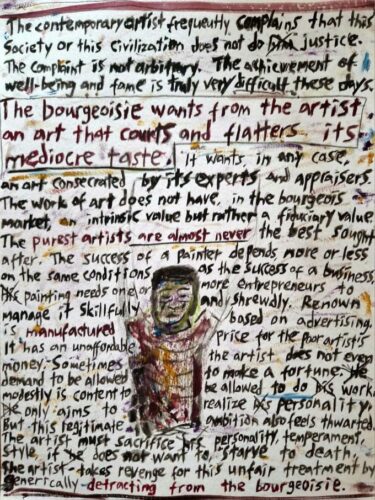
Cover image by Malmö-based artist, musician, and political scientist Julian Dannefjord (@proleartthreats). Original quotation from José Carlos Mariategui (1923). Translation of the quotation from Spanish to English was done by the artist.