Debt, Domicide, and the Politics of Method in Urban Studies
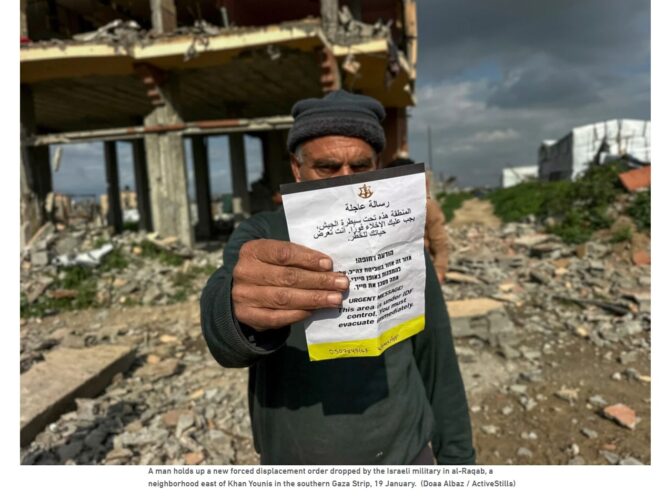
The cover image for this article was taken by Doaa Albaz and used with permission by ActiveStills. Please consider donating to this fundraising campaign to help ActiveStills with equipment.
The author would like to recognize research assistance by Ms. Nawaal Saksouk, architect and research assistant at Public Works Studio.
Introduction
Across sites of open warfare and cities governed by markets alike, housing has become a central terrain of dispossession. This article advances two propositions. First, that war and financialization are not sequential—destruction followed by reconstruction—but coexisting and continuous within a single temporality of capitalist accumulation. Second, that these processes are not primarily organized at the level of the nation-state, but are structured transnationally through circuits of debt, militarized governance, and legal expertise that bind disparate geographies into a single field of accumulation.
Urban scholarship has largely disaggregated these dynamics. Work on war foregrounds violence, sovereignty, and rupture, while research on financialization treats housing as an asset class within national political economies. In both, housing is analytically contained—either as a casualty of conflict or as a site of market exchange. This article argues instead that housing is an infrastructure of social reproduction enclosed through the joint and ongoing operation of war and financialization within capitalism. These are not distinct processes that follow one another, but mutually constitutive mechanisms operating simultaneously and across borders.
In this sense, war is not external to housing markets or an interruption of them, but constitutive of their formation and operation within capitalism, alongside financialization. Financialization, as used here, refers not simply to the expansion of finance, but to the reorganization of access to the means of life—especially housing—through debt, speculative valuation, and the subordination of social provision to profit. Housing becomes both a vehicle for accumulation and a tool of macroeconomic management, tying everyday survival to global circuits of capital. Crucially, financialization does not displace violence; it is sustained by and intertwined with it.
Foregrounding temporality and transnationality shifts the analytical frame. War no longer appears as an external shock to otherwise stable housing markets, nor does financialization appear as a peacetime economic transformation. Instead, both emerge as co-produced modalities of capitalist enclosure, operating through overlapping rhythms—destruction, anticipation, and reconstruction—and through transnational networks, linking sites such as Gaza and Beirut to global financial and geopolitical infrastructures. States, militaries, and developers remain central actors, but they operate within a broader field structured by global capital as a driving force of accumulation.
The claim is therefore not only analytical but political. Housing studies, precisely because it sits at the intersection of everyday life and macroeconomic transformation, offers a privileged vantage point: to show capitalism not as an abstraction, but as a historically produced and violently maintained order with decisive consequences for housing and life itself, challenging technocratic housing policy and liberal accounts of capitalism alike.
The article moves from theory to case and back to theory. It revisits debates on war, financialization, and urban political economy, showing how Middle East housing studies unsettles their separation. It then draws on approaches that treat the Nakba not as rupture but as ongoing structure, developing Palestine as a conceptual anchor. Gaza, in particular, makes unusually explicit the simultaneity of destruction and speculative imaginaries of redevelopment. That lens sharpens how we understand Lebanon’s postwar housing regime—as one inseparable from transnational debt governance, through which global capital disciplines states and reorganizes social life. Housing, in this account, brings war and financialization into a single frame: capitalist enclosure of the means of life. The article concludes by turning to method, arguing for action research that names capitalism and social justice, follows value across borders, and remains grounded in lived experience through collective, transnational inquiry.
Housing at the Fault Line of War and Capital
Critical urban scholarship has long insisted that housing is more than shelter. It is a store of value, a site of rent extraction, a financial asset, and increasingly a substitute for welfare (Harvey, 1982; Aalbers, 2016; Krippner, 2011). The built environment absorbs crisis and binds housing finance to state power; homeownership disciplines labor and shapes political behavior. Yet within this framework, war often appears as an external shock, an interruption that resets accumulation, rather than as something constitutive of housing markets themselves.
A parallel body of work places violence at the center. Housing is analyzed as military infrastructure (Weizman, 2007) or as a terrain of differential exposure to death (Mbembe, 2003; 2019). These approaches illuminate sovereignty and coercion, but they often bracket the political economy of debt and accumulation through which violence is financed and reproduced.
Naomi Klein’s The Shock Doctrine (2007) and David Harvey’s The Condition of Postmodernity (1989) offer a bridge. Klein shows how war and disaster enable privatization and asset transfer through reconstruction. Harvey’s notion of “creative destruction” captures how capitalism resolves crises through the destruction and remaking of the built environment. Middle East housing studies pushes these insights further. In contexts such as Lebanon and Gaza, destruction and speculative redevelopment do not unfold sequentially but simultaneously; war is not an episodic interruption to normalcy but a structural condition through which accumulation and financialization operate. In this context, housing becomes a privileged lens for seeing capitalism beyond liberal narratives of orderly markets and voluntary exchange.
Across the region, scholarship shows that accumulation and coercion are not separable processes. Gulf urbanization is embedded in militarized oil regimes and labor coercion (Hanieh, 2011). In Cairo, housing functions simultaneously as a welfare substitute and an accumulation strategy under military control of land (Sims, 2012). In Egypt, more broadly, displacement laid the groundwork for a housing crisis later intensified by deregulation and cronyism (Shawkat, 2020). And in Beirut, war forms the structural precondition for reconstruction and real estate development (Fawaz, 2009; 2025).
It is in Palestine, however, that the unity of war and financialization becomes most explicit. Kareem Rabie’s Palestine Is Throwing a Party and the Whole World Is Invited (2021) shows how neoliberal development in the West Bank substitutes for sovereignty under occupation, producing luxury apartments and commercial centers marketed to a transnational Palestinian middle class even as territorial fragmentation deepens. Roy (2016) sharpens this point through the paired cases of Ramallah and Rawabi, tracing how a donor-and-developer language of “resilience” and normalcy is materialized as an urban identity project that promises futurity through property, masterplanning, and middle-class consumption while remaining structurally contingent on the infrastructures and permissions of occupation. Chitti and Moser (2019), meanwhile, urge urban scholars to track the often-neglected actors who build this landscape—developers, consultants, and investors—and to read Palestinian urbanization as imbricated in wider market-based processes, including Gulf-backed real-estate projects, rather than as an urban reality reducible to episodic escalations of violence. Here, violence and speculation do not take turns; they operate simultaneously as a continuous process.
The Nakba as Structure: Palestine as Conceptual Anchor
This article argues that Palestine should not be treated as an extreme or exceptional case, but as a conceptual anchor for naming the structural relationship between war and financialization.
Palestinians use the term Nakba to describe the iterations of settler colonialism, apartheid, and genocide in their context, and recent scholarship has increasingly adopted the concept as well. The argument has even been made for recognizing the Nakba as a legal category within international human rights law (Eghbariah, 2024).
Here, the Nakba is understood not as a discrete historical rupture but as a durable structure. Its persistence is underscored by recurring threats by Israeli public figures to “repeat the Nakba” (Asif, 2023). From early Zionist writings that compared the colonization of Palestine to the dispossession of Native Americans (Jabotinsky, 1923), to the present confinement of Palestinians to densely packed, fragmented spaces deprived of adequate housing, healthcare, and economic opportunity—recalling indigenous reservations (Badr-Wągrowska, 2025, p. 399; Salaita, 2016)—the logic has remained consistent. The Nakba, then, is not an aberration but a durable mode of rule.
Gaza, moreover, has made starkly visible the articulation of speculative imaginaries with ongoing war. U.S. officials have referred to the territory as “valuable waterfront property” (Kushner, 2024), while proposals for a “Gaza Riviera” circulate alongside bombardment (Trump, 2025). Asked about the cost, funding, and organization of Gaza’s reconstruction, Steve Witkoff, a real-estate developer turned U.S. envoy, stated that “we’ve been working on masterplans for the last two years,” suggesting that planning imaginaries predated the assault (Witkoff, 2025). These statements do not simply reflect opportunism. They reveal how speculative planning and war are co-produced.
Reading the Nakba as structure compels a shift in theory. War and financialization are not best understood as successive phases—destruction followed by reconstruction—but as co-produced mechanisms of enclosure. The stakes of this shift become clearer when extended beyond Palestine. In Lebanon, for instance, it reframes the question from how war produced a postwar order to how “postwar” itself operates as a recurrent modality of war-finance, repeatedly reopening housing and infrastructure to expropriation, debt, and speculative redevelopment.
Lebanon: Financial Privilege Earned in War
Hannes Baumann’s Citizen Hariri (2016) shows how wartime elites consolidated power in Lebanon through postwar state restructuring, sovereign debt, and real estate-led development—demonstrating how political authority and accumulation were made together.
Before the civil war formally ended, the bulldozers of Lebanese-Saudi contractor Rafic Hariri were already clearing rubble in downtown Beirut in preparation for a privatized redevelopment model that would crystallize in Solidere, the company founded by Hariri after his appointment as prime minister (Baumann, 2016, pp. 67–69; Makdisi, 1997, p. 667; fn. 15, p. 674). Marketed as national recovery, its project recast the Beirut Central District as a space of investment, consumption, and global connectivity (Solidere, 1995, p. 5; Makdisi, 1997, p. 675). Yet, this transformation relied on large-scale expropriation, the suspension of ordinary property rights, and the consolidation of urban land under a corporate vehicle tightly coupled to political power. Solidere institutionalized a financialized mode of urban development not simply after war, but through legal and political arrangements forged in its wake (Mhanna, 2021; Zbeeb, 2021).
This urban transformation was embedded in a debt regime from the outset. Reconstruction was financed through sovereign borrowing at extraordinarily high interest rates, among the highest globally and historically (Salti, 2019). Under conventional macroeconomic logic, such debt would have forced currency depreciation. Instead, the Banque du Liban (BdL) pegged the currency to the dollar, shielding creditors at the expense of productive sectors. Agriculture and industry collapsed under an overvalued exchange rate that made Lebanese exports uncompetitive and made imports cheaper than local production. Sustaining the peg, however, required dollar inflows—flows the economy could no longer generate (Bloomberg, 2020).
Housing became the substitute engine of dollarization and liquidity. The postwar absence of a housing strategy and the dismantling of state capacity were not simply governance failures but conditions of possibility. They created a vacuum in which the market became the dominant route to shelter (Mhanna, 2019; Saba Ayon, 2021). Into that vacuum stepped subsidized mortgage lending—framed as housing policy but revealed over time to be a central instrument of monetary management. The Public Corporation for Housing partnered with commercial banks to issue subsidized, low-interest mortgages, while BdL circulars relaxed reserve requirements and encouraged banks to treat mortgage portfolios as secure assets, folding housing finance into balance-sheet stabilization and liquidity management (Fawaz, 2025; Nahle, 2019).
Housing thus functioned less as shelter than as a node in the defense of the currency and creditors’ interests. Rising prices justified larger mortgages; mortgages inflated prices; inflated prices sustained dollar reserves (Bekdache et al., 2021). Access to credit remained concentrated among higher-income groups and politically connected elites, whose average loan values were far larger than the rest (Fawaz et al., n.d., p. 24; fig. 12, p. 26). Meanwhile, wages stagnated even as property values multiplied (Nahle, 2019).
When regional instability intensified after 2011, dollar inflows slowed, exposing the fragility of the model. What remained was one of the world’s highest debt-to-GDP ratios and no productive base capable of sustaining it (Chaker, 2020b). When banks began retreating from new Eurobond purchases, the BdL responded with “financial engineering,” masking insolvency through monetary expansion: it effectively printed lira and sold it at a massive discount to meet rising dollar-denominated interest obligations. Then, when inflation loomed, the BdL abruptly tightened credit; subsidized mortgages were cut. In short, housing was sacrificed to protect creditors (Chaker, 2020a). Even if housing is widely recognized as an engine of accumulation rather than a universal provision, the Lebanese case renders inescapable a conclusion less readily acknowledged in more stable contexts: that, under capitalism, the means of life are subordinated to profit.
These were not policy errors but the expression of a political-economic coalition, consolidated through war and stabilized through finance. By 2016, 18 of the country’s 20 largest banks were owned by politicians in government or parliament, and they controlled 43 percent of banking assets. Five percent of developers, politically connected, controlled half of Beirut’s reconstruction and benefited from zoning exceptions and privileged access to credit (Fawaz, 2025). These actors consolidated power through wartime alliances and political brokerage. Their access to transnational capital was forged within Cold War geographies of proxy conflict and regional patronage: Hariri’s appointment in 1992 coincided with Saudi deposits at the BdL that stabilized the currency (Al-Baqmi, 2016), translating political leverage into financial privilege and enabling sustained dollar borrowing.
Even if housing is widely recognized as an engine of accumulation rather than a universal provision, the Lebanese case shows that it can be withdrawn altogether when it threatens financial stability, rendering inescapable what more stable contexts tend to obscure: that the issue is not one of degree but of essence—under capitalism, the means of life are subordinated to profit.
What Gaza adds to the Lebanon story is a more disturbing temporality. If Citizen Hariri and related accounts show how war-made coalitions translated violence into postwar finance and real estate, Gaza makes it harder to sustain the very category of “postwar.” Today the US proposes an “investment hub potentially linked to Eastern Mediterranean gas projects” in a South Lebanon that remains under daily bombardment (Ghazeye, 2025). When the destruction of the built environment and its reopening as a speculative frontier occur—and recur—together, what emerges is a durable regime of accumulation. This dynamic recalls Harvey’s notion of “creative destruction,” through which capitalism remakes space in response to crisis, but here, destruction and speculative redevelopment are not successive moments—they unfold simultaneously. Reconstruction is not an “after” but a recurrent modality of rule, and housing can no longer be understood as a policy field periodically disrupted by crisis. It must be read instead as a site where war, debt, and speculation are structurally intertwined. Housing struggles, on this reading, confront not isolated policies but rather an enduring regime of enclosure.
Enclosure as Global System: War and Debt Beyond Borders
Lebanon shows that housing financialization is inseparable from the growth of sovereign debt and that both are produced through a transnational alliance of political and financial interests. The linkage becomes most visible at the moment of default, when what appears to be a “national” crisis reveals itself as a field of cross-border governance.
Since the 1990s, international donor and creditor conferences repeatedly stabilized Lebanon’s increasingly unsustainable public debt, which remained highly lucrative to creditors. These were not neutral technocratic events: they were staffed by foreign policy officials of global powers, by the IMF and World Bank, and by functionaries of global finance, binding Lebanon’s fiscal policy to geopolitical priorities and creditor expectations (El Halabi, 2018). When the state resorted to austerity to sustain strained finances while waiting for a stalled donor cycle, an uprising erupted. In October 2019, protesters objected to debt repayment when the last dollar reserves could instead sustain a few additional months of vital imports—fuel, flour, and medicine—demanding that social survival be prioritized over creditor claims (National News Agency, 2020a; 2020b; Chaker, 2020b).
This is when global capital stepped in with all its might, as anticipation of default reshaped the terrain of power. Foreign funds acquired controlling stakes in Lebanese debt, shifting leverage to actors able to litigate, veto, and impose timelines on international terms. Ashmore, active across sovereign-debt crises in Argentina, Ecuador, Venezuela, and Lebanon, exemplifies this distressed-debt ecosystem, which combines speculation with legal and political pressure to secure repayment from Global South governments (Abelson and Porzecanski, 2014). To lobby for a “solution” centered on privatization—the transfer of public assets to debt holders, further constraining public capacity—the Association of Banks in Lebanon did not turn to a local authority, but to France (Kraiche, 2020). At stake in these negotiations are not abstract fiscal balances, but concrete assets—including urban land that could support social housing and public funds that might otherwise subsidize mortgages—reoriented toward creditor recovery. What began as a distributive conflict within Lebanon was transformed into a governance issue managed through geopolitics rather than democratic will, with global capital subordinating social provision to financial claims.
Nor is this a discrete story. Imperial debt governance has been ongoing for centuries, and it relies on military power—sometimes implicitly, sometimes explicitly (Toussaint, 2016). This is not only a pattern in war-torn settings; it extends to ostensibly stable contexts. Using the U.S. subprime crisis as a prime example, Herman Schwartz and Leonard Seabrooke (2009) show that housing booms in contract-governed settings are politically constructed growth strategies rather than market accidents. When they collapse, public balance sheets are bled to stabilize private finance, exposing the asymmetry of protection afforded to creditors.
In short, debt governance and war are not separate logics. They are intertwined forms of enclosure operating across borders, varying in form over space and time but remaining legible as capitalism’s recurrent means of extracting value from the means of life.
Housing as Infrastructure of Social Reproduction
Housing makes the unity of war and debt visible when it is understood not as an asset class but as infrastructure of social reproduction—alongside education, childcare, water, transport, and health. These domains are targeted in war zones such as Gaza, but they are also steadily enclosed in ostensibly stable contexts. From Medicare and Medicaid to subprime credit expansion, states and capital redraw the boundary between public goods and commodities through privatization and debt.
Feminist and Marxist approaches clarify what is at stake. Nancy Fraser (2016) describes capitalism’s enduring tension between accumulation and social reproduction. Silvia Federici (2018) shows how enclosure shifts the costs of crisis onto households through rent, mortgages, and unpaid labor, while militarization facilitates dispossession. Angela Mitropoulos (2012) foregrounds how contractual debt disciplines populations, reorganizing life through selectively enforced obligation. In Middle East urban studies, these contradictions often surface through the tension between use and exchange value, captured in debates over the “right to the city” (Mitchell, 1995).
Analyzed in this framework, Palestine and Lebanon sharpen the stakes. Housing becomes the terrain on which enclosure is most tangible. Mortgage default in Beirut and domicide in Gaza no longer appear as separate crises; they appear as expressions of a single structural logic—capitalism’s drive to extract value from the means of life, through contracts or through force, and often through both at once.
From Analysis to Struggle: Housing and the Politics of Method
The importance of structural analysis becomes clearer when we trace how its post–Cold War retreat reshaped political practice. In Palestine, liberation and decolonization were recast as market integration, pressuring political strategies toward accommodation (Rabie, 2021). In Lebanon, national aspirations were reframed as investment opportunities. With hindsight, this turn produced disenfranchisement and demobilization rather than emancipation.
In many contexts, urban justice movements in the 1990s shifted from redistributive and property-challenging demands toward technocratic frames of governance reform and financial access. In contrast to the militant tenant movements and squatting struggles of the 1970s and 1980s, which openly challenged property regimes and state authority (Castells, 1983; Marcuse, 1986; Pruijt, 2003), post–Cold War housing politics increasingly unfolded within managerial vocabularies, reflecting what scholars have described—particularly in the wake of 2008—as the NGO-ization, managerialization, and depoliticization of urban struggles (Brenner, Peck, and Theodore, 2010; Marcuse, 2009; Miraftab, 2009).
A structural vocabulary reopens the political horizon narrowed in the post–Cold War era. It allows converging movements to recognize shared antagonisms and align across borders. It expands the political tools available to housing struggles, reconnecting them to longer histories of decolonization and social justice rather than confining them to questions of affordability or regulation. In this sense, what is unfolding in Gaza is not only a humanitarian catastrophe but a theoretical turning point—one that demands renewed clarity about the systems at stake and the forms of knowledge required to confront them.
This shift has methodological consequences. Rather than treating housing markets as bounded national systems, research must follow money across borders patiently and rigorously: tracing value generated through war, reconstruction, and debt; mapping the legal and technical expertise involved in capturing it; and analyzing how local politics and geopolitics both shape and are shaped by these dynamics. It must also connect hyperlocal experiences—evictions, mortgage defaults, infrastructure breakdown—to transnational architectures of capital and governance. To study housing today is to map power across scales.
Such work is already underway in the Middle East. At Public Works Studio in Beirut, for instance, the Land Policy Observatory[1] tracks zoning, ownership, and the legal instruments of redevelopment, while the Housing Monitor[2] follows everyday precarity—evictions, landlord practices, building conditions—and provides a platform for testimony and support. By centering personal accounts, the Housing Monitor renders lived experiences legible as collective conditions rather than isolated misfortunes. In partnership with public interest advocacy platform Legal Agenda, Public Works Studio sometimes intervenes to support tenants. These interventions cannot be scaled to resolve structural injustice, but they produce forms of knowledge unavailable through statistics or secondary literature alone that inform a broader politics of housing justice. These efforts blur the line between research and organizing, producing knowledge that is both analytical and actionable.[3] Cross-border research infrastructures such as the Housing Justice Network[4] extend this approach, building shared structural analysis alongside locally grounded responses.
Conclusion: Housing, Capitalism, and Transnational Politics
Moving from Palestine as conceptual anchor to Lebanon as bridge to imperial debt governance, this article has argued for reading housing as infrastructure of social reproduction enclosed through war and financialization. These are not sequential phases—destruction followed by reconstruction—but co-produced mechanisms operating within a single capitalist logic. To recognize this requires naming capitalism, rather than treating its effects as policy failure or deviation from a liberal ideal.
Housing studies offers a particularly generative site for such a critique. Taken together, Palestine and Lebanon expose the cyclicality through which war, debt, and redevelopment reorganize space and life in ways central to global accumulation. Gaza makes unusually visible the simultaneity of war-making and speculative development. Through this lens, local housing struggles become legible as confronting a transnational system rather than isolated crises.
If housing is where war and debt converge most concretely, then housing studies cannot remain neutral. A liberatory urban research agenda must refuse the split between analysis and struggle and build theoretical, methodological, and organizational infrastructures across borders. The task is daunting—politically fraught and materially demanding—but urgent, because housing is emerging as a powerful site of political articulation. As Mamdani’s New York victory suggests, demands around rent and debt can once more be articulated alongside principled solidarity with Palestine—expanding political imagination and restoring a line of sight between housing justice and anti-colonial struggle that the post–Cold War order worked hard to obscure. Naming capitalism is not an academic gesture; it is a political precondition for building the solidarities that contemporary urban life demands: a global housing movement rooted in research and able to speak across sectors and borders as easily as capital does.
[1] Public Works Studio, Land Observatory https://publicworksstudio.com/en/observatory/
[2] Public Works Studio, Housing Monitor https://publicworksstudio.com/en/housing-monitor/
[3] Other examples include Cairo’s Built Environment Observatory https://marsadomran.info/en/, and Beirut’s City of Tenants platform https://beiruturbanlab.com/en/Details/891
[4] Housing Justice Network https://www.instagram.com/housing.justice.network/
References
Aalbers, M. (ed.) (2016) The Financialization of Housing: A Political Economy Approach. London: Routledge. Available at: https://doi.org/10.4324/9781315668666
Abelson, M. and Porzecanski, K. (2014) ‘Argentina’s vulture Paul Singer is a Wall Street freedom fighter’, Bloomberg, 1 May. Available at: https://www.bloomberg.com/news/articles/2014-08-07/argentinas-vulture-paul-singer-is-wall-street-freedom-fighter (Accessed: 25 February 2026).
Al-Baqmi, S. (2016) ‘[What if Saudi Arabia withdrew its financial deposits from the Central Bank of Lebanon?] “Maza law sahabat al-Sa‘udiyya wada’i‘aha al-maliyya min al-bank al-markazi al-lubnani?”’, Asharq Al-Awsat, 22 February. Available at: https://rb.gy/6oknfb (Accessed: 25 February 2026).
Asif, Y. (2023) ‘Israeli Knesset member calls for second “Nakba” amid ongoing conflict with Hamas’, Al Arabiya English, 8 October. Available at: https://english.alarabiya.net/News/middle-east/2023/10/08/Israeli-Knesset-member-calls-for-second-Nakba-amid-ongoing-conflict-with-Hamas (Accessed: 25 February 2026).
Badr-Wągrowska, J. (2025) ‘Settler colonialism and statehood: a comparative analysis of the USA and Israel’, Eastern Studies, 19, pp. 387–417. Available at: https://doi.org/10.4467/20827695WSC.25.021.22834
Baumann, H. (2016) Citizen Hariri: Lebanon’s Neoliberal Reconstruction. London: Hurst.
Bekdache, N. et al. (2021) ‘Home loans exacerbate inequality: a report on the defaulters’ complaints to the Housing Monitor’, Housing Monitor, 15 March. Available at: https://publicworksstudio.com/en/home-loans-exacerbate-inequality/ (Accessed: 25 February 2026).
Bloomberg (2020) ‘Currency peg’s implosion is taking the Lebanese economy down with it’, Gulf News, 27 June. Available at: https://gulfnews.com/world/mena/currency-pegs-implosion-taking-lebanese-economy-down-with-it-1.71933276 (Accessed: 25 February 2026).
Brenner, N., Peck, J. and Theodore, N. (2010) ‘After neoliberalization?’, Globalizations, 7(3), pp. 327–345. Available at: https://doi.org/10.1080/14747731003669669 (Accessed: 25 February 2026).
Castells, M. (1983). The City and the Grassroots: A Cross–Cultural Theory of Urban Social Movements. Berkeley: University of California Press.
Chaker, J. (2020a) ‘[The Banque du Liban is using housing to increase bank profits] “Masraf Lubnan yusakhkhir al-iskan li-ziyadat arbaah al-masarif”’, Jadaliyya, 5 January. Available at: https://www.jadaliyya.com/Details/40412 (Accessed: 25 February 2026).
Chaker, J. (2020b) ‘The Lebanese economic crisis 101’, Jadaliyya, 23 March. Available at: https://www.jadaliyya.com/Details/40855 (Accessed: 25 February 2026).
Eghbariah, R. (2024) ‘Toward Nakba as a legal concept’, Columbia Law Review, 124(4), pp. 887–992.
El Halabi, B. (2018) ‘Billions pledged at Paris conference in attempt to boost ailing Lebanese economy’, France24, 6 April. Available at: https://www.france24.com/en/20180406-lebanon-france-11-billion-pledged-paris-conference-attempt-boost-economy (Accessed: 25 February 2026).
Fawaz, M. (2009) ‘Neoliberal urbanity and the right to the city: a view from Beirut’s periphery’, Development and Change, 40(5), pp. 827–852. Available at: https://doi.org/10.1111/j.1467-7660.2009.01585.x
Fawaz, M. (2025) ‘Beirut: A city for sale?’, Beirut Urban Lab. Available at: https://www.beiruturbanlab.com/en/Details/612/beirut%E2%80%99s-residential-fabric (Accessed: 25 February 2026).
Fawaz, M. et. al., (n.d.) ‘Lebanon’s Housing Ecosystem and Self-Recovery Pathways’, Beirut Urban Lab. Available at: https://beiruturbanlab.com/en/Details/867 (Accessed: 25 February 2026).
Federici, S. (2018) Re-enchanting the World: Feminism and the Politics of the Commons. Oakland, CA: PM Press.
Fraser, N. (2016) ‘Contradictions of capital and care’, New Left Review, 100, pp. 99–117.
Ghazeye, B. (2025) ‘Trump’s economic zone: a new “Gaza Riviera” in South Lebanon?’, The New Arab, 3 September. Available at: https://www.newarab.com/analysis/trumps-economic-zone-new-gaza-riviera-south-lebanon (Accessed: 25 February 2026).
Hanieh, A. (2011) Capitalism and Class in the Gulf Arab States. New York: Palgrave Macmillan.
Harvey, D. (1982) The Limits to Capital. Oxford: Basil Blackwell.
Harvey, D. (1989) The Condition of Postmodernity. Oxford: Basil Blackwell.
Jabotinsky, Z. (1923) ‘The Iron Wall’, Razsviet, 4 November. Available at: https://en.jabotinsky.org/media/9747/the-iron-wall.pdf (Accessed: 25 February 2026).
Klein, N. (2007) The Shock Doctrine: The Rise of Disaster Capitalism. Toronto: Knopf Canada.
Kraiche, D. (2020) ‘Lebanese banks turn to France to outflank government rescue plan’, Bloomberg, 16 September. Available at: https://www.bloomberg.com/news/articles/2020-09-16/lebanese-banks-turn-to-france-to-outflank-government-rescue-plan (Accessed: 25 February 2026).
Krippner, G. (2011) Capitalizing on Crisis. Cambridge, MA: Harvard University Press.
Kushner, J. (2024) ‘Middle East Dialogues’, interview by T. Masoud, Harvard Middle East Initiative, YouTube, 8 March. Available at: https://www.youtube.com/watch?v=dtaIHr5S0ts (Accessed: 25 February 2026).
Mhanna, M. (2019) ‘[What housing policies in Lebanon?] “Ayy siyasat iskan fi Lubnan?”’, The Legal Agenda, 2 July. Available at: https://shorturl.at/eedfP (Accessed: 25 February 2026).
Mhanna, M. (2021) ‘[Interview with Mohammed Zbeeb: Monopolistic structures at the heart of the regime’s crisis] “Muqabala ma‘ Mohammed Zbeeb: al-buna al-ihtikariyya fi samim azmat al-nizam al-qa’em”’, The Legal Agenda, 6 May. Available at: https://tinyurl.com/yc57427y (Accessed: 25 February 2026).
Makdisi, S. (1997) ‘Laying claim to Beirut: urban narrative and spatial identity in the age of Solidere’, Critical Inquiry, 23(3), pp. 660–705. Available at: https://www.jstor.org/stable/1344040 (Accessed: 25 February 2026).
Marcuse, P. (1986). Abandonment, Gentrification, and Displacement: The Linkages in New York City. In N. Smith & P. Williams (Eds.), Gentrification of the City (pp. 153–177). Boston: Allen & Unwin.
Marcuse, P. (2009) ‘From critical urban theory to the right to the city’, City, 13(2–3), pp. 185–197.
Mbembe, A. (2003) Necropolitics. Expanded edition (2019). Durham, NC: Duke University Press.
Mitchell, D. (1995) The Right to the City. New York: Guilford Press.
Mitropoulos, A. (2012) Contract and Contagion. New York: Minor Compositions.
Miraftab, F. (2009) ‘Insurgent planning: situating radical planning in the Global South’, Planning Theory, 8(1), pp. 32–50.
Nahle, Y. (2019) ‘[The infernal plan of the Bank of Lebanon to deprive the Lebanese of housing] “Al-mukhatat al-jahannami li-Masraf Lubnan fi hirman al-Lubnaniyyin min al-sakan”’, Almodon, 12 August. Available at: https://tinyurl.com/mwz2w77h (Accessed: 25 February 2026).
National News Agency (2020a) ‘[March to Parliament demanding a financial rescue plan] “Masira ila al-majlis al-niyabi mutaliba bi-khitat inqadh maliyya”’, I’m Lebanon, 27 January. Available at: https://www.imlebanon.org/2020/01/27/revolution-43/ (Accessed: 25 February 2026).
National News Agency (2020b) ‘[Groups from the October 17 Movement: For a comprehensive restructuring of debt] “Majmu‘at min Hirak 17 Tishrin: li-i‘adat haykala shamilah lil-dayn”’, Lebanese Forces, 28 February. Available at: https://www.lebanese-forces.com/2020/02/28/17-october/ (Accessed: 25 February 2026).
Pruijt, H. (2003). “Is the Institutionalization of Urban Movements Inevitable? A Comparison of Squatting Movements in Amsterdam and Berlin.” International Journal of Urban and Regional Research, 27(1), 133–157.
Rabie, K. (2021) Palestine Is Throwing a Party and the Whole World Is Invited. Durham, NC: Duke University Press.
Saba Ayon, M. (2021) ‘On the absence of state housing policies’, Public Works Studio, 3 August. Available at: https://publicworksstudio.com/en/about-the-absence-of-state-housing-policies/ (Accessed: 25 February 2026).
Salaita, S. (2016) ‘The Native American model for Palestine’s future’, The Electronic Intifada, 10 March. Available at: https://electronicintifada.net/blogs/steven-salaita/native-american-model-palestines-future (Accessed: 25 February 2026).
Salti, N. (2019) ‘No country for poor men’, Carnegie Middle East Center, 17 September. Available at: https://carnegieendowment.org/research/2019/10/no-country-for-poor-men-how-lebanons-debt-has-exacerbated-inequality?lang=en¢er=middle-east (Accessed: 25 February 2026).
Schwartz, H. and Seabrooke, L. (eds.) (2009) The Politics of Housing Booms and Busts. London: Palgrave Macmillan.
Shawkat, Y. (2020) Egypt’s Housing Crisis. Cairo: The American University in Cairo Press.
Sims, D. (2012) Understanding Cairo. Cairo: The American University in Cairo Press.
Solidere (1995) The Development and Reconstruction of Beirut Central District [Information Booklet]. Lebanon: Solidere.
Toussaint, E. (2016) ‘Greece: continued debt slavery’, Committee for the Abolition of Illegitimate Debt, 17 May. Available at: https://www.cadtm.org/Greece-Continued-debt-slavery-from (Accessed: 25 February 2026).
Trump, D. (2025) ‘Gaza 2025: What’s next?’, Instagram Reel, 26 February. Available at: https://www.instagram.com/reels/DGhfpgHsOg6/ (Accessed: 25 February 2026).
Weizman, E. (2007) Hollow Land. London: Verso.
Witkoff, S. (2025) ‘Extended interview with Jared Kushner and Steve Witkoff’, 60 Minutes, 19 October. Available at: https://www.cbsnews.com/news/jared-kushner-and-steve-witkoffs-extended-60-minutes-interview/ (Accessed: 25 February 2026).
Zbeeb, M. (2021) ‘[The monopolistic structure at the heart of the existing regime’s crisis] “Al-Buna al-Ihtikariya fi Samim Azmat al-Nizam al-Qa’em”’, The Legal Agenda, 12–15 May.