Rules of Fames- Negotiating the legal in subcultural Graffiti
Videor, ergo sum – I’m seen, therefore I exist – is in many ways a perfect description of graffiti in its subcultural form. Subcultural in the sense of a systemized and highly ritualized way of performing a self-made-up name – by writing a tag – in a stylish way. The subcultural subject is constructed and maintained through other writers recognizing that name, establishing a sense of belonging. Consequently, subcultural existence is achieved through a perceived presence (Schacter 2024).
The stress on visibility is intimately tied in the previous research to the notion of risk: “The more visible, the better” notes graffiti researcher Nancy MacDonald (2001, 76), and adds “[t]he greater the danger, the greater the respect” (ibid, 84). MacDonald further pushes the thrill of writing, pointing out that without the risk, writing graffiti becomes just routine, and even “dead” (ibid., 114). From such a point of view, the layman’s framing of graffiti as “territorial pissing,” “dirt,” or pure “vandalism” appears adequate, or at least not absurd (Austin 2001). Graffiti is meant to stick out, a public eyesore, spotlighted through what Rafeal Schacter (2024, 17) has aptly called its adjunctive quality: it is not merely written upon a wall but impressed into it. Subcultural graffiti refuses assimilation, rupturing a sense of place.
This stress on visibility and risk begs the question of how graffiti writers refer to surfaces that lack those qualities. We have elsewhere (Hannerz & Kimvall, 2019) argued that open walls – as in walls ascribed by authorities as a surface to apply paint and express yourself on – constitute an anomaly in subcultural graffiti as they’re an officially granted and public negotiation of place rather than being based on a subcultural logic. In this article, we would like to expand on the definition of the “legal” within subcultural graffiti. Our focus will be on what in graffiti are called “fames” or “soft spots” – walls and surfaces that fall outside of the public and perilous – and how their status, rules, and uses are negotiated through their perceived lack of visibility and risk rather than in spite of them.
Writing subcultural graffiti
As noted in the introduction, the ritualized aspect of subcultural graffiti refers to the establishment of an existence. First, graffiti is written, as in writing a name. One’s subcultural identity is primarily performed through this name, through a tag which is chosen, designed, established, claimed, and defended through repeated writing of that name, ideally to the point that other writers cannot avoid one’s name and thus one’s being (MacDonald 2001). Writers thus both collaborate and compete for the attention of other participants, a non-commercial (sub)version of the “attention economy,” where to exist is not just to be seen, but also to be talked about. Consequently, writers are also battling transit authorities, municipalities, security companies, and cleaning firms, who all, in various way,s seek to prevent or remove graffiti and erase the attempts of a subcultural existence (Kramer 2010).
The aesthetic system
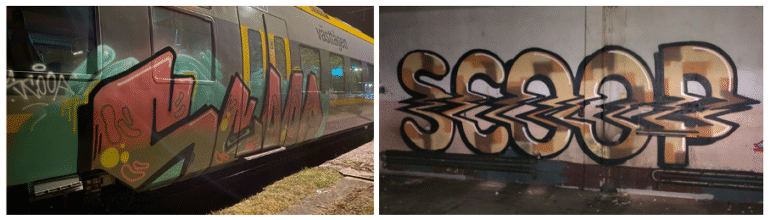
Second, subcultural graffiti refers to an aesthetic system of established forms. Whereas latrinalia, political graffiti, or street art are pragmatic in their doings and open in the visual outcome, subcultural graffiti refers to an aesthetic system established in New York City in the early 1970s and fully developed by the end of the decade. The written tag is the foundation, and the subcultural name is not referred to as a proper noun but as a verb. It’s not “what’s your name?” and “I’m…” but “Whatchu write?” and “I write…” (Castleman 1982, 85-86). However, the subcultural name could also be designed as different “pieces,” or through a series of “throw-ups.” The first of these aesthetic forms thus refers to the tag (image 1), a form of signature, a single and monochrome layer written with a marker, spray can, or brush roller. As is seen in image 1, the form of the letters is repeated regardless of the size of the tag or the medium, as are added elements (in the photos, the halo and the added line under the “p”).
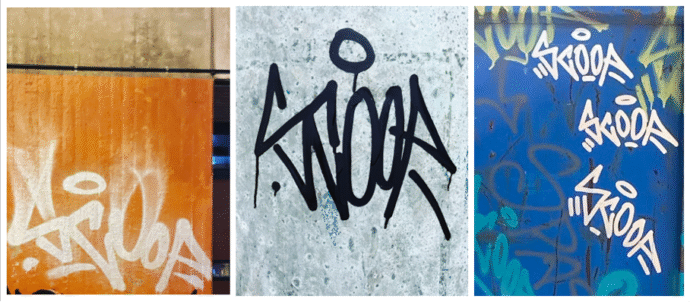
The second form of subcultural graffiti (image 2) – the piece – typically constitutes a substantially larger and more elaborate version of the name. It refers to a multilayered and polychrome form whereby the letters of the tags are stylized – a fill-in, background – and made to pop out from the surface through outlines, highlights, and second outlines. More so, distinct from the tag, the letters are repeated yet in different styles. The tag, used as a traditional signature, is also often included.
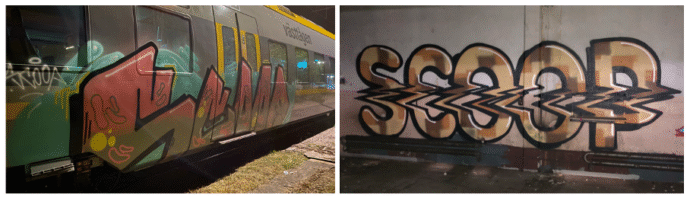
The third form (image 3) – the throw-up – usually combines the tag and the piece into a simple yet outlined form and an often abbreviated, two or three letter, version of the name. In image 3, the same tag SCOOP is abbreviated into SCP, with simple and fast letters. Similar to the tag, and contrary to the piece, the throw-up is a form that is designed for repetition and a kind of mass production. Here, the function of the tag is not primarily as a signature, but rather as a caption explaining the abbreviation.
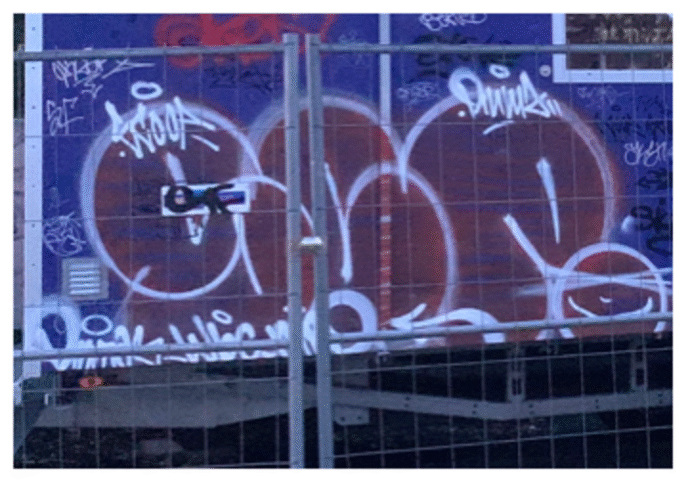
Participants also write collective tags, a group of friends or associates who share a similar name, or what in graffiti is called a crew. Writing this collective name, however, follows the same aesthetic form, meaning that participants are often able to trace out who has written a crew tag or done a crew piece through the individual style of the letters. These three forms were developed by the mid-1970s and soon merged into a fourth format: the production. This came with the invention of the “whole car” – where the entire side of a subway car is used as a canvas – often combining the piece and the tag to become elaborate messages containing sceneries and characters (Hannerz & Kimvall 2024).
Whereas writing a tag establishes a subcultural existence, the aesthetic system embellishes and negotiates the existence. Again, the name is not a proper noun but a verb. Single tags, pieces, and throw-ups of the same name are not perceived as separated or separating, but rather as symbolic representations of a whole, where every single bit of graffiti adds to the previous bits, and every surface taken, or distance covered, is appended to that which preceded it (Brighenti 2010). This creates a productive relationship between the activities, the artifacts, the individual bodies, and the subcultural structures of meaning that work to validate these relations, forming sequences that reaffirm one another (Hannerz 2024). Accordingly, subcultural graffiti is rhythmic both in the sense of the relation of the specific, and individual, to the whole, and collective, but also in the play between absence and presence and discontinuity and continuity: discontinuity through the individual doings at different times and in different places, continuity through the collective being that works to connect these disparities into a whole (Schacter 2014).
Just as with other forms of graffiti, subcultural graffiti can be, and is, written almost everywhere. The difference lies rather in the ritualization of space and the subcultural myths and history attached to such rituals (Andron 2024). Subcultural graffiti developed in the streets of Philadelphia and New York City in the late 1960s, with the first writers writing their name where they lived and would hang out. In the early 1970s this changed as writers – such as Taki 183 – started going all city, extending writing across different parts of the city. As graffiti evolved, so did its emplacements: moving objects such as buses, trucks, and subway trains were turned into distribution channels that disseminated one’s tag through the city, rather than the individual writer moving through the city. Further, the role of public transport as a moving, condensed mass of people that follows a single trajectory from a single distance and position opened up walls and objects along train tracks and highways as a way to stand out and attract the attention of other writers (Austin 2001).
Out-of-place as in the absence of risk
Over the last 15 years, we have followed and interviewed hundreds of graffiti writers in Sweden and documented their outcomes through photography. Whereas some of these writers mainly focus on trains, others prefer writing graffiti in the streets or along highways, and all also do graffiti in places that they refer to as “legal.” The legal is a complicated term in relation to subcultural graffiti, in part as it is used to refer to activities and surfaces that could be defined as within the realm of the juridically legal, including commissioned walls, curated walls, open walls, and gallery work (Hannerz & Kimvall 2019). In another part, it has also come to include surfaces that are juridically defined as illegal, yet subculturally treated and referred to as legal. In her book on Norwegian graffiti, criminologist Cecilie Høigård (2002, 130f) points to how the status of a wall as legal or illegal is defined subculturally through how the wall is perceived and used. If seen as disused and as involving little, if any, risk of getting caught, the wall is deemed as legal, regardless of its actual juridical status.
In our interviews and fieldwork, such walls are referred to as “soft spots” or “chill walls” defined through their out-of-placeness within other forms of graffiti. Often this refers to surfaces that are scattered around the countryside. Examples include the back side of a noise barrier by the highway, a derelict shooting range in the woods, or an abandoned warehouse or factory in the city peripheries. What these places have in common is a perceived absence of risk, largely defined through their lack of visibility. Whereas the side of the noise barrier facing the highway is highly visible from a car, the back of it is not only invisible, it is also largely inaccessible. Few people would by chance pass the underside of a rural bridge, or a transformation house by the train tracks in a rural area. Risk and visibility are thus spatially excluded, but also sought after. A recurrent representation of this absence of risk was stressing that in contrast to other walls, soft spots could be approached and used during daytime:
That the A and O really, I mean that what’s graffiti is about, it is about the space, and how you analyze space. I mean it is a lot about being seen and then you have to pick the right spot, or it is about finding a nice wall that is nicely situated so that it is really chill and you can stand there during the day.
Interview 22
Of course, you never want to get caught, you know, so you try to be as careful as possible with keeping watch and scoping, and never taking anything for granted, always trusting your gut feeling and that kind of stuff. But it depends, like, if it’s a station thing, if it’s something central, then it can be pretty nerve-wracking. But if it’s, like, out on the line in the woods, then you don’t really have to care that much—you can just stand there and, like, smoke a spliff at the same time. But then it also depends on whether you’re doing it during the day or not, though even then you know, like, how the hell are they supposed to get out here right away anyway? Then it’s mostly just that thing about trains honking and stuff if you get noticed.
Interview 17
These two excerpts are telling of how the soft spots, as in the “really chill” and “out on the line in the woods,” are differentiated from other places in graffiti, marked by their lack of visibility, or by their lack of preparations – as in keeping watch and scoping the place – due to a perceived absence of risk. The spatial seclusion allows for a temporal accessibility, articulated above through the emphasis on places that can be used in bright daylight rather than in the shadows of the night. More so, rather than being defined as stupid or irrelevant due to their lack of visibility, such spots were, as in these excerpts, highlighted as attractive due to this out-of-placeness. They add something else, a different feeling.
Before we move into the specifics of this affective trait of the “soft spots,” it is important to stress that what is perceived as being a space devoid of risk is not measured by objective standards. Whereas cutting through the bushes to reach the underside of a bridge, or jumping a demolition fence to enter an abandoned factory, may appear as devoid of risk to some participants, they were at times the opposite to writers who were new to the place or to graffiti. The second excerpt above, referring to a track side wall in the woods and the only risk being train drivers honking when passing by, was for example mentioned by other participants as examples of something thrilling or potentially scary. Accordingly, what matters is not just how the wall is perceived but also how it is used and felt.
Feeling the out-of-place
As implied in the second quote above, the out-of-place soft spots are perceived as different from other places in graffiti, not just because of their lack of visibility and risk, but also because they allow for a different kind of mood and approach than other spots in graffiti do: ”you don’t have to care about things and can smoke a spliff at the same time.” “Having a beer” is the standard representation of a soft spot in our empirical data, but other examples include bringing food, music, or even a sun chair, all of which would be bizarre in relation to doing graffiti in most other places. More importantly, participants stress the meditative and relaxing mood of these places, of letting go of everything else, including risk of detection, and being able to focus and take your time on the wall:
You know all aspects of life are connected, at the moment I have a rather hectic time at work, there are a lot of stressful situations and then I am in need of doing illegal stuff and going for the trains, whereas if I feel more calm and in harmony and if I’m satisfied with life, then focus is more on the legal and developing style, well maybe not LEGAL, but just working on your style and putting in more work.
Interview 5
Note the distinction here between the different aspects of the legal within subcultural graffiti. The writer corrects himself through the disclaimer that the legal walls that he is referring to are not really legal in a juridical sense, but legal as in allowing for a different approach and to do more elaborate works and develop one’s style.
Similarly, in the next excerpt, three writers start discussing the “almost legal,” stressing the social aspects of the easy and the chill spots. Spots that are “almost legal,” devoid of risk but more importantly through behavior and the use of space, as a consequence, differ from other kinds of spots:
1: A place that is [an] almost legal and easy place to do graffiti in.
2: Yeah a chill place where you can do graffiti and just don’t have the stress really. So you can go there daytime. […]
3: With the abandoned houses, normally you enjoy it most, when it’s only you and your friends there. Not hundreds of other people there.
2: Yeah, me too, I like that too under those forms.
3: Usually when it’s summer you bring beer.
1: It’s not really getting drunk to enjoy, it’s more like-
2: Socialize.
3: Yes to socialize and to calm myself (Interview 11).
The stress on the mood of the out-of-place is obvious in this excerpt. Even if the spot is chill, the presence of too many others risks robbing the moment of its relaxed mode. The “almost legal” or “maybe not LEGAL” is a dish best served alone or with one’s close friends so as to accomplish something more than merely writing graffiti, as in, finding a calm, enjoying the moment, or experiencing a heightened focus on the aesthetics.
The potential popularization of the soft spots – for example an abandoned factory building devoid of risk that attracts a subcultural crowd – leads us to a third aspect of the soft spots and the “legal”: how spatial anomalies are symbolically represented through a ritualized desacralization of the work of others.
The ”legal” as in legal rules
Given the stress on visibility in subcultural graffiti and that one’s subcultural existence is established through writing, the written name comes to constitute a subcultural sacred (MacDonald 2001). You are what you write, but what is written is also you. Once a writer has claimed a spot, that writer is deemed to own that very space. Going over someone else is accepted only through a bigger investment of time and risk, as in going bigger, or doing a piece over a tag or throw-up. The other way around, doing a tag or a throw-up over someone’s piece is, as the writer Shy expresses it in the classical graffiti documentary Style Wars (1983), a “never forgive action,” a violation of the other’s existence, a symbolic blow to the head. Hence, writers take care to avoid going over or even touching others’ graffiti, seeking out the voids next to, below, or above, others’ works and thus step by step covering available surfaces (Hannerz 2023). In principle, soft spots in our interviews and fieldwork are no exception. Even if a space is hard to reach, hard to see, and as a consequence perceived as devoid of risk, as long as there is available space, the prohibitions surrounding the sanctity of the already-marked are upheld. One example in our data comes from two pieces from Malmö documented in June 2008. A piece by Penso is painted above an obviously much older, worn, and bleached piece by Marr, and the relationship between the two pieces is further
The ”legal” as in legal rules
Given the stress on visibility in subcultural graffiti and that one’s subcultural existence is established through writing, the written name comes to constitute a subcultural sacred (MacDonald 2001). You are what you write, but what is written is also you. Once a writer has claimed a spot, that writer is deemed to own that very space. Going over someone else is accepted only through a bigger investment of time and risk, as in going bigger, or doing a piece over a tag or throw-up. The other way around, doing a tag or a throw-up over someone’s piece is, as the writer Shy expresses it in the classical graffiti documentary Style Wars (1983), a “never forgive action,” a violation of the other’s existence, a symbolic blow to the head. Hence, writers take care to avoid going over or even touching others’ graffiti, seeking out the voids next to, below, or above, others’ works and thus step by step covering available surfaces (Hannerz 2023). In principle, soft spots in our interviews and fieldwork are no exception. Even if a space is hard to reach, hard to see, and as a consequence perceived as devoid of risk, as long as there is available space, the prohibitions surrounding the sanctity of the already-marked are upheld. One example in our data comes from two pieces from Malmö documented in June 2008. A piece by Penso is painted above an obviously much older, worn, and bleached piece by Marr, and the relationship between the two pieces is further pointed out by the latter with a greeting – in the lower left corner – to the former: “YO MARR”.
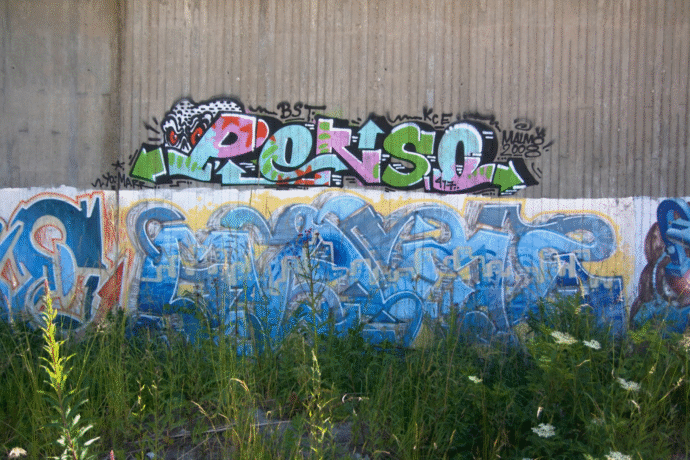
The intriguing moment occurs when such a spot is popularized and available space becomes scarce or non-existing. In relation to spots along train tracks, this is referred to in our data as the line being “full,” forcing writers to find other spots elsewhere. Interestingly, when the same thing occurs in a perceived soft spot, the status of the wall is subculturally transformed from a soft spot to a “legal” fame, making it possible for participants to start going over one another, just as on the formally legal walls appointed by authorities (Hannerz & Kimvall 2019).
IP: We have a new fame along the abandoned train line. Some of us found it, all overgrown and stuff, but we cleared out the space close to the wall, and now everyone can just go there.
EH: You can go over others?
IP: Yeah, it is a fame same as with an open wall.
EH: But can anyone go over anyone?
IP: Yeah it’s like a legal wall, I mean you still choose who to go over.
EH: But what makes it a fame and not just a wall?
IP: It’s a soft spot and then a lot of people started doing graffiti there, and then it becomes a fame. Like with an abandoned house, when there is free space you take that, but when there is no more free space, you go over others, and then it becomes a fame.
EH: So if I find a soft wall, on the countryside, along the train tracks, where no one goes, is that a fame?
IP: No, because then it is a line spot. See, first and foremost it should be a place no one notices, that is tricky to get there, that it is a place no one just passes.
EH: So the invisibility is important.
IP: Yeah, cause otherwise it is just a wall. And then you can’t just go over someone.
EH: But that wall, if the trains started running on that track again, it would become a line spot.
IP: Yeah, but then you would have to cut down the bushes, because now you can’t see it from the tracks.
EH: And then you can just go over others?
IP: Yeah, because then it becomes a kind of legal wall (Fieldwork 2015).
The term “fame” is an equally complicated term in graffiti. Besides being used synonymously with subcultural status, it can also refer to a place that is owned by a particular group of writers, where access is restricted. In the above excerpt, it is instead used to signal a soft spot with “legal” rules. Furthermore, note that the legal here refers to particular kinds of rules rather than the actual wall. What defines this wall as “legal” is not its juridical status but the combination of invisibility, inaccessibility, and a lack of free space. We have elsewhere covered this in relation to open walls and how presence is repeatedly interchanged, forming a subcultural etch-a-sketch whereby the same wall can be covered in several layers of paint during the same day (Hannerz & Kimvall, 2019). A third important point is the malleability of the actual space. Should the trains start running again (as they indeed did a few years later) and should the bushes hiding the wall be cut down (as they were right after the track became active again), the status of the wall changes and thus also its use. It goes back to being “just a wall.” Similarly, just as important as the perceived lack of risk was the absence of the buff – that the wall was not cleaned, as this would, similar to other surfaces in the city, open up new space to be taken and reinforce “regular” rules.
Concluding remarks
Even though the graffiti writers we have followed and interviewed would stress the importance of visibility and risk in doing graffiti, they would, at the same time, frequently do graffiti in spaces devoid of the public and perilous. Throughout this article, we have pointed out how, although defined as out-of-place within the subculture, such spots are nevertheless seen as attractive. More so, we have shown how it is their very out-of-placeness that makes them attractive. The lack of visibility and risk is proactively used to allow for a relaxed and informal atmosphere, where writers can focus on style and interacting with their friends rather than constantly having to address the risk of getting caught. The attraction of their out-of-placeness lies in the “time out of time” they offer (Presdee 2000). This temporal aspect includes the luxury of daylight and a break from the stress of avoiding risks, but more importantly, it also enables a time out from the rules protecting the already marked. Similar to how Presdee argues that carnivals allow their participants to transgress rules and borders between order and disorder, “legal” fames allow for a temporal and spatial inversion of subcultural hierarchies. Making the otherwise impossible possible: a beginner going over an established writer, but also allowing for interaction.
Consequently, the “legal” here refers to a decontextualization of subcultural rules and ideals, rather than to an actual spot. The perceived inaccessibility and invisibility of the surface voids it of risk, altering both the atmosphere and behavior. And when full, their out-of-placeness is ritualized and reinstated by accepting a disregard of otherwise firm rules protecting the individual’s name. Soft spots and “legal” fames hence come to constitute important spaces within subcultural graffiti, providing a collective and communal space, a temporary refuge or, if you prefer, disorder within the ordered.
References
Andron, S. 2024. Urban surfaces . graffiti and the right to the city New York: Routledge
Austin, J. 2001. Taking the Train: How Graffiti Art Became an Urban Crisis in New York City. New York, NY:
Columbia University Press
Brighenti, A. M. 2010. At the wall: graffiti writers, urban territoriality, and the public domain. Space and Culture 13 (3), pp. 315–332.
Hannerz, E. 2023. The Pretty Vacant: Exploring absence in subcultural graffiti. NuArt
Journal, 4 (1), pp. 35-44
Hannerz, E. 2024. Vandals in Motion: the “where” of graffiti in the streets. In Hannerz, E. and Bengtsen, P. (eds) Urban Creativity: Essays on interventions in public space. Årsta, Sweden: Dokument Press Academic
Hannerz, E. & Kimvall, J. 2024. From writing the streets to Instagram: A history of subcultural graffiti as media. In Hannerz, E. and Bengtsen, P. (eds) Urban Creativity: Essays on interventions in public space. Årsta, Sweden: Dokument Press Academic
Hannerz, E. & J. Kimvall. 2019. “Keep Fighting Malmö” – Graffiti and the negotiations of interests and control at Open walls” In Brunnström, P & Claesson, R. (eds) Creating the City, Malmö: Maipus
Kramer, Ronald (2010), ‘Moral panics and urban growth machines: Official reactions to graffiti in New York City, 1990–2005’, Qualitative Sociology, 33:3, pp. 297–311.
MacDonald, N. 2001. The Graffiti Subculture: Youth, Masculinity and Identity in London and New York. New York: Palgrave MacMillan.
Presdee, M. 2000. Cultural criminology and the carnival of crime. London: Routledge.
Schacter, R. 2014. Ornament and Order: Graffiti, Street Art and the Parergon. Farnham: Ashgate.
Schacter, R. 2024. Monumental graffiti – tracing public art and resistance in the city. Cambridge: The MIT press