The clarity of an atmosphere: some thoughts on lighting and graffiti documentation
In the world of graffiti writing, visibility is a complicated issue. On the one hand, graffiti writers will often want their work to be seen by others. On the other hand, because of the formal illegality of much graffiti writing, as well as the more subtle and internalised governmentality that causes many people to see graffiti and graffiti writing as inherently “bad”, writers will typically want to go undetected while painting. Interestingly, though, as sociologist Erik Hannerz has found, graffiti writers at times want their work to be seen neither by their peers nor by the wider public. Instead, they prefer to paint on surfaces that will be cleaned almost immediately (note 1). This includes painting on commuter trains that may never go into traffic, as they are taken out of service to be cleaned the moment graffiti is discovered on them. In these cases, as well as under other circumstances in which the governing of our shared environments causes removals to happen very quickly, the graffiti may only be experienced by people other than the involved graffiti writers and removers through visual (e.g. photographic and/or videographic) documentation. The writers themselves will frequently do such documentation and, due to the often-desired invisibility of the act of graffiti writing, this will in many cases happen in low-light conditions (as well as in narrow spaces, such as packed train yards, where it is not always possible to step back and get a full view of a painting). This can lead to the production of what has been described as “useless photos” – that is to say photos that do not clearly present a full view of the graffiti, for instance, due to the photographs being underexposed, flashed out, blurry, out of focus, or awkwardly framed (note 2). If a writer did not intend for their graffiti to remain unseen, and if they were unable to secure clear photos of their work during or after production, it is not unusual to see requests on social media from graffiti writers for daytime photos of their paintings. Such requests are emblematic of the perceived importance of securing good (i.e., well-lit, sharp, comprehensive) photos of one’s graffiti. However, as independent curator Pietro Rivasi points out, photos that fail to capture a piece of graffiti in a clear and full manner can still be immensely valuable to graffiti writers as they “may give back in atmosphere and remind you [of] the circumstances in which you executed the piece” (note 3). Furthermore, if made available to the wider public, such photos can provide a window into the world and act of graffiti writing that well-framed and perfectly-lit photos of finished graffiti do not. Seemingly poor photos, then, may bring clarity, not in a visual sense, but in terms of feeling or atmosphere. This photographic essay, with its focus on lighting and graffiti documentation, leans into the notion that it is possible and valuable to photographically communicate the atmosphere of experiencing graffiti under circumstances that do not allow for documentation that is clear in a more straightforward or traditional sense.
When I began selecting images for inclusion in the present publication, I quickly came upon a challenge: Although I wanted to focus on photographs of graffiti mainly illuminated by artificial light, I found few such photos in my archive (included here are Figures 3, 8–10). This was not really surprising. When documenting graffiti, I have generally strived for clarity in the visual reproductions. This, almost by default, leads to taking daytime photos that show details and the entirety of the documented graffiti, as well as – preferably – its surrounding environment (see Figures 1, 2, and 7). I was therefore faced with the need to create new images specifically for this photographic essay. The collection of new empirical material took place in the spring and summer of 2025, when there is a lack of darkness in the south of Scandinavia. The resultant images (Figures 4–6) have therefore all been taken in parts of train stations that are always mainly lit by artificial light.
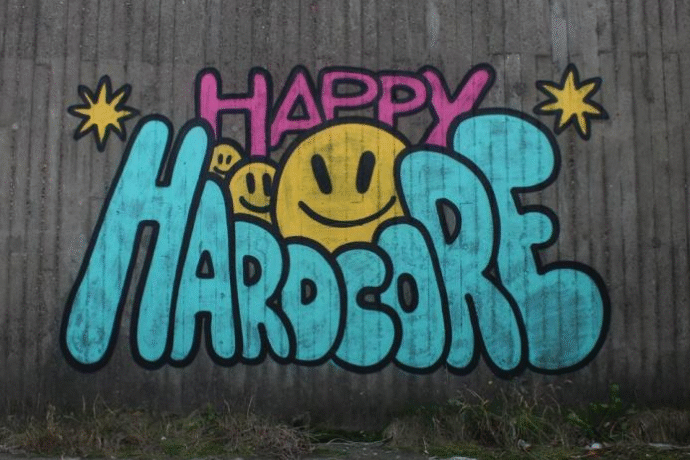
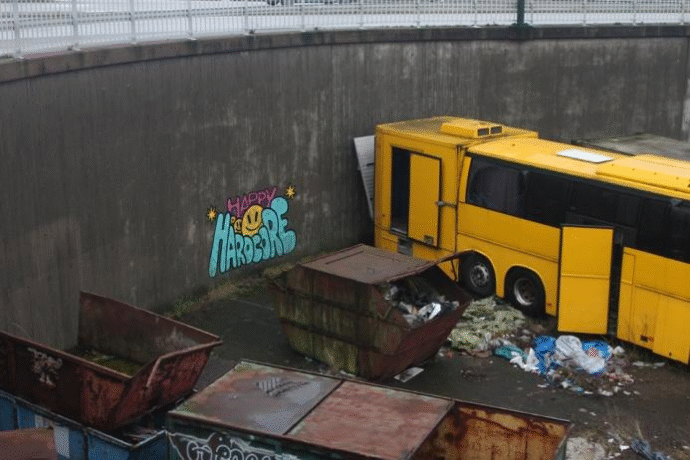
FIGURES 1 AND 2: Graffiti by Max Solca in Malmö, Sweden, documented on 2 September 2018 (left) and 1 February 2020 (right). These images exemplify how graffiti is often photographed from multiple angles in daylight to clearly document both the painting and its context. Photographs by Peter Bengtsen.
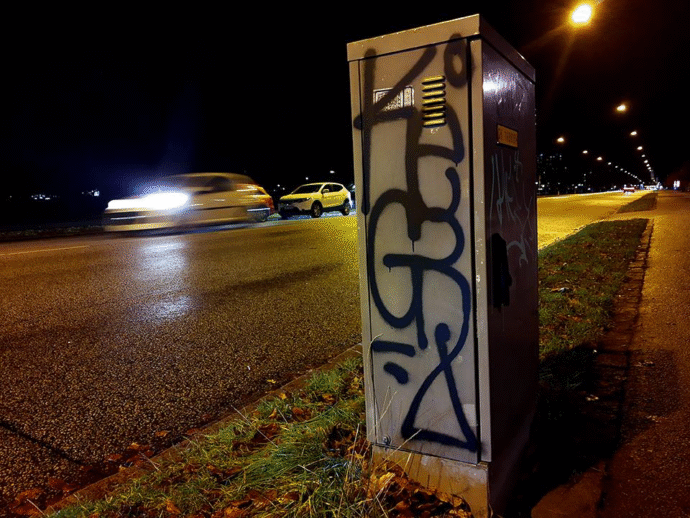
FIGURE 3: Graffiti tag by Kegr in Malmö, Sweden, documented on 14 December 2024. The darkness of night and the electric lights add a sense of mystery and drama to the depicted scene. Contributing to this is a passing car, which, due to the low light conditions, is characterised by motion blur. The lighting also makes it possible to frame and bring into focus the Kegr tag while ensuring that the other tags on the electric box are less visible. Photograph by Peter Bengtsen.
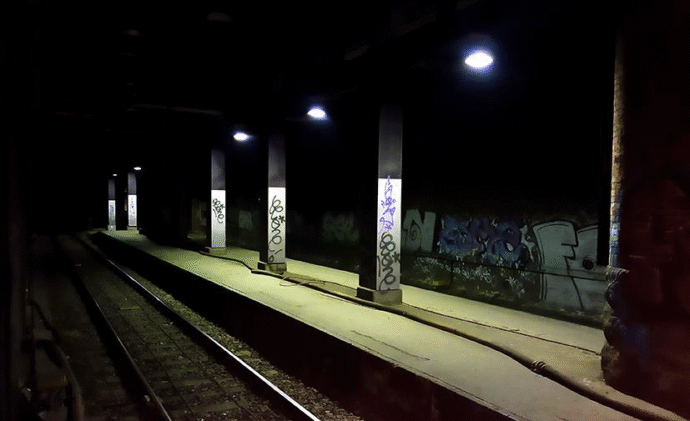
FIGURE 4: Graffiti on pillars and walls in a tunnel at the central station in Copenhagen, Denmark, documented on 8 May 2025. These illuminated graffiti expressions are indexical signs of transgressional behavior that challenges the conventional understanding of what constitutes an appropriate use of public space. They also draw attention to the hidden world that lies beyond the train platform from which they have been photographed. Here, at the mouth of a tunnel that is meant to be out of bounds, and which is mostly shielded from daylight, the electric lights are essential for viewing and documenting the graffiti. Photograph by Peter Bengtsen.
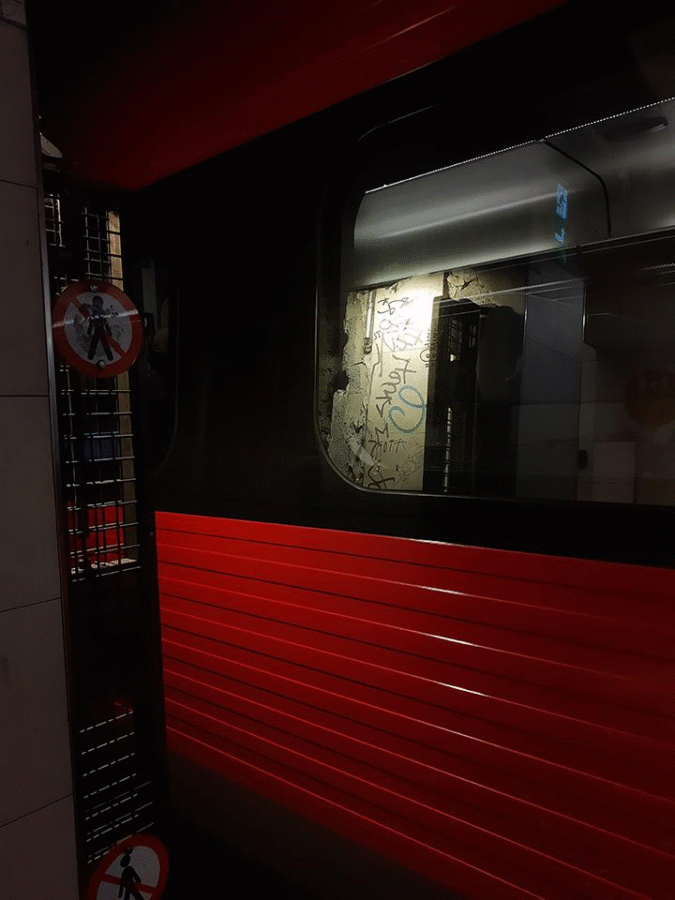
FIGURE 5: Graffiti at Nørreport station in Copenhagen, Denmark, documented on 8 May 2025. Here, the visibility of the graffiti is contingent not only on electric light illuminating a wall in an off-limits area beyond the train platform but also on the specific placement of a train as a reflective surface. Unless one peers around or goes beyond the metal grating, the graffiti depicted here is only visible a) when the electric light is on and b) when a train is leaving the station or – as here – is parked partly outside of the platform so that a reflection of the graffitied wall is visible in one of the train windows. Given the very specific conditions needed for this graffiti to be visible from the platform, it could be argued that it is likely mainly meant to be seen by graffiti writers and others who venture out of bounds. Photograph by Peter Bengtsen.
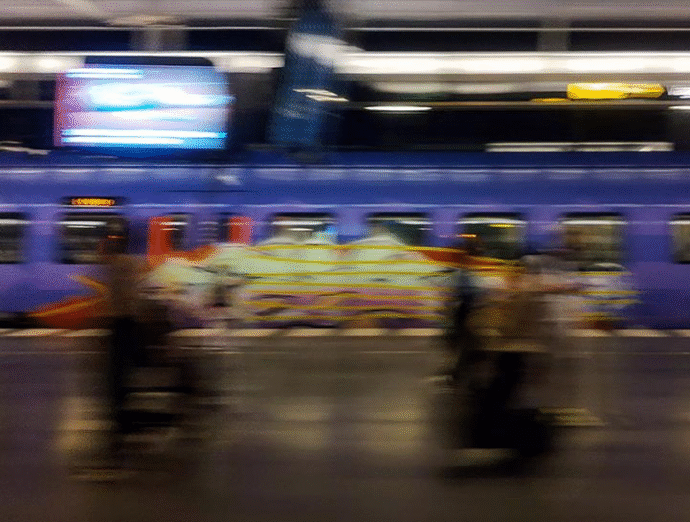
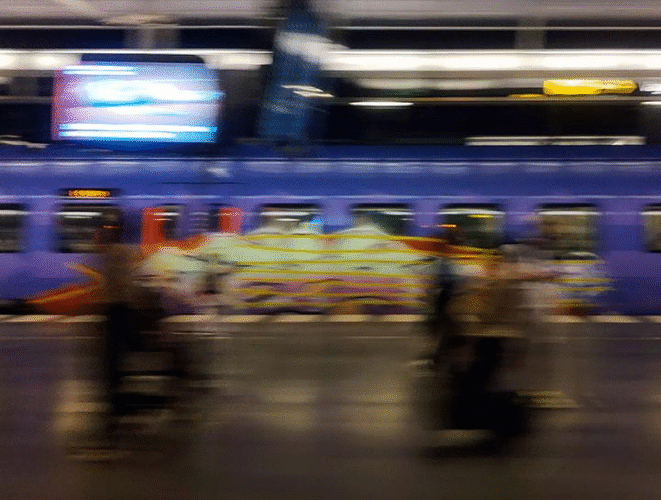
FIGURE 6: Graffiti on a train at the central station in Malmö, Sweden, documented on 5 June 2025. Low light conditions often make it difficult to photograph graffiti clearly. This is especially true when movement is unavoidable. While the graffitied train in this instance was motionless, the photograph was taken from a train that was leaving the station. This caused significant motion blur, making it impossible to clearly read the graffiti. The photograph is, however, an accurate representation of the way graffiti is often experienced when using public transportation. It is frequently not a static object that can be studied in a deliberate manner, but rather something that is seen (and perhaps documented) in passing. Photograph by Peter Bengtsen.
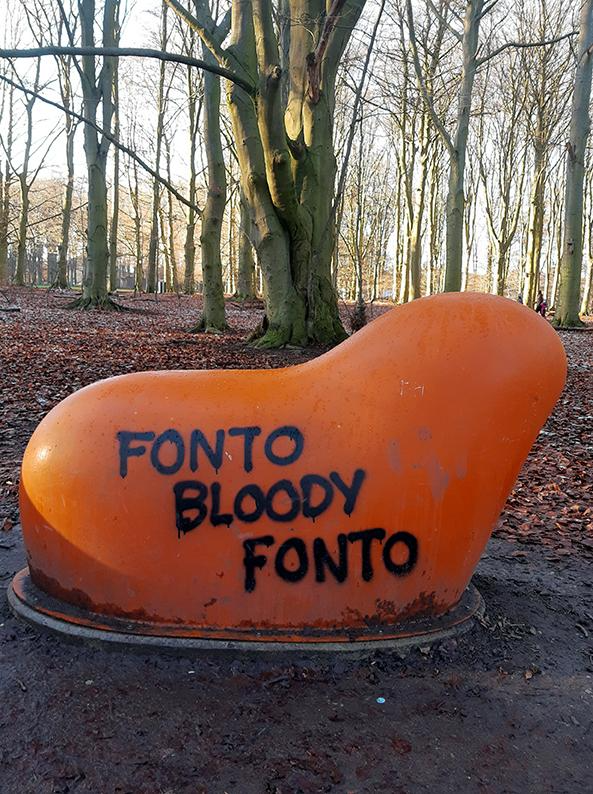
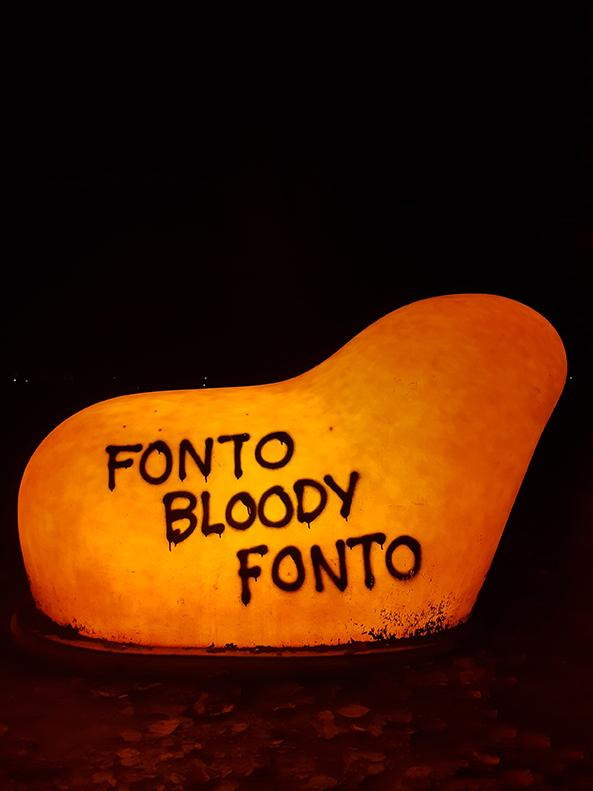
FIGURES 7 AND 8: Graffiti by Fonto on a sculpture by Monica Gora in Malmö, Sweden, documented on 2 January 2025 (left) and 14 December 2024 (right). Here, one of Gora’s JIMMYS – light sculptures made from polyester reinforced with fiberglass – becomes the substrate medium for the graffiti writer Fonto’s expression “FONTO BLOODY FONTO”. From the point of view of experiencing and documenting graffiti, the vast visual difference between day and night is of particular interest. When darkness falls, Gora’s sculpture begins to glow and thus goes from being an object that is seen in light to being seen as light (note 4). As this happens, the sculpture’s function as the substrate medium for Fonto’s graffiti also changes. Whereas during the day, the black spray paint clearly stands out as an addition to the surface of the sculpture, once the latter is illuminated from within by a fluorescent lamp, the graffiti markings appear as black voids in the luminous sculpture through which one can seemingly peer into the darkness of the surrounding park. Photographs by Peter Bengtsen.
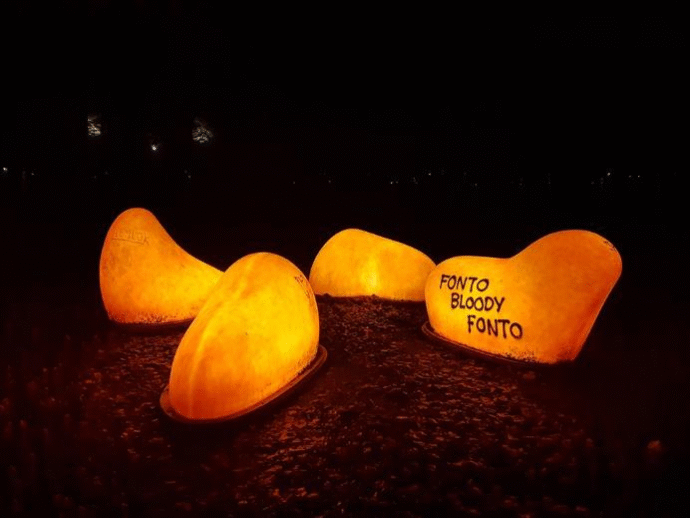

FIGURES 9 AND 10: Wider view of the graffitied sculpture group by Monica Gora in Malmö, Sweden, documented on 14 December 2024. The wider framing in these two photos further reveals the atmosphere created by Monica Gora’s sculpture group. The emerging orange light establishes an intimate space in the park – an island in a vast sea of darkness. While Fonto’s graffiti is not the only marking on the sculpture group, it stands out in virtue of its bold, black letters. The remaining markings, which are much smaller and rendered with thinner lines, are almost invisible at night due to the luminous nature of their substrate medium. Photographs by Peter Bengtsen.
References
NOTES
1 Erik Hannerz, “The Pretty Vacant: Exploring Absence in Subcultural Graffiti,” Nuart Journal 4, no.1 (2023): 43
2 For more on this, see the graffiti zine Useless Photos. Debatable Publishing 2022.
3 Pietro Rivasi, “In the Graff Game, Useless Photos Do Not Exist. Period,” Useless Photos. Debatable Publishing 2022: n.p.
4 Monica Gora’s sculptures are examples of what German philosopher Gernot Böhme has described as “luminous objects”. He notes that “[t]he unique aspect of these objects is that they show themselves. Thus they differ from all other objects we see only in light but not as light” – Gernot Böhme, The Aesthetics of Atmospheres. Edited by Jean-Paul Thibaud. Routledge 2017, p. 195 (my emphasis).