Ravens End
Is it possible for an actor to portray another person’s experience? Experience that has been recorded by someone else? Is it possible to step into a young person’s hardships and dreams, to feel hunger and gnawing uncertainty about the future – even though a hundred years have passed?
We have our first gathering at Lodgatan 3B in Malmö. The old factories in Oljehamnen surround us. Many of them are closed down, others have been converted into architectural offices, a lot of them are being demolished one by one. Malmö is no longer an industrial city but a city of knowledge. That brand has been hammered out in the city council. But Malmö is the same old city in many respects. It snorts and writhes in the convulsions of inequality. The young people in the suburbs are chased by the police and monitored in newly established visitation zones. The elderly and newly arrived are denied an interpreter at doctor’s appointments and bank transactions. They will be forced to learn Swedish, says a combed politician who looks like he stepped out of a German documentary in 1939. The rich live where they have always lived, in the villas along Ribersborgsstranden. There, wealth and power are manifested in a long row of giant, silent, electric-powered cars, where the alarms go off if the postman approaches the letterbox from the wrong direction.
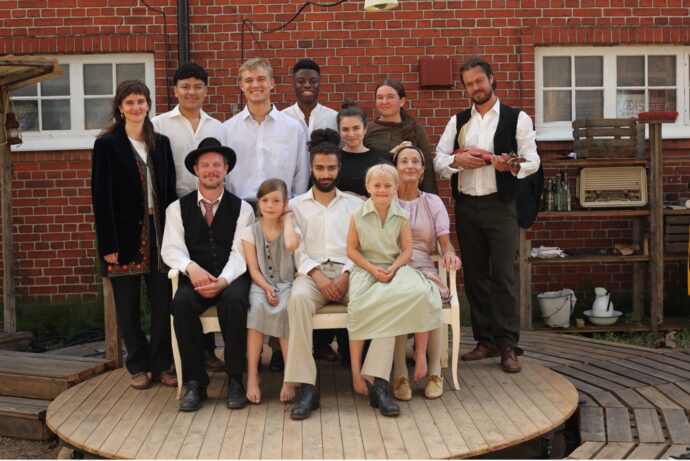
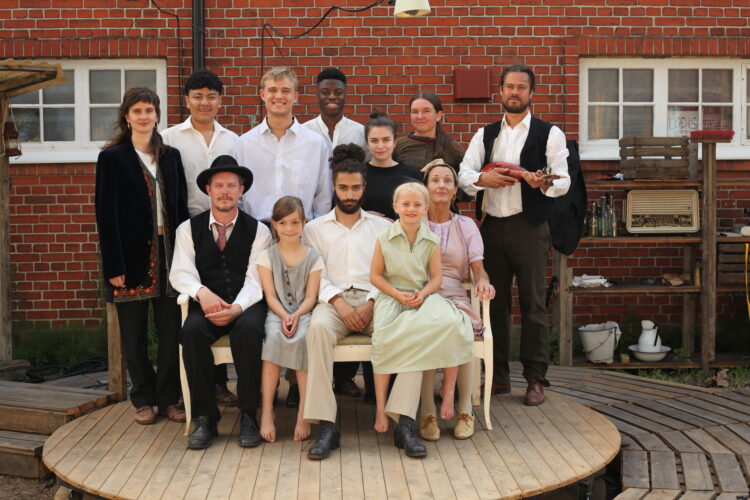
When we meet in the oil port, it’s dark outside. It’s January 2024. We’re gathering to begin dismantling a classic, an award-winning film called Kvarteret Korpen. Our task is to take the film apart into its smallest components and then rebuild it again, but this time as a theater performance. We have about six months. We know where to start. We start, as we always do in the theater, by reading the text. It’s a rule that no theater breaks. The text is law; it’s the starting point for our work. We are of all ages. The youngest are 8-9 years old, the oldest in their 60s. But the ones we are really talking about are between 19 and 25 years old. It’s the young Malmö during the time of the nascent workers’ movement – a working-class city, our own city – that we are going to describe. That is what the text says.
We want to be good, want to do the right thing. We read emphatically. That does not apply to everyone. The two young actors who are in their first year at the Malmö Academy of Dramatic Arts lean back and slur, speak quietly … it’s a signal, as if to tell us that they actually do not have the right to interpret the text yet, because they do not know it or have only just begun to interpret it. The others, without the education do the opposite, take it extra seriously when there is an exclamation point, or turn to their opponent at the table if there is a question mark, and reach for an answer!
We play with a text, we play with a thought. Now it’s a song from the resistance movement in Denmark during World War II. A young man shapes the words. He carries the precociousness of a young man in his features, his parents fled war and humiliation in our time. He sings:
Först så tar vi Hitler och hänger i ett träd
sen så tar vi Göring och hänger strax bredvid
Sen tar vi Himmler och Ribbentropp
och hänger opp i trädets topp
Det blir en tavla fin
av fyra nassesvin
(in translation)
First we take Hitler and hang him in a tree
then we take Göring and hang him right next to him
Then we take Himmler and Ribbentropp
and hang him in the top of the tree
It makes a nice picture
of four Nazi pigs
It is tentative. He asks about the names: I know who Hitler is of course, he says … but tell me about the others.
I say that I don’t know that well, no more than that one was the propaganda minister and another recorded the execution of Jews …
We sing again but this time we sing together. We learn the song. The melody is borrowed from a European song, a song sung all over Europe, and sung by Marlene Dietrich, among others, Lili Marleen:
First we take Hitler and hang him from a tree
Then we take Göring and hang him right next to him …
But we are interrupted. It actually doesn’t sound good, says one of the actors.
She is right, we have a lot to learn. We need to read up on Nazi Germany, about the years before the war broke out, we need to listen to the song in the version that was popular during the thirties. We need knowledge if we are to portray a time that we have only heard older relatives tell us about fleetingly at a family dinner or glimpsed in American war films. We need more than that …
As an actor, portraying a script written in 1963 with a plot that takes place in 1936 is about understanding a context, a time, and a circumstance that is not yours. A time that you only vaguely perceive, like blurry black and white photographs in a family album. A bygone era, perhaps indicated by smoky chimneys, heavy industry, horse and cart. The young people in the ensemble are nineteen, twenty, twenty-two, and twenty-four. They have parents who were not even envisaged when the screenwriter Bo Widerberg wrote Kvarteret Korpen in 1963, and perhaps their grandparents were not even born when the film’s plot takes place in the pre-war period.
We talk about what our task is: to be able to portray something that none of us have experienced, as if we were asking our parents (if they are still around to answer). Yet it still becomes a second-hand, or third-hand, retelling. How are we supposed to re-formulate past lives in a credible way? How are we supposed to interpret a text that lies sealed in a sarcophagus, submerged in time? Does the text mean anything at all when we read it? What happens when we read it aloud? What happens if we read it when we walk and stand and move around a room?
We talk about what we think it wants to tell us. We decide to investigate with our bodies and our minds, to meet the text and do what we think it wants with us, to coax it to do its will. But we notice that it is not enough, nothing happens. It remains mute. We need to investigate more: the bodies, the clothes, the gestures. We need to read the text in a different way. Not as something finished. Maybe as a floor to stand on. Is that what the text is? An ordinary floor, in an ordinary room, which requires someone to actually enter and step onto the floor for it to come alive.
The method is slow; we do it over and over again, with the intention of putting ourselves in a sensitive, receptive state. Receptiveness to a different way of talking, a different way of expressing oneself, a different suit, a different hairstyle. Yes, another person’s body. How did you walk then, in those days? How did you converse then? And your group of friends in the backyard, how did you hug when you saw each other?
But the actor’s task cannot be seen merely as an act of transformation in which one’s own body is to be exchanged for the body of another, in which gestures and speech are to be replaced with movements and pronunciations that were designed precisely in the backyard in Malmö, in the actual Korpen neighborhood of 1936. It is in the break between then and now, the impossibility of the task of giving true testimony; it is there, in the encounter between the young actor’s own experience from his own backyard, with the handshakes and hugs, the speech and the silence, the noise and the stillness from Kroksbäck and Holma and Västra Sorgenfri in Malmö in 2024, that the performance comes into being. It is in the conflict between the impossibility of retelling correctly and flawlessly, and the desire to fill in with all the life experience the actor brings to the performance work, that we can understand something about ourselves in the encounter with the text. It is in the encounter with those signals, the black marks on white paper (a message to us from another time), that we are forced to realize that we are not enough. We cannot, and perhaps we should not, become one with a text, a time, a style of clothing, since if we tried to, we would testify only to an unfinished endeavor, a failure …

We turn it around. We need to think the other way around. We talk for a long time about filling in with our own experiences. We talk about our siblings. Someone has a sister who arrived late to the hospital. It is similar to the story’s Klara, the one who dies in the film because the family could not afford a thermometer. Our own knowledge does not stand in the way of the knowledge recorded about another time, it is a prerequisite for us to be able to approach what happened in Malmö a long, long time ago. Here, an urgent need for the actor to excel, to pull gears and to examine everything she has access to, with her entire register, meets the virtuosity of a writer penning a script in 1963.
It is in that conflict that we can breathe and create. Let it be a perfect text, and let us accept that we are also perfect. Let us make everything our own, and if we are not enough, let our inadequacy be a breath, a rest, an opportunity for the audience to see how the different timeframes are incompatible. And yet not.
The examination of the text is an examination of one’s relationship to the text, not the text itself. There is a common thread from the meaning of the text to the actor’s interpretation of it. A common thread that is the interior of the story, to be reborn in the actor’s encounter with the audience. But it is easy for something to come between: an obstacle, an obstruction, a practiced manner, a theatrical reflex instilled in institutional theater, which is forced on every actor who undergoes theater training on the very first day at theater school. It is as if listening is gone, as if the text is just in the way. Carelessly read text becomes careless interpretation. The tired audience is once again seeing theater where any interaction between the actor’s deep life experience (regardless of age) and the author’s desire to tell us something from another time or place or perspective is not allowed.
The knowledge of the performance, or the knowledge that comes from our work with the performance, is not something permanent. Each interpreter will present their version, make their own cuts in the text, add and subtract. What is fleeting and impossible to consolidate as a correct description of something someone else has told comes to life anew when it is reinterpreted and portrayed by someone with a different understanding of the work. The one who hates his father will emphasize the son’s anger at his fictional father’s betrayal. The one who is filled with longing for a father figure will convey that. The interpretation cannot become a retold document of truth, and the interpreter cannot be true to history, we can only meet the testimony and retell it with our own hunger, our own desire, our shortcomings, and skills.
We know when we work with Kvarteret Korpen that hunger and poverty taste equally bad no matter what time we live in. We know that the children at Holma in 2024 go to a communal breakfast before they go to school. We know that the non-profit service will make a difference. It starts there, with care for the children and with political conversations about the injustices that make the children of the poor suffer through the first hours at school with stomachaches and hunger pangs that make it impossible to follow the lessons. The young people in the ensemble can relate to that. We want to tell about that, it’s real.
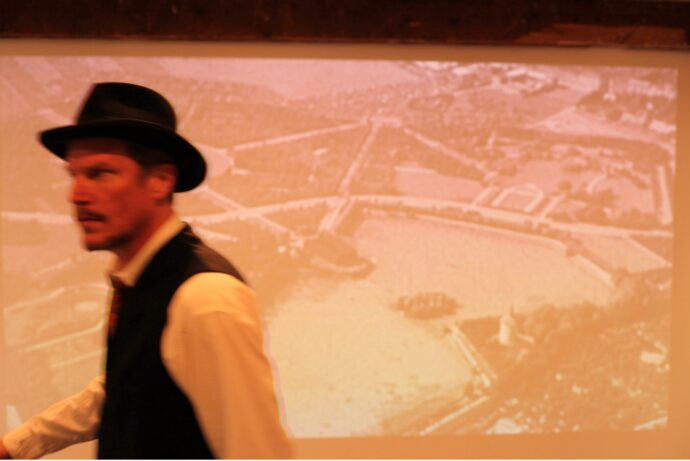
Therefore, we have to put aside all the rehearsed theatrical gestures and meet the hunger of the children in Kvarteret Korpen in 1936 with the hunger in Malmö in 2024. That is our job. It is to make ourselves receptive to the text. We do not need to interpret it based on the black signs on the paper, the letters that lie flat and dead before us. We need to give the text our own experience to bring it to life, to make it tell a story anew. In the same way, when we encounter the text’s dialogue between father and son, we bring with us our own relationships to fathers, to girlfriends/boyfriends, and peers.
All of this does not have to be understood by the young actor, but it must be confronted. By confronted I do not mean they are to be held accountable, or merely exposed to, but on the contrary: to become aware of as a quality, an asset, even a requirement for encountering a story from another time, being able to carry it on their own shoulders. This approachshould allow the story to be illuminated, fertilized, and reformulated into an understandable and comprehensibleperformance. After all, it is not a documentary we are going to make, it is a work of art.
The art of both being true to what is said and to the truth of one’s own voice, to the voracity of one’s own experiences, is an asset in the work of understanding and absorbing an event, or process, or body from another time. But we encounter resistance, each of us, in the form of the expectations we carry. Expectations to perform. Expectations to, as we now say in Swedish, “deliver”. As if theater were an industry, an entertainment industry, with an accompanying manual for how something should be “packaged”. It is actually so bad that in 2024, culture is talked about in words that give the feeling that we are not artists but part of a market economy where the product or concept takes precedence over our own story and interpretation of Malmö. We need to be brave, we need to strip ourselves of the language and conditions of industrialism, the conditions that once oppressed the working class, starved children and took away their dreams, and the conditions that still oppress the working class today, starving children and taking away their dreams.
Mother: En sång ur föreställningen Kvarteret Korpen. Sångarna: Aaron Rada, Junior Mukonde, Alfons Kammonen. Directed by Jonas Jarl, photography Jonatan Gyllenör.
References
References:
Kvarteret Korpen (English title: Raven’s End), directed and written by Bo Widerberg; cinematography by Jan Lindeström; produced by Waldemar Bergendahl; Europa Film (Sweden), 1963, 101 min.