Photo essay

Children & youth in the city

This essay describes current and creative practices of placemaking, by children and youth in public space in an urban context. It is in part based on my master’s thesis in landscape architecture: Ungas plats i offentlig miljö; Om att göra, hänga och skapa i det gemensamma rummet. The purpose of the thesis is to contribute to a socially sustainable and boundary-breaching planning of public space, that can support a more flexible use of the places that we share, so that everyone, regardless of age, can feel a sense of belonging.  

Children’s play, their need to engage in, and explore different kinds of physical challenges, and opportunities to practice problem-solving, are recognized as vital components of human development. Adventure playgrounds are a widespread phenomenon all over the world, and used to be common in Sweden. This is no longer the case. In this essay, Guldängen Adventure playground in Malmö is described with several pictures, due to its unique character as the only staffed play space in the city of Malmö. At Guldängen, the children are in charge of the esthetics. They decide what’s being built, and they are given the means to build it themselves. 

The other places are presented as snapshots of a more random character.

The aim of the essay is to show how children and youth make use of public space, adapting it to their own needs to achieve a sense of belonging. All examples have been documented by the author or by Växtvärket Malmö, the non-profit organization running Guldängen Adventure playground in collaboration with the city of Malmö.

Limhamns Sjöstad, Malmö 2023. An old landmark in the industrial part of Limhamn. The silos are planned to be taken down and replaced by a high-rise building. In the meantime, they seem to be used by the local youth. How do they feel about the planned development?
Limhamnsfältet borders a cluster of trees, “Lagunenskogen”. A very orderly and managed kind of woods, but if this is what you know as a woodland, it’s a magical place for making a den and a makeshift pair of binoculars to spy on the local archery club practicing on the other side of the fence…or anything else that might come into view!

Arboglyphs, or cuttings into the bark of living trees, commonly appearing in both parks and in natural woodlands across the world. Some examples date centuries back (Andersson 2005).
Craftivism in Norrköping. Craftivism is the activity of using crafts to try to achieve political or social change (Curious Earth 2025).
Lack of nature. Grafitti in central Malmö 2019.
Burnout on tarmac. Placemaking with the help of a vehicle.
Graffiti in Ystad. Existentialism.
Colour makes a difference. Schoolground project in Ystad.
A bench of friendship. Schoolgrounds in Ystad.
I need it I’ll make it. Goal in Kirseberg, Malmö.
I need it I’ll make it. Tire swing in Gärsnäs.
In the wrong place. Seats in Rosengård, Malmö.

We were here, Handprints in the dust by an escalator in Triangeln, Malmö.
Something is missing (?). Stencil in Wales.

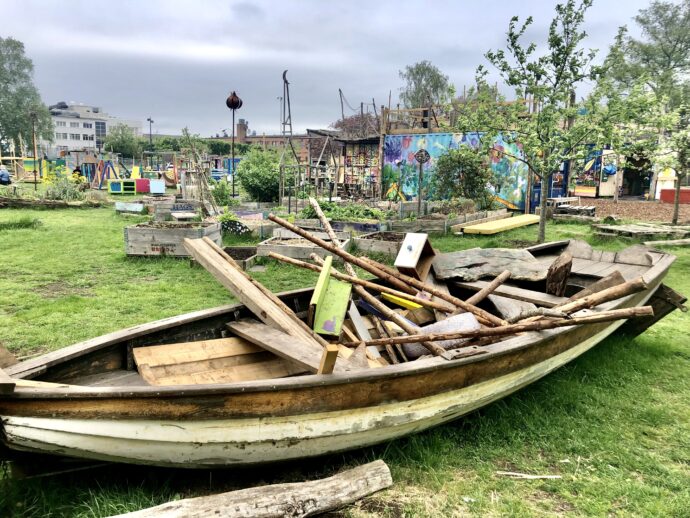
Guldängen adventure playground. A unique, ever-changing place. Open for play and exploration 24/7 year-round, by, with, and for children! In Uddeholmsparken public park, Sofielund, Malmö (https://www.vaxtvarket.se/projekt/guldangen/).

The container at Guldängen in Malmö.
Den with garden, Guldängen, Malmö.
The land of dens 1.

The land of dens 2.

Detail Labyrinth, Guldängen, Malmö.

In the land of dens, Guldängen, Malmö.

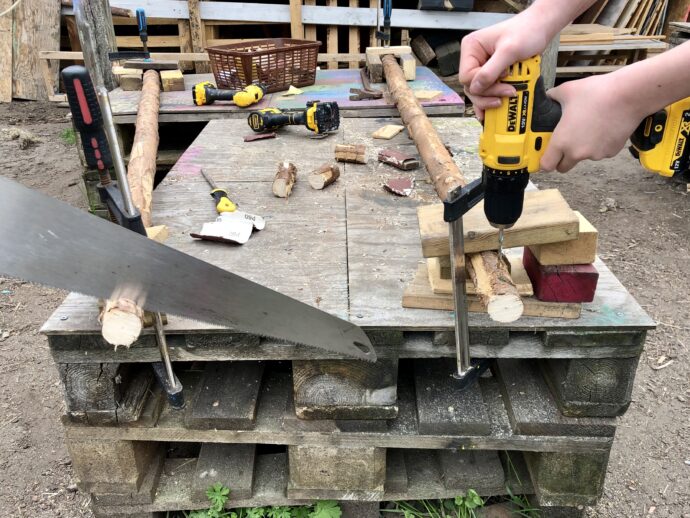
Kids with tools, Guldängen, Malmö.

Working with tools at Guldängen in Malmö.

Construction play.

We made our own skate track, Guldängen, Malmö.

What time is it?, Guldängen, Malmö.
Hands on at Guldängen in Malmö.

Where are we going?, Guldängen, Malmö.

The courtyard.

Flowers grow here at Guldängen in Malmö.

Digging action.

Paper flower, Guldängen, Malmö.

Don’t forget your dream. Graffiti at Guldängen in Malmö

References

Rolf Andersson, Historical Land-Use Information from Culturally Modified Trees (PhD diss., Swedish University of Agricultural Sciences, Faculty of Forest Sciences, Department of Forest Vegetation Ecology, Umeå, 2005).

Curious Earth, “Craftivism: Changing Our World One Stitch at a Time,” Curious Earth, February 2024, https://curious.earth/blog/craftivism-changing-our-world-one-stitch-at-a-time/ (accessed May 11, 2025).

Elin Portinson, Ungas plats i offentlig miljö: Om att göra, hänga och skapa i det gemensamma rummet (Master’s thesis, Swedish University of Agricultural Sciences, SLU Alnarp, 2019), https://stud.epsilon.slu.se/15217/.

Växtvärket, https://www.vaxtvarket.se/ (accessed May 11, 2025).

Issue: Entering Urban Humanities

This Urban Matters issue marks the IUR’s entry into urban humanities by bringing together researchers, artists, and community partners to explore the field through collective reading, dialogue, and practice. Framed as a form of public humanities, urban humanities connects urban studies with design and the arts to reimagine cities, foreground human experience, and foster just, collaborative, and ethically engaged urban environments. Through shared discussions and contributions, authors of this issue found a common language for practices already emerging in their work, revealing the transformative potential of combining humanities, urban research, artistic methods, and community struggles.

See all articles published in this issue
Urban Matters Journal
Privacy Overview

This website uses cookies so that we can provide you with the best user experience possible. Cookie information is stored in your browser and performs functions such as recognising you when you return to our website and helping our team to understand which sections of the website you find most interesting and useful.

Read more about what cookies this site is using at our privacy policy.