Mediating Place: Against Smooth Media in Appalachia
As extractive economies continue to impact the lived experiences of countless communities in the US context, some of the most vulnerable residents are those at the urban periphery. In this essay, we will be focused on such a region– one which casts an unusually long shadow in the popular imaginary: Appalachia. Exploring one film set in the region and one organization that serves as infrastructural support for media making and preservation there, we make the case for what we call ‘lumpy’ media practices that can work to undermine or resist the smooth logics of extractive capitalism, which have shaped and sometimes devastated this understudied landscape in the US. The film In the Air is a media object. The organization Appalshop is a kind of community media infrastructure. By examining these two media phenomena within the context of their sites in the region, our own analysis is necessarily intermedial, attempting to put together what seem like two very different orientations toward Appalachia in order to unearth their shared concerns. We begin with a discussion of our understanding of ‘lumpy’ and ‘smooth’, continue with an overview of the region and its challenges, and then move on to the case studies to make the case for the value of lumpy approaches to the intersection of media and place.
Countering Smooth Logics
Our attachment to the ‘lumpy’ as a way to understand the possibilities of non-extractive media and media practices is here inspired by architect Keller Easterling. In her work, she tracks a history of technosolutionism in economics, architecture, and elsewhere and asks whether “an alternative habit of mind would value the coexistence of multiple, counterbalancing, contradictory logics, looking not for the next superior subsuming platform but a disposition of interplay between different coexisting platforms of information. Might,” she goes on, “this ratcheting or reciprocal interplay enrich rather than restrict information?” (Easterling 2015). Easterling’s concern is in the possibilities of a particular kind of architectural practice. Our understanding of lumpy, like hers, is attached to the embodied and the material, the “in real life” rather than the smooth, operational, and virtual, but our interest goes beyond architecture and traditionally conceived media platforms to think of laymen and nonspecialist practices as capable formulations of a lumpy response to space and place. The lumpy, in our formulation, is then more or less what it sounds like: textured, prone to cause friction, and decidedly material. We view lumpy media and lumpy media practices as a counter to the smooth narratives of informational capital, narratives that cling to fantasies of fluid and instantaneous movement of information and money, and which obscure the material underpinnings of contemporary media– hardware, labor, natural resources, and culture and their ecological and decidedly material impacts. As media theorist Nicole Starosielski has pointed out, the claims of “friction-free” movement often attached to media infrastructure, and we think to media more broadly, are rooted in colonialist and capitalist logics (Starosielski 2015, 5).
The on the ground, lumpy, intermedial cases we aim to present here offer new ways of not only understanding the environment, but also interacting with it through daily engagements, shaping the spaces and lives lived there. By highlighting the work of one film (a media object) and one cultural organization (an example of community-based media infrastructure), we plan to show how alternative media practices help us reclaim the right to media and to rural and regional urban spaces alike. These practices work against both the economies of extraction and the flattening work of stereotypes and straw men–things we view as decidedly smooth–that have harmed Appalachia and its inhabitants. Liza Johnson’s 2009 In the Air and the media arts and archive organization Appalshop are put in conversation together as a way to think through aesthetics and cultural infrastructure, and the entwining of the two, that may lead the way to think against the smooth and the flat, and toward the lumpy. They show ways that the lumpy might open possible avenues to refigure and reframe both urban and rural intervention.
Appalachia: Extraction for Elsewhere
Appalachia is expansive and mountainous, incorporating thirteen states in the US. It is inclusive of areas with various regional monikers such as: Coal Country, the Rust Belt, the Midwest, and “flyover country.” While these communities continue to decline economically, they are also subjected to the slow violence (Nixon 2011) of poor air quality, flooding, groundwater contamination, and infrastructural failure related to a network of surrounding petrochemical industries. Furthermore, Appalachia, when not ignored, is often the object of irritation or even disdain from coastal urbanites: stereotypes of the ‘hillbilly’ persist alongside more contemporary constructions of Appalachians as an uneducated, climate change denying, racist, and otherwise ‘backwards’ people. Popular Hollywood films and books such as Hillbilly Elegy (Vance 2016) promote an image of individual responsibility for overcoming poverty in the region, while depicting a more or less standard vision of Appalachians as white, poor, substance abusers. More complex and engaging representations can be found, however, such as in the work of author and activist bell hooks, who seeks to unearth the complexities of the region as she remains rooted in community solidarity (hooks 1990).
Given its demographic spread, Appalachia may strike some as an unlikely space in which to contend with questions about media and the urban as the impacts of anthropogenic climate change are increasingly felt. But, of course, the ecologically damaging extractive industries that have shaped and devastated the region are entirely entangled with media (in its most capacious definition) and with the urban: American cities were built and powered thanks to mining, agriculture, and other laborious pursuits throughout Appalachia (Hutton 2020). Furthermore, as many media scholars have pointed out, media infrastructure in particular is often situated in rural areas for the benefit and support of urbanization elsewhere (See Parks, Palmer and Grinberg 2017).
When we do see Appalachia in the context of an approach to the urban, the communities and the sprawling infrastructural networks it contains are often represented through what Harun Farocki calls “operational images”: machine-readable images from satellites, thermal imaging, and GIS mapping that impact the world and focus attention (Parikka 2023). While these visual representations help the understanding of broad urban phenomena, they also codify knowledge of the region through a largely top-down view that depends on a smooth and seamless digital world–a world without its people. Instead, we are interested in less smooth, “lumpy” forms of media and media practices.
The importance of constructing a spatial counter-narrative, a lumpy narrative, through diverse media is crucial in a region like Appalachia. According to the Appalachian Regional Commission (ARC), there is a growing digital divide between those who have access to broadband internet, with 15% of some areas devoid of access to any digital devices (Appalachian Regional Commission 2023). Predominant forms of media and technology in the region bolster forms of extraction through mapping, LIDAR, and technical reports. Together, along with political and corporate messaging, they create a media feedback loop that suggests the only progress that can be made in Appalachia must come through economic development centered around extractive economies—economies that consistently benefit urban centers far from the coal mines, data centers, and transport routes of the region. The smoothness of these media practices forecloses other, more radical possible futures and hides the devastation of extractive economies, in turn perpetuating cycles of generational slow violence and reifying forms of extraction in the region.
A key economic feature that links the geography of small towns and small to midsize cities throughout Appalachia is disinvestment. For generations, both the private and public sectors abandoned these sites from any meaningful intervention. Even a cursory analysis and examination of a variety of social indicators shows the infrastructural breakdown of the modernist welfare state practices of planning, resource distribution, and social relations. Under-resourced, these communities now face another generation of disinvestment, leaving them to face what Patricia Williams describes as an “inheritance of a disinheritance” (1991: 217).
Ecologically and economically, the region suffers from overlapping concerns related to coal and natural gas extraction and the refinement of these fossil fuels for other purposes. Coal extraction largely takes place through mountaintop removal, a practice that increases flooding of communities in proximity, while decimating local habitat. Natural gas extracted through hydraulic fracturing, or fracking, is an inevitable reality here, due to the largest national deposit of Marcellus-Utica shale in the region. The fracking industry has boomed within the past decade, and is influential in three key ways. First, fracking has produced an abundance of fossil fuels, prompting the transition of many of the coal-fired power plants from the region into natural gas energy plants, and a network of pipelines, wells, and storage facilities. Second, it has partially invigorated struggling regional industries, such as the steel industry, through the production of pipelines and equipment. Third, and most importantly, it is spurring the development of a plastics industry in Appalachia. Ethane, a byproduct of fracking, is mainly used to produce ethylene, which is then used by the petrochemical industry to produce a range of intermediate products, most of which are converted into plastics (Granholm 2022: 2).
In the broader historical context of Appalachia, investment by state or private sources is neither guaranteed, or, if it does occur, it tends to reinforce existing privatized institutional frameworks, often benefiting private actors more so than any broader public. The oil and natural gas industries look to shape the region as the next “petrochemical corridor,” similar to Louisiana’s infamous petrochemical “Cancer Alley,” located between Baton Rouge and New Orleans. Some environmental advocacy groups use the pejorative moniker of “Cancer Valley” to suggest the nature of ongoing petrochemical development within the Ohio River Valley, a subregion of Appalachia. Recent subsidies, while providing for some environmental cleanup, also offer generous tax breaks to petrochemical companies, and earmark tens of millions of dollars for natural gas storage hubs (Barnes 2022).
Lumpy Aesthetics
Filmmaker Liza Johnson challenges the received narratives of the region in her 2009 film. In the Air portrays the struggling river town of Portsmouth, Ohio in western Appalachia. Johnson chose to represent her hometown in the film, but it symbolically acts as a site for the broader generational disinvestment prevalent across the region. For the residents in Johnson’s Portsmouth, air is a common space, not yet relegated to the infrastructural ruins of neoliberal late capitalism. It is a space of rehearsal for an alternative social form. The town’s teen youth are the film’s central focus. Against a backdrop of vacant buildings, drunk parents, a junkyard, and an austere gray and brown landscape, the teens seek commonality in the town’s dance and circus studio, Cirque d’Art. While the film is not documentarian, Johnson employed local residents and used real locations such as Cirque d’Art to shape the story. In this sense, Johnson’s film is intermedial as defined by Marina Grishakova (2024: 2). By transgressing and negotiating boundaries between fictional narratives often depicted in films and documentaries, which aim for objectivity in their form, the audience is asked to actively interpret the film as a genre. While Johnson is a well-known Hollywood filmmaker, this portrait of her hometown is a more subversive short film intended for a critical audience, but also the residents of the region. The film as a genre could be considered as lumpy, as well as the unfolding narrative it depicts.
By focusing on movement, the protagonist teens casually interpret the otherwise bleak and vacant town center. The prescribed uses of the environment, predicated on extracting monetary value through industrial operations and commercial space, are thwarted. Their vacant or near vacant status creates the freedom to interpret the space differently. While the adults in the film maintain the buildings in hopes of the return of some form of capital-intensive development, the protagonists awkwardly yet convincingly re-appropriate the space by jumping on ledges, loitering, and avoiding potholes through choreographed jumping while learning new forms of social relation.
In this way, the Portsmouth portrayed by Johnson acknowledges use value of the space, even if its form was constructed for another use. It is an occupation of capital’s ruins in ways that point towards new social and spatial relations. This echoes architectural theorist Andrew Herscher’s argument for acknowledging the deep potential of use value, as opposed to exchange value, in a city like Detroit following the wake of deindustrialization and the foreclosure crisis. In discussing Detroit, Herscher says, “The shrinking city is neither empty nor populated by only the impoverished and disempowered; rather the challenges of the city have inspired many of its inhabitants to re-think their relationship to the city and to each other” (2014:7). Herscher also challenges us to think of inhabitation as an intentional act, as opposed to a condition, echoing In the Air’s subversive occupation of space. In a heavily mediated city like Detroit, Herscher points to the art installation “Detroit Demolition Disneyland,” as a way to defiantly inhabit space through the use of media. In the project, artists painted vacant houses a solid construction orange color to call attention to the numerous foreclosures and derelict properties. By brightly painting them and calling them art, the houses were removed from the public imagination as a commodity to be cleared away. The bright orange could also be seen from a distance, and beckoned Detroit residents to reconsider their relationships to vacant housing and to take action (2014: 26-27).
Herscher’s insight works well in an approach to the lumpy culture-making in Appalachia exemplified by Johnson’s film. Far too often, the region’s inhabitants are understood as impoverished and disempowered, without an active and engaged relationship to their surroundings and communities. But of course, this is not so. Johnson’s film points to the role of existing, yet unassuming institutions like the Cirque d’Art, which encourage an alternative occupation of space.
We offer two interpretations of the film’s title, In the Air. The first is that the circus school trains students to occupy spaces in unconventional ways. The air is a vantage point to see different possibilities and can be associated with lightness and floating. The other interpretation of the film’s title is that it gestures to the possibilities of politics and alternative social forms that linger in the air. It is noticeable, but perhaps not immediately identifiable. It lingers and waits to be figured out through collective action and interpretations. Johnson’s work can be read an assertion of the right to the city. Geographer David Harvey offers, “The right to the city is far more than the individual liberty to access urban resources: it is a right to change ourselves by changing the city” (Harvey 2008:23).
Additionally, though the film does not directly address the ecological devastation suffered by the region, In the Air might indicate at least an awareness of the natural, and our right to it. Air, after all, ostensibly belongs to us all. While air is a space not easily represented through media, it can be opened, the film suggests, as a space for asserting the right to the city and resisting slow violence.
Johnson’s portrayal of Portsmouth through In the Air challenges conventional representations of the region and of social form through performance. Designer and scholar Bryony Roberts discusses the importance of media performance in relation to the occupation of urban space. In her article, “Performative Rebellion,” Roberts traces the roots of marching bands by marginalized Black communities in New York City. Roberts argues that marginalized groups participating in a familiar form of civic pageantry “can enable otherwise impossible visibility and reinforce entitlement to public space” (Roberts 2017). For groups traditionally underrepresented in public space, Roberts argues that the intentional and subversive occupation of public space through performance asserts agency and allows alternative social codes to emerge from familiar public practices like marching, ultimately displacing the normative structure. She writes, “The historical lineage of marching shows how reinhabiting a familiar form—by changing the who, where, and how of its materialization—can give that form a completely different spatial and political agency” (Roberts 2017). Further, Roberts draws the connection between protest marching and drill marching, suggesting that the two share a disciplined form and help claim a right to the city.
The spatial practices represented in Johnson’s In the Air, along with Herscher and Roberts’ analyses, suggest breaking the relationship between the existing city and its normative habits tied to capital extraction. In assessing Portsmouth and Johnson’s In the Air, theorist Lauren Berlant suggests that these new spatial occupations also help build momentum and forms of habit that do not rely on existing institutional and governmental structures. For Berlant, it is more fruitful to operate outside of appealing to state forces, or seeking an unlikely return to some form of a welfare state and its planning logic. As they state, “Mid-twentieth century forms of expansive world building toward the good life have little or unreliable traction. In a fundamentally unstable economy, planning can be seen as a neurotic reminder of the previous era’s optimism that everyone, or anyone, could be significantly necessary to capital” (Berlant 2016: 409).
Together, the practices in Johnson’s film point towards an aesthetic occupation of space and social cohesion that is partially present, or “in the air,” and fosters an alternative politics.
Cultural Infrastructure and Regional Placemaking
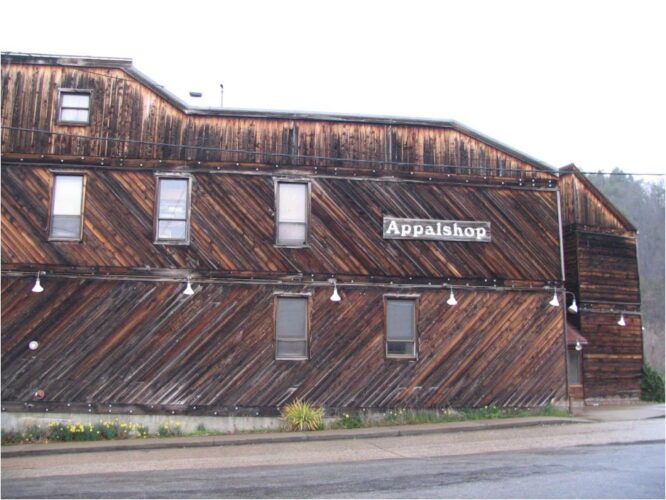
Another place to continue our exploration of both the confluences of extractive and smoothing forces and the eruption of lumpy possibilities might be an organization called Appalshop. Located in Whitesburg, Kentucky, Appalshop (not yet then named thusly) began as a film workshop in 1969 in this rural Appalachian community. Its initial goals were to “teach young Appalachians to operate 16 mm film equipment. Boost the economy through vocational training. Offer a counternarrative to the one that made Eastern Kentucky the poster child for American poverty.” Since then, Appalshop has grown into a well-known institution in the region, continuing to offer photography and film workshops, launching a literary journal, a record label, a roadside theater, a radio station, and an annual music festival. It is now, too, host to the Appalachian Media Institute and home to an archive “of thousands of hours of recordings, photographs and print material that–together–span almost a century of life and history in Appalachia” (Appalshop.org). In the summer of 2023, however, when historic flooding devastated the rural community in which Appalshop has become such a fixture, a substantial portion of that archive was damaged when its headquarters was submerged in water.
The cause of the historic flooding as well as the magnitude of its destruction can be traced, more or less directly, to the extractive industries and economies that shaped, and then largely abandoned Appalachia. The water’s path was smoothed by mining tactics that cleared forests and removed mountaintops, destroying vegetation and geology that could have served to mitigate the damage. Furthermore, the lack of social and material infrastructure paired with economic deprivation left in the wake of the coal industry’s departure from the region meant that homes and structures were modest, and residents were largely without the means to update, insure, or otherwise protect their homes and businesses (See McCracken, 2022).
Appalshop remains in the region. Its radio station was back in operation two months after the floods and while the organization lost all of the filming equipment in the deluge, it has secured funding for replacement. Preservation labs work on restoring damaged materials. The whole of Appalshop continued to work on relief and recovery, not only of the materials attached to the institution, but to their neighbors and friends in the region.
The case of Appalshop indicates, on the one hand, that the smooth logics of extractive capital may, in fact, literally smooth the way for catastrophe. Appalshop’s persistence in and commitment to the region it calls home, even in the face of such dire outcomes, point to the power of what we’re here calling lumpy practices. They also offer a pragmatic alternative to the governmental and institutional infrastructures that, at least in Berlant’s view, offer little in the way of legitimate world building.
These practices are ‘lumpy’, in our view, because they are not easily digestible by the apparently smooth logics of extractive capitalism: the materials, for example, preserved at Appalshop have no concrete value in the contemporary art or media markets. The organization’s location, and vocal attachment to it, also work against popular stereotypes of the region as ‘flyover’ country or backwoods. Appalshop consistently finds and advertises social and cultural value in a region otherwise neglected both by national policy and national media, refiguring the ‘use’ value of not only the media it houses and the media objects whose production it facilitates, but also of the region writ large. In this way it offers a radical path to reclamation of both the right to the city, or at least the right to communal place-making, and the right to media. Appalachia is a largely rural and by-in-large poor region and as such, the smoothing work of contemporary regimes of control defines the entire area and its people as essentially valuable only for the extraction of labor or material resources. Finally, the diversity of materials Appalshop collects, and the amateur and professional artists they train and support, intentionally and consistently work to display the diversity of views, ecologies, aesthetics, cultures and histories within Appalachia: this diversity is, of course, precisely what the smooth logics of capital would seek to elide.
Appalshop’s programs work to preserve and foster community and creativity precisely against the destructively smooth logics of extractive capitalism and the imaginations that undergird and perpetuate it. That it does so by leveraging media is instructive. Where regimes of control deploy the smooth in mediatic terms (think of the operational images with which this essay began, or of the flattening popular representations of Appalachia that circulate on media) Appalshop, In the Air, and no doubt other approaches to the region consistently make their media lumpy: that is, their use of media objects and practices seeks to engender productive frictions and material capacities for and from within the people who live and work there–preserving and celebrating the complexities and contradictions of the region, rather than smoothing them over.
Lumpy Conclusions and the Right to Media
If In the Air and Appalshop show the power of lumpy approaches to space and place in Appalachia, they also call for a refiguring of urban thought. They are indications that rather than smoothing over the diversity, contradictions, and dynamism of the region, we ought to embrace their lumpy possibilities. Reframing vacancy, resisting generalization, embracing new and old cultural forms that emerge from and for Appalachia will be essential to address the region’s many social, ecological and political challenges. Appalshop’s media infrastructure reinforces the importance of the right to media, while Johnson’s In the Air offers an aesthetic possibility for the re-inhabitation of space through critical praxis.
What Appalshop and In the Air seem ultimately to be after and what they produce, are novel infrastructures and novel performative aesthetics that promote the non-extractive, community-oriented power of media and seek to fulfill the promise of the right to media and to the city. They are not just interventions that critique structures, but ways of relating in movement, of producing affective relationships that revalue and reshape space and place. Appalshop’s archive of material, In the Air’s use of local youth: these things are intended to positively reevaluate what Appalachia is, how it is viewed, and what futures it can build. Such endeavors are needed if Appalachians, or any of us, can have a shot at reclaiming the right to the city. Given the value the region has offered, and the infrastructures it supports for the elsewhere of the urban landscape, this revaluation should not be neglected in our understanding of the contemporary state of the intersection of media and urban life. It’s our hope that writing about them and thinking about them might encourage more lumpy interventions in the city and everywhere.
References
Cover image: Appalshop headquarters, Whitesburg, Kentucky. Photo by Aaron Vowels. Creative Commons License, available https://www.flickr.com/photos/97964364@N00/2332969121.
Appalachian Regional Commission (ed.) (2023) Computer and broadband access in Appalachia, Appalachian Regional Commission. Available at: https://www.arc.gov/about-the-appalachian-region/the-chartbook/computer-and-broadband-access-in-appalachia/#:~:text=Learn%20More-,Households%20with%20No%20Device%20Access,half%20were%20in%20Central%20Appalachia (Accessed: 15 January 2024).
Appalshop.Org. https://appalshop.org/story. (Accessed: 15 Jan. 2024).
Barnes, C. (2021) What the Bipartisan Infrastructure Bill Means for Appalachia, Appalachian Voices. Available at: https://appvoices.org/2021/08/17/infrastructure-bill-appalachia/ (Accessed: 15 January 2024).
Berlant, L. (2016) ‘The Commons: Infrastructures for troubling times*’, Environment and Planning D: Society and Space, 34(3), pp. 393–419. doi:10.1177/0263775816645989.
Easterling, Keller. (2015) “IIRs.” E-Flux, no. 64, https://www.e-flux.com/journal/64/60837/iirs/. (Accessed: 15 Jan. 2024).
Granholm, J. (2022) US Methane: Market Issues & Opportunities. rep. Washington DC: Department of Energy, p. 2.
Grishakova, M. (2023) ‘Intermediality: Introducing Terminology and Approaches in the Field’, in The Palgrave Handbook of Intermediality. London, UK: Palgrave Macmillan Cham, pp. 1–17.
Harvey, D. (2008) ‘The Right to the City’, New Left Review, (53), pp. 23–40.
Herscher, A. (2014) Unreal Estate Guide to Detroit. Ann Arbor, MI: University of Michigan Press.
hooks, bell (1990) Belonging: A culture of place. New York: Routledge.
Hutton, J. (2020) Reciprocal Landscapes: Stories of Material Movements. London & New York: Routledge.
McCracken, John. (2022) “How Coal Mining Contributed to Deadly Kentucky Floods.” Grist, 8 Aug., https://grist.org/energy/how-coal-mining-increased-east-kentuckys-flood-risk/. (Accessed: 15 Jan. 2024).
Nixon, Rob. (2011) Slow Violence and the Environmentalism of the Poor. Boston: Harvard University Press.
Parikka, J. (2023) Operational Images: From the Visual to the Invisual. Minneapolis: University of Minnesota Press.
Parks, L., Palmer, L. & Grinberg, G. (2017) “Media Fieldwork: Critical Reflections on Collaborative ICT Research in Rural Zambia,” in Applied Media Studies, 97-116, ed. Other, K. New York: Routledge.
Roberts, B. (2017) ‘Performative Rebellions’, Harvard Design Magazine. 44 (17). https://www.harvarddesignmagazine.org/articles/performative-rebellions/ (Accessed: 15 Jan. 2024).
Starosielski, N. (2015) The Undersea Network. Durham, NC: Duke University Press.
Vance, J.D. (2016) Hillbilly elegy. New York, NY: HarperCollins Books.
Williams, P.J. (1991) The alchemy of race and rights. Cambridge, MA: Harvard University Press.