Brussels’s Cultureghem Festival – aesthetic of a malleable environment
Nothing for everyone, something for everybody. These words have been adopted by Viernulvier, a popular show venue in Gent, to present its Spring 2022 cultural program:a clever, accurate motto for a venue striving to differentiate its offer and public. Similarly, an increasing number of cultural institutions in Belgium are delving into matters of cultural accessibility at different levels, facilitating the exchange with different audiences, including non-professionals, sweeping away legitimacy concerns, or making use of friendlier media and display formats. This is the case for realities such as Globe Aroma, Park Poetik, Cinemaximiliaan, MedEx, Toestand, DesBlocs, and others – with Flemish cultural centres thoroughly researching their public and their access threshold (Art, Crisis and transition, A fair new world in the arts?, Flanders Art Institute, 2023).
But what practical methods are currently being put in place by cultural institutions to reduce the gaps between producers, programmers, and audiences?
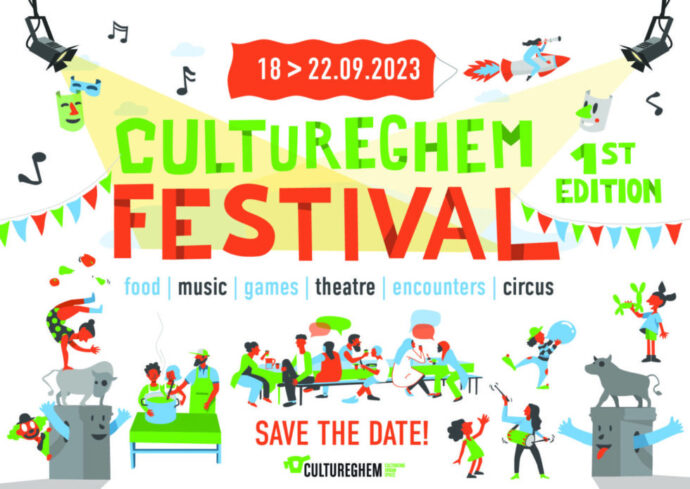
While looking for practical experiences, I came across the first edition of Cultureghem Festival, a very peculiar arts festival in the site of a popular open market in Brussels.
Produced by the Cultureghem association, this event took place in September 2023, following a years-long trajectory which aimed to progressively allow citizens to take an active role in the programming and organisation of the venue (Cultureghem: the people behind the scenes are more important than the artists, 5/11/2023, BRUZZ).
The 19th century complex of the Abattoir regularly hosts hundreds of thousands of users every week for a big food market, representing a historical landmark for the Anderlecht Municipality and its neighbourhood Cureghem. Part of the so-called croissant pauvre (poor semicircle) of Brussels, in this densely populated neighbourhood, residents have one of the lowest incomes in the region. The population is culturally heterogeneous, with an over-representation of north and sub-saharan Africans, as well as Eastern European nationalities (Datas refer to the 2016 study Institut bruxellois d’analyse et de statistique, Observatoire de la santé et du social Bruxelles, Zoom sur Anderlecht, édition 2016).
Cultureghem has its roots in this context, founded out of the proposal of Eva De Baerdemaeker, an engaged citizen, to implement a social plan for the site of Abattoir. In 2012, Cultureghem set its first activities – a series of collaborative cooking sessions – in compliance with the market functioning.
Since then, the association has contributed shaping the site with an attention to its users, to the extent of receiving a prize as the best new public space in 2018 from public institution Pyblic (Cultureghem wint Pyblik-prijs voor activering Abattoir, BRUZZ, 27/9/2018).
Today, Cultureghem’s program revolves around three key axes: Food, Space and People. The program includes actions against food waste (Collectmet), collective cooking (Kookmet), occasions for eating in community (Dreamkitchen), and a mobile playground managed by youngsters (Ketmet), all following one basic principle: free, unconditional access for everybody.
Given the semi-public status of the Abattoir and its usage as a public market, a large number of people are already users of the space: Cultureghem then acts as an activator in its potential for new relations and usages.
The association aims to offer a welcoming space to neighbours, socially engaged citizens, and people experiencing different kinds of exclusions – economic disadvantage, administrative or physical limits – or suffering loneliness.
This heterogeneous group constitutes simultaneously the public and the core of Cultureghem, the so-called Dreamteam: everybody is engaged according to their will, availability, and skills in various activities, from food collection, to cooking, to animation. The possibility of being engaged at different degrees of responsibility allows for the participation of up to a hundred people (Interview with Anne Watthee, 16.11.2023).
Beyond sharing the table, the public has progressively shown another appetite, asking to be involved in cultural events. This led in 2021 to the creation of OMTA, Open Meeting Space for Temporary Arts, as a platform to promote Cultureghem’s social mission through cultural actions.
OMTA was originally conceived as a cultural program taking place in the Abattoir, and as a process of implication of site’s users in it. For its first year, it included an open podium to perform or share artistic skills, an open-air cinema, a street photography exhibition and other kinds of productions and workshops.
Despite having originated from the requests of the volunteer team, this first format ended up being very demanding for both them and Cultureghem’s workers: by selecting and producing artistic work, the organisation was stepping out of its primary social functions to take the role of a cultural institution (Interview with Anne Watthee, 16.11.2023).
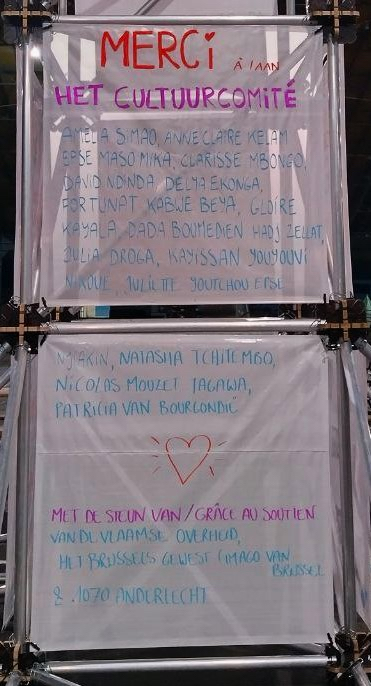
That is why, from 2022, OMTA changed format: on one side, cultural institutions were invited to put in place their own mediation activities for the site. On the other side, volunteers that were willing to be more engaged in culture were invited to constitute Cultureghem’s first Cultural Committee. Following some meetings with Article27, an organisation promoting cultural rights in Belgium, they took part in a full program of exhibitions, theatre shows, and guided tours. Over the whole year, Cultureghem provided them means and occasions to get in touch with the varied cultural offer of the region, and to reflect on their will for the cultural life of the Abattoir. (DOSSIER NETWERKTRAJECT – How to OMTA, de culturele programmatie van Cultureghem in handen van burgers, Demos, 01/02/2023).
In 2023, the Committee was asked to take a step further in their responsibility, bringing their experience back to the market to put in place what ended up being the Cultureghem Festival.
Cultureghem’s Anne Watthee, responsible for OMTA, realised the importance of the whole process that led to its organisation, from the creation of the group, to the collective decisions and the final realisation. She then started working on ‘How to OMTA’, the overall research process that included confrontations with the Committee and with external professionals. Cultureghem is in fact part of a learning network constituted by Flemish-funded cultural institutions to share ideas and good practices for democratising decision-making processes in cultural programming. Coordinated by research platform Demos vzw, it proposes inter-organisational meetings, even among the communities involved, and buddying sessions (Netwerktraject how to OMTA, Demos, 01/02/2023 ).
Demos has also been responsible for the ENTER festival, a multidisciplinary arts festival focused on participatory artistic practices, which represents a reference for OMTA. The festival invited artists to realise a collaborative work during a residency in neighbourhoods, while citizens took care of the whole selection and production process for other artworks. Similarly, How to OMTA focused on the development of a methodology of empowerment and decision-making for non- professionals in culture.
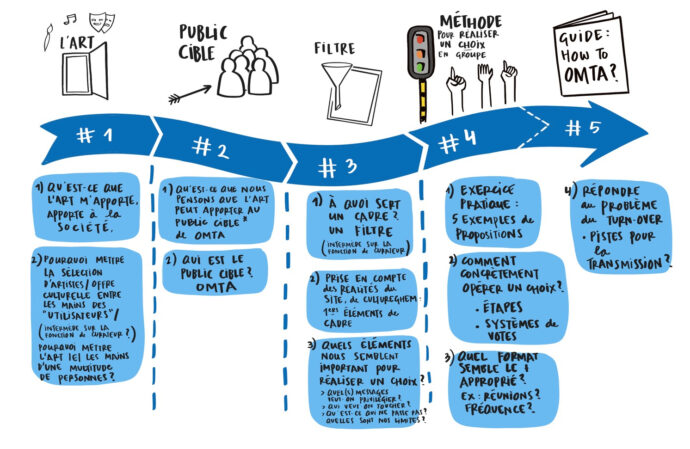
For its first steps, the Cultural Committee was invited to define itself, digging into the reason of its engagement in arts: during five sessions in early 2023, the group gathered to discuss their common values with the support of visual facilitator Judith Du Faux. They faced questions that were fundamental in leading their future actions: their status as decision-makers in culture – of curators and users at the same time – or the people they wanted to reach, and the impact arts could have on their lives.
They had to figure out ways of collaborating and taking collective decisions, and for this purpose came up with criteria and values that backed their choices for the festival: more than site curators, they took a role of ‘dialogue partners’ that would encourage other people to take part in this process. (Ann Van de Vyvere, Cultureghem Festival in handen van burgers, Démos, 22.06.2023).
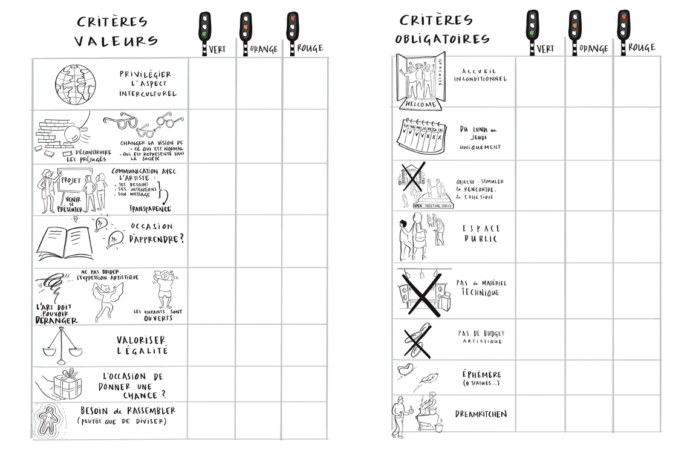
From theory to practice, Watthee presented artists’ spontaneous proposals to the Committee, so they could check their compliance with some mandatory criteria – for example, there was no artistic budget nor specific technical material, and the work needed to be ‘welcoming’ and fitting for a public space. The artists themselves had to actively take part in the Dreamkitchen to get into contact with its space and people. Although these aspects could be seen as serious limits for an artist, they clarify Cultureghem’s social goal and the public nature of the context: again, the association has different constraints from a production or exhibition space.
The works were also discussed according to the values they could bring, through a list that included: valorising the intercultural and equality, deconstructing prejudices, learning or gathering occasions, and yet the possibility to be challenged by the artwork (Demos, Uit Vrije Wil in Vrije Tijd, 2023). These criteria are particularly interesting because they visualise values and impacts identified by a group of cultural users for their community. In other words, being implied in the definition of a cultural program led the group to reflect over the values they aim to share with fellow users of the Abattoir.
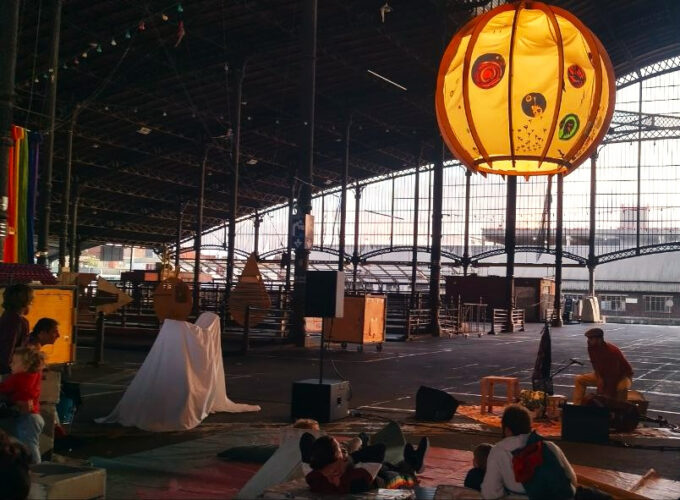
In this way, a dense program for the festival was finally set up, going from food exchange to music, from circus to performance, with an attention to presentations from different cultures. Pocket Poney concert ‘The Genesis’ by performer Paola di Bella was hosted on the first evening, a dynamic performance with Sicilian songs and dance improvisation on the scenario of the market. The member of the Dreamteam and rapper Dada organised the one-day Festival de las Naciones, a buffet with food from different countries including an evening of folk and rap concerts. Performer Julia Droga collaborated to organise a collective walk, led by components of the Committee to show places of their affection in the neighbourhood; and yet in the festival, an open mic, a circus and a musical theatre performance, and a dj-set (here the after video presenting the full festival).
The festival offered a variety of media and experiences that the critical eye could judge as disconnected between them: this is due to the fact that the process focused more on the transformation of an open space into a welcoming, friendly context than on a curated selection. As Watthee observed, quality was not at stake in this case, rather the overall process: how the Abattoir has become the centre of various usages, by and for its users, and its curation as a tool to imagine the space otherwise.
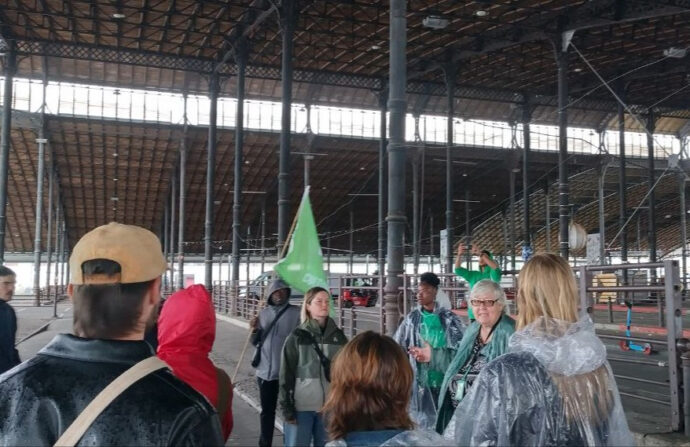
This event represents a crash test, one of the first chapters for further developments in the organisation of Cultureghem itself: moving from an event to a structural logic, the goal is to encourage users of the Abattoir to progressively organise and take decisions over the space and its activities. From 2024, the Committee will be encouraged to discuss its autonomy from Cultureghem to be as self-managed as possible.
The festival left a soothing sensation of possibility and empowerment over a daily-used market, where even the aesthetic experience, along with the others, becomes a matter of public concern.
As the priority was given to the general user’s experience of the place, the festival offered a program more responsive to the different sensitivities that inhabit the Abattoir; in these terms, it’s interesting to note how more space was given to food sharing occasions and music, rather than visual arts.
In his 1995 Education for the Mastery of Environment (Freedom Press), anarchist writer Colin Ward called upon an ‘aesthetic of a variable, manipulable, malleable environment’, against the discouragement and the delegitimization of people towards their environment. He suggested an integration of politics of participation in cultural life, in detriment of forms of ‘cultural elitism’ which impose fixed environments, made to be passively experienced. Under the banner of an explicit social goal, and loyal towards its public, the process leading to Cultureghem Festival echoes these words, offering us a hint of this empowering aesthetic.