MediaScapes: On the Constant (and Intermedialised) Dialogue Between the Urban Space and the Literary Texts of D. H. Lawrence and James Joyce
Introduction: Intermediality Matters
Living in the twenty-first century has one benefit: access to nearly all information. While watching a film, a TV series, or a staged performance, a curious beholder [viewer, reader, listener, etc.] may find out that, as literature has long served as a source of plots and fables for other media, many works are adaptations of the texts written in a specific time and place. Although written narrative literature is traditionally considered to be the most natural (and simple) literary form, it should be seen, in fact, as the opposite: an artistic form integrating a complex and highly engrossing intermedial system (Bruhn 2016). In the case of the adaptations of the literary works of D. H. Lawrence and James Joyce, the curious beholder will quickly find out that the texts [source media], for instance, Sons and Lovers (1913) or Ulysses (1922), are autobiographic and refer to Eastwood, United Kingdom or Dublin, Ireland. The beholder may believe that their adaptations [target media] accurately represent the places during Lawrence’s and Joyce’s lives: for example, in Ulysses, Dublin is vividly depicted, with specific locations such as the Martello Tower and the River Liffey playing significant roles in the narrative. The beholder may also dislike the adaptation and question its representation of reality. Eventually, they might travel to Eastwood and Dublin to see what remains of the novelistic setting.
There, they shall witness a bidirectional process. In the triangle ‘the writer – the place – the work’, the Lawrentian and Joycean novels are asynchronous actors: first, they have been impacted by the urban place at the beginning of the twentieth century, and now they are making a profound impact on the cityscapes in return. This two-directional intervention establishes a dialogue between literature and architecture. Such ongoing dialogue is not new in the studies of the morphology of arts; however, the cases of Lawrence and Joyce stand out, being intermedialised to a greater extent due to the experimental nature of the texts themselves. While their texts impact the contemporary landscapes of two urban settlements, they construct a ‘mediascape’, a term we would use to describe the convergence of various media forms in a specific geographical location. In this mediascape, fiction, history, arts, media, culture, and reality merge into one fabric. This forms a transmediated hyperreality, a simulacrum where the literary and the urban intermingle. The mutual interference, a porous contact between the literature of Joyce and Lawrence and the architecture of Dublin and Eastwood, i.e., between two media, will not always have the initial textual element visible. Yet, the visualised textual code is always present and functional in a certain way (Plunkett, Vadillo, Gagnier, Richardson, Rylance and Young 2012).
The contact between these two forms of media also raises the matter of literary tourism, a transformative experience that can alter one’s perception of the urban landscape. While residents may overlook the literature’s impact on the landmarks, like an uninformed passerby, others may travel there to explore the link between literature and urban forms. The effect of the writings, be it consciously reflected upon or unnoticed, may ‘remind’ the residents, passersby, or tourists of the meditated image they have experienced while watching the adaptation, listening to an audiobook [another form of intermedial adaptation], or reading the source media. This transformative experience can bring additional cultural value to the urban space, stimulating media-related tourism, heritage tourism, and cultural tourism, which can redefine various aspects of the urban routine and economics (see Hoppen, Brown and Fyall 2014 and Squire 1994).
As pointed out earlier, the idea of the dialogue between arts (and media) is not new. It is linked to the morphology of arts, their syncretism, and dominating art forms (see Isagulov 2017), the matters discussed in detail by the Hellenic philosophers and Romanticist aestheticists. The matter was also studied in the literature: regarding the novel as a new genre and its role in the twentieth century, as well as the dialogism between the novel and other artworks (see Bakhtin 1981). This brought forward the term ‘intertextuality’ (see Kristeva 1969), which, in turn, supported the coinage of the word ‘intermediality’ (see Hansen-Löve 1983). Consequently, perceived as “specific relations among dissimilar media products and general relations among different media types” (Elleström 2017), intermediality has taken a strong position in our lives, offering new ways to interpret and engage with various medial forms. Now, any relation between a sculpture and a book, a novel and an architectural artefact [work of art, art piece], or a piece of music and a film can be seen, analysed, or interpreted as a case of intermediality, where two or more media interact and build something new, something in-between, where all artefacts form a mixed assemblage (see Bruhn 2016).
The relationship ‘in-between media’ can be perceived, in an analogy to a landscape, as a mediascape – we propose to see it as a specific place where media meet, establish a dialogue, feed a polyphony of arts, and facilitate the creation of new artefacts, i.e., the crossroads of various intermedial processes. In this case, a medium becomes a communication tool with material, sensorial, spatiotemporal, and semiotic modalities (Elleström 2010). Its material aspects, senses, space and time, and meaning give it a valuable documenting function that can be exploited both by readers and tourists. In this regard, we would like to support the opinion that “literary criticism can no longer ignore the materiality of its objects” (Johnson 1997) and argue that the material modality of the literary medium (i.e., its ‘interface’), along with the variety of forms involved in the dialogue between particular media, creates a significant base for the detection, deciphering, and analysis of intertextual and intermedial links and components within literary and non-literary artefacts. While in this paper, our attention is paid to literary modernism and its dialogue with two contemporary urban spaces, we would also like to support the idea that the medium “really is the master of modern culture” (Murphet 2009) and demonstrate that literary texts often depend on or incorporate substantial amounts of ‘extraliterary’ material and that such dimension of literature [which we argue to be intermedial] is ignored too often (Bruhn 2016). By focusing on literary artefacts’ intermedial components, we gain new insights and a broader understanding of each work. This pragmatic thesis is crucial, as intermediality works inside and outside the arts (Bruhn 2016), building bridges between the imaginary and the real and helping us assess the world.
The Place – The Writer – The Text
At the beginning of the twentieth century, the literary medium relied on mass printing, growing literacy rates, and the establishment of literature as a new commodity and market (see Altick 1999 and Lloyd 2007). As an art capable of incorporating other arts, mimicking and parodying them (Bakhtin 1981), literature became very experimental. Nevertheless, its growing dominance yielded to the spreading of new media. Modernist writers like Lawrence and Joyce tried to re-think the role of art, specifically the semiotic aspects. As they lived through rapid technological changes and the development of new media, they reflected on what they witnessed in their writings and new aesthetics through experimental forms (Guillory 2022 and Isagulov 2023). The change of the landscapes around them [urban, political, cultural, medial, etc.] impacted and intervened their texts, facilitating their intermedial character.
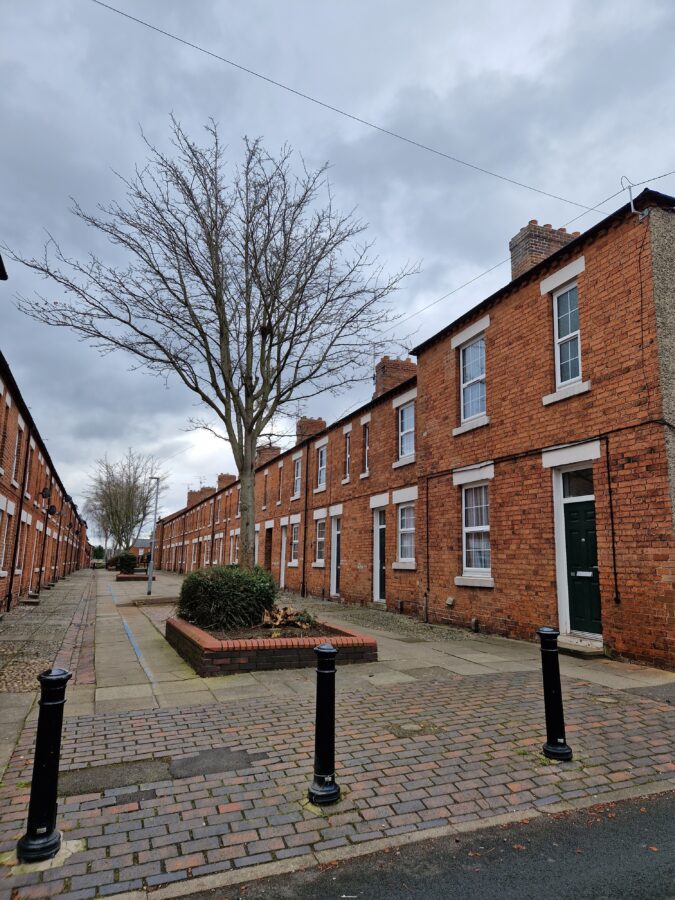
For example, Lawrence (1885-1930) was born in Eastwood, Nottinghamshire, a region which could be called the place of Victorian stability and traditions. However, towards the end of the nineteenth century, the coal mining industry quickly and irreversibly reshaped the landscape. The men worked in the pits, and the mining companies built new housing for men (see Pic. 1). The excavation of the fossils created dumps, and their shapes changed the horizon. Mines required railways, electricity, and water supply, which attracted new workers and established new services. As a result, the industry created a new routine for people. This changed Eastwood and other provincial settlements, making a sharp pivot from farming to industrial mechanisation.
As changes led to increased self-reflexion of the writers (Killen 2015), Lawrence reflected on what he saw and experienced in Eastwood as a child and a young man. The readers of The White Peacock (1911), Sons and Lovers, The Rainbow (1915), Women in Love (1920), and other works are presented with a new literary focus: through his protagonists and narrators, the writer speaks about people who need to adjust to the new reality, live in urbanised areas, or even move away to cities. The novels focus on the human interior (mind and soul), often opposed to chaotic external changes. Persons facing the turbulences of modernity, who experience fear and torment, move a lot through a new, urbanised landscape as it becomes inseparable from their new lives and challenges.
In Sons and Lovers, for instance, Lawrence speaks about Eastwood disguised as Bestwood. He describes the town and a dozen mining pits and farms around it, building a ‘city–countryside’ opposition. The writer also depicts the new industrialised landscape and its impact on nature. He speaks of the parts now known as The Breach, Victoria Street, Sons and Lovers Cottage [the Lawrences’ second home in Eastwood], Walker Street, and Greenhill Lane. He describes the town market, the Co-op shop, the office of mine owners, and the local boarding school.
While depicting the residents of Eastwood, Lawrence draws parallels with well-known fables and stories. He imposes cultural archetypes on his characters, enhancing the layer of intermediality in the text and enlarging the contexts of the novels through fragmentation. In the case of The Rainbow or Women in Love, also based around Eastwood, he connects the layers of the Bible, Hellenic mythology, and Richard Wagner’s operas (see Whelan 1988), which forms a plexus of intermedial elements in the text, where characters’ archetypes mostly mismatch. This can be interpreted as people’s unwillingness or unreadiness to embrace the changes around them (including the new urban landscape) and move forward.
As Lawrence’s origins are in a small town in the countryside, his symbolism becomes nature-based. As a result, his texts reject mechanisation and industrialisation. One may conclude that he rejects urbanism and modernity in favour of nature and the primaeval order of life. This supports his anti-urban cosmology, rooted deeply in human souls. Yet, the souls he studies reflect the external reality and unavoidable changes brought by modernity to the rural countryside.
Unlike Lawrence, Joyce (1882-1941) was born in the city of Dublin. At that time, it was not yet the capital of an independent state but a province of a British colony. There, the Irish language was discouraged, the folklore was forgotten, and people had to work for English traders. The streets of Dublin at that point were full of cattle to be transported to England, horses, and struggling men who drank and gambled in the hope of earning some money (see NA). These elements are repeatedly mentioned in Ulysses, often as a parallel to Homer’s Odyssey and the cattle of Helios from Hellenic mythology. As he muses on colonialism of the Catholic and British imperia, he refers to, for instance, the Daedalus myth and Saint Stephen legends in A Portrait of the Artist as a Young Man (1916) to oppose the Hellenic quest for freedom and Catholicism’s doctrine of acceptance. By reworking these two literary sources [which is a change of medial modality and can be seen as intermediality in a broad sense], he presents Dublin as a place of a lower class, filled with hatred for the Empire (see Deane 2000). Yet Dublin had specific features to be imprinted in human perception and memory: the city’s bright doors, smelly rivers and canals, and a busy port. The novel focuses on the young artist at various stages of his maturity, described by scholars as a series of photographic portraits or cinematographic sketches (see Bell-Villada 1996 and Paraskeva 2009) [that is, extended ekphrases, another traditional intermedial form in literature that was impacted by the advance of new media]. As Stephen Dedalus is presented as an artist, the focus on Dublin’s architectural and visual elements seems obvious. However, in the young and curious mind of the protagonist, the ‘urban’ media of Dublin are merged in a text that reads like synaesthesia: we see it as another experimental form, where sounds and colours of the city – as media perceived and presented through senses – form another medial modality of the text.
As throughout his oeuvre, Joyce speaks of his concerns about Ireland being a colony and the most belated race of Europe and reflects on the accelerating changes brought by the twentieth century, he places his characters in locations he knows well. As his novels are autobiographic in terms of space, they bear a documenting function [Visit Dublin website claims that “if Dublin ever disappeared, you could rebuild it through the words of […] Joyce” – see VD]. Stephen, his primary embodiment in A Portrait and Ulysses, walks to the same schools, attends the same college, and visits the same places and people. While moving around or thinking about such districts as Rathgar, Rathmines, Drumcondra, Blackrock, Clontarf, and Fairview, where Joyce lived with his family, Stephen witnesses the same changes [economic, political, cultural, urban, etc.] as Joyce did and documents them through text that gets intermedialised by the focus on the city and its elements.
Eventually, processing and reflecting on two different situations, Lawrence and Joyce produce differing intermedialised modernist literary fables and plots impacted by urbanisation. The “kaleidoscopic and fractured experiences of urban space” were as important to them as concerns about everyday life, perception, and time (Marcus 2015). As both writers struggled to publish their texts and were initially rejected by the editors and readers, they became well-known due to trials, scandals, or the ‘indecency’ of the topics raised. This brought them under the spotlight, along with the actual places that stimulated such writing.
The Contemporary Dialogue
Suppose our curious beholders, interested in these modernist masterpieces, decide to go to Eastwood. In that case, they might eventually notice the D. H. Lawrence Literary Trail that circles the contemporary town and marks places either related to Lawrence’s life or mentioned in his novels. It also brings the visitor to the D. H. Lawrence Birthplace Museum. The place, surrounded by the terraced houses built for miners (see Pic. 1), shows why the depicted life seems so miserable: it was indeed hard for Lawrence’s family and other people who switched their trades and skills or moved from farms to towns surrounded by mining pits.
Eastwood might also surprise visitors with the names of local pubs and shops, as many are related to Lawrence’s novels. For instance, one can have a pint at The Lady Chatterley pub, get a coffee at The White Peacock (see Pic. 2), exercise at Phoenix Cue Sports, or buy a teapot at Rainbow Cards homeware shop. All these places refer to specific literary works of Lawrence: Lady Chatterley’s Lover (1928), The White Peacock, Phoenix (1932), and The Rainbow. These places are both attractions for book-loving tourists and a symptom of the value of Lawrentian heritage.

The visitor may also be surprised by the number of phoenixes in Eastwood: the image of the mythological beast, taken from Lawrence’s sketches (see MSC), marks the trail and is placed on some buildings and litter bins in the town. This image recurs throughout his novels [as a symbol and visual, i.e., intermedial element] and is put on his gravestone [can be seen at the D. H. Lawrence Birthplace Museum]. As the symbol of Lawrence’s seeking for freedom and re-birth, it is crucial for the characters in his novels: it serves as a metaphor linking life, death, vegetation, and fear of mechanisation. Now, it is a critical infrastructure element for Eastwood of the twenty-first century. It has travelled from the writer’s books and accompanying sketches into the urban and is currently its inseparable constituent: as indivisible from Eastwood as from the texts of the novels.
These elements, noticeable or not, form the mediascape of Eastwood and keep re-defining the place and impacting the residents, visitors, and passersby. Without them, modern Eastwood would be a different place, with different names, history, and available services and attractions. They are re-enhanced through various events dedicated to the writer and his novels: this re-defines the town through the acts of celebration of Lawrence, his life, and his works. These public events shift the focus of attention towards lesser-known buildings, farms, churches, etc., which creates a new perspective for locals and visitors. Once one finds out that a seemingly unimportant architectural form has an additional symbolic or metaphoric value, one may start perceiving it as something meaningful, worth care and preservation.
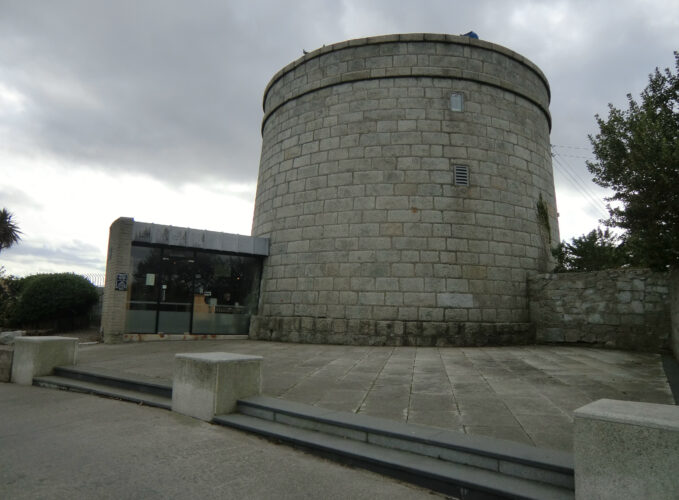
By comparison, if the beholder is more interested in Joyce and travels to Dublin, they will see a slightly different picture. Joyce is a ghost of the vibrant city: he and Ulysses rule over the cityscape of Ireland’s capital once a year, although they are always present in the cityscape. First, Joycean writings and their controversial nature facilitated the creation of the Museum of Literature Ireland (MoLI), the acronym of which echoes Molly, one of the protagonists of Ulysses. Visitors can also quickly come across the James Joyce Centre, the writer’s statue in the city’s heart, and the James Joyce Tower & Museum. These are Dublin’s landmarks and essential locations for lovers of Joyce, as they are linked to his texts and are proofs of the bidirectional dialogue between past and contemporary, the fictional literary and the real urban (see Pic. 3).

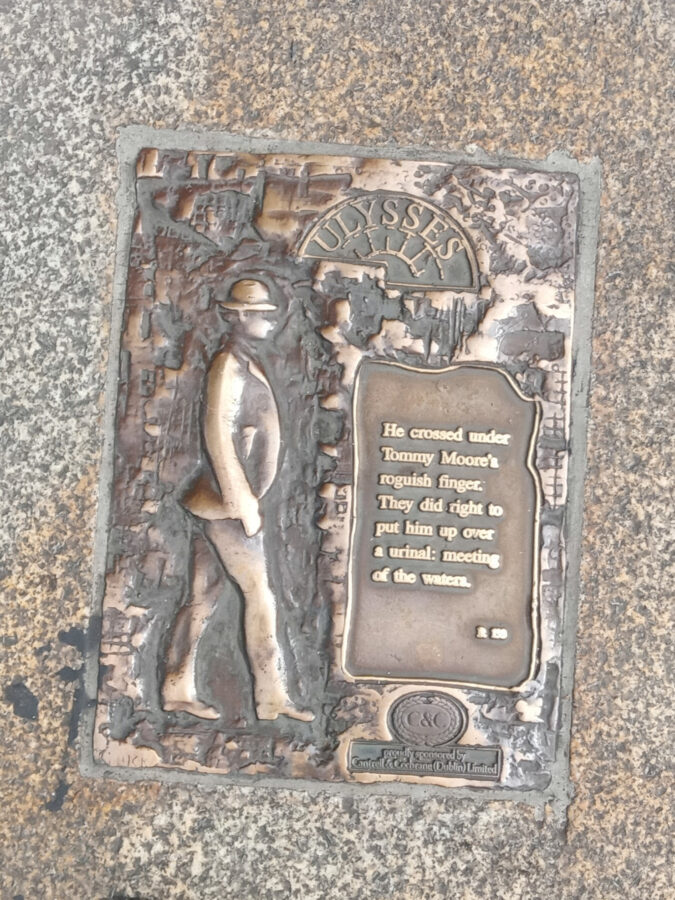
Secondly, as Joyce tends to describe Dublin as is, providing details of real life, some routes of his characters can be followed. Rather than walking around Dublin aimlessly, some visitors will choose to walk the city like the characters from Ulysses, Stephen Dedalus and Leopold Bloom. This will allow the visitors to compare the changes in the cityscape and sense the city: Stephen Dedalus from A Portrait speaks and thinks a lot about Dublin’s smell, noises, and bright colours. Eventually, the possibility to ‘re-imagine’ and grasp the hyperreality merges heritage and modernity, as many of the houses remain unchanged [In our personal experience, the doors of the city are very colourful and River Liffey and the Dublin Bay are very odorous during the low tide – possibly, as bright and odorous as they were a century ago when Joyce describe them via Stephen Dedalus’s observations]. Of course, no cattle are on the streets anymore, and there is no port, but this can be easily fantasised. At the same time, Joyce’s legacy remains and has an actual physical form. As Leopold Bloom, the modern Odysseus from Ulysses, walks through Dublin the entire day, this fictionalised day, 16 June 1904, was turned by enthusiasts into Bloomsday, probably Ireland’s second most famous festivity after Saint Patrick’s Day. Enthusiasts – Joycean scholars, literature students, and curious tourists – come to Dublin to perform specific mandatory manipulations [This tradition counts a hundred years: the first cases of observing the Bloomsday on 16 June happened in 1924, two years after the novel’s first publication – see Gilbert 1957]. The crowds dress in old clothes and follow Bloom’s route through the city. Bronze bas-relief plaques, an architectural form incorporated into the walkways, mark the way (see Pic. 4). These signs bear the quotes from Ulysses about specific places in Dublin in front of which they are installed [which also makes them intermedial forms].
As people follow the route, they visit the key places mentioned in the novel and repeat Bloom’s actions: for example, they buy lemon soap from Sweny’s pharmacy, where there are daily readings from Joyce. There are places to have a pint or consume specific cuisine, just like the characters did in the book: Davy Byrnes on Duke Street, International Bar on Wicklow Street, Oval Bar on Middle Abbey Street, and Kennedy’s in Westland Row (see VD). On Bloomsday, these places become mini-stages, spots of sporadic group performances: reading of Ulysses, enactment of its chapters, and musical renditions of specific paragraphs. These acts depend on an actual place in Dublin and a related chapter of the novel, as each chapter has its own modality and narratorial style linked by the writer to specific art and medium. This makes the literary festival a feast of adaptation and intermediality, as text and its medialised modalities cross the border of a literary medium, penetrate the city’s real life, and re-define the contemporary urban space.
Overall, whether you meet a crowd of people wearing dated clothes in Dublin or an explorer walking Lawrence’s trail marked with bronze phoenixes, the experience shall be exclusive. The world of literature, impacted by Dublin and Eastwood of the early twentieth century, impacts contemporary urban spaces. Everyone can join the festivals or walk the routes; everyone can attend the museums that re-defined the local buildings; and everyone may ignore these interventions of the literary into the urban. Yet Joyce, Lawrence, and their literary characters are present in many instances and forms and can be met at any time in the urban places from which they originated.
Conclusion
Literary works impact the city; it is visible, sensible, perceptible, and ontological. Changes facilitated by a literary medium may become inseparable from contemporary urban settlements and well-integrated into local architecture. This establishes a mediascape, an intermedial fusion of literary and non-literary in urban areas.
From a cultural perspective, the link between the urban and the literary may help create new landmarks and develop literary tourism, making the relation between the urban form and the literary medium intermedial and two-directional: the urban travels into the books through topics, motifs, or routine of the characters; synaesthesia, ekphrases, or other text-based intermediality of a published book impacts the urban, making the new, highly medialised cityscapes.
While reflecting on life in Eastwood, Nottinghamshire, England and Dublin, Ireland at the beginning of the twentieth century, the novels of Lawrence and Joyce managed to produce this bidirectional intermedial effect and establish a constant dialogue between the urban and the literary. Born out of the specific urban settlements, the literary layer has impacted the architecture and the urban infrastructure, having re-shaped architectural elements during the last hundred years: there are new names, museums, walking routes, festivals aimed at readers, scholars, tourists, and literary enthusiasts, that signify the transition of the literary into new visual symbols and new cultural acts.
Acknowledgements
The author thanks Arvian Hesketh for his valuable suggestions, editors Nafiseh Mousavi and Philip Dodds, and the peer reviewer for their kind and constructive feedback regarding the first draft of the paper.
References
ALTICK, R. A. (1999). Publishing. In H. F. TUCKER (Ed.) A Companion to Victorian Literature & Culture, pp. 289-304. Oxford: Blackwell Publishers.
BAKHTIN, M. M. (1981). The dialogic imagination: four essays. Austin: University of Texas Press.
BELL-VILLADA, G. H. (1996). Art for art’s sake & literary life: how politics and markets helped shape the ideology & culture of aestheticism, 1790-1990. Lincoln and London: University of Nebraska Press.
BRUHN, J. (2016). The intermediality of narrative literature: medialities matter. London: Palgrave Macmillan.
DEANE, S. (2000). Introduction. In J. JOYCE A portrait of the artist as a young man. London: Penguin Books.
ELLESTRÖM, L. (Ed.) (2010). Media borders, multimodality and intermediality. London: Palgrave Macmillan.
ELLESTRÖM, L. (2017). Adaptation and intermediality. In T. LEITCH (Ed.) The Oxford handbook of adaptation studies, ch. 29. New York: Oxford University Press.
GILBERT, S. (Ed.) (1957). Letters of James Joyce. New York: Viking.
GUILLORY, J. (2022). Professing criticism: essays on the organization of literary study. Chicago: University of Chicago Press.
HANSEN-LÖVE, A. (1983). Intermedialität und Intertextualität. Probleme der Korrelation von Wort- und Bildkunst – Am Beispiel der russischen Moderne [Intemediality and intertextuality. Problems of correlation of verbal and pictorial art – using the example of Russian modernism]. Wiener Slawistischer Almanach, pp. 291-360.
HOPPEN, A., L. BROWN, and A. FYALL. (2014). Literary tourism: opportunities and challenges for the marketing and branding of destinations? Journal of Destination Marketing & Management, vol. 3, pp. 37-47.
ISAGULOV, M. (2017). Интермедиальные доминанты: от Античности к современности [Intermedial dominants: antiquity to modernity]. Antiquity – Modernity (Matters of Philology), vol. 5, pp. 172-184.
ISAGULOV, M. (2023). Turbulence of the fin de siècle: arts through the looking-glass of intermediality. IAFOR Journal of Arts & Humanities, vol. 10, no. 1, pp. 107-119.
JOHNSON, J. (1997). Friedrich Kittler: media theory after poststructuralism. In F. KITTLER Literature, media, information systems: essays, Introduction. London: Routledge.
KILLEN, A. (2015). The second industrial revolution. In M. SALER (Ed.) The fin-de-siecle world, ch. 3. London: Routledge.
KRISTEVA, J. (1969). Sēmeiōtikē: recherches pour une sémanalyse. Paris: Seuil.
LLOYD, A. J. (2007). Education, literacy and the reading public. British Library Newspapers. [Accessed online at https://www.gale.com/intl/essays/amy-j-lloyd-education-literacy-reading-public on 28 Nov. 2023].
MARCUS, L. (2015). Film and modernist literature. In G. RIPPL (Ed.) Handbook of intermediality: literature – image – sound – music, ch. 12, Germany: De Gruyter.
MSC: MANUSCRIPTS AND SPECIAL COLLECTIONS, UNIVERSITY OF NOTTINGHAM (n.d.). [Accessed online at https://nottingham-uk.userservices.exlibrisgroup.com/discovery/delivery/44NOTTS_UNUK:44NOTUK_NEW_VIEWER/9922311505305561/ 04 Dec. 2023].
MURPHET, J. (2009). Multimedia modernism: literature and the Anglo-American avant-garde. Cambridge: Cambridge University Press.
NA: NATIONAL ARCHIVES (n.d.). [Accessed online at https://www.nationalarchives.ie/search-the-online-catalogue/ 16 Apr. 2024].
PARASKEVA, A. (2009). “In the beginning was the gest”: theater, cinema, and the language of gesture in “Circe”. In M. BEJA and A. FOGARTY (Eds.) Bloomsday 100: essays on Ulysses, ch. 7. Gainesville, Tallahassee, Tampa, Boca Raton, Pensacola, Orlando, Miami, Jacksonville, Ft. Myers, and Sarasota: University Press of Florida.
PLUNKETT, J., A. VADILLO, R. GAGNIER, A. RICHARDSON, R. RYLANCE, and P. YOUNG. (Eds.) (2012). Victorian literature: a sourcebook. Basingstoke: Palgrave Macmillan.
SQUIRE, S. J. (1994). The cultural values of literary tourism. Annals of Tourism Research, vol. 21, no. 1, pp. 103-120.
VD: VISIT DUBLIN (n.d.). [Accessed online at https://www.visitdublin.com/guides/james-joyce-ulysses-locations/ 15 Apr. 2024].
WHELAN, P. T. (1988). D. H. Lawrence: myth and metaphysics in ‘The Rainbow’ and ‘Women in Love’. Ann Arbor: University of Michigan Research Press.