Bråkmakargatan in Rosengård: On the intermedial politics and poetics of Swedish suburban rap
Since 2019 I have been a researcher in musicology at Lund University, where I have also lectured on, among other things, the history of hip-hop and especially the political aesthetics of Sweden’s suburban rap scenes. But when in 2021 I joined a research project on home, migration, and aesthetics based in the department of ethnology, I began reading old PhD theses that had been published in my new department. I was especially interested in Per-Markku Ristilammi’s 1994 thesis on Rosengård and the Black Poetry: a Study of Modern Otherness, which explored how the Malmö suburb of Rosengård had been constructed as a stigmatised other in relation to mainstream Sweden.
Rosengård is famous in Sweden, variously hailed as the birthplace of football star Zlatan Ibrahimović or discussed fretfully in TV debates about the country’s “problem areas” (“highly vulnerable areas” according to police categorisation) and/or the supposed failure of migrant “integration” policies. Built in the 1960s as part of the major state-driven Million Programme housing project, this large district on Malmö’s eastern edge initially symbolised the frontline of Social Democratic modernity, but by the 1990s it had switched, as Ristilammi (1994, p. 13) explains, from “a futuristic utopia to a stigmatised failure”. It has a complex history and it is internally differentiated, containing several distinct sub-suburbs and significant demographic variation, but references to Rosengård in Swedish media relate primarily to the so-called transit areas where more than 90 percent of the population has a migrant background – including large numbers of recently arrived refugees – and unemployment surpasses the national average (Listerborn 2013). A site of significant poverty and the scene of various social uprisings in recent decades, it is, as Mustafa Dikeç puts it, “the most emblematic of Sweden’s ‘badlands’ suburbs” – although “this Badlands image is more imagined than real” (Dikeç 2017, p. 137). Further, Rosengård now functions as the iconic concrete suburb, and as a metonym for somewhere where non-Swedes – or those who are not real Swedes – live (Ristilammi 1994; Ristilammi 1997).
The constant summoning of a symbolic Swedish migrant “concrete suburb” as a “problem area” has reinforced “an association between marginal location and insurmountable cultural ‘distance’” (Pred 2000, p. 175). Political activism based around marginalised suburban identities has emerged in the so-called förortsrörelsen, or “suburbs movement”, including through art collectives such as United Suburbs (Rosales & Ålund 2018; Skinner 2022). There is also a flourishing förortsrap (suburban rap) genre. Such alternative platforms of belonging in Sweden have been the subject of critical political media discourse, ostensibly for their “separatism” and/or threat to an imagined national cohesion or mythologised cultural homogeneity (Tesfahuney 1998; Dahlstedt 2019; Hultén 2019). For far-right parties such as the Sweden Democrats, such discourse – increasingly using the language of cultural rather than ethnic difference – serves their long-term and consistent aim of excluding racialized others, especially Muslims and other non-white immigrants (Hellström 2016; Norocel et al. 2022; Skinner 2022). This emphasis on culture rather than race has been normalised in mainstream Swedish politics, commonly through liberal framings of “areas of exclusion” plus their supposed solution: cultural “integration” (Norocel 2017; Mulinari & Neergaard 2017). Suburbs are depicted as the source of social exclusion, requiring adaptation to broader Swedish societal norms and values (Dahlstedt 2019). Through this process, the suburb has emerged as “the counterpoint to a desired normality” and the place “through which the Swedish state stages itself” (Ristilammi 1997, p. 76). This is, as Allan Pred puts it, “the spatially segregated Other as the counterimage to Swedish normality” (Pred 2000, p. 111).
So, with this context in mind, I was especially drawn to the questions or challenges Ristilammi identifies at the end of his PhD thesis:
It is difficult to conjure up a picturesque image of an international folk life at the same time as the image of the oppressive concrete… What do those poetics look like that can describe suburbs in a way that does not entail the production of otherness and stigmatisation?
(Ristilammi 1994, p. 153; p. 155)
It seemed to me that an answer might be found in some of the intermedial poetics – the combinations of music, rhythm, persona, narrative, imagery, dance, and film, plus both local-suburban and national-iconic symbolism – that I discuss in my Swedish suburban hip-hop lectures.
Here I focus on one song: “Bråkmakargatan” [trans: “Troublemaker Street”] by Ozzy feat. Timbuktu (2019), with two of Timbuktu’s regular collaborators Jens Resch and Patrik Collén listed as co-songwriters. The song’s title is an “intermedial reference”, in Irina Rajewsky’s (2005) sense, to a series of classic children’s novels by the Swedish author Astrid Lindgren. The song is also best understood as a complex “media combination” (Rajewsky 2005), and my analysis here focuses specifically on the spectacular live performance of “Bråkmakargatan” on Swedish national television in 2020, exploring how the lyrics, flow, musical production, and live staging and performance render a stigmatised concrete suburb as part of Sweden’s multifaceted national mythology. In this task I am inspired by Leppänen and Westinen’s (2017) study of rap music in “peripheral” Finland, with a similar focus on “the multisemiotic (linguistic, discursive, cultural, embodied, cinematic and aural) resources the rap performance draws on”, and am addressing a similar question to theirs: how “mediatized practices of migrant rap can bring about new meanings about who can belong to a society” (Leppänen & Westinen 2017, p. 3; see also Rastas & Seye 2019). I am also inspired by Skinner’s (2022, p. 116; pp. 143-145) analysis of rap songs that explore the “outsider” or “marginal” framing of racialized suburban Swedes and how such framings can lead to a strong concrete-suburb-based identity (see also Sernhede 1998). More generally, I write here in the tradition of research on rap music’s politicised (local) meanings, pioneered by Tricia Rose (1994). I draw on Imani Perry’s Prophets of the Hood: Politics and Poetics in Hip Hop (2004), which contextualises and provides methods for analysing hip-hop’s intertextual, “multi-layered discourse”, its “internal conversation” character, its prioritisation of suggestive, allusive, and subtextual critique rather than overtness, and the importance of its “community of listeners” with their “community knowledge” (Perry 2004, pp. 36-38; p. 50).
Ozzy (now styled as Ozz6y) is the artist name of Cismaan Maxamed. He was born in Somalia in 1991 and moved to Sweden at five months old. His family settled in Rosengård. He grew up during an era when racism was common and Swedish popular imagery and discourse positioned “blackness as a symbol of that which is not Swedish” (Sawyer 2002, p. 18). Since his teenage years he has been producing music, and as a multi-award-nominated Swedish-language rapper, he contributes to what Skinner (2022, p. 3) describes as “a period of pronounced Afro-Swedish effervescence”. He has done so as part of the rap collective Malmö New Wave, which features the rappers Adam Aden and Guleed, both of whom are also black Swedes with family roots in East Africa. All three produce music (and music videos) that heavily reference Malmö’s suburban landscape. Particularly prominent in their lyrics and imagery are the local supermarkets and small “livs” grocery stores that often function as crucial landmarks in or synecdoche for particular areas of the city (see, for example, Adam Aden’s “Offside”). These often set the scene for fable- or fairytale-like narrative raps that make extensive references to popular culture, especially children’s popular culture, while exploring such themes as gang violence and suburban marginalisation (see, for example, Guleed’s “Endz”). Several of Ozzy’s earlier songs exemplify these characteristics common to the Malmö New Wave artists. The fairytale opening of “Askungen” (trans: Cinderella), for example, is followed by an exploration of the politicised position of suburban Swedes, including through the line: “vi är Nelson Mandelas i trakten” (trans: we are Nelson Mandelas in the neighbourhood) (on racialized suburban Swedish rappers’ identification with the position of Mandela and the use of apartheid comparisons, see Sernhede 1998).
Lyrically, “Bråkmakargatan” is a narrative rap that explores Ozzy’s achievement of professional and financial success despite a tough upbringing in a context of poverty and racial discrimination in a ghettoised neighbourhood. There are references to weapons and criminality, and the overall picture is of a place where people grew up scarred by violence, war, and trauma, but the track’s tone is nostalgic and even romantic. The second verse begins with Ozzy exploring memories of being mocked for being a poor refugee, but it transitions (“that was back then, now it’s nothing other than sunny”) to him now having stacks of money and getting attention from “groupies” on the basis of his success as a rapper.
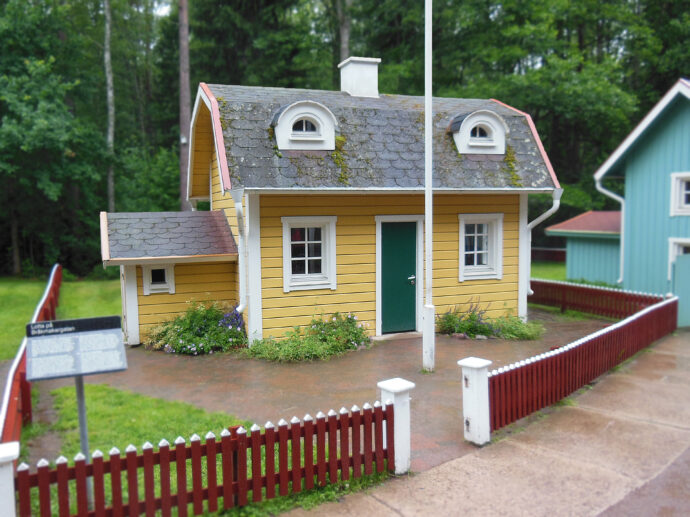
Narrative raps of this kind are often used to explicate the personality, lifestyle, and circumstances of the rapper’s persona (Perry 2004, p. 80). Jay Z has been a leading exponent of this style of rap, and indeed there are several resonances between his own rags-to-riches rap “Hard Knock Life (Ghetto Anthem)” (1998) and Ozzy’s “Bråkmakargatan”. “Hard Knock Life” famously samples the 1982 musical film Annie about the life of impoverished children in a New York City orphanage during the Great Depression. Ozzy also draws on popular culture and children’s fiction. Most obviously, “Bråkmakargatan” references the Astrid Lindgren novels Barnen på Bråkmakargatan (1956; published in English as The Children on Troublemaker Street in 1964) and Lotta på Bråkmakargatan (1961; Lotta on Troublemaker Street, 1964). In doing so, Ozzy imaginatively expands the world of his narrative (Perry 2004, p. 65), transposing the sleepy, traditional, white-Swedish, small-town setting of Lindgren’s classic tales onto his Rosengård context. While Lotta is simply a strong-willed child, Ozzy offers a different explanation for the “problem children” in Rosengård: this is a place where “almost everyone is from war”. But just as the difficult upbringing of the tough, streetwise Annie is a helpful metaphor for Jay Z, so Lotta’s childish mischief models the troublemaking in Ozzy’s life in Rosengård.
The intertextual pop-cultural references do not end with Astrid Lindgren. When Ozzy refers to Törnrosa as his babysitter, he is using both the name of a Rosengård preschool and the Swedish name for Sleeping Beauty. Swedish hip-hop fans will recognise references to Petter’s “Goda Dagars Magi” (2007) and förortsrap pioneers the Latin Kings. The line “Mamma’s kvarter – 213 adress” (“Mum’s quarter – 213 address”) also refers both to the influential “213” US hip-hop collective featuring Snoop Dogg, Warren G, and Nate Dogg, who were named after a Long Beach telephone area code, and to the 213 postcode area of Rosengård where Ozzy grew up. Such intermedial references position Ozzy as part of a global and Swedish hip hop canon, immersed in a widely shared pop-cultural mythology, and located very specifically in Malmö’s politicised suburbs.
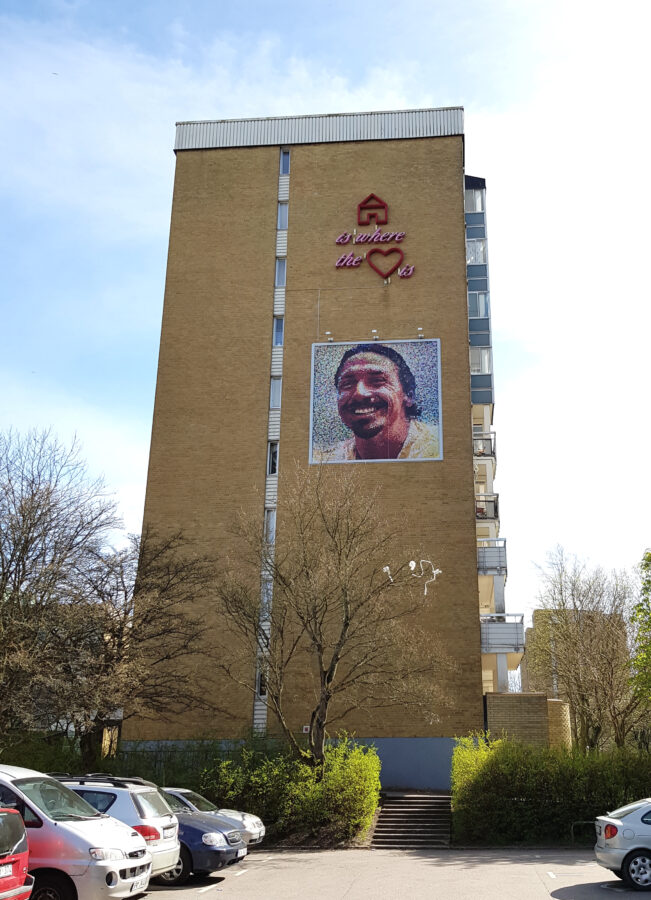
Another key cultural and placing reference of this kind comes in the first line: “På Bråkmakargatan alla barn vill bli Zlatan” (“on Troublemaker Street all the kids wanna be Zlatan”). This reference to the iconic Swedish footballer evokes an entire rags-to-riches story and immigrant success narrative, with Zlatan Ibrahimović as a suburban black sheep who became a national sporting hero despite a tough upbringing. Moreover, Ibrahimović himself grew up in Rosengård, very close to where Ozzy is from. The Zlatan Court estate in this part of Rosengård is named after him. For Ibrahimović and Rosengård, “place and person have merged into one unified story” as Rosengård is “the place that is used as a backdrop when media wants to point to Ibrahimović as a role model for migrant youth in deprived housing areas” (Johansson, Ristilammi & Tolvhed 2023, p. 443). The reference to Zlatan is therefore both a widely understood reference to a national symbol of success from adversity and a highly specific placing method that in connection with other lyrical details puts Ozzy’s story in a specific part of Rosengård.
Crucially, Ozzy’s narrative does not entail overcoming, transcending, or leaving the Rosengård context. Despite its nostalgic tone, “Bråkmakargatan” has a nowness indicating that Ozzy still proudly speaks from his place in Rosengård. He describes events that happened “häromdan” (meaning both “around here” and “recently”). He uses the present tense (“Sing when you come to my block”) and continually repeats the phrase “my block”, often returning to it at the beginnings and/or ends of verse lines, to signify both the inescapability of his location and his intense and ongoing commitment to it (see Dodds 2023). He raps: “on Troublemaker Street we will always walk” and “it’s always been the same block since we were small”. “My block” also has the double meanings of both the estate he comes from, which is the scene of his personal story and the material basis of his creative success, and the writing pad he creates his raps on, as in “penna har block” (i.e, “pencil has block [of paper]”). These are the poetic and aesthetic “authenticating device[s]” by which Ozzy, as many rappers seek to, positions himself as still “committed to his or her community, professes that allegiance, and remains honestly and organically rooted in his or her position in the world” (Perry 2004, pp. 87–8). Ozzy’s persona of an individual who is authentically rooted in a place and can speak to its conditions from personal experience “dislocates the authority for defining the black underworld” by “giving a voice to the stereotypical figure” (Perry 2004, p. 109). This sense of ongoing presence in the situational context is reinforced in the live performance, as I will explore below.
There is also, in the “Bråkmakargatan” chorus, a slippage from the first-person singular (“I”, “my”) to the collective “we”. As Perry points out, hip hop “concerns itself with both the self and the we. Its consciousness is both of the ego and of the collective” (Perry 2004, p. 88). Rapped stories of individuals are often intended to represent the challenges of life faced by a particular community. This collectivity is here reinforced by the call-and-response-conversation format of the chorus, which features Timbuktu as Ozzy’s collaborator. Timbuktu – real name Jason Diakité – has been one of Sweden’s most popular musicians for approaching three decades, as a multi-award-winning solo artist incorporating “Ghanaian high life, Black American hip-hop, and Swedish troubadour style” (Sawyer 2008, p. 97). He has also composed music for children’s films. Lena Sawyer (2008) describes Timbuktu as one of a number of Swedish musicians with African heritage who “have been important in changing the image of blackness, Africanness, and perhaps most importantly the public image of black Swedes” by “incorporat[ing] a black and African diasporic sensibility in their sound and style to negotiate and expand our understandings of Swedishness” (Sawyer 2008, p. 97). In his 2016 memoir, Timbuktu explains how he has struggled “to be able to be one of us. That Sweden could be home for me” (Diakité 2016, 11). As a young man growing up in Lund near Malmö, he “wished for a white skin colour, an origin, a collective story. A homeland” (Diakité 2016, p. 8). He describes feeling unwelcome in Sweden despite its national culture being ingrained in him – from eating falafel in Malmö, to laughing at Hasse and Tage, to learning about Vikings at school, to being eaten by midges on long summer nights (Diakité 2016, p. 11). Skinner describes how Timbuktu speaks to “an entire generation of Swedes who have experienced the stigma and abuse of social exclusion (utanförskapet) and everyday racism (vardagsrasism)” before asking, rhetorically, “What could be more ‘Swedish’ than Timbuktu?” (Skinner 2022, pp. 208–209). Indeed, Timbuktu is both quintessentially Swedish and a symbolic figure of those who have struggled to fit into conservative conceptions of Swedishness. The we that Ozzy can adopt with Timbuktu, then, is both the we of Sweden in general and the we of the socially excluded.
Timbuktu’s presence increases the popular appeal of “Bråkmakargatan”, but the track is also popular in musical style. In its production and rapping style it is lighter and more accessible than much of Ozzy’s other work. A repeated sample of playful children’s voices provides an atmosphere of childish innocence and enables a track with gangsta rap themes to have a fairytale tone. (The children’s voices function similarly in “Hard Knock Life”’s Annie sample.) And while other Malmö New Wave tracks use jarring and unsettling beats, “Bråkmakargatan” has a distinctively simple rhythm. The track is built on a simple repetition of two piano chords as a steady rhythmic layer, with a steady hi-hat following this rhythm. (This is the same rhythm as the one piano chord in “Hard Knock Life”.) Sparse syncopated bass gives some colour and momentum, but momentum towards the collective choruses is also generated melodically and through variation in rapped flow. While the first two lines have a high-energy, staccato quality due to their repetitive assonance, alliteration, and multisyllabic internal rhymes, more space and rhythmic variation is introduced thereafter. From the third line (“Bråkmakargatan, Lindgrenska sagan”), the rapping becomes syncopated – the first syllable comes after the first stressed beat of the bar – and uses a kind of two-step mirroring, with the second half of the line the symmetrical and logical answer to the first, as one foot follows the other. This evokes the momentum of walking, especially in combination with the syncopated bass line. Later, there is greater variation between short lines (“Jag minns dagis”) and more flowing phrases that use internal rhymes to blur line endings (“det finns Glock, MAC-10s / Back then det var blåsigt väder”). Ozzy’s rapping also becomes more akin to singing from the mid-point of each verse. A rising intensity and pitch and Timbuktu’s sung backing vocals inaugurate an increasingly melodic style, for example with the long, drawn out syllables of “problembarn”. In other Malmö New Wave tracks, autotune pitch correction creates a flat and technologically enhanced coldness and emotionlessness, but here it is used for a wide melodic range and popular tunefulness that builds to the sung chorus. The chorus’s call-and-response melodic duet ends by invoking walking with the line “på Bråkmakargatan kommer vi alltid at gå” (trans: “on Troublemaker Street we will always walk”).
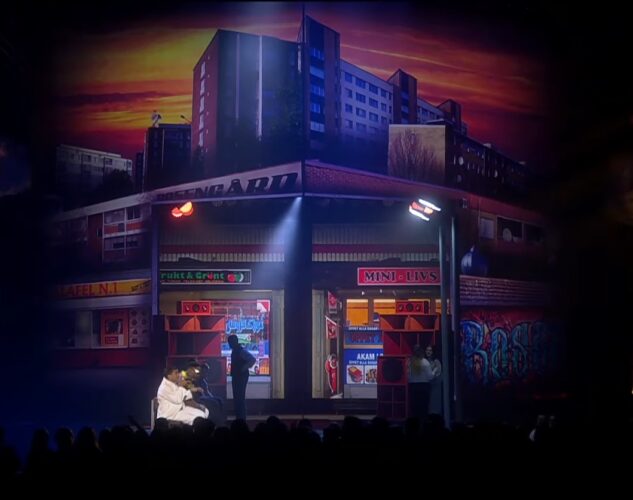
The sense of walking on the street comes through most strongly in the televised live performance of the track at the 2020 P3 Guld music awards ceremony. The elongated stage is a street with road markings. Stage lighting comes from streetlights. The second verse is filmed by a panning camera that moves past the two singers, suggesting that the performers are walking down the street-stage towards the audience (see 01:35-01:55). Timbuktu’s dancing – swinging his arms and shifting his weight from side to side – resembles walking too. This walking-down-the-road as dance-choreography is complemented by groups of onstage figures who perform a kind of urban “hanging out” around street furniture. When Timbuktu is introduced, he sings his chorus lines from among a group of backing performers assembled casually around a bench, and Ozzy and Timbuktu sit there again in the bridge section.
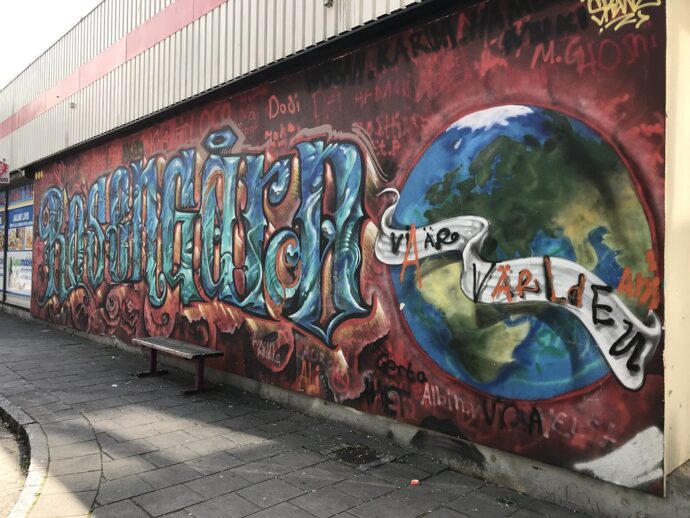
Such urban staging and choreography in rappers’ live performances and music videos commonly signify that the performers are authentically rooted in “real” urban spaces and communities. In the P3 Guld performance, the “real” place being staged is highly specific. Ozzy is shown in a pre-recorded video buying a soft drink and stepping out from a small livs. (The “Hard Knock Life” video likewise begins with Jay Z buying a soft drink and stepping out from a New York City grocery store.) When his live rapping begins, Ozzy is framed by a collage of three real livs shop fronts from different areas of Malmö, including Akam Livs from a Rosengård block that has since been controversially demolished (something that Ozzy has lamented – see Negash 2024). The livs are intermedial references that function both as specific placing devices and as cultural loci or symbols of an “international folk life” (Ristilammi 1994, p. 153). Later, wide shots show the full backdrop as a stylised composite of recognisable Rosengård apartment blocks at dusk, plus a falafel shop, street signs, and graffiti from the area. Ozzy has been photographed amidst these places for other promotional material. This suburban imagery – just as Swedish as the traditional yellow-painted detached wooden house and small grocery store on the square in Lotta på Bråkmakargatan – is reinforced as part of Ozzy’s artistic identity, functioning as the “real” setting for his story.
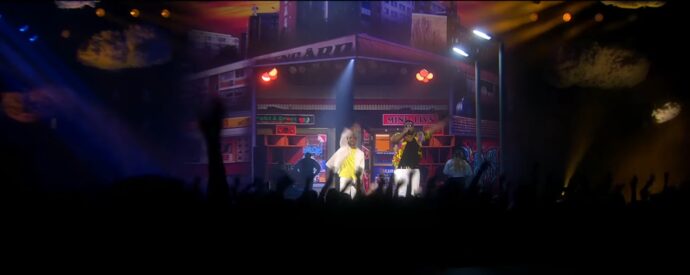
At the end of the live performance of “Bråkmakargatan”, the camera pans out to show Ozzy and Timbuktu surrounded by these urban performers and images, chanting “Hey! Ho!” in symbolic communion with the silhouetted audience who join in with their arms in the air. This is the opposite of Leppänen and Westinen’s (2017) Finnish example where the rapper’s solitude symbolises the “impossibility of social belonging.” In this case, “Bråkmakargatan” – with its undeniably clichéd climax of collective singing and dancing that commonly signifies the performers becoming one with their audience – performs a social union with both the live studio audience and a national television audience. But does Ozzy’s intermedial intervention into Swedish cultural politics really speak, like Timbuktu, to and for both the suburban socially excluded and to and for the imagined community of the nation in general? Does it address or even unite both “communit[ies] of listeners” and both sets of “community knowledge” (Perry 2004, p. 50)? To what extent has Ozzy’s intermedial, intertextual collaging achieved the unity of the two “we”s? And does his intermedial transposition of Lindgren into the landscape of Zlatan expand what it means to be Swedish? Do his intermedial poetics – his combination of music, rhythm, persona, narrative, imagery, dance, and film, plus both local-suburban and national-iconic symbolism – answer Ristilammi’s challenges?
To take Ristilammi’s questions one by one: first, it is fair to say that Ozzy’s “Bråkmakargatan”, with its use of children’s story references and positive account of a multicultural place using popular music conventions and framed by nostalgic images of Million Programme architecture, does “conjure up a picturesque image of an international folk life at the same time as the image of the oppressive concrete” (Ristilammi 1994, p. 153). For the second question – are Ozzy’s intermedial poetics those “that can describe suburbs in a way that does not entail the production of otherness and stigmatisation?” (Ristilammi 1994, p. 155) – the answer is more complicated. As discussed above, Ozzy uses various techniques for presenting himself as the real voice of a real (collective) suburb – as an artist who is organically rooted in and creatively inspired by its reality, able to speak for Rosengård better than outsiders who would stigmatise or other it. From this position, Ozzy presents Rosengård not as a signifier of non-Swedish places but as a place where real Swedes live, with the suburb’s geography and trouble equivalent to the traditional Swedish small town scenes and trouble depicted in Astrid Lindgren books. Even while it is simultaneously related to ghettoised areas of New York, California, and South Africa, Ozzy’s concrete suburb is no longer “the counterpoint” or “counterimage to Swedish normality” (Ristilammi 1997, 76; Pred 2000, 111). Rather, Rosengård is now the stage for an unquestioned Swedishness,
But does “Bråkmakargatan” challenge fundamental mechanisms of othering and stigmatisation? Arguably it does not challenge the premise that real Swedes (should) know Lindgren or even Zlatan. It does not stop right-wing nationalists from saying but those people are not truly Swedish because they don’t appreciate Astrid Lindgren. Ozzy draws on a settled set of supposedly nationally relatable examples, with what Kandice Chuh refers to as the “casualness of exemplification” that implies of course, nobody would question that Lindgren is Swedish, reinscribing her “hypercanonical” status in the process (Chuh 2019, p. 38). The Sweden Democrats rely upon this kind of repeated referencing and casual exemplification: they have themselves deployed politicised interpretations of Zlatan, Lindgren stories, and other “symbolic representations of Swedishness” (Hellström 2016, p. 93). Famously, the current government with the support of the Sweden Democrats intends to produce a “Swedish cultural canon”. To leave those nationalist references there, untouched and unquestioned, or even to renew their significance in contemporary culture, may of course have the effect of reinforcing such reactionary political forces’ tendency to other or stigmatise suburban Swedes with migrant backgrounds who do not know or identify with such a canon.
However, and crucially, “Bråkmakargatan” does show the processual and unstable nature of canon formation, especially when canonisation is attempted with narrowly nationalist motivations, and it models the malleability of cultural-canonical symbols. Alongside the uncontroversial national references, Ozzy also draws on a hip-hop canon, both from a globalised popular music genre and from Sweden’s politicised suburbs. Further, his intermedial poetics achieve an easy transposition of the Lindgren tales onto a suburban landscape of Million Programme architecture and grocery stores with Persian and Arabic writing on their shopfronts, and in doing so they fundamentally undermine the racially and culturally exclusionary function of such cultural-canonical symbols.
References
Chuh, K., 2019. The difference aesthetics makes: On the humanities “after Man”. Duke University Press.
Dahlstedt, M., 2019. Problematising the urban periphery: Discourses on social exclusion and suburban youth in Sweden. In Suvi Keskinen, Unnur Dís Skaptadottír, Mari Toivaneni (eds.) Undoing Homogeneity in the Nordic Region (pp. 88-102). Routledge.
Diakité, J.T., 2016. En droppe midnatt. Albert Bonniers Förlag.
Dikeç, M., 2017. Urban rage: The revolt of the excluded. Yale University Press.
Dodds, P., 2023. Music and the Cultural Production of Scale. Palgrave Macmillan.
Hellström, A., 2016. Trust us: Reproducing the nation and the Scandinavian nationalist populist parties. Berghahn Books.
Hultén, G., 2019. Race place shape: a case study of contested racialized boundaries of belonging, embodiment, and gender in Swedish alternative media. African and Black Diaspora: An International Journal, 12(1), pp.20-31.
Johansson, R., Ristilammi, P.M. and Tolvhed, H., 2023. Zlatan Ibrahimović: a monument and a mirror of his time. Soccer & Society, 24(3), pp.333-349.
Leppänen, S. and Westinen, E., 2017. Migrant rap in the periphery: Performing politics of belonging. Aila Review, 30(1), pp.1-26.
Listerborn, C., 2013. Suburban women and the ‘glocalisation’ of the everyday lives: gender and glocalities in underprivileged areas in Sweden. Gender, Place & Culture, 20(3), pp.290-312.
Mulinari, D. and Neergaard, A., 2017. Theorising racism: Exploring the Swedish racial regime. Nordic Journal of Migration Research, 7(2), pp.88-96.
Negash, M., 2024. Field Notes: Power of Places. Urban Matters [Themed Issue: Urban land and landscapes: Thinking urban matters relationally].
Norocel, O.C., 2017. Åkesson at Almedalen: Intersectional tensions and normalization of populist radical right discourse in Sweden. NORA-Nordic Journal of Feminist and Gender Research, 25(2), pp.91-106.
Norocel, O.C., Saresma, T., Lähdesmäki, T. and Ruotsalainen, M., 2022. Performing ‘us’ and ‘other’: Intersectional analyses of right-wing populist media. European Journal of Cultural Studies, 25(3), pp.897-915.
Perry, I., 2004. Prophets of the hood: Politics and poetics in hip hop. Duke University Press.
Pred, A., 2000. Even in Sweden: Racisms, racialized spaces, and the popular geographical imagination. University of California Press.
Rajewsky, I.O., 2005. Intermediality, intertextuality, and remediation: A literary perspective on intermediality. Intermédialités, (6), pp.43-64.
Rastas, A. and Seye, E., 2019. Music and anti-racism: Musicians’ involvement in anti-racist spaces. Popular Music and Society, 42(5), pp.592-610.
Ristilammi, P.-M., 1994. Rosengård och den svarta poesin: En studie av modern annorlundahet. Östlings Bokförlag Symposion.
Ristilammi, P.M., 1997. Betongförorten som tecken. In Karl-Olov Arnstberg and Ingrid Ramberg (eds.) I stadens utkant. Perspektiv på förorter (pp.75-85). Mångkulturellt centrum.
Rosales, R.L. and Ålund, A., 2018. Renässans från marginalen: aktivism för demokratisk förnyelse. In Aleksandra Ålund, Carl-Ulrik Schierup and Anders Neergaard (eds.) Nation i ombildning: essäer om 2000-talets Sverige (pp.333-359). Boréa Bokförlag.
Rose, T., 1994. Black Noise: Rap Music and Black Culture in Contemporary America. Wesleyan University Press.
Sawyer, L., 2002. Routings: “Race,” African Diasporas, and Swedish Belonging. Transforming Anthropology, 11(1), pp.13-35.
Sawyer, L., 2008. Engendering ‘race’ in calls for diasporic community in Sweden. Feminist review, 90(1), pp.87-105.
Sernhede, O., 1998. Waiting for Mandela. Soundings, 8, pp.163-175.
Skinner, R.T., 2022. Afro-Sweden: Becoming Black in a Color-Blind Country. University of Minnesota Press.
Tesfahuney, M. 1998. Imag(in)ing the Others: Migration, Racism and the Discursive Construction of Immigrants. PhD dissertation, University of Uppsala.