Homeplace City Plaza
The “Refugee Accommodation and Solidarity Space City Plaza” – or, simply, “City Plaza” – was a migrant housing occupation and political project located in central Athens, Greece. The squat ran from April 2016 to July 2019 and was self-managed by both migrants and activists. On one hand, City Plaza originated from the necessity to provide people in motion with a safe shelter as an alternative to living in the streets or in refugee camps. On the other, it aimed at countering and expressing dissent towards EU migration policies. Soon after its opening, City Plaza turned into a centre of struggle whose impact went far beyond the borders of Greece, establishing a transnational network and gaining support from different solidarity groups from all over Europe.
Originally, the building hosted a hotel which had been closed and left abandoned due to the effects of the 2008 Greek financial crisis. However, following 2015 long “summer of migration”, the exacerbation of the condition of migrants due to the EU-Turkey deal, and the consequent closure of the Balkan route, a collective of Greek activists decided to occupy its premises. Together with them joined a hundred migrants who had been living in tents for weeks in the nearby Viktoria square.
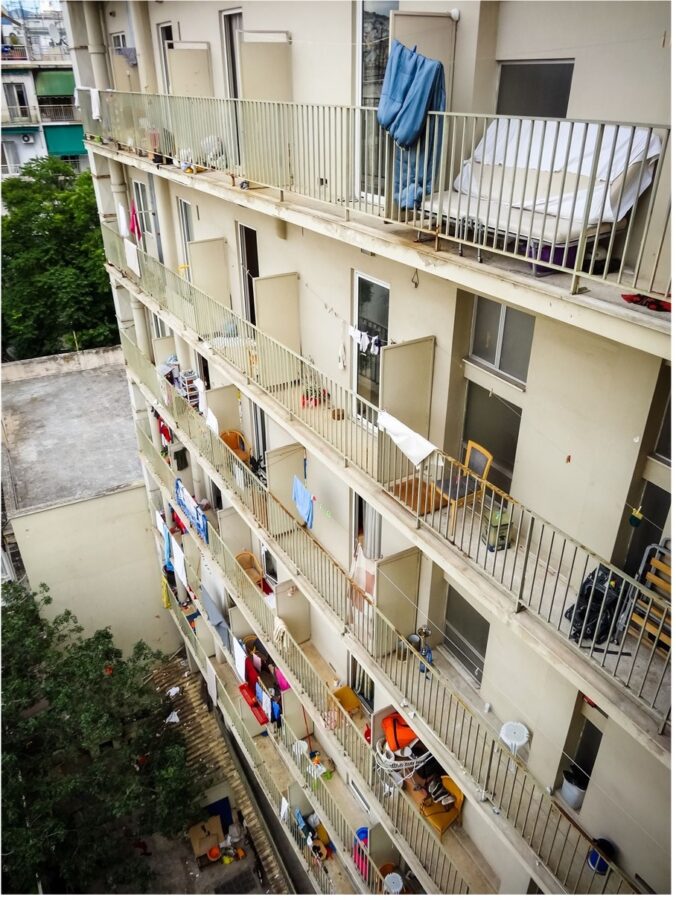
During its three and a half years of activity, the seven-storey building on Acharnon Street turned into a home for more than 2,000 people who found there a shelter on their journey from Athens to other European countries. City Plaza guaranteed a safe and dignified reception, a place where people could rest and recover a sense of “normality” in a daily life otherwise troubled by the journey and the uncertainties related to their precarious circumstances. Therefore, over time the squat became much more than a mere refuge.
Based on principles of solidarity and sharing, City Plaza created new social bonds and possibilities of encounter aimed at dismantling the dominant discourses around migrants and refugees, while fostering a sense of belonging to the place and between its inhabitants. In City Plaza, these concepts were embodied by the project’s constitutive slogan – ζούμε μαζί, αγωνιζόμαστε μαζί, “we live together, we struggle together”. Indeed, City Plaza represented a “homeplace” for its residents, which proved effective in countering evictability. Through cohabitation, City Plaza managed to sweep away concerns and insecurities caused by rejection and exclusion, which accompanied many migrants in their everyday life in Athens. At the same time, it contributed to building a sense of home-like safety and confidence in such a difficult context. Homeplace is intended here as a political space and “shelter of sameness” (hooks, Eizenberg and Koning, 1994, p. 22), where everyday life creates bonds among the occupiers while transcending notions of race, class, gender, and nationality. Homeplace is, therefore, an “inner space”, a “site of resistance and liberation struggle” (hooks, 1990, p. 385), which originates and develops in contrast to a hostile and repressive “outer space”, building a sense of entitlement and empowerment.
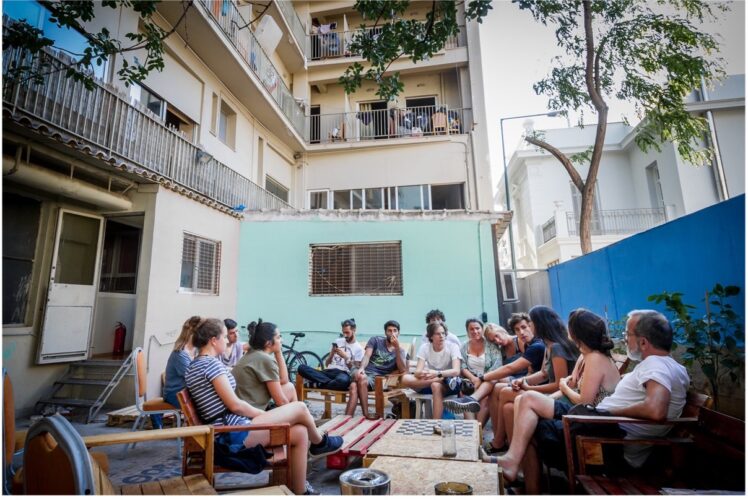
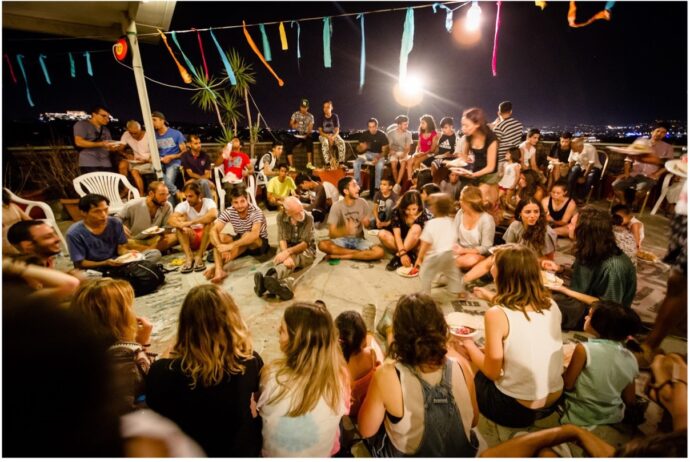
The squatted hotel’s bar, kitchen, dining room, courtyard, rooftop, Women and Kids Spaces, all contributed to creating a sense of togetherness. For instance, people gathered in the bar to chat, drink coffee, play cards, as well as to participate in the weekly assemblies and take decisions regarding the squat’s management. Residents spent between three and four hours per shift in the kitchen cooking and preparing meals while getting to know each other and creating bonds. Similarly, corridors were not just passageways but also meeting places, where City Plaza’s residents interacted and kept up to date regarding daily life. Finally, children, who represented forty per cent of the squat’s population, had plenty of space at their disposal to play under the watchful gaze of the adults, who took care of them just like in an “extended family”.
Furthermore, City Plaza’s rooms were multifaceted spaces, able to serve a variety of purposes: classrooms, playrooms for children, exclusive meeting places for women, workshop areas, and warehouses. Above all, they were “homes” for the people living in the squat and an intimate place which provided people with privacy. In this regard, the possibility of having a space for one’s own often encouraged City Plaza’s residents to furnish and decorate their private rooms, so as to recreate a unique environment which resembled that of their original home. Yet again, this custom reinforced the concept of the individual’s struggle through cultural practice against the imposition of blueprint and sterile spaces enforced in the shape of domination structures (hooks, Eizenberg and Koning, 1994, p. 25) such as refugee camps and hotspots. Thus, despite their small size, City Plaza’s rooms provided a friendly and safe environment where migrants were able to carve out a private space for themselves. City Plaza represented an experiment of coexistence that went beyond meeting the need for temporary accommodation. City Plaza’s residents came together as a family that, from below and not without difficulty, challenged the powers of the state and institutions while also trying to overcome the divide between them and us. We too were part of that family, living for more than a year or a few months at City Plaza, to do field research for a doctoral thesis and to carry out a photographic project on life inside the squatted hotel. During the time we spent at City Plaza, we had the privilege of getting to know its residents, sharing thoughts and life stories. The photos part of this essay comes from that experience[1]. They were taken at different times in the life of City Plaza, and depict various aspects of its daily life and struggle. As introduced above, they aspire to show how people who lived there managed to create and evolve a sense of homeplace by transforming, adapting and re-adapting the occupied hotel’s spatialities. In particular, they illustrate the production, through cohabitation, of the intimate and “inner space” built in response to the “outer space” represented by a foreign urban environment, discrimination, institutional hegemony, and seemingly interminable bureaucracy.
[1] For what concerns the usage consent from the subjects represented in the pictures, we did not use written agreement forms during our research. Nonetheless, permission of use for all the images presented here was always verbally granted by the subjects at the moment the pictures were taken (in the case of minors, by their parents). For situations where many people are framed in the same shot and was not feasible to ask every single person (i.e. the party on the hotel’s rooftop or the assemblies), our presence was evident at all times, and the scope of our activity clear to everyone, both the subjects represented and the organisations involved.
Captions
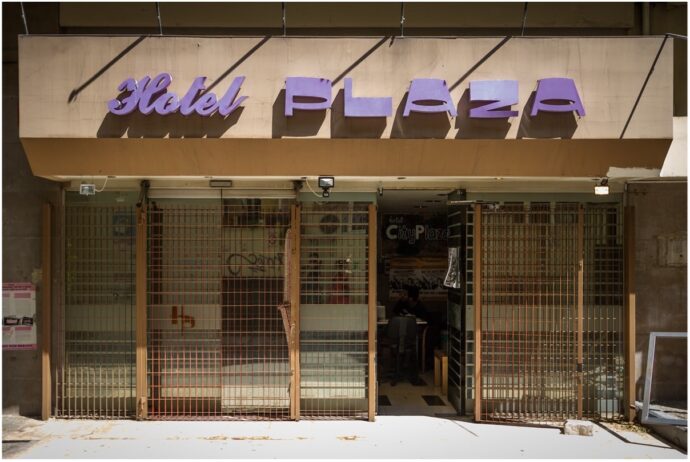
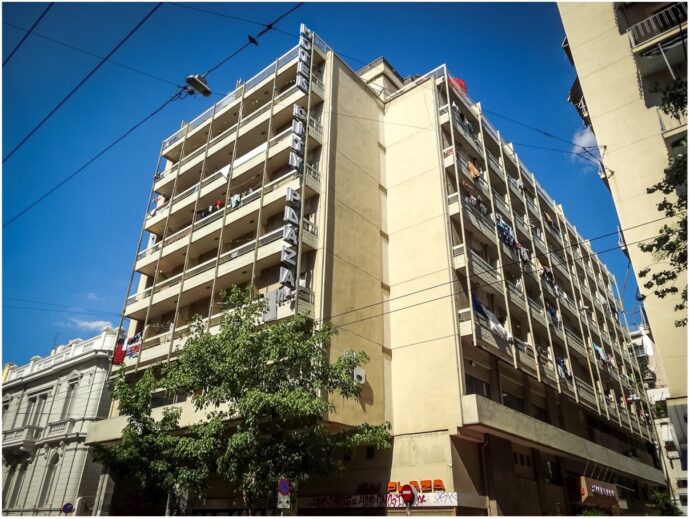
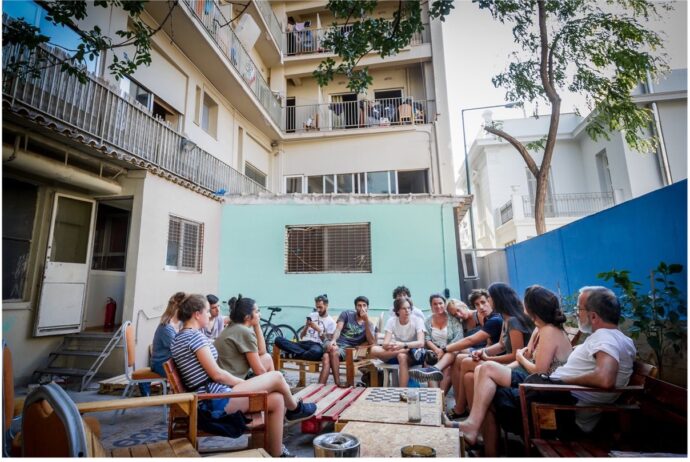
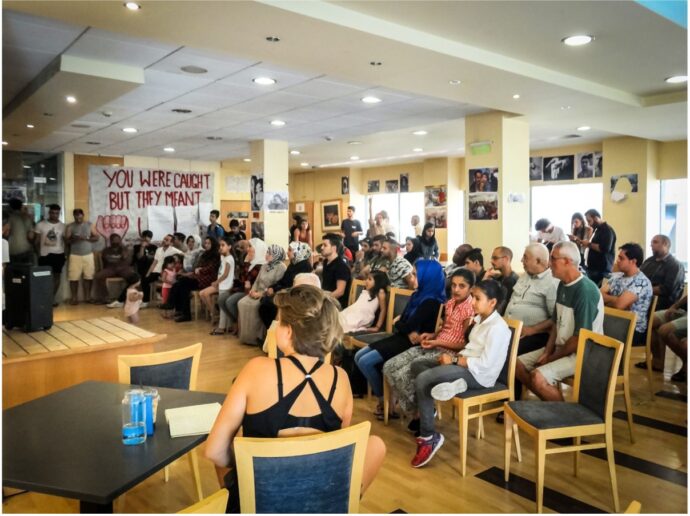
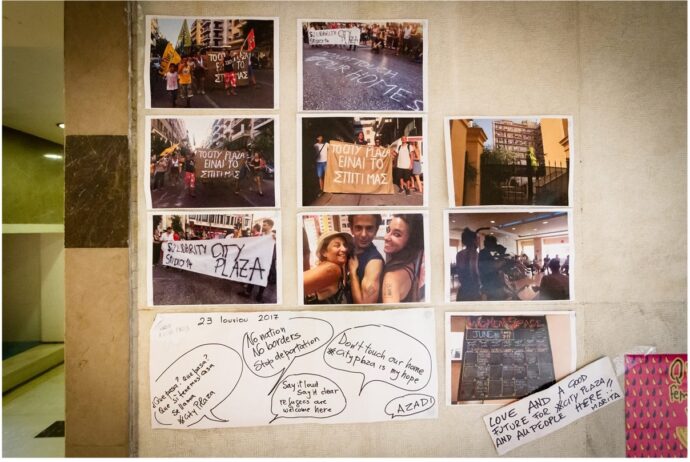
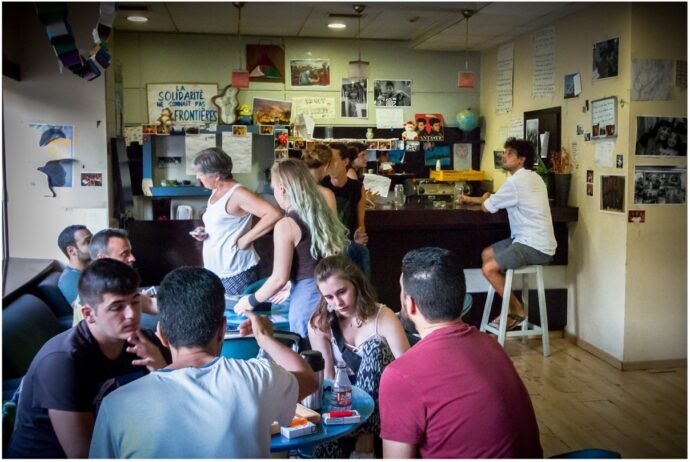
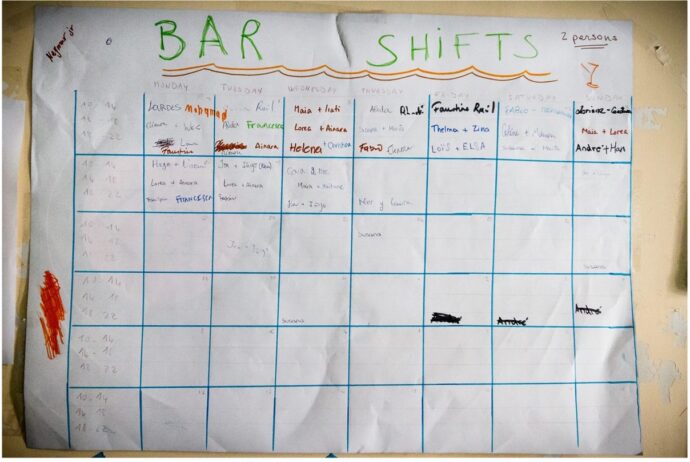
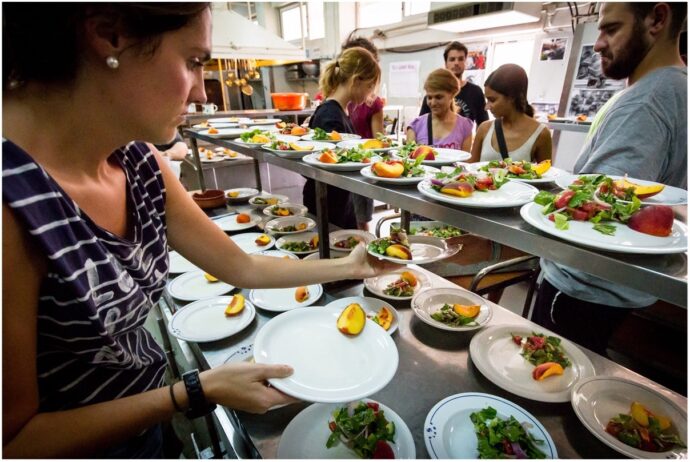
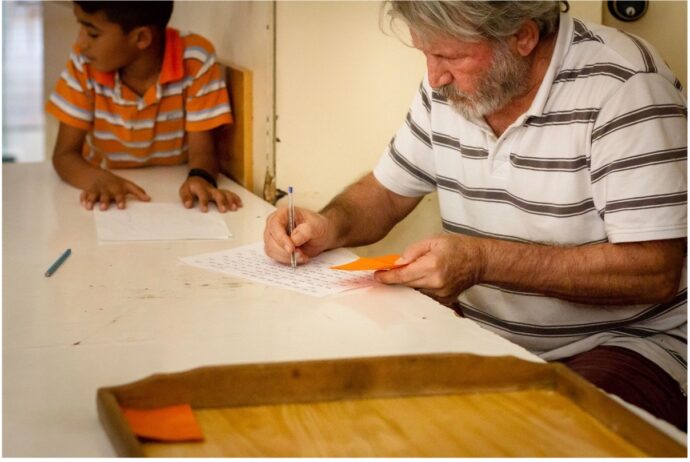
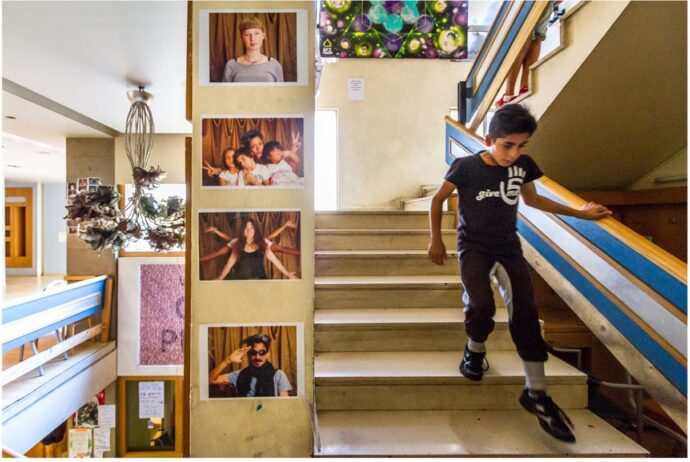
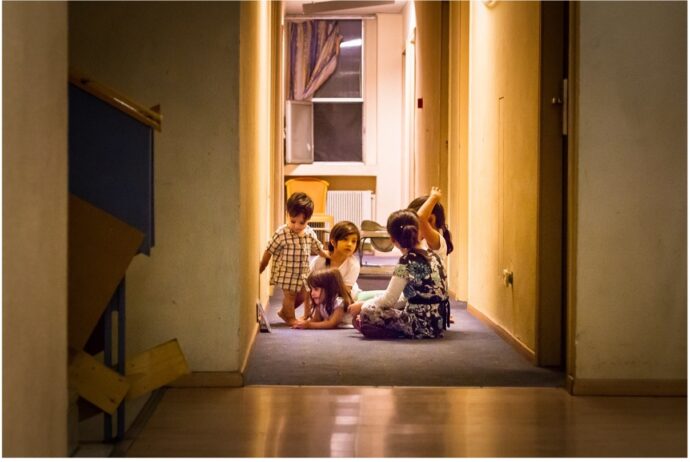
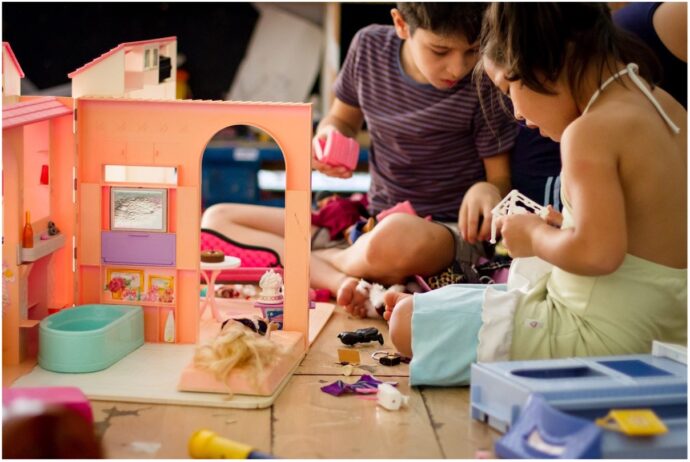
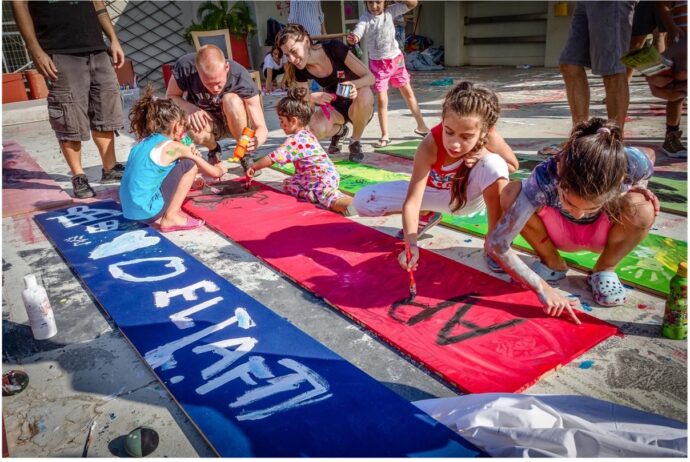
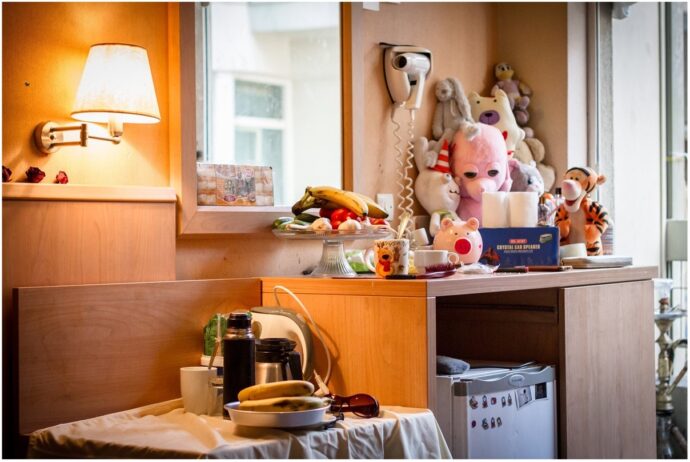
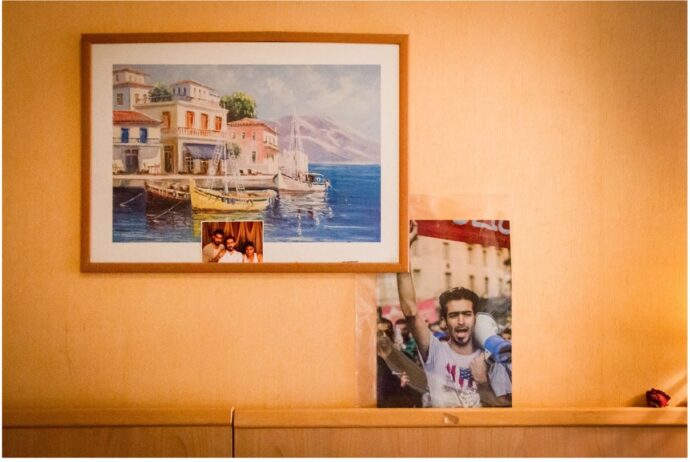
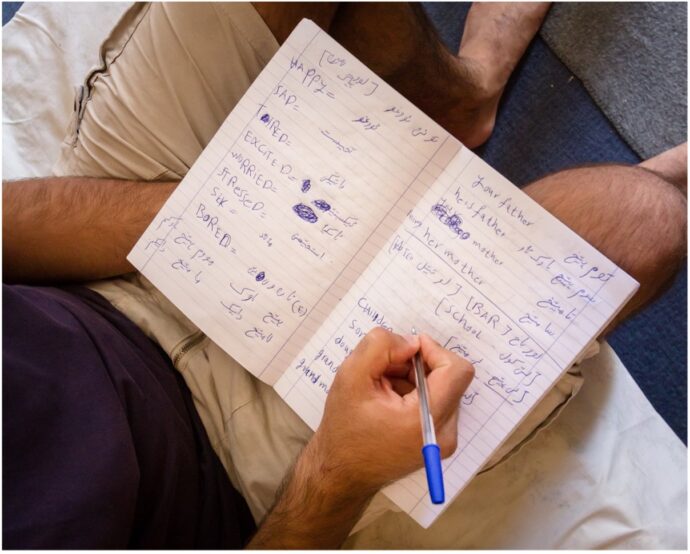
Figure 16 – A resident reviews his English lesson (August 2017). Several language courses were also organised within the City Plaza for the residents. Learning a European language, first of all English was essential in order to find a job.
References
hooks, b. (1990) ‘Homeplace (a site of resistance)’, in Yearning: Race, gender, and cultural politics. Boston, MA: South End Press.
hooks, b., Eizenberg, J., & Koning, H. (1994) ‘House, 20 June 1994’, Assemblage: A Critical Journal of Architecture and Design Culture, 24, p22–29.