A Queer Failure Of ‘Sustainable Urban Development’
Throughout the last decades and with increased awareness of anthropogenic climate change, the so-called sustainability question has risen to the top of the global agenda, aiming to balance economic, environmental, and social concerns. Within disciplines such as architecture, spatial planning, and urban design, ‘sustainable urban development’ (SUD) has emerged as one response. The urban emphasis is not a coincidence but rather a cornerstone of this emergent typology. Angelo and Wachsmuth (2020) stress that cities were known as ‘sustainability problems’ throughout most of industrialization and urbanization, due to both concentrations of emissions and social inequality. The endemic poverty that had been somewhat hidden on the countryside was much more revealed in the city (Hall 2014). Nevertheless, from the early 1990s and onwards, cities have been identified as the central units for the globalizing economy, and also where sustainability can and should be pursued (Angelo and Wachsmuth 2020). Linked to a broader eco-modernization discourse, SUD is not only characterized as dense and urban, but also as driven by financial (capitalist) interests and promoting ‘green’ technology (Hagbert, Wangel & Broms 2020). The forging of sustainability as urban is an interesting context to further study how (social and environmental) ‘sustainability’ has been merged with (economic) ‘development.’ The seemingly oppositional, even oxymoronic, values (see McNeill 2004; Redclift 2005) have been successfully narratively bridged through the formation of a new concept and language. But how are they materialized in and through SUD?
This text will explore the allegedly ‘sustainable’ urbanization of agricultural land in the SUD project Hyllie, an emerging ‘smart city’ district in southern Malmö (Sweden’s third largest city). With the aim to provoke discussions on some often-overlooked dilemmas with the expansionist and projective character of SUD, the concept of ‘queer failure’ is brought in as a disruptive and generative idea. The text builds on my ongoing PhD studies in architecture with fieldwork carried out in Hyllie, including on-site and digital observations, conversations, photography, and document studies.
High hopes for Hyllie
Hyllievång[1], approximately 900 hectares of land located in southern Malmö, has a long history of agricultural use. During the 1960s and 70s, it was a land reserve for housing development within the so-called Million Home Program, but as opposed to neighboring city districts Holma, Kroksbäck, and Lindeborg, these plans were never realized. Until the 1991 agreement between Sweden and Denmark to build the Öresund bridge, the agricultural land of Hyllievång was unbuilt except for a characteristic water tower. The new political-economic geography of (southern) Malmö generated by the bridge was at first translated into a quite modest planning proposal called Brozonen (1991) and later Brostaden (from 1994), aiming to cater to 5500 residents and 3700 workers in 2015, which was at the time almost 20 years ahead (Malmö stadsbyggnadskontor 1994). Fast forward to the 2020s, the vision is for Hyllie to be fully ‘developed’ around 2040 with 25 000 residents and 15 000 workplaces (Hyllie n.d.).
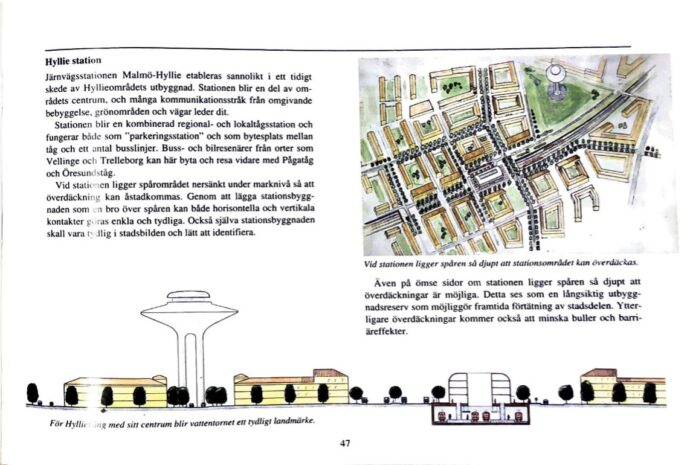
Figure 1. The strategic development plan for Brostaden shows a quite conventional grid structure with a slightly higher density around the railway. The water tower stands out as a landmark. The ambition is not to compete with the inner city, but rather to attract businesses who are not looking for a central location. Source: Malmö stadsbyggnadskontor (1994).
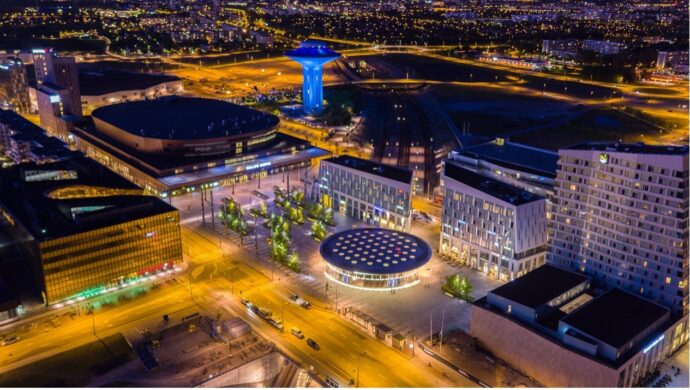
Several factors laid the foundation for the shift from moderate to large-scale urbanization in Hyllie. The bridge agreement and the related investments in the new city tunnel were the main conditions for urban development, but the political-economic force of such infrastructural investments was significantly re-interpreted throughout the course of the 1990s and the early 2000s. During this time, the entire city of Malmö was in transition. The crisis of the industrial city was used as a window of opportunity to reconfigure a new identity as knowledge city, a visionary work broadly guided by Social Democrat and trained architect Ilmar Reepalu. As described by Dannestam (2009), the new and successful city was largely enacted through the built environment, for example the Öresund bridge (opened in 2000), Malmö University (opened in 1998), and high-profile urban development projects such as Västra Hamnen (initiated with the city fair Bo01 in 2001 and gradually expanded, not the least with the new landmark Turning Torso in 2005).
In the discursive reinterpretation of Hyllie and its role in the broader development strategies of Malmö and the Öresund region a few spectacular architectural projects, largely driven by the engagement of private entrepreneurs and property investors, played particularly important roles. In the late 1990s, a new vision for Hyllie as a regional entertainment and event node was launched (Hyllie centrum 2012), largely driven by Percy Nilsson, a well-known public figure in Malmö who has been a driving force in Hyllie since around 1995. Nilsson has described the resistance from the city of Malmö, saying that they found him ‘completely crazy’ at first but after several years they begun to agree with his vision, and he argues that the current area is very similar to what he imagined (Hyllie n.d.). An important component to the vision was the opening of Malmö Arena in 2008, a project tightly connected to Nilsson’s engagement in the hockey team currently known as Malmö Redhawks. But Percy Nilsson, in cooperation with a team of architects not the least from Wingårdhs, was not the only force in altering the trajectory for Hyllie. Three different high-rise hotel buildings have been proposed in Hyllie: Scandinavian Tower, presented in 1997 by Norwegian hotel magnate Arthur Buchardt and decommissioned in 2004, Malmö Tower proposed by property investor Greg Dingizian (and his company Annehem) in 2005, and ultimately The Point (a part of the complex Point Hyllie), finished in 2019 and currently managed by Volito Properties and PEAB. Additionally, the shopping mall Emporia owned by Steen & Ström was inaugurated in 2012 as, at the time, the largest shopping center in Scandinavia. The assembly of landmark buildings (shopping center, arena, and hotel) are all situated by the central square of Hyllie stationstorg and the train station, which was brought into traffic in 2010.
As Torisson (2021) argues when he writes on the history of skyscrapers in Hyllie, the performative power in introducing new architectural narratives really worked to change the narrative of the site. Visionary, perhaps even utopian, ideas presented by powerful actors changed the prospect of Hyllie, sometimes regardless of whether these plans resulted in ‘finished’ buildings or not. While the first skyscraper proposal was a quite drastic and seemingly out-of-place suggestion for this kind of site, over time the idea became increasingly naturalized, playing an important part in producing a more grandiose narrative for Hyllie (see also Sandin 2019 about the plans for a Scandinavian theme park in Hyllie). Furthermore, according to Nordell (2022), the plans for an arena and shopping mall were deeply intertwined, as one could not really be pursued without the realization of the other. Through architectural visions driven by a few very engaged individuals and supported by municipal urban planning, the so-called potential of Hyllie was not as much identified as it was actively constructed through the increasingly spectacular imaginaries. Hellström Reimer (2018, 137) argues that the planning processes of Hyllie worked to ‘alter relations between present and futures,’ as the proposal was not compared to the current state of the area (as usually done in a so-called nollalternativ) but rather to an imagined but allegedly ‘realistic’ future where public transport was already in place. Rather than responding to a new political geography of southern Malmö, architecture and planning has thus been performative in de/stabilizing the idea of what Hyllie was, is, and could be.
Entering: sustainability
Yet, we have not even come to the purportedly biggest selling point of Hyllie – the launch of this urbanization project as a ‘sustainable urban development.’ Over the last couple of decades, Malmö has become known as a global frontrunner in environmental sustainability and low-carbon futures (Stripple & Bulkeley 2019), and I would argue that Malmö is a particularly good example of the global position that Sweden holds internationally, with a leading role in the global discourse that has resulted in both ‘sustainability tourism’ and ‘sustainability export’ (see Hult 2017 for a more extensive account). Throughout the reformulation of post-industrial Malmö as a success story, a rise of the phoenix, I argue that sustainability has played an instrumental part. Västra Hamnen has been an important component to the successful sustainability branding and much studied as an example of SUD (see for example Jönsson & Holgersen 2017). Hyllie, in turn, has been described as one of Sweden’s ‘showcase developments’ (Hagbert, Wangel & Broms 2020) and a continuation of the type of planning that Västra Hamnen laid the foundation for (Baeten 2012).
Hyllie is actively engaging with these outspoken ambitions of ‘sustainability’ innovation in many ways. The initiative LFM30[2] facilitates working towards reduced emissions in the building and construction industry and is tied to many building projects in Hyllie. There are ambitions for planning and landscape practices to increase biodiversity and work with climate change adaptation through, for example, stormwater management. Through Mallbo[3], Hyllie could contribute to provide relatively affordable apartments in the face of housing shortage. Infrastructural investments are continuously made into public transport, as well as in new schools and pre-schools, and in service and leisure for residents and visitors. The property complex Embassy of Sharing, built by Granitor Properties, is a new landmark added to ‘central’ Hyllie with a much more explicit sustainability profile. The foundation of the project is described as innovation, sustainability, and sharing economy (Granitor n.d.). It is noteworthy that Wingårdhs Arkitekter has been involved also in Embassy of Sharing, following up on a long-term involvement in Hyllie, including projects such as Malmö Arena and Emporia shopping mall.
Despite Hyllie’s sustainability profile, some difficult contradictions between the interpretation and materialization of how (economic) ‘development’ can be merged with ‘sustainability’ have surfaced throughout my fieldwork at the site. The excellent possibilities for sustainable transportation, utilized by turning Hyllie into a public transport node, also intimately connect Hyllie with ‘unsustainable’ modes of travel – not the least with Kastrup International Airport. The materialization of ‘sustainable mobility’ clearly emphasizes regional and global connectivity but rarely considers Hyllie as a border zone and a support for ‘sustainable’ migration. Furthermore, Hyllie can supposedly support sustainable everyday life through, for example, bike and pedestrian infrastructure, urban gardening, recycling, and ‘smart’ solutions for energy efficient living (see Malmö stad 2015), all framed through the attractive contrast between the serene rural landscape and the pulsating urban cityscape, in immediate connection with the region and European continent (see Malmö stad 2019). However, the appropriation of first-class agricultural land is rarely mentioned (and when mentioned, it is primarily seen as an asset for the SUD), nor is the contradiction of building an SUD around a shopping mall – offering much support for socialization and leisure, but nevertheless intrinsically intertwined with the deeply unjust and exhaustive global relationships of (over)production and (over)consumption.
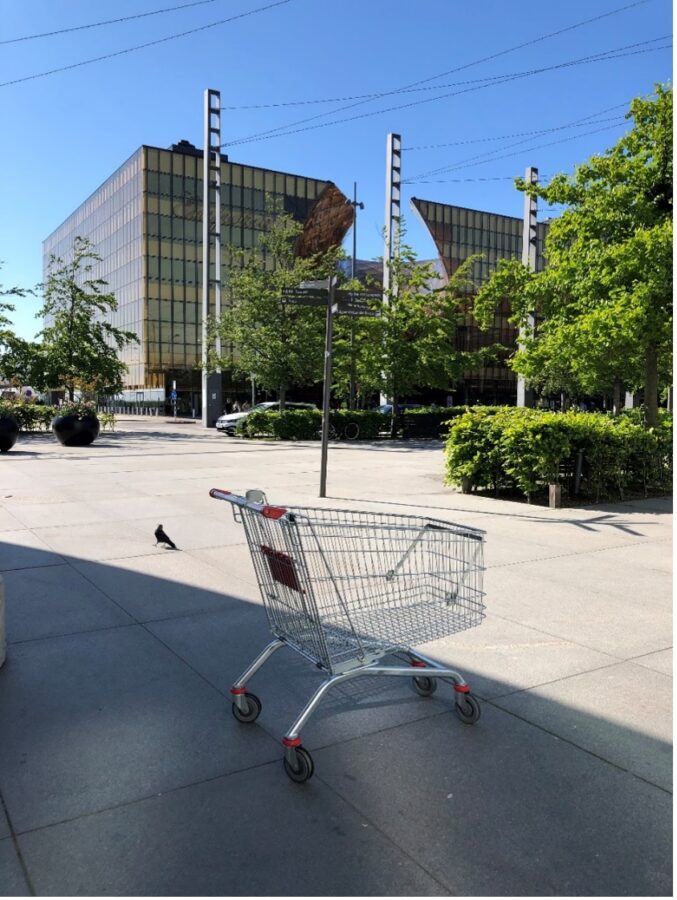
Figure 3. Standing on Hyllie stationstorg looking onto Emporia shopping mall’s main entrance. The central position of consumption in an allegedly sustainable city district appears contradictory. Photo by the author.
Queering (sustainable) development
Rather than perceiving these contradictions (i.e., the intersection between climate concerns, social equity, and sustained GDP growth) as a challenge for the sustainability discourse, arguments can in fact be made that they are quite integral to how sustainable (urban) development is understood and enacted. A long history of modernization has shaped the Western conceptualization of ‘development’ as focused on sustained GDP growth and technical innovation (see Du Pisani 2006), and sustainable development can be described through the eco-modernist attempts to decouple economic growth from environmental impact through notions such as green industrialism or green growth (Lidskog & Elander 2012). While the mainstream sustainability movement has generated a much greater level of mainstream awareness of climate change, as well as important global agreements devoted to reducing climate impact while also caring for social inequity, Stacy Alaimo (2013, 559) urges us to also consider how sustainability has ‘co-opted and institutionalized’ the environmentalist social movement to assume a more ‘palatable’ form with a technocratic and apolitical approach. The critique against economic systems because of the intimate relationship between climate impact and GDP growth has now been displaced by a view of ‘keeping things going’ (Alaimo 2013, 559).
Approaching SUD from a queer perspective aligns with this criticism against the co-optation of sustainability, described by Anders Blok (quoted in Hult 2017, 108) as serving to “create and reinforce particular norms of urban environmental performance – to the exclusion of more ‘radical’ alternatives.” I align with the argument made by Caniglia and Vogel (2023) that transdisciplinary sustainability studies can be inspired by the queer ethos to “transgress social norms, cross imposed boundaries, and promote alternative scripts to flourish in a world hostile to those who lie outside what is predefined as ‘normal’ and ‘appropriate.’” Let’s be reminded here, by Judith Butler (2016), that queerness can be understood not only as an identity but also as a movement of thought (a theoretical strategy) and as a language and alliance between different precarious segments of the population.
While queer theory often speaks from a precarious position, from both the joy and the pain of being different in a normative world, I think that this approach is just as useful to study sites of normality and privilege, such as the strong support systems formed in an emergent SUD in Malmö, Sweden. Thinking of so-called ‘developing’ countries as the main contributors to environmental destruction is a continuation of imperialist forms of violence that has been undertaken in the name of ‘development’ (Aguinaga et al. 2013). Instead, we must direct the critical lens towards the contexts we consider frontrunners. For the purpose of disrupting common sense thinking and following queer lines of impossibility, I propose to look into the idea of ‘queer failure.’
The promise of queer failure
First of all, what is failure? What makes failure important? Jack Halberstam dedicated his entire book The Queer Art of Failure (2011) to “all of history’s losers,” arguing that the main objective of the book is to dismantle the logics of success and failure. Instead of learning from one’s failures, that is, using failures as an opportunity to further internalize a very limited and particular logic of what success is, we can use failure as an opportunity to reconsider what we see as success. Queer failure offers the opportunity to reflect on what we exclude from our practice and discipline at the given moment, because it is bound to fail in the current system. Halberstam (2011, 174) argues that the logic of success and failure is used to ensure that “all future radical ventures will be measured as cost-ineffective,” meaning that we have an urgent need to creatively and critically reconfigure our understanding of the economic system if we are looking to find alternatives to the status quo.
Many things can cause disruptions to a building process or planning project, such as a financial crisis, or politicians putting a sensitive project on pause for a time before elections. These can either be used to further ingrain knowledge about how to successfully navigate the economic reality, or we can ‘queer’ crises by focusing on the opportunities to reconsider that arise with them. To quote a landscape architect invited to do some trendspotting at an event for architecture practitioners which I attended: “hopefully all bad projects will not happen now, thanks to the economic recession.” José Esteban Muñoz (2008, 27) suggests that queerness, failure and utopia belong together, because the feeling that the present is not enough is a queer experience; an experience of those “who do not feel the privilege of majoritarian belonging, normative taste, and rational expectations.” Queer failure reminds us that being construed as different and therefore causing a disturbance to normality (by failing to be like normal people, and do normal things – guided by normal, common sense) is not always pleasant. Still, it is an important experience and perspective, at least for those of us who seek to find alternatives to the ways of the dominant order.
I can imagine several ways to prompt a queer failure in Hyllie, for example, that Emporia shopping mall becomes occupied by climate activists, such as in the story told in the fictional sound walk Memories From the Transition (Narrating Climate Futures 2022). But the most impactful disruption would probably be to just put a halt to the building process. It could perhaps be ignited by a civil servant involved in the project entering a mode of refusal and actually being listened to by politicians. I have heard about a Swedish municipal urban planner and biologist who was given the task by local politicians to present a plan for housing development. The plan was achieved, but the planner declined (maybe refused?) to sign the documents, recognizing that the two goals of aggressive development of new housing and doing active ‘sustainability’ work are impossible to combine.
Queer failure is about taking a leap despite the potential risk of critique: Utopian! Naïve! Childish! Delusional! Not helpful!
The failure of promises: from sustainable futures to queering the present
It has already been demonstrated through the case of Hyllie that architectural visions can be very performative (that is, they can set effects in motion), sometimes regardless of being materialized or only imagined. To put something into words (or drawings, or visualizations) over and over again does not make it true but perhaps more possible. If we could, in just a few years, alter our collective perception of Hyllie’s future from an agricultural plot of land to a dense urban city district with a skyscraper, mall, and arena, I believe that we could attempt another change of course. But altogether stopping the construction work in Hyllievång would bring some serious challenges for the actual site and planning project. How would we deal with the urban island in the agricultural and infrastructural fields of southern Malmö? How would it be connected to its surroundings without using the means of new buildings? How would we deal with the need for schools and preschools? What about the housing shortage?[4] What about the construction industry? And the vision for a future Malmö where Hyllie is an important part?
The further expansion of Hyllievång is somehow motivated not only by business as usual, but also by the hope of a ‘sustainable future.’ It is largely the unbuilt environments of Hyllievång that carry such promise, which has been a big motivation behind more than 20 years of expansionism and the continuation for almost 20 years to come. In the future, we can do better than we do now, but in order to get to that future, we must continue with what we currently do. As Hyllie is planned as a ‘new town’[5], it is not very receptive to changed plans, not only because we put our faith in the promise of the future which keeps the expansion going, but also because this SUD project was started in the middle of an agricultural field. This in itself sort of demands that the project must be ‘finished’ in order to deal with its separation from the surroundings and expand enough to ‘meet the edges.’ Have we gotten ourselves stuck in a vision that is so inherently expansionist that we cannot surrender it, even if we wanted to?
When the role of architecture and planning is skewed towards enabling expansionist development plans, the task of designing supportive living environments becomes severely marginalized. We should not underestimate the impact of urban design on everyday life, but with the wrong strategic planning and political decisions, its potential impact is undermined. A shopping mall with a sedum roof is still a shopping mall. With this being said, the failure of (an) SUD is not an argument for the failure of the planning and architecture profession – I see it rather as an opportunity to reconsider the content, values, and actors of our practices. Many architects and planners have both the ambitions and competences to respond to a situation of multiple crises, but when the professional practice turns into primarily enabling clearly limited notions of development (under the name of sustainability, or not) we need to foster a great resistance. For this, disruptive thinking can become a starting point. Building on Adorno, Judith Butler (2015, 216-217) describes resistance as “no-saying to the part of the self that wants to go along with the status quo” but, importantly, also recognizes that resistance is not an end goal, but merely a starting point to collectively access imaginaries currently situated outside the scope of possibility.
[1] Hyllie is the name of a statistical district in Malmö, including several different neighborhoods such as Hyllievång, Holma, and Kroksbäck. The planning project is concentrated to Hyllievång but has anyhow adopted the name Hyllie.
[2] LFM30 is short for Lokal färdplan för en klimatneutral bygg- och anläggningssektor i Malmö 2030, an agreement between the City of Malmö and a group of contractors. The goal is to achieve a climate neutral building and construction industry in Malmö with net-zero CO2-emissions and a ‘positive climate impact’ by 2035. This is more ambitious than the national goal for a climate neutral industry by 2045 (LFM30, 2021).
[3] Mallbo is short for Malmö Allemansrätt Boende and is an initiative to support citizens’ rights to affordable and good quality housing. The basic outline for Mallbo is to provide rental apartments with a maximum rent of 1400SEK/sqm and year (Hem & Hyra 2021).
[4] A perhaps more accurate term than housing shortage is housing inequality (see Listerborn 2018), and this is a condition that is more difficult to impact with newly built housing.
[5] Hyllie can be considered a new town because it revolves around the crafting of a ‘new’ city district on previously agricultural land.
References
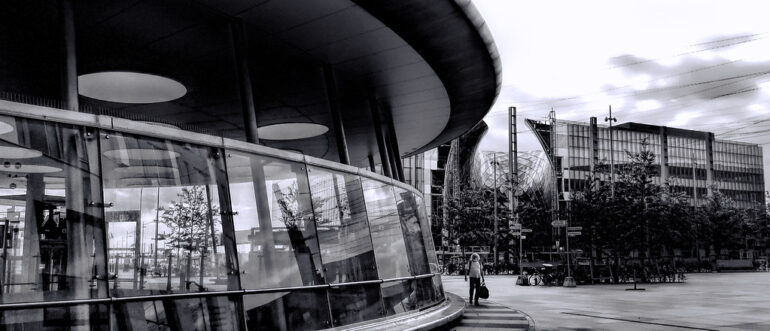
Cover Image: “Hyllie Station” by Miradortigre is licensed under CC BY-NC 2.0.
Aguinaga M., Lang M., Mokrani & Santillana, A. (2013) Development critiques and alternatives: A feminist perspective. In: Lang M., Mokrani D.(eds) Beyond Development: Alternative visions from Latin America. Quito, Ecuador: Fundacion Rosa Luxemburg, 41–59.
Alaimo, S. (2012). Sustainable this, sustainable that: New materialisms, posthumanism, and unknown futures. Pmla, 127(3), 558–564.
Angelo, H., & Wachsmuth, D. (2020). Why does everyone think cities can save the planet?. Urban Studies, 57(11), 2201-2221.
Baeten, G. (2012). Normalising neoliberal planning: The case of Malmo, Sweden. In: T. Tasan-Kok, & Baeten, G. (eds.) Contradictions of neoliberal planning: Cities, policies, and politics. Dordrecht: Springer, 21–42.
Boverket (2021). Miljöindikatorer – aktuell status. URL: https://www.boverket.se/sv/byggande/hallbart-byggande-och-forvaltning/miljoindikatorer—aktuell-status/
Butler, J. (2015). Notes toward a performative theory of assembly. Cambridge, Mass.: Harvard University Press.
Caniglia, G., & Vogel, C. (2023). On being oriented: Strengthening transgressive orientations in transdisciplinary sustainability research through queer theory. GAIA: Ecological Perspectives for Science and Society, 32(1), 167–171.
Dannestam, T. (2009). Stadspolitik i Malmö: politikens meningsskapande och materialitet. Diss. Lund: Statsvetenskapliga institutionen, Lunds universitet.
Du Pisani, J. A. (2006). Sustainable development: Historical roots of the concept. Environmental sciences, 3(2), 83–96.
Granitor (n.d.) Att dela ger mer i Embassy of Sharing. https://www.granitor.se/properties/embassy-of-sharing [2023.11.15]
Hagbert, P., Wangel, J., & Broms, L. (2020). Exploring the potential for just urban transformations in light of eco-modernist imaginaries of sustainability. Urban Planning, 5(4), 204–216.
Halberstam, J. (2011). The queer art of failure. Durham: Duke University Press.
Hall, P. (2014). Cities of tomorrow: An intellectual history of urban planning and design since 1880. (4th ed.). Chichester: Wiley-Blackwell.
Hellström Reimer, M. (2018). Going whole hog – Merging ecobranding and park politics in the smart city. In: Gromark, S., Mack, J., van Toorn, R., Frichot, H., Sandin, G. & Schwalm, B. (red.) Architecture in Effect Vol. 1 Rethinking the social in architecture: making effects. New York: Actar Publishers.
Hem & Hyra (2021). För dyrt med nybyggt – så ska hyrorna hållas nere i Malmö. https://www.hemhyra.se/nyheter/for-dyrt-med-nybyggt-sa-ska-hyrorna-hallas-nere-i-malmo/ [2022.11.14]
Hult, A. (2017). Unpacking Swedish sustainability: The promotion and circulation of sustainable urbanism. (Diss.) Stockholm: Kungliga Tekniska högskolan.
Hyllie (n.d.). Om Hyllie och Hyllie Citysamverkan. URL: https://hyllie.com/om-hyllie-citysamverkan/
Hyllie Centrum Flickr (n.d.). URL: https://www.flickr.com/photos/hylliecentrum/
Hyllie centrum (2012). Vision Hyllie 2015. URL: https://www.youtube.com/watch?v=UAouthY9yxw
Jönsson, E. & Holgersen, S. (2017) Spectacular, realisable and ‘everyday’. City, 21(3-4), 253–270.
LFM30 (2021). Tillsammans utvecklar vi en klimatneutral bygg- och anläggningssektor i Malmö. https://lfm30.se/ [2023.11.15]
Lidskog, R. & Elander, I. (2012) Ecological Modernization in Practice? The Case of Sustainable Development in Sweden. Journal of Environmental Policy & Planning, 14(4), 411–427.
Listerborn, C. (2018). Bostadsojämlikhet: Röster om bostadsnöden. Stockholm: Premiss.
Malmö stadsbyggnadskontor (1997). Fördjupad översiktsplan för del av Hyllievång: ÖP 2023. Malmö stadsbyggnadskontor: Översiktsplaneavdelningen.
Malmö stad (2019). Översiktsplan för södra Hyllie: Fördjupning av Översiktsplan för Malmö. Malmö stad.
Malmö stad (2015). Miljöprogram Hyllie: Mål och åtgärder för förverkligandet av Öresundsregionens klimatsmartaste stadsdel. Malmö stad.
McNeill, D. (2004). The concept of sustainable development. Development Studies and Political Ecology in a North South Perspective. 5, 26–46.
Muñoz, J.E. (2009). Cruising utopia: The then and there of queer futurity. New York: New York University Press.
Narrating Climate Futures (2022). Memories from the transition. URL: https://www.climatefutures.lu.se/memories
Nordell, Oskar (2022). Arenaboom: en arkitekturstudie av idrottsarenor i Sverige under 2000-talets första decennier. (Diss.) Uppsala: Uppsala universitet.
Redclift, M. (2005). Sustainable development (1987–2005): an oxymoron comes of age. Sustainable development. 13(4): 212–227.
Sandin, G. (2019). The making of ‘Scandinavia’ in the visionary design of a theme park. In: Toft, A., Rönn, M. & Wergeland, E. (eds) Reflecting histories and directing futures proceeding series 2019-1. Oslo: The Nordic Association of Architectural Research, 249–278.
Stripple, J., & Bulkeley, H. (2019). Towards a material politics of socio-technical transitions: Navigating decarbonisation pathways in Malmö. Political geography, 72, 52–63.
Torisson, F. (2021). Malmhattanism: skyskrapan i Malmös utveckling. Lund: Nordic Academic Press.