Field Notes: Power of Places
Introduction
This is a story of failed attempts. It’s an account of what unfolded within a small-scale, high-profile architectural competition. The project Power of Places was initiated by the city of Malmö and the Swedish Agency for Architecture and Design (ArkDes) in the spring of 2023. To draw some tentative lessons, I will revisit our attempt at working alongside city and state employees (i.e. non-elected public servants) with the new plans for Rosengård, a racialized working-class neighborhood in the eastern periphery of Malmö on the cusp of a large rejuvenation (through densification) effort. The new plans involve 2800 new apartments and 30 new businesses. Development is expected to be ongoing until approximately 2050 (ArkDes 2024).
It is an experience highlighting conditions in which ‘urban labs,’ defined as trans-disciplinary, innovative, or exploratory projects, shape visions of urban futures. It teaches us something about why policy discussions with transformative implications for land use become impossible to sustain while transformative change as such becomes understood and operationalized as highly limited tinkering with dominant modes of spatial planning.
Through the architecture competition Power of Places, Malmö municipality and ArkDes sought two intradisciplinary teams to work on the early redevelopment plans at two sites in Malmö -Nyhamnen and Rosengård (ibid). Plans for Nyhamnen, located by the water next to the central station, are the latest continuation of a decades long redevelopment process transforming the city’s industrial landscapes along the coast into prime real estate (Holgersen & Baeten 2016). Near Nyhamnen you’ll find flagship projects such as university buildings and the new concert hall Malmö Live. Rosengård, on the other hand, is located in the eastern periphery of Malmö. The area houses around 35 000 people, mostly in tower blocks and lower 2-3 story apartment buildings surrounded by open courtyards and green spaces achieved through far-reaching traffic separation. Rosengård has, together with a handful other neighborhoods that share similar characteristics, come to epitomize socio-spatial segregation in larger Swedish cities. Thus, the neighborhood is routinely invoked in national (extending to the Nordics) debates on crime, segregation, unemployment, poverty, migration, religious extremism, and so on (Mulinari Schclarek 2020).
Illustrating these disparate geographies, Rosengård and Nyhamnen, together isn’t a new theme for Malmö. For the past decade, the city has explored different ways of bridging the divide that separates poor peripheral neighborhoods from the central and western parts of Malmö, where large scale public investment into the city’s new economy and population is continuously concentrated (Baeten 2016, Holgerson & Baeten 2012, Pries forthcoming). One, arguably weak, mending effort is Rosengårdsstråket, a biking path that connects Rosengård to the Malmö university campus and the affluent western harbor, which was first developed as part of the housing exhibition Bo01 and was espoused by the city to be the first carbon neutral neighborhood in the world (Grundström 2014, Listerborn et al. 2014). Another example is the regeneration of Norra Sorgenfri. In visions and plans, the city described how the development of Norra Sorgenfri, sitting between the city center and the eastern peripheries (i.e. Rosengård), could help create a physically and socially cohesive city. The regeneration of Malmö’s oldest industrial neighborhood would, according to planning documents, become instrumental in countering socio-spatial segregation through the creation of an attractive pathway lined with dense, mixed-use development, ensuring ‘healing’ qualities in the form of increased east-west mobility through the city (Pries forthcoming). The connection between western and eastern areas of the city has also taken center stage in the densification plans for Rosengård. In 2017, Malmö’s city council oversaw the transfer of 1650 units of the municipal housing stock in Rosengård to the newly founded housing company Rosengård Fastigheter. The new housing company is a public-private partnership in which the city and private rental companies Balder, Heimstaden and Victoriahem own equal shares. Victoriahem is currently owned by Europe’s largest private rental company Vonovia (Gustavsson 2021). In addition to the sale, which comprised 7 percent of the total municipal housing stock, the city also sold 300 building rights (byggrätter) in the area to Rosengård Fastigheter. Finally, tied to the sale was also the commitment that Rosengård Fastigheter build the Culture Casbah Tower (ibid). The tower, for which the plans were conceived by the municipal housing company, sat at the center of older renewal plans for Rosengård. Plans for the new tower meant for it to become a regional attraction, containing commercial spaces as well as apartments, and by referencing other signature buildings in the city center and the Western Harbour, something for residents of Rosengård and Malmö at large to be proud of. As such, the Culture Casbah Tower was presented as an architectural counterweight that would restore some balance to a growing Malmö. It is with this backdrop that the city, together with ArkDes, invested in a project that drew together two disparate geographies in the early stages of redevelopment.
Come 2023, UNESCO awarded Copenhagen as “World Capital of Architecture.” The appointment would culminate in the international conference Sustainable Futures – Leave No One Behind in July 2023. The appointment caused ripples in Malmö’s planning department, who wanted to join in (Malmö stad 2024). Being a mere 40-minute train ride away from Copenhagen, Malmö’s effort to connect itself to Copenhagen’s appointment went under the name Malmö in the Making and consisted of public talks and a public program on architecture and design curated by the city in addition to the architecture competition Power of Places. The competitionwas described as a platform for imagining future forms of sustainable development where applicants were invited to think about how pre-existing resources, material and immaterial, can be used in the redevelopment of the areas. In essence, Power of Places was to provide a fresh perspective on what a move towards transformation rather than new development can look like in a redevelopment process and to identify new ways forward (Malmö stad 2024). The competition got a lot of attention and close to ninety teams applied.
Tribulations
Things went south even before we were publicly announced as winners. After receiving the good news, the team consisting of Hanni Kamaly (artist), Rebecka Engvall (architect), and Miriam Negash (urban planner) was asked to touch base with the public relations teams of the city and ArkDes, respectively. They wanted to prepare the press releases and overall communications strategy. We responded that we would refrain from taking any active part in the optics of things. From our point of view, we hadn’t entered the competition to place-market Rosengård or to help brand Malmö in the most efficient way, in connection to the UIA Conference, or otherwise. We didn’t see the need to create a media splash, describing Malmö and the entire endeavor as interesting or successful before anything had actually been accomplished.
Malmö municipality quickly took issue with our passive stance. Marcus Horning, director of Malmö’s planning and building department, phoned us up to set us straight. In our first conversation, he told us that he recognized the irony of choosing our team with the expressed job description of pushing boundaries on existing planning processes, only to then reprimand us for doing just that. However, he continued by arguing that our stance was stretching principles too far and would not be accepted. If we didn’t submit to the city’s marketing strategies around the competition, they wouldn’t sign the pre-negotiated contract. In fact, he told us that our resistance to doing so actually made them rethink our project. We were told that we, by simply not submitting glossy pictures and bios of ourselves, were undermining the democratic right to know where public means are directed. However, the Swedish principle of public access, legislated through The Freedom of the Press Act, does not cover voluntary, municipally run marketing strategies (Ministry of Justice 2020). Further, he continued, we needed to understand that this was the city’s largest investment in the arena of architecture and design during a financial year where Malmö otherwise was forced to austerity measures across the board, further stressing the public’s right to know who would be using public means. However, for context, it is necessary to stress that the production budget for Power of Places did not exceed €100.000 per team, which was co-financed with ArkDes and the private foundation Malmö’s Beautification and Planting Association (Malmö Förskönings- och Planteringsförening). Therefore, this hardly amounted to a large expenditure, especially not in relation to the public investments needed to build and plan the redevelopment of the two designated areas. Nor in relation to the planning and building department’s yearly budget (nämndsbudget 20203). Thus, it is probably safe to say that Marcus Horning’s personal insistence that we bend to their marketing strategies had very little to do with his concerns about core democratic values. If that were the case, we’d be seeing a lot of photos and personal biographies of the largest shareholders and owners of large consulting firms and companies involved in public-private partnerships initiated by the city over the last decade or so. To sum it up, the level of commitment to the optics made it unbearably clear that image was not only key but paramount (Malmö stad 2024b).
In the end, we accepted a compromise. However, it soon became clear that whatever trust in our abilities and intentions that existed on part of the planning department prior to the fallout had vanished in the process. From this point onward, Malmö’s planning department treated us as hostile actors. And we were to some extent, as this strong-arming left us with the distinct impression of dealing with a project organization, an institution, that was more concerned with image, place-marketing and individual career advancement than with substantive improvements in living conditions and quality of life for current and coming inhabitants in Rosengård.
As we had all previously worked with and in a municipal framework, we were expecting some bumpy stretches throughout the process of this project, however we could not have imagined things beginning this poorly.
Inventory, sketch, prototype.
We set out to explore alternative forms of listening to the public needs expressed in the area. We wanted to amplify conversations about the everyday problems that dominant participatory planning models seem unable to capture or respond to. A particular form of participatory planning consultations is required by the Swedish Planning and Building Act, but there are also more expansive projects that we regularly see in racialized neighborhoods problematized as unsafe. These participatory attempts are more often organized around a set of objectives that correspond to a narrow set of physical interventions that are already in the making. Rarely do we see participatory planning models that offer a platform where form and framework can be adjusted to the issues that are raised by residents.
Responding to this situation, we leaned on a wide variety of sources to develop an archive of voices from within and on Rosengård. By studying planning documents, research, art, documentary photography, movies, music, news-media coverage, poetry, and fiction, we compiled knowledge covering 50 years of experiences in, and of, Rosengård. This approach allowed engagement with a wide range of perspectives, while we sought to also avoid the extractive and frankly exploitative tendencies that can be found in many participatory planning models. This approach worked very well for Rosengård precisely because of its position in the Swedish public imaginary. In short, we had an abundance of interesting material to go through.
We experienced a continuous pressure to operationalize our proposals into stable physical interventions, while other forms of strategic support to the municipality and ArkDes were disregarded. Again, one of the main concerns brought to us by the City Architect for Malmö, Finn Williams, was the necessity to quickly show residents of Malmö and especially Rosengård tangible results, suggesting that anything else would be too subtle for residents to read as meaningful contributions. From the inventory, we had brought with us a few themes that we identified as central to how we can think about densification in Rosengård. Fears around affordability and rent hikes in the wake of the regeneration effort have been recorded (Derakhti & Baeten 2020, Gustavsson 2021). The local tenant’s association had also recently fought and stopped the highly unusual attempt by Rosengård Fastigheter (and other private rental companies in Malmö) to follow through on a second rent hike, actively sidestepping ordinary negotiations with the tenant’s union, just months after the yearly rent increases had been negotiated and fixed. Despite this, we were unable to engage the city in any discussions about affordability and/or risk of displacement.
This was the case although Malmö’s chairman of the municipal board, Katrin Stjernfeldt Jammeh, signed onto The Shift, an international network of cities that explicitly work against the financialization of housing-markets and towards an understanding of housing as a social right in 2019 (The Shift 2024). However, it was clearly not on the agenda when “sustainable development” with “special care” for existing environments, human and material resources, and an understanding of “maintenance” as a “core practice in future sustainable development” was to be explored through Power of Places. Upgrading the area’s environment as well as the localization and design of new buildings were considered an architectural issue with social implications, and they were understood to be positive for residents. Housing affordability and risk of displacement, however, was a social and economic problem squarely pushed beyond the scope of the project.
From the perspective of our work, (un)affordability affects the way we move in and perceive our surroundings, and fears of displacement cannot be untangled from how the built environment is used and understood and needs to be part of all efforts to develop and operationalize the Swedish national policy for Designed Living Environments (Nationell Politik för Gestaltad Livsmiljö)
Through the inventory phase, the team also found Rosengård’s greenery, parks and open court yards to be prized among residents. This can be traced through public responses to various plans. As architectural theorist Jennifer Mack’s work suggests, planners and architects tend to engage with these landscapes as ahistoric and uninteresting. However, through interviews she traces a “green affect” among residents in Swedish postwar housing areas. Rather than dramatic reimaginations, her interviewees tend to like their own neighborhoods despite the place-bound stigma and voice demands for humble things like basic maintenance (Mack 2021). Further, Pries and Zalar (2022) outline planning practices in Rosengård that have made land accessible for development by the “unmapping” of neighborhood “green spaces” without acknowledging that these landscapes have been mindfully designed as continuous parks, parklets and courtyards linked by pedestrian and bike paths. Unrelenting early critique of the barren and alienating public environments in the years that followed their completion resulted in large state investments to green the area (Ristilammi 1994, Mack 2019, Flemström & Ronnby 1972). Early redevelopment plans have suggested building on these green spaces and traffic to be drawn into the neighborhoods, spoiling the green interconnected networks that allow children to roam freely without the accompanying risks of heavy traffic. The feature rather deserves strengthening by way of extending and developing the green networks into some of Rosengård’s least cared for areas that significantly lack well maintained and green courtyards but have parks and parklets close by. Ironically, the densification scheme rests on a vision of redevelopment leading to a “safer and an even greener neighborhood (…) where more people want to spend time” (Rosengård fastigheter 2024, my transl.).
The dense and mixed-use city is promoted for several reasons. Densification as a fix for chronic housing shortage, as a physical intervention to reduce crime and fear of crime, to bridge socio-spatial segregation, and to preserve arable land by avoiding urban sprawl. Some arguments are stronger than others. Regardless, there is reason to discuss what fair densification means or might look like, and to seriously question if the burden to solve issues of sustainable land use is being distributed fairly across cities, or if certain geographies are expected to absorb densification to a greater degree. We are currently experiencing large densification schemes across Malmö’s (and Sweden’s) postwar housing estates. But these neighborhoods are already relatively dense. What we aren’t seeing is corresponding plans in sparsely populated areas dominated by single family homes. The very suggestion to do so is considered childish and out of touch. The special status of private property and well-established notions of home ownership seem to shape imaginations of what can and cannot be achieved in different places. Precisely because of that, it is important to stress that developing housing on green spaces in neighborhoods like Rosengård is comparable to planning and developing new housing in villa gardens.
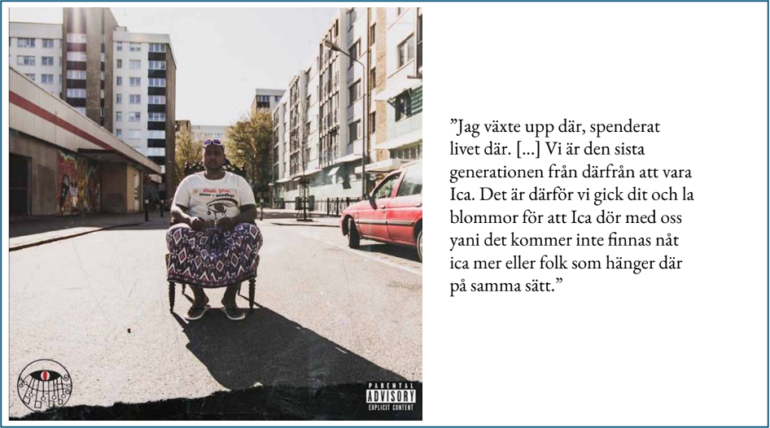
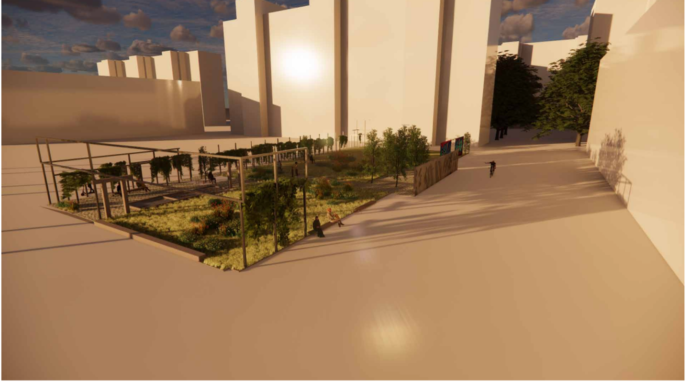
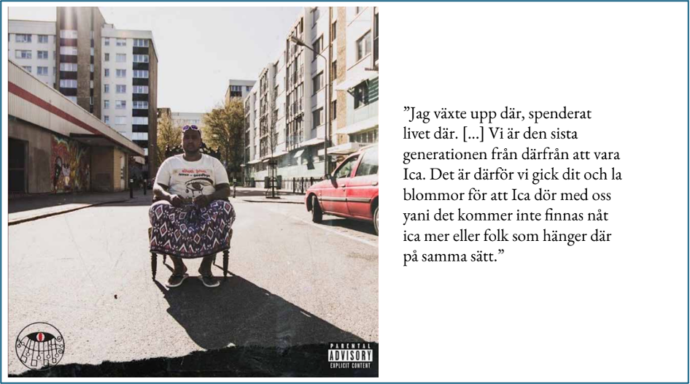
Considering the situation, our main objective moving forward became suggesting physical interventions that could touch upon some of the issues outlined above. We presented sketches for a temporary park at the planned location for the future Culture Casbah Tower. The park-design traced the floorplan of the building that was demolished in 2022 to make way for Rosengårds piece de resistance. The now demolished single-story building originally contained a convenience store and a few smaller retail spaces on the ground floor, while the basement contained space reserved for neighboring residents to use for various purposes, such as study/meeting spaces. The city approved the demolition against their own referral body on conservation and cultural heritage that suggested the now demolished building constituted an important part in a coherent and well-functioning landscape of cultural value (see pictures below). Preferably, they suggested that the poorly maintained building be restored to resemble its original design. If demolition had to go forward, the conservation expert suggested that any new structure mimic the original in scale, volume, and function to maintain a coherent and traceable architectural landscape. However, completely disregarding this, the city is (at the time of writing) planning to replace the convenience store with a twenty-two stories high tower.
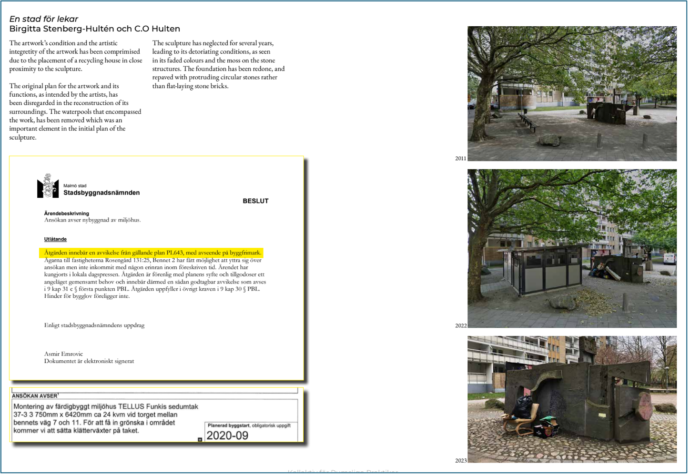
Additionally, we presented a plan to restore the dilapidated and garbled sculpture by Birgitta Stenberg Hultén and C.O Hultén from 1967 as an alternative to the park suggestion. This came about as we had worked on gathering information about public artwork in the area throughout the inventory phase. We found works to have disappeared or be in various degrees of distress. The original artwork with strong colors and water features has been allowed to fall apart and has been exposed to changes. Recently, the city allowed Rosengård Fastigheter set up a garbage disposal and recycling building right in front of the sculpture, replacing a couple of benches that faced it. We found sketches, original color scheme, and material choices at the Museum of Artistic Process and Public Art (Skissernas Museum) in Lund that could be used for reference.
However, the city didn’t accept our plans. We were told that there was an unfortunate scheduling conflict for the Culture Casbah site since the city was planning the construction of a temporary pavilion there, to last one month, together with the architecture firm Kjellander & Sjögren as part of Malmö in the Making (Södra Skog 2023). This came as quite the surprise since the biweekly meetings with the city and ArkDes had not generated any mention of plans for activities in that location in conjunction with Malmö in the Making and even though we had communicated that we were interested in the site. Additionally, scheduling conflict was a moot point since the temporary park would be in place until construction started on site, which will probably take years, while the pavilion was planned to stay at the site for a month. Furthermore, the difficulty with restoring the artwork, we were told, was that it no longer sat on public land, as it was part of a property that had been transferred to Rosengård Fastigheter. The public employees that we met with regularly, and that we were told were there to facilitate our work and help things run smoothly, were very reluctant to ask Rosengård Fastigheter about the possibility of cooperating with us. We were told that they’d never agree and that the city, who owns one quarter of the company in question by way of the municipal housing company, and that has far-reaching authority in a planning process which is currently underway and in which Rosengård Fastigheter is reliant on the city to agree to their plans, could not persuade Rosengård Fastigheter to let us restore artwork or construct a temporary park on their land. We were unceremoniously sent back to the drawing board.
After spending a few summer weeks thinking about what could be achieved if we weren’t allowed to move forward with our first plans, we ended up presenting the creation of a replica of the Charging Bull/Bull of Wall Street by Arturo Di Modica from 1989, located in New York. The piece, made to boost the morale of stockbrokers during a recession, has become a tourist attraction. It has also been used by Occupy Wall Street activists, and during the height of the Me Too movement the sculpture Fearless Girl was placed in front of the Bull in what seemed to be a feminist statement, but that actually turned out to be a branding stunt by an asset management company. Further, there are several replicas or paraphrases of the Bull in financial districts across the world, in Sao Paolo and Amsterdam to name a few (Ricciulli 2021). We suggested the bull be placed in a park, possibly partially sunken into the grass, that we were told the city would accept as a site for a sculpture. Although we were frustrated by the entire ordeal, we rather liked the idea of letting the Charging Bull replica tell a tale about the productive forces shaping land use in Rosengård (Gustavsson 2021). Unsurprisingly, the city of Malmö and ArkDes did not.
We decided to leave Power of Places soon after that. We offered ArkDes to exhibit our work in their museum at Skeppsholmen in Stockholm, even as we left the project. We never got a proper response. However, the team from Nyhamnen is currently exhibiting their work under the name The Square: Power of Places. Our team and what we learned, as well as the lessons the city and ArkDes drew from our failed attempts, have been completely written out of the project.
On their webpage the exhibition is introduced in the following way:
“The world is facing immense climate challenges. Through practice-based research project Power of Places, ArkDes collaborates with the city of Malmö to examine how architecture and design can contribute to a positive transition, focusing on reviving the old terminal area in Nyhamnen by leveraging existing elements.
The project is led by Team Layered, an international team consisting of Daniel Feldman, Ana Sokoloff, Sumayya Vally, and María José Arjona. Through collaborations with local artisans, the community and the city, they are testing, among other things, if an old truck ramp and concrete troughs can be transformed into a theater stage and if an urban forest can grow on asphalt.”
(ArkDes, 2024)
Lessons learned
We failed to sustain any meaningful conversations about residents’ fears concerning the redevelopment plans. Mere discussions on land use policy that centered on ensuring residents’ “right to stay put” were impossible to achieve (Clark & Lund Hansen 2017). We were probably labelled nostalgic in our efforts to develop rather than erase a significant Swedish cultural landscape and safeguard residents’ rights to stay in a neighborhood that, after years of abandonment, is on the cusp of experiencing large investments. However, the city’s and ArkDes’s un-nuanced vantage point reduced our room for action to interventions that would counterweight plans that have completely failed to even consider potential costs on part of the neighborhood residents.
Instead, our work in Rosengård was time and again framed by a flat reading of the stigmatization debate. A reading that is mobilized as a justification for development through densification. In that context, densification in combination with place-marketing is understood as a necessary step in rehabilitating the neighborhood’s image. The problem of socio-spatial segregation largely becomes a problem of some areas having a bad image, with a reading that is narrowly focused on the symbolic violence bound up in media framings of neighborhoods like Rosengård. The framing of stigma is not used to understand and offset some of the most debilitating, and very material, effects of ravaging inequality (Wacquant, Slater & Borges Pereira 2014). Instead, bastardized notions of race and space now work to produce, or at least justify, interventions that will most likely exasperate existing problems. It was within this framing that the soft power of place-marketing was implemented to challenge stigma and initiate changes to the area that, by definition, would increase displacement pressures, that our work appeared troublesome. The team’s insistence that some things were quite good, and that basic repairs and care for everyday environments were more needed than dramatic place-marketing simply wasn’t compatible with the framing of stigma as an image problem. Pointing towards the negative consequences of decades of political abandonment as a democratic problem that needed to be addressed was just not acceptable. Not when changing the areas image and, in the long run, its demographic composition, had already been pronounced over-arching strategy.
There are lessons to draw from failures. However, it requires that they are acknowledged as that in the first place. Through Power of Places, we encountered public institutions that asked for exploratory practices but did not have the capacity to facilitate or even entertain slight changes to processes in place. Instead, we encountered extremely risk-averse organizations that had strong incentives to (re)produce a particular kind of spatial planning, even when alternative routes and possibilities were open for exploration. To be clear, we were shut down by non-elected public employees long before coming up against potential legislative boundaries or political decision-making. When “successful” interventions are required or demanded, and sometimes even declared and celebrated in advance of any actual achievement, it’s very difficult to produce something that is exploratory and thus, by definition, runs the risk of failing in some way. What we are left with are public institutions that, through perverse incentives, work very hard to create the perception of undergoing meaningful changes or exploring new paths, while staying the same in every meaningful way. In this case circumstances that objectively set the project outside the bounds of basic market logics were not enough to produce results that explored alternative planning horizons. Further, this case suggests that this has to do with the discretionary power of public employees, and with the intimate ways that career advancement for public employees can become bound up with the production and circulation of expert knowledge in the form of ‘good examples’ or ‘best practice’ (Peck 2005, Mukhtar-Landgren 2021). In a sense, ‘good examples’ that are collapsed into branding/place-marketing practices have the capacity to move not only from place to place as outlined in the policy mobilities literature but from physical geographies and into careers (Peck 2005). Interventions communicated as successful through the ‘good example’ then serve an additional purpose with its own rationale.
This serves as a possible explanation to why senior public employees with influence in our project regularly worked in ways that countered expressed public needs, and that they did so unprompted by political decision-making. In our case, this meant attempting to work alongside public employees, a majority of whom told us in informal settings that they agreed with our objectives and concerns while shutting our work down in formal meetings. It would also serve as an explanation to why this failure isn’t allowed to exist as a learning moment but had to be written out of the history of the project by ArkDes and the city of Malmö alike.
One way of countering these problems is through vibrant debates within the planning professions. For that, scholars are strategically well-positioned to initiate and facilitate crucial discussions among students, colleagues and practicing planners. There is desperate need for scholarship that stretches beyond immanent critique of neoliberal statecraft, and connects with real, uncomfortable discussions about accountability, agency, and discretionary power in planning processes. There should be no comfortable retreat into academic debate.
References
ArkDes, Praktiknära forskning, Power of Places, https://arkdes.se/gestaltad-livsmiljo/praktiknara-forskning/power-of-places/ [retrieved 2024-03-10]
Beaten (2012) Normalizing Neoliberal Planning: The Case of Malmö, Sweden. In Tasan-Kok, T. & Beaten. G. (Eds.) Contradictions of Neoliberal Planning, Cities, Policies and Politics.
Derakhti, L. & Baeten. G. (2020) Contradictions of Transit-Oriented Development in Low-Income Neighborhoods: The Case Study of Rosengård in Malmö. Urban Science, Vol. 4:2.
Flemström C& A, Ronneby (1972) Fallet Rosengård: En studie i svensk planerings- och bostadspolitik. Prisma
Gustavsson, J. (2021) “They had already sold”: Uncovering relations among the local state, the market, and the public in the case of municipal housing privatization in Rosengård, Sweden. Environmental Planning A: Economy and Space Vol.54:2
Grundström, K. (2014) Stråk mellan öst och väst; Stadsbyggnad i ett föränderligt stadslandskap. Malmö University Publications in Urban Studies, pp.17-28.
Holgorsen, S. & Beaten, G. (2016) Beyond a Liberal Critique of ‘trickle down’: Urban Planning in the City of Malmö. International Journal of Urban and Regional Research, Volume 40, Issue pp.1075-1250
Kjellander Sjöberg (2021) Nya Culture Cashbah i Rosengård. https://kjellandersjoberg.se/posts/nya-culture-casbah-i-rosengard/ [retrieved 2024-03-10]Listerborn, C. Grundström, K. Claesson, R. Delshammar, T. Johansson, M. & Parker, P. (2014) Strategier för att hela en delad stad Samordnad stadsutveckling i Malmö. Malmö University Publications in Urban Studies 16
Lund Hansen, A & Clark, E (2017). The Right to Freedom from Displacement: Practical Implementation and Challenges. In M. Davis, T. Gammeltoft-Hansen & E. Hanna (Eds.), Human Rights Cities and Regions: Swedish and International Perspectives (pp. 23-30). Raoul Wallenberg Institute of Human Rights. http://rwi.lu.se/publications/human-rights-cities-regions/
Pries, J., & Zalar, A. Unmapping Green Space: Notes on the densification of Rosengård. Välfärdens Landskap.
Mack, J. (2019) “Renovation year zero : Swedish Welfare Landscapes of Anxiety, 1975 to the Present,” Bebyggelsehistorisk tidskrift, vol. 76, s. 63-79.
Mack, J. (2021) Impossible nostalgia: green affect in the landscapes of the Swedish Million Programme, Landscape Research vol.46:4, Special Issue: Welfare Landscapes
Malmö stad (2024a) Malmö in the Making, https://malmo.se/Malmo-in-the-making.html [retrieved 2024-03-10]
Malmö stad (2024b) Utlysning, Power of Places, https://malmo.se/Malmo-in-the-making/Utlysningen-Power-of-Places.html [retrieved 2024-03-10]
Malmö stad (May 2023) Press-release, https://www.mynewsdesk.com/se/malmo/pressreleases/power-of-places-klart-vilka-team-som-ska-utforska-rosengaard-och-nyhamnen-3251516 [retrived 2024-03-10]
Ministry of Justice (202) Public Access to Information and Secrecy, the legislation in brief. https://www.regeringen.se/contentassets/f381325faa3b41dc859080a0b1b4c994/public-access-to-information-and-secrecy.pdf [retrieved 2024-03-8]
Mukhtar-Landgren, D. (2021) Commentary, Narrating the city through best practices. Urban Matters, Issue Tales of the city.
Mulinari Schclarek, L. (2020) Race and Order: Critical Perpectives on Crime in Sweden. Department of Criminology, Stockholm University.
Peck, J. (2005) Struggling with the Creative Class. International Journal of Urban and Regional Research. Vol.29:4, pp 740-770.
Pries, J. (forthcoming) ‘Spatial theory in planning practice? On the concepts of space that made urban design a planning solution for segregation in Malmö, Sweden.’ Antipode – a Radical Journal of Geography.
Pries, J. & Zalar, A. (2022) Unmapping green space, Discursive dispossession of the right to green space by a compact city planning epistemology. City, Analysis of Urban Change, Theory, Action Vol. 26:1
Ricciulli, V. (2021) https://www.curbed.com/2021/11/brazil-charging-bull-touro-de-ouro-sao-paulo-nyc.html, Curbed [retrieved 2024-03-10]
Ristilammi, P-M (1994) Rosengård och den svarta Poesin: en studie av modern annorlundahet. Östlings förlag.
Rosengård Fastigheter (2024) Vad är Culture Casbah? https://www.rosengardfastigheter.se/culture-casbah [retrieved 2024-03-10]
The Shift (2024) The Shift, https://make-the-shift.org/ [retrieved 2024-03-10]
Södra Skog (2023) En paviljong i KL-trä ger Malmöborna rum för samtal och reflektion kring stadens utveckling. https://www.sodra.com/sv/se/byggsystem/nyheter/2023/malmo-in-the-making/ [retrieved 2024-03-10]
Wacquant, L. Slater, T. & V, Borges Pereira (2014) Territorial stigmatization in action Environment and Planning A, volume 46