Frictions of Movement: Platform Work and the Urban Experience in Copenhagen
The Cycling Paradise under Platform Pressure
It is 5 p.m. on Nørrebrogade, one of Copenhagen’s busiest arteries. The bike lanes fill quickly: commuters ride in disciplined flows, cargo bikes glide past cafés, and traffic lights regulate movement with near-mechanical precision. Copenhagen’s cycling infrastructure, which is frequently ranked among the world’s best, is performing exactly as intended.
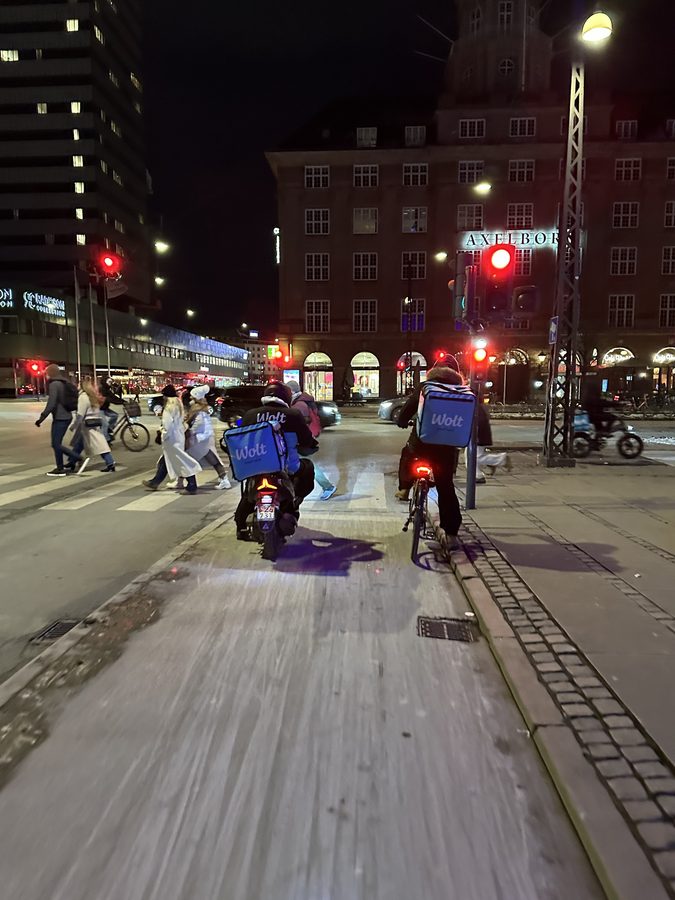
As a food delivery courier, I experience this choreography differently. My phone vibrates sharply, cutting through the street’s rhythm: a new order that feels like it’s already late. I accelerate, overtake, brake, merge, again, and again. Although the bike lane appears safe and efficient, platform time pressures transform it into a narrow corridor of speed, risk, and constant calculation. I am seen throughout the city with my large blue box and fluorescent blue jacket, yet I rarely feel like I belong.
For many foreign newcomers to Copenhagen, including myself at that time, the city’s cycling infrastructure initially inspires genuine admiration. Especially when arriving from contexts in which cycling lanes are fragmented, unsafe, and largely nonfunctional, the contrast is striking. The city moves as a coordinated system: predictable, legible, and apparently inclusive. In the voices of several food delivery workers interviewed for this research, the bike lanes in Copenhagen provoke admiration. “Ten out of ten,” one said. They also repeatedly emphasized connectivity and accessibility: “Bike paths take you everywhere,” one explained; “Everything connects to everything, it’s well thought out,” said another. Additionally, for recently arrived migrants, cycling offered not only mobility but also a rapid pathway into the labour market, without Danish language requirements. A bicycle, a smartphone, and availability were enough. Under these conditions, cycling felt efficient and almost too easy.
How, then, could anyone complain about cycling in Copenhagen?
This optimism mirrors dominant narratives in urban policy and cycling scholarship, where the city of Copenhagen’s high-quality infrastructure is framed as more inclusive, safe, and risk-reducing. This vision is part of what scholars call cycling urbanism: a planning approach that positions cycling infrastructure as central to creating sustainable, liveable, and socially inclusive cities. Copenhagen is widely regarded as one of its most accomplished examples (Emanuel, 2019; Freudendal-Pedersen, 2019, 2022; Vind, 2023). Additionally, given Denmark’s reputation as a strong welfare state, it is easy to assume that platform labour, widely criticized for its working conditions, operates under gentler conditions: less dangerous, more regulated, and more humane.
This article challenges that assumption. I argue that cycling infrastructure does not merely coexist with platform labour but actively reshapes it. The mechanism driving this reshaping is algorithmic management: the use of automated systems by platforms like Wolt to assign orders, monitor courier location and performance, and calibrate pay in real time. Unlike a traditional employer, the algorithm has no face. Yet, it is omnipresent, embedding time pressure, competitive incentives, and performance surveillance directly into the act of cycling. It is this technology, operating invisibly through the smartphone, that transforms the bike lane from a shared urban commons into a site of individualized economic pressure (Jesnes & Rasmussen, 2024; Graham, 2020). Under algorithmic management, per-delivery pay, and intense temporal pressure, Copenhagen’s bike lanes become sites where speed, risk, stigma, and inequality are intensified rather than neutralized. The infrastructure remains impressive, but it does not operate in a social vacuum. Instead, it interacts with labour precarity, migrant status, and urban hierarchies, producing new forms of vulnerability. In this context, cycling infrastructure reshapes urban life not only materially, but socially and politically.
Studying Platforms from Within
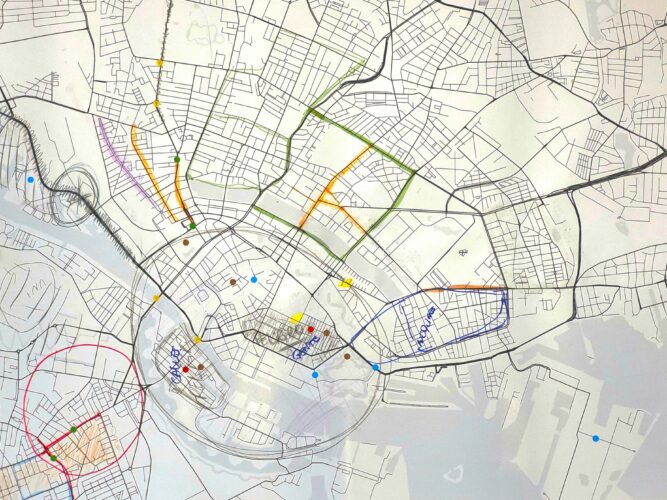
This article is based on qualitative research conducted in 2025 as part of a master’s thesis in Global Development at the University of Copenhagen. The study combines semi-structured interviews with food delivery couriers working for the platform-based company Wolt in Copenhagen, a participatory mapping workshop with Argentine couriers, and autoethnographic fieldnotes produced while working as a courier myself.
Being both a researcher and a courier let me see daily interactions, join informal chat groups, and experience cycling work first-hand. Instead of aiming for statistics, the research focuses on real-life experiences to show how city infrastructure, migration, and platform jobs connect in practice.
This research primarily focuses on Argentine migrants, as they constitute a large and visible group among Copenhagen’s delivery couriers. Their stories show how migration, insecure jobs, and city infrastructure shape daily movement. While their experiences do not represent all couriers, they help explain bigger patterns in platform work in Copenhagen.
The Street as Workplace: How Platform Labour Reshapes Urban Navigation
This article looks at food delivery couriers for Wolt, a Finnish company started in 2014. Wolt delivers food in cities and works like Deliveroo and Uber Eats. After joining DoorDash in 2022, Wolt spread to over 30 countries. In Denmark, it leads the food delivery market, especially in Copenhagen, where other companies have a small share (Campbell, 2020).
Wolt exclusively uses freelance couriers (referred to by Wolt as partners), who choose their working hours and are paid per delivery, with rates set algorithmically based on various factors (Jesnes & Rasmussen, 2024). Couriers supply their own vehicles, most commonly bicycles, and bear responsibility for equipment, maintenance, and personal safety. Like in many other gig-economy and platform-based jobs, courier work is presented as flexible and independent. However, it is heavily controlled by algorithms that prioritize speed, availability, and continuous movement (Graham, 2020; Jesnes & Rasmussen, 2024; Vandevenne & Vanroelen, 2024). Wolt’s operational model is a clear instance of algorithmic management: couriers receive no direct instructions from a human supervisor, but are continuously evaluated, allocated, and incentivized by an automated system designed to maximize order throughput and minimize delivery time (Jesnes & Rasmussen, 2024; Vandevenne & Vanroelen, 2024).
For most interviewees in this study, courier work with Wolt was their first job in Denmark. Its appeal was immediate: no language requirements, fast onboarding, and rapid income generation. Yet, this accessibility also meant entering the city through physically demanding, spatially exposed labour. The street became the workplace, and the bike lane was the primary site of production.
Building on Graham’s (2020) concept of platform urbanism and Bauriedl and Strüver’s (2022) platformization of urban life, I use courier urbanization to specifically describe the pattern in which platform delivery workers collectively reshape how urban space is used, experienced, and contested. It refers not just to couriers moving through the city, but to how their labour, visibility, and precarity actively alter urban rhythms, social relations, and infrastructural meaning.
Over time, couriers develop highly localized spatial knowledge of the city. Many described preferring specific neighbourhoods where they felt efficient, comfortable, and safe. Familiarity reduced reliance on GPS, lowered stress, and allowed anticipation of restaurant delays and traffic patterns. These areas felt less like workplaces and more like “normal bike rides.” A sense of belonging mattered.
At the same time, this spatial autonomy proved fragile. Income depends on order volume, and algorithmic allocation routinely pushes couriers beyond their preferred territories. As one interviewee explained, “Before, I could afford to say no. Now I can’t choose anymore, I take whatever they give me.” High-density zones promise more orders but also introduce frictions: cobblestones, pedestrian congestion, unfamiliar layouts, and heightened exposure to conflict.
Couriers frequently described the city’s emotional geographies, with certain areas associated with stress, avoidance, or discomfort. The inner city, especially tourist-heavy zones, was often cited as overwhelming: crowded sidewalks, erratic pedestrian movement, and constant interruptions. “It’s a jungle,” one courier remarked. Others mentioned fears of theft, hostility, or social tension when leaving bikes unattended.
Importantly, these spatial perceptions were not neutral. Interviews revealed how discomfort was sometimes articulated through racialized or stigmatizing language directed at other marginalized groups. One courier noted avoiding areas perceived as “unsafe,” linking this feeling to the presence of specific communities. These narratives reflect how couriers themselves navigate urban hierarchies while simultaneously occupying precarious positions within them. Infrastructure here operates not only materially but also affectively, producing what might be understood as emotional infrastructures shaped by fear, speed, exposure, and social judgment.
Time pressure intensifies these dynamics. Couriers repeatedly emphasized that “any extra minute is lost money.” Waiting at restaurants, navigating congested streets, or searching for addresses directly translates into reduced earnings. This temporal compression reshapes behaviour. Speed becomes a necessity rather than a choice. Several interviewees admitted to running red lights, riding on sidewalks, or taking risks in bad weather. As one put it, “You stop caring, you just want the money.”
These practices generate friction. Couriers are frequently described and describe themselves as disruptive figures in otherwise orderly cycling environments. “People yell at us,” one courier said. “They think we don’t respect anything.” This perception feeds into what I conceptualize as blue stigma: the marking of couriers, with their fluorescent blue uniform, as out of place within the city’s cycling order, simultaneously essential and unwanted.
Yet, admiration for the infrastructure persists. Many described Copenhagen’s bike lanes as “life-changing,” especially compared to cities where cycling felt dangerous or impossible. This coexistence of appreciation and critique is central. The problem is not the bike lane, but how platform labour reorganizes its use, meaning, and social perception. Under platform pressure, infrastructure designed for collective mobility becomes a site of individualized competition and exposure.
Compressed Time, Expanded Risk: Cycling Under Algorithmic Management
For couriers, the bike lane is not merely a piece of transport infrastructure. It is a workplace governed by time pressure, performance metrics, and continuous evaluation. While Copenhagen’s cycling network is designed to promote safety and smooth flow, platform labour introduces a different operational logic: one that prioritizes speed over care, and efficiency over bodily endurance.
Many couriers said that working for Wolt changed how they ride. They started running red lights, using sidewalks, and avoiding hesitation because it could cost them money. As one interviewee put it:
“On rainy or cold days, you could run someone over, run every red light, cut through wherever, and in that moment, you just don’t give a damn because you want the money. One hundred percent dangerous if you ask me.”
This pressure comes from the app itself, which tracks time, distance, availability, and performance. Algorithmic management transforms everyday cycling decisions into economic calculations, adding urgency directly into the infrastructure.
This produces a paradox. Copenhagen’s bike lanes are widely experienced as exceptionally safe. “There is no danger in Denmark,” one courier remarked, “especially compared to Argentina.” Yet this perception shifts once cycling becomes paid labour. The same infrastructure that feels calm and secure during leisure riding becomes a high-speed corridor when every minute translates into income gained or lost. What emerges here is a form of time compression, where infrastructure designed for comfort and predictability is repurposed to intensify pace and pressure. By fostering new forms of social interaction, gig economy platforms reshape urban temporalities and mobilities, creating new spatial and temporal proximities (Bauriedl & Strüver, 2022).
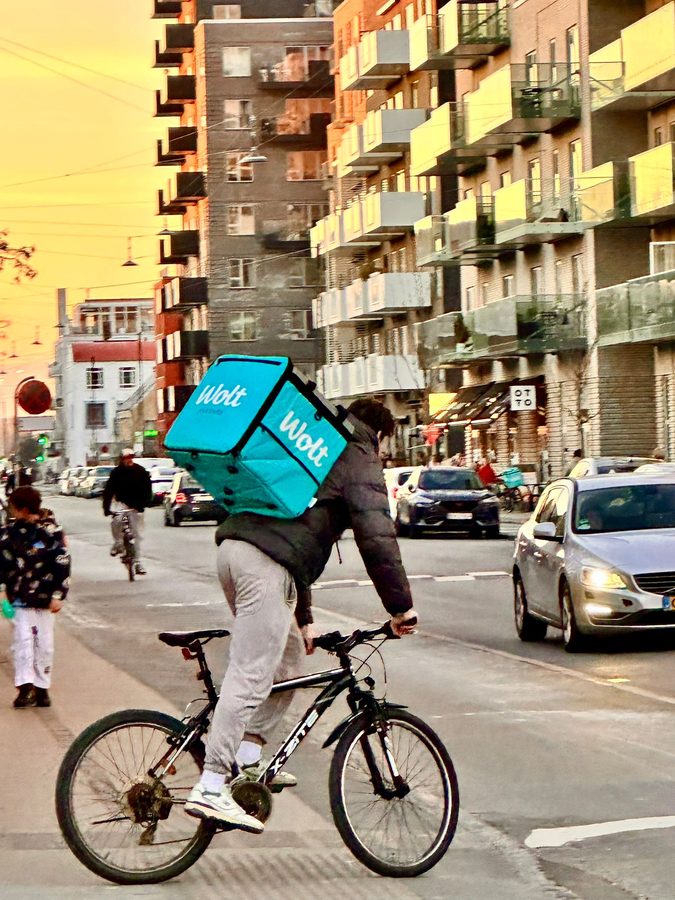
Waiting emerged as one of the most stressful dimensions of this compressed temporality. Couriers repeatedly emphasized that “any extra time is lost money.” Waiting for food at restaurants, waiting for orders to appear, or enduring slow periods all generated anxiety. One interviewee described standing in a restaurant for fifteen minutes after being told an order was “almost ready,” only to realize that the delay had effectively erased the value of the delivery. In this context, time is not neutral. It is monetized and unevenly distributed.
These pressures encourage risky practices that spill into public space. Several couriers reflected critically on their own behaviour and that of others. “I see Wolt couriers not respecting anything,” one said. “They ride on sidewalks, run red lights, ignore people who have the right of way.” Another added, “A lot of people doing Wolt are out there breaking every rule on the road.” While such actions are often framed in public discourse as individual irresponsibility, couriers themselves consistently traced them back to the platform’s payment structure and delivery-time demands (Vandevenne & Vanroelen, 2024).
Weather conditions further intensify these risks. Cold, rain, and snow strain the body while the app continues to demand speed and availability. One courier recalled falling on an icy street while rushing to deliver a pizza during a snowstorm:
“I had zero experience with snow. I thought, ‘Whatever, I’ll go for it.’ Then suddenly I was on the ground, crying, freezing—for a stupid pizza.”
The incident illustrates how environmental exposure intersects with platform incentives, turning ordinary winter conditions into acute workplace hazards. Despite operating in a city celebrated for safety and welfare, like in many other platform-based jobs, couriers carry the physical risks themselves, often without insurance, protective gear, or institutional support. In that way, risk is individualized, normalized, and absorbed by workers (Srnicek, 2017).
Seen from this perspective, Copenhagen’s bike lanes do not simply enable platform work; they absorb its pressures. They become spaces where the city’s commitment to cycling crashes with the economic logic of on-demand labour. The result is a form of accelerated urban mobility that may appear efficient from above but is experienced as exhausting and hazardous from within. In the next section, I turn to how this acceleration reshapes social relations in public space, producing stigma and uneven belonging.
Visibility, Stigma, and Uneven Belonging in Public Space
Acceleration in the bike lane not only generates physical risk, but it also reshapes how couriers are seen and treated in public space. Platform delivery work is highly visible. Couriers move quickly, wear branded uniforms, carry oversized delivery boxes, and circulate continuously through the city. Yet, this visibility does not translate into recognition; instead, it often produces stigma and exclusion.
Many couriers described feeling simultaneously hyper-visible and out of place. Their speed, necessary to meet platform demands, was frequently interpreted by others as aggression or irresponsibility. “People look at you like you’re crazy,” one interviewee explained. “They don’t see the pressure behind it. They just see a Wolt guy breaking the rules.” These encounters contribute to what I have called blue stigma, in which Wolt couriers’ blue uniforms and equipment become symbols of disorder within an otherwise orderly urban environment.
In Copenhagen, blue stigma is at the meeting point of infrastructure, work, and aesthetics. Couriers break this flow not by choice, but because they must. Their swift movements and frequent stops make them noticeable, turning them into visible exceptions in a system designed for regular commuting. Because of this, couriers are often seen as the problem, rather than being constrained by the system that shapes their actions.
Importantly, stigma is not evenly distributed. While almost all couriers reported some level of public hostility, racialized migrants described particularly heightened vulnerability. This became especially evident in certain social encounters. At the same time, some couriers linked their discomfort in specific areas to fears of theft or confrontation, often articulated through racialized narratives about “dangerous” places or people. One interviewee explained:
“There are some areas I try to avoid—not because of traffic, but because of the social environment. (…) Sometimes you leave your scooter and it’s knocked over, or someone steals from your box.”
Such statements reveal how couriers themselves navigate stigma while simultaneously reproducing it. What emerges is a form of relational racism, where vulnerability, fear, and marginalization are redistributed along racialized lines (Kim, 1999). Couriers who feel socially exposed and economically pressured may distance themselves from other marginalized groups, even as they experience exclusion themselves. The bike lane, in this sense, becomes not only a site of movement but also a site where social hierarchies are negotiated and reinforced.
Stigma affects private life too. One courier said that working for Wolt made his housing situation harder. At first, everything was fine in his sublet. But when he came home every night in his Wolt uniform and parked his scooter and box outside, neighbors complained. The building regarded the courier’s uniform and equipment as unwanted. The landlord told him and his partner to leave. Since their sublet was temporary, they felt they couldn’t argue and moved out early.
This instance illustrates how blue stigma travels beyond the street, shaping access to housing and everyday security. Being a courier did not simply mark the interviewee as a worker in public space, but it also positioned him as socially undesirable in private space. The stigma attached to platform delivery work thus contributes to broader forms of precarity, reinforcing migrants’ sense of conditional belonging in the city.
Despite these experiences, couriers rarely saw themselves as victims. Many highlighted their resilience, adaptability, and gratitude for having a job. Their complaints were often softened by comparisons to conditions in their home countries. Several interviewees said that “we shouldn’t complain,” referencing Argentina’s economic instability or lack of infrastructure. This comparison, where hardships in Denmark are seen as less severe than those elsewhere, further normalizes insecurity and discourages collective critique.
In the next section, I look at how these factors connect with legal status, irregular jobs, and the normalization of vulnerability among migrant couriers. I show how platform work takes advantage of not just infrastructure but also social grey areas in the city.
Working in the Grey Zones: Precarity and Platform Vulnerability
Beyond everyday navigation and public encounters, platform delivery work exposes couriers to deeper vulnerabilities linked to legal status and institutional uncertainty. While Wolt operates within Denmark’s formal economy, many of the labour relations supporting its service exist in legal and regulatory grey areas.
Several interviewees reported working as couriers without valid residence or work permits. One explained that after his visa expired, delivery was his only income. Unable to register officially, he rented a Wolt account from someone else for a weekly fee. This practice, known among couriers, allows those without legal authorization to work by pretending to be someone else on the app. Although banned, account rentals are openly discussed in courier WhatsApp groups. From the platform’s view, such arrangements often go unnoticed unless detected. For workers, this creates a constant fear of police, accidents, or being flagged by verification systems. Any of these options could potentially lead to job loss, detention, or even deportation. This highlights how platform work shifts migration risks onto workers while keeping the service running.
I briefly experienced this myself: shortly after arriving in Denmark, waiting for residency approval and with no formal income, I worked one shift using a borrowed Wolt account. The experience was overwhelming: little local knowledge, inadequate clothing, and a nearly dead phone. I struggled to find addresses, panicked when my phone died, and feared platform support would expose me. Though I stopped soon after, it showed how desperation can override caution and how fragile the line is between survival and serious trouble.
These practices aren’t anomalies, they are built into the system of platform work combined with migration insecurity. The features that make delivery accessible (low entry hurdles, quick onboarding, little oversight) also make it vulnerable to exploitation. Flexibility benefits some, but for others, it becomes forced adaptation under threat. Recently, Wolt introduced biometric ID checks to address account sharing. While meant to increase security, these checks also increase surveillance, especially impacting migrants with unstable access to work.
Overall, these stories show how platform labour normalizes vulnerability. Risk is shifted onto workers, legality becomes personal, and insecurity becomes part of daily life. In the final part, I will reflect on what courier urbanization reveals about the limits of “good infrastructure” and the politics of cycling cities.
Rethinking Cycling Cities: Platform Work and Everyday Realities
Copenhagen’s bike lanes are praised for making the city safer, greener, and more inclusive. They work well in many ways, but as shown here, their success depends on who uses them, in which conditions, and for which reasons.
For food delivery couriers, bike lanes are more than a public good; they are their workplace. Couriers face time pressure, insecure pay, and constant monitoring. The bike lanes that make commuting easy also push couriers to move faster, take more risks, and feel exposed. What looks smooth and organized from the outside can feel tiring and uncertain for those working inside it.
By following couriers’ daily routes through Copenhagen, this article has demonstrated how infrastructure interacts with platform labour rather than standing apart from it. Payment per delivery, algorithmic management, and competition over time reshape how bike lanes are used and experienced. Waiting becomes costly, speed becomes necessary, and safety becomes negotiable. Under these conditions, risk is not an exception but a routine feature of work.
These findings show that social inequalities appear on the street. Many migrant couriers start delivery work because it is easy to enter and does not require much local knowledge or language. But this easy access comes with problems: legal uncertainty, informal work, and more surveillance. These risks are often hidden in official stories about cycling cities. Promising inclusion is not enough to protect people who are already vulnerable.
Public reactions to couriers further reveal how mobility is tied to belonging. Fast-moving riders in branded uniforms become targets of frustration and complaint. These encounters show that conflicts on bike lanes are not only about traffic behaviour, but about who is perceived as legitimate, orderly, and deserving of space. The bike lane, in this sense, becomes a site where broader anxieties about labour, migration, and urban change play out.
Taken together, these insights suggest that infrastructure alone cannot resolve the tensions produced by platform urbanism. Even in a city with world-class cycling facilities and a strong welfare state, precarious labour can thrive alongside and partly because of well-functioning urban systems. This does not diminish the value of Copenhagen’s bike lanes. Rather, it underscores the need to understand infrastructure as socially embedded, shaped by economic models and power relations that extend far beyond design.
Courier urbanization invites a shift in how cycling cities are evaluated. Instead of asking only how efficiently people move, it pushes us to ask whose time is compressed, whose risks are normalized, and whose labour remains unseen as cities celebrate sustainability and flow. If Copenhagen represents the promise of cycling urbanism, the experiences of platform couriers reveal its limits, and point to the urgent need to think about mobility, work, and justice together.
Acknowledgements
This article draws on research from my MSc in Global Development at the University of Copenhagen, supported by the Green Solutions Centre and my thesis supervisor, Associate Professor Natalie Marie Gulsrud. I also thank the couriers who shared their time and insights through interviews and a workshop.
References
Bauriedl, S., & Strüver, A. (2022). Platformized Cities and Urban Life: An Introduction. In Platformization of Urban Life (pp. 11–36). transcript Verlag. https://doi.org/10.1515/9783839459645-002
Campbell, J. (2020, December 17). A cycle of struggles in Copenhagen. Notes From Below. https://notesfrombelow.org/article/cycle-struggles-copenhagen
Emanuel, M. (2019). Making a bicycle city: Infrastructure and cycling in Copenhagen since 1880. Urban History, 46(3), 493–517. https://doi.org/10.1017/S0963926818000573
Freudendal-Pedersen, M. (2019). Engaging with sustainable urban mobilities in Western Europe: Urban utopias seen through cycling in Copenhagen. In The Routledge Handbook of Anthropology and the City (1st ed., pp. 240–253). Routledge. https://doi.org/10.4324/9781315647098-17
Freudendal-Pedersen, M. (2022). Copenhagen is a good place to bike: But it could be better. In Routledge Companion to Cycling (1st ed., Vol. 1, pp. 419–426). Routledge. https://doi.org/10.4324/9781003142041-55
Graham, M. (2020). Regulate, replicate, and resist – the conjunctural geographies of platform urbanism. Urban Geography, 41(3), 453–457.
Jesnes, K., & Rasmussen, S. (2024). The bitter aftertaste of app-based food delivery. The Working Environment of the Future. https://pub.norden.org/temanord2024-531/chapter-5-the-bitter-aftertaste-of-app-based-food-delivery.html
Kim, C. J. (1999). The Racial Triangulation of Asian Americans. Politics & Society, 27(1), 105–138. https://doi.org/10.1177/0032329299027001005
Srnicek, N. (2017). Platform capitalism (Polity).
Vandevenne, E., & Vanroelen, C. (2024). Measuring employment precariousness in gig jobs: A pilot study among food couriers in Brussels. Work, 77, 487–510.
Vind, D. L. (2023). Copenhagenize: Designing regenerative mobility. In D. L. Vind (Ed.), Danish Design Heritage and Global Sustainability (1st ed., pp. 201–210). Routledge. https://doi.org/10.4324/9781003261018-15