
We exist in all spaces: anticolonial struggles in the streets of La Paz
Dos besos llevo en el alma, llorona
Que no se apartan de mí
Chavela Vargas – La llorona
The Olla
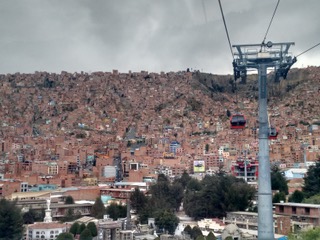
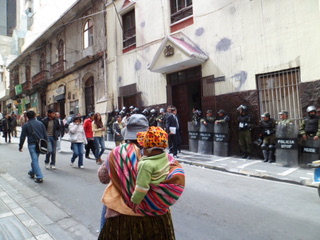
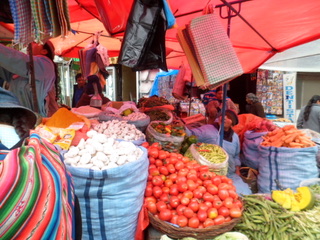
The routine in La Paz can be arduous, starting with walking up the steep slopes surrounded by thin air. The day breaks, and the streets are already full of pedestrians. The cholas have already spread their colorful awayos[1] filled with food on the ground. The witches’ market is already offering its medicinal herbs and amulets, in rhythm with chewing coca leaves. Maybe a march is already underway, and a protest camp has stood still. Maybe the daylight is shining on new graffiti. That’s how the day unfolds in La Paz, a walking city, even in the sky, where you can see the movement from the cable car lines. It’s crowded, made of close distances, not like certain metropolises where you can walk kilometers without seeing a living soul on the street. In wealthier parts of the city, there is a certain calm and a greater presence of private cars, revealing inequalities. The lowlands and highlands highlight power relations and resistance. Commerce also happens amidst the flow, sometimes organized but generally informally. That’s how I first perceived the streets of La Paz. People were always crossing back and forth, in the midst of many forms of public transport, markets, and between the past and the present. Shaped like a pan – olla in Spanish – the city boils. The impression is that this intense movement characterizes the action on the streets, while the Illimani Mountain remains, a constant presence like a dream on the horizon.
The setting is La Paz, a Bolivian city where past and present intertwine, along with rebellious bodies. The movement is Mujeres Creando, an anarchist group of women who turn creativity into action in the streets. Part of the urban landscape since 1992, the collective is known for its provocative strategies of political struggle. In this photo essay, I revisit some of Mujeres Creando’s actions, drawing from their own productions and my ethnographic work from 2013 and 2015[2]. In this narrative, I also seek to understand how urban space is appropriated and reterritorialized when these organized women take to the streets and disrupt the daily flow of the city, blur the boundaries between private and public arenas, and stage new societal projects. Actions such as Escultura Lesbiana (Lesbian Sculpture), which took over the public square and showcased a living sculpture, and Grafiteadas, the rebellious writings on the city’s walls, challenge normative roles related to gender, race, ethnicity, and class, among others. Additionally, they envision another city: one that embraces heterogeneity and confronts the colonial forms of oppression displayed throughout the landscape. According to Elizabeth Grosz (1995), city and body define each other. In this sense, we could think of this type of action as both redefining the city and being affected by it.
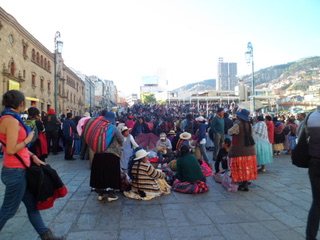
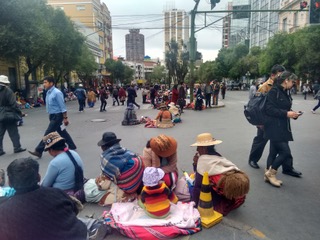
My first visit to La Paz was in 2013. I was walking slowly up one of the hills, trying to spare my lungs, when I saw a sign that read “se necesita joven o cholita” (young person or cholita needed). It was posted in front of a restaurant that served chicken and fries, one of the most common in the city – the street gave off that characteristic smell. The sign clearly offered job positions, but what stood out was the ethnic distinction in the ad. Chola generally refers to indigenous women living in the city, who are a visible presence with their polleras[3], their aesthetic a historical testimony of resistance to Spanish colonization. Their clothes are a mix of appropriation of colonial symbols and their re-signification. Cholita can refer to a young chola and may imply single status. Both designations have become popular, but they can also be used in a pejorative way, as some Bolivian women explained to me informally.
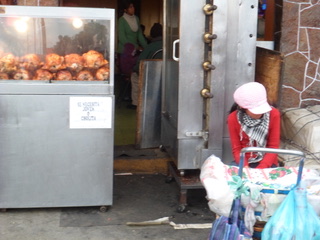
Later, I was talking with Violeta[4], one of the members of Mujeres Creando, the anarchist feminist collective from La Paz. She explained to me how colonial persistence is often expressed in the small details of everyday life in the city, often going unnoticed. According to her, there is a hidden prejudice, which, beyond the distinction between a common young woman and a young chola, manifests in the pejorative use of the word cholita in its diminutive form, when it could simply be written as chola. Violeta is of indigenous descent and says that living in the city does not make her feel less connected to her roots. Clothing also doesn’t completely define a chola, or even a cholita or chota. There’s also the term birlocha, which refers to indigenous descent in an urban context but without the traditional clothing. It’s usually used in a derogatory way, but it has been re-appropriated by Mujeres Creando and returned to society with a tone of defiance, according to my conversation with Violeta.
In Bolivia, it’s easy to see that cholas are a part of daily life. Silvia Cusicanqui (2010b) tells us how they take over and dominate the municipal market, which is a symbolic space. This is important to understand the city because the liberal reforms of the late 19th century destroyed spaces like these, targeting the indigenous population. The majority of the Bolivian population self-identifies as indigenous. Most of the indigenous peoples live in rural areas, with the exception of the highland region, where Aymara and Quechua ethnicities are predominant in the cities. Bolivian history shows how the mestizo-creole and white elite imposed forms of extermination and economic exploitation onto indigenous cultures and sought to exclude indigenous peoples from politics. From a historical point of view, it is possible to observe a continuity with the colonial era through various forms of internal colonialism that combine mechanisms of hegemony, such as the school system and the military service, and mechanisms of domination, like the use of force and political power. In this way, the subaltern tend to be the indigenous people (Teixeira, 2009).
In the 20th century, revolutionary nationalist intellectuals expressed the desire for an internalized territoriality, which meant the construction of a Bolivian identity that was expected to be broad and inclusive of citizenship. Starting in 1920, this idea sparked an urban social imagination with the myths of mestizaje and Westernization (Cusicanqui, 2010b). To think about Latin American realities, we need to consider the coexistence of the past and the future. Silvia Rivera Cusicanqui, who wears many hats, – sociologist, artisan, historian, and activist – says that this simultaneity is more obvious in “third world” countries, where the foreign imposition of economic and political changes didn’t blend smoothly with native structures. In our territories, alongside different races and languages, different historical layers coexist (Paz, 1950). Various eras are still in conflict and resistance to externally imposed models persists today.
The urban landscape of La Paz throws wide open this relationship between the persistence of colonial forms of organization and the fight for social transformation, as it is a part of the city’s daily life. One example Cusicanqui (2010b) gives is the gathering of working cholas since the 1920s. It’s by no accident that the first modern women’s popular movement in the Andean zone of Bolivia was the anarchism of the unions, Women’s Union of Various Trades and the Women’s Workers’ Federation[5]. Defending community autonomy, cultural identity, and women’s rights, this movement stood up against blind modernization and a form of citizenship that aimed to homogenize and exclude ethnic and cultural differences. The history of female anarchist unionism runs through the struggles of women today who recognize the need to decolonize and dismantle patriarchy in society. Since then, there’s been an attempt to reshape language “so that it stops being the conqueror’s talisman and becomes a means of communication and a space for exercising freedom” (Cusicanqui, 2010b, p.199). Figures like Petronila Infantes, a cook and leader of the Sindicato de Culinarias y Ramas Similares[6], are still a reference for women’s social movements.
Mujeres Creando emerged in 1992, constituting their movement with local references, such as “our grandmothers’ anarchism,” as one of them explained to me, a perspective that is not imported from European books. The collective is well-known locally and globally for their political activism, which takes over public spaces in all sorts of ways: graffiti, interventions, marches, irreverent installations, radio shows, interviews, audiovisual productions, and debates. They stir up all kinds of reactions. Additionally, they are based in La Paz and Santa Cruz de La Sierra. Their house in the capital has become a point of reference where many projects take place, but their main location for political action is the streets, with creative interventions that disrupt people’s daily lives.
The movement realized the need to develop from within a theory and practice that would support their utopia and demands in society, based on a heterogeneous identity – in other words, embracing diversity. The group brings together women with a range of identifications: different ages, social backgrounds, sexual orientations, cultures, and life stages. As they describe themselves, they are “some lesbians, some indigenous, disinherited oligarchs, city-dwelling natives, women in the middle of divorces, unemployed, and some rebellious gringas[7]” (Creando, 2005, p. 207). María Galindo, one of the founders, speaks of their commitment to an autonomous feminism grounded in daily life and what they call “concrete politics.” This is a feminism that proposes a utopia of social transformation without institutional mediation and that, starting from the lives of ordinary people, frames politics as a practice that transforms society. In their words: “conceiving that the ideas, affections, and alliances that move us and subvert the system are a precious treasure cooked in the very guts of the struggles we experience firsthand” (Creando, 2005, p.141).
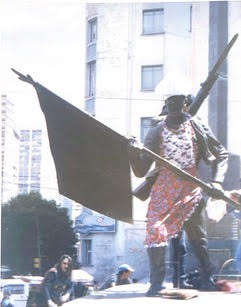
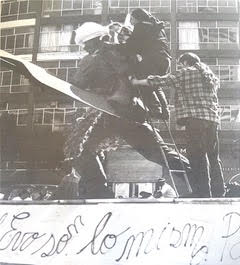
Escultura Lesbiana
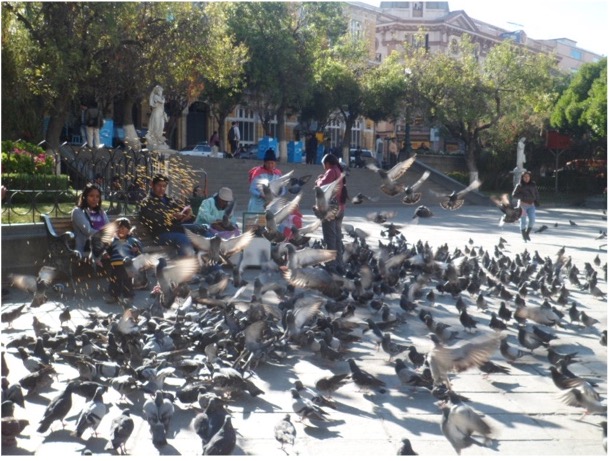
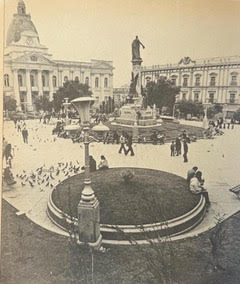
One year before my second visit to La Paz in 2015, a protest took place at Plaza Murillo, named in honor of the patriot Pedro Domingo Murillo but previously called Plaza de Armas, part of the colonial desire to design the city like a chessboard. It’s a square in the central area of the city where the government headquarters are located, and it is intended to be the starting point from which all distances are measured. I was going through the pages of the Mujeres Creando planner that I had bought a couple of days after arriving there when a picture caught my attention. It was a photo from the action called Escultura Lesbiana, and I began thinking about the intent to place a living statue – two women – in a city filled with colonial and patriarchal symbols. It was Pride Day, just one day after Congressman Roberto Rojas from MAS (Movimiento por el Socialismo) stated that the country was not prepared for homosexuals, saying that “they seem mentally ill.” Juana and Laura were entangled in public, holding signs that read phrases such as: “The anti-discrimination law is just for show[8],” “GLTB = fat, lesbian, stubborn, and Bolivian,” and “There is no political freedom without sexual freedom.”
Blurring the idea of separating public and private dimensions of life, they entangled themselves and remained still, creating the illusion of permanence like a stone figure while still breathing. A simple act that shocked the public. Soon, the police intervened, and the struggle began. A kiss was performed, another simple act that apparently caused shock. The living statue faced the intent of movement, of displacement, but for a while remained there, disrupting the daily image of the city and later appearing in the newspapers. As Raúl Zibechi (2007) describes, Mujeres Creando “contribute an intransigent rebellion that, by being provocative and uncomfortable, helps us think.”
An issue of Opinión (2014) newspaper discussed the police violence against these women, as well as how they promised to take action against the mentioned congressman and file a complaint for discrimination. The newspaper described the action as “peaceful-poetic” and spoke of the resistance of the two women embracing amid the whistles from the spectators and the police’s advances. Another newspaper, Nueva Crónica (2014), stated that Mujeres Creando do not need more institutional legitimacy than the street and questioned whether the audacity of a kiss between two women, a provocative sign, or even the mere presence of their bodies could threaten a state order that is homophobic, misogynistic, and rooted in colonial patriarchy. In another words, where power is structured around colonial dominance and male supremacy.
Laura, who participated in the action, later shared more with me. It was not an easy process for her to declare herself a lesbian after a life, a marriage, and four children. The Escultura Lesbiana represented a moment of rupture in her journey. The exposure of those bodies in the street, including her own, triggered a series of events. Police violence followed, along with media coverage, while her father watched on television. The action challenged the taboo surrounding lesbian sexuality and, like other actions by Mujeres Creando, was rooted in the collective’s own experiences. These initiatives arose from a moment, from the everyday lives of women. Laura told me that was during this time that she “came out of the closet.” Faced with a state that creates laws and fails to enforce them, where the city witnesses the unjust deaths of women, people with different sexual orientations cannot be public, she said.
In the conversation, we mention how the group reclaim public spaces as their own. Laura talks about situations like holding hands with her partner and walking with her and their children without someone pointing fingers, or going to their children’s school with her wife as a homosexual couple without being judged or pointed at by other parents or teachers. On a Friday, Juana called her and told her to buy some lace undergarments, those that women wear under dresses, called nawas. With these outfits, they would perform sexual positions based on lesbian experiences. Another companion made the art on the black hearts they carried, which stated that lesbians exist in the police and armed forces. She said, “we exist in all spaces,” but out of fear of society judging and silencing them, they say they are in the closet. In her experience, there are lesbian women present in many public and private spaces, but many times they remain silent.
The intention of the act was to challenge this situation. The day arrived, and Laura was already made up, thinking that it would be a calm and static performance as the statue. She arrived in a taxi, already dressed and protected by other movement companions. They set up a table that read “escultura lesbiana,” with Juana and her on top. The press arrived and started taking photos. The kiss between Juana and Laura occurred, and she clarified that they are not a couple. Then the police arrived, including special forces, to remove them, violently charging at them, pulling them off the table, and releasing tear gas on them. Laura remembered the critical moment of the police intervention and how she couldn’t let go of Juana because if she did, they would automatically detain one of them and then the other.
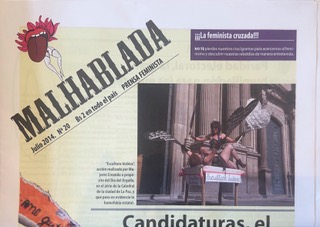
They wouldn’t let go of each other. She describes what followed as a kind of struggle, in which the police tried to take them away while the other Mujeres Creando comrades tried to help them. A dog ran by and bit Juana, causing more chaos. Laura’s outfit was almost falling, nearly leaving her chest exposed, and the police even dragged them, trying to remove them from the square. She emphasizes that she didn’t hide her identity, giving her name to the press. In the end, they left the location, and the story spread through other media, such as reports and people who passed by. For Laura, that day marked the beginning of a new moment in her life; she says it was like spreading her wings, transforming into a butterfly after being a caterpillar for so long. Not only do women occupy these spaces, but also lesbian mothers, like her, who advocate for weaving and gathering collectively.
Grafiteadas
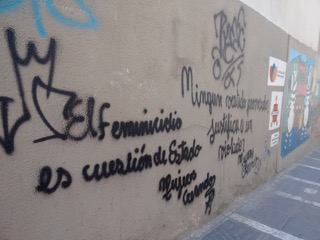
In 1993, during the presidential election campaigns, Mujeres Creando began their grafiteadas, a mix of graffiti and tagging. The graffiti served as a protest, denouncing racism, domestic violence, sexual violence, and state and institutional violence. The graffiti is a strategy of struggle that does not lose its meaning over time. For them, if the walls could speak, they would ask for graffiti. This method also allows for a non-hierarchical and non-thematic expression of daily life. It enables the expression of everyday experiences and endures on the walls. Through it, Mujeres Creando argues that it is possible to break the political routine, the silence of women, and disrupt the social order (Creando, 2005). The choice of space and time for the movement is also a process of collective reflection and a way of directly addressing the population.
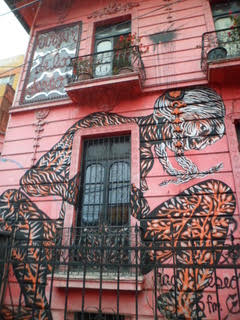
The first graffiti emerged from Café Carcajada, a space created by the movement, which provided a collective learning environment to articulate manual, intellectual, and cultural creative work, and which guides the political struggle strategies of the movement. Aesthetics are not dissociated from politics in the actions of Mujeres Creando. Galindo states that they do not unite through art as such, they are rather agitadoras callejeras (CREANDO, 2005). Being street agitators is not the same as being artists, as I understood it, there is a difference and it is political, because art often occupies a more prestigious and sometimes elitist place in society.
The struggle is built in the streets, a space where it can be raised in the social imaginary the possibility to confront a system that renders the city untouchable through the lines and regulations of the municipality, according to Mujeres Creando. They add that the image of women in the city, with their informal street vending, reflects a reappropriation of public space in an explosion of thought and expression. For the movement, creativity exceeds art, it is a way of recreating the world and enacting social change. The disorder of social relations is necessary to create new relationships. The messages inscribed in the graffiti “were not intended to reach the politically aware layers of society, but rather to ordinary people in their everyday lives” (CREANDO, 2005, p. 41).
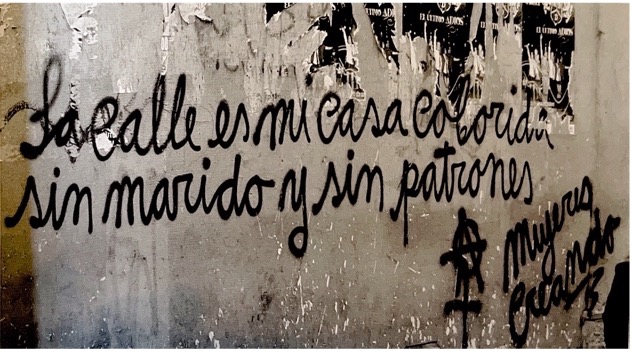
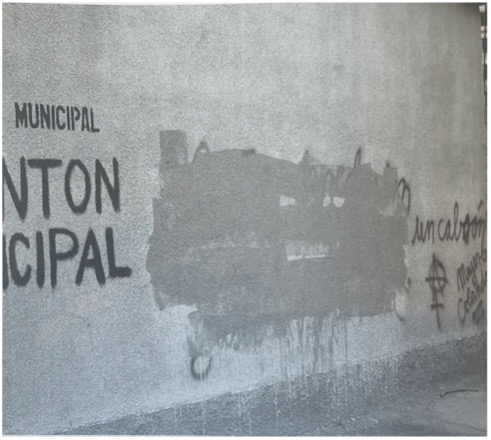
In this way, by taking to the streets with graffiti and actions like the lesbian sculpture, Mujeres Creando appropriate public space and face the risk of removal, while circulating and recreating relationships and reterritorializing the city. Beatriz Sarlo (2010) suggests that we can discover clues to social transformations in literature, art, and urban design. In Buenos Aires, for this author, the margins have become visible and contaminate the center and the “respectable” neighborhoods. The actions of the Mujeres Creando movement bring to the public urban scene bodies and images that have suffered attempts of erasure throughout Bolivian history and the group operates a displacement in areas dominated by other symbols.
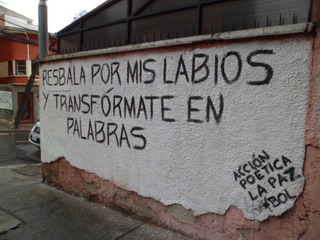
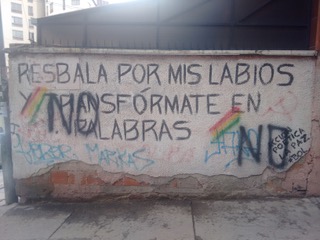
Walking through La Paz, an observer may find phrases like “Indigenous women, whores, lesbians, together, rebellious, and sisterly” and “our revenge is to be happy.” When they were about to open the collective’s house called Virgen de los Deseos, they left a message on the walls of the city: “Woman, the Virgin is coming, wait for her.” Later someone wrote “lesbians” above it and then Mujeres Creando wrote “and happy”. Another stated about the street itself: “The street is my colorful home, without a husband and without bosses.” Yet another characterized the group’s feminism: “Our feminism neither recycles nor fills, it removes, moves, and stirs.” Some respond to political tensions unfolding in a particular moment, such as when a graffiti piece by the group was erased on the same night it was made, according to them because it denounced the abuses of engineer Chicote Gutiérrez against his wives.
Endings and beginnings
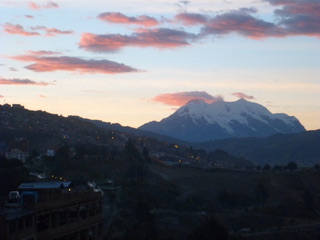
Returning to my arrival in November 2015, when I set foot on the Altiplano, I felt the cold breeze of El Alto. In the minibus, descending the slope to La Paz, I was absorbing the colors, the smells, and the differences. Laura was with me, talking about the city, the new cable car lines, the social movements at the university, and introducing me to some new aspects of life in La Paz. The city already seemed distinct to me, and I noticed the exposed brick houses that gave it an unfinished appearance. I thought that “unfinished” was not a bad adjective; it could mean constantly under construction. The geography was uniquely rugged. The colorful ensemble of buildings, which I would later learn is a more or less recent phenomenon of El Alto architecture, the choletes. The walls painted with “Evo Sí” and repainted with “No,” meaning yes and no to the president. We got off of the collective transport in some central area and walked uphill, passing other walls painted with “Sí” and “No.”
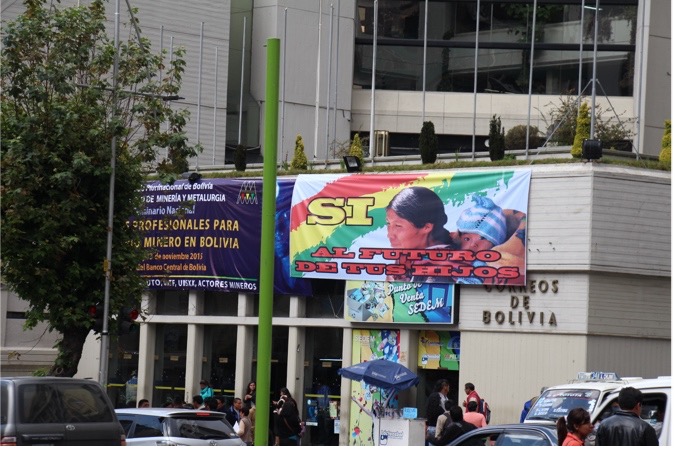
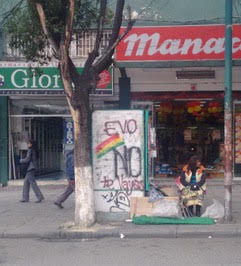
There was an effervescence surrounding the “Sí” and the “No,” a plebiscite voting for or against the change in the Constitution that would allow a second reelection for Evo Morales. That government was accompanied by a wide range of social achievements but also by frictions, ambiguities, and tensions. Between popularity and rejection, the response in two plebiscite votes was “No.” The streets of La Paz and El Alto became arenas of debate, with walls painted with “Yes” and “No” everywhere, resembling posters of a long protest. Often, the “Sí” was crossed out with “No,” and vice versa. It was possible to follow the debate on the walls.
As I tried to portray through weaving some histories and temporalities, the appropriation of public space in Bolivia is not an uncommon practice. It is a very politically active society, and many political actions take the streets as their stage. The bodies and graffiti of Mujeres Creando also took to the streets, proposing a new aesthetic for the city and constructing a critical narrative that seeks to dismantle contemporary forms of colonialism inscribed in the urban landscape. For them, it is not possible to decolonize without depatriarchalizing, and in this struggle, the bodies, symbols, and words agitate the streets. As Judith Butler (2017) tells us, the gathering of bodies is significant, and it means more than the discourse and claims that this gathering might defend. In the case of Mujeres Creando, one can see how their meetings go beyond discourse and become action with many possible outcomes. As I once saw in one of their graffiti, they call for collectivization: “Indigenous women, whores, and lesbians, together, rebellious, and sisterly.”
References
REFERENCES:
Butler, J. (2017). Cuerpos aliados y lucha política. Ediciones Paidós.
Creando, M. (2005). La Virgen de Los Deseos. Tinta Limón.
Creando, M. (2009). Mujeres Grafiteando Más. Ed Mujeres Creando.
Cusicanqui, S. R. (2010a). Ch’ixinakax utxiwa: una reflexión sobre prácticas y discursos descolonizadores. Tinta Limón.
Cusicanqui, S. R. (2010b). Violencias (re) encubiertas en Bolivia. Editorial Piedra Rota.
Grosz, E. (1995). Space, time and perversion: Essays on the politics of bodies. Routledge.
Mendonça, B. R. (2018). Agitadoras Callejeras: alianças autônomas e as palavras em movimento das Mujeres Creando. Universidade Estadual de Campinas.
Palacios, P. F. (2014, July). El beso de las Mujeres Creando: Subversión y misoginia. Nueva Crónica, 15.
Paz, O. (1950). El laberinto de la soledad. Fondo de Cultura Económica.
Saenz, J. (1980). Imagenes Paceñas. Lugares y personas de la ciudad. Editores Difusión.
Sarlo, B. (2010). Modernidade Periférica: Buenos Aires 1920 e 1930. Editora Cosac Naify.
Teixeira, R. de C. M. (2009). Identidades indígenas nos movimentos sociais populares e urbanos da Bolívia. Universidade de Brasília.
Zibechi, R. (2007). Dispersar el poder: los movimientos sociales como poderes antiestatales. Ediciones Desde Abajo.
(2014 6). Opinion. https://www.opinion.com.bo/articulo/el-pais/denuncian-diputado-califico-gays-como-enfermos-mentales/20140628085200492059.html#google_vignette
NOTES:
[1] The awayo, also spelled aguayo, is a traditional fabric from Andean culture, particularly in Bolivia and Peru. It’s commonly seen in La Paz being used to carry babies, goods, food, or other items on the back.
[2] This study was financed in part by the Coordenação de Aperfeiçoamento de Pessoal de Nível Superior – Brasil (CAPES) – Finance Code 001.
[3] The pollera is a layered skirt worn by cholas in Bolivia, often decorated with lace or stitched designs. Along with other elements, like a rounded hat and a wrap, it carries cultural and social meaning, especially in urban areas like La Paz.
[4] Given the time that has passed since the research was conducted in 2015 and considering the safety of the people I interacted with, I have anonymized their names in this writing.
[5] Translated by the author from the original names “Sindicato Femenino de Oficios Varios” and “Federación Obrera Femenina.”
[6] A possible translation would be “Union of Culinary and Related Trades.”
[7] The word “gringas” typically refers to foreign women, especially those from the United States or Western countries. The citations are translated by the author.
[8] Translated by the author, the same as other graffities and statements in this text.