“The ontological margin”: An interview with Wangui Kimari
Introduction by Mateo Villamil-Valencia
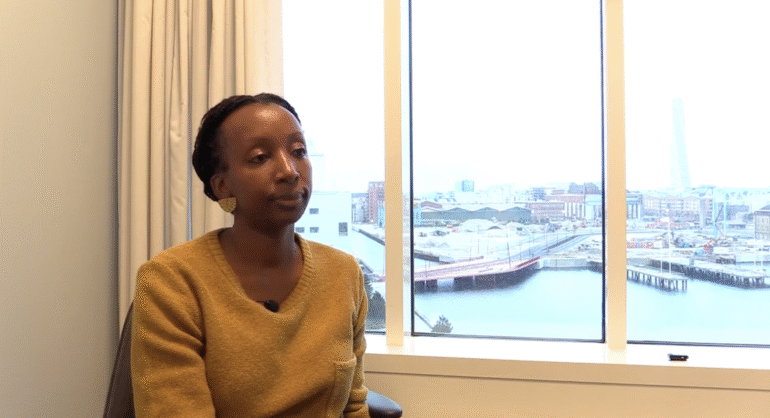
On the 13th of February 2025, the Nordic Network of Global South Urbanisms (NEGSU) hosted Dr. Wangui Kimari at the Institute for Urban Research (IUR) at Malmö University. During her visit, I had the opportunity to chat with Dr. Kimari about the importance of everyday life in global South countries when it comes to planning, using, and interacting in urban settings. Departing from her insights about self-constructed infrastructure in marginalized neighborhoods in Nairobi, Kenya, we discussed how the core of urban studies, the city and its concomitant networks of meaning, is fundamentally made of everyday life. In my view, these are the centripetal and centrifugal forces[1] rather than a mere compound of ideals about density, services or architectural forms (Villamil Valencia, 2024). We talked about how the realities of the majorities, usually excluded and impoverished, are the backbone of the city, and how the reshaping of the urban universe deals with surviving, living, and sustaining the community, regardless of the imperialistic mandate that sets rules and aspirations for the universal meaning of a good (aka servile) town.
City dwellers and their bodies connect human needs and will through a complex net of interdependence that allows for social transformation and accomplishes increasingly more just articulations of inhabitance. These bodily-mediated actions are systematically excluded from archives and official accounts of urbanity, but it is this stubborn disobedience and prevailing demands that sustains the urban communities. The critical fabulations of Saidiya Hartman (2024), Frantz Fanon’s (1963) analysis of the colonial city, and the immaterial incorporations of Harry Garuba (2003, 2013) and Francis Nyamnjoh (2017) nurtured my questions. There is a necessity of understanding the spiritual and human-nature connections of inhabiting places beyond technical master plans, as well as the central role of inter-subjective exchanges of global South ways of experiencing the city.
Lastly, Dr. Kimari and I discussed the need to reclaim that “marginality” to which the North condemned the rest of the world in the capitalist world order. In my view, through both practical and conceptual disobedience, the margins should be positioned as a centripetal force (Villamil Valencia, 2024), an advanced post to assert the humanity of those who refuse a colonized subjectivity, and a locus for an “unsupervised” creation of urban futures, disenchanted with external (colonial) validation. But these endeavors are not only a question of decentering the planning and the adaptation of existing locations, but are most importantly a matter of cultural healing: our landscapes and their social arrangements must reflect processes of mutual and self-recognition that lead to anti-colonial resistance.
Interview transcript (edited)
MVV: How do you understand the urban?
WK: In terms of how I think about the urban, we are often given very hegemonic definitions. The urban has such population density, or the urban has these forms of built environment, or these forms of services. But the urban ultimately is made of people, and often the people who hold up the urban are the ones excluded from the services that it offers. In my work, I try to tear away from these portrayals of what the ideal urban is, whether the ideal urban is a city that looks like Dubai… I focus on thinking about the life force and the actions of the often excluded, often low income, who have to hold up the services of the city and ultimately reshape it in the search for better futures. So, the urban sure is an area that politically or in law is defined as having such population density or such services. But for me, it is ultimately the people whose actions, whose bodies are geared towards upholding it and looking for more just iterations or more just articulations of city life.
MVV: What are anti-colonial theories that are useful to theorize the urban?
WK: For me, what’s most inspiring when I think about anti-coloniality are the everyday expressions of people who may not have names or faces that we know of, who are missing from the archives, who are missing from our histories of the city, but have everyday actions that stem the tide of coloniality, whether it’s through disobeying laws or through demanding their space, demanding that they live in a city that they were not meant to. For me, that’s what’s most inspiring. But at the same time, there are scholars who helped me really encounter these bodies, these people missing from the archives, scholars like Saidiya Hartman and who, through critical fabulation, fill in the gaps of the voices and the people missing from our archives. People like Frantz Fanon, who really offer power analysis of the colonial city. Analyses that are salient for Nairobi, but maybe also for Guadalajara, also for Bogotá. That for me is really important. And earlier today, I was thinking of scholars who talk not just about the material city, maybe the exclusions or the missing voices, but also the immateriality of the city. I’m inspired by scholars like Harry Garuba and Francis Nyamnjoh, who talk about spirits in the city. I’m inspired also by urban political ecology, which emphasizes the importance of nature. But then Harry Garuba and Nyamnjoh locate that more strongly in our context by talking about animisms and practices for the oppressed. Lending life, lending stories, lending sentience to animals, to spirits, also allows us to have understandings of the city that are important. But ultimately, primarily, I’m inspired by the people who were never meant to be in the city, but are still there demanding claims to space, claims to citizenship, and claims to the future of the city.
MVV: How can indigenous practices inform our understanding of the city and urbanization?
WK: I would say that in terms of urbanization, sometimes it’s taken for granted that someone can choose not to build a house in a certain shape or in a certain location because of, perhaps, ideas about spirituality. Maybe someone’s orisha lives there, or maybe it’s not in line with the spiritual practices. And that’s an urban practice of choosing, for example, where to locate a building, or how to draw, or how to design something. Those are urban practices, and this one is informed, whether we like it or not, by spiritual identifications. Often, we just attribute city building to a master plan, which some technical bureaucrat is going to sit and draw, hopefully informed by some level of participation. But we attribute city making to people in a very technical manner, without thinking of the experiences that they bring to bear, the spirits they bring to bear, the nature that is there as well. I would be curious to know how city building has proceeded in this area[2], and what indigenous ideas or belongings have been introduced in these ideas of laying out the city and conceiving what the city is.
MVV: Considering the ubiquity of technology, what aspects of the type of urbanity familiar to you reveal distinctive ways of understanding and inhabiting cities?
WK: For me, one thing I really appreciate about Nairobi is that everything is embedded in social relations. And I think parts of how we’re building the city seek to alienate people from themselves and their communities. Nowadays we can resolve everything by technology and it’s available there in Nairobi, but it doesn’t recognize that we live in communities, that, as Ubuntu philosophy says, “I am because we are”. I really appreciate the forms of living where your life processes are shaped by inter-subjective relations. For example, and this is also betraying my class position, but, if I want a chicken to eat, or flowers, or someone to fix my shoe, I need to go through diverse relations. I need to talk to my auntie, or I can call the guy at the corner, or I can ask another sister. And these are all your ways of knowing the city, your ways of producing the city, all socially. And I see that also. I briefly was in Salvador de Bahía in Brazil and I really saw that, I truly hope we don’t promote cities where we think that the future is the inevitability of technology, and that all our relations need to be modulated by a technological interface. Instead, I hope that we recognize that cities are us, and we are cities, and that we produce knowledge about them, we walk through them, and we offer each other services through this embeddedness in each other’s lives.
This kind of modernity is not total. Even if we really want it to be total. I think Kenya, in East Africa, we really want to look like it, more than other countries. We really want to be the most futuristic Africa. It’s a big problem. But it’s not total. And despite our governor saying we’re going to have order, and despite us thinking we’re the “Silicon Savannah”, because Kenya wants to be the “Silicon Savannah”, it will never be total. And thankfully, people resist that alienation. It is just PR, because at the end of the day, if you have a result: water, housing, dignity, land tenure for people, we don’t need to think we’re San Francisco. And that allure is not for us. It’s not for the real denizens of the city. It’s for an image that has more kinship with these very alienated visions of cities than with the actual experiences of people on the ground. But it sounds appealing. Many people make money from this appeal, and half of our new electricity interfaces are there to justify this “Silicon Savannah” status. There’s so much money pouring in from everywhere. But at the basic level, that identification is not emerging from the bodies of the majority or from the households who are the majority in the city. It’s emerging from policy, mobilities, and PR exercises that want a city connected too, but also that is individual-oriented in these capitalistic processes of city-making.
MVV: How do we navigate the challenges and limitations of using global South approaches in the North?
WK: I do think that through the type of networks that you’re making, there are many opportunities to not just convey knowledge from, say, Bogotá or elsewhere. You’re not just conveying for the sake of conveying, but to challenge certain understandings of city life. And I think you will always find someone who welcomes those questions. You may find people that may not welcome those questions. I don’t know if you can tell me, even in Bogotá, like in Nairobi, people may not be receptive to my discussions of the city as a colonial location, as a white-supremacist city, as a city that wants to kill the poor, the majority. I don’t think many people would be receptive to that. But I do know that that challenge is probably harder here in Sweden and Europe, where certain knowledges are taken for granted, and they are internalized in bodies. Whereas in Nairobi, it’s not just the hegemonic city ideal that is internalized in the body. It’s the recognition that I need a chicken, and a live chicken, and a live goat, in my yard. And even if my books tell me that the only way to plan a city is the Garden City model, I know internally that there’s another possibility. So perhaps this can be more useful, even if many Africans love colonial cities.
MVV: Latin Americans love them as well.
WK: It’s a challenge here, certainly, but I feel that in all your expertise, in coming together, you can take some incremental steps towards putting questions in people’s minds, at the very least.
MVV: You discussed Nairobi’s ontological margins, and I think we somehow understood because it aligns a lot with what we are trying to do here. But I want you to elaborate a little bit on that. We’re trying to, from the ontological margin, transform what it means to be and to exist in the city.
WK: Many people are trying. And to be honest, I can’t give you a conclusive and profound answer. But one example, or examples, that I take from the communities where I work, have to do with reclaiming that marginality. Certainly, it’s not at the expense of my body, so I’m not saying this in a romantic way. But reclaiming that marginality by saying “okay, I’m problematic. I’ll be disobedient.” Or just asserting your humanity in ways that need no validation from the outside world. For example, and I’m trying to answer this without using the word ontology, because I think that’s also a word that leads to confusion. In Nairobi, this community we have been working with was not deemed worthy of trees. It was subject to the environmental apartheid that governs Nairobi. So, what young people are doing, and these are young people who have come out of jail, young people who maybe were forced by many structures to engage in crime… They are saying: “what we’re going to do is create parks”. And we are creating parks to feed ourselves. Sure, we need food security. It’s not just going to be a park like Central Park. It’s going to be a park where we’re growing vegetables and mango trees, but also a park that has swings for our kids, but also a park to invest in trees so that this tree that grows, we can have shade to sit under and think, but it also gives us the discipline to rehabilitate ourselves. As we’re rehabilitating the landscape, we’re also rehabilitating ourselves. I don’t care if you think that I’m marginal, but in this process that I’ve engaged in by myself and through our environment and through community, I am renovating my ideas of self and move myself from being the ontological margins, the margins of your center, or the margins of existence, of the nature of being, to create my own healing. Because I’m going to rehabilitate myself, not from moving from the margins, not from moving from this poor area, but through interrogation of myself and a coming-together of self that allows for healing.
To me, healing is this rescuing of the self, rather than moving and changing myself to be the center. Let me be clear. I’m moving from the margins, not because you said I need to move this way through the margins, or out of these margins, the margins that you have imposed on my nature because I’m a problematic subject. But I’m moving from the margins and, even while staying in these ontological margins, I know I’ve moved through processes of healing and regeneration of myself and the community. And it is not my experience, but as an outsider, I’m really inspired by it. Because the goal is not to say that my location is bad and I need to move to your location. The goal is to say, you put me on the margins, and I’m okay with these margins, and you can deal with your center, because ultimately, when I’ve healed myself, I am and collectively we are aware, and even you will be aware that these margins are not just “the margins.” Even you, at the center, will know that there are many centers here that can be replenished, and you can draw from.
Why do I use “ontological margins”? Because geographically, it is not the margins. It comes from a very imperial notion of what a city should be, what a subject should be, and thus what a city subject should be. Or what an African is. And trying to recognize the power structures that create those margins that say, “this is your nature”. These imperialistic structures label us as “barely human”. And that is tied to space. But it’s important to recognize that remedying that ontological deficit in your being is not a matter of… We don’t care about moving to your center anymore. We care about healing ourselves and healing our communities. You will perpetually put us in the margins, even though we are not at the margins, because of the very nature of our beings. But we don’t need your center, we will heal ourselves, and that’s more important than being the kind of subject that you want us to be.
[1] Centripetal forces, which facilitate and reinforce social transformation, and centrifugal forces, which behave as obstacles for said transformation tendency. See Villamil Valencia, 2024.
[2] Dr. Kimari refers to Malmö and the Öresund region, as well as to Scandinavia and the Nordics in general.
References
Hartman S (2024). Wayward lives, beautiful experiments: Intimate histories of social upheaval. In: Carver, T. (eds) Feminist Theory. Palgrave Macmillan, Cham. https://doi.org/10.1007/978-3-031-55397-4_8
Fanon F (1963). The wretched of the earth. Grove Weidenfeld.
Garuba H (2003). Explorations in animist materialism: Notes on reading/writing African literature, culture, and society. Public culture, 15(2), 261-285.
Garuba H (2013). On animism, modernity/colonialism, and the African order of knowledge: Provisional reflections. Contested ecologies: Dialogues in the south on nature and knowledge, 42-51.
Nyamnjoh FB (2017). Incompleteness: Frontier Africa and the currency of conviviality. Journal of Asian and African studies, 52(3), 253-270.
Villamil Valencia M (2024) The Revolutionary Reason and the Whirlpool Theory. Centripetal Forces and Centrifugal Forces [Doctoral Dissertation], Complutense University of Madrid. https://docta.ucm.es/entities/publication/18892642-e4dc-4bb7-9ecf-cd824142c1b2