
Keeping Plastic at Bay: Aesthetic Blindness and the Distancing of Waste in Consumer Cultures
Modern consumer societies are often characterized as ‘throwaway cultures’, embracing a single-use mentality that privileges convenience and disposability over ecological consciousness and sustainability. This has created a crisis with far-reaching consequences, as mounting waste continues to accumulate on a global scale. By promoting a culture of relentless consumption and unlimited growth, consumer cultures dissociate consumers from the burden of their waste. They achieve this by concealing waste and creating waste hierarchies through which it is systematically displaced from affluent societies to economically marginalized regions. The dissociation is also an aesthetic strategy that excludes waste from the dominant sensory order of consumer cultures.
This article focuses on the production of such invisibilities, which in turn establish and maintain waste hierarchies. I pay particular attention to plastic as the quintessential single-use material that embodies the ethos of the throwaway age. I argue that modern consumer cultures operate through aesthetic mechanisms that privilege the shine and glow of new products over the unpleasant realities of waste, its circulation, and its socio-environmental costs. I propose that disrupting this cycle of waste dissociation can begin with interventions that challenge the sensory order of consumer societies and cultivate a greater sense of care and responsibility for the environment. Drawing on Bennett’s theory of enchantment and vibrant materiality, I conceptualize enchantment as an aesthetic methodology for engaging with unwanted, perplexing, and recalcitrant waste materials. I illustrate this approach through field notes from beach cleanup sessions in a coastal city in the Netherlands, showing how encounters with waste can generate ecologically informed narratives. I argue that by bringing waste back into the realm of visibility, these encounters can challenge the aesthetic blindness that dominates consumer culture and helps to bridge the gap between consumers and the waste they produce. Although the discussion focuses primarily on the micro-level, it seeks to outline a preliminary path toward cultivating greater awareness of the global circulation of waste and the power asymmetries through which individual consumers are implicated.
A Society of Waste Makers
In his seminal 1960 book, The Waste Makers, American journalist Packard examines the rise of post-war consumer culture in the United States with grave concern. With a sense of irony, he describes the utopia envisioned by business owners and sales experts as a “Cornucopia City”: a city in which the supply-demand cycle expands infinitely without any obstacles, generating an accelerating flow of goods. In this model, economic vigor is measured by the rate of production: the more, the merrier. Packard criticizes such a society for its urge to turn its members into ‘waste makers’, that is, people who “must be induced to step up their individual consumption higher and higher, whether they have any pressing need for the goods or not. Their ever-expanding economy demands it” (p. 6). This leads him to conclude that “prodigality is the spirit of the era. Historians, I suspect, may allude to this as the Throwaway Age” (p. 7).
In his fierce criticism, Packard pointed to the illusion lying beneath the premises of the Cornucopian vision: Unlimited production and relentless consumption are not cost-free. Not only do they exhaust natural resources, but they also create huge piles of waste. He denounced marketing experts who, “despite their air of chronic excited optimism, are grappling with a problem that would frighten the wits out of less resolute people. The problem is the specter of glut for the products they are already endeavoring to sell” (p. 3). Since the mounting trash in Cornucopia City needs to be stored somewhere, linear production and overconsumption are, by necessity, precursors to a garbage crisis. Cornucopia City, as Packard foresaw, was in fact a dystopian mirage.
It is difficult to look back at Packard’s reprimand without a sense of unease and apprehension, as prodigality has now become a commonplace institutionalized practice within the global economy. With the alarming increases in solid waste worldwide, Packard’s “specter of glut” is no longer a mere phantom; it is a concrete problem signified by trash mountains, garbage patches, and junkyards mushrooming across the globe, particularly in countries of the Global South. The desire for limitless production has given rise to a crisis of accumulation, marked by a global surplus of goods that serve no real function or fail to satisfy fundamental needs. This built-in waste is not incidental, but an essential part of the cornucopian economy to be managed rather than overcome.
The issue of waste management becomes more perplexing and dubious when it comes to plastic, a non-biodegradable material that, despite being produced in large quantities, persists for an exceptionally long time, and is difficult to recycle or recover effectively. As a prime disposable material plastic is at the heart of the Cornucopian dream, enabling the rapid expansion of consumerism while also materializing its shortcomings. As Gabrys, Hawkins, and Michael (2013, p. 3) point out, “More than any other material, plastic has become emblematic of economies of abundance and ecological destruction.” The longevity of plastic waste and its long-lasting environmental harm makes its management inevitably contested, raising questions of spatial (in)equality and social (in)justice. Given how less-developed, poorer, or peripheral areas are often at the receiving end of the global addiction to plastic, these concerns are indeed alarming.
Wasting, as Liboiron and Lepawsky (2022, p. 3) argue, “is a technique of power”: it involves a wider set of social, political, and material value-driven systems that create power hierarchies. Rather than being neutral acts, waste practices are partial, classified, and power-driven. The global plastic waste trade is not an exception. It shows how periphery nations are systematically subjugated by being exposed to the toxic burdens of global plastic overproduction. Plastic waste trade thus can be described as a form of “waste colonialism,” “the transboundary movement of waste from areas of privilege and affluence to areas with lower economic status and influence” (Liboiron, 2018). These top-destination countries often lack the infrastructure necessary to manage imported waste effectively. As a result, plastic waste, which often contains petrochemical additives, accumulates in the environment and threatens the health of local communities. The global waste trade thus reveals a toxic relationship between the core and the periphery, where toxicity connotes both hazardous material effects and an unhealthy, uneven, and exploitative form of dependency. The institutionalization of toxic dependencies ensures the continuity of neo-colonial forms of power and ownership. Shipping excessive waste to less developed countries, exhausting the land, and burdening locals extends colonial dynamics well into the present. As Liboiron (2021, pp. 6-7) explains, “pollution is not a manifestation or side effect of colonialism but is rather an enactment of ongoing colonial relations to Land. That is, pollution is best understood as the violence of colonial land relations rather than environmental damage, which is a symptom of violence.” Accordingly, colonial relationships safeguard continuous access to indigenous lands while appropriating them as a form of waste sink. While shielding one group from the consequences of their consumption, global flows of waste heavily burden others. In this context, plastic animates a capitalist logic of disposability in which raw materials, as well as people, land, and non-human beings are all treated as exploitable and replaceable resources.
It can be concluded that the society of waste makers, to borrow Packard’s terminology, is a hierarchical society that treats wasting as a right and an institutionalized practice. However, as the case of transboundary waste demonstrates, this right is not equally distributed. Rather, the right to waste is a prerogative enjoyed mainly by those who can be conveniently removed from the burgeoning weight of their consumption and lavish lifestyle. In this context ‘cleanliness,’ defined as a state of being free from visible waste, is a luxury product that is maintained through elaborate systems of waste management, movement, and trade. Yet, important questions arise: how is cleanliness achieved in economies designed to thrive on waste-making? How do the exponentially growing number of consumer products, whose increasingly glamorous packaging, advertising, and marketing inundate the scenes and senses of everyday life, remain largely invisible once they reach the end of their life cycle? In the following section, I argue that one way to produce and maintain this invisibility is through a deliberate dissociation of consumers from their trash in cornucopian economies. By promoting a relentless cycle of consumption, such economies cultivate an aesthetic blindness to the socio-ecological costs of consumer abundance, including toxic dependencies and unequal waste distribution practices.
Vanishing into Thin Air: Making Waste Insensible
Modern waste management systems are also technologies for waste concealment, primarily designed to control the movement of waste and divert its unwanted, often hazardous, consequences away from urban and densely populated areas. Their success depends on the efficiency with which they can make waste disappear. Landfills are prime examples of how sanitation is often synonymous with ‘dumping somewhere else.’ The principle of waste concealment holds particularly true for plastic as a rogue material whose state of overabundance in disposable single-use items is in sharp contrast with its low recycling rate. As Barnes (2019) argues, the dominant attitude toward managing plastic waste is an “out of sight and out of mind” approach that systematically occludes plastic’s post-consumption trajectory. As a result, consumers, who often develop an impersonal relationship with their waste, are barely concerned with the afterlife of their discarded items. Clapp (2002, p. 158) refers to this phenomenon as an “understanding gap”: “a gulf of information, awareness, and responsibility between consumers and wastes.” This gap is often encouraged and furthered through mechanisms of “distancing,” in which “key decision-makers—producers and consumers—are separated from the decisions that directly lead to the generation and disposal of waste” (p. 157). Distancing, thus, is a way of cloaking waste and alienating consumers from the high costs of production and disposal of goods in modern consumer cultures.
Waste distancing is not only a management strategy, but also an aesthetic principle that involves excluding waste from the sensory realm of everyday life. In maintaining and achieving cleanliness, the infrastructure also determines what shall remain in the sphere of the sensible and what is considered a nuisance that disturbs the sensory order of a given community. Through this relentless machinery, cleanliness as both a material and performative phenomenon is (re)produced and (re)imagined, and certain common hygienic standards are set.
Rancière’s aesthetic theory is particularly helpful for understanding the aesthetic politics of modern waste management systems and the production of waste hierarchies. For Rancière, aesthetics pertains to certain configurations of experience that define the conditions of perception. This is what Rancière (2004) refers to as “the distribution of the sensible.” Sensible, in this sense, refers to anything that can be perceived through the senses, including what is audible, visible, intelligible, or speakable. Accordingly, a distribution of the sensible “establishes at one and the same time something common that is shared and exclusive parts” (p. 12). Thus, it also determines the dominant sensory order of a given society, contributing to how the common world appears and is experienced. Rancière views aesthetics and politics as inherently interrelated. As he puts it, “politics is not primarily a matter of laws and constitutions. Rather, it is a matter of configuring the sensible texture of the community for which those laws and constitutions make sense” (2009, p. 8). Since the distribution of the sensible “determines the very manner in which something in common lends itself to participation and in what way various individuals have a part in this distribution”, it is also deeply political (2004, p. 12). Thus, politics is a form of aesthetic activity that affects how the common world is perceived and experienced, setting the conditions and possibilities of perceptive acts. As such, while the question of visibility or invisibility of a particular phenomenon is an aesthetic concern, it is inevitably also a political one.
Cornucopian economies are characterized by their overwhelming flow of consumer goods and the constant exclusion of waste from the realm of the sensible. As Gineprini (2024, p. 42) puts it, “waste’s allocation to a peripheral position is part of consumer society’s distribution of the sensible.” In the throwaway society, the economic system functions on a take-make-waste mentality, relying on, as Packard has warned, relentless, ever-growing consumption. Rather than confronting the unpleasant and material reality of mounting waste, the dominant sensory order of consumer culture privileges the shine and gloss of new products deliberately designed to ‘lure’ consumers. Kane (2015) discusses a certain “plastic shine” that has shaped modern visual culture and aesthetic perception. This has been reflected, for instance, in the promotion of Hollywood glamour in the 1920s and ‘30s, in which “plastic products provided a repertoire of new materials and metaphors in mirrors, shiny surfaces, lighting effects, smoke screens, and synthetic auras available to all who dared to look.” While signaling a sense of abundance and material wealth wrapped in attractive, slick packaging, consumer society actively obscures the afterlife of commodities, their neocolonial trajectories, and environmental harm from the sensory order of everyday life. In other words, “Garbage bins, waste containers, and the whole infrastructure of waste collection regulate the disappearance of garbage from everyday experience, aesthetically staging its invisibility” (Gineprini, 2024, p. 42).
Rancière’s theory sheds light on the mechanisms that, by rendering waste invisible, distance consumers from the burden of their trash. It shows how the creation of waste hierarchies in cornucopian economies is also enabled and maintained through aesthetic practices that shape the dominant sensory and political order. As important as policies and legislation are for breaking the vicious cycle of toxic dependencies, it is equally necessary to attend to the aesthetic underpinnings of consumer cultures that sustain the status quo. If we follow Rancière’s account of aesthetics and politics, we must turn to practices that intervene in the dominant sensory order and reconfigure the realm of the sensible. Such ‘eye-opening’ experiences may function as a stepping stone to overcoming the systematic dissociation between consumers and the waste generated by their consumption.
Enchantment as an Aesthetic Methodology
Modern consumer cultures foster an aesthetic numbness that filters out their unpleasant, toxic consequences and environmental harms. To challenge this distribution of the sensible, new aesthetic sensibilities oriented toward what Douglas (1966) famously calls “matter out of place” need to be cultivated. Such an ambition requires practices that actively unlearn the established sensory order and instead develop novel ways of engaging with and literally seeing the world. This would mean replacing the “strategic amnesia” (Crawford, 2021, p. 26) built into existing systems with “the arts of noticing” (Tsing, 2015, pp. 17-26). In her anthropological inquiry into conditions of precarity in late capitalism, Tsing uses noticing as an experimental ethnographic method that, by reorienting our attention to “the divergent, layered, and conjoined projects that make up worlds” (p. 22), might “revitalize political economy as well as environmental studies” (p. 23). Noticing, in this sense, requires a sensory reset: regaining the capacity and skills to perceive the damage inflicted upon the world and responding to it with sensitivity. It is a radical strategy to redistribute the sensible and bring hidden harms to light.
Retraining sensible faculties necessitates meeting the world with a heightened sense of ‘curiosity’ and allowing oneself to be ‘enchanted’ by unexpected encounters. In her theory of vibrant materiality, Bennett discusses enchantment as an important component of an affective experience of encountering things. Enchantment entails “[being] struck and shaken by the extraordinary that lives amid the familiar and the everyday” (2001, p. 4). It emanates from a sense of surprise, which compels us to encounter the ordinary differently and to discover it anew. Bennett’s own example of the enchanting power of vibrant materialities includes an encounter with a range of disparate items clustered together in a grate over a storm drain. These items not only caught Bennett’s attention in a moment of surprise but also animated her intellectual activity. For it is through this encounter that Bennett (2010, p. 6) conceptualizes her notion of “Thing-Power,” “the curious ability of inanimate things to animate, to act, to produce effects dramatic and subtle.” Thing-Power stimulates a response in the body that is affected by its force, which may lead to forging a new relationship between them. Enchantment arises from such an affective encounter in which cognitive bias is momentarily suspended, making room for a new orientation toward matter. It thus functions as a form of aesthetic defamiliarization, emerging from the gap between a priori knowledge and the affective force of the thing-encounter. As Bennett (2001, p. 6) puts it, “In an enchanting refrain, sense become nonsense and then a new sense of things.”
Bennett’s theory of enchantment offers an important methodological insight for research concerned with material encounters. Accordingly, allowing oneself to be taken aback by mundane objects is a “methodological naiveté” that stimulates the capacity “to treat nonhumans—animals, plants, earth, even artifacts and commodities—more carefully, more strategically, more ecologically” (2010, pp. 17-18). This affective orientation toward matter requires “a cultivated, patient, sensory attentiveness to nonhuman forces operating outside and inside the human body” (p. xiv). Becoming attuned to matter out of place through enchantment and noticing holds immense potential to challenge the dominant sensory order of consumer societies, in which waste is systematically rendered invisible. In other words, these affective modes can be understood as methods for making sense of waste.
In the next section, I illustrate how I drew on this methodological insight in my own interactions with plastic waste during a field trip to Zandvoort, a coastal Dutch city along the North Sea. In September 2025, I participated in a beachcombing activity organized by Juttersgeluk, an initiative that collaborates with local communities and volunteers to conduct regular cleanups in the western Netherlands. Exposed to oceanic currents that exceed the organizing logic of modern waste management systems, beaches are liminal zones where consumerism’s dominant sensory order may be momentarily disrupted. When waste dumped into the ocean returns to the coast, it acquires a haunting presence, confronting observers with toxic relationalities animated through plastic’s ecology. It moves through environments and landscapes, connecting organic and inorganic matter, people, ecosystems, cultures, and systems of power. Embodied, enchanted engagement with matter out of place can redistribute the sensible, inspiring alternative aesthetic regimes attuned to relationalities and the fundamental interdependence of beings.
The following short vignettes capture a few key moments from my encounters with plastic, highlighting how seemingly mundane trash can reveal a dynamic system that intimately connects us to distant beings and geographies. They also propose an experimental methodology of “interactive fascination” with matter out of place, one that remains attentive to chance encounters, relationalities, and matter’s capacity to generate thought and foster ecological narratives (Bennet, 2001, p. 5).
On Sea Offerings and Relationalities
Vignette 1: Plastic Literacy
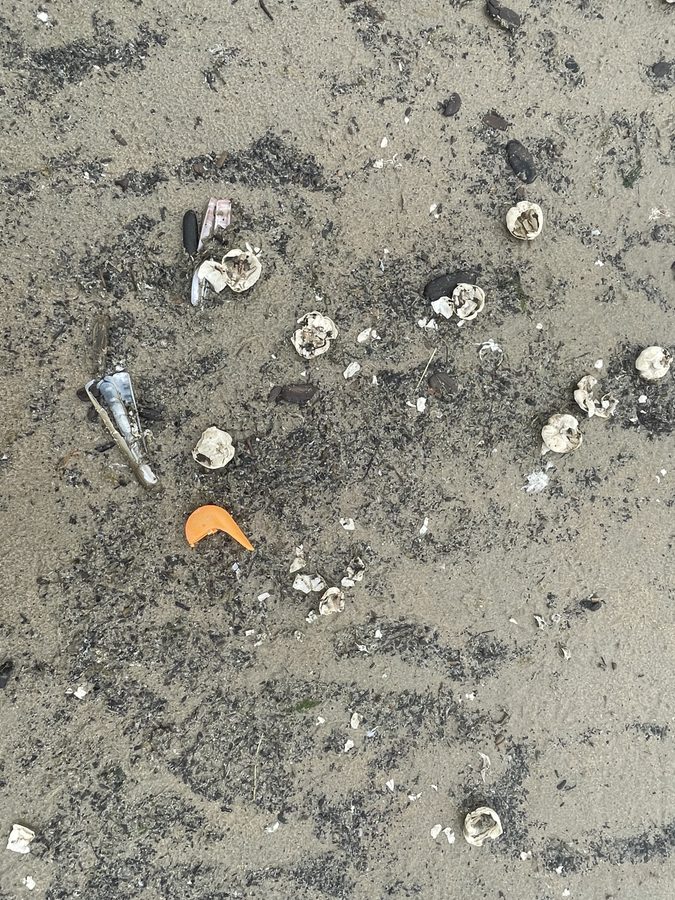
As we commence our session, I realize it is not always easy for me to detect plastic in my surroundings. It is particularly harder when it comes to smaller pieces, which are often camouflaged with biological detritus. Unsurprisingly, others at my company are much quicker and more skilled in recognizing plastic. This is partly because I lack the local, embodied knowledge of marine coastal ecosystems necessary to identify common types of plastic debris on the beach. Gradually, my perception starts to change. I no longer look for plastics as familiar objects. Instead, I try to notice incongruous materials around me. This is a different practice, one that requires setting aside prejudices and defamiliarizing myself with a material I thought I knew very well. Still, I am surprised to find out many of these junked scraps belong to familiar objects that I own, use, and see in plenty in my surroundings. It becomes clear that even when I dispose of plastic in the hope that it will be recycled, these non-biodegradable items find their way back.
Vignette 2: Uncanny Encounters

While combing the beach, the question of nature versus artificial comes to the foreground. For this is exactly what I am doing: in cleaning the beach, I am separating the human-made ‘pollutant’ from biological detritus. On my walk, I encounter two artificial plants lying on the sand under the blazing sun, reminding me that plastic defies the image of a pristine nature, as any neat distinction between the natural and the synthetic worlds begins to fall apart. Plastic has colonized the natural world, imitating it in its shape, color, and function Replacing natural materials with cheaper replica. These artificial plants are uncanny counterfeits. Even though they replicate the outer appearance of natural materials, they fall short of participating in the organic, lively rituals of death and decay. Instead, they accumulate in the environment, contributing to its gradual demise.
Vignette 3: Toxic Entanglements
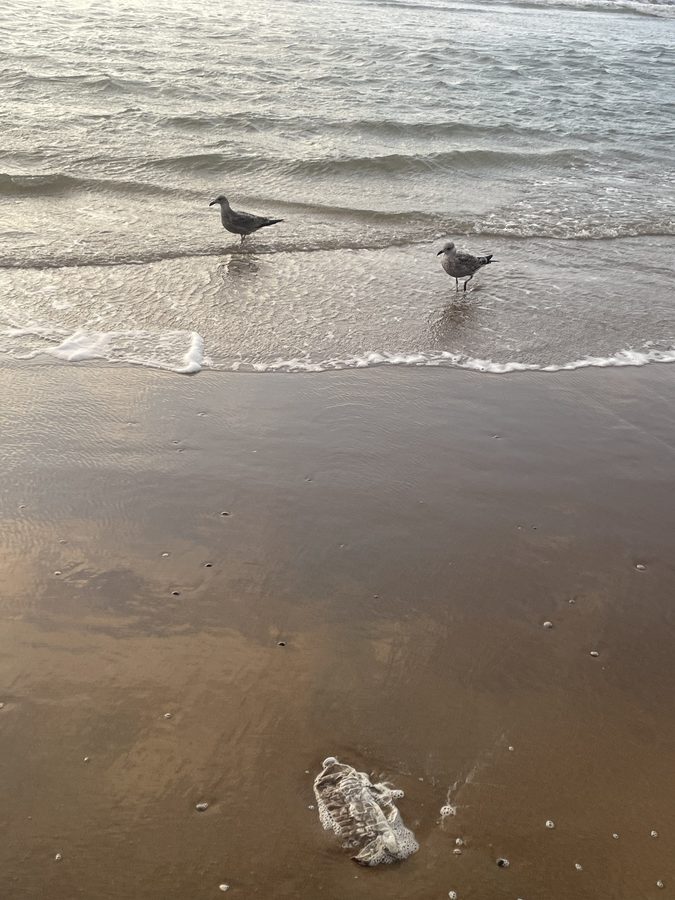
I pause for a break, looking up at the sublime beauty of the sun-drenched sky tinted with divine light. Around me, seagulls are running energetically on the shore, sometimes gathering together as if discussing where to take off next. I’m immersed in the beauty of the scenery before my eyes: the coast, the sand, the water, the seagulls, the decaying seagrasses, the shells, the shiny stones, and the crabs. Yet the glimpse of something solid, shiny, and white calls my attention. Even from a distance, it signals incongruity with the image of natural beauty I had constructed in my mind just a few minutes ago. I look in amazement at the composition before me, a white plastic bottle pointing at the two seagulls innocently going about their adventures on the beach. It looks like a weapon, poised to discharge silently and envelop us all in its toxic fumes. As plastic disintegrates, it breaks down into smaller pieces that may land in my or the seagulls’ bodies. It contaminates us. Bodies rot while plastic persists. I feel a strong urge to shield myself and the seagulls from this strange artifact. As I carefully pick up the bottle with my grabber, I know there is no easy escape from the messy material aftermath of a long-lived toxic love affair with petroleum.
A beach cleanup is essentially an experiment in suspending the dominant distribution of the sensible, as the goal is to actively ‘look for’ trash, items that create nuisances in the existing aesthetic regime. I was advised to keep an eye on ‘shiny’ things with ‘unnatural’ colors, visual hints of plastic’s presence. My task was to notice plastic and collect and categorize it. In doing this, I was training my eyes to become ‘plastic literate,’ detecting plastics among other forms of debris and recognizing their types. This is a deviation from the dominant sensory order of consumer culture that, by normalizing plastic’s presence, trains consumers to become what Whitman et al (2025) refer to as “plastic blind.” In their littered state on the beach, mundane plastic objects are both too familiar and too foreign, too commonplace and too extraordinary, too personal and too remote. These queer encounters draw in onlookers, and incite their curiosity and wonder, which may lead to critical questions about the material’s origins, flows, and impacts. Plastic demands attention, a momentary pause of reflection, and a reaction. This space of recognition offers the possibility of realizing how the very stuff we consume daily creates harm. Indeed, recognition implies an act of ‘re-discovery,’ becoming aware by forging new sensibilities. In that, it holds a significant transformative potential.
Conclusion
The feverish dreams of Packard’s feared Cornucopia have created a conundrum with far-reaching consequences. The ecology of plastic captures the folly of such illusions and the impossibility of separating human consumption from natural systems. Flows of recalcitrant plastic waste that evade human control signal the failure of the cornucopian dream, as the material reality of wasted commodities stands in stark contrast with the sparkly, insouciant vision promoted by consumer culture. As the refuse of modern civilization, scattered plastic debris in seemingly pristine natural environments highlight the significance of waste, not only as what society deems useless and discards, but also as a reflection of how it operates, discriminates, dreams, and ultimately imagines itself.
References
Barnes, S. J. (2019) ‘Out of sight, out of mind: Plastic waste exports, psychological distance and consumer plastic purchasing’, Global Environmental Change, 58, 101943.
Bennett, J. (2001) The enchantment of modern life: attachments, crossings, and ethics. Princeton: Princeton University Press.
Bennett, J. (2010) Vibrant matter: A political ecology of things. Durham: Duke University Press.
Clapp J. (2002) ‘The distancing of waste: Overconsumption in a global economy’ in Princen, T., Maniates, M. and Conca, K. (eds.) Confronting consumption. Cambridge: MIT Press, pp. 155-176.
Crawford, K. (2021) Atlas of AI: Power, politics, and the planetary costs of artificial intelligence. New Haven: Yale University Press
Douglas, M. (1966) Purity and danger: An analysis of concepts of pollution and taboo. London: Routledge.
Gabrys J., Hawkins G. and Michael M. (2013) ‘Introduction: From materiality to plasticity’ in Gabrys, Hawkins, and Michael (eds.) Accumulation: The material politics of plastic. London: Routledge, pp. 1-14.
Gineprini, L. (2024) ‘Aesthetics and politics of waste: Rejects in consumer society’s distribution of the sensible’, The Nordic Journal of Aesthetics, 33(68), pp. 34-49.
Kane, C. L. (2015) ‘Plastic shine: From prosaic miracle to retrograde sublime’, e-flux, 65 [online]. Available at: https://www.eflux.com/journal/65/336456/plastic-shine-from-prosaic-miracle-to-retrograde-sublime (Accessed: 28 April 2026)
Liboiron, M. (2018). ‘Waste colonialism’, Discard Studies,1 November[online]. Available at: https://discardstudies.com/2018/11/01/waste-colonialism/ (Accessed: 22 April 2026).
Liboiron, M. (2021) Pollution is colonialism. Durham: Duke University Press.
Liboiron, M. and Lepawsky, J. (2022) Discard studies: Wasting, systems, and power. Cambridge: MIT Press.
Packard, V. (1960) The waste makers. New York: David McKay Co.
Rancière, J. (2004) The politics of aesthetics: The distribution of the sensible. Translated by Gabriel Rockhill. London: Continuum.
Rancière, J. (2009) ‘The aesthetic dimension: Aesthetics, politics, knowledge’, Critical Inquiry, 36(1), pp.1-19.
Tsing, A. L. (2015) Mushrooms at the end of the world: On the possibility of life in capitalist ruins. Princeton: Princeton University Press
Whitman, K., Bowyer, C., Nieto-Garcia, M., Georgiou, G., Evans, T., and Fletcher, S. (2025) ‘Plastic blindness: Lifting the blindfold through citizen science’, Environmental Science & Policy, 173, p. 104218.