Changing Perspectives of Waste Management Systems in Semi-Urban Areas in India: A Case Study of Goa
Introduction
The concept of waste management has been transformed over time from being focused on unregulated dumping to organised methods operating in areas of concern such as public health, environmental protection, and resource recovery. Organic waste, prevalent in early societies, was discarded in open areas or water bodies, leading to diseases (Letcher and Vallero, 2011). However, modern societies provide municipal collection, dustbins, and a systematic disposal system to help reduce such diseases (Tchobanoglous and Kreith, 2002). Rapid urbanisation, industrialisation, and economic growth have led to a rise in municipal solid waste per person that exceeds the capacity of existing government infrastructure. According to the CEEW report 2025, India generates about 170,000 tonnes per day of municipal solid waste, of which around one third is generated from agriculture, industry and consumption (Khan et al., 2025). There is a rapid expansion of urban facilities and services to villages adjacent to suburban areas. The local government experiences difficulties in providing basic infrastructures and most of the waste generated is not managed properly. Therefore, local governments in these semi-urban areas experience challenges in managing the increasing production of solid waste. The Indian state of Goa is one of the best in waste segregation at the source. The local government played an important role in enhancing community-level awareness and promoted community-centric waste management mechanisms. This study aims to explore the barriers that limit equitable participation in community-centric waste management and to identify how the needs of marginalised groups can be better incorporated into waste management systems.
Understanding Waste Management in India
Centralised waste management can be categorised by a “collect and transport” model. It depends on a single, large-scale infrastructure to handle the waste of an entire municipality or region. India faces significant challenges in centralised waste management despite the potential for economies of scale, with a large chunk of the waste disposed of and treated in open dump yards or landfills, after which the remaining small portion is usually treated in composting, recycling and through waste to energy. Data from the Ministry of Statistics and Program Implementation (MoSPI, 2015) confirms this heavy reliance on landfilling across various Indian states, highlighting a gap between policy intentions and ground reality.
While large-scale initiatives can help reduce per-unit costs for recycling of waste, a large part of the Indian Waste Management system depends on formal and centralised collection. However, the NIMBY (Not in my Backyard) movement, in which local people oppose the centralised waste management facilities, makes it difficult for the government to find suitable waste management locations. The centralised waste management system also poses a significant risk of failure in the event of natural hazards, particularly when environmental controls are not regularly monitored.
The Solid Waste Management Rules 2016 emphasised decentralised waste management and conceptualised waste as a resource in a circular economy. The decentralised waste management approach offers a reliable way to manage waste, focusing on local origins, reducing transportation costs, and promoting local employment. This model reduces logistical costs and environmental burdens by segregating and managing waste locally. It fundamentally reorganises the limitations of urban infrastructure and moves away from capital-intensive end-of-pipe solutions toward smaller, community-managed systems that prioritise resource recovery over mere disposal (MOHUA, 2016). In the case of Goa, the decentralised waste management approach has become the bedrock of environmental sustainability, especially in light of the geographical nature of the state and the large number of visitors that it receives during the peak tourist seasons. Recently, the government included the approach of waste reduction at the source, reuse and recycling of materials, composting of organic waste, incineration with energy recovery, and sanitary landfilling for residual waste. According to the Solid Waste Management Rules 2016 of India, waste segregation at the source is mandatory. Households have to segregate waste into three streams: organic waste, dry waste, and domestic hazardous waste. Additionally, bulk waste generators such as hotels and hospitals must treat organic waste either on-site or by working with the urban local body. Urban local bodies can charge bulk generators a user fee for collecting and processing their waste. They can also impose spot fines on individuals who burn garbage or discard it in public areas. No non-recyclable waste with a calorific value of 1,500 Kcal/kg or more is allowed in landfills.
The Indian state of Goa is presently leading the way in a transformation of waste management. As of 2026, Goa is no longer collecting waste and is moving towards a technologically-sound circular economy. Despite the presence of a tourist population of over 1 crore per year (GoG, 2025; Hindustan Times, 2025)there has been substantial progress. According to the Goa Waste Management Corporation (GWMC) Status Report in 2026, Goa has made progress in waste segregation at the source level at a rate of nearly 90% (GWMC, 2026), one of the highest in the country. So, how do the local communities understand and practice waste management on the ground, and which challenges remain?
Selection of a study area
The study has been conducted in a village panchayat of South Goa district, situated along the Zuari river estuary. It is geographically significant as it is located near a major city and an industrial belt, making it a semi-urban settlement with mixed residential, industrial, and commercial activity. The village experiences a significant floating population due to its proximity to industrial and transport hubs. According to the Goa Panchayati Raj Act 1994, the Village Panchayat (VP- the local government in rural areas) is responsible for the primary collection and management of solid waste within its jurisdiction. In recent years, the selected VP has undertaken several notable steps under the Swachh Bharat Mission (SBM) Urban 2.0, the nationwide campaign to improve solid waste management practices and promote safe sanitation and hygiene:
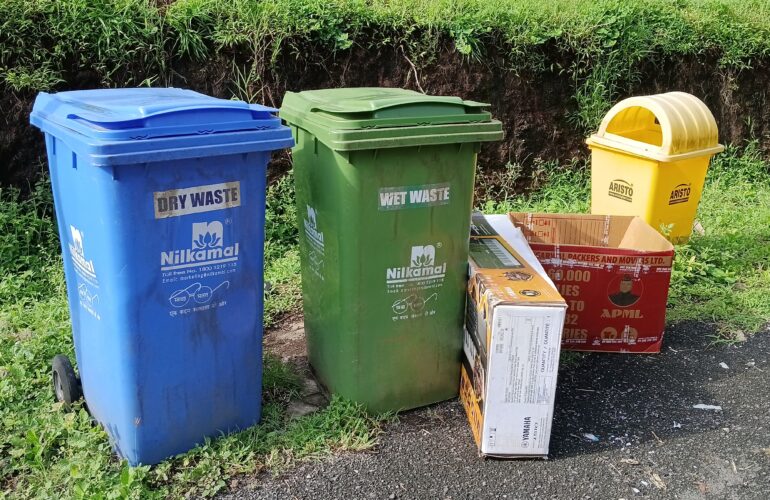
(a) Waste collection and transportation: The panchayat introduced door-to-door waste collection using dedicated vehicles (tippers/tricycles), segregating wet (green bin) and dry (blue bin) waste at the household level.
(b) Waste segregation and recycling: A small-scale Material Recovery Facility (MRF) has been set up at the panchayat level, where dry waste such as plastic, glass, and paper is sorted and channeled to registered kabadiwalas (scrap dealers) and recyclers.
(c) Building community awareness: Wet waste is directed to a community-level composting unit, with the finished compost being distributed to local home gardens and reviving a traditional practice that had declined due to urbanisation.
(d) Organising Swachhata Drive: The VP regularly conducts Swachhata (cleaning) drives along the beach and the riverfront, which are prone to littering by tourists and fishing communities.
The local government coordinates with the Goa Waste Management Corporation (GWMC) to ensure that non-recyclable residual waste (especially from fishing activities, such as nets, ropes and polystyrene boxes) is transported to the Cacora Plant in South Goa rather than being dumped near the waterfront.
The study adopts a mixed methodological approach, combining quantitative and qualitative methods to understand the ground realities. The selection of the study areas depended on the performance of the wards (the smallest administrative subdivision of a village panchayat. The elected member of each ward is known as a Panch or Ward Member) in waste management, as determined by the village panchayat office. The study was conducted in the best performing wards. Semi-structured interviews were conducted with households across different wards of the village panchayat, covering questions about waste generation volume, segregation practices, frequency of collection, and awareness of Swachh Bharat Mission guidelines. There were also interviews with village panchayat officials, sanitation workers (known as the Swachhata Doot), and local elected ward members. Field observations were conducted along waste collection routes, at the Material Recovery Facility, and at common dumping spots near the beach and fish market. The study also analysed available reports in the village panchayat.
Local-Level Waste Management Practices
The residents of the selected village panchayat follow both traditional and urbanised waste management systems. As a coastal village, there is a huge amount of agricultural waste as well as fish and fishing related waste. The villagers use fish waste, coconut shells, and vegetable peels for making compost and feeding animals. There is a shift in lifestyle and demographics that has changed the trend of waste generation and its management. The proximity of rapid infrastructural development in villages and adjacent areas, industrial development in rural areas and a high flow of tourists and migrants have changed the lives and social environment in the village panchayat. The waste generation in the panchayat is closely related to changing economic activities in the village. The trends of waste generation are:
(a) Shifting Consumables: The rise of nuclear families and working professionals, coupled with easy market access in nearby cities, has led to a heavy reliance on processed and packaged foods. This has caused a sharp increase in non-biodegradable dry waste, specifically plastic wrappers, tetra packs, and polystyrene.
(b) Sector-Specific Waste: The fishing jetty area presents a unique challenge, generating high volumes of specialized waste such as discarded fishing nets, expanded polystyrene (thermocol) ice boxes, and commercial packaging that often falls outside the standard scope of the Swachh Bharat Mission (SBM) framework.
(c) Post-Pandemic Residuals: Since the COVID-19 pandemic, there has been a sustained surge in single-use plastics, including delivery packaging and personal protective equipment, which remains high despite the return to normalcy.
(d) Seasonal Volatility: From October to March, the influx of tourists significantly inflates the waste volume produced by hotels, shacks, and home-stays, often exceeding the daily collection capacity of the local panchayat.
Table 1: Nature of waste generation in the village panchayat
| Source of waste | Waste generators | Types of waste |
| Residential | Household level waste | Food waste, agricultural waste, paper, plastic, textiles, leather, glass, metal, electronics waste |
| Industrial waste | Light manufacturing and chemical plants | Food waste, packaging, construction materials and hazardous materials |
| Commercial | Supermarkets, hostels and restaurants, marketplaces, fishing ports, office buildings | Paper, plastic, glass, food |
| Institutional | Schools, health centres, government offices | Paper, plastic, glass, food |
| Construction and building | New construction site, road repairs, demolition of a building | Woods, iron, concrete and dirt |
Based on local sample data, the change in household waste behaviour is stark. An Indian family that previously generated roughly 500g of waste per day (almost entirely organic) has seen their output rise to 800–1000g per day. More significantly, the composition has shifted from nearly 100% organic to a mix where 40–50% of total generated waste is now dry or packaging material. This represents a 60–100% increase in total mass and a fundamental change in the complexity of local waste processing requirements (Table 1).
Local Waste Segregation and Collection
Waste segregation at the local level is a combination of culture, social norms, and hierarchy. Household-level waste segregation depends on environmental awareness, the influence of neighbours, the rules imposed by the local government, available facilities for segregation, and available responsible people for segregation. The local government administration provided dual bins (green for wet waste, blue for dry waste) under the Swachh Bharat Mission initiative, but the actual segregation practice remains low (i.e., 35%–45% of households). There are structural and non-structural challenges in household waste segregation. Waste collection involves two stages: door-to-door collection and collection from designated waste depots. The door-to-door waste collector employed by the local government comes to collect the waste at a specific time every morning, when households with members who all work often miss handing over the segregated waste. They cannot keep the waste bins outside their houses because street dogs often spoil them. Therefore, they rely on housemaids who keep all waste in a single packet without segregation. Sometimes the local government becomes strict in accepting the non-segregated waste from the households, but this causes disputes between the local government and households.
Traditionally, women are responsible for household waste segregation. As women engage in formal jobs, the role of waste segregation has shifted to migrant housemaids from different parts of India. There are waste management committees at the community level, but these housemaids do not get space. The local government organises campaigns and provides guidance for waste segregation at the source. The housemaids do not follow these waste management instructions because of their unfamiliarity either with the local language or English. Housemaids work at multiple houses in a day and are therefore reluctant to spend extra time on household-level waste segregation. Sometimes, they also demand extra payment to engage in such activities.
Industrial growth and livelihood opportunities in the village changed the demographic structure. Several private housing colonies have been developed in semi-urban areas. The resident welfare associations (RWAs) of these housing colonies played an important role in household level waste management. The resident welfare associations organise their own campaign along with the local government and impose strict rules for residents to segregate the waste. However, there is not much interest among residents to make compost at home.
In public places, such as local markets and community halls, waste segregation is rarely practiced, even after separate bins are provided. Sometimes, fish workers are reluctant to segregate waste at the local level. At the fishing jetty and fish market, vendors frequently mix fish scales and gutting with polystyrene ice boxes and plastic bags. This single-pile collection makes it nearly impossible for waste management workers to process efficiently at the Material Recovery Facility. Although the local government has implemented various measures, these waste materials are still being disposed of in the water bodies near the market, causing an ecological crisis.
With improved road connectivity in villages, waste collection is faster in the village panchayat. The total amount of waste has increased 800-1000g/day per household in the last five years. As the waste collection vehicle is able to connect every corner of the village, residents are mainly dependent on the panchayat’s morning tipper truck. Local level waste disposal is combined with formal systems and informal community practices, shaped mainly by daily life, topography and traditions. The waste disposal system is managed by the local government. However, open dumping of waste is still seen along highways, even after the waste collection initiatives implemented by the local government. A large amount of dry waste is collected by waste collectors from undesignated dumping areas, roadsides, and creeks.
The Role of Local Government in Waste Management
According to the Goa Panchayati Raj Act of 1994, and the SWM Rules of 2016, the village panchayat is responsible for providing waste management services. There are waste management workers known as Swachhata doot (messengers of cleanliness) who drive waste collection vehicles to collect waste door-to-door. The Swachh Bharat Mission (SBM) has allotted funds for the procurement of tricycles by the VP, which will help reach the narrow lanes of fishing colonies where the tipper cannot reach. The vehicle runs on a particular route in the morning throughout the week. The village panchayat has an agreement with the GWMC for transporting the non-reusable waste to the Cacora facility center in South Goa. The village panchayat has also provided facilities for collecting waste from the fish market and from areas near the beach, catering to the needs of fishermen and vendors, though not every day. Recently, the village panchayat started charging a fee to users of commercial units (shops and restaurants) in accordance with the Solid Waste Management Rules 2016. The main challenge for the local government to provide waste management is to find an adequate number of workers and staff to provide door-to-door waste management services. The situation becomes most difficult during monsoons. There is also non-cooperation of residents with the local government in continuing the service. Many migrants who generate significant waste are often away from the waste collection services.
The local government followed a grassroots level campaign to promote waste segregation at the source. The campaign was conducted in local schools to teach children, who could then spread the message at home. Wall paintings and signboards in Konkani, Hindi and English were installed at the local government office building and waste collection points to spread the message of waste management. The local government distributed twin-bin sets (dry and wet) to almost all the households. Colour-coded waste bins are also installed at the marketplace, beach, and main road junctions. The local government included the Mahila Mandals (women’s groups) to conduct a door-to-door awareness campaign. The Angarwadi workers are also coordinated to spread the message of waste segregation among young mothers at the source. The local government organised “Segregation Sunday”, a monthly drive in which ward members personally visited ten households each to demonstrate proper bin use. These community based strategies showed significant improvements in waste segregation at the source. The local government can also impose fines under the Solid Waste Management rule 2016, but actual enforcement is limited due to social proximity and lack of dedicated enforcement staff.
The inclusion of Mahila Mandals (women’s groups) and self-help group leaders plays an important role in promoting awareness and monitoring waste management. There is an issue of increasing burden on women to take responsibility for waste management. While interacting with local government representatives, it was found that the local government also works closely with youth clubs, academic institutions, and religious institutions. Local government representatives take on important roles in negotiating waste management activites with the festival organising committee, heads of religious organisations, schools, and local club administration.. Local religious institutions have been engaged by the local government to raise awareness of waste management, particularly during local religious festivals such as Ganesh Chaturthi (a Hindu festival). Ganesh Mandal (committee for organising the festival), in collaboration with the local government, provided segregation facilities along the procession route and at the immersion ghat to prevent flower, thermocol, and other garbage from being thrown into the creek after the festival.
Discussion and Conclusion
This case study examines the dynamics of waste management in a semi-urban area of India. Despite a well-developed policy framework (SWM Rules 2016, SBM 2.0), ground-level implementation in a village panchayat reveals a persistent gap between awareness and action. Households are aware of the need for waste segregation and disposal, but structural challenges limit the success of waste management. These structural challenges include the lack of planning for waste management, the absence of implementation strategies tailored to local needs, and the failure to incorporate the socio-economically weaker sections into waste management. Harriss-White (2020: 251) argues that top-down orders in waste management follow social hierarchies and a lack of consultation on the ground. Adjusting waste collection times and providing bins in every hamlet, with details available in different languages, helps residents engage in the waste management process. The local government’s approach to campaigning for waste management at schools (Licy et al., 2013) and among SHGs (Kandpal and Saizen, 2022) is crucial but fails to reach migrant domestic workers who directly engage in waste management.
Waste management in coastal fishing villages is crucial for marine ecosystems. Fishing activities in a coastal village generate waste from fish discards, onboard fish processing waste, metal and plastic waste from abandoned or discarded fishing gear, food materials, and other waste from fishing vessel operations (Boopendranath, 2012). These wastes can be hazardous or non-hazardous depending on toxicity. Therefore, UNEP (2012) has raised concerns about such hazards, which affect the ecology and livelihoods of people in coastal areas (Werner et al., 2016). Although the local government takes steps to manage these wastes, indiscriminate dumping in fishing harbours, streets, and water bodies causes major challenges. The unregulated disposal of fishing related waste causes public health threats and affects aquatic resources. There is a lack of awareness among the fisherfolk about the implications of fishing related solid waste disposal (Mensah, 2021). There are no guidelines from the local government under the Swachh Bharat Mission framework for fisherfolk that address the challenges of waste management at the source. There is a need for sector-specific waste management protocols for coastal fishing villages.
A broader theoretical framework notes that waste management is deeply gendered. Women, whether as housewives, housemaids, or SHG members bear the operational burden of daily waste sorting and management. It is largely gendered because of societal roles attached to women in waste management. There is a shifting waste management responsibility to housemaids who are migrants who belong to a socially marginalised sections of Indian society. Muchangos and Vaughter (2019) discussed gender roles in waste management, but the ‘lower status’ and ‘impure’ job (Harriss-White, 2020: 252) has been assigned to the lower-class women according to socio-economic hierarchies (Harriss-White, 2020: 249). These women are the lowest paid in the waste management process.
The Solid Waste Management Rules-2016 of India significantly recognises informal waste workers in the waste management process. India has over 1.5 million informal waste workers, and integrating them into the formal waste management system offers local bodies an opportunity to improve operations while providing secure income opportunities for waste workers. Informal waste workers in India act as a bridge between the local government and the community in waste collection, segregation, handling, and disposal activities (Coffey and Coad 2010). They generate their livelihoods from the resource value of waste. The local government has a network of informal waste workers who perform a significant recycling function, often without recognition or formal integration into the village panchayat’s waste management system. Their exclusion represents both a social injustice and an operational inefficiency. Harriss-White (2020) and Pastor et al. (2024) argue that informal waste workers are excluded because of their low status in the informal economy and their low social status. Marello and Helwege (2018) found that these informal waste workers face significant health risks and economic insecurity.
The collaborative civic sense and civic leadership from youth clubs and local academic institutions encourages many young people to participate in beach cleanups. Civic sense encourages the active involvement of people in waste management including waste segregation, recycling participation, community clean-up initiatives, and advocacy. The success of waste management at the local level depends on active civic engagement. Youngquist et al. (2015) argue that waste management is not merely a technical issue, but a socio-political process requiring collaboration between governments and citizens. There is an increasing need for education and awareness of waste management, as community involvement fosters a sense of collective responsibility. There is also a requirement for sector-based waste management regulations and incorporation of different stakeholders, particularly people who belong to lower sections of society for community centric waste management. Community engagement also enhances the legitimacy of waste management decisions. Community-based organisations play a crucial role in mobilising citizens and implementing localised solutions. These groups act as intermediaries between governments and residents, promoting resource efficiency and circular economy practices.
References
Boopendranath M. R., 2012. “Waste minimisation in fishing operations”, Fisheries Technology, 49, 109–119.
Coffey, M., and Coad, A. 2010. Collection of municipal solid waste in developing countries. UN-Habitat, United Nations Human Settlements Programme.
Government of Goa (GoG), 2025, Goa Tourist Arrival Statistics – 2025. Available at https://goatourism.gov.in/blog-list/goa-records-strong-and-sustained-growth-in-tourist-arrivals-2025-figures-reflect-continued-momentum/ (Accessed on 4 May, 2026)
GWMC. 2026. GWMC status report 2026.
Harriss-White, B. 2020. “Waste, Social Order, and Physical Disorder in Small-Town India”, The Journal of Development Studies, 56:2, 239-258, https://doi.org/10.1080/00220388.2019.1577386
Hindustan Times, 2016. “Goa sees 1.08 crore visitors in 2025, but foreign charter arrivals decline: Data” Available at https://www.hindustantimes.com/cities/others/goa-sees-1-08-crore-visitors-in-2025-but-foreign-charter-arrivals-decline-data-101768065264826.html (Accessed on 4 May, 2026)
Kandpal, R. and Saizen, I. 2022. “Self‑help group participation towards sustainable solid waste management in peri‑urban villages: evidence from Mumbai Metropolitan Region, India”, Environment, Development and Sustainability, 24:3791–3814. https://doi.org/10.1007/s10668-021-01588-6
Khan, A, Mishra, S. and Singh, P. 2025. Tailoring Solid Waste Management in India: Learnings from Cities with a Million-plus Population. New Delhi: Council on Energy, Environment and Water (CEEW).
Letcher, T.V. and Vallero, D.A., 2011, Waste: A Handbook for Management, Elsevier Academic Press.
Licy, C. D., R. Vivek, K. Saritha, T. K. Anies, and C. T. Josphina. 2013. “Awareness, Attitude and Practice of School Students Towards household Waste Management.” Journal of Environment, 2(6):147–150.
Marello, M., and Helwege, A. 2018. “Solid Waste Management and Social Inclusion of Waste pickers: Opportunities and Challenges”. Latin American Perspectives, 45(1), 108-129
Mensah, J. 2021.”Fisherfolk’s Perception of and Attitude to Solid Waste Disposal: Implications for Health, Aquatic Resources, and Sustainable Development”, Journal of Environmental and Public Health Research. https://doi.org/10.1155/2021/8853669
MOHUA. 2016. Municipal Solid Waste.
MOSPI. 2015. Solid Waste Accounts. Available at https://www.mospi.gov.in/sites/default/files/reports_and_publication/statistical_publication/EnviStats/Chapter_3_2023.pdf
Muchangos, dos L, and Vaughter, P. 2019. “Gender Mainstreaming in Waste Education Programs: A Conceptual Framework”, Urban Science 3 (1): 29. doi:10.3390/urbansci3010029
Pastor, J., Subramanian, V., Cucurachi, S. and Ghorbani, A. 2024. “Research article Caste, mistrust and municipal inaction: The interwoven barriers for the integration of waste pickers in India’, Journal of Environmental Management, 356 (2024) 120513.
Tchobanoglous, G., and Kreith, F. 2002. Handbook of Solid Waste Management, New York: McGraw-Hill Education.
United Nations Environmental Program (UNEP) 2012.Developing Integrated Solid Waste Management Plan Training Manual. Assessment of Current Waste Management System in Developing World and Gaps Therein, Osaka, Japan.
Werner S., Budziak A., van Franeker J. 2016. “Harm caused by marine litter”, Thematic Report; JRC Technical report: EUR 28317 EN, European Union, Brussels, Belgium. https://doi.org/10.2788/690366.
Youngquist, C. P. , Goldberger, J. R. , Doyle, J. , Jones, S. S. 2015. “Public involvement in waste management research and decision‐making: A case study”, Regional Science Policy & Practice, 7(3), 141-162. https://doi.org/10.1111/rsp3.12061
Contribution of Authors
Mohan Kumar Bera: Conceptualisation, Background of the study, Data collection, Data analysis, Discussion and conclusion and overall structure of the paper
Ritik Dwivedi: Data collection, background of the study
Lakshya Arora: Data collection, background of the study
Eshaan Gupta: Data collection, background of the study
Mokaloba Mokaloba: Background of the study and discussion