
Impressions of Brazil: City as a neobaroque Theatrum Mundi?
The city is an open, complex, and dynamic staging space for predictable and unpredictable events. Lewis Mumford (1937) called the transformative potential of the city “a theater of social action”. The notion of Theatrum Mundi is a metaphorical baroque concept, known today through Shakespeare’s “all the world’s a stage”. When bringing the world theater and the urban everyday together, a passer-by – like ourselves – might draw attention to performative interactions and interconnected temporalities in and around the city space. At least, these are our personal impressions of Brazilian cities Belo Horizonte and São João Del Rei, and the environment around them. We are two European academics (poor photographers but very keen learners and observers) who attended a series of conferences on the other side of the world thanks to our esteemed colleague, Miriam de Paiva Vieira, and her generous help.
Our essay is filtered through our literary and scholarly background. As Europeans, we are used to walking around cities like London, Berlin, or Warsaw with the familiar approach that intertwines the present experience with the national history of the given native country and the specificity of the particular city. In Brazil, however, we could not draw from the same experience and knowledge. Yet, we watched and reacted like astonished kids to the performative life we encountered in the cities of Belo Horizonte and São João del-Rei, which contrasted with our impressions of Serra do Cipó National Park. We thematize here our impressions, thoughts, and feelings of joy, but also of concern elicited by Brazilian nature and culture. We are well aware that for us, Brazil – marked by its history of colonial exploitation and construction of its own national identity grounded in the notions of baroque and neobaroque – is rather connected with a fascinating and exotic otherness that we question through the metaphorical frame of neobaroque Theatrum Mundi. Therefore, our essay draws heavily from the neobaroque philosopher Walter Benjamin (1892-1940) who was not only concerned with baroque tragedy, but also with the technical reproducibility of artworks and, as a philosopher of history, with the untimely Angel of History. When quoting other authors, we foreground the performative multiplicity of the everyday rather than an idealized, solipsistic unity. With these ideas, we drove through several Brazilian towns and explored local “nature”. To summarize our impressions, we combine our photographic memories with some expressionist poems, fragments of novels and manifestos each of us draws from her own national canon, and Brazilian poetry. Thus, we combine the historical practices of the European Situationists, who considered the urban space as a performative stage beyond institutionalized theatrical plays, with our own interest in media-reflexivity. By doing so, we provide a framework that instigates the reader’s own associative creativity and cultural background when interconnecting words and images. Photographies and fragments of literary texts are qualitative media products that contrast our life experience from the past with the loss of authenticity triggered by reproducibility. Knowing that aesthetic ideas are never given beforehand, we strive to step beyond photographic clichés, idealistic impressionism, and academic realism.
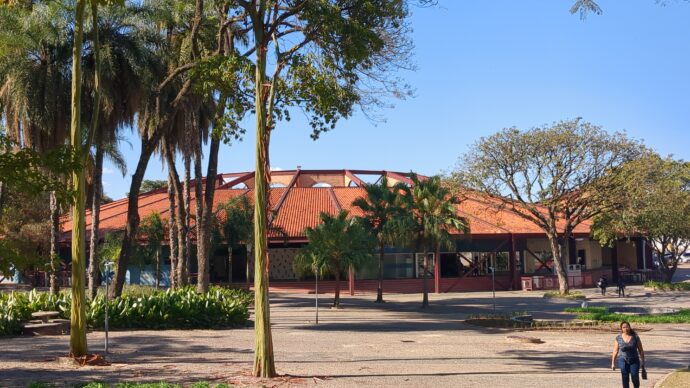
Walking around this theater-like building, we remembered the multiple modifications of the Theatrum Mundi metaphor (the Great Theater of the World). Not only did Shakespeare come to our mind, who in the soliloquy from As You Like It says: “All the world’s a stage, And all the men and women merely players; They have their exits and their entrances; And one man in his time plays many parts“, but also the Theatrum Mundi that was intertwined with many dramatic plays (Trauerspiele) during the European Baroque. This popular metaphysical vision considers God as the original author of the play in which people perform their social roles while struggling more and more for their own free will within the prescribed rules and social functions, often considered as larger, invisible forces. This metastructure can be compared to a game of chess, where the figures are subjected to the rules despite the players’ free will.
Theatrical plays are isolated and repeatable media products that have been staged since ancient times, both in specific buildings and public marketplaces. However, it is a neobaroque trait to set religious rituals and performances also in the time-spaces of churches, where actors and spectators are surrounded by the pictorial and sculptural artifacts as well as musical performances. According to the religious understanding of Theatrum Mundi, the holy mass is a religious drama that does not regard reason as human essence but emotional, habitual, and social practices. By contrast, Walter Benjamin (2014, p. 22) indicated the everyday performances of Berlin during the 1920s as the secular frame of Theatrum Mundi:
On stage you would see various, parallel-running depictions of daily life, separated from one another by simple set pieces and continuously moving along invisible rollers. Wild game pursued by hunters and hounds; wagons, riders, and pedestrians; grazing cattle; steamships and sailboats; a train; boys scuffling about—everything came again and went in set intervals. It was a sort of mechanical forerunner to today’s cinema.
Benjamin (2014, p. 22)

In São João del-Rei, we admired the neobaroque Church of Saint Francis of Assisi, erected in 1774. It exemplifies the stage of Theatrum Mundi where people act for and in the name of God. As God, the creator outside our time and space, assumingly guarantees the metaphysical order of the theater of the world, the microcosmos of the humans’ play seems to be safely embedded in the divine macrocosmos. But the nineteenth century German philosopher Friedrich Nietzsche (1844–1900) challenged this harmonious cosmological model by proclaiming that “God is dead” and “we have killed him” (Nietzsche, 1974, sec. 125).
Where are we left today when entering the Church of Saint Francis of Assisi? Do we still encounter therein and outside the indubitable authority of God lending power and legacy not only to our values but even to their earthly religious and political representatives? We remembered that (neo-)Baroque churches have also been considered as places for staging the so-called premodern Gesamtkunstwerk. This form of Total Work of Art was performed both before and after the better-known Romantic concept developed by the German composer, Richard Wagner (1813-1883).
As tourists, we enjoyed the colorful Brazilian neobaroque, remembering both St. Francis, the patron of nature, and – as scholars – the art historical discourse on the “hallucinatory quality of baroque epistemology” as Mieke Bal (2011) explored it in her famous essay “Baroque Matters”. Due to our international intermedial academic activity in Belo Horizonte and São Jão del-Rei, we explored the specific Latin American discourse on the concept of “neobaroque” that, in stepping beyond the misleading historiographical period/style terms, foregrounds the similarities and variations between European and Latin American Baroque.

in São João del-Rei
The impressive amount of gold in the church is reminiscent of the Brazilian gold rush among the Portuguese colonists around the 1690s. The colonial power established the major gold producing area of Ouro Preto (“black gold”) and exported most of the gold to Portugal. For the decorations in the Brazilian churches, merely a thin layer or an imitation of gold was used, testifying to the country’s former richness.
In practice, we admired Brazilian neobaroque sculptures and decorations by the famous local artist Aleijadinho (1738-1814)2. As we found them not only in Saint Francis’ church in São João del-Rei, but in numerous other local churches, we directly experienced a similarity between the multiple faces of European and Brazilian Baroque and considered the similar aesthetic practices of Minas Gerais. We understood how meaningful it is to consider the baroque phenomena beyond a strict European chronological periodization based on geographical divides. Neobaroque allows for connecting the objects that were earlier called arts and crafts. It also includes the performative practices of actors and spectators in urban spaces as well as the effect of dispersal. In his ambiguous study Barocco, Severo Surduy (1937-1993), a Cuban poet, playwright, and critic of Cuban literature and art, writes that “baroque… challenges every instauration, that metaphorizes order under examination, God under judgment, the law being transgressed” (qtd. in Greene, 2009, p.151).
Both theater and the multiple forms of (everyday) performance are a collaborative art form, encouraging the activity of the spectators and a performative communication that not only harks back to the Theatrum Mundi metaphor but also includes many modern media types.
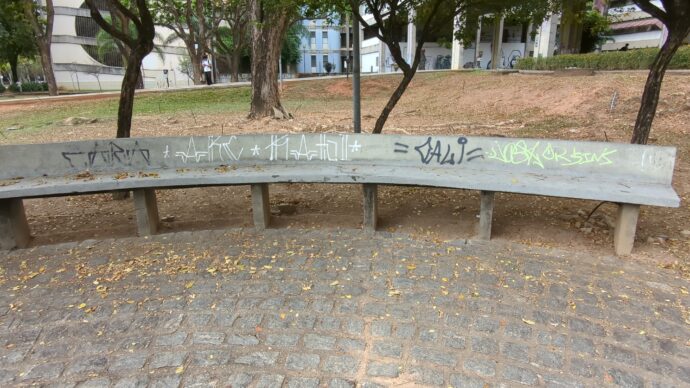
Gerais in Belo Horizonte
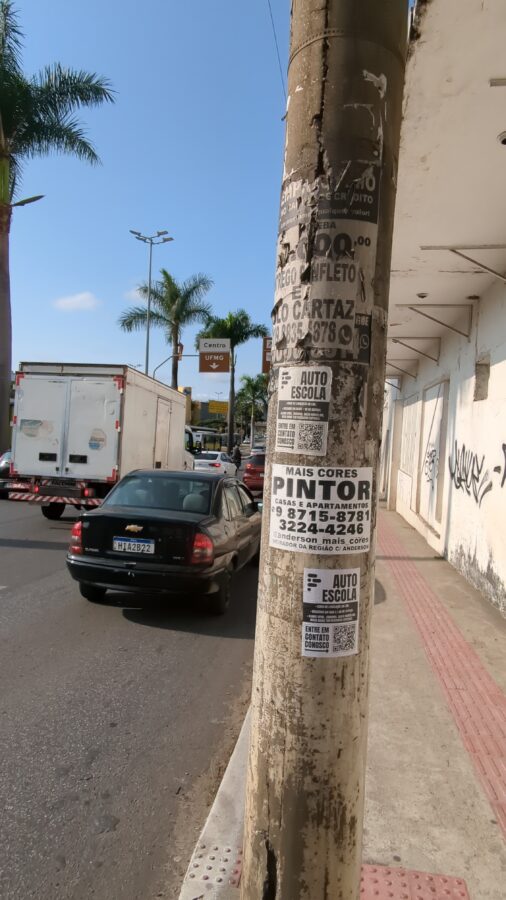
Advertising, graffiti, or the graphic in everyday life?

Indeed, even an (artificial) lonely gazer can contemplate acting in the social space of the city. Is the heightened position of the window merely an ideal aesthetic position of disembodied disinterestedness? In exploring modern modes of attention, we became aware of the ubiquitous impact of mobile phones. While they helped us frame our multimodal impressions, they transformed others into objects in the process of collecting our impressions. Is there another “in-sight” to otherness?


I looked out the window at dawn and saw a young apple tree translucent in brightness.
And when I looked out at dawn once again, an apple tree laden with fruit stood there.
Many years had probably gone by but I remember nothing of what happened in my sleep.Czeslaw Milosz, “Window” (1981, p. 82)[i]


Infinite is this night. And cloudlight
Georg Heym, “The City” (1964, p. 452) [ii]
Tears before the moon descends.
And thousand windows line the night up
And blink their eyelids, red and small.
Like veins, streets run through the city,
Countless, people are flooding out and in.
And eternally dull tone of dull Being
Monotonously comes out in silence, drained.
Childbirth, death, wrought monotony,
The babble of labor, the long death cry,
In blind change it goes by mutely.
And light and fire, torches red and burning,
they loom remotely with their hand outstretched
And sparkle high from the dark wall of clouds.

Belo Horizonte means “Beautiful Horizon”. This third largest city in Brazil with nearly 6 million inhabitants not only extends onto several hills, but it is also completely surrounded by the characteristic mountains of Minas Gerais. In 1897, Belo Horizonte became the busy capital of this region after the smaller Ouro Preto nearby, which is famous for its colonial baroque or neobaroque architecture from the eighteenth century.

Minas Gerais, meaning “General Mines”, is the second most populous state in the Southeast of Brazil and is mostly known for its attractive biological and ecosystem diversity.
While driving from Belo Horizonte to São João del-Rei, we saw many natural landscapes and such degraded mountains that they forced us to reflect on the relationship between humans, their experience, and dealing with the environment in terms of separate or even oppositional concepts of nature and culture. What is at stake on the stage of the Theatrum Mundi? Neither gold nor slaves exploit the mountains today, but modern technology and industry shape the natural landscape into a new aesthetic artifact, another secularized urban Theatrum Mundi. Indeed, the neocolonialist heritage of the past, the present, and the future fold together here, creating the neobaroque atmosphere of Theatrum Mundi. Nature – a victim of human activity since ancient times – merely provides the background for staging new cultural artifacts in the name of progress.

A desired world – the idyllic reality of untouched nature?
I’m walking on the floor of the air. Enclosed in this moment with myriads of things in this corner of the world. Together we are this world: soft ground, reeds, lake, chairs, tables of the Fisherman’s Cottage, carp in the water, gnats above it, birds in the gardens of the villas of Zehlendorf, cuckoo’s call, grasses, sand, sunshine, clouds, fishermen, poles, lines, hooks, bait, children singing, warmth, electric tension in the air. How blindingly the sun rages up there. Who is that? What a mass of stars rage beside it; I can’t see them. The dark, rolling, roaring power. You dark, furious, intertwined you gentle, delightful, unimaginably beautiful, unbearably heavy, unceasing powers. Trembling grasping flickering thousand-foot thousand spirit thousand-head.
(Döblin, 2021, p. 10)[iii]

What are these lines: telephone wires or Deleuzian “lines of flight”?
My homeland has many palm-trees
and the thrush-song fills its air;
no bird here can sing as well
as the birds sing over there.We have fields more full of flowers
and a starrier sky above,
we have woods more full of life
and a life more full of love.Lonely night-time meditations
please me more when I am there;
my homeland has many palm-trees
and the thrush-song fills its air.
My homeland has many palm-trees
and the thrush-song fills its air;
no bird here can sing as well
as the birds sing over there.We have fields more full of flowers
and a starrier sky above,
we have woods more full of life
and a life more full of love.Lonely night-time meditations
Antônio Gonçalves Dias, “The Song of Exile”[iv]
please me more when I am there;
my homeland has many palm-trees
and the thrush-song fills its air.
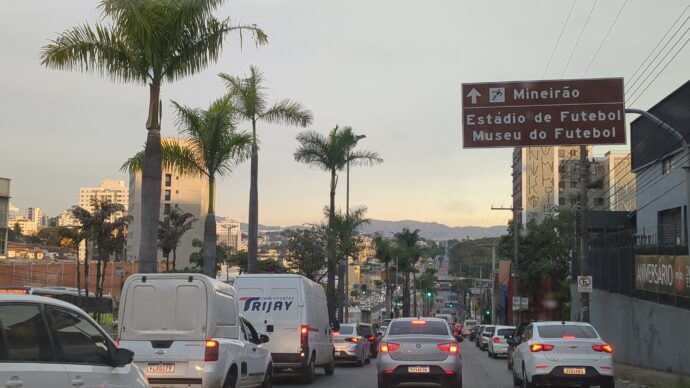


And in May
I am used to riding, dear gentlemen,
On the front platform of the tram!
The city pierces me through and through!
Oh, what is going on in my head:
Impulses, drives, fires, links,
Happiness from top to bottom,
And the greatest happiness while taking turns!
On bends – circularly
I wrap my arms around it with delight,
And the trees in a rush of inspiration
Are raging with spring fragrance,
Julian Tuwim, “To the Critics” (1920, p.116)[v]
The buds burst with joy,
The streets are ringing alarm bells
May, May! – –
Yes, I’m riding on the front platform of the tram,
Very distinguished gentlemen!

God is dead, but given the way of men, there may still be caves for thousands of years in which his shadow will be shown. And we — we still have to vanquish his shadow, too.
(Nietzsche, 1974, p. 108)
Does the church hold the position of the urban center in the neobaroque Theatrum Mundi? How do we then arrange an order to explain and perform the world in its eternal transformation? Does the Theatrum Mundi imply thestage for a tragic drama or merely an eventless event? The certainty about the role in our life is transformed into uncertainty. What are the roles one will or should play?

A “Wunderkammer” is a cozy cabinet of collected religious and artistic practices and media products. It connects the religious Theatrum Mundi with reproductive technology and the aesthetic question of “aura”.
The world in which people are born is no longer seen as having been decreed by fate but as an agglomerate of possibilities. One can shape the world as much as one can shape oneself. At least in our imaginations, there are no limits to the possibilities of ‘shaping our world’…Destiny, not fate, now defines the individual’s relation to the world.
(Heller and Féher, 1988, p.17)
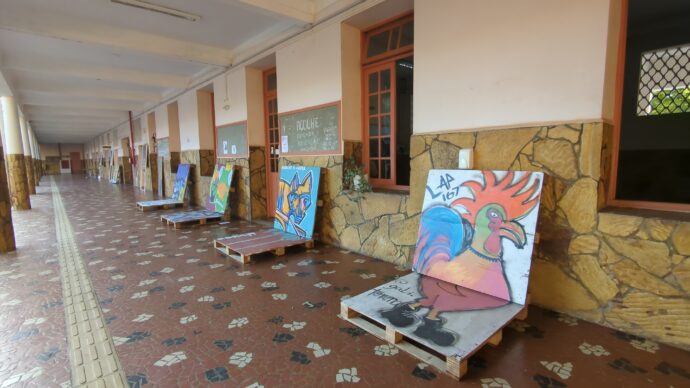
In principle a work of art has always been reproducible. Man-made artifacts could always be imitated by men. Replicas were made by pupils in practice of their craft, by masters for diffusing their works, and, finally, by third parties in the pursuit of gain.
(Benjamin, 1969, p. 2)

The presence of the original is the prerequisite to the concept of authenticity.
(Benjamin, 1969, p. 3)
Or is the aura nevertheless reproducible?
With lithography the technique of reproduction reached an essentially new stage. This much more direct process was distinguished by the tracing of the design on a stone rather than its incision on a block of wood or its etching on a copperplate and permitted graphic art for the first time to put its products on the market, not only in large numbers as hitherto, but also in daily changing forms. Lithography enabled graphic art to illustrate everyday life, and it began to keep pace with printing. But only a few decades after its invention, lithography was surpassed by photography. For the first time in the process of pictorial reproduction, photography freed the hand of the most important artistic functions which henceforth devolved only upon the eye looking into a lens.
(Benjamin, 1969, p.2)

Again: where and what is the center of and on the stage? Who is the seeing audience? Does a transmediated photographic media product imply an action, frozen movement, and condensed meaning as assumed in Lessing’s (2005) model of pregnant-moment images? Can an image “mean” anything specific without a verbal or visual context of other images, representing another object trouvé in Belo Horizonte, or can it just “be”? Does modernity begin with technology? Is modernity equal to technology?

Our fine arts were developed, their types and uses were established, in times very different from the present, by men whose power of action upon things was insignificant in comparison with ours. But the amazing growth of our techniques, the adaptability and precision they have attained, the ideas and habits they are creating, make it a certainty that profound changes are impending in the ancient craft of the Beautiful. In all the arts there is a physical component which can no longer be considered or treated as it used to be, which cannot remain unaffected by our modern knowledge and power. For the last twenty years neither matter nor space nor time has been what it was from time immemorial. We must expect great innovations to transform the entire technique of the arts, thereby affecting artistic invention itself and perhaps even bringing about an amazing change in our very notion of art.
(Paul Valéry qtd. in Benjamin, 1969, p. 1)

Who is the victim of the potential violence, hidden there in the beauty of the urban space?

Does the neobaroque Theatrum Mundi depend on a “primordial unity”?
Obviously, Friedrich Nietzsche clings to this metaphysical hypothesis as a source for the creation of our values. Still, when he asks if God is held responsible for the origin of evil, he insists that we have to face the impact of cruelty in history. As we experience it every day, Theatrum Mundi stages violence as a forceful agency. Nietzsche explains the change between beauty and violence through the masked actors: Apollo and Dionysus, a pair of gods who always shift roles, acting “untimely” throughout all times.
Likewise, time for Walter Benjamin is not a straight timeline of linear development, but similarly to Deleuze, the past and the future are folded in the present. Benjamin’s allegory of the angel of history is inspired by Paul Klee’s painting titled Angelus Novus:
His face is turned toward the past. Where a chain of events appears before us, he sees one single catastrophe, which piles wreckage upon wreckage and hurls it at his feet. The angel would like to stay, awaken the dead, and make whole what has been smashed. But a storm is blowing from Paradise and has got caught in his wings; it is so strong that the angel can no longer close them.
(Benjamin, 2003, p. 392)

Violence is an everyday experience and an artistic topic of the baroque and the neobaroque. Violence is not merely a negative historical force though. Rather, unheard voices express themselves as performing in the urban space and creating media products with the potentiality for a new beginning, a rebirth.


The cities are the principal home and seat of the human group. They are the coral colony for Man, the collective being. Is there any sense in opposing the country and the city? One can find weaknesses and dangers in the cities, can take sides in the battle of instincts at work in the cities. But one cannot reject or even evaluate the cities themselves, the foci of the social instinct. One can only confirm the existence of such forces of nature and their manifestations.
(Döblin, 1963, p. 74)
Can bridging time and space while communicating different functions matter in urban spaces?

Even underwater!
Fabio Weintraub, “Náufrago” (fragment)[vi]
I’m a man even underwater!
shouts the looming figure curled
in felt and revolt
cardboard and delirium
on the avenue’s median
What water was he referring to?
Who had made him walk over the plank?
For how long had he
fought with the wave
of car and soot?
The castaway holds on
to the treasures of manhood
no coffer, no map
no bottle that leads
to the nearest island
his drowned word

Stagnant water
Ana Martins Marques, “Espelho”[i]
and exact
like a lake
with four corners.
Gives us back the unmindful face.
Never dies.
But notice: it gets old
with us.
[i] Czesław Miłosz (1911-2004) was a Polish poet and literary historian, the winner of the Nobel prize in literature (1980) for the polyphonic structure of his writing. Translation mine (DBN).
[ii] Georg Theodor Franz Artur Heym (1887–1912) was a German poet whose early expressionist poetry was typical of the years immediately before the First World War. Translation mine (HF).
[iii] Alfred Döblin (1878-1957) was a Jewish writer, best known (but criticized by Walter Benjamin) for his experimental narrative technique in his novel Berlin Alexanderplatz (1929) and other works. This excerpt from his science fiction novel titled Mountains Oceans Giants: An Epic of the 27th Century, (1924) complains about the effects of urbanization, the alienation from nature, and ecological devastation as forms of dehumanizing the modern world. His poetic words resonate with our wordless impressions.
[iv] Antônio Gonçalves Dias (1823 -1864) is regarded as the Brazilian national Romantic poet. This poem is said to be known by every Brazilian schoolchild. Translated by Nelson Ascher (allpoetry.com).
[v] Julian Tuwim (1894-1953) was a Polish poet of Jewish descent, one of the members of the so called Skamander group, and a contributor to children’s literature. Translation mine (DBN).
[vi] Fabio Weintraub (1967- ), a poet from São Paulo, evokes the voice of a pathetic homeless man, driven mad amidst the traffic. “A human being transformed into an excretion tries to assert himself amid the indifference of those who pass him by. He proclaims his indisputable virility while his voice is drowned out by the noise of traffic, like a shipwrecked navigator” (Bosi, p. 55). Quoted and translated by Bosi (2020, p.55).
[i] Ana Martins Marques (1977-), according to Viviana Bosi (2020), often thematizes the role of poetry, questioning the relationship between the word and the world. Quoted and translated by Bosi (2020, p. 56).
References
Ammann, L. (2023) “Aleijadinho’s Mestiço Architecture in Eighteenth-Century Brazil: Inventing Brazilian National Identity via a Racialized Colonial Art”, Arts, 12.5, p. 214. https://doi.org/10.3390/arts12050214
Bal, M. (2011) “Baroque Matters”, in Hills, H. (ed) Rethinking the Baroque. London: Routledge, pp. 183-202.
Benjamin, W. (1963) Ursprung des deutschen Trauerspiels. Frankfurt-am-Main: Suhrkamp Taschenbuch.
Benjamin, W. (1969) “The Work of Art in the Age of Mechanical Reproduction”, in Arendt, H. (ed) Illuminations. New York: Schocken Books, pp.1-26. https://web.mit.edu/allanmc/www/benjamin.pdf
Benjamin, W. (2003) “On the Concept of History”, in Benjamin, W. Selected Writings, Vol. 4: 1938–1940. Cambridge: Harvard University Press, pp. 389-401.
Benjamin, W. (2014) Radio Benjamin. London: Verso.
Bosi, V. (2020) “Brazilian Contemporary Poetry: an Overview”, Revista Brasileira de Literatura Comparada, 22.41, pp. 46-57. DOI:10.1590/2596-304x20202241vb
Döblin, A. (1963). Aufsätze zur Literatur. Olten: Walter-Verlag.
Döblin, A. (2021) Mountains Oceans Giants. A Novel of the 27th Century. Galileo Publishers.
Deleuze, G. (1988) Le Pli: Leibniz et le Baroque. Paris: Les Éditions de Minuit.
Heller A. and Féher F. (1988) The Postmodern Political Condition. New York: Columbia University Press.
Heym, G. (1964) Dichtungen und Schriften. Band 1. Verlag Heinrich Ellermann.
Greene, R. (2009) “Baroque and Neobaroque: Making History”, PMLA, 124.1, pp. 150–55.
Lessing, G.E. (2005) Laocoon: An Essay upon the Limits of Painting and Poetry. New York: Dover Publications.
Miłosz, Cz. (1981) Poezje wybrane. Warszawa: Państwowy Instytut Wydawniczy.
Mumford, L. (1937) ‘What is a City?’, Architectural Record, 82, n.p.
Nietzsche, F. (1974) The Gay Science, With a Prelude in Rhymes and an Appendix of Songs. New York: Vintage Books.
Tuwim, J. (1920) Sokrates tańczący. Warszawa: Wydawnictwo J. Mortkowicza.