Implications of “conceded informality”: The state and adaptive reuse in brownfield regeneration in Shanghai
Introduction: the state and adaptive reuse in brownfield regeneration in Shanghai
In major Chinese cities, industries grew rapidly after the founding of the socialist country in 1949. By the end of 1980s, manufacturing sites occupied around 30 per cent of the urban land in large Chinese cities (Hsing 2006). Since the 1990s, urban land policies have been reformed from free allocation of land to paid transfer of land use rights. This has resulted in increasingly high value of urban land in declined old industrial sites. Thus, manufacturing industries in central urban areas in China were relocated from urban centers to new towns and development zones in peri-urban areas (WB and DRC, 2014: 137; Kamal-Chaoui et al., 2009: 19) or closed due to industrial restructuring (Kamal-Chaoui et al., 2009: 33). Major former Chinese industrial cities started to face tremendous challenges of industrial land regeneration. In zoning plans, the transformation of industrial sites was usually planned as redevelopment projects involving demolition and reconstruction rather than adaptation to “non-industrial” use. Nevertheless, for an intermittent period before further redevelopment, the vacant industrial buildings were reused for mixed purposes, particularly for small-scale cultural and creative sectors, such as galleries and studios. Hence, the industrial site is called a “Creative Industrial Park” (CIP). Though not all business activities on the site belong to creative sectors, CIP is the term that has been widely referred to, to describe the reuse of these buildings for purposes which differ from their original industries, in most cases “non-industrial” uses.
CIPs have developed to different stages of establishment. As adaptive reuse is temporary and informal, CIPs are occasionally further transformed according to zoning plans. Some have been promoted by local governments for tourism purposes, such as the M50 Creative Industrial Park. Some have been demolished after success in promoting cultural industries, such as Red Town Creative Industrial Park, while others remain as CIPs. The existence period of the parks varies from one case to another – from a few years to more than a decade. This paper examines what has led to the different transformation approaches of those CIPs.
Although the practice of adaptive reuse is based on the negotiation between the de facto landowner (state-owned enterprises) and new users who rent buildings (usually private entrepreneurs), its transformation has happened under heavy state-involvement. To understand governance of brownfield regeneration, it is key to understand the role of the state in dealing with changes and challenges in the comprehensive transformation of old industrial sites. Taking a step further, we look at how the state intervenes in different ways in the regeneration process.
The concept of “conceded informality” and its implications
To analyze the role of the state in brownfield regeneration, we borrow the concept of “conceded informality”. Derived from observing regenerating urban villages in Southern China, the concept of “conceded informality” summarizes how the state deals with informality (Schoon and Altrock, 2014).
Contrary to conventional understandings that see informal uses and practices as a result of spontaneous bottom-up developments, there is considerable evidence that informality is often produced by the state itself (Roy, 2005) and lies “within the scope of the state rather than outside it” (Roy 2009a: 826). To understand informal spatial production, it is therefore relevant to study the specific relation and interactions of the statutory and mundane institutions within the informal developments, acknowledging that both play constitutive parts in the informal development (Appelhans, 2017). However, only the planning and legal apparatus of the state has the power “to determine what is informal and what is not, and to determine which forms of informality will thrive and which will disappear” (Roy, 2005: 149). The activities and populations in informal space are “concurrently tolerated and condemned (Yiftachel, 2009: 89). This implies that the perception of informal uses may vary dramatically—from “illegal” to “creative and innovative”—subject to the state seeing them either as threat or potentially beneficial. In the case of China’s urban space, the active role of the state is evident. Derived from observing regenerating urban villages in Southern China, the concept of “conceded informality” summarizes how the state deals with informality (Schoon and Altrock, 2014). Urban villages, which were for a long time excluded from urban planning due to their status as rural land, remain a challenge for the state when trying to upgrade and integrate them into the urban planning system (Wu et al., 2013; Wong et al., 2018).
Subject to different priorities, five strategies of coping with informality could be identified based on empirical studies of urban villages in the Pearl River Delta, which are summarized as follows (Schoon and Altrock, 2014):
- Strategy 1: The state actively supports informality when institutional gaps are successfully closed. Instead of abandoning urban villages, the state integrated the respective informal practices into the formal urban planning and development system through various policies and strategies, particularly through the provincial regeneration program of “Three Olds Redevelopment”, aiming at redeveloping old towns, old factories and old villages. In the case of Xiasha Village, for instance, the state supported the bottom-up idea of village regeneration and integrated it into urban planning.
- Strategy 2: The state promotes informality when it produces new strategic knowledge. A post-hoc analysis method has been applied by the state to learn from reform experiments in urban villages. Successful projects served as model or example for later comprehensive approaches, such as Liede Village as a model of full demolition and redevelopment.
- Strategy 3: The state utilizes informality when flexible guiding principles can serve as a political strategy. The strategies of regenerating urban villages are closely linked to a stabilization of the Chinese political system to serve a certain political agenda, such as the construction of a harmonious society.
- Strategy 4: The state tolerates informality when the latter serves development. Despite partially redeveloping urban villages, they have been tolerated by the state as welcome reservoirs for migrant workers, floating population and low-income groups that could hardly have been housed otherwise.
- Strategy 5: The state overcomes informality when important economic (or other) interests are prevailing. For instance, urban villages were formalized after redevelopment, driven by economic interests or other interests such as the Asian Games. The Chinese (local) state has the power to flexibly select one of those strategies.
2. The Chinese (local) state has the power to flexibly select one of these strategies.
The concept of conceded informality is different from informality theories derived from other national contexts where the involvement of the state is not comprehensive and systematic (see the recent contributions in Alter-Chen and Carré 2020). To address this gap in Cape Town, a pilot attempt was made to formalize neighborhoods by granting them a new zoning status. This status allowed construction in designated areas, thus de-criminalizing everyday housing practices of the urban poor (Appelhans, 2014). However, this approach has so far not been adopted at the national level in South Africa. More prevalent, a generally antagonistic approach towards informal developments has been described by Roy (2009b). In India, where she sees the state in a situation that does not allow for strategic or anticipatory planning, informal developments in contexts of poverty are systematically eradicated. A similar stance could be observed in Ethiopia (Appelhans, 2017), where such clearance strategies are even leveraged by the change of zoning regulations. Without rights of continuance, unwanted neighborhoods are declared as informal for the authorities to conveniently legitimize their demolition (ibid.).
In China, the state neither integrates nor ignores informal development totally, but treats it strategically. In the case of urban villages, the state aimed to integrate them into the city landscape by upgrading and restructuring them. The theory of “conceded informality” traces back to experimental governance in the political environment in China. Contrary to the contested assumption that legislation goes prior to implementation, in China a practice of testing and experiments occurs prior to legislation and policy is largely generated through local experiments and model demonstrations. The policy approach fosters creative proactive and evasive tactics for managing sudden change and uncertainty under the authority of a central leadership, thus known as “guerrilla-style policy-making” that can be traced back to Mao’s era (Heilmann and Perry, 2013; Heilmann, 2018). Instead of scientific or evidence-based policy selection, China’s experiment-based policymaking has been “an intensively politicized process” (Heilmann, 2008: 28) at every stage, from setting policy objectives to generalizing policy options.
Similar to urban villages, the production of urban space on former industrial sites is conducted with heavy involvement by the state. From the acceptance of CIPs to their tolerance and promotion, various units of government play active roles, thereby resulting in spaces of “controlled creativity” (Zielke and Waibel, 2014).
Overview of adaptive reuse in brownfield regeneration in Shanghai

For this research, four districts (Putuo, Jing’an, Hongkou and Yangpu District) in the inner city of Shanghai were selected for analysis. These were chosen because they were historically industrial areas, where Shanghai’s two most important waterways—Suzhou Creek and Huangpu River—go through. Since the economic reform, these four districts have been economically and socially more disadvantaged, so-called “xiazhijiao areas”, compared with the southwestern part of the city, so-called “shangzhijiao areas” (Pan, 2005). These four districts face more complex challenges and issues in urban transformation processes.
They display particularly high concentrations of former manufacturing factories, which have either closed or relocated since the 1990s, and provide sizeable land for potential urban regeneration projects. Overall, 187 regeneration projects of adaptive reuse, finished between 2000 and 2020, were identified for quantitative research.
The original buildings are not demolished but reused for a purpose different from the original factory, such as cultural, commercial and public facilities, or even residential purposes. Four types of adaptive reuse have been identified. Table 1 shows the number of different types of projects and their proportion.
Table 1: Projects associated with adaptive reuse of former industrial land in four districts of Shanghai (Putuo, Jing’an, Hongkou and Yangpu) 2000-2020
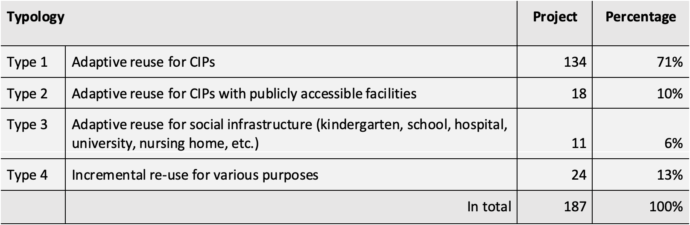
Based on these four types of adaptive reuse, we explore the state strategies behind the various types of transformation, with the facilitation of concept of state dealing with informality in urban villages as described in “conceded informality”.
State strategies dealing with adaptive reuse in brownfield regeneration
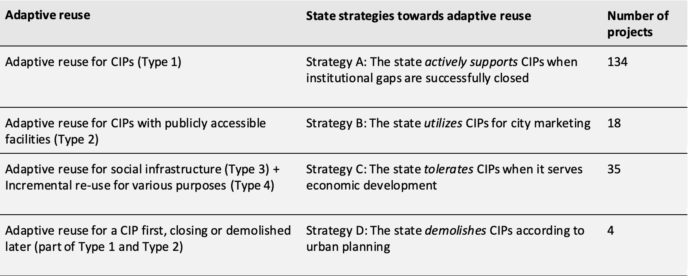
The strategies of how the state negotiated adaptive reuse on post-industrial sites are best explained with the help of case studies. Four major strategies could be identified in various CIPs in brownfield regeneration in Shanghai.
Strategy A: The state actively supports CIPs when institutional gaps are successfully closed
The state directly supports the development of adaptive reuse as CIPs, which refer to type 1 and type 2. Different from Western cities such as New York and Berlin, where creative zones are embedded in neo-bohemian cultures (Johannes and Colomb, 2013), the shaping and making of CIPs in East Asia often follows a top-down approach led by the state (Gu, 2014; He and Wang, 2019). Creative space is supported by the state through certain institutional settings. Regarded as a revenue generator (Zheng, 2010), creative space has been endorsed by local governments as a coping strategy through formal arrangements such as so-called “three unchanging policies” to close institutional gaps. Proposed in 2005 by Shanghai Creative Industry Center, the “three unchanging policies”—i.e., implanting new functions into industrial land without changing building ownership, building structure and de jure land use—attribute a quasi-legal status to creative industrial parks (He, 2019; Wang, 2009). This creates a particular legal set-up which indicates that the creative industry as land use is explicitly temporary and part of a larger transformation plan. Another well-known policy promoted by the Shanghai Municipal Government since the 1990s is withdrawing manufacturing industries in the urban area to give way to tertiary industry (tuier jinsan) (Zheng, 2010: 146; Li et al., 2018). This practice aiming at restructuring industrial land and not necessarily referring to CIPs, is often utilized to argue for transformation of industrial sites to CIPs. Although not directly designated by the state, CIPs (type 1 and type 2) were developed in the light of the pro-policy.
The 1933 Creative Park shows that the state played an active role in supporting the emergence of such space. Not only is a formal title accredited, the semi-state organization, Shanghai Creative Industry Center (which reports to Shanghai Economic Commission), participated directly in the project of redeveloping the park as an investor.
Case study: 1933 Creative Industrial Park (Shajing Road 10 and 29, Hongkou District, Shanghai)
Designed by a British architect and built by Chinese developers, the two historic buildings were built between 1933 and 1935. The site has a total size of 1.5 hectares with a floor space 31,700 m². Originally used as a slaughterhouse, the buildings served a number of purposes over the years from a cold storage facility to a medicine factory, before it was converted to a CIP in 2005. Over 100 million RMB have been invested by Shanghai Creative Industry Investment Company, a cooperative between state-owned enterprise, private company and Shanghai Creative Industrial Center. The park has had great success since its opening in 2007. Beyond restaurants and creative retail shops, offices for design companies and artist studios, other prominent functions include fashion shows, product launches, concerts and conferences.
Strategy B: The state utilizes CIPs for city marketing
These CIPs have been utilized by the state for city marketing and promotion, particularly during the World Expo in 2010, when CIPs played a diplomatic role, presenting Shanghai as a city of innovation and creativity for visitors. Hosting pioneering art galleries and museums, some CIPs became the hot spots and most fashionable places of Shanghai, such as M50 and Red Town CIP. Other CIPs are successful in hosting events and commercial activities, such as Hongkou Xingyefang CIP. On the other hand, World Expo 2010 was a catalyst to foster the expansion of CIPs. Two creative industry belts, Huangpu River Creative Industries Belt and Suzhou Creek Creative Industries Belt, have been planned (Chen, 2012: 453). The following case shows how the World Expo in 2010 in Shanghai accelerated the development of CIPs.
Case study: Shanghai International Fashion Center (Yangshupu Road 2866, Yangpu District, Shanghai)
Figure 1: Shanghai International Fashion Center (Photo by author)
Originally a Japanese cotton textile factory, the industrial site was designed by a Japanese architect and built in 1935. Since the opening-up of China, the Shanghai Municipal Government has worked to make Shanghai an international metropolis, followed by many initiatives of developing places, institutions and organisations named with “international centers” by district governments. The site was identified by the Yangpu District Government as an international fashion center and enjoyed preferential policies and financial support from the national, municipal and district governments. After the Cotton Textile Factory was moved to Jiangsu Province in 2007, regeneration started in 2009 to transform it into a CIP. Phase 1 was renovated and opened to the public on 16 March 2010, shortly before the opening of Shanghai Expo on 30 April 2010, to use it as a show place to support the Shanghai Expo (SPCC, 2020). In 2020, the last phase of the park was finished.
Strategy C: The state tolerates CIP if it serves economic development
Adaptive re-use of industrial sites in the form of CIPs mostly takes place without explicit planning permission. The temporary aspect of reusing old industrial lands attributes to the Chinese urban planning system. In China, statutory land use plans include two sets of maps: existing and planned land use. Reusing post-industrial space for tertiary purpose is neither a category of existing land use zoned as “industrial” nor of planned land use, and the areas on which they are planned are often designated for residential purposes or businesses in the tertiary sector with much higher floor area ratio than the existing urban structures. The transformation of industrial sites is usually planned as a redevelopment project rather than as adaptive reuse in form of CIPs for “non-industrial” use (with few exceptions of new types of industries) without fundamentally changing the physical structure. In this regard, adaptive reuse is a type of informal, temporary or interim use of industrial buildings before planned permanent redevelopment is undertaken. A formal and permanent brownfield redevelopment follows a process of land requisition and selling led by local governments or the land banking institution, a quasi-governmental organization representing the state. Through this process, the original industrial land use can be formally converted into a new land use, and the government normally obtains a considerable land premium from the bidders.
However, under certain circumstances, the state neither intervenes nor forbids their existence, which is also a position of tolerating CIPs as long as it serves economic development goals of the local government. The compliance of this with state-vision of economic development is subject to interpretation, rather than aligned to objective criteria, and lies in the hands of local authorities. The Type 4 of “incremental reuse for various purposes” is a kind of adaptive reuse tolerated by the state. The reuse of industrial properties is based on an agreement between factory owners and individual tenants, without much involvement of the state. Without much renovation, buildings are rented to individual tenants by factory owners in piecemeal way. The fast-changing new use types include small scale businesses, adaptive storage, logistics, snack places, car repairing and cleaning and budget hotels.
Investments and appropriation are undertaken in the awareness that the land-use is tolerated for an undefined period of time, but not fully legalized by the state. Very simple renovation and quick opening and closure of small businesses are often observed in the parks. All the involved actors—both factory and shop owners—benefit from small-scale adaptive economic activities until the site is formally redeveloped. The formal plan is unclear, to be changed or not yet ready to be implemented. As long as the state does not take actions to redevelop the site, the adaptive reuse is maintained. In some cases, the adaptive reuse may be very long, even more than 10 years.
Case study: Shanghai Yuejin Electrical Machinery Factory (Meizhou Road 300, Yangpu District, Shanghai)
Including four main buildings, the site of the former Yuejin Electrical Machinery Factory has been reused for various purposes. In the three-floor building in the southeastern corner, the second and third floors were used as a hotel from 2013-2017, however, have remained empty since 2019. The ground floor of the building was reused for various restaurants and shops, which changed frequently in the last eight years. The building in the south along Shenyang Road has been used as shops and restaurants on the ground floor, including a vegetable market, and apartments on the second and third floors. The remaining buildings on the site have been used as a residence, known as Jiuxuantang Apartment. This case is very typical in that the ground floor is used for various small shops and the upper floor for hotels and residential purposes.
When the period of tolerance is terminated on behalf of the state for reasons of redevelopment, the tenants must comply with the eviction. They have no formal leverage to make claims or counter the redevelopment.
Strategy D: The state demolishes CIPs according to urban planning
Although the state supports the transformation of post-industrial sites to CIPs, it chooses to demolish them according to formal urban planning for greater economic and political achievements, such as revenue generated from land use transfer fee. Under certain circumstances, the state takes a final decision on a CIP and transforms it into a formal space. The adaptive reuse is abandoned and replaced by commercial or real estate purposes in most cases. In the regeneration process, the local government pursues a pro-growth agenda aiming at economic benefits and political achievements rather than social concerns in urban restructuring, such as in the case of Xintiandi (He and Wu, 2005; Yang and Chang, 2007). This is not to say that all CIPs will be transformed in the near future; they will be redeveloped when internal and external conditions are met. In fact, only a small number of CIPs have been demolished. The respective process may involve tensions and conflicts between current users and the local government. Though terminated in the name of formal land conversion, the adaptive reuse will have had a certain impact in the later formal plan, particularly in the field of heritage conservation. In extreme cases, resistance to formal land conversion is so strong that the state may be forced to adjust zoning plan to adopt to current uses, such as the case of M50 CIP. As long as the property-led redevelopment to facilitate swift economic growth is prevailing, the existence of CIPs will be threatened.
Case study: Red Town Creative Industrial Park (Huaihai West Road 570, Changning District, Shanghai)
The predecessor of Red Town CIP, Shanghai Tenth Steel Plant, was established in 1956 and closed down in 1989 and merged to Baosteel Group. The site remained unused for more than a decade before being transformed into a creative park. The reuse of the historical industrial buildings was initiated by artists to establish the Shanghai Sculpture Space and favored by the municipal urban planning authority (Shanghai Urban Planning and Land Resource Bureau). From the beginning, the urban planning authority directly supported the idea of transforming it to a CIP. An open bid was organized by Shanghai urban planning authority in 2004 to find a management company to undertake regeneration activities. Mr. Zheng Peiguang outdid other competitors and obtained the operating rights for 12 years with a comparatively low rent (Wang, 2009). Very soon, Red Town CIP made its name in Shanghai through influential art exhibitions and was awarded several honors, such as “Art Demonstration Zone” by the Shanghai Municipal Government.
However, its success as a CIP did not protect it from being demolished. Obviously for the property owner, selling centrally located land (near Huaihai Commercial Street) for high density commercial and real estate project could bring higher profits than rental income generated from the creative park. For the government, revenue generated from selling land use rights implied much higher profit than tax revenues from a CIP. The state therefore terminated adaptive reuse in a legal and formal way for economic interests. In 2013, the change of land use from industrial to commercial purposes was approved by the Shanghai Municipal Government. Baosteel Group sold the land use rights to the district government that could sell it profitably through a bidding process. The bidding winner was allowed to use the land for commercial-office purposes. In this way, the land use was formally converted from industrial use to commercial-office use.
The implication of “conceded informality” – applicable beyond urban villages in China?
In the transformation of urban villages and CIPs, there are common and different state strategies. In terms of urban villages, five major strategic approaches have been applied by the state to deal with informal spatial practices in urban villages. Strategy 1, wherein the state actively supports urban transformation when institutional gaps are successfully closed, is shared by urban villages and CIPs. In terms of urban villages, strategy 2 refers to “experimental urban governance”. The state declared certain regeneration projects of urban villages, such as Liede Village, as experiments that were expected to serve as examples for future comprehensive approaches. This is not applicable for CIPs, as the state does not declare to comprehensively transform them, and they are much smaller in size with fewer inhabitants and users compared to urban villages. Rarely, a CIP is over 10 ha, while urban villages are usually larger. Further, the relocation and resettlement of the residents in urban villages have proved to be tremendous tasks. Strategy 3 refers to the relationship between urban transformation and overall political goals of the state, such as “harmonious society” and “scientific development” promoted particularly during the Hu-Wen administration.
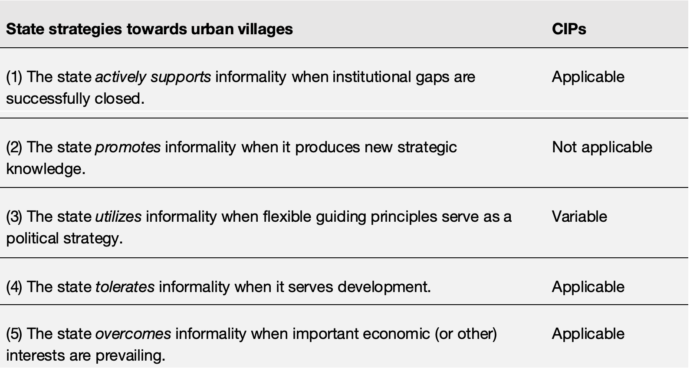
The practice of CIPs shows that state strategies do not exactly follow all the five categories suggested by “conceded informality”, as transformation of CIPs in Shanghai differs from urban villages in south China. Yet, “conceded informality” gives implications to understand urban transformation through the lens of the state and its various intervention strategies subject to the priority of its working agenda varying according to time, as well as its multi-dimensions of working agenda. Particularly, for a politically centralized system in China, the concept demonstrates how bottom-up initiatives of urban regeneration are selectively treated by the state in a top-down approach.
“Conceded informality” does not mean “a fixed arrangement” and it allows for a flexible management of diverse informal practice by the state, the paramount leader and decision-maker (Schoon and Altrock, 2014: 216). In terms of urban villages, the state “neither tries to completely formalize informal space as in the case of western developed states, nor gives itself up to informal practices as in the case of some of the least developed states in the global south” (ibid., 217). Table 3 shows how the state has acted to cope with CIPs under various circumstances. The low number of cases of strategy 4 may be surprising, but this reflects the fact that many of the cases in the four Shanghai districts are a result of the period since 2000, and may increase when more sites are redeveloped in the future.
Conclusion: implications for critical urban studies
This paper revisited the concept of “conceded informality” developed in China to elaborate informal settlement of urban villages in the Pearl River Delta, and tested its application to CIPs in Shanghai. The paper shows that even between different types of urban space within the same city, the role of the state in top-down intervention can vary. “Conceded informality” has hence proved as an analytical tool apt to describe developments related to CIPs in China, which could be refined to suit the relevant case study. However, there is a need to view the concept as a flexible framework that can be adapted with insights from the field to diversify theoretical concepts of critical urban studies. On a larger scale, the differentiation of “conceded informality” can be read as an expansion and localization of theories regarding informal urban space, in the line of de-centering urban theory building. While relating to Roy’s fundamental notions on informality, conceded informality distinguishes the Chinese state-relation to informal development from those observed in other world regions, noting the strategic element beyond a dichotomy of tolerance and clearance of informally developed structures. This opens further research questions on the contingent normative ethics behind the decision-making on urban informality and the role of CIPs in China.
References
Alter Chen, M. and Carré, F.J. (eds) (2020) The informal economy revisited: examining the past, envisioning the future. Abingdon, Oxon ; New York, NY: Routledge (Routledge explorations in development studies).
Appelhans, N. (2014) Möglichkeiten der Integration informeller Urbanisierung in die formelle Stadtentwicklung: Lernen vom globalen Süden. In Informationen zur Raumentwicklung (IzR) 2, 103-112.
Appelhans, N. (2017) Urban Planning and Everyday Urbanisation. A Case Study on Bahir Dar, Ethiopia. Transcript, Bielefeld.
Chen, Y. (2012) Making Shanghai a creative city: exploring the creative cluster strategy from a Chinese perspective. In M. Van Geenhuizen and P. Nijkamp (eds.), Creative Knowledge Cities: Myths, Visions and Realities, 437-464.
Gu, X. (2014) Cultural industries and creative clusters in Shanghai. City, Culture and Society 5.3, 123-130.
He, S. (2019) The creative spatio-temporal fix: Creative and cultural industries development in Shanghai, China. Geoforum 106, 310-319.
He, S. and J. Wang (2019) State-led creative/cultural city making and its contestations in East Asia: A multi-scalar analysis of the entrepreneurial state and the creative class. Geoforum 106, 305-309.
He S. and F. Wu (2005) Property-led redevelopment in post-reform China: A case Study of Xintiandi redevelopment project in Shanghai. Journal of Urban Affairs 27.1, 1-23.
Heilmann, S. (2008). From local experiments to national policy: The origins of China’s distinctive policy process. The China Journal 59, 1-30.
Heilmann, S. (2018) Red Swan: How Unorthodox Policy Making Facilitated China’s Rise. Hong Kong: The Chinese University Press.
Heilmann, S. and E.J. Perry (2013) Embracing uncertainty: Guerrilla policy style and adaptive governance in China. In S. Heilmann and E. J. Perry (Eds.), Mao’s Invisible Hand: The Political Foundations of Adaptive Governance in China, pp. 1–29. Cambridge: Harvard University Press.
Hsing, Y.T. (2006) Land and territorial politics in urban China. The China Quarterly 187: 575-591.
Kamal-Chaoui, L., E. Leman and R. Zhang (2009) Urban Trends and Policy in China. Paris: OECD publishing.
Johannes, N. and C. Colomb (2013) Struggling for the right to the (creative) city in Berlin and Hamburg: New urban social movements, new ‘spaces of hope’. International Journal of Urban and Regional Research 37(5): 1816-1838.
Li, Y., X. Chen, B. Tang, and S. Wong (2018). From project to policy: Adaptive reuse and urban industrial land restructuring in Guangzhou City, China. Cities 82, 68-76.
Pan, T. (2005) Historical Memory, Community-Building, and Place-Making in Neighborhood Shanghai. In L. J. C. Ma and F. Wu (eds) Restructuring the Chinese City: Changing Society, Economy and Space. Oxon and New York: Routledge.
Roy, A. (2005) Urban informality: Toward an epistemology of planning. Journal of the American Planning Association 71.2, 147-158.
Roy, A. (2009a) The 21st-century metropolis: New geographies of theory. Regional Studies 43.6, 819-30.
Roy A. (2009b) Why India cannot plan its cities: Informality, insurgence and the idiom of urbanization. Planning Theory 8.1, 76-87.
Schoon, S. and U. Altrock (2014) Conceded informality. Scopes of informal urban restructuring in the Pearl River Delta. Habitat International 43, 214-220.
SPCC-Shanghai Political Consultative Conference, 22.06.2020, “From No.17 Cotton factory to International Fashion Center”, http://www.shszx.gov.cn/node2/node5368/node5380/node5396/u1ai106220.html, visited on 13.01.2021.
Wang, J. (2009) ‘Art in capital’: Shaping distinctiveness in a culture-led urban regeneration project in Red Town, Shanghai. Cities 26, 318–330.
WB and DRC – World Bank and the Development Research Center of the State Council, P. R. China (2014) Urban China: Toward Efficient, Inclusive, and Sustainable Urbanization. Washington DC: World Bank.
Wong, S.W., B.S. Tang and J. Liu (2018) Village redevelopment and desegregation as a strategy for metropolitan development: Some lessons from Guangzhou city. International Journal of Urban and Regional Research 42.6, 1064-1079.
Wu, F., F. Zhang and C. Webster (2013) Informality and the development and demolition of urban villages in the Chinese peri-urban area. Urban Studies 50.10, 1919–1934.
Yang, Y. and C. Chang (2007) An urban regeneration regime in China: A case study of urban redevelopment in Shanghai’s Taipingqiao area. Urban Studies 44.9, 1809-1826.
Yiftachel, O. (2009) Theoretical notes on ‘Gray Cities’: The coming of urban apartheid? Planning Theory 8.1, 88-100.
Zheng, J. (2010) The “Entrepreneurial State” in “creative industry cluster” development in Shanghai. Journal of Urban Affairs 32.2, 143-170.
Zielke, P. and M. Waibel (2014) Comparative urban governance of developing creative spaces in China. Habitat International 41, 99-107.