Geolocated dreams- The Platformization of Home
Immersion and Quantification
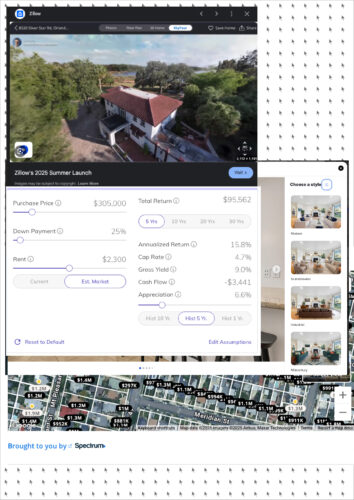
Two tabs in one browser window. The first tab is a Skytour, the newest feature for Zillow’s Showcase listings, which enhances virtual interior 3D tours and interactive floor plans with an immersive experience of viewing the house’s surroundings from any angle. The second tab is Lofty’s financial interface for buying tokens of a vacation rental listed on Airbnb. This interface features projected rental yield and annual return from a housing unit, homeowners’ insurance and property management costs, the underlying asset price, and property taxes, among many other parameters. The platformization of home in the United States occurs simultaneously in two opposing but complementary realities – complete immersion and meticulous quantification. While fly-over tours and interior staging help turn a house into an object of desire that embodies the life aspirations of the buyers, an overwhelming amount of interactive financial data is there to assure future homeowners or investors that this particular house is a reliable vehicle for generating equity over time. Property technology (proptech) platforms deploy both approaches to uphold the sanctity of the property in the world of financial markets.
However, platforms alone do not cause an increase in the financialization of housing. Financial practices, housing policies, government-sponsored mortgages, tax deductions, and the popularity of individualized, asset-based welfare are among the most important contributors to financialization (Fields, 2017). A gradual conversion of homes into financial assets to be owned, traded, and monetized has changed the way people experience and access housing. Proptech platforms have intensified this process by leveraging advancements in mobile technologies and machine learning, among others. They operate with law-like logic, suggesting that the housing market is legible, navigable, and optimizable through their interfaces. However, these socio-technical systems are not imposed on users. It is users themselves who shape and maintain their coherence through daily actions of scrolling, saving, liking, and sharing. In the process, they become an infrastructure that establishes relationships between people and their homes, that facilitates and enables transactions and decision making. An ability to establish social and economic divisions is latent in this infrastructure. As Stephanie Sherman (2024) writes:
“Whether digital or physical, hardware or software, platforms are a general systems type—a standardized foundation, architecture, or arena upon and through which other things are planned and programmed. Platforms perform in similar ways. They combine rigid protocols with flexible adaptation; they consolidate and distribute power; they coordinate supply and demand; they leverage surplus via network effects; they perpetuate early plans while staging the potential for ongoing emergence.”
By collecting and standardizing data to integrate it with representations of material space, proptech platforms reduce the complexity of real estate management and transactions. In the process, they introduce a plethora of new complexities, this time algorithmic. The housing market, viewed through the lens of proptech, is supposed to appear legible, navigable, and optimizable.
In this essay, I examine the practices of immersion and quantification of proptech platforms to understand the ideologies that underpin them. I do this with the help of three case studies: a niche platform designed for a specific audience and purpose, a workflow platform that most users will likely never hear about, and an all-encompassing platform. Lofty is a young user-centric platform that tokenizes homes and acts as a marketplace for these tokens. A high level of data saturation in its interface, typical of fractional investment platforms, makes users feel their decisions are objective and grounded in quantifiable reality. Restb.ai is a business-to-business platform that provides computer vision services to other real estate actors. It is an active participant in flattening the material reality of homes into images to be tagged and analyzed. Finally, Zillow is the most well-known proptech platform, popularizing features such as automated estimates, interactive maps, algorithmic suggestions, and 3D home virtual tours.
Lofty and New Forms of Property Relationships
Lofty is a real estate platform that facilitates fractional ownership of properties and serves as a marketplace for exchanging these shares between users. As a homeowner, you can sell varying amounts of home equity for a 3% fee collected by Lofty. After an appraisal and the credit check, the homeowner transfers their property deed to a Wyoming Limited Liability Company (LLC). Finally, the property is listed on a marketplace, and users can purchase fractions that correspond to the ownership of the LLC that holds the property. However, homeowners must maintain at least 10% equity in their property to be able to buy it back at any time from users / investors.
What allows the property to be divided into shares is a Decentralized Autonomous Organization (DAO) Supplement, passed in March 2021 in the Wyoming Senate. It is one of the first working legal regulations for a so-called DAO wrapper, allowing it to interact with traditional financial and legal systems while maintaining its decentralized nature. DAO, a term proposed by Daniel Larimer in 2013, was further developed by Vitalik Buterin in “DAOs, DACs, DAs and More: An Incomplete Terminology Guide (2014).” DAO is a collectively owned and member-managed internet organization with a built-in treasury and various governance systems that include voting based on the number of owned tokens or the reputation of the user. Initially, this model presented itself as a vehicle for bottom-up socio-political organizing, relying on smart blockchain contracts that eliminate the need for third-party mediation (Catlow and Rafferty, 2022, p.28). Lofty uses this peer-to-peer system to ensure compliance with laws governing the ownership of a single property by thousands of landlords. However, currently, the governance of their DAO LLCs is not automated and is mediated by Lofty. The platform sends users voting prompts that range from determining apartment rent amounts to how much time to give tenants before filing evictions.
The full stack of Lofty includes the Algorand blockchain, several property management companies, and House Canary, an AI-powered valuation service that uses data streams from G73, a data organization within the RE/MAX family, solving “interesting and mission-critical geospatial challenges” according to its website. In 2019, Lofty itself was a provider of high-frequency data to predict neighborhood and individual property growth. One of its co-founders, Jerry Chu (2019), in his Hacker News post, gives a range of indicators used for its model, “from the growth in the number of postings on social media about a specific dog breed, to the number of restaurants in an area serving a specific type of trendy food, to the average wait time for ride-sharing apps, and the average maximum temperature an area can experience.” The first iteration of Lofty selected homes best suited to become successful assets, whereas today’s platform allows everyone with $50 or more to become a landlord. Currently, Lofty’s website features around 160 properties, including single-family homes, vacant land, and small apartment buildings.
Lofty claims to provide an infrastructure for individuals who are typically excluded from traditional routes to accumulating housing assets. According to the Harvard Joint Center for Housing Studies 2025 Report, homebuying in the United States fell to its lowest level in 30 years due to rising costs unmatched by income. In an attempt to manage the risks and insecurity of growing old in a country with rapidly diminishing welfare provisions, people are ready to invest in shares or tokens if they cannot afford to purchase a house. They enter an already complex and opaque system of financialized housing in the country. Lofty’s users buy shares in a house whose mortgage has already been pooled with other mortgages to create Mortgage-Backed-Securities (MBS), which are then sold to hedge funds, pension funds, or other financial institutions to distribute the risk. In this way, a 700-square-foot apartment in Akron, Ohio, or an Airbnb-listed short-term rental in Albuquerque, New Mexico, connects hundreds, or potentially thousands, of fractional investors, homeowners, tenants, and investors in MBS. Every participant is trying to capture the speculative promise of real estate assets.
While the full transformative potential of this model is yet to be realized, we can expect a further customization of real estate services and more frequent transactions. Most of us see purchasing a house as a once or twice in a lifetime transaction that corresponds to major life changes. Platforms, like Lofty, Landa, and Concreit encourage their users to buy and sell shares as often as possible. The ease is what matters. Scrolling, saving, liking, zooming in, and sharing are the ways in which thousands of people interact with housing today. In one of the interviews, Jerry Chu praises the utility of his investment service, which leaves users only the parts they enjoy, such as viewing properties, projecting revenues, comparing interior images, and neighborhood-friendliness scores. One can even find links to Airbnb profiles of properties, including all booking histories, tenant information, and inspection reports. These quantified property metrics continue to advance a techno-economic vision of homes amid increasing housing precarity.
Value Determinants of Restb.ai
Another real estate platform crucial for documenting and broadcasting housing online is Restb.ai, a computer vision platform launched in 2015 in Barcelona, Spain. Its primary service is tagging property images to convert them into datapoints, such as the presence of dual sinks, freestanding soaking tubs, skylights, exposed brick, or rustic style. These so-called actionable data points are then used to create property valuations, identify similar properties on the market, generate search-engine-optimized image captions, or ensure photo compliance with various real estate guidelines. Restb.ai’s computer vision tools introduce uniformity and consistency to marketing and valuation of homes. For nearly a century, appraisers were the ones tasked with establishing value. As Sandy Isenstadt (1999, p.62) writes,
“Accordingly, even in the most sober manuals, ‘value’ was defined in a general way as the ‘aggregate properties of a thing that make it useful or desirable’ or the ‘present worth of all the rights to future benefits of ownership’ [Association of Appraisal Executives, 1936, p. 11]. Rather than a weakness, such definitions were designed to allow for the range of often unpredictable influences on property value.”
Traditional appraiser assessments use a standardized system to rank quality (Q1-Q6) and condition (C1-C6). Restb.ai offers decimal-level scoring for more granular distinctions and an AI-generated score for home parts, like the kitchen, bathrooms, and exterior. Machine learning-assisted translation of intangible qualities into precise numerical values is appealing to many actors in the real estate sector. Institutional iBuyers of single-family rentals (SFRs) can quickly identify houses that fit their investment profile and assess their condition without requiring physical visits. Agents can instantly generate listings, ensure images comply with industry standards, and find comparable properties using qualitative data. Appraisers are supposed to benefit from minimizing subjective judgment by relying on automated valuation systems. The market share of so-called desktop appraisals is steadily growing, with Fannie Mae, or the Federal National Mortgage Association, already offering it as an option to lenders and borrowers.
Precision, instantaneity, and increased comfort. This is what image-based analytics from companies like Restb.ai offer today. What they also introduce is a heightened level of standardization of the domestic environment. Restb.ai publishes white papers and reports that contain information about design preferences, which are market drivers. Take, for example, kitchens:
“Atlanta kitchens show the largest preference for islands, while counter to the nationwide trend, Miami kitchens favor peninsulas over islands by more than a 2-to-1 margin.”
“White cabinets continue to dominate kitchen design and remain the most popular choice in new (69%) and existing (45%) homes.”
Proprietary computer vision models become the new tastemakers, advancing a techno-economic vision of housing with white cabinets and kitchen islands. They flatten homes into a collection of visual signifiers of value, which are further collected into various house-flipping improvement lists. Floors should be wood, or engineered wood, and consistent across main areas. Kitchen countertops should be granite, quartz, or butcher block; appliances – stainless steel and built-in; cabinetry – white, gray, or natural wood, with brushed nickel, matte black, or bronze hardware. Under-cabinet lighting and modern backsplash tiles should also increase the overall score. Walls should remain neutral, without accents or bold colors. Fixtures like old chandeliers or fans should be replaced with modern-looking lights. Owners should consider replacing any hollow-core interior doors with solid or paneled ones and adding wainscoting or crown molding. Equipped with this knowledge, homeowners acting as investors or developers make sure to follow the protocol for value enhancement compliant with machine-vision parameters.
Zillow and New Media Representations
While consumer-facing fractional real estate investment platforms, such as Lofty, claim to be democratizing the accumulation of land-based wealth, companies like Restb.ai enhance the effectiveness of various institutional real estate actors. Meanwhile, Zillow is becoming an all-encompassing housing platform in the United States. Founded in 2006, Zillow, following numerous acquisitions and transformations, became synonymous with real estate. Yanni Alexander Loukissas (2022) explains Zillow “as part of the ‘interface economy,’ a rapidly growing area of business in which companies aggregate data from various sources and provide access as well as interpretative tools.” “Zillow surfing” turned into an addiction for many over the past five years, allowing users to imagine other lives and indulge in comparisons. The smoothness of the platform experience facilitates this real estate escapism. Zillow’s interactive map allows users not only to zoom in and out, but also to save homes they like and draw a boundary around the area of interest. Geo-tagged home prices that populate the map render the urban fabric as a homogeneous space, composed of investment opportunities, some of which are alluringly marked “FOR YOU.” Zillow’s interactive map, along with other data-driven features, like Zestimate, BuyAbility, mortgage calculator, and, recently, Zillow Showcase, normalizes this dynamic representation of houses and neighborhoods.
Visually communicating data overlaid on a city map is a ubiquitous practice not only in real estate but across all platforms; however, brokers were definitely the pioneers of online mapping software (Northwest Multiple Listing Service, 2024). The database Locator began using its most primitive version as early as the 2000s. The pivotal moment in the “domestication” of online mapping was the launch of the Google Maps API (Application Programming Interface) in 2005, which enabled anyone with basic programming skills to integrate maps and satellite imagery into their web applications. This possibility for embedding was a crucial feature for the real estate platforms to become user-centric. APIs have been described as “the foundation for the ‘Web as platform’ concept” (Helmond, 2015) and “elements of infrastructures for accessing the seams through which cities are perceived and managed” (Raetzch et al., 2019). APIs are interfaces that ensure interoperability between different applications by providing structured access to data streams through calls. Opening up some parts of the platform to the public encourages the growth of an ecosystem around it, ultimately increasing the value of the original platform. Zillow itself provides a range of APIs, like agent reviews, Zestimates, and mortgage data. Just like Google Maps, Zillow is becoming a foundational layer for other services. Over the years, it has defined the data standard and user experience for other proptech platforms. One of its main revenue streams is real estate agents purchasing visibility and receiving leads directly from Zillow, since it controls most of the real estate traffic in the country. Since Zillow shapes user expectations and sets standards for most actors in the real estate industry, it is only a matter of time before other platforms introduce new immersive media. Virtual AI-enhanced staging, digital twins instead of photo galleries, and AI-generated fly-throughs promise to further dematerialize homes in the near future.
Advanced Mediation of Homes
Taken together, the above-described platforms demonstrate how, by using immersive representation tools and an overwhelming number of projection graphs, calculators, and various scores, they create new spatial arrangements. Virtual staging and return-on-investment calculations are part of socio-technical systems that reference the material reality of homes but do not represent it. They represent a speculative potential of owning. Housing is often the first encounter with a complex financial product, a revenue-generating asset with a complex temporality. It is the first encounter with a speculative promise. Geographers Kean Birch and Callum Ward affirm: “Something capable of generating rent is created through enclosure, then abstracted into an asset through capitalization of its future revenues, and this asset acts with material power on the present” (2022, p.2). Even when one is “simply” browsing homes and their surroundings on the Zillow mobile app —saving them as favorites, noticing new trendy tile types, and checking the “buyability” score using personal income and credit score details — one is indirectly participating in a techno-economic vision of contemporary housing. The downstream effects of this dynamic value-capture environment, driven by instant gratification and extraction logic, may not be self-evident to every participant; however, left unaddressed, they will continue to push ambiguities into the background and move further away from the material lived realities of residents. They put those who rent homes in a significantly more precarious position while serving an asset-owning class of investors and homeowners who benefit from rising property values. Proptech platforms of today are “infrastructures that make specific forms of coexistence possible, or they prohibit them – an ability that highlights infrastructures’ role in the (re-)production of those societal and global asymmetries that manifest themselves in everyday forms of racism, sexism, class structure, and, consequently, inequality” (Beck et al. 2022, p.9). It is hard to imagine existing platforms abandoning their fundamental premises and shifting away from their original user base. Instead, we need new systems that foreground the relevance of local conditions. A concerted effort to design different infrastructure for housing documentation and access can help us move beyond a state of resignation, and beyond embeddedness in a statistical model of proptech platforms.
References
Beck M. et al (2022) Introduction, Broken Relations: Infrastructure, Aesthetics, and Critique (Leipzig: Spector Books).
Birch, K. And Ward, C. (2022) ‘Assetization and the ‘new asset geographies,’ Dialogues in Human Geography, pp. 1-21.
Buterin, V. (2014) ‘DAO’s, DACs, DAs and More: An Incomplete Terminology Guide,’ ethereum foundation blog, May 6. Available at: https://blog.ethereum.org/2014/05/06/daos-dacs-das-and-more-an-incomplete-terminology-guide (Accessed: August 21, 2025).
Catlow, R. And Rafferty, P. (2022) Radical Friends: Decentralized Autonomous Organizations and the Arts (London: Torque Editions).
Chu, J. (2019) Y Combinator Hacker News, August 14. Available at: https://news.ycombinator.com/item?id=20697449 (Accessed: August 21, 2025).
Fields, D. (2017) ‘Constructing a New Asset Class: Property-led Financial Accumulation after the Crisis,’ Economic Geography, 0(0), pp.1-23.
Helmond, A. (2015) ‘The Platformization of the Web: Making Web Data Platform Ready,’ Social Media + Society, 1(2), pp. 1-11.
Isenstadt, S. (1999) ’The Visual Commodification of Landscape in the Real Estate Appraisal Industry, 1990-1992,’ Business and Economic History, 28(2), pp. 61-69.
Joint Center for Housing Studies of Harvard University (2025) The State of the Nation Housing. Available at https://www.jchs.harvard.edu/sites/default/files/reports/files/Harvard_JCHS_The_State_of_the_Nations_Housing_2025.pdf (Accessed: November 5, 2025).
Loukissas, Y.A. (2022) ‘Who Wants to Live in a Filter Bubble? From ‘Zillow Surfing’ to Data-Driven Segregation,’ Interactions, May-June. Available at: https://interactions.acm.org/archive/view/may-june-2022/who-wants-to-live-in-a-filter-bubble (Accessed: August 21 2025).
Northwest Multiple Listings Service (2024) The Evolution of Mapping Listings: 40 Years of Powering the Region’s Real Estate Industry. Available at https://www.nwmls.com/a-40-year-evolution-of-mapping-listings/?utm_source=chatgpt.com (Accessed: January 30, 2026).
Raetzsch C. et al.(2019) ‘Weaving seams with data: Conceptualizing City APIs as elements of infrastructures,’ Big Data & Society, January-June, pp.1-14.
Restb.ai (2025) Special Report – Kitchens: Design Trends and Market Appeal. Available at: https://blog.restb.ai/special-report-kitchens-design-trends-and-market-appeal (Accessed: August 21 2025).
Sherman, S. (2024) ‘The Fordian Slip,’ e-flux, September 13. Available at: https://www.e-flux.com/architecture/new-silk-roads/626301/the-fordian-slip (Accessed: August 21 2025).
Dynamic interfaces of proptech companies. Courtesy: Zillow and Roofstock.
Cover image credit:
Dynamic interfaces of proptech companies. Courtesy: Zillow and Roofstock.