Calling a Halt to Technologies of Abandonment
Commodifying fear and safety
Consider the definition of a safe, secure home. Depending on a person’s circumstances, that term—a safe, secure home—has several connotations. It might mean having access to adequate housing where their family can grow and thrive (Hearne, 2023), or the availability of rent-stabilized homes in neighbourhoods that they know. For others, it could mean being able to live in a home free from the threat of demoviction or renoviction. Being able to live in a home without fear of intimate-partner violence might be a factor for some. Or it might mean not having to be fearful of strangers when using their neighbourhood’s public spaces.
Now consider what happens when the promise of a safe, secure home rings hollow. That’s what happened when the rent-stabilized tenants at Atlantic Plaza Towers (APT) in the Brownsville neighborhood of Brooklyn, New York, received notice from their landlord, Nelson Management, in 2018 that their wireless key-fob entrance system would be replaced by a virtual doorman platform which would authenticate tenants based on their biometric facial recognition data. Tenants were told that the new system would ensure their safety by “keeping key fobs out of the hands of the wrong people” (McElroy & Vergerio, 2022: 608).
Concerns arose among the tenants based on their research on anti-Black racial bias embedded in facial recognition algorithms. Their astute perception was that the system, known as StoneLock Facial Biometrics, was being installed as part of a targeted scheme to gentrify the neighbourhood (McElroy & Vergerio, 2022). Research by Joy Buolamwini and Timnit Gebru (2018) at MIT proves that facial recognition algorithms misclassify darker-skinned females, producing an error rate of 35 percent. This is in stark contrast to the maximum error rate for lighter-skinned males, which is 0.8 percent. Just like a digital fingerprint, a facial print generates a mathematical model which is indexical of the human body and, given the inordinately high misclassification rate for darker-skinned females, may be considered an extreme form of racial profiling (CCLA, 2021).
According to Erin McElroy, the promise of a safe, secure home was not for the benefit of current tenants, but for “future gentrifiers yet to arrive” (2019). APT tenants were frustrated by the ongoing gentrification in Brownsville and suspected that the virtual doorman platform was responsible for the increased number of evictions in the neighbourhood. Concerned about the prospect of landlords using digital platforms to surveil and racialize them, one tenant, Anita, remarked that “so many people in the neighborhood are being pushed out… Please consider this a tragedy waiting to happen.” (McElroy & Vergerio, 2022: 608).
Even before the announcement, tenants were already concerned at the troubling level of surveillance (CCTV) cameras installed throughout the APT complex, where 90 percent of the property’s residents are people of colour and 80 percent are women (Melton, 2019). Tranae’ Moran, a third-generation Black Brooklynite who grew up in APT, likened the surveillance to that of Fort Knox, remarking that “they did not want to get rid of all the current surveillance. They wanted to add facial recognition on top of it. So not only do I have to now tap my key fob in all these places, but I now have to scan my face as well. And it has to approve!” (McElroy & Vergerio, 2022: 608).
Tenants’ trepidation was well-founded. Several days after a group of them, all Black women, met in the building’s lobby to hand out fliers warning their neighbours about the harms associated with facial recognition technology, they received warning letters from Nelson Management. The letters stipulated that their “loitering” in the lobby was illegal and would have to stop (McElroy, 2019). The lobby’s CCTV cameras had “caught” the tenants in violation and, as proof, full-colour surveillance printouts were slipped under their apartment doors. The tenants’ faces were circled and their apartment numbers were scribbled onto the timestamped printouts (McElroy & Vergerio, 2022).
If the landlord was willing to go to such extremes to weaponize CCTV by falsely claiming to “catch” tenants breaking the rules for simply gathering in their apartment complex where they already paid rent, what might the landlord do with a digital platform that utilizes facial fingerprinting and harvests biometric data in order to evict racialized tenants?
Loitering, lingering, and property transgression are commonly cited by police to keep the unhoused moving (Walcott, 2021). Expanding the scale and scope of such infractions to incriminate Black tenants inside their own common area is a troubling exercise of power which invariably becomes part of the criminalization continuum (Walcott, 2021). This is especially true now that facial fingerprinting is “beginning to supplement CCTV cameras as a means of implementing carceral domesticity, largely in BIPOC housing” (CCLA, 2021; McElroy & Vergerio, 2022: 617).
One very problematic element of this is the brazen intentionality with which scopic landlord tech is purposefully weaponizing policing tactics found at the street level in order to terrorize tenants inside their rent-stabilized building, and then using minor violations as grounds to evict tenants, deregulate the vacated units, and raise the rents (Ng, 2019).
Justifying the installation of facial recognition systems on the grounds of ensuring safety seemed like a familiar policing tactic to APT tenant Fabian Rogers, especially given the history of over-policing and surveillance in the Brownsville community (Clarke, 2019). He remarked, “I kind of feel like a criminal even though I pay my rent on time.” (McElroy, 2019).
As Rinaldo Walcott contends, these exercises of power not only further erode the commons, but also make the possibility of regaining it that much more remote (2021). The roots of these tactics can, in fact, be traced back to the “Black Codes”—a series of draconian laws designed to keep post-emancipation Black people subordinate to the white planter class (Taylor, 2016).
The continuum of criminalization
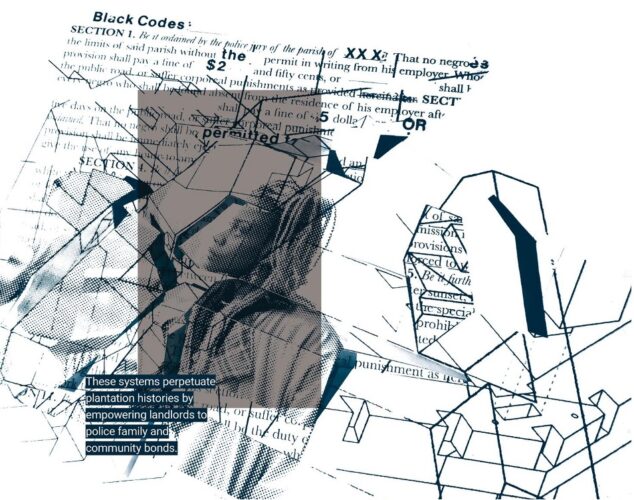
Keeanga Yamahtta-Taylor describes how the “Black Codes” were enacted by southern states after the end of the American Civil War (1861–1865) to justify the surveillance and control of Black people and their labour. They confined Black people to southern plantations, prohibiting them from voting, renting nearby lands, or associating with each other after sunset, and made it illegal for them to speak publicly without the permission of the police (Taylor, 2016). These laws codified state-wide carceral infrastructures by conflating Blackness with criminality and gave, to all white citizens, surveillance and policing powers over newly emancipated Black people (Taylor, 2016).
The surveillance of Blackness has long been, and continues to be, a social and political norm, according to Simone Browne (2015). In her book Dark Matters: On the Surveillance of Blackness, she shows how contemporary surveillance technologies such as biometric systems have their historical precedent in colonial lantern laws issued in New York City (1731). These laws criminalized and punished “any Black, Indigenous, or mixed-race person caught walking after dark without a lantern” or for “not being visible” to white authority (Browne, 2015; McElroy & Vergerio, 2022: 617).
Taylor (2016) and Walcott (2021) chronicle a succession of rationalizations, reforms, and institutions invented to maintain the ongoing denigration of Black life. These include “broken windows” policing and “stop-and-frisk” practices brought in during the 1990s under the tenure of NYPD Commissioners Bill Bratton and Raymond Kelly. In fact, most of these reforms criminalized public displays of poverty, making it illegal to sit, sleep, or beg in public (Taylor, 2016). This left Black people most at risk due to their history of poverty, from slavery to the present (Walcott, 2021). More importantly, it effectively launched the police into the role of stormtroopers for gentrification because they now had a plausible pretext to disproportionately target and patrol poor and working-class neighbourhoods (Taylor, 2016).
Heavily policed communities in NYC had become test beds for further iterations of surveillance technologies by the 1990s. Companies such as Oracle, IBM, and ESRI, leaders in the field of data analytics and cybernetics, joined forces with the NYPD to produce CompStat, a GIS data management system which tracked daily crime statistics (Taylor, 2016). As a data-driven policing strategy, the CompStat system provided real-time metrics on individual officers who conducted the most stops and arrests, leading to praise for those officers (Taylor, 2016). However, CompStat effectively became synonymous with systemic racial profiling, as argued in a 2013 federal lawsuit filed by the Center for Constitutional Rights against the NYPD (Floyd v. City of New York, et al.), because it overwhelmingly incentivized the excessive use of “stop-and-frisk” against Black and Latino individuals (Taylor, 2016).
So, the enhanced state and corporate surveillance capacities of “smart city” urbanization and open data frameworks pose a particular threat to poor and working-class BIPOC tenants living in rent-stabilized residential buildings in NYC (Cowen, 2020). A particular group of landlord tech companies, with names such as SafeRise, Reliant Safety, and StoneLock, has been testing facial recognition entrance systems on these tenants, in most cases without their consent, in what tenants suspect is a racist scheme by the real estate industry to expedite evictions and automate gentrification (McElroy & Vergerio, 2022). Not since plantation slavery, or perhaps during the foreclosures in the aftermath of the subprime mortgage crisis, has the landlord class in the U.S. benefited so greatly, this time by capitalizing on the exploitation and dispossession of female-led households from their rent-stabilized homes through racialized surveillance and biometric infrastructures.
The following analysis of Reliant Safety’s biometric infrastructure uncovers the ruling relations rooted in the historical standpoint of white supremacist property law (Crosby, 2023). It illustrates how these systems perpetuate plantation histories by empowering landlords to police family and community bonds, and the sharing of space and shelter, and to prohibit subletting, especially among low-income individuals (McElroy & Vergerio, 2022).
In their online marketing materials, Reliant Safety promises to “eliminate illegal subletting” and other lease violations by “collecting intelligence” from neighbouring tenants and using biometric detection, combined with facial recognition and body movement analysis, to identify and authenticate residents. Since biometric recognition is not transferable, the building cannot be accessed via key fob, which means that even if they wanted to, residents could never share access to their apartment with a friend or family member unless they are already enrolled in the system.
It’s already common practice for information technology and security corporations such as StoneLock and Reliant Safety to share surveillance data with the state, and, in fact, they boast about their cooperation with the New York Division of the DEA and multiple precincts in the NYPD to secure prosecutions, fines, and evictions (Reliant Safety, no date). This level of cooperation represents an expansion of racialized surveillance infrastructures according to Deborah Cowen (2020: 471), whose research is concerned with how the settler colonial state often mandates certain urbanization projects as “national infrastructure” in order to sanction violent economies of enslavement and dispossession. She cites “smart city” urbanization initiatives such as “Sidewalk Labs” and “ShotSpotter” as an area of growing concern among Black community organizers in Toronto and New York and suggests that these need to be understood more broadly as part of a larger deployment of carceral infrastructures (2020: 483).
Given the high rates with which facial recognition systems consistently misidentify darker-skinned females (Buolamwini, 2018), and the coercive powers of surveillance already exercised by police officers, customs officers, and welfare agents to harass Black and other racialized poor women in their homes (Maynard, 2017), it’s easy to understand why tenants at ATP have organized and refused the oppressive logic embedded in “data grabbing” platforms such as StoneLock and Reliant Safety (Vadiati et al, 2025; Sadowski, 2020: 571). They are, in effect, pushing back against a criminal justice system that gives them no legal recourse when private security firms and law enforcement agencies misuse and mishandle their biometric information.
Technologies of abandonment
Facial recognition landlord platforms are currently augmenting the next iteration of technologies of abandonment against Black women, who continue to be subjected to greater degrees of surveillance and coercion than others, and are essentially stripped of their rights to the same protections as the rest of society (Maynard, 2017; Pratt, 2005). According to the National Institute of Standards and Technology, the fact that facial recognition matching systems have the worst false positive rates for Black women places those women in the highest risk category for being falsely accused of a crime (McElroy & Vergerio, 2022). Discriminatory algorithms only serve to aggravate the known harms associated with state-sanctioned processes which systematically denigrate Black femininity to the point where Black women and other gender-oppressed people are rendered disposable (Maynard, 2017).
In January 2020, AI Now co-founder Meredith Whittaker provided testimony to the US House Committee on Oversight and Reform hearing on Facial Recognition Technology (Part III): Ensuring Commercial Transparency and Accuracy. The AI Now Institute had previously written an amicus letter in support of Atlantic Plaza Towers tenants’ opposition to their landlord’s application for the installation of a facial recognition entry system which was filed with the New York State Homes and Community Renewal in July 2018. In her testimony to the House Oversight Committee, Whittaker warns that “proponents of facial recognition rarely account for the fundamental power imbalance built into the way facial recognition is developed and deployed” (2020).
It is neither an anomaly nor an accident that such technologies of abandonment are propelled by racial capitalism to devise plots and schemes to catch those who are out of place or, as Ruth Wilson Gilmore remarks: “Unfree people who… couldn’t say where they worked, or prove that they were free, or show a ticket or a pass, a document to save their skin, or save themselves from the narrative that their skin, stretched in particular ways across muscles and bones… seems to suggest something about where they shouldn’t be—caught” (2022).
References
Browne, S. (2015). Dark Matters: On the Surveillance of Blackness (1st ed.). Duke University Press. https://doi.org/10.1515/9780822375302
Buolamwini, J., & Gebru, T. (2018). Gender Shades: Intersectional Accuracy Disparities in Commercial Gender Classification. In: Conference on Fairness, Accountability and Transparency. PMLR, pp. 77–91. Available at: http://proceedings.mlr.press/v81/buolamwini18a.html
Canadian Civil Liberties Association. (2021, July 15). Facial Fingerprinting [Press release]. CCLA. Retrieved August 2, 2025, from https://ccla.org/our-work/privacy/surveillance-technology/facial-recognition/
Center for Constitutional Rights. (2025, June 3). Floyd, et al. v. City of New York, et al. [Press release]. Retrieved August 2, 2025, from https://ccrjustice.org/home/what-we-do/our-cases/floyd-et-al-v-city-new-york-et-al
Clarke, Y. (2019, May 17). Letter to Commissioner Visnauskas 5 17 19 [Press release]. Retrieved August 7, 2025, from https://www.documentcloud.org/documents/6207311-Letter-to-Commissioner-Visnauskas-5-17-19
Cowen, D. (2020). Following the infrastructures of empire: notes on cities, settler colonialism, and method. Urban Geography, 41(4), 469–486. https://doi.org/10.1080/02723638.2019.1677990
Cowen, D., Mitchell, A., Paradis, E., & Story, B. (2020). Digital Lives in the Global City: Contesting Infrastructures. UBC Press.
Crosby, A. A. (2023). Resisting Eviction: Domicide and the Financialization of Rental Housing. Fernwood Publishing.
Fields, D. (2022). Automated landlord: Digital technologies and post-crisis financial accumulation. Environment and Planning A: Economy and Space, 54(1), 160–181. https://doi.org/10.1177/0308518X19846514
Gilmore, Ruth Wilson. 2022. “Chapter 20: Abolition geography and the problem of innocence.” In Abolition Geography: Essays Towards Liberation, pp. 471-495. Verso Books.
Hearne, R. (2023). The Financialization of Purpose-Built Rental Housing for Canada’s Review Panel on the Financialization of Purpose-Built Rental Housing. In The National Right to Housing Network (NRHN). Retrieved August 7, 2025, from https://housingrights.ca/wp-content/uploads/Dr-Rory-Hearne-Submission-on-Financialization-Canada-Review-Panel.pdf
Kern, L. (2019). “Chapter 5: City of Fear.” In Feminist City: A Field Guide. Between the Lines.
Kim, E. (2019, November 21). Brooklyn landlord does an about face on facial recognition plan. Gothamist. Retrieved August 7, 2025, from https://gothamist.com/news/brooklyn-landlord-does-about-face-facial-recognition-plan
Maynard, Robyn. (2017). “Chapter 5. Misogynoir in Canada.” Policing Black lives: State violence in Canada from slavery to the present. Fernwood Publishing.
McElroy, E. (2023). DIS/POSSESSORY DATA POLITICS: From Tenant Screening to Anti‐Eviction Organizing. International Journal of Urban and Regional Research, 47(1), 54–70. https://doi.org/10.1111/1468-2427.13150
McElroy, E. (2023, June 7). Automating Gentrification in Times of Crisis. Just Tech. https://doi.org/10.35650/jt.3057.d.2023
McElroy, E., & Vergerio, M. (2022). Automating gentrification: Landlord technologies and housing justice organizing in New York City homes. Environment and Planning. D, Society & Space, 40(4), 607–626. https://doi.org/10.1177/02637758221088868
McElroy, E. (2019, November 6). Digital Frictions: Disruption at the Doorstep. Urban Omnibus. Retrieved August 7, 2025, from https://urbanomnibus.net/2019/11/disruption-at-the-doorstep/
Melton, M. (2019, July 24). Lawmaker who challenged facial recognition in majority Black building introduces new bill for public housing. Forbes. https://www.forbes.com/sites/monicamelton/2019/07/23/hud-bill-blocking-facial-recognition-wont-stop-landlords-plans-to-install-in-majority-black-building/?sh=5c93133224f8
Ng, A. (2019). Smart home tech can help evict renters, surveillance company tells landlords, CNET, 25 October. Available at: https://www.cnet.com/home/smart-home/install-smart-home-tech-evict-renters-surveillance-company-tells-landlords/ (accessed 7 August 2025).
Pratt, G. (2005). “Abandoned women and the spaces of the exception.” Antipode 37 (5):1053-1078.
Reliant Safety (2021) Results. Available at: www.reliantsafe.com/results/ (accessed 10 May 2024).
Sadowski, J. (2020). The Internet of Landlords: Digital Platforms and New Mechanisms of Rentier Capitalism. Antipode, 52(2), 562–580. https://doi.org/10.1111/anti.12595
Taylor, Keeanga-Yamahtta. (2016). “Chapter 4. The double standard of justice.” From #BlackLivesMatter to Black liberation. Chicago, Illinois: Haymarket Books.
United States House of Representatives, Committee on Oversight and Reform, Whittaker, M., & AI Now Institute, New York University. (2020). Facial Recognition Technology (Part III): Ensuring Commercial Transparency & Accuracy. https://ainowinstitute.org/wp-content/uploads/2023/04/WRITTEN-testimony-MW-oversight-FINAL.pdf
Vadiati, N., Chiappini, L., & Bangratz, M. (2025). (En) coding care into digital urbanism: Vignettes of collective practices. Digital Geography and Society, 8, Article 100120. https://doi.org/10.1016/j.diggeo.2025.100120
Walcott, R. (2021). “Chapter 3. Abolition now: From prisons to property.” On Property. Biblioasis.
Wilson, J. Q., & Kelling, G. L. (1989). Making neighborhoods safe: sometimes “fixing broken windows” does more to reduce crime than conventional “incident-oriented” policing. The Atlantic Monthly (Boston, Mass.: 1981), Vol. 263(2), 46-52. https://www.theatlantic.com/past/docs/politics/crime/safehood.htm
Source Photo Credits: