Fuzzy Frontiers: Chennai’s compound walls and intermedial encroachment
Walls are symbols and structures of social and material division. Much of the literature highlights the operation of walls as infrastructure that configures or represents aspects of state power (see Till et al., 2013). However, there is little research on walls as architectonic forms of the everyday that are mediated by a host of social actors, blurring their status as strictly formal or informal entities. This is an especially relevant gap regarding South Asian urbanisms, where the quotidian form of the compound wall plays a pivotal role as both a spatial divider and a dynamic surface for a variety of visual media. This article addresses this research gap by delving into the usages of compound walls and by highlighting the urban relations and territories that they configure within the city of Chennai, Tamil Nadu. This is undertaken by theorising the compound wall as an intermedial interstice that is not merely a spatial boundary, but a dynamic visual actor, mediating notions of the public and private, political discourses, and access to the city itself.

Compound Walls
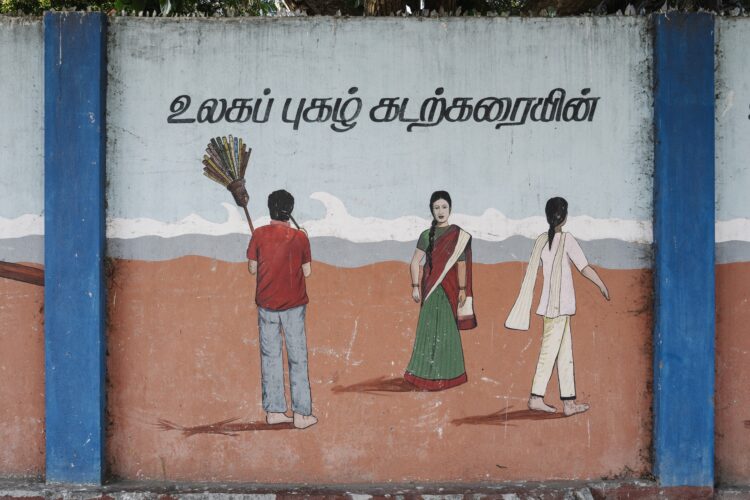
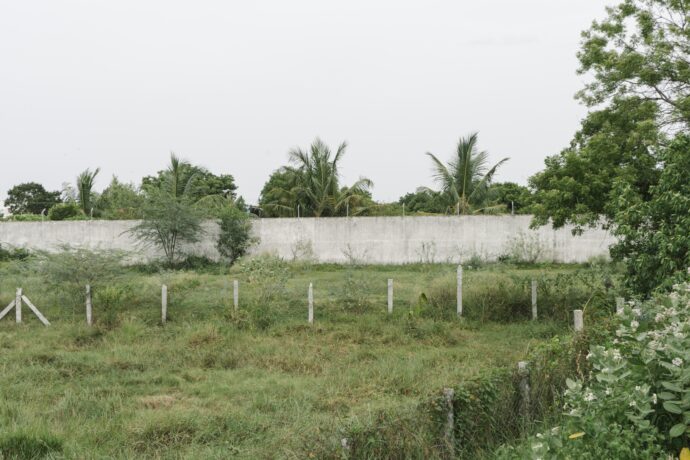
Compound walls are an everyday aspect of urban morphology across many urbanisms in the world, though especially commonplace within South Asia and Southeast Asia. This definition of the word ‘compound’ in English is itself derived from the word ‘kampung’ in Malay and Indonesian for ‘village’ (Funo, Yamamoto and Silas, 2002). The term ‘compound wall’ encompasses a wide variety of architectural structures that establish a physical perimeter around a parcel of land, residence, or institution. In Indian contexts, the most conventional iteration is a masonry wall structure infilled between concrete posts (Ayyappan and Thiruvenkatasamy, 2018), varying in height from approximately 1.5 metres to 2 metres (see Image 1). Additionally, compound walls are often built in shorter waste-height variations, constructed of continuous masonry material. Both variations serve as spatial barriers; the latter is used to define plot boundaries, while the former additionally offers sonic, physical, and visual insulation from the outside world. In this capacity, compound walls provide several space-oriented applications, including generating privacy, controlling the wandering of animals, and shoring up land claims.
In a broad sense, all types of walls are active forms in the social organisation of streetscapes and neighbourhoods, organising the spaces in which communities can and cannot overlap. However, compound walls, particularly in South Asia, have come to embody an atomisation of the social body under the increasing pressures of urbanisation and modernisation. Abraham (2018, p. 99) observes that the advent of compound walls within the city of Thalassery amplified the individuation of private property, transforming formerly public pathways into sites of trespassing. In this context, the compound wall transcends its role as a mere physical barrier, becoming a socio-spatial form that increasingly diminishes the permeability between interior and exterior spaces, while furthermore augmenting notions of the private and public realm. Brighenti (2009) maintains that walls, as socio-spatial disruptions, serve as instruments of territorialization by inscribing and sustaining relationships within an urban zone: “Walls demarcate a within and a beyond and, by doing so, they define flows of circulation, set paths and trajectories for people and, consequently, determine the possibilities and impossibilities of encounters.” (2009, p. 65). The compound wall emerges as a vertical boundary influencing the horizontal direction of social interactions, contestations, and traversals initiated within the public territory of the Indian streetscape.
Moreover, walls function as dynamic sites in the organisation, sustainment, and amplification of urban practices, exceeding their function as barriers between social and spatial zones. Brighenti (2009, p. 65) posits that while walls generate division between urban territories, they become territories in their own right through their visuality and legibility. The “surfaceality” (Brighenti, 2009, p. 65) of walls is produced by their vertical and public-facing positions, employed within a variety of urban contexts by road signs, advertising signage, murals, graffiti, and more. In the urban landscapes of South Asia and Southeast Asia, compound walls often constitute a continuous network of highly legible vertical surfaces, generating a communicative function alongside the roadside frontiers of public space. The surfaceality of compound walls within these contexts configure the structures into “technical media of display” (Elleström, 2021, pp. 33–38), physical entities which become a platform for a wide range of media products, including advertisements, obituaries, apartment listings, film banners, and political murals. As surfaces, the compound walls communicate aspects of an urban imaginary, representing “varied expressions which reflect the identity of the city – what the city is, what it needs and what it aspires to be”. (Sharma, 2022, p. 126). Thus, it is the surfaceality of compound walls that indicates their status as more than passive palimpsests situated between urban territories and instead a “vibrant matter” (Bennett, 2010) that actively gives voice and shape to the identity of an urban context.
Two questions arise here as to how the wall may operate as both boundary and surface— as a structure that configures territories, while also hosting media products that render and shape the urban? Who gains or loses visibility by way of the interventions and practices embodied within compound walls, and in what capacity? I propose that the concept of the ‘interstice,’ another ‘in-between’ urban form, provides a framework to understand the wall’s intricate role. The interstice frames the wall as a complex entity that not only generates divisions but also sustains intermedial socio-visual assemblies. The interstice, defined as a field in-between spatial or social programming, challenges the notion that spaces associated with edges and gaps within urban forms are merely voids. Instead, scholarship on interstices suggests that these areas are crucial for social practices vital to urban functioning, renewal, and transformation (Tonnelat, 2008; Sousa Matos, 2014; Dovey and King, 2016). Chakravarty and Negi (2016) define interstices within the context of Indian urbanisms as the everyday and inconspicuous spaces within which urban actors contest and defend their livelihood against the differentiating pressures of contemporary urbanisation. Interstices territorialize the interventions and encroachments of formal actors (state authorities, financial institutions, non-government organisations, etc.) as well as, what has been described by Goodfellow (2020) as “para-formal” actors (hawkers, vendors, migrant labourers, informal residents, etc.). In this way, interstices echo Bennett’s (2010) concept of “vibrancy” in which actants and epistemologies bristle into contact with each other through use and circulation. This writing suggests that this circulation is sustained by the compound wall’s hosting of mediatic projections that navigate Chennai’s social and spatial interstices.
The specifics of how this relationship is formed are influenced by where and around what the compound wall is constructed. Many of Chennai’s key arterial thoroughfares (salai), providing access to a variety of large-scale public and private institutions, are bordered by compound walls. The four lanes of Sardar Patel Road are marked by conventional concrete two-metre-high walls fronting Guindy National Park and Anna University. Similarly, the Chennai High Court on Netaji Subash Chandra Bose Road, and the offices of telecommunications giant Bharat Sanchar Nigam Limited (BSNL) and Dr. M.G.R. Medical University, both of which are located along the artery road of Anna Salai, are bounded by such concrete compound walls. In the backstreets of neighbourhoods such as Adyar, Saidapet, and Royapettah, the commercial and residential properties on the mid-sized (theru) and smaller roads (chandu) are also commonly bounded by compound walls. In all instances, the influence zone of the compound wall extends beyond the vertical structure, territorially encroaching into surrounding footpaths, sewers, and roadways. However, the practices and visual languages occurring within this extended territory on major roads and backstreets operate in differing manners due to ownership, visibility, and shifting government policies.

Aspirations and Paradoxes of Chennai’s Arterial Roads
The compound walls lining major arterial roads frame the interactions between competing political parties and multimodal representations of heritage. In 2009, a ban on posters, murals, and hoardings was piloted along two arterial roads as part of the DMK political party’s larger Singara Chennai (Beautiful Chennai) initiative to clean up the city. Once the walls were effaced, artists were then hired to paint murals depicting tidy representations of local heritage through scenes of rural life, religious iconography, and cultural practices. The high surfaceality of the arterial compound walls were prime locations to express the DMK’s vision of a “world-class” Chennai which is clean and attractive to foreign investment while simultaneously consolidating a tidy image of the past. Gerritsen posits that the imagery of the murals derives from an assembled nostalgia composed of “fragments of cultural values and moralities” (2019, p. 82) determined by local powers to best align with comfortable historical imaginations of the middle- and upper-classes. This echoes Arabindoo’s (2010) contention that heritage within Chennai is frequently configured as an “elite discourse which fails to successfully encompass all social groups, using heritage issues instead to mark the setting of a new order of power and precedence, and fixing the spatial evolution of the city through a one-dimensional accounting of history” (2010, p. 159). However, the material conditions of the heritage murals ultimately rendered its semiotics vulnerable to the competitions and inconsistencies of the local Dravidian parties. Following the election of the rival AIADMK party in 2011, many of the beautification murals were removed due to their association with the previous policies of the DMK party, regardless of the imagery. Heritage becomes employed by those with access to the power to sustain its use as an intermedial device that “generate[s] realities – rather than the reality” (Boenisch, 2006, p. 109, emphasis in original). Consequently, the compound wall emerges as a socio-spatial interstice, where notions of heritage and identity are generated amidst the shifting visual fields of governance.
A noticeable development in the current use of public compound walls, especially on the major roadways, is the association with environmental issues. A corridor of walls on Greenways Road, including Thiru-Vi-Ka bridge over the Adyar river has been painted by the Environmentalist Foundation of India (EFI) with imagery of local endangered birds. While the stated intent of the imagery is to raise awareness and promote knowledge of local fauna (Mylapore Times, 2019), the compound walls encapsulate the entanglements and contradictions of Indian urban development projects and environmental policies (see: Image 4). The roadways are increasingly becoming “new state spaces” that unlock a neoliberal nationalist imaginary of an interconnected India open to transnational capital and investment, while simultaneously are presented as ecologically beneficial (Bathla, 2023, pp. 355–359). This contradiction that is revealed by the visual media elucidates how the state capitalizes upon “voids and incompleteness of the city extensions” (El-Husseiny et al., 2021, p. 51)—configuring the interstitial territories into paradoxical sites of world-class aspirations.

Tactics in the Backstreets
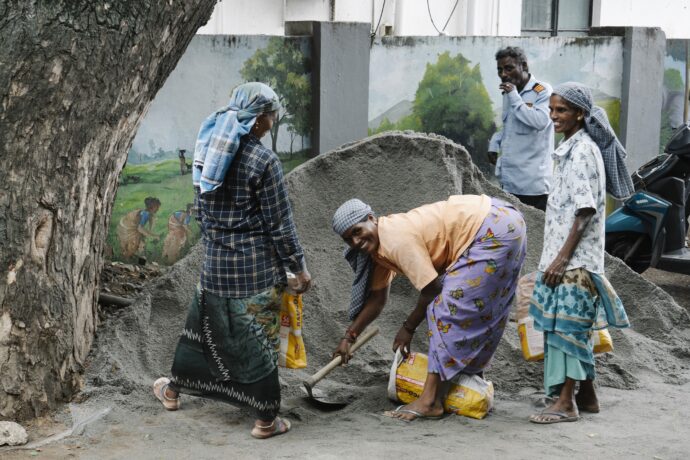
The lower visibility and private ownership of compound walls along the backstreets contrast and mirror the top-down transformations observed along major thoroughfares, offering a variety of everyday mediatic tactics that shape the urban landscape by way of socio-spatial contestation and encroachment. While the backstreets are far from devoid of state power and imagery (see: Image 2), the compound walls generally indicate a decentralised unsettling and reorganisation of urban hierarchies involving non-governmental organisations, homeowners, and para-formal actors. The footpath within the backstreets are home to a wide range of street vendors who are defined as “including hawkers, peddlers, squatters” (Ministry of Law and Justice, 2014, p. 3). Street vendors occupy an ambiguous place within the socio-juridical imagination of the Indian streetscape. Saha (2016) notes that street vendors are framed by law as having a “definite role in “modern urban society’” (Sodhan Singh vs Delhi Municipal Corporation cited by Saha, 2016, p. 27), whose business is constitutionally protected. Yet, they are also targeted as nuisances who face evictions and harassment in the name of keeping the urban space clean (2016, pp. 105 and 131). Arabindoo (2012) has also detailed how street vendors within Chennai are framed by middle-class residents as an unhygienic menace that obstructs a developmentalist path towards a liberalised future Chennai. In both instances, the street vendor embodies a useful urban agent, providing necessary services while simultaneously interrupting the middle-class aspirations of a ‘world-class’ modernity through the developmental logic of sanitation.
Compound walls have been a central actor within sanitation initiatives aimed at curbing public urination. Halting public urination was central to Prime Minister Narendra Modi’s 2016 ‘Swachh Bharat!’ or ‘Clean India!’ campaign which furthermore sought to position children and young people as catalysts for civic change. While public urination in urban areas is more acutely considered an infrastructure issue initiated by a lack of access to facilities, the issue became a point of focus for middle-class youth who had grown impatient with the state’s lack of substantive steps towards ‘modernising’ public space (Doron, 2016, p. 737). Doron provides a fascinating account of how internet space becomes a location for mobilising youth interest through memes and content—although the compound wall, as the typical site for the act of urination, emerges as the superlative site of tactile interventions. The backstreets of Chennai contain two notable tactical practices, occurring as roadside shrines and NGO mural projects, that configure the streetscape towards an urban vision that is increasingly intolerant of practices associated with subaltern groups that are perceived as unsanitary and atypical of a modern city. This interplay of social groups that territorialise the compound walls speaks to an intermedial dimension within what Harvey articulated as “the fierce contest over images and counter-images of place” (1996, p. 322). The compound wall stands, not as a lawless zone outside of state apparatuses, but as an interstitial territory where disputed outcomes favour those who can more readily control space via the capturing of the visual media of and within place.
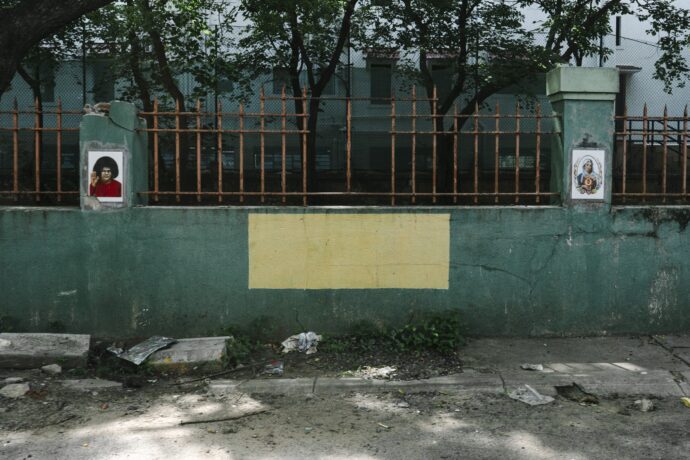
The first tactical practice is established in roadside shrines, also known as wayside or footpath shrines, which are accessible religious sites built in the public domain. In the urban areas of India these shrines are often built on compound walls, or nearby on the footpath. They are spontaneously built without planning permission, representing a structural form within para-formal urbanisms that is produced and sustained by a multiplicity of minor, everyday, and uncoordinated acts of devotion (Rao, 2023). The roadside shrines may occur in a wide variety of forms, ranging from complex structures to small photographs, and may be associated with Hindus, Muslims, Christians, Buddhists, and Jains. Throughout Chennai, most of the sites enshrine Hindu deities, especially Lord Ganesha. While the roadside shrines primarily function as spiritual sites, Sekine (2006) notes that the shrines operate as the locus for power relations between local authorities and para-formal footpath economies. Here, the spiritual authority, reverence, and popularity of sacred imagery are employed as tools to rebuff the antagonisms of state agencies. Elison (2018) has theorised roadside shrines as an aspect of visual cultural studies where spiritual iconography initiates an affective, embodied and performative exchange between urban residents, deities, and city space. This “sacred spectacle” (Elison, 2018, p. 18) predicated upon the visual exchange between subject and the divine initiates concrete transformations within urban space. The backstreets of Chennai offer a clear example. Private residents navigate the previously discussed politics of public urination by installing tiled images of religious figures upon the public façade of compound walls. This use of the compound wall initiates two articulated transformations by way of sacred semiotics. The structure produces a site of veneration for busy residents, while also generating a territory that configures social behaviour in the public realm.
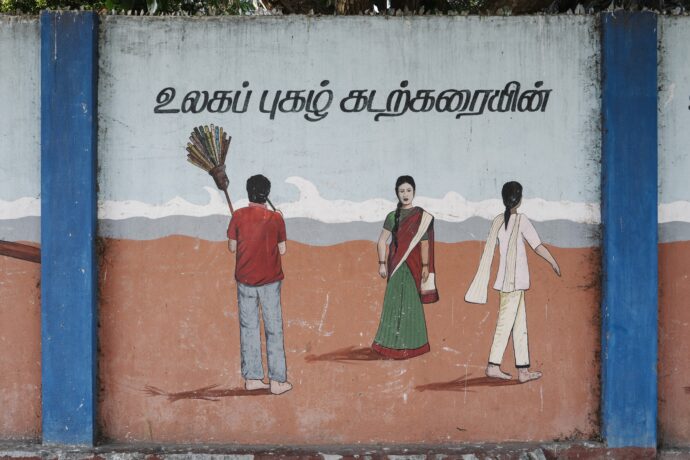
A second tactic returns the practice of mural painting through the activity of non-governmental organizations. Similar to the mural painting activities detailed earlier, NGO mural projects generate an urban imaginary through content while concurrently producing socio-spatial urban transformation through the transposition of ‘unsanitary’ and ‘antisocial’ behaviour, frequently in conjunction with schools and other youth-level institutions. Such organisations typically position their motivations as defence against the troublesome members of society who abuse public space. Such abuses, which range from urination and littering to squatting and street vending, are targeted by way of imagery and text that produce a determined social imaginary. This imaginary displaces the para-formal urban practices in both production, as the streets must be cleared ahead of community painting events, and in content, presenting an image of a Chennai that is modern, clean, socially responsible, and exclusively composed of formal actors. These mural projects are seen as a “graphic message” that reconfigures the unauthorised activities associated with local para-formal groups, including slums residents, and educes an extension of a unilateral worldview into the shared domain of the public (The Hindu, 2019). The compound wall as a canvas for such visual and textual configurations territorialises the world-class imaginary into the streetscape while simultaneously supplanting perceived transgressive activities and actors. Here image, text, and imagination become vehicles for generating a street-bound bio-politics that occurs on the compound wall and simultaneously beyond its frontier. This intermedial network of associations becomes a vehicle that amplifies social reorganisation beyond the limits of its spatial form. An illuminating example is provided by way of a quote from an organiser of a compound wall painting initiative at Corporation Higher Secondary School in Mylapore which shares a road with a local fish market: “Though the school is on the inside of the wall, they don’t have control of the outside, which has been vandalised over the years.” (The Times of India, 2023).
Coda
As the DMK party, now returned to office, initiates a second wave of beautification projects under the shrewdly named Singara Chennai 2.0 initiative, Chennai surely faces new transformations. However, the form, content, and semiotics of such prospective visual encounters are yet to be seen. Following from this, I conclude with three issues for further research facing the intermedial aspects of compound wall that I invite other minds to pursue. A remarkable development is the shifting socio-spatial dynamics under the transformations of the digital revolution. Already compound wall murals are available as NFTs (The Hindu, 2022), while graffitied WhatsApp phone numbers connect the concrete coordinates of Chennai to digital territories. Second, the tactics detailed in this writing have been effective at displacing other visual practices such as poster obituaries, job listing, and advertisements. These media appear to be increasingly common on electrical and water infrastructure, inviting new analysis. Third, as the nearby hinterlands outside of Chennai face multi-dimensional reconfiguration (Arabindoo, 2020), the compound wall takes on new meaning as an agent of extended urbanisation (see Schmid, 2021).
In many ways, the compound wall is a silent and seemingly immutable actor unable to speak to how the images of world-class status and spirituality gain meaning. However, the compound walls constitute a multi-modal surface that, through its relations to aspects of the semiotic lexicon, are able to convey the reordering of socio-spatial geographies. As the multiple and fragmented epistemologies that are produced within Chennai change in composition and arrangement, so too will the canon of media by which these urban transformations are expressed and sustained.
References
Abraham, J. (2018) ‘The Lives of Others: The Production and Influence of Neighbourhood Cultures in Urban India’, in I. Pardo and G.B. Prato (eds) The Palgrave Handbook of Urban Ethnography. Cham: Springer International Publishing, pp. 95–111. Available at: https://doi.org/10.1007/978-3-319-64289-5_6.
Arabindoo, P. (2010) ‘Isolated By Elitism: The Pitfalls Of Recent Heritage Conservation Attempts In Chennai’, in D. Prashad (ed.) New architecture and urbanism: development of Indian traditions. Newcastle: Cambridge Scholars, pp. 155–160.
Arabindoo, P. (2012) ‘Bajji on the Beach: Middle-Class Food Practices in Chennai’s New Beach’, in M. Waibel and C. McFarlane (eds) Urban Informalities. 0 edn. Routledge. Available at: https://doi.org/10.4324/9781315548814.
Arabindoo, P. (2020) ‘New geographies of hinterland’, Re-centering the City: Global Urban Mutations and Post-socialist Modernity, pp. 211–23.
Ayyappan, K. and Thiruvenkatasamy, K. (2018) ‘December 26th, 2004 Tsunami structural and geotechnical damages in the Districts of Cuddalore and Nagapattinam East coast of Tamil Nadu, India’.
Bathla, N. (2023) ‘Nature and the extended city: Wasteland governmentality, the sacred, and anti-wasteland politics in the Aravalli region’, Environment and Planning E: Nature and Space, p. 25148486231187811. Available at: https://doi.org/10.1177/25148486231187811.
Bennett, J. (2010) Vibrant Matter. Duke University Press. Available at: https://doi.org/10.2307/j.ctv111jh6w.
Boenisch, P.M. (2006) ‘Aesthetic Art to Aisthetic Act: Theatre, Media, Intermedial Performance’, in F. Chapple and C. Kattenbelt (eds) Intermediality in Theatre and Performance. BRILL, pp. 103–116. Available at: https://doi.org/10.1163/9789401210089.
Brighenti, A.M. (2009) ‘Walled urbs to urban walls – and return? On the social life of walls’, in A.M. Brighenti (ed.) The Wall & The City. Professional Dreamers.
Chakravarty, S. and Negi, R. (2016) ‘Introduction: Contested Urbanism in Delhi’s Interstitial Spaces’, in S. Chakravarty and R. Negi (eds) Space, Planning and Everyday Contestations in Delhi. New Delhi: Springer India, pp. 1–17. Available at: https://doi.org/10.1007/978-81-322-2154-8_1.
Doron, A. (2016) ‘Unclean, Unseen: Social Media, Civic Action and Urban Hygiene in India’, South Asia: Journal of South Asian Studies, 39(4), pp. 715–739. Available at: https://doi.org/10.1080/00856401.2016.1218096.
Dovey, K. and King, R. (2016) ‘Active Interstices: Urban Informality, the Tourist Gaze and Metamorphosis in South-East Asia’, in A.M. Brighenti (ed.) Urban Interstices: The Aesthetics and the Politics of the In-between. 1st edn. Routledge, pp. 183–202. Available at: https://doi.org/10.4324/9781315548807.
El-Husseiny, M. et al. (2021) ‘Not Just Roads: Nitin Bathla and Klearjos Eduardo Papanicolaou, directors. 2020. Delhi and Zurich (Film, 67 min., color).’, The AAG Review of Books, 9(4), pp. 39–52. Available at: https://doi.org/10.1080/2325548X.2021.1960094.
Elison, W. (2018) ‘Site, Sight, Cite: Conceptualizing Wayside Shrines as Visual Culture’, South Asia Multidisciplinary Academic Journal [Preprint], (18). Available at: https://doi.org/10.4000/samaj.4540.
Elleström, L. (ed.) (2021) Beyond Media Borders, Volume 1: Intermedial Relations among Multimodal Media. Cham: Springer International Publishing. Available at: https://doi.org/10.1007/978-3-030-49679-1.
Funo, S., Yamamoto, N. and Silas, J. (2002) ‘Typology of Kampung Houses and Their Transformation Process– A Study on Urban Tissues of an Indonesian City’, Journal of Asian Architecture and Building Engineering, 1(2), pp. 193–200. Available at: https://doi.org/10.3130/jaabe.1.2_193.
Gerritsen, R. (2019) Intimate visualities and the politics of fandom in India. Amsterdam: Amsterdam University Press (Asian Visual Cultures, 5).
Goodfellow, T. (2020) ‘Political Informality: Deals, Trust Networks, and the Negotiation of Value in the Urban Realm’, The Journal of Development Studies, 56(2), pp. 278–294. Available at: https://doi.org/10.1080/00220388.2019.1577385.
Harvey, D. (1996) Justice, nature, and the geography of difference. Cambridge, Mass: Blackwell Publishers.
Ministry of Law and Justice (2014) ‘The Street Vendors (Protection of Livelihood and Regulation of Street Vending) Act’. MINISTRY OF LAW AND JUSTICE.
Mylapore Times (2019) ‘EFI paints the wall of Thiru-Vi-Ka bridge’, MYLAPORE TIMES, 14 July. Available at: https://www.mylaporetimes.com/2019/07/efi-paints-the-walls-of-thiru-vi-ka-bridge/ (Accessed: 31 December 2023).
Rao, U. (2023) ‘Making Informal Sacred Geographies: Spiritual Presence, Sensual Engagement, and Wayside Shrines in Urban India’, Space and Culture, 26(2), pp. 192–203. Available at: https://doi.org/10.1177/12063312221130244.
Saha, D. (2016) Informal Markets, Livelihood and Politics: Street vendors in urban India. 1st edn. Routledge India. Available at: https://doi.org/10.4324/9781315543086.
Schmid, C. (2021) ‘4 Networks, Borders, Differences: Towards a Theory of the Urban’, in N. Brenner (ed.) Implosions /Explosions. De Gruyter, pp. 67–81. Available at: https://doi.org/10.1515/9783868598933-005.
Sekine, Y. (2006) ‘Sacralization of the Urban Footpath, with Special Reference to Pavement Shrines in Chennai City, South India’, Temenos – Nordic Journal of Comparative Religion, 42(2). Available at: https://doi.org/10.33356/temenos.4631.
Sharma, S. (2022) ‘Mobilising a Folk Art: Madhubani Paintings and the Aesthetic Transformation of a Patna Streetscape’, in Jha, S. and Bharat, G., The Social Life of Streets in India. London: Bloomsbury Publishing, pp. 125–149.
Sousa Matos, R. (2014) ‘Urban Landscape: Interstitial Spaces’, Landscape Review, 13(1), pp. 61–71. Available at: https://doi.org/10.34900/lr.v13i1.794.
The Hindu (2019) ‘Residents send out a graphic message Abhiramapuram 3rd Street Lane’, 16 June. Available at: https://www.thehindu.com/news/cities/chennai/residents-send-out-a-graphic-message-abhiramapuram-3rd-street-lane/article27958569.ece (Accessed: 5 January 2024).
The Hindu (2022) ‘Wall art as NFTs? Chennai now has public art that is up for sale digitally’, 13 April. Available at: https://www.thehindu.com/entertainment/art/chennai-hosts-wall-art-that-is-being-sold-as-nfts/article65317057.ece (Accessed: 29 December 2023).
The Times of India (2023) ‘I got sunshine on my walls’, 2 April. Available at: https://timesofindia.indiatimes.com/city/chennai/i-got-sunshine-on-my-walls/articleshow/99180436.cms (Accessed: 5 January 2024).
Till, K.E. et al. (2013) ‘Interventions in the political geographies of walls’, Political Geography, 33, pp. 52–62. Available at: https://doi.org/10.1016/j.polgeo.2012.11.005.
Tonnelat, S. (2008) ‘`Out of frame’: The (in)visible life of urban interstices — a case study in Charenton-le-Pont, Paris, France’, Ethnography, 9(3), pp. 291–324. Available at: https://doi.org/10.1177/1466138108094973.