From a non-place to a place and a hyperplace: the Vltavská case
In the everyday communication of Prague residents, “Vltavská” refers not only to the Line C subway station named after the nearby river Vltava, but also to the station’s above-ground surroundings. In fact, the area that “Vltavská” refers to depends on the attitude of the beholder and/or user, and the location has evolved over time. In the past three decades, and especially in the past three or four years, Vltavská has experienced several changes, becoming an intersection of several cultural and social phenomena. The original transportation hub has (been) changed from a post-communist non-place to a liberal place claimed both by informal communities and the municipality, only to end up as a future hyperplace that is supposed to embody the idea of a highly structured municipal cultural hub.
The ethnologist Marc Augé’s definition of a place is based on its relation to the functioning of a community, to its history and identity (Augé 1995: 77). A place is characterized by opportunities and facilities that make it possible to socialize and to maintain relationships, thus forming a community. This is opposed to a non-place, which is characterized by its lack of these qualities. Typical examples of non-places are airports, supermarkets, and large hotels. The term hyperplace is a metaphoric analogy I introduce here to conceptualize a dramatic complex change that is imposed upon an existing place. The term involves the idea of hyperspace, i.e. the capacity of an imaginary dimension to distort the three-dimensional space, thus bringing its distant points close. These characteristics also apply to a highly organized project of the architectural transformation of a place that is concerned with identity and social functions, yet distorts and reduces the original network of these qualities that developed over time and defined the previous place.
In its original form and function, Vltavská may be understood as a typical location aspiring to the status of a non-place: A subway station at the very heart of a public transportation hub designed to provide capacity for a number of passengers heading to the large housing estates located in Prague’s suburbs, keeping them moving to make space for further ones. In Augé’s concept, the alienating effect of typical non-places inevitably results from the economy and efficiency of their construction, sometimes followed by collateral effects resulting from subsequent economic and thus technological reduction of an originally generous public project. Nevertheless, in the historical phase of the communist regime referred to as normalization (1970s to 1980s), the alienating or even hostile impression emanated by public spaces might have been welcome as part of an ideology turned into a political strategy: moving people to their private zones as fast as possible without offering public space for informal socialization, thus reducing the communication in civic society. In the 1970s, the typical space of socialization was a private apartment. While the members of dissent striving for political discussion and philosophical reflection had withdrawn themselves to home seminars, the residents of the political (and moral) grey zone enjoyed their family “kitchen talk” (cf. Svetlana Alexijevich’s collection of post-communist witnesses, 2013). In spite of the collectivist concept of the communist society, the withdrawal of the citizens to the private sphere was silently approved by the representatives of the real socialism of the normalization period. The discrepancy between the private and public sphere was mirrored by conflicting trends in private and urban architecture: while people searched for, bought, and strived to refurbish old country houses, and the inhabitants of housing estates tended to furnish their apartments with pieces and elements of rural style to experience coziness, the public constructions featured the principles of brutalist architecture.
The subway station and its surroundings: brutalist architecture and hostile impression
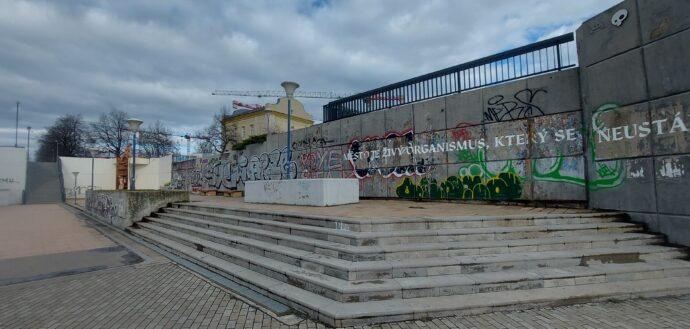
The historical point of departure of my enquiry lies in the 1980s extension of Line C of the Prague subway. Vltavská station opened to the public in 1984. The appearance of its above-ground surroundings resulted in part from the city’s two-level transportation scheme. The upper level is represented by an intersection of the North-South Motorway, which runs through the very center of the city. The lower level is meant to provide transit from one means of public transportation to another (subway, tram and railway). Because the relatively deep subway tunnel was built by cut and cover technology, even the above-ground surroundings of the station remained immersed relatively deeply in the terrain. The differences in height were mitigated by multi-levelled terraces, the upper level of which provided some outlook, thus legitimizing the reference to the otherwise invisible Vltava. Those who wished to access the riverbank of Vltava on foot in the 1980s had to submerge into the poorly lit erratic corridors. In the 1990s, the corridors opening to the riverbank had become a temporary home for homeless people. After a standard pedestrian crossing was introduced on the surface, these underpasses lost their meaning, and their function changed dramatically. The pedestrians still had to ascend several staircases to achieve the required level: the first one in the station’s vestibule, another one to the railway station, and yet another to the busy Strossmayerovo square.
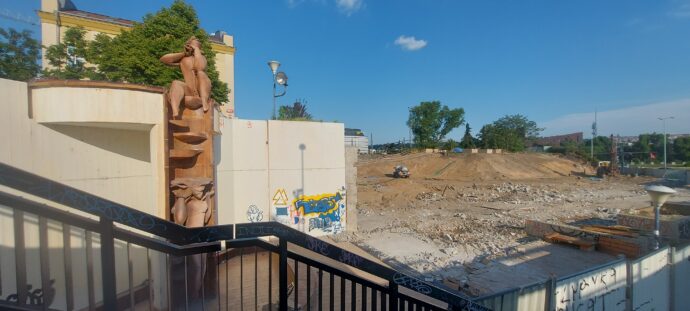
The construction of the entrance hall of the Vltavská station (by Vladimír Uhlíř, Jiří Navrátil, and others) reveals its brutalist architectural concept. The low, heavy body of exposed concrete does not oppose the submersion of the surroundings. On dark winter days, glass panels in heavy frames give it the look of an arctic research station that has to be protected from the effects of cold; on a starry summer night, it might resemble the ceiling of an underground dancing hall to the inspired beholder. There is no doubt that the subway may be understood as a significant component of the democratic infrastructure; the question is whether the egalitarian discomfort of its adjoining facilities is supposed to be understood in the same way. The upper gallery of the vestibule should be viewed rather as its visual extension, not as a space that may provide a temporary shelter to passengers. The northern entry of the vestibule facing the railway station remained locked for more than twenty years and finally re-opened in 2017 to provide access to a newly-established train stop. The question is: is an egalitarian brutalist architectural complex supposed to be hostile in its functioning? The missing escalators and elevators evidenced the lack of consideration to passengers with special needs, mirroring the wider practical exclusion of disabled people from public life. Although the brutalist scheme of the surroundings included elements that were meant to bring dynamics and freshness into it (gushing water and jardinières with growing plants in the terraces), it remained a place one wished to leave as soon as possible. Without regular irrigation, the planted jardinières turned into heavy containers of dry soil, and the concrete started to deteriorate. The fountain – integrated in a niche in the retaining wall – remained dry for most of the time, while the ceramic walls were stained by leakage. The fountain sculptures – featuring a faun and a naiad – are ideologically highly interesting, in part because of the striking contrast between the alienating environment and the symbolic meanings of the sculptures. There are obvious references to antiquity, to the Golden Age, to mythology, and possibly to the metamorphoses (the sculpture of the naiad is often interpreted as an impersonation of Vltava). From where does this idea stem? The answer to this question may be related to the general rules of socialist construction and the economics of their planning: the budget of public constructions used to include the installation of a work of art (a sculpture, mosaic, fountain etc.). Figural sculptures that accompanied infrastructural constructions such as the subway related to a limited scope of themes: from an optimistic, if not idyllic future (embodied by timeless motifs), to the deeds of the constructers, and to the heroic past, i.e. to the victorious moments of the communist movement (the takeover of power in 1948) and historical periods that were evaluated as progressive retrospectively (Hussitism).
Erased history
While the Golden Age was projected into the communist future, the local, contemporary history of the space was omitted or ignored. The historical buildings and structures closest to Vltavská are interconnected with the history of transportation; at their time, they represented technical progress and modernity. There is the Hlávka Bridge, the first reinforced concrete bridge in Bohemia, named after the renowned construction engineer and philanthropist Josef Hlávka. A pair of allegoric sculptural groups was set up at the northern bridgehead, near the site of the future Vltavská station, in 1913. The allegories Labor and Humanity (by Jan Štursa) represent the ethos of vigor and techné while retaining the soft power of knowledge and love. Due to the extension of the roadway for public transport, the sculptures were removed in the 1960s. They were reinstalled in 1983, yet elevated on high-profiled pylons, so that they may stand out in the visual competition with the complicated motorway intersection raised above the level of the bridge.
Also nearby is the functionalist building of the Electric Company of the city of Prague, with its vast white-tiled walls. When it was built between 1927-1935, it could boast of many up-to-date technological facilities. At the time of the subway construction, the building was still operating without sensible maintenance. After two decades of decay, it became subject to a substantial (intensely discussed) renovation as a property of a developer group (2018-2020). The symbolic capital of this building lies in the fact that it used to house a predecessor institution which comprised several municipal companies (power engineering and lighting, public transportation). This complex functionality may be understood not only as a metonymic memorial of technological progress but also as the social responsibility of the municipality.
These are two potential “memorials” that suggested historical points of reference that might have been involved in the symbolic scheme of the Vltavská hub. (Another, even older one was the railway station Bubny, a mark of the progress of the 1860s.) Nevertheless, it would have been a reference to the successes of a capitalist society that might have been considered undesirable during the socialist period. One of the historical aspects of the socialist identity was the communist resistance movement during the Nazi occupation; the retrospective interpretation of the Czech World War II resistance gave the impression that communists impersonated its leading power. Between 1941-1945, the Bubny station served as the departure point for transporting Jewish citizens from Prague to the Terezín ghetto and further to concentration camps. The reaction of the public, including the communists, may be referred to in applying the famous verses introduced by Martin Niemöller: “Then they came for the Jews, and I did not speak out”.
This case of the silent majority was left out from the communist record of Holocaust history. The motif is reflected in the project “Memorial of Silence” launched by a group of activists in 2012. Their idea of transforming the old railway station building into a memorial of Shoa and a place for critical reflection of the past received state support, and the railway company agreed on a free of charge rent of the building for 99 years. In 2015, the sculpture The Gate of Infinity by Aleš Veselý, a railway track lifted upwards as to resemble Jacob’s ladder, was raised at the place where the deportees took their last steps prior to boarding the train. One of the most impressive interventions aimed at recovering the memory of the place is the annual event “Drumming for Drums”, the name of which comes from the toponym Bubny (i.e., drums). This public expression of the shared will to break the silence, to speak out and to be heard, requires the physical engagement of the participants. Physical participation in the process of creating or re-recreating a place will be become the focus of the following explication.
The “wild” 1990s, graffiti and sanctioned art
The grey non-place started to change its appearance – not necessarily for the better – after 1989, a period referred to both by witnesses and historians as the wild 1990s. Numerous social practices in that time derived from the idea of freedom lacked the democratic limitations and the only rule they complied with was that “anything goes”. Public space meant open space. Graffiti appeared everywhere: full-fledged artistic pieces, as well as vast numbers of clumsy, blurred and dripping tags on the concrete blocks of non-places and on the freshly painted walls of carefully restored monuments in the Old Town. Both the municipality and the residents of Prague experienced mixed feelings when confronted with writing. At Vltavská, the colors of graffiti highlighted the decay of the neglected structure. In the 2000s, the municipality adopted a more accommodating stance to the graffiti and approved of street art festivals, including writing at the Vltavská station (2008). In 2018, a work by the graffiti artist Mode2 was destroyed due to the rehabilitation of the wall. In his conciliatory comment on the event, the artist stressed the processual character of the medium, and the ephemerality of its products: in his view, ten years was a period long enough for a graffiti piece to reach the limit of its lifetime.
While the structural changes in Prague’s public transportation in the 1970s and 1980s resulted in the emergence of non-places such as Vltavská, political changes slowly brought about more interest in the city conceived of as a cultural (thus, also a medial) environment. In 2019, the City Council in cooperation with the Prague City Gallery launched the tender scheme Art for the City intended to introduce publicly sanctioned street art to city spaces such as Vltavská. In 2021, the winner of the tender for Vltavská, visual artist Jakub Tytykalo, presented a black-and-white mural where two-dimensional objects meet spatial ones in a dynamic interplay, featuring staircases that invite the viewer to ascend them. The image also involved a stylization of one of Štursa’s allegories, which attracted the attention of the beholder thanks to the mirroring of the profiled pylon: while the base of the sculpture suggested solid ground and safety, the mirrored upper part resembled a stream of rays of light or energy. Thus, Tytykalo’s image referred to the symbolic meanings of the sculptures. And above all, the motif of the sculpture itself established a strong semantic, spatial, and historical interconnection with the evolution of the place.
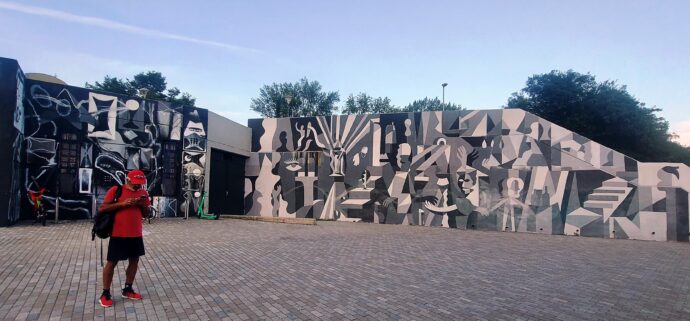
Yet another medial and social intervention was to come: After the realization of his mural, Tytykalo could observe comments on the wall that expressed discontent: not with the quality, but with the presence of his work, including challenges such as “Give it up”. An acquaintance of his referred these activities to a graffiti community located in another district of Prague. This (unverified) claim may indicate that the writers involved were not claiming the “place” or “territory” for themselves. They might have tried to draw the attention of the (publicly sanctioned) artist to the fact that the space concerned should remain open, since it may be claimed by any member of the graffiti community. Exploiting the space for a sanctioned artwork might have been considered a violation of the rules of independent graffiti writing. We may conceive of this case as an illustrative example of media intervention: though inevitably represented by an individual author of the comment, it is in fact the media itself, or rather its philosophy and politics of social independence, that “strikes back”. In Augé’s terms, this gesture of claiming a place (and thus, claiming control of its use) may be understood as an opposition, not only to the officially sanctioned artwork itself but also to the whole cultural scheme funded by the municipality that expropriated the public, i.e. “free”, space from the informal community.
During the pandemic years of 2021 and 2022, the district council supported Vltavská’s transformation into an open gallery. This began with an exhibition of black-and-white photographs called The people of Vltavská by Kevin V. Ton. The photographer – who prefers the traditional, “documentary” technology of the medium – focuses on everyday life, often following the objects of his interest in long-term projects. His collection displayed both typical and genuine situations related to the location, thus suggesting and confirming the identity of the place at the same time. A site-specific installation called That’s Not a Fairy, That’s a Mum (2021-2022, by Markéta Magidová, winner of the Art for the City tender) followed, meant as a reference to the figural sculpture of faun and naiad. The artist transformed them into a family in order to “tell a new story of the mythological figures and (to) play with their alternative roles”. While challenging traditional patriarchal schemes may be an attractive theme in itself, Magidová’s effort to establish a dialogue between the current artwork and the components that have been forming the character of the space for years is evident and valuable. The projects within the Art for the City scheme involve direct references to the (pre-)histories or current functions of the locations and, by making the passers-by stop and behold for a moment what they have been passing by for years, they raise the public’s awareness of their urban environments.
This intention is also obvious in the selection of photographs by Kevin V. Ton, who depicted another fascinating phenomenon of the Vltavská surroundings: its appropriation by motion. His photographs featured young people participating in urban sports such as parkour and skateboarding. This mode of making use of the underpasses after they lost their original function was adopted by the district council that introduced profiled paths with boulders adapted to the needs of skaters and bikers. However, the attempt to repaint the space according to a colorful geometric design was ill-conceived: the graffiti writers quickly claimed their open space back from this officially sanctioned media intervention. Even though the passing pedestrian must watch out for the skaters and bikers, they definitely bring an air of life and pure joy to the once dark corridors and grey paths.
The Future that has already happened and the BIG bang
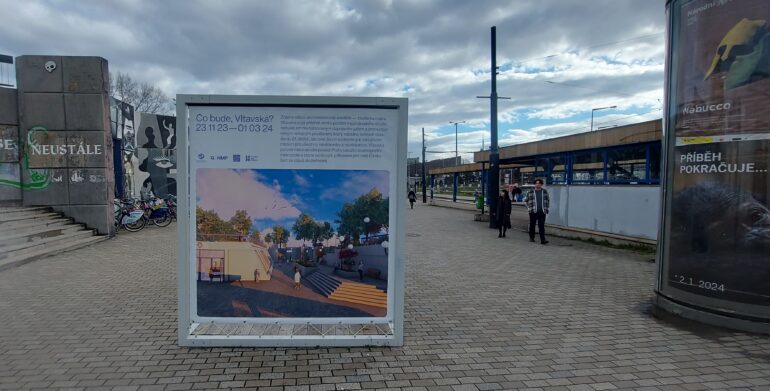
In late 2023, a few metal-and-canvas exhibition cubes appeared in the Vltavská space, displaying a project called “What’s next, Vltavská?” with a rather enigmatic subtitle: “the future that has already happened”. The roots of this oxymoron lie in the past of the non-place. First, let us focus on the motivation of the proposal of Eva Truncová and Monika Přikrylová, two young architects based in Brno. These characteristics are of importance, since they imply that the attitude of the authors is unencumbered by local or generational prejudices; they are able to conceive of brutalist architecture not as a post-communist burden characterized by massive constructions ignoring their surroundings, but as an interesting phase of evolution, the best examples of which should be preserved both as functional wholes and as historical monuments (cf. Horák et al. 2018). Indeed, Truncová’s and Přikrylová’s project of revitalization of Vltavská pays full respect to the function of a transportation hub, while suggesting a social cultivation of the space in creating a friendly environment. Another important intention of the proposal is to spotlight the particular qualities of brutalist architecture. The visualizations of the mended space exhibited at Vltavská remind the beholder of sunny presentations of residence projects she has encountered time and again. A close reading of the optimistic, if not enthusiastic, commentary makes her suspicious: Do the architects mean it? Yes, they do, actually, but one has to note that the project presented by Truncová and Přikrylová is a fictitious one. The sentence about “the future that has already happened” refers to the solution that might have been realized much earlier in the evolution of Vltavská. And the strategies employed in the presentation of the proposal imply a critique of the verbal rhetoric and visual poetics commonly used for selling the future to the public. The scenery is visualized in soft pastel hues resulting from optimal weather and lighting conditions. Shade comes from mature trees that would require several decades to grow. There are none of the advertisements, neither official nor illegal, that predominate in public spaces. Surfaces are not weathered and worn through everyday use. Any people depicted are sanitized representatives of a neutral class (while the inclusive potential of the area is of course praised in the adjoining commentary). As Truncová and Přikrylová highlight, the whole scene is depicted from a perspective that optimizes the constellation of objects and enhances the emotional effect of the image, yet may not be ever possible from a physical beholder’s position. In other words, these images of the virtu-reality tend to erase any particular local quality that might be preserved and inhered into the new structure. The mental image implanted in the mind of the beholder is based on a generic scheme that is derived from prevailing visual and discursive strategies typical of the architectonic and urban PR presentations. The would-be project by Truncová and Přikrylová may be conceived of as a parody of this scheme, yet brings up a serious reminder of the past at the same time. The question “what ’s next?” bears an ironic connotation.

These days, everyone in Prague knows what comes next: a monumental project of the Vltava Philharmonic Hall that is supposed to be launched in 2027 and accomplished in 2031. The winner of the international competition (2022), the Bjarke Ingels Group (BIG), inspired my denomination of the radical change as the BIG Bang. Vltava Philharmonic: a reference to the location? Yes. A reference to the Elbphilharmonie in Hamburg? Definitely. A reference to Smetana’s composition Vltava? Obviously. A fascinating piece of architecture? No doubt. But there are still questions: Where will all the traffic go? What will happen to the Vltavská transportation hub, which seems to be elegantly covered by the dynamic promenades and multi-level roofs of the Philharmonic? Has the North-South motorway been redirected and a city circle road finally built? Is this another future that has already happened? Needless to say, many of the typical traits of urban visualizations identified in Truncová and Přikrylová’s project may be observed in the presentations. Even the brownfield adjoining the Bubny railway station appears already occupied by a dense residential neighborhood. The building of the Vltava Philharmonic is depicted as a kind of a Prague Anadyomene, as if emerging from the stream of the river in veils of fog, or, staged more dramatically, as a dome emitting warm light to welcome its visitors. The roofs of the opera are supposed to provide a shelter to several cultural spaces and social activities. Yet the whole construction in relation to the past characteristics of the place appears as imposing another place onto an existing one, thus introducing a hyperplace, which, similarly to the hyperspace, bends the original spatiotemporal structure of artistic and social activities into a mere time-loop.
Urban sports and the right to the place
Now let us proceed to a final, and perhaps most salient, example of how the Vltavská space has been socially transformed. Parkour (or l´art du deplacement originally) invaded Czech streets (one may say, non-places in particular) in the early 2000s. As with the skaters, who repurposed the corridors of Vltavská’s underpasses to their needs, the traceurs (tracers, people practicing parkour) made use of the neglected, decaying and abandoned terraces of Vltavská. In other words, the traceurs revealed the positive potential of the space for practicing a physical activity designed to cope with difficult terrain in an effective sequence of motion. Which appears, from the point of view of an appreciative onlooker, as an inevitably spectacular activity. A community started to gather around the place, training and competing. The terraces were referred to as “Vltavská cascades” in the parkour speak. The name was a familiarization and contextualization in one: it referred both to the location itself and to the historical system of dams built on Vltava to prevent floods and supply water. After learning about the Vltava Philharmonic project in 2021, members of the community of traceurs took action to protect their place, and published a petition demanding the cascades, “a Mecca” for traceurs, be preserved. They also required that the representatives of the Czech parkour community be included in the project’s development. From a legal perspective, the traceurs might be involved only as factual proprietors. Nevertheless, by making use of a neglected structure of public space, establishing and maintaining a community connected by common interests, practices, rules and values, they transformed a non-place to a place. It is this process from which they derived their moral and practical “right to the city” (Mitchell 2003) and collective voice. Augé might say their claim is an anthropo-logical one. In May 2023, the parkour community arranged the Goodbye Vltavská Jam; a year later, the cascades have been torn down.
To conclude: This case study suggests that the city’s propensity to produce non-places is not a strictly historical one, though enhanced by supermodernity (as suggested by Augé) and globalization, and by the needs of all the networks resulting from it. Neither does the production of non-places seem to result from the principles, practices, economics, or ideologies of a particular regime. It also suggests that hostile architectural structures may stem from both elitist and egalitarian stances. It reveals that processes and decisions with urban impacts that may be attributed to economic interests or mere negligence of authorities may also result from selective collective memory. Nevertheless, some positive historical aspects of the exemplified transformations of a non-place to a place should be noted: the Memorial of Silence coming into existence and the activities of its supporters result from conditions granted by a democratic society, access to archives and the possibility of critical reflection of the Czech past. The modes of collective appropriation of Vltavská space are connected not only to the introduction of western urban sports after the fall of the Iron Curtain but also to the never-ending inventive activities of locals. The publicly funded artistic projects demonstrate the positive effect of raising people’s awareness of their urban environments. This necessarily brief survey of the evolution of Vltavská, and the case of the “Vltava cascades” in particular, suggests that public spaces, changed into places, might be comprehended as dispositifs of communication. Nevertheless, in the situation concerned, the symbolic capital of a breathtaking city concert hall matters more than the social and creative potential of a district and its communities. With the first sounds of the eponymous symphonic poem in the vast hall of the Vltava Philharmonic, all the grassroots intermedial and social interventions will become history.
References
Alexijevičová, S. (2015/2013) Doba z druhé ruky. Příbram: Pistorius a Olšanská.
Augé, M. (1995/1992) Non-places: Introduction to an anthropology of supermodernity. Translated by John Howe. London and New York: Verso.
Horák, O., et al. (2018) Praha brutálně krásná: mimořádné stavby postavené v Praze v letech 1969-1989. Praha: Scholastika.
Mitchell, D. (2003) The right to the city: Social justice and the fight for public space. New York: Guilford Press.