Fault Lines, Fragments & Punch Lines
Content Warning: This interview includes discussions of sexual violence
Jeanelle Hurst is an intermedial artist, a reclaimer of cities, and a driven and influential member of the Brisbane independent art scene from the early 80s until the mid-90s, whose work is best represented by Red Comb House, O'Flate National Art Safari, Outdoor Art Drive-In, and Interface 88. Her early cross-disciplinary work embraced activism, early digital media, telecommunications, and public art.  She returned to her working life in 2016 and is involved in several current projects, including In the Real Estate of the #, Beautiful Data Dangerous DNA, and The City that Whispers and Dreams.

This piece is a conversation between Jeanelle Hurst and John Willsteed in  Brisbane,    Australia on January 6, 2024.
John Willsteed: Jeanelle, is there some overarching or binding principle that threads through your creative life?
Jeanelle Hurst: I’m interested in the indivisibility created by hybridizing the physical and digital worlds and our journey through this space. In navigating the indivisibility, I see the city as an organism we exist in as cellular fragments of the whole, and interventions as connective tissue.
How do you respond or react to the term ‘intermedial’?
I’ve always used a blender-like approach to media, tossing non-digital and digital into the mix in search of the connective tissue that gives traction and agency to an idea, concept, feeling, or experience and conductive delivery to destination.
My work in intermedial interventions in the city began as a reactionary response to the invasion of personal and public space in the late 1970s and early 1980s. Later, it morphed into a structural strategy to find and utilize the building blocks of interconnectivity in the pre-internet world of the mid-1980s. My current interests lie in working sustainably/non-destructively in the urban space while exploring projects across the physical and digital terrain that make room and give value to individual narratives while exploring the fault lines of gender, racial, and environmental violence.
Within this terrain, it’s impossible not to be mindful of our hunger for connection, stimulation, immediacy, efficiency, expediency, and the future minefields associated with our willingness to be tagged and tracked.
Let’s talk about that time and this place. In the late 1970s and early 1980s, Brisbane was a town with embedded problems. Systemic racism layered with 1950s social mores; a conservative state government in power since 1967, ruled by Premier Joh Bjelke-Petersen and made up of mostly regional politicians with vested interests in mining, agriculture, and tourism and no interest in culture or art; and a sadistic police force who were given free rein to exercise their corrupt connections and brutal tendencies. But in the spring of 1976, The Saints released (I’m) Stranded, embracing a DIY approach that permeated art and music-making through the next decade in Brisbane. An underground culture flourished, somewhat haphazardly, but with strong perceived connections to a global political/cultural movement. Can you tell me what it was like growing up in this landscape?
I was a white middle-class kid in the suburbs of Brisbane, where social inclusion and cohesion were a given until I was attacked, raped, and humiliated in the city as a 15-year-old. From that point on, I was adrift and running blind in the patriarchal misogynistic maze that was life in the 70s. [In] 1979, I attended the International Women’s Day rally in King George Square, where I was manhandled by Special Branch cops, the Queensland Police Force’s “intelligence” unit. A young uniformed policeman intervened. His action was a fracture in the policing response to street marches, and he paid the price with immediate dismissal from the force and an onslaught of establishment vengeance via quasi-drug raids, traffic stops, fines, and arrests. By affiliation, I became a target of revenge.
With hindsight, I now understand how Bjelke-Petersen was an early adopter of grievance politics as practiced by Morrison, Dutton, Johnson, Trump, Putin, and Netanyahu: identify, divide, polarize, manipulate, and conquer.
[The protest rallies in the center of Brisbane supporting political causes like the Campaign Against Nuclear Power or abortion rights (illegal at the time in Queensland) were treated with increasing violence by the police force. Inconveniencing the businesses in the city was considered an outrage, and eventually, the marches were made illegal, and civil liberties rallies protesting this law began. There were many arrests. – JW]
It was in this adverse landscape that rogue artist-run initiatives found traction. They were intense creative workouts promoting freewheeling experimentation, DIY mixed and multi-media strategies with open-ended engagement. Many of the activities were fueled by anti-establishment rage for Bjelke-Petersen’s culture war against feminists, gays, political activists, and people of color; his territorial disputes over the streets of Brisbane; and his incitement and explicit support of police violence.
The Artist Run Spaces (ARIs) functioned as cultural composting, generating the growth of exhibitions, performances, site-specific installations, videos, films, (maga)zines, poster design production and distribution, multimedia events, film screenings, and midnight cabarets. They were foundational in building infrastructure and cultural capital in Queensland.
I was involved with five epicenters of action between 1982 and 1986: Red Comb House was an industrial-grade, five-story grain distribution center in Roma Street close to the center of the city, demolished in 1984 to make way for the new Police Headquarters; One Flat, a two-bedroom flat in South Brisbane overlooked Musgrave Park which housed the tent city for the Indigenous Land Rights protests of 82; One Flat George Street Branch, a disused bank building with an underground vault; O’Flate Studios in a warehouse space in Fortitude Valley; and the O’Flate Art Safari across Australia.
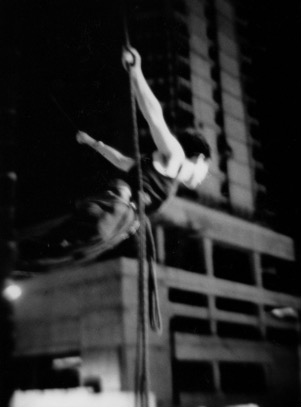
The DIY culture of the ARI years was launched with the installation of a sandpit on the mezzanine floor of Red Comb House and an invitation for all to come and play. The culture of intervention followed with artists: fishing for red herrings on the footpath outside One Flat South Brisbane; climbing the crane of the Queensland Cultural Centre construction site to replace a flag representing corporate ownership with the Indigenous flag representing identity, presence, and country; serving dinner out of a filing cabinet on the State Government helipad moored on the Brisbane River; hanging out of and off the sides of building facades to deliver punchy one-liners; roaming the inner city streets with musical interludes – yellow raincoats and ladders; using Australia Post for the transmission of art strategies and objects and covering the White Pages telephone book covers in public telephone booths with the Dark Ages version demanding Land Rights before Games in the lead up to the 1982 Commonwealth Games in Brisbane.
The old Westpac bank building on George St, Brisbane’s main NW/SE thoroughfare and home of Parliament House and the Executive Building became the site of direct and intense intervention with the establishment of the performance window. Peak-hour street-level performances would fuse incoherently with the bumper-to-bumper and pedestrian exodus heading north out of the city to suburban homes. The bank building was the site of the transition from inside to outside surfaces, where hair, crushed billboard paper, and living room wallpaper were plastered to the windows and walls.
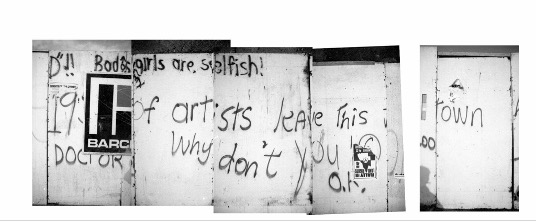
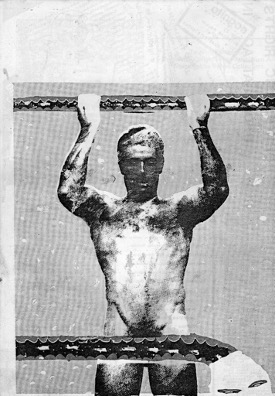
The images below represent anti-establishment arts activism in Brisbane in the early 80’s.




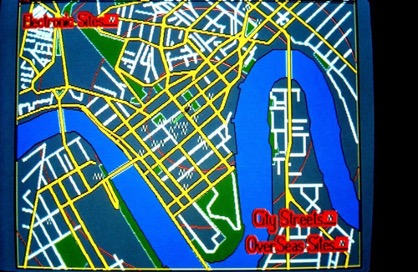
In late 1984, while attempting to document the interventions via a customized spreadsheet, I realized the need for a new method for mapping the cultural/historical landscape across the city. Adam Wolter, a fellow artist, responded by producing a digital map of Brisbane city with icons representing the activities. The map was called the Map of the World Revised Edition Database.
This is very early in relation to this kind of technology. Was this map available online? Was there even an online then??
We were using paper street directories to navigate cities, with a grid coordinate system of numbers and letters. The online integrated and connected world we know today didn’t exist back then. The digital map stood as a mockup tool for future use.
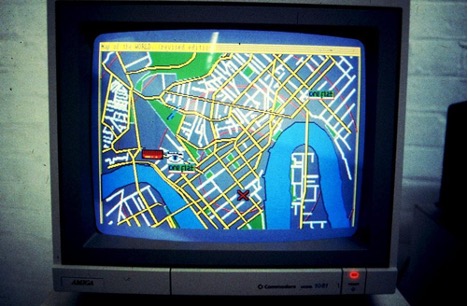
In 1985, I started researching telecommunications systems as the building blocks for interconnectivity, linking the physical to the digital and the local to the global. I believed that interconnectivity would bring visibility, traction, and agency to women, minority groups, and regional communities while creating new terrain in the fusion of physical and digital spaces.
I met with a local guy who was accessing North American bulletin boards. The green screen was filled with chunky text messages endlessly scrolling down. I started typing, “Make way, make way I’m coming through.” The screen went blank, and someone typed ‘Where are you from?” I responded with “Queensland Australia.” The screen exploded with messages like “Australians are the most beautiful people in the world” and “I know someone who lived in Australia.” The experience was intoxicating, and I could see that online communications would become an addiction we’d never escape from.
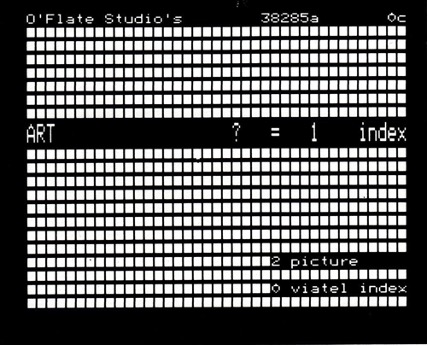
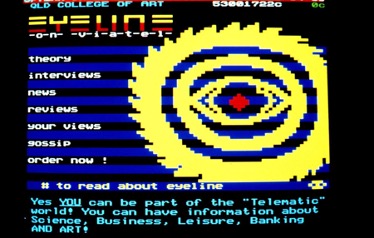
A chance meeting with the ex-policeman, who by then was working for the government-owned communications company Telecom Australia, allowed me to meet with the team rolling out Viatel, Telecom’s National Videotex System. The meeting led to the sponsorship of 20 pages on the system and the equipment to build and run the nascent site called O’Flate Studios.
I road-tested Viatel while traveling across Australia for the O’Flate National Art Safari in early 1986. I knocked on the doors of Telecom substations in far-outback New South Wales, asking to plug my modem into their outlet jack. Surprisingly, the doors opened! The safari extended my collaborative work with fellow artists Adam Boyd and Russell Lake, producing performance/video works for experimental art spaces in Fremantle, Adelaide, Melbourne, Hobart, and Sydney.
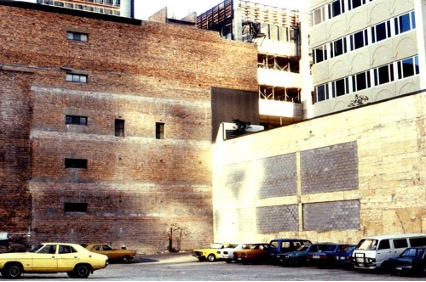
On returning to Brisbane, I applied my ideas for an interconnected physical and digital space, securing an open-air car park in the city center as the physical site and designing the Viatel site as the online connective tissue.
I chose to use the Videotex system over bulletin boards because it was structured as a central information base with menus and hyperlinks. Even though it was Lego chunky, it allowed you to lean into the digital world of conversation, connection, and engagement—a world that was clearly ahead of us.
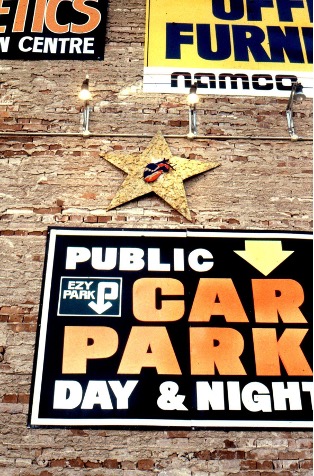
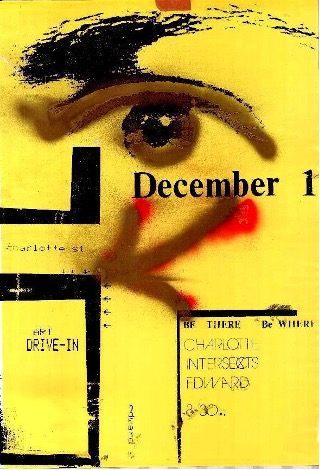
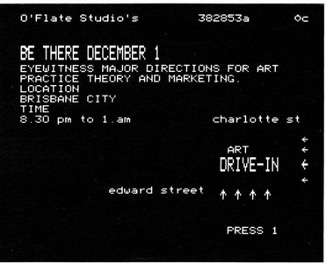
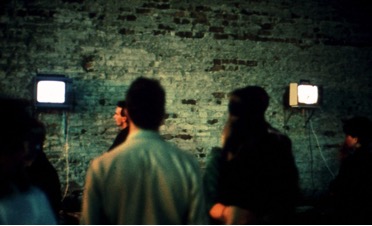
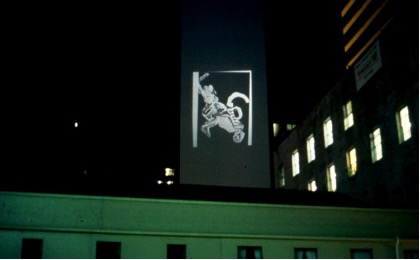
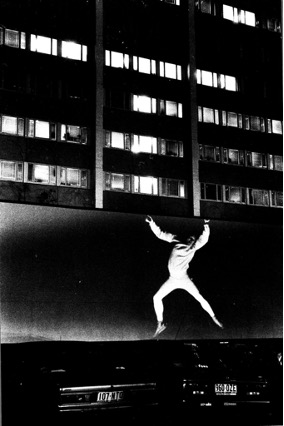
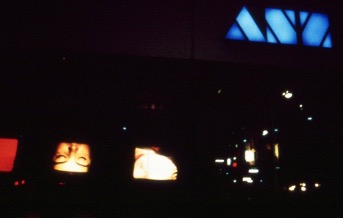
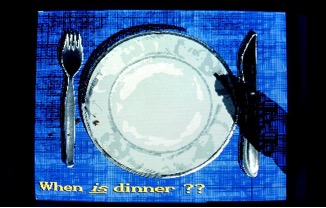
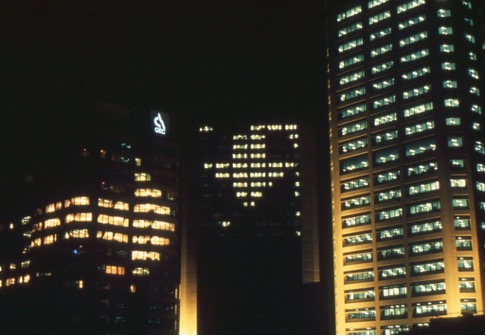
The project was titled Outdoor Art Drive-In and incorporated high-rise slide projections; an office lighting display of arrows illustrating information flow on the Queensland Health Building; three television monitors attached to the car park wall playing video performances and interviews with Brisbane artists + artworks and performances; and the first test run art image on the electronic display boards in the Queen Street Mall in the center of Brisbane.
The images below detail the Outdoor Art Drive-In 86 strategy to connect physical and digital space launching the O’flate Studio’s site on Viatel, Telecom Australia’s National Videotex System. This project acted as the template for the broader scope InterFace 88 project.


How was this project funded?
It was a zero-dollar budget, with equipment sourced via sponsorship and goodwill. I needed funding to upscale the Outdoor Art Drive-In template. Australia’s Bicentennial celebrations and Expo 88 were two years off, and there would be money to burn. However, these celebrations caused a significant rift in the arts community Invasion Day[1] celebration.
Ultimately, I chased funding as a woman, an artist, and a single parent. My application was successful, and I designed and developed the InterFace 88 Project as one of five Bicentennial Art Space projects across Australia.
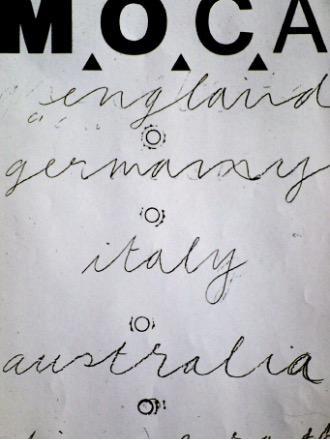
I used a domino-type strategy, building relationships and securing sites on high-rise buildings, electronic display boards, billboards, commercial buildings, retail stores, Hoyts Cinemas, Queensland Art Gallery, and the Queen Street Mall. Adam upgraded the digital map with site icons linked to scanned images of the artworks. Viatel was used to digitally ‘transcribe’ extracts from Eyeline Art Magazine and promote the InterFace Project. Images of site-specific installations were faxed to Brisbane from an artist, Diena Georgetti, who was traveling through Europe and displayed in a small gallery site embedded in an external wall at the Museum of Contemporary Art (MOCA) in South Brisbane.
Adding sound and music was a natural progression.
I secured a rooftop for musicians to play live and kind of lured Muzak systems into playing original sound works. I also tried unsuccessfully to organize a cycling club to attach boom boxes to their bikes and carry music from the community radio station through the inner city streets.
As I roamed the city through that two-year build, my combative relationship with the cityscape started to change as I could see and feel the city as an immersive experience of elevations, structures, surfaces, perspectives, colors, textures, movement, rhythm, information flow, and human activities.
Also, I wondered how indigenous artworks appeared to reveal a satellite view of the world with a visual narrative mapping of the country. How was it possible to have elevated viewpoints and perspectives without technology? Halftone billboard posters illustrated how fragments of color could become distinct images from a distance, and I started to see the city as a composition of stationary and moving fragments.
In late 1987, I found a company in Brisbane that had started wireframing Brisbane City using what was probably AutoCAD 3D. They gave me a printout of that early 3D modeling, which I used in the InterFace 88 promotion to illustrate moving through and around the cityscape.
All of this activity in the city must have had some impact. What was the local response to this project on the ground in Brisbane?
Gary Warner’s Boom Box Town & Country anti-consumerism sound work was shut down almost immediately by the Muzak System operator in the Queen St Mall. Micro minutes later, the plug was pulled on his curated New Media Art video work displayed on the 3 x 3 bank of monitors in the foyer of the Hoyts Regent Theatre Picture Palace.
I think this was a clear case of cultural dissonance as Crocodile Dundee II, Good Morning Vietnam, Coming to America, and Three Men and a Baby were Hoyt’s cultural staples.
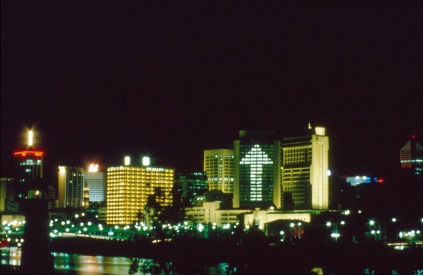
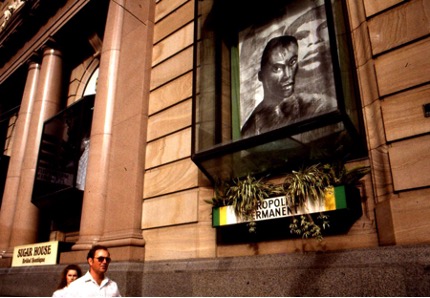
The InterFace 88 Project scaled up the Outdoor Art Drive-In template with sites across the inner city, allowing for high-rise projections, still images, electronic images, video and sound installations, performances, and sculptural installations. Images were faxed and displayed from overseas. The arrows floating up and around the building facades represented the information flow in the coming interconnected world, while the two computers set up in the Queen St Mall demonstrated the fusion of physical and digital space via the inner city map with site icons linked to scanned images of the artworks and the videotex site, invited visitors to interact with art information, ideas, strategies, and projects.





Was there any interest in these works nationally or internationally?
The Interface Project gained recognition when I presented it at the First International Symposium on Electronic Art (ISEA) during the Networking in the Arts Workshop in Utrecht, Holland, in 1988. Later, I received an invitation from Carl Loeffler, Director of ACEN (Art Com Electronic Network) based in San Francisco, to present the Interface Project at the 1989 NCGA (National Computer Graphics Association) Arts Conference panel The Shaping of Tele-Culture held at San Jose State University, California, USA.
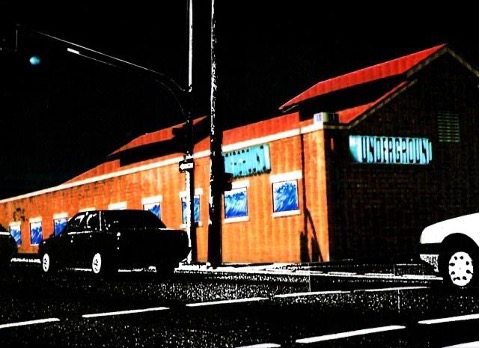
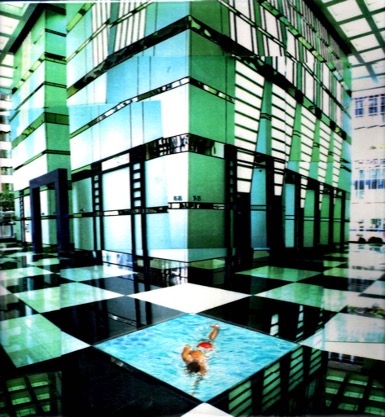
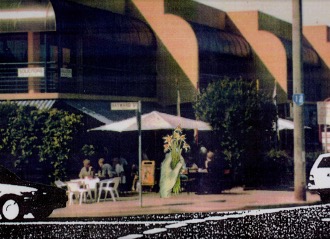
From 1988 to 1992, I researched Main Street revitalization strategies and festival event management. I wanted to explore the rhythm, energy, and logistics of street-level festivals while treading water, waiting for the time when images could be uploaded to the emerging internet. By 1992, I’d started to distil my work and ideas into a technology-based public art strategy where waves could wash up and against building facades, animated cars could twist and dance along the streetscape, swimmers could swim through foyers, and sculpted body parts constructed with molded flexible monitor technology displaying mass media content could emerge from footpaths. Again, these projections were for future technologies like flat and flexible LED screen technology.
1992 Technology-based Public Art Strategy Proposal:

You disappeared from the art scene in the early 90s only to reemerge for the Ephemeral Traces exhibition at the University of Queensland Art Museum in 2016. Where have you been for those 25 years?
I left the art world in 1993 after moving to the outer Brisbane suburb of Inala and finding myself enmeshed in the warfare of domestic violence, terrorism, threats of paternal filicide, and battles in the Family Court arguing for the right to say no to violence.
Through the sixteen years I spent raising my children in social housing in multicultural Inala, I experienced poverty, economic and social discrimination, and the never-ending legacy of colonialism, The White Australia Policy, and the criminalization of people of color. Every child (Indigenous, Islander, Sudanese, Vietnamese) we met through school and sport had been pulled up and questioned by police on the streets or followed by security in retail stores and shopping malls. Children of color were targeted and tagged as ever-present threats to white homogeneity. These children would then, in their frustration, rage, and confusion, ethnically band and turn on each other, brawling for territory, authority, and meaning.
In what way did these life experiences inform the direction you now take in your art practice? And where are you headed—what is in store?
As I returned to arts practice, the palette of my experiences was challenging. I understood the tsunami waves of damage caused by proprietary violence and had witnessed the impact of transgenerational racism on individuals and across communities. It was hard not to see violence flying every which way. Cities are supposed to be expressions of civilization, innovation, inclusion, and cohesion, but I saw cities as sites of dispossession, displacement, fractures, and fissures.
Brisbane city seems trapped in an evolutionary authoritarian loop. It has the appearance of a dystopian film set, where every square millimeter of space is bursting with brutalist props, textures, and structures. Facial recognition surveillance technology and social credit systems will blend seamlessly with this style guide, and I feel compelled to ask – has open space become anathema to architects and urban planners, or is everyone just desperate for a slice of the pie, a piece of the action and the desire to make their mark?
But still you want to work in this space?
Yes, but non-destructively. I’m drawn to the Burning Man principle of ‘Leaving No Trace’ – other than in collective memory and presence across the digital landscape. It’s an attempt to strategize minimalist interventions by not adding permanent structures or objects as prescriptive cultural filler to the city and finding ways to work with elements, recycled objects, and materials within ephemeral, transient, and provisional practices.
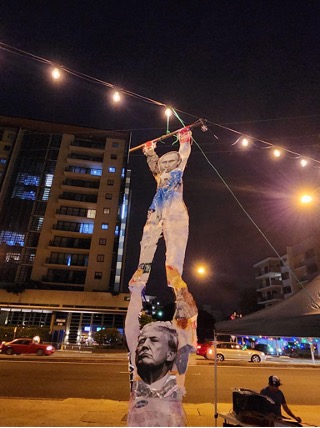
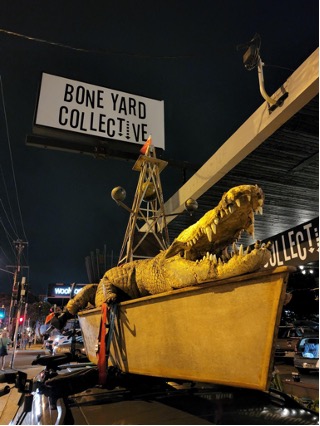
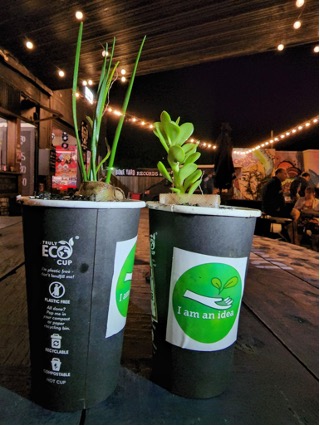
The recent Boot Art Project 22 – 23 exemplifies this strategy. Boot Art was a wilding art strategy grafting public art with a past-era service station site repurposed as the Bone Yard Collective Vintage Record Store and Espresso Bar. Artists were invited to work in, on, and out of their vehicles within an open engagement framework, exploring their interests and concerns. Walter Stahl’s work Crocland became a mobile intervention with a folkloric outcome as he crisscrossed Brisbane with his 3mt croc attached to his roof racks. Community drawing strategies, The Big Painting project, and speed painting comps were run out of the service station car park. Participants sprawled across the open space with canvases, paints, brushes, paper, and pencils, eager to learn new techniques and share in communal creative expression.
The Boot Art Wilding Art Strategy generated a quick-draw DIY response to creative engagement within the urban environment and the freedom to work outside the scripted objectives of city planners, architects, tourism, and public art authorities.





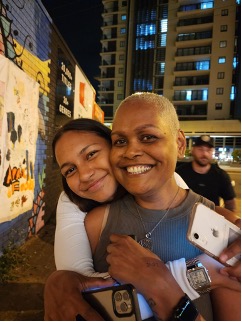
Your engagement with the city seems as vital and thoughtful now as it was in the 1980s.
I think I’m less recklessly combative and more strategic. This is probably a parenting thing. The interconnected world we could only dream of in the past is here with a million and one intermedial tools to be explored and tested. I’ve started testing them but with a deep sense of humility, respect, and homage to Australia’s First Nations people’s cultural affinity with responsibility and stewardship for the environment.
I have two projects under R&D that arc the physical and digital: Beautiful Data Dangerous DNA and In the Real Estate of the #.

Beautiful Data Dangerous DNA is evolving as a transformative engagement strategy inviting victims of domestic violence who have experienced trauma, dispossession, and displacement in houses, streets, suburbs, and cities to use the intimacy of digital space with the element of water to give acknowledgment to their experiences and share in the creation of communal healing spaces.
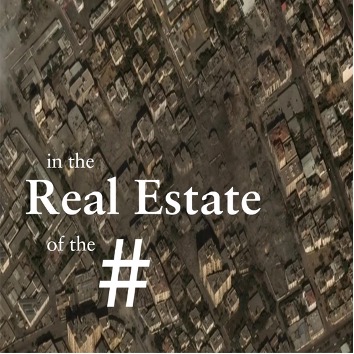
In the Real Estate of the # started with a simple proposition to utilize the # as a virtual project in response to the city’s lack of affordable real estate. But then the 2023 Referendum on an Aboriginal and Torres Strait Islander Voice to Parliament happened in Australia. Social media, homes, community centers, and polling centers were flooded by a mess of transgenerational racism and conspiracy theories, erupting across the landscape of white Australia and then evaporating without consequence in the public persona of Australia’s multicultural cohesion. The # could have been used to scoop and document the NO vote as a way to study the underbelly of the beast that’s Australia’s colonial history and racist reality. This was a lost opportunity, but from that point on, I started to see the hashtag as a multifaceted connective tissue in the intermedial toolkit.
Hashtags as cultural signifiers and markers have the potential to direct and harness our collective responsibility and conscience and in the case of #gaza, function as a gut-wrenching real-time aggregation of the destruction of the 360 square kilometers of the Gaza territory, the Palestinian people, and their culture.
As artists, we have so much terrain to explore across the physical and digital worlds and so many tools at our fingertips and I’m increasingly drawn to crisis-responsive art strategies and of course collaborative relationships.
Thanks so much, Jeanelle it’s good to have you back!
[1] January 26 is celebrated in Australia as Australia Day, marking the landing of the First Fleet in 1788. It has been renamed Invasion Day or Survival Day by First Nations people since the bicentennial in 1988 and is marked by protests around the country.