Waste as a Dual Face of Power in Popular Urbanization: A Tool of Solidarity and a Tool of Control – Study of Lille Metropolitan Area in France and Cairo, Egypt
Introduction
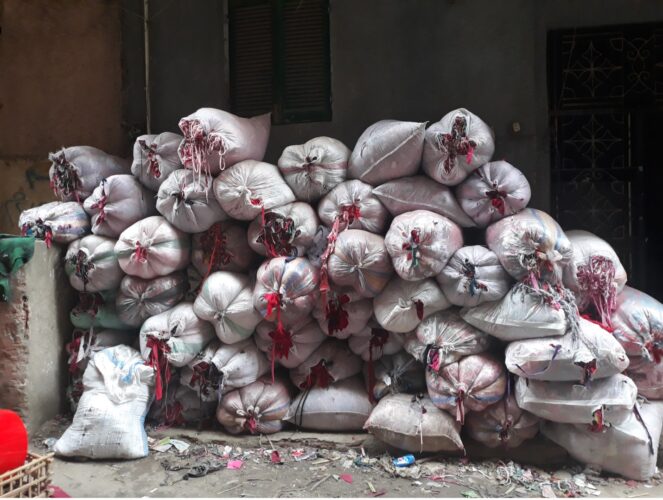
Waste handling has attracted considerable attention from municipal officials, practitioners, activists, and scholars globally in recent decades. In Egypt, the topic is even considered over-researched within academic literature (Desvaux, 2019). While waste constitutes a public issue affecting urban quality of life, cleanliness, and hygiene, it also functions as a critical source of livelihood in urban environments (Rosa & Cirelli, 2018). In contexts of popular urbanization—which exhibits particular configurations in both the Global North and the Global South—waste is prominently visible, particularly in dense activity spaces such as marketplaces, small retail shops, and informal manufacturing sites.
The term “popular urbanization,” as proposed in my PhD thesis (Eldefrawi, 2025), departs from the conventional notion that equates it with districts of the urban poor or working class. Instead, it encompasses diverse social statuses, defined by modes of economic organization under the ṭawā’if hierarchy. As outlined in my dissertation, this type of urbanization is configured by three main pillars—a unified party, prescriptive regulations, and gradual growth—which distinguishes it from urbanization driven by expert alliances and large-scale corporations.
These spaces often coexist with accumulations of waste generated by traders, artisans, and local residents. This visibility raises two central research questions: What does the visibility of waste signify within popular urbanization? How do authorities instrumentalize this visibility?
To address these questions, this article analyses waste practices in France and Egypt, introducing new dimensions to the understanding of waste in popular urbanization alongside parallel urban interventions implemented by authorities and experts. Waste is not addressed here as a neutral subject within popular urbanization, nor are popular groups characterized as inherently “dirty”. Rather, the focus extends beyond surface-level manifestations to examine the underlying social dynamics and mechanisms of stigmatization (Eldefrawi, 2025). The discussion identifies two dual mechanisms of power dynamics regarding waste in popular urbanization: “Solidarity Power” (“Waste as Social Capital”) and “Control Power” (“Waste as an Instrument of Governance”).
The first part of this article traces findings from fieldwork, which reveal that the visibility of waste in popular urban areas allows authorities to exert control through stigma associated with cleanliness and hygiene protocols. This stigma justifies urban interventions that often involve relocation programs, which sever social ties and disperse communities, thereby weakening collective structures (Vulbeau, 2018). The article examines tactics (according to De Certeau’s terminology), used by powerful groups to construct stigma around this form of urbanization through the discourse of “cleanliness.” This stigma does not function merely as a hazard, but as a mechanism of “stigma power” to control practices that operate outside standardized systems (Chikarmane, 2016; Luthra, 2020a). This stigma power is accompanied by what Bourdieu (1987) terms symbolic power, revealing how dominant groups impose codes of hygiene and order, thereby marginalizing alternative practices. Finally, structural discrimination emerges in urban policies and laws targeting “popular urbanization,” such as France’s “politique de la ville,” which specifically targets popular districts.
Moving from stigma power, the second part of the article explains how popular groups perceive waste and why its visibility is particularly apparent in their contexts. It emphasizes that group practices drive visibility by transforming waste into an instrument of social cohesion and economic solidarity. Under the concept of “waste for share”, waste in public spaces becomes part of the social fabric. Items left on the pavement or beside waste containers are understood to serve informal sharing networks, extending product lifespans and creating economic opportunities. Cultural practices, such as Islamic concepts like “israf” and “tabzir” (the avoidance of waste) and the principle of “la darar wa la dirar” (no harm and no reciprocating harm), guide waste minimization and resource maximization. Waste in popular urbanization can also serve as a livelihood for resident groups, such as those in Ezbet Al-Nakhl in Al-Matarīyya. Here, the article highlights the power of organization under the “tawā’if” (guild) system and the use of traditional practices like the appropriation of fina’ (a custom in Muslim countries to occupy the street near the house door or businesses (Al-Hathloul, 2005; Barau, 2010, Ahmed, 2015)), which compete with the hegemony of Western waste handling methods. Finally, the article concludes by noting that some of the visibility of waste in public spaces results from the failure of standardized waste handling systems, which often fail to respect local consumption patterns, leading to “waste everywhere”.
Research Methods
This research draws upon ethnographic fieldwork conducted across three distinct phases and contexts. The initial phase (2004–2016) took place in Cairo and the Lille Metropolitan Area (LMA), during which the author participated in various projects as a researcher at the HBRC Research Centre in Cairo. This work continued from 2016 to 2019 as part of the author’s PhD research in the same field. Most recently, in 2026, the research expanded as part of a postdoctoral fellowship funded by the University of Paris 8, focusing on waste handling practices in the popular district of Wazemmes in Lille.
The methodological approach combined observational studies with semi-structured and in-depth interviews conducted with residents, traders, municipal officials, and waste workers. Additionally, the research involved a critical examination of urban planning documents, municipal policies, and historical records related to the respective urban projects. Fieldwork was situated in two distinct geographical contexts: the Lille Métropole Agglomeration (LMA) in France—specifically the Pile district in Roubaix and Wazemmes in Lille—and Al Matarīyya in Egypt, including the districts of Ezbet Shalabi and Ezbet El Nakhl.
Particular attention was paid to specific spatial units, notably courtyards or backyards (known as “Ḥosh” in Arabic), which remain dominant architectural features in many popular areas of Al Matarīyya and LMA. Furthermore, the research traced the trajectories of waste left in street corners or adjacent to waste bins across various activity zones in these popular districts. Examples include pallets in the Wazemmes marketplace in Lille and organic leftovers in the Semeika market in Al Matarīyya.
In Roubaix, characterized by its status as a “popular centrality” within LMA (Collective Rosa Bonheur & Miot, 2016), the research focused on the implementation of urban renewal projects within the framework of the French “politique de la ville”. This policy identifies urban areas requiring renewal or renovation, with eligibility calculated in 2014 based on household income levels. In Al Matarīyya, the research concentrated on Ezbet El Nakhl, a district specialized in waste management, as well as surrounding marketplaces and workshop spaces.
From Roubaix to Al Matarīyya: Waste as a Tool for Urban Interventions
Pile, Roubaix
The significance of waste in popular districts first emerged during my fieldwork in 2014–2016, conducted in the Pile district of Roubaix with support from a grant by the French research institution in Cairo. In collaboration with Julien Talpin from the University of Lille 2, this research initially focused on the participation of popular groups in urban renewal projects. However, waste handling surfaced as a critical theme during observations of the “maison du projet,” a space central to the urban renovation program in Pile.
Designed as a “participatory space” to facilitate engagement between residents and urban professionals—such as architects and technicians—the “maison du projet” was intended to involve residents in decision-making processes. Nevertheless, over two years of observation, the space failed to effectively communicate project details to the community. Rather than fostering genuine inclusion, it appeared to divert attention away from the urban development process, thereby undermining its participatory objectives (for further analysis see Eldefrawi, 2025).
Notably, during semi-structured interviews with project experts, the district’s “dirtiness” was repeatedly cited as justification for intervention. The project’s architect, for instance, expressed concerns regarding abandoned furniture and household items left on the pavement. Despite the urban plan originating from the National Agency for Urban Renewal (ANRU)—which involved the expropriation of hundreds of small private housing units for demolition or repurposing—the architect’s “participatory” approach resulted in only limited modifications to this displacement program. The architect framed these minor adjustments in his revised proposal, “Pile Fertile”, as essential for reconstructing the district’s image as clean and aesthetically refined, employing strategies of population reduction and waste minimization.
Over the two-year period, the “Pile Fertile” architectural team conducted workshops and surveys within the “maison du projet”, focusing heavily on cleanliness and environmental themes. These concepts were subsequently utilized to justify their updated design proposal. Following this so-called “participatory period,” the revised design featured additional expropriations, demolitions, and relocations of small private houses to create what the architect described as “green islands.” In subsequent interviews, the architect revealed that these islands were intended to conceal waste disposal facilities (Interview, 2016).
When residents realized that the revised design, ostensibly based on their participation, had led to the displacement of more neighbours, they expressed regret over their involvement, questioning who exactly the project was “fertile” for. This dynamic was documented in the 2018 film “Pile: Permission to Demolish,” which portrays the displacement of one household (Mary) during the second phase of the “Pile Fertile” plans. This highlights how waste and cleanliness functioned as key instruments in the intervention process. Even when residents formed a collective to resist the relocation program, elected officials employed tactics to prevent the formation of a united front, despite maintaining a highly participatory discourse (Talpin, 2016).
A similar connection between cleanliness and displacement was articulated by the head of “Fabrique de quartier”, one of the agencies responsible for projects under the “politique de la ville.” This discourse was reiterated in interviews with municipal officials, including the deputy mayor. In Pile, waste was not merely a rhetorical device for urban intervention; the pursuit of cleanliness resulted in material consequences, such as the closure of houses for demolition. By 2016, approximately 30% of homes were vacant or demolished, creating “no man’s land” areas where garbage accumulated due to unclear responsibility (Arab & Miot, 2021).
Al Matarīyya, Egypt
Following the research in Roubaix, the study was extended to the Greater Cairo region at the end of 2016. The findings from Cairo revealed thematic resonances with those previously observed in Roubaix. This research initiative in the Greater Cairo region began in 2017 through a collaborative partnership with Maike Didero, culminating in an article published in “Égypte Monde Arabe” (2019). In 2018, the research focus intensified on the Al Matarīyya district, specifically Ezbet El Nakhl, a neighborhood specialized in waste handling activities. Concurrently, systematic observations were conducted in marketplaces and workshop areas throughout Al Matarīyya to document spatial practices and waste management dynamics.
Similar to the case in Roubaix, interviews with the district chief in Al Matarīyya revealed that waste generated by popular markets and workshops was a primary factor driving relocation objectives. For instance, the chief’s intention to relocate the Al Khamīs marketplace was predicated on reducing the visibility of waste and associated congestion, thereby creating a cleaner urban aesthetic—particularly in central public spaces such as Al Matarīyya Square, where the market operates weekly. These same urban renewal objectives were consistently echoed in interviews with representatives of other local administrative units in Cairo, including Al Basteen, Boulaq, and South Giza districts.
In 2020, municipal authorities initiated the relocation of Al Khamīs market segments that were prominently visible to pedestrians along main thoroughfares, operating under the official slogan “Restoring the urban appearance of streets and squares”. However, market segments situated within narrow alleys between residential structures continued their activities. This dichotomy illustrates the hierarchical power dynamics of Egyptian municipalities over large public spaces, while smaller alleyways remain governed by traditional fina’ regulations. These informal rules remain operative and are principally controlled by local residents and traders.
The relocation of the Al Khamīs open-air market to a semi-enclosed kiosk complex called Al Masla, situated on the district’s periphery near a highway, significantly disrupted established commercial order and accessibility patterns. Residents now face transportation challenges, including the need to navigate highway crossings to access the market, which has substantially reduced customer frequency. While the visibility of waste persists in the new market as a normal outcome of the activities of hundreds of vendors, waste management in the original location was more effective due to local arrangements among participants. In the new site, this informal organization has been disrupted, leading to emerging conflicts over cleanliness.
Waste and the stigma power of popular urbanization
Link et al. (2015) define stigma power as instances where stigma processes achieve the aims of stigmatizers regarding the exploitation, control, or exclusion of others. Drawing on Bourdieu’s (1987; 1990) work, they emphasize that power is most effectively deployed when hidden or “misrecognized.” Phelan, Link, and Dovidio (2008) identify three primary objectives achievable through stigma: exploitation and domination (“keeping people down”), enforcement of social norms (“keeping people in”), and exclusion of those deviating from normal appearance (“keeping people away”). The key insight is that stigma exercises serve underlying motives or interests of powerful groups seeking to achieve specific ends (Hatzenbeuhler et al., 2013).
Applying the concept of “stigma power” to waste handling in popular urbanization reveals how new cleanliness standards and hygiene protocols established in cities, rendering any outside act with the stigma of “uncleanness.” While officials and experts have created standardized regulations, they create conflicts with certain cultural practices like popular groups concerning waste—such as “circulating waste” between them as an expression of solidarity—contradict these standards. A leftover couch in an alley—where popular groups are not bothered by its presence and actually use it as seating as part of the public arena—becomes unacceptable to authorities and professionals arguing for aesthetic and hygiene factors. This “one standard” approach cannot be separated from the hegemony of Western notions on “behaviour” that misrecognize lifestyles of people from ‘other’ places worldwide (MacGregor et al., 2019). This creates pressure on “others,” whether popular groups, migrants, or others, to conform to standardized practices or lie under “stigma power” for their different approaches.
Some scholars in the Global North, where waste handling rather relies on mechanized systems, connect this stigma with outsiders to cities. MacGregor et al. (2019), in their work on Somalis in the UK, challenge the assumption that newcomers from the Global South are less capable of sustainable practices and that they require adaptation programs to comply with standards. However, the French experience in this study enlarges the discussion from “immigrants” (even LMA has a large immigrant population) to the stigma attached to certain city dwellers that do not follow contemporary “standardized” practices. Power dynamics related to waste emerge in discussions about the imperialism of Global North methods over Global South practices, even when the latter proves more efficient.
Another lens to read waste-related stigma is through Bourdieu’s (1987) concept of “symbolic power.” Symbolic power operates through legitimized visions of the social world. Since stigma represents statements about value and worth made by stigmatizers about those they stigmatize, it functions as a form of symbolic power in Bourdieu’s framework. However, Bourdieu (1990) also notes that people disadvantaged by symbolic power often internalize cultural assessments of their value and rightful (lower) place in the social order—a phenomenon evident in “internalized” or “self” stigma (Corrigan & Watson, 2002), which is not the case among popular groups who present their approaches toward waste circulation and sharing without feeling ashamed. This unconcern for stigma, is sometimes driven by practices rooted in religious concepts, like “israf and tabzir” in Islam that aim to maximize the use of objects (Farida Achmad, 2022; Eriza et al., 2024; MacGregor et al. 2019), that are stronger in their values than authorities’ regulations and stigmatization. But it remains a way for those in power to exercise power over these areas.
On another level, in the Global South, areas where waste is considered as a livelihood, involved groups are usually not considered as part of the mechanism of waste handling even through many researchers emphasize their efficiency (Wittmer, 2022). Power and hegemony often operate through expert knowledge discourses (Foucault, 1980) and standardized processes that marginalize alternative practices (Jayasinghe, 2019).
Another level of stigma over the visibility of waste in popular urbanization is created through a “Structural Discrimination” by authorities’ laws and structures that frame certain places as “popular districts” under specific urban policies, like France’s “politique de la ville” or in Egypt under the name of “informal” or “chaotic.” It makes them subject to certain urban programs that stigmatized residents cumulatively over time through social policy, laws, and institutional practices (Hatzenbuehler et al., 2013) experienced in France and Egypt using waste as key points constituting urban policies and programs.
From Waste “for share” to Waste “everywhere”
The visible presence of waste in public spaces often reinforces the perception that residents lack cleanliness habits associated with modernity and civilization (Furniss, 2015). The processes of civilization and standardization have conditioned urban dwellers to reject the visibility of waste, increasingly framing hygiene as a primary marker of civility (Kokoreff, 1991). Accordingly, this section examines three interconnected dimensions of waste in popular urbanization. First, the relationship between popular groups and waste in daily practices. Second, waste as a specialized livelihood sector governed by the “tawā’if” (guild) organizational structure, exemplified by Ezbet Al-Nakhl in Cairo, where comprehensive activities including collection, sorting, recycling, and trading occur (Didero, 2012; Didero & Eldefrawi, 2019). And third, the mishandling of waste by standardized collection systems incompatible with residents’ lifestyle, cultural factors, and waste production patterns.
This third dimension echoes Jolé’s (1991) study of Maghreb cities, which emphasized the importance of cultural context in assessing cleanliness. In Muslim cultures, where household purity holds significant religious importance, waste accumulation in public spaces may reflect cultural priorities regarding the cleanliness of internal domestic spaces rather than negligence (Jolé, 1991). This analysis reveals a systemic disconnect between standardized waste management models, often derived from Western paradigms, and local realities. The hegemony of these standardized approaches frequently contributes to inefficiencies and the proliferation of waste in public areas.
Waste for Share: Socio-Cultural Dimensions of Waste Practices
Research in popular districts of both the Global North and South indicates that the presence of waste in public spaces is significantly influenced by socio-cultural factors rather than negligence. Fieldwork in LMA and Cairo demonstrates that residents frequently conceptualize waste as a resource for redistribution rather than as refuse destined for “no man’s land”, as they often express it. Traders, artisans, and community members establish informal networks for waste transfer through tacit agreements, leaving items in communal areas for others to utilize.
Thus, the waste visible in street corners—which disturbs architects and officials—is revealed by residents as an act of solidarity. In Pile, France, Fatima explained in an interview that items no longer needed in her home, such as couches and appliances, were left for Farid, a resident who collected and recycled or upcycled materials in his courtyard. Farid’s house, strategically located at a street corner, facilitated this exchange. Fatima emphasized the solidarity and support inherent in Farid’s activities, preferring this practice over transporting items to official disposal sites or “no man’s land.” This practice of leaving items on the pavement or beside waste containers raises critical questions about the meaning of waste visibility in popular urbanization. Similarly, Manal in Epeule reported leaving her children’s toys outside, noting, “I know other neighbours will be interested in those toys, and they will pick them up later” (Interview, 2017).
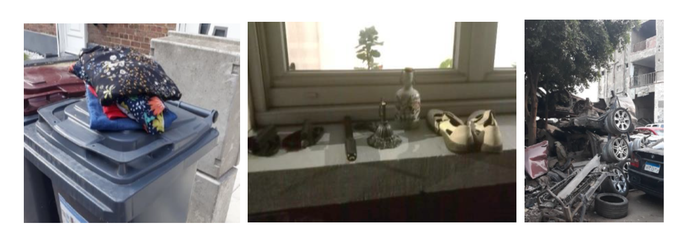
This principle of waste redistribution extends beyond human networks to include local wildlife. The mutual aid aspect of these practices also extends to environmental relationships, with residents frequently sharing food waste with local wildlife. Fawzi in Epeule explained his preference for feeding pigeons and cats rather than disposing of food waste in trash bins, arguing, “The human value and religious significance of ‘sharing’ are more substantial than the temporary image of ‘mess.'” This perspective reflects a cultural understanding of waste as potentially valuable material, challenging the dominant aesthetic concerns of urban governance. Discarding bread, clothing, furniture, and toys in communal spaces or near waste bins contributes to waste visibility, yet this practice reflects community ethics rather than a disregard for cleanliness (see Figure 1).
In Egypt, similar dynamics are observed in Sūq Semeika in Al Matarīyya, where organic waste from vegetables and fruits is strategically placed in corners to be consumed by goats brought by a local breeder. Interviews with market traders revealed that this temporary visibility was not problematic, particularly because they selected a wall beside the metro station where no residents lived—an unoccupied area. Their perspective aligns with the Islamic concept of “la darar wa la dirar” (no harm and no reciprocation of harm), emphasizing that supporting the goat breeder justified the temporary uncleanliness at that specific location (Eldefrawi, 2025).
A comparable pattern emerged in interviews with car repair workshops in Ezbet Shalabi. Artisans left unused materials (in Arabic Khorda), in designated corners for collection by individuals working in the recycling sector. The visibility of Khorda piles did not concern them. Rather, they prioritized the efficiency of network-based exchange over immediate aesthetic concerns.
Waste Handling and the Stigma Driven by the Hegemony of Western Model
The analysis of waste practices in popular urbanization reveals deeper power dynamics when waste handling constitutes not merely individual acts by popular groups, but a specialized livelihood like Ezbet Al Nakhl in Al Matarīyya. My doctoral study emphasized how they are still today organized under ṭawā’if organization that has historically handled municipal waste for centuries (Eldefrawi, 2025). This evolved into two groups Al Wahīyya and Al Zabbālîn network (du Roy, 2019; Fahmi, 2005; Furniss, 2012). Although British colonial administration officially abolished it in the late 19th century, it continued operating unofficially as was traced in Cairo through the hierarchy from “ma’lem” (head of the organisation) to the ‘sabi” (the apprentice) (Eldefrawi, 2025).
This system of waste handling faced difficulties by the middle of the 20th century. Since the 1960s, Egyptian decision-makers have demonstrated a persistent fascination with Western models (Ghannam, 2002), particularly evident in waste handling reforms implemented with international agency support (Desvaux, 2019). The 2003 initiative by Cairo’s governorate to replace traditional systems with multinational corporation-led operations exemplifies this approach, introducing large-scale container systems and automated collection methods modelled on Global North practices (Furniss, 2012). However, this Westernization process ultimately failed by 2010, leading to a recognition that imported systems were incompatible with local contexts (Al-Ahram, 2010).
The hegemony of Western models led to a stigmatization of local methods as “backward” or “uncivilized”. Specialized waste-handling areas are subject to negative perceptions due to visible sorting and processing activities in fina’. Second, authorities impose regulations that criminalize traditional practices like the appropriation of fina’, even maintaining them on the ground, creating a contradiction between official policy and practical reality (Eldefrawi 2025, Ahmed, 2015). Third, the complex organizational structures of ṭawā’if systems—with their intricate business networks extending beyond standardized approaches—are systematically devalued despite their demonstrated efficiency and sustainability (Assad, 1996, 1997).
This Western-centric perspective influences not only policy decisions, but also scholarly approaches. As Desvaux (2019) observes, Western scholars often exhibit fascination with waste handling practices in the Global South that deviate from “normal” Western models, framing them as “monstrous” or exotic. Conversely, some scholars from the Global South adopt a “developmentalist” perspective that views Western models as ideals to be replicated (Fahmi, 2005; Furniss, 2012).
The hegemony of one model is based partly on the western state-society relationship. Western models typically presume state legitimacy while portraying alternative systems as “abnormal”. This perspective marginalizes global south community-based practices even though they are often more efficient (MacGregor et al., 2019).
Waste Everywhere: Systemic Inefficiencies and Cultural Mismatch
Besides the existence of some socio-cultural waste practices that lead to waste visibility in popular areas, standardized collection systems also create conditions that result in waste accumulation. Urban authorities frequently implement generalized approaches that minimize adaptation to local social and cultural contexts, contributing to systemic inefficiencies. This mishandling has been traced in Roubaix and Cairo, where waste challenges are often attributed to resident behaviour rather than system failures.
In the “Pile Fertile” renovation project, recommendations for street-corner disposal bins failed to account for the district’s specific cultural and demographic waste production. Three common cultural factors were traced in Roubaix’s and Cairo’s popular areas: first, large family sizes which generate greater household waste production. Second, the cultural practice of “open door” (al lama) results in frequent visitors, increasing waste generation beyond typical household patterns. Third, traditional cooking practices involving fresh, organic ingredients—such as tajin in North African, or mahshi (filled vegetables with rice) in Egyptian homes (Eldefrawi, 2025).
These cultural factors, combined with limited collection frequency, create conditions where waste accumulation becomes inevitable. Residents often prioritize maintaining cleanliness in their private spaces while accepting waste visibility in public areas, recognizing that organic waste poses greater health risks when stored indoors (Jolé, 1991).
Another example highlights the failure of official system of waste handling: the experience in Cairo in 2003 during the transition from door-to-door ṭawā’if collection to western-automated collection (Furniss, 2015). The enforced imported model didn’t take into account cultural and social dimensions such as accessibility issues and work hours, which led to its failure and the continuation of the tawā’if system despite its stigmatization (Elsakka, 2014).
In conclusion, urban waste functions as a site of power, particularly in popular districts where local meanings diverge from official narratives. It presents an imperialistic power form that disregards locally adapted practices developed over generations. Visibility of waste—whether rooted in the social, economic, or religious practices of popular groups, or in authorities mishandling standardized system—is frequently misread as negligence or cultural deficiency of residents. This misinterpretation is crucial as it transforms waste into a political contest, serving as a mechanism for asserting control over urban spaces.
References
Achmad, L. F. (2022). Religious perspectives on waste management in Indonesia. Gadjah Mada University Press. https://doi.org/10.14421/rejusta.v21i02.6263
Al-Ahram. (2010). “Cairo’s waste management crisis: Lessons from failed privatization.” Al-Ahram Weekly.
Ahmed, K. G. (2015). “Investigating ‘Relevancy’ of the Traditional Principle of the Right of Appropriation of Open Space and Fina’ in Contemporary Urban Poor Communities in Cairo, Egypt.” Journal of Architecture and Urbanism, 39(4):260–72. https://doi.org/10.3846/20297955.2015.1113674
Akbar, J. (1988). Crisis in the Built Environment: The Case of the Muslim City. Concept Media
Al-Hathloul, S. 1(981). “Tradition, Continuity and Change in the Physical Environment: The Arab-Muslim City.” PhD Dissertation, Massachusetts Institute of Technology.
https://doi.org/10.1016/0264-2751(97)90005-6
Arab, N. and Yoan M. (2021). “Espaces vacants et dégradation du cadre de vie dans une ville décroissante : le cas de Roubaix.” Cybergeo: European Journal of Geography [en ligne], URL : http://journals.openedition.org/cybergeo/37759 Assaad, Ragui. 1997. “Kinship Ties, Social Networks, and Segmented Labor Markets: Evidence from the Construction Sector in Egypt.” Journal of Development Economics. 52(1):1–30. https://doi.org/10.4000/cybergeo.37759
ANRU. (1990). “Urban renovation project documentation” Agence nationale pour la rénovation urbaine.
Assaad, R. (1996). “Formalizing the Informal? The Transformation of Cairo’s Refuse Collection System.” Journal of Planning Education and Research. 16(2):115–26.
Bourdieu, P. (1987). The Force of Law: Toward a Sociology of the Juridical Field. Hastings LJ, 38, p.805.
Bourdieu, P. (1990). The Logic of Practice. Stanford University Press.
Chikarmane, P., (2016). Public space, public waste, and the right to the city. New Solutions: A Journal of Environmental and Occupational Health Policy, 26(2), pp.289-300. https://doi.org/10.1177/1048291116652689
Collectif Rosa Bonheur, Yoan M. (2016). Centralité populaire : un concept pour comprendre pratiques et territorialités des classes populaires d’une ville périphérique”. SociologieS [En ligne]. Dossiers. URL: http://journals.openedition.org/sociologies/5534
Corrigan, P.W. and Watson, A.C. (2002). Understanding the impact of stigma on people with mental illness. World psychiatry, 1(1), p.16.
Desvaux, P. (2019). “Introduction: les Zabbâlîn, un objet sur-étudié?” Égypte/Monde arabe 19(1):19–32. https://doi.org/10.4000/ema.4452
Didero, M. (2012). “Cairo’s Informal Waste Collectors: A Multi-Scale and Conflict Sensitive Perspective on Sustainable Livelihoods.” Erdkunde, 66(1):27–44. DOI:10.2307/41444861
Didero, M. and Eldefrawi S. (2019). “Cairo’s Zabbaleen. (Dis-)Entangling the Urban and Social Geography of Informal Livelihoods in a Globalized Megacity.” Egypte/Monde Arabe 19(1):91–110. https://doi.org/10.4000/ema.4606(2025).
Du Roy, G. (2019). “Imaginer les marges urbaines du Caire : les zabbâlîn en récits.” Egypte/Monde arabe. 19(1):33–50. https://doi.org/10.4000/ema.4505
Eldefrawi, S. (2025). Popular urbanization addressed through the group’s politics in vending, car repair and waste handling. The case of Egypt (Greater Cairo Region) and France (Roubaix). unpublished doctoral dissertation, University of Paris 8.
Elsakka, Sherine. (2014). “The Awareness of Environmental Aspects in Solving the Solid Waste Management Problems: An Overview on Egypt”. Scientific journal of research and business studies.
Eriza, F., et al. (2024). Islamic Ethics in Waste Management to Prevent Environmental Damage: A Fatwa Perspective of the Indonesian Ulema Council. ISVS e-journal, 11(01), pp.150-161.
Fahmi, W. (2005). “The Impact of Privatization of Solid Waste Management on the Zabaleen Garbage Collectors of Cairo.” Environment and Urbanization. 17(2):155–70.
Foucault, M. (1980). Power/Knowledge: Selected Interviews and Other Writings, 1972-1977. New York: Pantheon. DOI:10.1630/095624705774481740
Furniss, J. (2015). “Alternative Framings of Transnational Waste Flows: Reflections Based on the Egypt–China PET Plastic Trade.” Area. 47(1):24–30. DOI:10.1111/area.12160
Furniss, Philip Jamie. (2012). “Metaphors of Waste: Several Ways of Seeing ‘Development’ and Cairo’s Garbage Collectors.” PhD Dissertation, University of Oxford.
Ghannam, F. (2002). Remaking the Modern: Space, Relocation, and the Politics of Identity in a Global Cairo. University of California Press.
Gill, N. (2010). Globalizing the Local: Recycling Networks in Urban India. Oxford University Press.
Hatzenbeuhler, M. L., et al. (2013). “Stigma as a fundamental cause of population health inequalities.” American Journal of Public Health, 103(5), pp.813-821. https://doi.org/10.1093/oxfordhb/9780190243470.013.4
Hatzenbuehler, M. L., & Link, B. G. (2014). Introduction to the special issue on structural stigma and health. Social science & medicine, 103, 1-6. DOI.10.1016/j.socscimed.2013.12.017
INSEE. (2016). “Demographic and social characteristics of metropolitan France.” French National Institute of Statistics and Economic Studies.
Jayasinghe, R., Azariadis, M., & Baillie, C. (2019). Waste, power, and hegemony: a critical analysis of the wastescape of Sri Lanka. The Journal of Environment & Development, 28(2), 173-195. DOI:10.1177/1070496518821722
Jolé, M. (1991). “Gérer ses résidus en public: R’Bati, Slaoui, et habitants de Temara aux prises avec leurs déchets.” Les Annales de la Recherche Urbaine. 53(1):33–39. DOI:10.3406/aru.1991.1635
Kokoreff, M. (1991). “La propreté du métropolitain : Vers un ordre post-hygiéniste ?” Les Annales de la Recherche Urbaine. 53(1):93–102
MacGregor, S., Walker, C., & Katz-Gerro, T. (2019). ‘It’s what I’ve always done’: Continuity and change in the household sustainability practices of Somali immigrants in the UK. Geoforum, 107, 143-153. DOI.10.1016/j.geoforum.2019.09.013
Rosa, E., & Cirelli, C. (2018). Scavenging: Between precariousness, marginality and access to the city. The case of Roma people in Turin and Marseille. Environment and Planning A: Economy and Space, 50(7), 1407-1424. https://doi.org/10.1177/0308518X1878108
Pugh, T., Hatzenbuehler, M., & Link, B. (2015). Structural stigma and mental illness. Commissioned Paper for Committee on the Science of Changing Behavioral Health Social Norms, Mailman School of Public, Columbia University (August 2015).
Talpin, J. 2016. “Une répression à bas bruit. Comment les élus étouffent les mobilisations dans les quartiers populaires.” Métropolitiques [en ligne]. URL: https://metropolitiques.eu/Une repression-a-bas-bruit-Comment-les-elus-etouffent-les-mobilisations-dans.html
Wittmer, J. (2022). Dirty work in the clean city: An embodied urban political ecology of women informal recyclers’ work in the ‘clean city’. Environment and Planning E: Nature and Space, 6(2), 1343-1365. DOI:10.1177/25148486221102374
Vulbeau, Janoé. 2018. “La rénovation urbaine à Roubaix: une modernisation sous tension (1957-1972).” Revue du Nord. 424(1):191–219. DOI:10.3917/rdn.424.0191