Geolocalization as practice of monumentality- How the human rights movements in Argentina and Uruguay reappropriate the city.
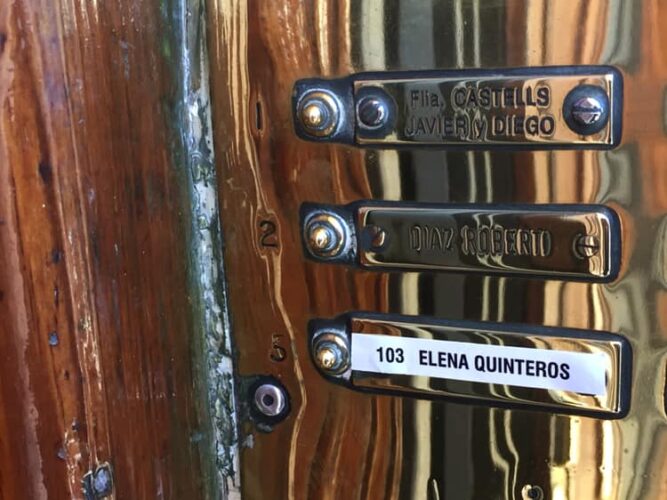
In 1976, teacher and activist Elena Quinteros was kidnapped and later disappeared by military forces in Montevideo, Uruguay. According to an investigation by the newspaper Brecha in 2016, her apartment is still being held by the military (Touriño, 2016). In commemoration, neighbours placed a name tag on the apartment’s doorbell (see figure 1).
Due to amnesty laws and lack of institutional support for the human rights organizations that emerged in Argentina and Uruguay after the civil-military dictatorships of the 1970s, the map of detention centres, clandestine burials, and other spaces that formed the machinery of state terrorism in the Southern Cone of Latin America is a complex one to trace. However, the militant work of monument production has sought to reconstruct this territory, making the disappeared appear in the urban space. By involving direct victims, families, and neighbours, these organizations have established new practices of monumentality rooted in their contexts.
This article seeks to understand how geolocalization is used as a tool of memory production in Argentina and Uruguay. The study cases reveal how this practice acts on several planes simultaneously and creates a logic of reproduction acting on a territorial level, which challenges conventional monument production.
The Place of Absence
“State terrorism” is the term used in the Southern Cone to describe how the totality of the state’s institutions and coercive power was employed to cause terror during the civil-military dictatorships of the 1970s. What Eduardo Duhalde calls “the multiplier effect of terror” is a central notion to understand the long-standing implications of the civil-military dictatorships in Argentina and Uruguay (Duhalde, 1984). The disappearance of people, a systematic practice during those years, sought not only to enact violence on the victim but also to render powerless their wider social context.
As Mariana Eva Pérez points out in her book “Fantasmas en escena,” forced disappearance was not simply a form of state violence but also a biopolitical tool. In her view, its goal was to produce spectres and cause paralyzing terror in society, which allowed the regimes to implement their neoliberal project (Pérez, 2022).
The molecular character of the disappearance of people during the dictatorship was mirrored in the urban space. The exiled, detained, and murdered left behind a landscape of empty houses and desolated public spaces and institutions, which multiplied the effect of terror. These urban spectres bear testimony to the lives of the victims and the places where they worked, studied or had political activity.
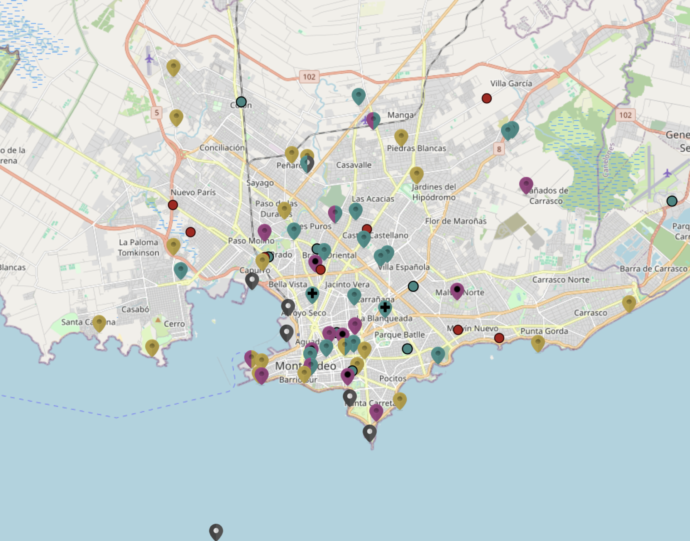
Moreover, in both Argentina and Uruguay, clandestine detention centres were embedded in the fabric of the city (see figure 2), making neighbours witnesses to torture and other forms of violence committed in these locations. Unlike in other cases of state violence, most of these spaces remain largely untouched. Although there may be small changes in layout or superficial renovations, the vast majority retain their original structures and outward appearances, still evoking fear in those who recognize them. Furthermore, many of these buildings continue to function, with some even operating as jails, police stations, or military training facilities.
The Identification of Places
Despite the great efforts of human rights activists, the path to justice for the victims of this period remains long. Amnesty laws and a lack of institutional support have deliberately slowed down investigations and trials. The unwillingness of the military, the church, and certain political factions to collaborate by providing documentation has forced human rights organizations to develop their own investigative practices.
Through the reconstruction of testimonies, the preservation of objects, the archaeological search for bodies, and, as this article focuses on, the identification of places, the human rights movement has documented a popular account of the dictatorial period.
The identification of spaces of repression began during the dictatorship itself, when family members and organizations searched for the kidnapped. Often, the detained were blindfolded and families were not informed of their loved ones’ whereabouts, making it difficult to pinpoint these locations. Many sites were identified through sounds, such as children playing or airplanes overhead, or through the testimonies of neighbours. In some cases, victims reconstructed the floor plans of the buildings where they were held.
The urgency to gather information about missing relatives fostered new exchanges and grassroots methods of knowledge production, eventually uncovering a complex network of spaces and actors. Through collective dialogue, the scale and methodology of the repression became clearer.
After the return to democracy, this collaborative investigative practice began to be recognized as the construction of memoria colectiva (collective memory), an ongoing societal effort. In the absence of official information, popular knowledge has contributed to the reconstruction of the truth of events and, in the last decade, has become the main source of evidence in trials.
More recently, there have been institutional advances in the legitimization of this knowledge. For example, in 2018, the Uruguayan parliament approved the law N° 1964: Declaración y creación de sitios de memoria histórica del pasado reciente, which has the mission of declaring and creating memory sites in relationship to the events that developed during the dictatorship. The law created the National Honorary Commission of Memory Sites, which has marked several sites where human rights violations occurred (IMPO, 2018).
Although some places remain unidentified, the active efforts of families and activists over the past 50 years have successfully geolocated most of the sites where repression occurred, both during and before the coup d’état, revealing an intricate network of spaces that range from private homes to large detention centres.
Memorial Practices
The ties between individuals and organizations that carried out the arduous work of investigation naturally led to the formation of new institutions and demands. Consequently, a wide range of memorial practices that take place at the territorial level involve a diverse array of actors. In addition to human rights organizations, other members of civil society, such as unions and neighbourhood councils, have contributed to the creation of various forms of memorials.
Moreover, these memorial practices have not been limited to sites of repression, but have rather extended to places where victims lived, worked, studied, or resisted. As a result, the ecosystem of narratives and symbols has re-signified spaces that had once been left as spectres.
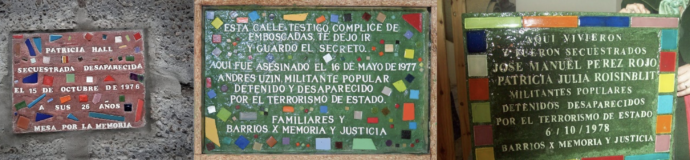
The collective Baldosas por la Memoria (Tiles for Memory) in Argentina creates tiles in collaboration with families, friends, and political activists to commemorate the victims of state terrorism. As they describe it, “It allows, through collective gathering, the reconstruction of memories, anecdotes, and consequently the initiation of a process of reworking trauma.”
Mariana Eva Pérez, a victim of the civil-military dictatorship in Argentina, described in her published diaries the process of producing and placing a tile in memory of her disappeared parents, José María Pérez and Patricia Roisinblit (see figure 5). The memorial was initiated by the neighbours of the house from which José María and Patricia were kidnapped. Mariana recounted how she met the group, the planning meetings, the creation of the tile, and finally, the ceremony of its placement on the public sidewalk. One of the participants, Marcela, an architect, took on the task of designing the tile: “She got some work done at home and brought the polyester resin letters already prepared. I ask her where she lives, when she made them; I would have asked if she has a partner, children, a pet, but I don’t dare go that far. I want to imagine her at the moment of making those letters. What she feels, what she thinks. I ask her, aware of the commonplace, if she has a missing relative. A friend, fifteen years old, is all she answers” (Pérez, 2012, p. 49).
Mariana carefully put the letters in place before the concrete solidified. She placed and unplaced the letters while the clock was ticking, and although she initially intended to perform this task on her own, she finally accepted the help of a participant (Pérez, 2012).
In her diaries, Mariana was constantly going back to this event, as the colocation ceremony put in motion a chain of new actors and sites that eventually unveiled new information about the lives of her parents. Through these events, Mariana was able to recover the only remaining photo of her father at the age of his disappearance (Pérez, 2012).
This tile is one of hundreds placed in public space in Argentina. Although the similarities in materials and message make them recognizable as a collective work, the tiles also bear their particularities. Each tile is both a part of a local construction of the neighbourhood and community, and of a larger narration of the city. When everyday spaces such as private houses, schools, and workplaces are marked with tiles of memory, they materialize popular knowledge and make it part of the urban experience.
In the re-signification process, the tiles of memory finally construct new experiences of resistance as they become places of congregation for new political movements.
In Uruguay, the house of activist Elena Quinteros, evoked at the beginning of this article, has become a contested site. Over the last 10 years, after a journalistic investigation revealed that the house remained in possession of the armed forces, multiple militant actions have sought to highlight the illegality of this fact and recover the memory of Quinteros (Touriño, 2016).
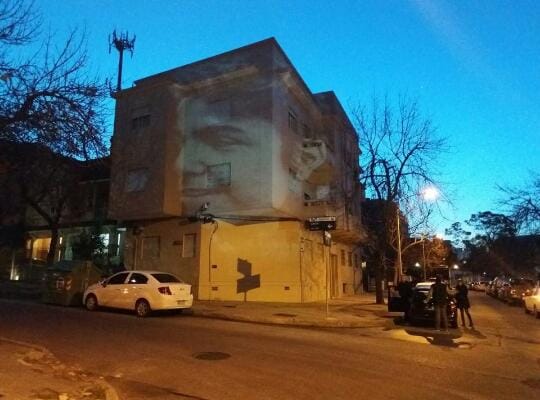
Over the years, neighbours have left multiple marks and written words on the façade, identifying the house as the home of the disappeared teacher. As in the case of the colocation ceremony in Buenos Aires, Argentina, the identification of the building has unveiled new information. A militant from the same political organization identified how he had been in the house for a meeting during the dictatorship and how the apartment was used as a printing facility for flyers denouncing the regime (Cianelli, 2018). One of the most prominent interventions was the work of Gabriel Orge, photographer and visual artist, who in 2018 projected a photograph of Quinteros on the façade of the house, as part of his project “Appearances” (Cianelli, 2018).
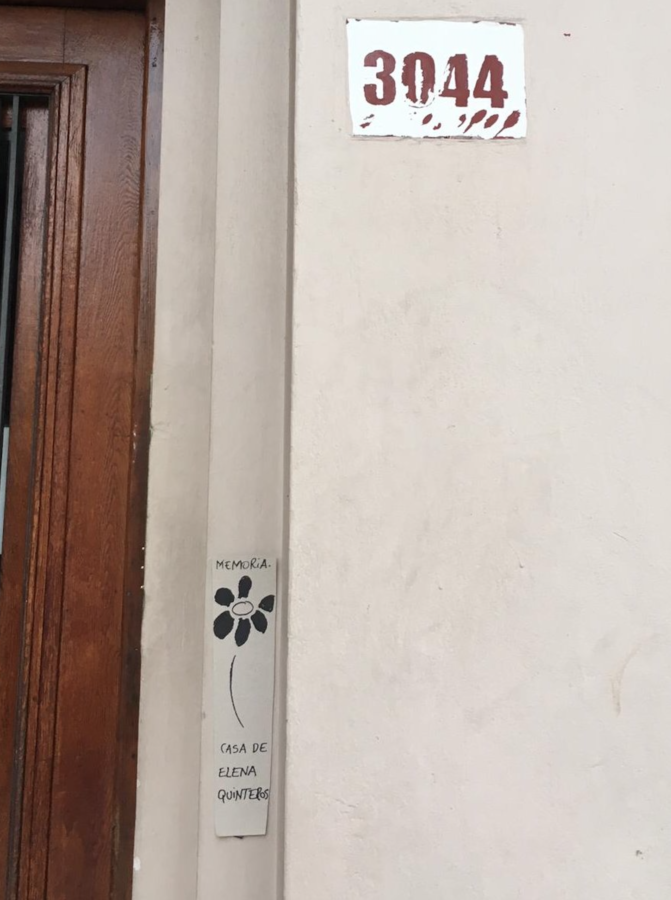
Recently, in September 2024, the Coordination for the Tribute to Elena Quinteros (Coordinadora de homenaje a Elena Quinteros), a large umbrella of human rights and political organizations, made a request for the apartment to become a memory site on the anniversary of her kidnapping, managed by the National Honorary Commission of Memory Sites.
This well-documented example showcases how the localization of these sites sets in motion a snowball effect where new elements come into play. Unlike the tiles of memory, there is no fixed format for these monuments. Each intervention in Elena Quinteros’s house gathers new actors, acts on different scales, and in each turn expands the political possibilities. It is the persistence on the place that cements the relationship between the house and Elena Quinteros, and, by extension, implicates the neighbourhood in the narrative of her life and disappearance.
Eira Capelán, in her work “Popular monumentality: Cultural memories, subaltern knowledges and material practices in Cerro de Montevideo,” defines popular monumentalities as “socio-territorial processes.” Departing from the same theoretical framework as Capelán, I argue that geolocalization and the subsequent physical identification of these spaces should be understood as practices, and therefore as ever-evolving processes of transforming meanings. Capelán draws on Shove et al., who dissect the notion of practice into the interrelation of three elements: materials, meanings, and knowledges (Shove et al, 2012, p. 25). Therefore, a practice is defined as the action of linking these Elements of practice (Shove et al, 2012, p. 25).
It is clear how the collective action of activists and families has, through different methodologies, established new intersections between the popular knowledge of human rights organizations, the meanings of these spaces on a territorial level, and the materials, manipulated by ordinary people in ways that escape conventional monument production.
Both the tiles of memory in Argentina and the multiple interventions in the house of Elena Quinteros in Uruguay illustrate how the geolocalization and later physical identification of these spaces is constantly negotiating the three elements. Furthermore, these monuments are never finished. The relationship between materials, meanings, and knowledges is never locked. Like the letters moving in the rapidly solidifying concrete, these urban marks are a collective construction that evolve in tandem with the social and physical changes.
Networked Monumentalities
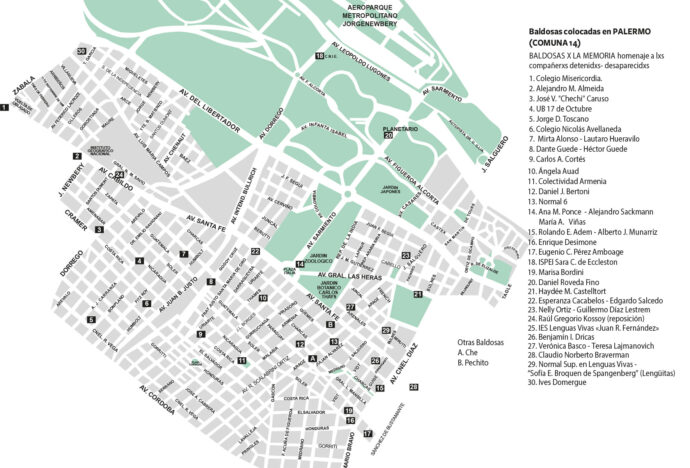
The cases mentioned above cannot be completely understood individually, as they are first and foremost a point on a map. Each point is always acting in relation to other points. As we saw previously, each point also opens the possibility of new points.
As Gabriel Tarde argues, memory is not a finite resource, as it can both give and retain simultaneously. Unlike material objects, which follow a logic of appropriation, where receiving something means losing it, memory operates on a logic of irradiation: when I share it, I multiply it (Lazzarato, 2018). The militant work of monument production in Argentina and Uruguay follows a logic of irradiation, where each place opens for the next without losing relevance, rather amplifying the narrative. The scattered monuments made up of different materials, shapes, and scales generate a logic of multiplication that counteracts the spaces of absence.
The tiles of memory reproduce organically with each space and collective that can agree on placing one. Every tile gathers new constellations of people that will simultaneously disperse and expand the boundaries of the tile.
Further, there are initiatives that map and distribute the information about these spaces. The Civil Association Palermo Memory (Asociación Civil Memoria Palermo) maps the tiles in the neighbourhood of Palermo, Buenos Aires. On the website of the association, an online interactive map connects each tile to the victim being remembered. On the information sheet of each victim, the user can find not only the known facts about the disappearance but also testimonies and pictures associated with the ceremony of colocation of the tile.
In Uruguay the self-described “militant and collective project” Memory Sites Uruguay (Sitios de Memoria Uruguay), has an interactive map showing sites of repression in the whole territory of the country. Through their website it is also possible to find all kinds of information about the sites, including digitalized documents with free access (Sitios de Memoria, n.d.).
The association is also involved in a larger project about Plan Cóndor (Operation Cóndor). In the 1970s, the authoritarian regimes of South America extended their repression beyond their domestic borders, cooperating in intelligence and persecuting exiled citizens. What was called Operation Condor was a transnational repressive system which coordinated oppression between countries (Lessa & Balardini, 2024). The project under the same name has created an interactive online map of the victims, hundreds of exiles who were kidnapped, tortured, and murdered. The map allows one to easily establish connections and trace the paths of the victims, aiding human rights organizations in their investigations and education of the public. Moreover, in this project, borders or spaces of transition such as airports were also geo-referenced, as these spaces were part of the repression system (Rómboli, 2024).
In Montevideo, the local Municipality B, which encompasses the city’s central neighbourhoods, has created an interactive map focused on four categories of memorial sites: institutional memory, collective memory, militant memory, and imprisoned memory. The project, called Alba, includes audio guides narrating the stories associated with each marked location and involves more than ten organizations in its conception (Municipio B, n.d.). As we can see, the interest in maps can be traced back to the grassroots knowledge production of human rights organizations. Even today, maps continue to play a crucial role in the search for truth and justice, as they reveal the systematic nature of the repression. Although the extensive network of monuments is difficult to map entirely, the maps themselves act in parallel to the physical production of memorials. The act of geolocalization involves a collective agreement that shapes and negotiates materials, meanings, and knowledge. These practices shape the city on an urban scale and tell new stories about neighbourhoods, while each map rearranges the connections between the individual monumental practices.
Conclusions
Attempting to categorize the production of monuments commemorating victims of state terrorism in Argentina and Uruguay would be a futile endeavour. The essence of these practices lies in their plurality. Behind each plaque, tile, or projection are countless organizations and individuals, resonating across geographies and decades. Each victim brings with them family, friends, colleagues, and neighbours. As Mariana Eva Pérez might ask: What brings them here?
While it is important to acknowledge that the absence of the victims cannot be repaired by these practices, the latter helps to rebuild the fractured social and urban fabric. As we have seen, each of these spaces disrupts the silence and paralysis by fostering encounters and activating the territory. Amidst a landscape that perpetuates impunity, each marked space situates these acts within their urban and social contexts. Moreover, the persistence of these practices gradually allows them to be identified as part of a series of connected spaces rather than isolated events, creating a coherent narrative that breaks more than 40 years of silence. The sum of these practices conforms a new layer in the palimpsest that shapes the city.
The micropolitics of the practices of monumentality in the Southern Cone shape cultural sensibilities and open new material possibilities. Each ceremony is not only a ritual of grievance but also a political act that reveals a city made of resistances.
Through these actions, the diverse human rights movement asserts its Lefebvrian right to transform and produce the city, giving voice to the silenced narratives of resistance and struggle. Through memorial practices, each of these places is transformed into a shared space of common understanding.
These practices challenge the conventional notion of monuments, as they aim to multiply rather than concentrate meaning. In doing so, the monumentality practices in Argentina and Uruguay offer new entry points for constructing meaning within urban settings.
References
Capelán Köhler, E. (2019) POPULAR MONUMENTALITY: Cultural memories, subaltern knowledges and material practices in Cerro de Montevideo.
Cianelli, M (2018) Se hizo una intervención urbana para recordar a Elena Quinteros. La Diaria. Available at: https://ladiaria.com.uy/politica/articulo/2018/6/se-hizo-una-intervencion-urbana-para-recordar-a-elena-quinteros/
Duhalde, E. L. (1983). El estado terrorista argentino / Eduardo Luis Duhalde. (1a ed.). Argos Vergara.
IMPO. (2018). Ley N° 19641. Available at: http://www.impo.com.uy/bases/leyes/19641-2018
Lazzarato, M. (2018) Potencias de la invención. La psicología económica de Gabriel Tarde contra la economía política.
Lessa, F., & Balardini, L. (2024). No Safe Haven: Operation Condor and Transnational Repression in South America. International Studies Quarterly, 68(2), sqae035. https://doi.org/10.1093/isq/sqae035
Municipio B, (n.d). Proyecto Alba. Available at: https://alba.gub.uy/
Perez, M. (2012) Diario de una Princesa Montonera, 110% verdad.
Perez, M. E. (2022). Fantasmas en escena. Teatro y desaparición. Fantasmas En Escena. Teatro y Desaparición.
Rómboli, Luis. (2024). Aportes para la digitalización de documentos y la georreferenciación de sitios vinculados a crímenes de lesa humanidad. La Diaria. Available at: https://ladiaria.com.uy/justicia/articulo/2024/10/aportes-para-la-digitalizacion-de-documentos-y-la-georreferenciacion-de-sitios-vinculados-a-crimenes-de-lesa-humanidad/?utm_medium=Social&utm_source=Twitter#Echobox=1728718165
Shove, E., Pantzar, M. & Watson, M., 2012. The dynamics of social practice: Everyday life and how it changes, London: Sage Publications.
Sitios de Memoria (n.d). Sobre el Proyecto. Available at: https://sitiosdememoria.uy/proyecto
Touriño, R. (2016) Vivienda de servicio. Brecha. Available at: https://brecha.com.uy/vivienda-de-servicio/
Images.
Figure 1 : Martina Lejtreger.(2019, May 19). ELENA, LA VECINA [Image] [Photograph]. Facebook. Retrieved September 27, 2024, from https://www.facebook.com/profile/592365383/search/?q=elena&locale=es_LA
Figure 2 : Sitios de memoria. (n.d.). Map of repression (1968-1985) [Map]. Retrieved September 27, 2024, from https://sitiosdememoria.uy/mapa
Figure 3 : La Opinión Semanario. (2021, March 24). [Memory tile for Patricia Hall, photograph]. Retrieved September 27, 2024, from https://www.laopinionsemanario.com.ar/noticia/dia-de-la-memoria-una-baldosa-en-recuerdo-de-patricia-hall-una-de-las-sampedrinas-desaparecidas
Figure 4: Memoria Palermo. (n.d.). Andrés Uzin, 9 de diciembre de 2016 [Photograph]. Retrieved September 27, 2024, from https://www.memoriapalermo.org.ar/baldosas.php
Figure 5: Princesa montonera. (2010, May 16). No es obra de un borracho [Photograph]. Retrieved September 27, 2024, from https://princesamontonera.blogspot.com/2010/05/no-es-obra-de-un-borracho.html
Figure 6: Colectivo Catalejo. (2018, June 21). Volvió Elena a su casa. Ayer el argentino Gabriel Orge proyectó la imagen de Elena Quinteros sobre la que fue su casa. [Image] [Photograph]. Facebook. Retrieved September 27, 2024, from https://www.facebook.com/colectivo.catalejo/photos/volvi%C3%B3-elena-a-su-casa-ayer-el-argentino-gabriel-orge-proyect%C3%B3-la-imagen-de-elen/1031088533706982/?locale=es_LA
Figure 7: Virginia Bosco [@BoscoVir]. (2020, May 21). [Tweet; https://x.com/BoscoVir/status/1263463086473822212]. Twitter. https://twitter.com/BoscoVir
Figure 8: Memoria Palermo. (n.d.). Plano de ubicación Baldosas x la Memoria en Palermo (Comuna 14) [Map]. Retrieved September 27, 2024, from https://www.memoriapalermo.org.ar/baldosas.php