Urban Regeneration Without Blueprints: Social Networks and Cultural Infrastructure in Nablus Old City
Introduction
This essay delves into a story of urban regeneration under conditions of military occupation, chronic instability, and an ongoing, quiet form of urbicide in Palestine, particularly in the Old City of Nablus, the Kasbah. Rather than treating conflict as an exception that temporarily suspends urban normality, our story shows that in militarily occupied cities, destruction, surveillance, and disruption are not episodic events but structural features of urban life itself. Any meaningful approach to regeneration must therefore begin from this premise.
To tell this story, we draw on our empirical experience with the Yalla Project, a self-funded initiative established in 2018. Rather than entering the Kasbah as outside experts, we engaged in “research-by-doing” – opening and running a café and a guest house as embedded participants in the everyday rhythms, risks, and solidarities of the Old City.
The essay unfolds through four interconnected parts. The first offers a close reading of the Kasbah as a dense, layered urban organism in which commerce, resistance, surveillance, and social life are inextricably entangled. The second develops a conceptual argument for an expanded understanding of urbicide: one that accounts not only for physical destruction but for the gradual erosion of confidence, centrality, and everyday presence. The third part proposes an alternative paradigm of regeneration — incremental, owner-driven, socially embedded, and financially autonomous — that operates within instability rather than waiting for a stable “after.” The fourth part documents the concrete spatial, social, and financial strategies through which the Yalla Project operationalised this paradigm over eight years.
More broadly, the essay offers a critique of NGO-led and donor-dependent models of urban intervention, proposing alternative, fairer approaches grounded in empirical practice in the field in a highly challenging context like the Nablus Kasbah, arguing that externally managed and episodically funded programmes often underutilise local capacities and foster dependency. In response, it proposes a site-situated practice that consistently embeds the local community — its knowledge, networks, habits, and culture — as the primary agent of long-term, self-sustaining urban regeneration.
The Old City: a layered urban organism
For both residents and returning visitors, the Kasbah of Nablus never fully reveals itself. Its everyday life cannot be grasped at once; it unfolds gradually through movement. Wandering through its narrow alleyways and historic mansions may lead one past an old soap factory, a bakery, a mosque, a coffee house, or a small shop embedded in a sixteenth-century bazaar. More strikingly, it opens onto ancient courtyard houses with irregular layouts, concealed volumes, layered thresholds, and openings that blur the boundary between exposure and privacy. The Kasbah resists immediate legibility.
First-time visitors experience the Old City differently from its inhabitants. Entering through any of its gates, one is absorbed into a dense human current. Vendors’ calls, bargaining voices, glances, invitations, carts, hanging garments, plastic goods, spices, and sweets fill the markets that stretch for hundreds of meters. Yet the souq (traditional marketplace) is not merely a commercial space. It is a socio-spatial system in which exchange carries memory, hierarchy, obligation, and negotiation. Local power geometries are embedded in everyday transactions. In the crowd, one can feel both anonymous and hyper-visible, lost among strangers, yet never entirely unseen.
Only a few steps away from these crowded arteries, the atmosphere shifts abruptly. Narrow passageways branch off from the market and descend into quieter residential clusters. For strangers, these spaces generate a sense of exposure: one feels observed, questioned, and out of place. The paths weave between stone walls, pass beneath vaulted ceilings, and slip through semi-covered tunnels where light and shadow alternate. These routes eventually lead to the ahwash—intimate residential courtyards accessible primarily to those who belong. What appears spatially open is socially regulated.
For residents, however, streets—especially the souq—are not neutral corridors linking functions. They form part of an enlarged domestic sphere. The Old City operates as a collective household in which familiarity structures movement. Distances are measured less in meters than in encounters: greetings, conversations, shared jokes, gossip, or even the noticeable absence of someone who is usually present. Social time, rather than physical scale, organises space.
Within less than three square kilometres, the Old City functions as a dense urban organism. Residential, commercial, industrial, cultural, religious, and open spaces coexist within walking distance. The Kasbah is the cumulative product of more than two millennia of urban formation—pre-Roman, Roman, Byzantine, and successive Islamic periods. Cycles of construction and destruction, reuse and adaptation, and natural and political upheavals have produced a compact and layered urban tissue. Rather than a static historical relic, it is an evolving structure shaped by continuous transformation.
Its social fabric is equally stratified. Families currently residing in the Old City include descendants of lineages that have inhabited Nablus for centuries, as well as families who arrived after the Nakba in 1948, those who migrated from rural areas, and others drawn by affordable housing. Over time, these groups have formed place-based social constellations: neighbourhood youth circles, mosque-based gatherings, informal assemblies of men or women, and recurring meeting points in cafés, former soap factories, street corners, or small shops.
Within these networks emerge recognisable figures who play active roles in maintaining social cohesion—the neighbourhood elder, the barber who knows every story, the informal mediator, the shopkeeper who circulates news. Such characters are not marginal; they animate and stabilise the social environment. Together, these groups and individuals produce a distinct social tissue that both inhabits and continually reshapes the Old City.
A Hidden Layer: Resistance, Surveillance, and Layered Visibility
Beneath the visible social life of the Old City lies another layer of urban dynamics that is rarely acknowledged in conventional urban analysis. The ordinary life of the city, its activities, families, neighbourhood groups, and social networks also constitute the milieu in which political resistance relies. Resistance in the Old City does not exist in inhabit a separate sphere and is not spatially segregated from the city. Political resistance is not an exclusive job, and political commitments coexist with ordinary tasks, unfolded in ordinary places. Members of the various resistance factions are also, and simultaneously, barbers, doctors, construction workers, plumbers, shopkeepers, and so on. They participate in weddings, sit in cafés, exchange jokes in the souq, partaking in the random conversations about future expectations and family life that take place in these mundane places. It relies on the same networks of kinship, trust, and proximity that sustain commercial and domestic life. Training, secrecy, and risk management unfold quietly alongside daily interactions. In other words, resistance is just another face of ordinary activities.
And so, the apparent normalcy of the market also embeds surveillance. Shoppers, visitors, and even self-identified sympathisers of the Palestinian cause may be operating as undercover Israeli units. In the Kasbah, stories circulate of individuals entering with foreign passports, staying in local hostels, performing solidarity while conducting surveillance and sometimes initiating raids. Whether every account is verified is less important than the fact that such possibilities shape perception and behaviour. Suspicion becomes part of spatial awareness.
Commerce, resistance, and surveillance therefore coexist within the same streets. Visibility and invisibility are constantly negotiated. A café conversation may be warm and tense at once. A crowded shopping day may contain the latent possibility of arrest. The medieval alleys, filled with spices and conversation, also hold the possibility of sudden, bloody confrontation. A moment of routine commerce can quickly turn into chaos if undercover agents reveal themselves and draw weapons. Warmth and trauma occupy the same spatial frame. The same dense spatial configuration of the kasbah that enables dense social interaction also facilitates monitoring and sudden intervention.
What may appear from an external perspective as an exceptional condition—a city swinging between normalcy and confrontation—has become the norm for the Old City and its inhabitants. Even in the absence of active fighting, the anticipation of raids and the possibility of infiltration have become a structural part of everyday life: the city of trade, heritage, and sociability is inseparable from the city of surveillance, pursuit, and armed incursion.
Mainstream urban theory has largely struggled to account for such entangled conditions. Dominant narratives tend to approach cities as spaces of governance, development, informality, or resilience, but rarely examine the urban environment as one in which insurgency and counterinsurgency infrastructures coexist (Bishop & Gregory, 2002) (Graham, 2010). Conflict is frequently analysed as an exception, an interruption—an episode that suspends urban normality—rather than as a structuring condition of urban life itself. The implicit assumption remains that there exists a stable civic sphere temporarily disrupted by violence.
The Kasbah of Nablus challenges this perspective. Resistance and Israeli colonial violence are not exceptional overlays but part of the urban rationale. Urban and architectural projects that approach the city ignoring this feature produce incomplete analyses and misguided interventions that overlook the security logics, informal protections, and tacit negotiations that shape how space is used and inhabited.
Regeneration in this context requires acknowledging this coexistence. This is not an act of sensationalism; it is a methodological necessity. Urban studies must move beyond dichotomies of peace and war, normality and exception, before-and-after. In places like the Old City, these conditions are not sequential—they are simultaneous.
Urbicide beyond destruction
The entangled environment described above is not episodic in the Old City of Nablus; it is structural. The Kasbah has long been a centre of political mobilisation, and for that reason, it is repeatedly targeted. Military incursions vary in intensity and frequency, but their unpredictability produces cumulative effects that extend beyond physical damage. Even when buildings remain standing, urban life is steadily eroded, with the structures and systems of control and occupation being internalised and eventually embedded in the daily life of the city and its inhabitants (Hammami, 2015).
Frequent raids, curfews, infrastructural blockages, and sudden confrontations discourage visitors, weaken commercial confidence, and push residents—particularly those with financial means—toward neighbourhoods perceived as safer. Businesses hesitate to invest; families reconsider long-term residence; customers shift their routines elsewhere. Over time, the Old City becomes socially and economically fragile. This slow, constant, and still unpredictable attrition constitutes a form of urbicide without large-scale destruction and without headlines announcing its decline.
Much of the literature on urbicide has focused on the deliberate destruction of buildings and infrastructure (Coward, 2009). Yet, the case of Nablus is paramount of another and perhaps more devastating form of urbicide, one operating relentlessly, through small and constant disruptions, to pursue the gradual and longstanding suffocation of everyday life. A city does not need to be reduced to rubble to be killed. It is enough to destabilise its rhythms, to stigmatise it through fear, and to establish uncertainty firmly enough that people withdraw voluntarily.
Since the large-scale invasion of 2002, which caused extensive physical damage, the Old City has repeatedly been treated as a battleground. Even in periods of relative calm, the anticipation of future incursions shapes choices and behaviours. The cumulative result is of the place and its communities: the Old City is imagined as dangerous, unstable, or economically unreliable. Such imaginaries reshape urban geography. When people avoid visiting, shopping, investing, or residing there, the city weakens—even if its materiality remains intact.
Urbicide, in this sense, operates through four intertwined processes that we observed in Nablus: the interruption of everyday routines, the erosion of economic confidence, the displacement of residents, and the establishment of persistent fear. This observation aligns with scholarship on slow urbicide in the West Bank context (Golańska, 2022), and Nablus in particular (Abujidi & Verschure, 2006), which similarly argues that physical destruction may accelerate these processes, but it is not a prerequisite.
In a context where violence is recurrent and unpredictability persistent, any meaningful urban response cannot wait for a stable “after.” It must operate within instability itself.
Recognising this expanded understanding of urbicide has important implications for urban intervention. If the threat lies not only in damaged structures but in declining centrality, then rebuilding cannot be limited to architectural rehabilitation or short-term economic support. The Old City requires continuous, all-around care—an ongoing effort to sustain the presence and practices associated with places, restore confidence, and reaffirm them within the wider urban system.
Urban interventions, therefore, must be conceived as a continuous and broad-ranging action capable of sustaining the urban ecosystem, reactivating the social and economic life that animates spaces in response to each wave of disruption. The goal is not merely to repair damage, but to oppose marginalisation – a distinction that shapes what we call revivification.
A Continuous Revivification: Toward an Alternative Paradigm
We have seen how urbicide operates not only through the demolition of materiality, but also and, very importantly, through the dismantling of essential immaterial aspects of the place: the erosion of confidence, perceived safety, belonging, and centrality. If so, then any meaningful response cannot rely solely on physical rehabilitation or donor-driven reconstruction. It must begin with restoring attachment.
Before proceeding, it is worth clarifying a terminological choice that shapes the remainder of this essay. We prefer the term ‘revivification’ over the more commonly used ‘regeneration’ or ‘revitalisation.’ The distinction matters. Urban regeneration, as defined by Roberts (2000, p. 17), is ‘a comprehensive and integrated vision and action which leads to the resolution of urban problems and which seeks to bring about a lasting improvement in the economic, physical, social and environmental condition of an area.’ The words ‘resolution’ and ‘lasting improvement’ embed a before-and-after logic — the assumption that urban problems can be solved, and that a stable condition can be achieved and maintained. This assumption is inapplicable to cities living under continuous occupation and chronic instability. Roberts himself notes that ‘revitalisation’, whilst suggesting the need for action, ‘fails to specify a precise method of approach’ (Roberts, 2000, p. 17) — making it both conceptually weaker and still implying a return to a prior state of vitality. ‘Revivification’ — the repeated act of bringing back to life — better captures what we observed and practised in Nablus: not a one-time project with a clear endpoint, but a cyclical, never-concluded effort to sustain urban life within ongoing disruption. In a city that cannot wait for stability, this distinction is not merely terminological — it is political. ‘Regeneration’, where it appears, refers to the broader field.
The high volatility that characterises the Old City raises methodological issues: under such conditions, the conventional idea of planning appears inapplicable and of little effect. How to make plans when nothing is stable and certain? Why invest in cultural programming, hospitality, or social spaces if disruption may arrive at any moment?
Yet this very unpredictability has developed locally a specific set of skills (achieved at a very high cost, indeed): rapid, informal adaptation, flexibility, rapid complex assessment, swift rerouting and damage control. Unlike bureaucratically rigid environments, the Old City is operating for decades through dense social networking and immediate responsiveness. In this process, we came to recognise that in cities without a clear ‘post-war’ phase, regeneration does not occur after violence—it unfolds, hesitantly and unevenly, within it.
Moreover, in the Old City of Nablus, belonging transcends property or the direct or immediate personal relationship with the place. Many residents consider themselves not merely tenants of space but heirs to it. Even when formal property ownership is absent, families often trace their presence in the Old City across generations. This historical continuity produces a strong sense of moral ownership. Yet ownership alone is insufficient. Without sustained attachment and attendance, such ownership can gradually shift toward commodification, romanticisation or abandonment. In this context, revivification must primarily focus on preserving and strengthening residents’ affective and social bonds to the place.
This requires a shift in how urban intervention is conceptualised. The ancestry-focused approach to ownership expressed by Nablus Kasbah’s residents makes it even more urgent that any effective revivification or urban recovery action embeds locals as the principal agents of regeneration. In this sense, revivification is not an external project imposed upon the city, but an internal capacity activated from within.
This approach does not reject large-scale rehabilitation initiatives. Major organisations in Nablus, such as the Welfare Association, have played important roles in restoring buildings and supporting businesses. However, large-scale, donor-dependent programs often operate episodically and from above. The prolonged reliance on external funding often develops into dependency, and the impairment of stakeholders’ spirit of initiative in the absence of donors and external funding, narrowing the imagination of what is possible, and the capability of realising the presence of different types of assets, while developing the sense of an exclusive accessibility to funds and opportunities through complex procedures and bureaucracy, a situation well-debated in colonial and post-colonial contexts and in Palestine (Challand, 2008) (Taghdisi-Rad, 2010), and largely met on the ground by the authors through their empirical engagement in Nablus and the West Bank. If regeneration is framed exclusively as a function of external capital and formal approval, local capacities remain underutilised.
In a context marked by recurrent disruption, waiting for large-scale funding cycles can delay or prevent timely intervention. The alternative paradigm we propose emphasises incremental, site-based, and owner-driven processes of revivification. It shifts attention from what residents lack—substantial funding and institutional backing—to what they already possess: space, social networks, grounded knowledge, and systems of mutual support and cooperation. The Old City’s spatial qualities are themselves a resource: its dense morphology, mixed uses, and historical character provide assets to build upon. When coupled with strong kinship ties, favour-based exchanges, informal cooperation, and trust-based collaboration, small-scale yet continuous and contagious interventions can occur.
The incremental, locally anchored paradigm complements, rather than competing with or replacing, major infrastructural projects, large-scale rehabilitations, and broader strategic programs, which are indispensable for harmonising actions into systematic future visions. Rather, grassroots-based actions enhance the durability and stable appropriation of broader initiatives. By maintaining everyday vitality between large projects—and by preventing cycles of abandonment—continuous, community-based revivification helps ensure that major investments do not occur in isolation.
In a context where violence is recurrent and unpredictability is persistent, revivification must operate as a relentless practice rather than a one-time event. The task is not merely to rebuild structures after damage, but to sustain attachment and confidence, prevent the dispersion of social tissues and the related wealth of practices and knowledge that occurs with crisis-generated displacement, cultivate local agency, and ensure that local instances stay represented and responded to.
In-war revivification in practice: the experience of Yalla Project
The work of Yalla Project positions itself precisely within this grounded reflection: how to act, mobilising available assets, not waiting for uncertainty to disappear but working within it?
People’s response to attacks cannot be generalised. Searching for security is central, yet in a place like Nablus, military incursions and curfews, while recurrent, are not constant. They do not define every hour of every day. However, what persists instead are everyday needs: to work, earn income, shop, socialise, and sustain a sense of ordinary life within extraordinary conditions. In such a context, urban actors do not simply react; they adapt. Shops temporarily close their doors during raids and reopen them once soldiers withdraw. Some households eventually relocate to neighbourhoods perceived as safer; others remain despite repeated disruptions. Businesses may reopen immediately after an incursion, while others close permanently. These decisions are shaped by a combination of financial capacity, emotional endurance, social networks, and risk perception. They are neither predictable nor reducible to a single variable.
Conventional research approaches — such as fieldwork observations, interviews, and focus groups — fall short, we found, of providing a sufficiently detailed and realistic understanding of how such decisions are made. Asking residents hypothetically why or how they stay or leave rarely captures the complexity of living within chronic instability. This realisation led us toward what we call research-by-doing, a long-term, permanent participatory approach in which we joined the local economic tissue by opening two small businesses with high social impact: a cafe and a guest house. While our researcher and professionally-educated background was known to the local community, our role and reason for being there were to start, run, and consolidate our commercial activities, which are entirely self-funded. The stable presence in the Old City, investing in its spaces, and working alongside residents and shopkeepers as peers – not as experts nor as solvers or aid providers, we were able to participate in decision-making processes while being ourselves affected by them, an inherent part of the very ecosystem that shapes such decisions. From this position, we share the experience of risk, which is not an abstract, distant entity but something negotiated daily, often relying on consultation with neighbours and surrounding shopkeepers. At the same time, we familiarised ourselves with the concept of hope as a not-rhetorical entity, but as something practised, through reopening doors, hosting events, and sustaining activity after each interruption.
Our work gradually clarified that revivification in such a context does not begin with capital injections or comprehensive master plans. It begins with two interdependent foundations: space and people. The two are tied by a third element-asset: time.
A grounded understanding of the main assets for revivification in Nablus Kasbah
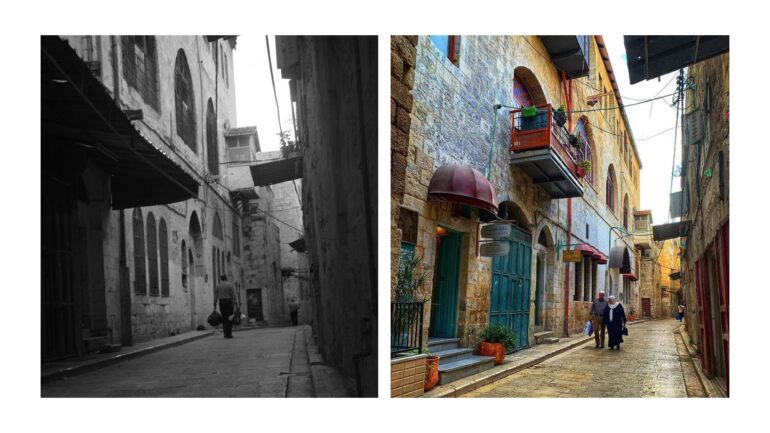
The Old City possesses exceptional spatial assets that are often overlooked in conventional development models. Its pedestrian-dominated streetscapes, where vehicular traffic is sporadic, foster social encounter and personal interaction. The medieval architectural fabric is human-scaled and highly diverse, combining housing, small-scale manufacturing, and commerce organised in clusters within a few minutes’ walking range, creating an environment that is both intimate and adaptable. The diversity of streets, from bustling souqs to narrow winding alleyways and semi-private courtyards, generates varied spatial atmospheres. Indoor spaces are systematically mediated through semi-open and semi-private space typologies -courts, vaults, inner gardens, …-, creating a gradual and interconnected continuity between inside and outside, highly collective and intimate. By means of such continuity, interiors with their centuries-old masonry, vaulted ceilings, thick stone walls, and shaded courtyards, offer climatic comfort that both relies on and contributes to outer spaces, creating an architectural character and urban micro-climate that contemporary construction rarely replicates. These material qualities are not nostalgic residues; they are active spatial resources capable of hosting renewed urban life (Fig. 1).
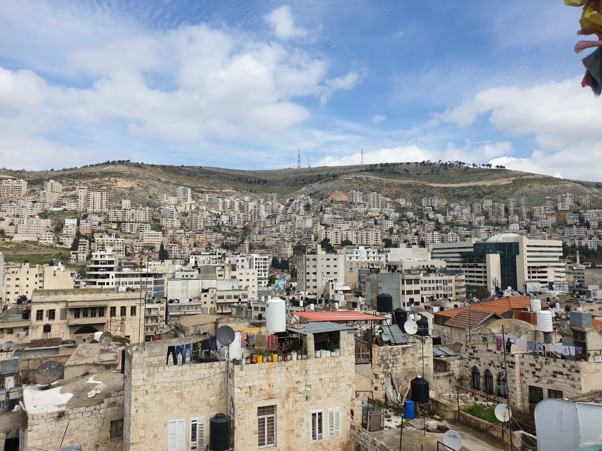
This spatial potential becomes significant and active through the social tissue embedded within it. The Old City’s population includes a large and energetic young generation, informal neighbourhood committees, active social groups, and strong traditions of solidarity and mutual aid. Despite high rates of formal unemployment, there exists significant latent capacity: traditional craftsmanship, skilled labour, construction expertise, and cultural knowledge passed across generations. Additionally, underemployment means more available time for part of the community and a willingness to engage in diverse activities to make a living, engage in the local economy of favours to gain credit in case help is needed in the future, or simply pass the time with purpose. Above all, there is pride in the Old City and a deep sense of attachment and belonging. This emotional investment is not symbolic—it translates into willingness to repair, reopen, organise, host, and persist. Revivification, therefore, emerges from the interaction between architectural inheritance and social commitment. Place provides the stage; people activate it.
Tracing the pathway to revivification
Revivification, therefore, was approached with a focus on people’s presence, before the intervention on space. Our approach was practical and deliberately office-less and plan-less. Rather than basing the endeavour on precise spatial outcomes to tend to, represented in drawings, maps and plans, the approach was strongly dynamic, situational and process-focused, based on a simple but clear trajectory we aimed to trigger: visit, re-activate, inhabit. The underlying intuition is that, if people are encouraged to return—even temporarily, even during relatively calm periods—the cycle of urban life could regain momentum. Increased pedestrian traffic encourages businesses to operate. Open shops generate safety and visible vitality. A lively environment strengthens confidence, making it easier for residents and visitors to imagine working, investing, or even living there.
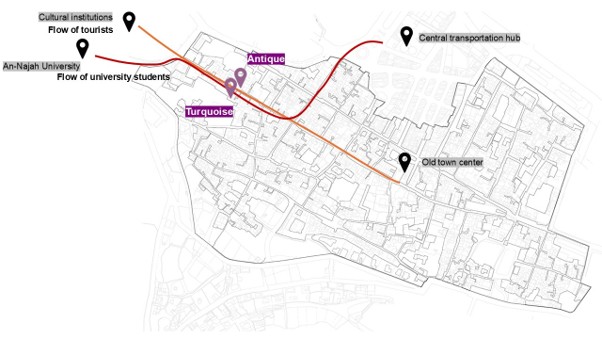
Pursuing this aim as individuals, with extremely limited funds, required a sustainable strategy based on incrementality, starting from a minimum-scale intervention with high strategic value and maximum impact. A small, dormant cafe in a marginal neighbourhood on potential routes connecting the souq, Nablus’s central bus hub, and the local university campus was hence chosen as the rooting place (Fig. 2).
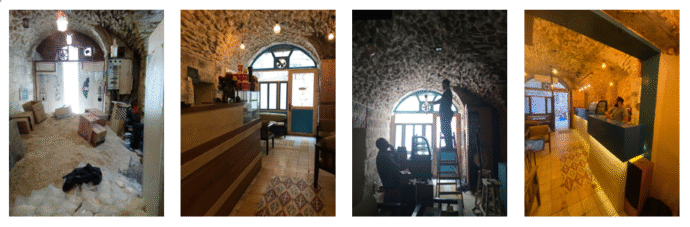
The spatial action concerned rehabilitating interiors incrementally through a series of recurrent, progressively more complex interventions, combined with the consistent activation through an everyday-use program that pivoted on food and catering, gatherings, and small-scale, recurrent free cultural events. Successive interventions could be funded by revenues from commercial activities and took place only once sufficient resources had been gathered. The approach, therefore, features a dynamic timeline informed by customers’ financial capacity and local security conditions, departing from the typical project setup, which typically entails a fixed time horizon to achieve goals. In practice, since its establishment, the process was slowed by punitive actions exerted by Israel on the Palestinian economy, which caused a series of delays and reduction of salaries paid to public employees by Palestinian administrations and interferences on banking, and by military attacks, armed raids in cities and blockages of Palestinian mobility through checkpoints. In other circumstances, however, the process was accelerated by periods of relative calm or ease of security or economic conditions, which encouraged people to go out and spend more on non-essential goods. Through this process, we experienced directly and through neighbouring shops how, while many local businesses have developed remarkable resilience—reopening repeatedly after incursions, changing timetables or trading techniques—the more fragile element is not supply but demand. Shops may reopen, but if visitors do not return, vitality remains partial. For this reason, attracting people to the Old City became central to our intervention. Progressively, the rehabilitation was achieved to restore and operate small-scale hospitality and cultural spaces—a café, a guest house, and a multipurpose venue—which functioned simultaneously as commercial enterprises generating income and as socio-spatial catalysts. These spaces served as anchors of presence, testing how confidence in place can be rebuilt amid uncertainty (Fig. 3).
This approach also made us particularly receptive to the Old City’s intangible infrastructure as the primary means of physical rehabilitation. While buildings, streets, and courtyards provide the physical framework of urban life, the dense and diversified web of relationships and communities -residents, shopkeepers, artists, youth groups, neighbourhood committees and regular visitors- is what enables the city to function under pressure through reorganisation and communication. This relational network operates as a form of living infrastructure—flexible, responsive, and capable of rapid mobilisation.
Unlike formal institutions, which often require permits, funding cycles, administrative approval, and extended timelines, social infrastructure in the Old City functions through familiarity and accumulated trust. Initiatives are not products of bureaucratic coordination; they emerge from lived relationships.
Information circulates quickly. Needs are identified informally. Support is negotiated through kinship, friendship, and shared experience. When a space is damaged, someone knows a mason who can repair it. When an event is proposed, someone can gather musicians, storytellers, or volunteers within hours. When a business struggles, neighbouring shopkeepers may extend informal credit or share resources. These mechanisms are rarely documented, yet they sustain everyday continuity. Organising activities rarely requires months of planning: a couple of phone calls to local performers or musicians may secure a show within days. An encounter in the mosque with the local baker —also a hakawati, or traditional storyteller—can result in his participation the following evening. A conversation in a café may lead to a poetry reading organised within hours.
Crucially, these collaborations are not structured primarily around profit. They are sustained by a shared commitment to keeping the Old City socially and culturally alive. Trust, credibility, and an extensive network played as our primary forms of capital.
For us, not native to the Kasbah, these assets were acquired through restoring our spaces ourselves, establishing a longstanding presence in the neighbourhood without an “end date”, and continuing to operate our activities directly.
The unconstrainedness to external agencies, delivery timing pressures, or profit-maximising imperatives provides the autonomy to manage programming in ways that prioritise local instances and social relevance over revenue generation. Accordingly, the downsides of having an extremely low budget were offset by the freedom to experiment and prioritise low-cost activities that minimised or eliminated altogether, and by economic barriers hindering participation and inclusion of the most fragile communities. Moreover, as programming emerges from interaction and exchange with local communities, the activities are responsive to local tastes, traditions, and cultural sensibilities, while also sensing and appropriately anticipating openings to innovation and change, rather than imposing models. In this sense, spatial rehabilitation is inseparable from social alignment. Ownership and operational autonomy enable the sustained delivery of an urban activation that is economically accessible, culturally grounded, and socially embedded (Fig. 4).
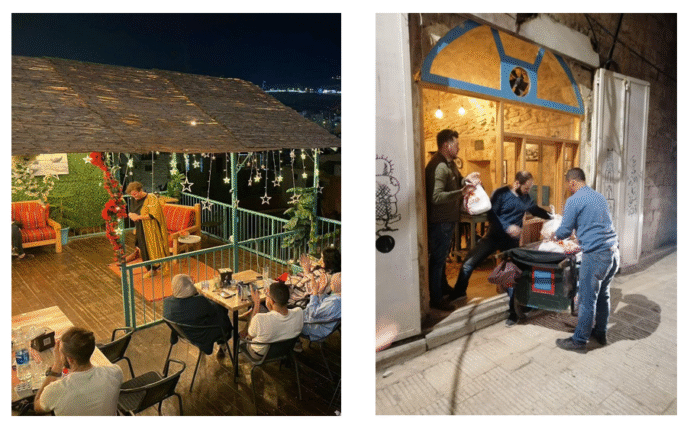
The now eight-year engagement with revivification in Nablus Kasbah is consistently proving that architectural restoration is less central to this purpose than architectural experts perhaps admit, but the continuous activation of social energy within space is. The people and the place are not separate variables; they are mutually reinforcing assets. By working within this relational infrastructure, the Yalla Project operationalises an alternative paradigm of urban revivification—one that functions during violence rather than waiting for its end.
Financial Resilience: An Instability-Designed Model
From its inception, the Yalla Project aimed to establish a financially independent model of urban revivification. Rather than relying on continuous donor funding, we began with a modest seed fund intended to initiate a self-sustaining cycle. Income generated from the first rehabilitated space would finance the next stage, creating a gradual, internally funded expansion.
The initial investment was intentionally small, demonstrating that revivification need not begin with large-scale capital. The seed fund was used to rehabilitate a small café, which became both our economic engine and our social gateway into the neighbourhood. Through daily interaction, neighbours came to know us as participants in local life rather than external actors.
As revenues stabilised, profits from the café were reinvested into rehabilitating a second building. This incremental growth relied not only on financial planning but also on relational trust. A local contractor, himself a resident of the neighbourhood, agreed to delayed payments over several years, reflecting shared commitment to the project’s continuity. Over time, revenues were consistently reinvested in maintenance, operations, and further rehabilitation until three buildings were fully restored without reliance on recurring external grants.
Operating in the Old City, however, required navigating recurring disruptions. The project endured COVID-19 shutdowns, periodic security escalations, and sudden declines in visitor confidence triggered by both real incidents and circulating rumours. Additionally, there is no reliable insurance mechanism to cover damage caused by military operations; owners must absorb the costs themselves. Risk, therefore, is structural rather than exceptional, and it highly affects the economic aspects of any endeavour.
The resilience of our financial model lies in its modest scale and internal flexibility. Incremental growth limited exposure to debt. Reinvestment strengthened each subsequent stage. Operational autonomy allowed rapid adjustment during downturns. Because we were both owners and operators, we could scale activities according to prevailing conditions without external contractual constraints.
In this sense, financial independence was inseparable from spatial ownership and social embeddedness. The model was not designed for stability; it was designed for volatility. Revivification became a cyclical process of activation, disruption, repair, and reactivation—capable of functioning without waiting for a stable “after.”
Conclusion: Revivification Without an “After”
The Old City of Nablus illustrates a broader urban condition in which disruption and continuity coexist. Urbicide does not operate only through physical destruction, but through the gradual erosion of confidence, centrality, and everyday life. In such contexts, revivification cannot be confined to a post-conflict phase; it must function within instability itself.
Through research-by-doing, the Yalla Project operationalised an alternative paradigm rooted in spatial ownership, social embeddedness, incremental reinvestment, and operational autonomy. Revivification was practised as an ongoing process of reopening, reactivating, and adapting after each interruption.
While grounded in Nablus, this experience speaks to other Palestinian cities and to urban contexts globally where chronic insecurity, economic fragility, or political volatility shape everyday life. In such environments, the capacity to sustain presence becomes more critical than uninterrupted growth. Revivification , therefore, is not about waiting for an “after,” but about cultivating continuity amid uncertainty.
The practical and methodological lessons developed through the Yalla Project directly informed the formulation of the Phoenix Gaza Recovery Framework—the Gaza-based post-war recovery proposal advanced by the Union of Gaza Strip Municipalities. In this sense, the knowledge generated in Nablus was not confined to a single city; it contributed to shaping a reconstruction vision for a territory facing widespread devastation. The experience demonstrates that locally grounded, incremental, and socially embedded urban practices can inform recovery strategies even at much larger scales.
References
Abujidi, N. & Verschure, H., 2006. Military Occupation as Urbicide by Construction and Destruction: The Case of Nablus, Palestine. The Arab World Geographer, 9(2), p. 126–154.
Bishop, R. & Gregory, D., 2002. The City-as-Target, or Perpetuation and Death. In: Cities, War, and Terrorism: Towards an Urban Geopolitics. Oxford: Blackwell Publishing, p. 54–74.
Challand, B., 2008. Palestinian civil society: Foreign donors and the power to promote and exclude. s.l.:Routledge.
Coward, M., 2009. Urbicide: The Politics of Urban Destruction. London: Routledge.
Golańska, D., 2022. Slow Urbicide: Accounting for the Shifting Temporalities of Political Violence in the West Bank. Geoforum, Volume 132, p. 125–134.
Graham, S., 2010. Cities Under Siege: The New Military Urbanism. Verso: London.
Hammami, R., 2015. On (Not) Suffering at the Checkpoint; Palestinian Narrative Strategies of Surviving Israel’s Carceral Geography. Borderlands E-Journal, 14(1), p. 1–17.
Taghdisi-Rad, S., 2010. The political economy of aid in Palestine: relief from conflict or development delayed?. s.l.:Routledge.