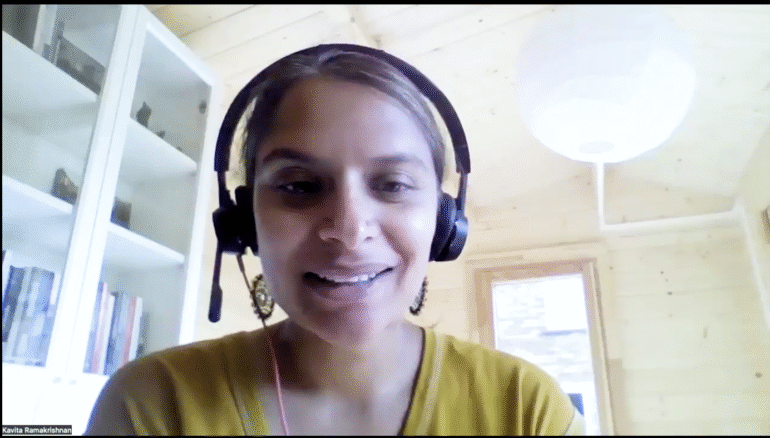
Of fragments and epistemic justice: An interview with Kavita Ramakrishnan
Introduction by Bruna Rossetti Mendonça
Allow me to begin with a small story and an image. Silvia Rivera Cusicanqui (2018), in the book Un mundo ch’ixi es posible, tells us, with her deeply sensitive writing, that when the earth shakes, we realize what we take for granted. Everything can crack and crumble if the planet merely scratches its nose and sneezes, she adds. My conversation with Kavita Ramakrishnan made me revisit this passage, since good encounters are like that. They inspire us, move us in new directions, and make us reread the world from a different perspective. After our brief online walk – each of us situated on different parts of the planet – I felt that the ground beneath me had shifted a few inches. This publication, therefore, is an invitation for the reader to mobilize as well – to walk a little, and to join the conversation.
In our talk, Kavita and I spoke of different lenses and important tools to understand realities. While Silvia gazes at the stars and speaks of vital “epistemological gestures”, such as situated thinking, Kavita brings us to the ground and the city. Although questions of housing and infrastructure have animated her work, our conversation overflowed beyond the urban as a geographical space to the urban that is in the life worlds. This is what people have and create in their daily struggles. Inspired by feminist geographers, Kavita reminds us to look at the minute details, at the “fragments”, drawing on the work of Colin McFarlane (2021), and the small everyday movements where life happens. It is an urge to consider how affect and the building of ethical bonds are inseparable from the practice of research.
These are challenges of an academic practice embedded in epistemic justice that, contrary to the idea of the lone researcher, seeks to be more collective, co-authored, and rooted in solidarity. María Lugones (2019) reminds us that we are made by practices passed from hand to hand: by ontologies, space-times, and cosmologies. Only community makes doing possible, as people always produce together with others, Lugones says. Kavita brings her colleagues and the organizations she meets on the ground into her learning. These are actors that create entire vocabularies and weave theories, even if they often do not receive credit for it. During one of my research periods in Bolivia, when I spent time with the women’s movement Mujeres Creando, I understood that some things are felt in one’s own flesh, as one of them used to tell me, and that life cannot be sustained in isolation. Creativity walked together with collectivity and politics. However, in our conversation, Kavita and I also spoke with honesty about avoiding romanticization, trying to face the limits of academic timeframes, and the tensions of our craft. This interview is itself one fragment. I end by highlighting my gratitude for the encounter with Kavita and my wish that words keep unfolding on other lips – inspired by a graffiti I once saw on the walls of La Paz that said, “Resbala por mis labios y transfórmate en palabras”, signed by Acción Poética.
Interview transcript (edited)
BRM: What is “the urban”? What do we study when we claim to study the urban?
KR: Thank you so much for collating these fantastic questions. I was thinking about this a lot, and for me, it’s perhaps getting a sense of the richness of life worlds that are present in the urban. So, not thinking about the urban as a geographical space, but the specific forms of circulation, of encountering, of relating to people and the richness that comes from this. And of course, thinking beyond stigma and precarity. And while those are kind of useful lenses, of course, and need to be paid attention to, that’s not the totality of urban life. And urban life is not always rooted in the city form, right? So, we think about migrants, and I know, Bruna, you study migrants, for instance, but how migrants can circulate between the urban and rural, and bring back different forms of culture, of food, of kinds of economic lifestyles, of hustles, of aspirations. And for me, it’s trying to get a sense of that interiority of people’s life worlds. And of course, this is always going to be partial. It’s always going to be situated. We’re never going to have a full sense of how people live, of what their deepest desires might be. That’s not what I think, as researchers, we seek to claim a full understanding of that, but just being able to glimpse, to share, to be able to write and communicate lives that are often deemed as marginal, as “other”. Kind of resuscitating these and showing that they are multi-layered, that they are rich, is important to how we study the urban, and for me, defines the urban in general.
BRM: How can we come to know “the urban”? I mean, I think it’s really important to ask the how, right?
KR: So, I suppose a lot of my work, and that of feminist scholars that I really admire, steps away from grand theories. And this is, I think, the more recent trend of critical urban studies. So, thinking about small aspirations, about hopes, about dreams, about desires. I don’t want to reify ethnography, but that’s been a very kind of powerful tool of understanding urban lives. I’ve also been really inspired by this idea of “the fragment” that Colin McFarlane writes about. So, how might we understand these kinds of fragments of people’s lives as they pull together infrastructure, as they walk from their homes, the gendered labor of procuring water? How might we understand accessing, perhaps, housing, and legitimacy and papers and titles, and government services? So, I think paying attention to these everyday struggles is a very important lens then into what it might mean to study the urban.
Also, I think there have been a lot of moves towards incrementalism in the so-called global South. So, how do people, gradually, over time, build up their lives? And this is something that has really, I think, taken me by surprise in my own fieldwork in resettlement colonies in Delhi. So, people who’ve been evicted and have over time had to build up housing, have had to build up their own half-and-half formal status, you know, that kind of murky ambiguity of being half between “legal” and half between “illegal” lives and livelihoods. How do they manage and navigate that? How do they start from nothing, almost, having been evicted, and slowly repair their lives? So that, for me, is also a very important lens. And a lot of this, I think, is that kind of deep-seated work, right? Spending time in communities, being able to really build bonds, really think about ethical encounters with the people that you’re working with, and thinking fundamentally about who you’re writing about and the purpose of it. You know, what are the kind of deep questions of your work, and what are the politics behind that?
BRM: So, my third question is: from where can we theorize the urban? I think you already answered it, but if you can talk a bit more about that. Because, I mean… reading you and listening to you, I know that it’s important to your work, thinking of constructing knowledge in a situated manner.
KR: Yes, I think that there’s a lot to be said about this. You know, I’ve been rereading the work by AbdouMaliq Simone. These kinds of marginal opportunities, what he calls the marginal opportunities for rehearsal, that take place on the periphery. So, a lot of what I do looks at the peripheries, and again, this isn’t a geographical location. This is also the ways in which people have been marginalized, have been forced to access infrastructure in very piecemeal, fragmented forms. In work that I’ve done around migration in Europe, with other collaborators at UCL, Tatiana Thieme and Eszter Kovacs, and my colleague Ludek Stavinoha at UEA, it was really kind of profound to think about how migrants inhabit multiple spaces within cities like Paris. They are constantly on the move, living underneath, next to railway stations, underneath bridges, near canals, and the messy solidarities that they form, you know? So, how they’re always trying to make sense of the city, get to grips with it on their own terms, thinking about how and when to make themselves visible so that they can access services, and even kind of form short-term, and leading perhaps, alliances with other migrants as they might find solidarity, and banding together for particular moments in time. So, I think it’s those kind of fleeting, ephemeral moments, and seeing what happens through different pressure points, through the different day-to-day challenges that arise.
I’ve also found infrastructure to be a really powerful lens to look into the urban. And here, to maybe answer your question a little bit more in depth. Theorizing the urban, it can also be helpful to even follow a policy as it lands on the ground, or something. There’s been a lot of critique, of course, of master plans in a lot of cities. In the so-called global South, they seem very wed to master plan and planning, even though so much of the population, particularly in the Indian context, is informal. So, understanding how infrastructure then plays out in this kind of day-to-day life, you know, for people who are racialized or excluded because of caste-based oppression, or face these kinds of gendered burdens. Of course, here I’m thinking about water, but also, how do people tap into electricity? And what does that mean, then, for how they make claims on the state? How do they think about housing as an infrastructure, as a way of proving their legitimacy?
So, these questions of citizenship and infrastructure have really, I think, animated a lot of my work. But I don’t want to just put everything on the material. And maybe this is something that a lot of us think about. What role does affect play? How do we understand that kind of visceral sense of what it means to be in the world, in this space, amongst other people who might be sharing similar experiences or feeling alienated from the more dominant flows that are happening in the city? So, I’m constantly, I think, trying to tack back between those two, the material and the affective, and thinking about, yes, there is infrastructure. And yes, there is a very kind of physical, embodied way in which people are accessing infrastructure. But what does this mean, on this kind of visceral level, what kind of sense does it bring forth? What kinds of constellations and groups of people does it bring together?
BRM: Thank you, Kavita. So, follow-up question. I think many of us, we turn to lesser-known theorists from the global South to think through anti-colonial and anti-capitalist critiques. And I was wondering, in your view, what possibilities and tensions emerge when theory travels across contexts of enunciation? And as someone that also “travels across” with your research, I was thinking if you could share some other references of less-known theorists, scholars, thinkers, or activists, or people that inspire your practice.
KR: Yeah, and I think that’s a powerful question, just thinking of us gathered here, you know, of how we’ve crossed borders and how we might think about theory in different ways. In my own teaching practice, I really tried to deconstruct this idea of theory as something with a capital “T”, that’s grand and universalizing. And of course, this, again, is inspired by feminist geographers who really push us to think on the scale of the intimate, or to think about some of these more small, everyday movements. Here I’m thinking of Cindi Katz, for example. But you’ve asked about lesser-known theorists, and for me, I’m thinking about how we democratize theory-making and theory-building. So, how might we actually learn from grassroots movements, and how might we learn from anti-eviction campaigns? How might we learn from labor unions? So, some of the work that has recently really inspired me has been from colleagues and comrades that I’ve interacted with here in the UK as I’ve thought about housing justice.
There’s a group called Southwark Notes, who’ve been really active in saving and kind of fighting against the demolition of social housing in Elephant and Castle, which is in London. And they’ve used a lot of humor and playfulness in their materials, you know. While thinking about the violence that, of course, eviction and gentrification causes, there’s still always been this playful element. So, for me, I think that’s been a really powerful way of showing how there is still, even within this “big word of resistance”, there are just these very subversive ways of doing it. In the Indian context, I’ve been really inspired by local organizations like The Hazard Centre in Delhi, which have done incredible work of documenting. I mean, there’s so much detail that they’ve given when it comes to enumeration. So, how do we think about and count the lives of people who just don’t make it into these official plans? Whether it is, you know, thinking about street hawkers and how many of them are actually circulating, and the dangers that they face, from, you know, overheating and working in hot conditions, to having the threat of police violence. In addition to all the residents of Delhi, for instance, who are living in substandard housing. So, I think these organizations are on the ground, actually, and they wouldn’t get the credit of theorizing, right? It’s something that academics tend to get that label, but yet they’re creating these very powerful vocabularies and documentations for what is happening. And I think beyond that, I’ve been really impressed and inspired by the work of various urban laboratories. The Hyderabad Urban Lab, the Karachi Urban Lab. I’m thinking of people like Nausheen H. Anwar, who’ve been writing a lot about the effects of heat in the city and failed governance. And that kind of draws into my own recent work and ongoing work on looking at what it means for citizens of places like Delhi to cope and to endure in very, very hot conditions. What does it mean for their life worlds, for their working conditions, for how they inhabit houses, how they circulate the city?
I was going to say one other point to this, if I may. I think too, so many of us rely on the help of research assistants, of translators, you know. It’s not the lone academic who makes the work anymore. And I think to be silent about that is really problematic. And I continue to refer to the work of Richa Nagar, who talks about a lot of these tensions, and she’s co-written with the Sangtin Writers, and she has this fantastic book that I refer to all the time called Muddying the Waters, and how she co-authors feminisms. And of course, it’s not an easy process, right, to build theory, to build these narratives together. We sometimes use different vocabularies. We come from different positionalities, different epistemic viewpoints. But it’s that work, that difficult work of translating, that is so important. Not just linguistic translation, but bringing ideas together and saying, you know, does this make sense? And how I’m representing your lives, how might you challenge me, and how might we potentially write this together. And I think that’s something that I’m still growing and thinking about within the academy, how I can better do that. That’s not a question that I’ve fully answered myself. It’s ongoing.
BRM: I was thinking, do you find that there is any risk in how the “global South” is mobilized in academic settings? Does it make sense for you to talk about the “global South”?
KR: Yeah, that’s a tricky one. It does in some ways, because I think that there are particular movements, particular ways of inhabiting the city, that are very particular to Southern urbanisms. And here I’m thinking of informality. That’s the one that pops into my head, just the ways in which, because of how the city has been planned, how the city’s been mapped… Colonial histories, of course, have really created cities that function in particular ways. So, I am all for creating vocabularies that are attuned to this and attuned to the ways in which people build very incremental lives and housing and livelihoods. And here again, Gautam Bhan writes really compellingly about this. But I think that there’s so much kind of cross-conversation and transnational solidarity building, and I use those words a little bit hesitantly and carefully, because I don’t want to romanticize or reify things, but just understanding how housing justice movements and researching these have learned from each other.
I mentioned Southwark Notes, but they draw heavily, I know, on the Anti-Eviction Campaign in South Africa. There’s also the L.A. Tenants Rights Network in, of course, Los Angeles. And they’re learning from all of these different movements, and you might have found the same in your own work. So, I think to silo what’s happening in the so-called global South, without expanding those conversations and trying to draw linkages, makes it feel very parochial, or makes it feel very other. And I think that there’s a kind of wider world and a wider way of thinking about this. And for me, migration really collapses a lot of those boundaries, right? So, a lot of the migrants that I interviewed would come from places like Sudan, would come from Afghanistan, and, you know, they’ve been traversing all of these different places, encountering so many different volunteers who are in communication with each other across Europe. These organizations are, in a lot of ways, helping facilitate, or were at the kind of height of the so-called “migration crisis”, and were helping facilitate their journeys before it became increasingly criminalized through Europe. So, I think, the migrants very much were responding to what was happening in the so-called global South, where they were coming from, cities that they were coming from, always thinking about these lives that they’d left behind, but yet, kind of facing this new challenge of becoming European. So, to me, there’s something very particular about writing on Southern urbanisms, but yet you see a lot of these echoes on the street of Paris as migrants are settling up, settling into camps, as they’re building their own kind of infrastructures, of welcome, of survival. So, yes, I kind of struggle with this tension, but I wouldn’t want us to solely be focused on the global South without thinking about these wider ripples, without thinking about these kinds of racialized capitalist processes that connect all of us.
BRM: As an anthropologist, I’m also concerned about ethnography and the ways we can do it. I was wondering about writing and positionality in ethnography. So, I remember in one of your publications, I was struck by this description of walking with Madeeha and how her “giddiness”, as you say, was “contagious”, and how you wove that moment into your own presence in the field. I would love to hear more about how you navigate these tensions in writing, for instance, between solidarity and appropriation, or between the “I” and the “we” in ethnography. How do you reflect on your presence in the field and the narrative choices that you make?
KR: I want to say that I’m really glad academia has shifted in its thinking, because I think when I wrote that piece, I wouldn’t have felt comfortable writing that in my dissertation. It felt very of a particular type of knowledge that wasn’t, I don’t know, serious enough for the academy. It had to be in a methodological piece, and I think that’s such a shame. And if I were to do it again, I would write it in a… I would maybe start from that point of how and where we’re writing from, and what this means, and what kinds of choices we make, what kinds of stories we include. And how, over time, we change our own ways of thinking, based on conversations and especially seeing people’s lives move on. I think some of the choices that I made back then, I perhaps wouldn’t have made now. I spent a lot of time with these women and became very close to them in this resettlement colony. These women worked at a particular NGO. And I spent a lot of time writing about their lives, writing about their work. But over time and in my shift to migration research, I began thinking about what we might not want to say, what we might not want to reveal about people’s lives. And I think that’s as important of a conversation as what we choose to reveal. I think that there might be things that we do need to be careful of in the migration context, being very careful about specific location, specific rhythms and routines, because there is that very real threat of incarceration, of police violence. So, there’s that aspect.
But even with this, “I” and “we”, how do we move towards more of a co-authorship? And I understand that the academic system doesn’t easily enable us to do this. And of course, academic writing is of a very particular kind that’s not accessible to everyone or not of interest to everyone. So that’s maybe where I’m trying to work more on creative methods, and some of those were experimented with in the piece that you referred to, Bruna. These kinds of walking methodologies. And I was so struck and so surprised at how that enabled me to see a different side of the women that I was working with. What became, sometimes, a very formal exchange over cups of tea, where they saw me very much as this researcher from elsewhere. And even though I’m obviously of Indian heritage, they very much saw me as a Westerner. And these were some of the uneasy hierarchies that kept kind of re-sedimenting, even though, of course, caste and economic privilege and all of these other things that I bring to the table. But walking and being able to see the former homes of women who were evicted, that was something very powerful. And I could also better imagine what their lives would have looked like, how they might have inhabited a very different part of the city, felt very different levels of freedom, of opportunity, of aspiration, and that became very clear to me. Some of my more recent work has been experimenting with zine-making. So, kind of informal DIY publications, where the people that I’m working with are able to contribute through collage work, through their own artwork, pages of a zine, and we put them together. And this worked really well when I was working with students at the University of East Anglia – doctoral students, some doctoral researchers – and trying to understand how they see themselves belonging within the university. So, I think that there’s a whole range of creative methodologies, and I’m so excited by what I see happening in geography, in critical urban studies, even in some arms of anthropology that really take these methodologies seriously, and that think about how they open up different life worlds, different viewpoints.
BRM: Thinking about methodologies, you were already telling me some of these creative methods. And I think you make visible the importance of epistemic justice, and it seems you reflect on this a lot. And I remember, reading your work, when you mentioned participant photography and “walk-alongs”. I wanted to ask if you can elaborate a bit more on these methods, if these or other ones have allowed you to access layers of knowledge or relationships that might otherwise remain out of reach, elusive in a way. Do you think this is part… these approaches… are they part of a broader political commitment in your work?
KR: I guess we’re all aware that some methods just make much more sense, depending on the context and depending on who you’re working with and how much visibility your respondents want to have. But in the resettlement colony, I gave women that I was hanging out with disposable cameras. Maybe that ages me, but I taught them how to use these, and they were really excited to take photographs. And I told them to take photographs of their family members as well, and I would get these developed, just so that they could have the full range of these. And we talked about some of the pictures that they took of the resettlement colony, and it really helped to then further elaborate what I was seeing. Or, you know, if they were very upset by an undeveloped plot, for instance, that had turned into an informal garbage dumping site, this was something that would come through in a photograph, and we could talk about it. Or places that they felt were “no-go zones” for them, that they felt very uncomfortable venturing into. We would talk about the kind of self-imposed, but very real, boundaries that they were living amidst within this quite small resettlement colony, relatively. So, I think it did open up a lot of different layers, similar to the “walk-alongs”, of thinking about very material aspects, but also being able to reflect, perhaps, on past history. So, where they came from, what their expectations were when they migrated to Delhi, as many of them were migrants to the city in the 70s and 80s from the rural state of Bihar, or rural parts of Bihar. So, they were able to discuss all of these through something as simple as walking, something as, perhaps, simple as a photograph. And I think walking really brings in that layer of embodiment. And I know this is something that feminist scholars from Latin America are writing really beautifully about, but how do we connect our body to so many of these spaces? Rather than just being present, how do we also, as much as possible, feel those connections to the land, to the infrastructure? To all of these struggles that the people that we are working with are facing, of course, realizing that it’s never going to be the same for us, right? We can remove ourselves. We have these relative privileges.
I think in terms of epistemic justice, I would want to be careful here, because I think sometimes there’s so much pressure to have activist-focused research. And while I think that is very important to think about who you’re accountable to, of what the politics of your research are, I think it is very difficult to have purely activist research in the timeframe of, for instance, a PhD, or a funded research project. And then what happens when the funding moves on? What happens when you go to the next project? How do you maintain that? So, for me, epistemic justice is really thinking about, in that moment of time, “Am I doing something that the people that I’m working with understand, that they feel, that in some way pushes towards this horizon of justice?”. You know? Is that about collating information, collecting data on, for instance, the violences that migrants face, and putting this together with other testimonies from organizations working on the ground? Is that part of the work, for instance, in terms of the work on resettlement, or are there smaller ways in which we can collaboratively document how living in resettlement colonies has been, at the time, completely devastating to people’s life goals, ambitions? So, I want to say that if we feel that the stakes are massive, if we push ourselves to this perhaps unrealistic goal of being “academic researchers”, I think we’re never going to be able to fully achieve that. That’s some sort of idealistic version of research that I think the academy just doesn’t and can’t support. So, it’s about thinking about within your own research, how do you carve out these moments of collaborative, collective ways of being? And these kinds of creative methodologies really, really enable them. They enable different types of outputs, different ways of being together, rather than this more formal back-and-forth interview, which I think a lot of us also find unsatisfying. So, maybe that’s not the answer that a lot of people would be looking for, but I think that’s the way in which… that’s maybe that cautionary step that I take in making sure that whatever work that you’re doing has this kind of realistic view, and that you’re always kind of accountable to the people that you’re working with. And thinking about, “Well, what am I doing here? For how long will I actually be here? How do I leave the ‘field’ comfortably, knowing that I haven’t left loose ends, but knowing I can’t fulfill everything?”.
Trying to navigate that fine line between solidarity and appropriation and knowing that solidarities are always kind of messy, as Geraldine Pratt says, they’re not perfect. But that’s part of how I keep thinking about research, “Where are the ways in which I can enact solidarity in forms that are meaningful, but also be considerate and conscious of how I’m writing about this, of why I’m writing about this?”. It’s not another paper, or it can’t be another paper. Particularly, I feel at my stage of my career, there’s very little to achieve from writing the same types of publications. I want to think of it critically, of, “Well, what might this be saying? How can I think about this? If I were to have to show it or explain it to the people that I’m working with, can I do that in a way that’s satisfactory, that feels like it has some resonances in their lives? It’s not just abstraction and the sake of theory for theory”.
References
Creando M (2005) La Virgen de Los Deseos. Buenos Aires: Tinta Limón.
Cusicanqui SR (2018) Un mundo ch’ixi es posible. Ensayos desde un presente en crisis. Ciudad Autónoma de Buenos Aires: Tinta Limón.
Lugones M (2019) Rumo a um feminismo decolonial. In: Hollanda HB (ed) Pensamento Feminista: conceitos fundamentais. Rio de Janeiro: Bazar do Tempo.
McFarlane C (2021) Fragments of the City: Making and Remaking Urban Worlds. Oakland: University of California Press.
Nagar R (2014) Muddying the Waters: Coauthoring Feminisms across Scholarship and Activism. University of Illinois Press.