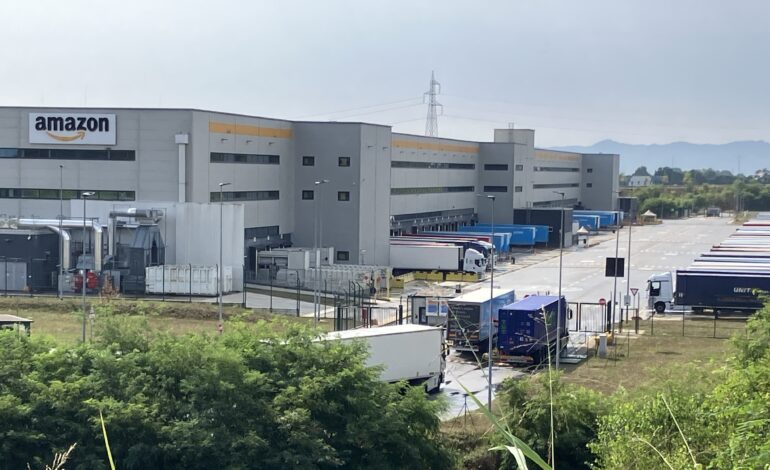
Location Matters: Amazon’s Logistics Spaces in Italy
Introduction: Digital Platforms, Infrastructure, and Geographical Footprints
There is growing concern about the possibility for Large Digital Platforms (LDPs) (e.g., Google, Facebook, and Amazon) to acquire infrastructural status across urban units, from cities to municipalities, regions, and more. Over the last decade, LDPs have emerged not only as providers of services for infrastructural functions such as IT, communication, logistics, and transportation, but also as active actors in improving these infrastructures (Hardaker, 2022) by shaping both digital and physical conditions where digitization narratives are defined as a transversal necessity. This further enhanced their legitimacy (Repenning and Hardaker, 2024), making them a necessity for other actors, including public institutions and business associations. In the urban context, digital platforms are a contested, normative, and still-evolving phenomenon in terms of their impacts, because they challenge the existing nexus among cities, territories, and economic development. The critical debate around LDPs highlights the complexity and contradictions they bring, underpinned by the Platform Economy (Van Alstyne et al., 2016; Grumbach, 2017; Kenney and Zysman, 2016). Despite their logic of technological innovations and relative positive externalities (e.g., jobs, wealth creation, regenerative interventions, bringing technological capacity to places, etc.), the critical debates often illustrate simultaneous manifold negative externalities (e.g., lock-in of economic actors, dependency circuits, platform workers’ struggles, etc.) along with significant geographical polarisations (Kenney and Zysman, 2020; Silva Neto et al., 2022, Cuppini et al. 2022) that are open-ended for offline outcomes. From an urban perspective, these platforms appear to produce a continuum within urban space. On the one hand, these platforms bring opportunities for territories that were once difficult to enter into the dimension of global flows of goods and services. At the same time, the other territories are negatively affected by these flows and witness the urban space as a field of tensions.
In the planning and policy context, these platforms are seen as a potential catalyst to address complex urban-economic issues that are more social, administrative, financial, and global in nature. This can be explained by the fact that LDPs often receive favourable economic treatments from public actors and institutions (Sands et al. 2020; McNeill, 2021; Leon and Rosen, 2020), in the form of subsidised use of existing public resources (e.g., land, transport nodes and corridors, etc.). Today, they are acknowledged as a necessary infrastructural tool and deployed worldwide to frame, organise, and manage the diverse urban infrastructure systems and services, thereby also influencing planning and governance practices and, hence, public agendas. However, due to their dispersed nature, they also pose a significant challenge for measuring the effects on the transformation of urban spaces, for example, which are the platform’s new geographies, which infrastructure assets and land resources are relevant to them, and how much platforms extract from/give back to places.
This article is built on ongoing research into the Amazon platform’s logistics expansion in Italy. In this article, the author focuses on the spatial implications of the Amazon platform through its logistics functions in the Italian regional context. From an urban planning perspective, the article explores the following question: How are Amazon’s logistics sites being constituted? Who are the key actors? Which factors or policy windows allow them to locate in one place or another seamlessly? What kind of new local-global arrangements or agencies are being formed in this process? The study is largely based on qualitative methods, such as desk research, visits to Amazon’s logistics sites, and key informant interviews. To obtain primary information, the author visited six Amazon sites in the Veneto region to observe the actual movements and connections of these new sites with their surrounding environment. To explore Amazon’s spatial expansion, the author has treated Amazon primarily as a logistics platform that produces peculiar urban sites: e-commerce-driven retail logistics premises of varying sizes, that are technologically engineered to speed up circulation between different actors and institutions at each end. Despite being a technology-driven company, Amazon’s physical spatial components, such as distribution centres and delivery centres, are central to the sustenance of its logistical scale worldwide.
Logistics Platform: The Case of Amazon
In the contemporary period of the platform/digital economy, platform capitalism (Srnicek, 2017; Kenney and Zysman, 2020; Sanyal and Ferreri, 2018; Grabher and König, 2020), Amazon platform has grown to more than just an e-commerce platform and has extended into many other areas, including logistics. Amazon’s logistical reach is now global rather than being concentrated in the United States. On a practical front, logistics activities entail the movement and flows of goods and services among the diverse links of an urban system (Guide, 2023; Raimbault and Heitz, 2024), take many forms across territories and cities, and are a sort of backbone for their core functions (e.g., manufacturing and production, distribution, transportation, etc.). In the past, logistics functions were primarily owned and carried out by the state, military institutions, and corporate industrial organisations (Cuppini et al. 2022; Guide 2023). Today, this has evolved as an independent industry underpinned by e-commerce, particularly the form of ‘retail logistics’, where Amazon plays a key role in shaping it to the extent that it has become an independent economic service sector populated by delivery and contractual workforces and other platform service providers. More specifically, such a form of retail logistics comprises various categories of platform agents and specialised expert clusters, capable of dealing with the complexities of planetary-scale geographical arrangements, distribution, and circulation through advanced digital technologies. In this way, Amazon plays a dual role in urban space, i.e., a global phenomenon while also a local reality. Now, logistics has become an essential service in our daily urban life.
On a material level, Amazon logistics functions operationalised on peculiar urban settings, i.e. a new generation of logistics sites, characterised by frequent and fast deliveries, proximity to main transport nodes and arteries, such as ports, airports, freight zones, and highways. These sites are a new breed of automated/digitised building structures, often on greenfield land areas as a supplier to metropolitan cities. A recent study on e-commerce logistics requirements for land (in the U.S. context) demonstrated that these new generations of e-commerce-based logistics sites require more than three times the land area as compared to traditional sites (Prologis, 2020). As a leading player in e-commerce, Amazon’s logistics setups in urban areas represent an ongoing shift (Schorung et al. 2024) in the requirements for logistics-related land uses. Its typical logistics spatial configuration comprises, mainly, three kinds of urban sites based on their distributional scale: large distribution centres (often for cross-border distribution), sortation centres, and delivery stations (see Figure 1).
Amazon’s Footprints in Italy through Logistics
Since 2000, Italy has been facing urbanisation pressures primarily due to the transportation and logistics needs (Mariotti, 2015) and associated strong logistics real-estate interests (Cuccu and Pontarollo, 2024). On a broader level, the country’s urban fabric is typically classified into three categories: high-density urban areas, medium/low-density areas, and rural areas (ISPRA, n.d.). A recent study by the national-level institute (The Institute for Environmental Protection and Research-ISPRA) disclosed a new category: high-density land use with low population density. This new category is mostly attributable to the development of large logistics premises and associated distribution infrastructure (outdoor storage, vehicle parking, connecting roads, etc.), which is predominantly concentrated in the country’s northern territories (ibid). This was evidenced by the fact that in 2021-22 alone, in the northern regions, 2/3rd of the land share was consumed by logistics and associated infrastructure (ISPRA, n.d.). In Italy, land consumption for development is not directly linked to the population dynamics. For example, there is high-speed growth in land consumption even in the presence of population stabilisation and in many cases, degrowth of the resident population (ibid). This significant land consumption for a single cause at the expense of agricultural and natural land has provoked debates in the country among civic organisations, citizens, and, to some degree, government actors about land use planning, governance practices for logistics, and possible mitigation measures.
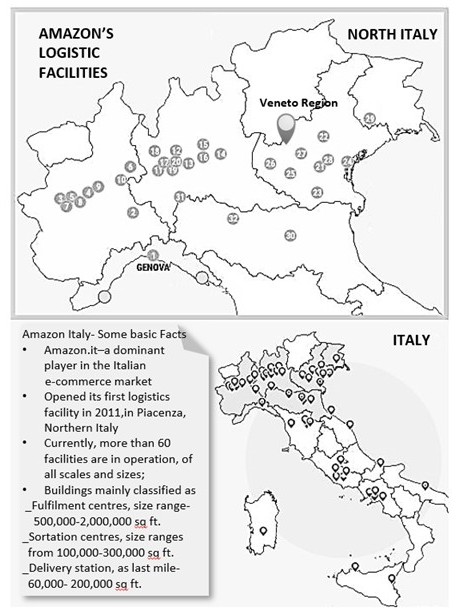
Source: Modified by the author based on the PuntoCritico.info database on Amazon.
At the current intersection of the platform economy with infrastructure services, these places also correspond to the diffused modalities of the previous development directions exclusive to the industrialisation-deindustrialisation-globalisation periods. On the one hand, these places represent the logistics of the upper circuit (Guide, 2023) produced by the hegemonic transnational agents (e.g., large platforms, states, large businesses, 4PL, etc.) in their pursuit of internationalisation of material flows and circulation. On the other hand, it is logistics for the lower circuit (e.g., 2PL, 3PL, delivery service providers, etc.) of the urban economy, triggered by upper-circuit agents. Amazon’s logistics spaces are a notable outcome of such modalities, in which the territory is treated as a resource.
In a span of 15 years of presence in Italy (started in 2011, with a large distribution centre in the province of Piacenza, Northern Italy), Amazon today leases/owns, manages, and operates over 60 logistics facilities (MWPVL, n.d.) of varying sizes and functional scales. Geographically, its facilities are concentrated in the northern territories and often placed around the country’s key freight zones, transport nodes, and highway corridors. This was confirmed based on personal site observations and interviews. When asked about the criteria that allow Amazon to locate within the country’s local places, one interviewee argued that ‘When Amazon comes to urban areas to place itself, there are situations in Italy that had to do with the bargaining power and presence of lobbying entities that are beyond the country’s regulations; why are their logistic facilities outside of the country’s freight villages (Interporti)? Because Amazon gets special favours regarding their location choices from city leaders and public institutions’ (Interviewee from a local research institute). Another response disclosed platform-side strategies, commenting that, ‘Amazon locates its distribution centres, especially the large ones, in socio-economic weak areas, with high unemployment rates; often located near metropolitan cities and near main transport nodes and highways’ (Interviewee from a local research organisation). In an attempt to uncover the overall perception of Amazon’s logistic spaces, the contradictions were also reflected in the interviews, ‘Amazon has occupied and saturated the Po Valley corridors- the country’s central-north corridor of trade and businesses, both upper and lower ones; we are witnessing a real occupation of a territory, an occupation that does not happen due to the military, but it happens thanks to the force of money’ (Interviewee from a local activist group).
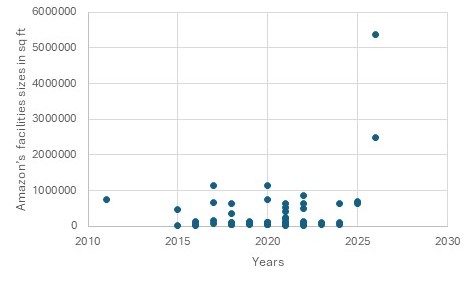
Apart from that, the spread of Amazon’s logistics sites also reflects its deployment strategy over time (see Figure 2). Before 2019, Amazon developed mainly specialised, small and medium-sized logistics facilities (e.g., sortation centres, delivery centres, etc.), ensuring its horizontal integration into local urban places. After 2019, there has been a shift towards more digitised/automated large distribution centres (usually for cross-border logistics functions), strengthening the spatial coverage of logistics infrastructure. This implies that after 2019, Amazon’s expansion strategy has shifted towards greater vertical integration, requiring larger distribution facilities, thereby inconspicuously exerting pressure on ‘logistics real estate’ requirements specific to its needs, and, hence, land.
Despite the platform’s logic of logistical innovation and opportunities, Amazon’s functional paradoxes were indicated, except for the representative from a business association and a consultant who works in partnership with the platform. For example, an interviewee from a civic organisation argued that ‘In reality, Amazon creates mostly precarious work, forming a reservoir of low-cost labour force, hungry for work and often has great difficulty getting jobs’ (Interviewee from a civic organisation). The interviewee from a business association supported the Amazon presence in Italy, though, with caution: ‘In general, Amazon’s presence is a plus for businesses. However, there is a need to work on regulatory developments in public procurement, from which small businesses are often excluded for a number of reasons’ (Interviewee from a business association).
On a structural level, there are also several initiatives, training programs, and promotional Campaigns (e.g., ‘Accelera con Amazon’; Fulfilment by Amazon program; Made in Italy Storefront), however, mainly initiated by Amazon itself, focusing on the digitisation of businesses and its positive impacts on urban areas. These imprints appear more towards the platform’s positioning as an e-commerce expert and a legitimate actor that feeds its scale, rather than on the promised tangible effects.
Amazon’s Logistics Spaces in the Veneto region
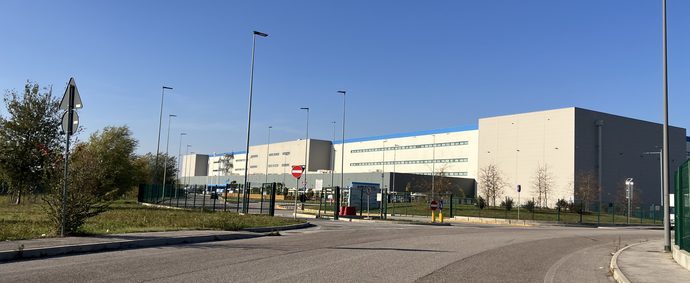
Veneto is one of Italy’s most economically advanced regions with a rich historical and industrial past, characterised by a dense network of small and medium-sized business clusters (Felici et al., 2025). The region is known for its manufacturing, logistics, and cross-border trade activities (ibid). Regarding land consumption by these economic functions, logistics stands at the forefront in terms of the use of land, particularly for its related infrastructural components, such as warehouse storage, parking lots, and connecting roads (ibid). In this region, Amazon has around nine logistics facilities, of which two are for cross-country distribution (primarily to other European countries), and the rest are for intra-country distribution. The author visited the six sites, including the large-scale ones. Of the two large-scale sites, one is still in the proposal stage (Amazon’s upcoming large-scale distribution facility in the municipality of Roncade) and is expected to start construction next year; however, it is facing opposition from the region’s small-business associations and local communities over environmental concerns and is delayed in its development procedures. Based on field observations, all sites are located in landscapes that share, to a certain extent, similar geographical, historical, and social properties. In these spaces, we obtain a closer sense of Amazon’s places as material outcomes of a long-term transition of hegemonic circulation and resource extraction (Cuppini et al. 2022) that took place over the course of the 20th century, now both digital and non-digital. It appears that these places are now serving Amazon as a historical incubator for expanding its scale through logistics.
Questions about Amazon’s locational choices and the actors involved revealed institutional gaps and the absence of municipal-level urban planning in logistics-related land development. For example, when answering the specific questions of how Amazon sites gets built in the region and the actors involved, one interviewee disclosed that ‘the most recurrent practice is that a real estate company specialised in logistics requests the authorisation to build a warehouse or a complex of warehouses to the mayor’s office. After having built the warehouse, they lease or sell it to logistics operators’ (Interviewee from a local activist group). Another response highlighted the platform’s strategy: ‘In the case of Amazon, there is a strong component of small towns or socio-economic weak municipalities in choosing a location, where Amazon negotiates with the mayor’s office, asking to have the necessary concessions to open a logistics hub and in exchange, promising employment and related benefits for the area’ (Interviewee from a civic organisation).
Other interviewees highlighted institutional gaps and power imbalances in governance practice, asserting that municipalities often do not have the financial and technical expertise to process such large developments, so the negotiations are often led by Amazon itself, who offer not only the financial support for implementation but also technical capacities to plan, design, coordinate, and manage the overall planning process. In other words, the platform obtains quasi-status to develop facilities in the local area.
The responses clearly demonstrated that not only Amazon, but also other large logistics premises, have been developed and built through a separate channel, i.e., a coalition led by transnational specialised logistics real estate developers and investors. This reveals the absence of planning practices in cities and municipalities for logistics-related land developments and a dependency on specialised logistics real-estate actors. Additionally, it is important to note that all the Amazon logistics sites in the region have been built on agricultural land.
Conclusion: Amazon’s Logistics Spaces – A Blind Spot in Planning Practice
Amazon’s logistics infrastructure is not just digital but, first and foremost, material (read: spatial). Fundamentally, the platform’s scale is realised through the production of its physical sites of distribution and hegemonic circulation. Here, the paradoxical nature of Amazon is reflected in terms of its appearance as a distant entity from the places or local urban conditions where it are settled in, yet simultaneously manifesting through diverse architectural and infrastructural arrangements along with new spatial typologies (e.g. fulfilment centres, sortation and delivery centres, etc.). These physical spaces are essential elements for the organisation’s different scales. In this sense, Amazon’s logistics model represents a paradigm rather than a fixed set of companies that generate value by distributing physical goods rather than making them, goods which start their lives elsewhere. In concrete terms, this new generation of logistics sites, combined with sophisticated digital mechanisms, centralises greenfield land uses towards platform-oriented functions, generating pressure on governments to integrate their narrow definition of digital or digitalisation frameworks with public agendas, primarily articulated as overcoming the development deficiencies of the urban.
So far, in Italy, planning and decision making (financial and technical competencies) for logistics-related development are the responsibility of the state and regional governments, which is further fragmented among regions (Cotella, 2021). But in recent years, with the explosion of e-commerce, related logistics flows and local struggles have triggered backlash against key players like Amazon and have questioned the role of local public agencies in planning processes, particularly in logistics-related land development practices. In addition, voices are emerging for a national-level logistics policy to limit greenfield land uses for single-function uses. For that, there is a similar policy agenda at the EU level in the context of land artificialization. However, there is still a need to pave the way into local planning practice. Too often, platforms’ narratives create ambiguities rather than clarity. A possible way forward would be to integrate more representations and voices, particularly from the platform itself and from local municipalities. Trade, digitisation, or other matters could be the responsibility of the region and state, yet, where to put a warehouse is a local government matter, with public consultation in deciding. This would help in understanding what is actually required for a viable adoption of such a new generation of logistics premises. Polarised viewpoints on the platforms’ modalities can undermine the prospects for balanced and refined policy debates. A reflexive learning framework exercises based on grassroots values can help read between the cracks and navigate among the competing interests of various stakeholders, thereby providing an outline for municipal-level planning actions and decision making.
References
Cotella, G. (2021). Country Profile of Italy. Hannover. ARL Country Profiles. Available at https://www.arl-international.com/knowledge/country-profiles/italy/rev/3770.
Cuccu, L. and Pontarollo, N. (2024). Logistic Hubs and Support for Radical-Right Populism: Evidence from Italy, European Journal of Political Economy, 82, p. 102522. Available at 10.1016/j.ejpoleco.2024.102522
Cuppini, N., Frapporti, M. and Pirone, M., (2022). When Cities Meet Platforms: Towards a Trans-Urban Approach. Digital Geography and Society, 3, p.100042. Available at https://doi.org/10.1016/j.diggeo.2022.100042
Felici, G., Codato,D., Lanzavecchia, A., De Marchi, M., and Lavagnolo, M.,C., (2025). Retail Development and Corporate Environmental Disclosure: A Spatial Analysis of Land-Use Change in the Veneto Region (Italy). Sustainability, 17(15), p. 6669. Available at https://doi.org/10.3390/su17156669
Ferreri, M. and Sanyal, R. (2018). Platform Economies and Urban Planning: Airbnb and Regulated Deregulation in London. Urban Studies, 55(15), pp.3353–3368. Available at https://doi.org/10.1177/0042098017751982
Grabher, G., & König, J., (2020). Disruption, Embedded. A Polanyian Framing of the Platform Economy. Sociological, 14 (1), 95-118.
Grumbach, S. (2017). Digital Platforms: A New Grammar for Territories? Available at doi: 10.14746/eip.2017.1.7
Guide, L., (2023). Brief Contribution of Brazilian Critical Geography to the Study of Platform Logistics. Into the Black Box. Available at https://www.intotheblackbox.com/articoli/brazilian-critical-geography-platform-logistics/
Hardaker, S. (2022). More Than Infrastructure Providers – Digital Platforms’ Role and Power in Retail Digitalisation in Germany. Tijdschrift voor Economische en Sociale Geografie, 113(3). Available at https://doi.org/10.1111/tesg.12511
ISPRA (n.d.). Consumo di Suolo, Dinamiche Territoriali e Servizi Ecosistemici, Edizione 2024. Available at https://www.snpambiente.it/notizie/temi/suolo/consumo-di-suolo-dinamiche-territoriali-e-servizi-ecosistemici-edizione-2024/
Kenney, M. and Zysman, J., (2016). The Rise of the Platform Economy. Issues in Science and Technology, 32(3), p.61.
Kenney, M. and Zysman, J., (2020). The Platform Economy: Restructuring the Space of Capitalist Accumulation. Cambridge Journal of Regions, Economy and Society, 13(1), pp.55-76. Available at https://academic.oup.com/cjres/article-abstract/13/1/55/5809994
León, L.F. and Rosen, J. (2020). Technology as Ideology in Urban Governance. Annals of the American Association of Geographers, 110(2), pp. 497–506. Available at 10.1080/24694452.2019.1660139
Mariotti, I. (2015) .Transport and Logistics in a Globalising World, A Focus on Italy. Springer Briefs in Applied Sciences and Technology, Polimi Springer Briefs, available at https://link.springer.com/book/10.1007/978-3-319-00011-4
McNeill, D. (2021). Urban geography 1: ‘Big tech’ and the Reshaping of Urban Space. Progress in Human Geography. Available at https://doi.org/10.1177/03091325211021945
MWPVL (n.d.). Amazon Global Supply Chain and Fulfillment Center Network. MWPVL International . Available at https://www.mwpvl.com/html/amazon_com.html
Prologis, (2020). Accelerated Retail Evolution could Bolster Demand for Well-Located Logistics space. Available at https://www.prologisgermany.de/en/insights/research/accelerated-retail-evolution-could-bolster-demand-well-located-logistics-space
Raimbault, N., and Heitz, A. (2024). Logistics Urbanization, Between Real Estate Financialization and the Rise of Logistics Urban Planning. Globalization and Dynamics of Urban Production, 73-103.
Repenning, A. and Hardaker, S. (2024). The Platform Fix: Analyzing Mechanisms and Contradictions of How Digital Platforms Tackle Pending Urban-Economic Challenges. Journal of Economic Geography. Available at https://doi.org/10.1093/jeg/lbae015
Sands, G., Filion, P. and Reese, L.A. (2020). Techs and the Cities: A New Economic Development Paradigm?’, Urban Planning, 5(3), pp. 392–402. Available at 10.17645/up.v5i3.2986
Schorung, M., Lecourt, T. and Dablanc, L. (2024). Assessing the Spatial Footprint of E-Commerce Logistics Differentiating the Types of Warehouses: The Case of Amazon in the United States. Journal of Transport and Land Use, 17(1), pp. 647–674. Available at 10.5198/jtlu.2024.2438
Silva Neto, V.J., Chiarini, T., Ribeiro, L.C., and Tupy, I.S. ( 2022). The Global Geography of Digital Platforms: Towards Platforms International Locational Determinants. Textos para Discussão Cedeplar-UFMG 650, Cedeplar, Universidade Federal de Minas Gerais. Available at https://ideas.repec.org/p/cdp/texdis/td650.html
Srnicek, N. (2017). Platform capitalism. John Wiley & Sons.
Van Alstyne, M.W., Parker, G.G. and Choudary, S.P. (2016). Pipelines, platforms, and the new rules of strategy. Harvard Business Review, 94(4), pp.54-62. Available at https://hbr.org/2016/04/pipelines-platforms-and-the-new-rules-of-strategy