Beyond Pilots: Urban Digital Platforms as Enduring Research Infrastructures
1. Introduction
Cities have long been understood not only as physical agglomerations, but as sites where social, political, and technological forces intersect and are continuously reconfigured (Brenner and Schmid 2015; Graham and Marvin 2001; McFarlane 2011). In contemporary urbanism, digitalization has added a new layer to these dynamics: platforms increasingly mediate how cities are governed, which services are provided, and to what extent citizens engage in urban life. A growing body of research – often discussed under the label of platform urbanism – has explored these developments in depth, focusing largely on corporate platforms such as Amazon, Uber, or Airbnb and their role in reshaping labor markets, disrupting incumbent industries, altering urban services, and extending corporate influence over public life (Grabher and König 2020; Leszczynski 2020; Sadowski 2020; Srnicek 2017; Van Doorn 2017).
While these insights are important, they represent only one strand in a broader picture. Urban platforms are not limited to private-sector applications; they are also developed and deployed by municipalities, research institutions, and civic actors to advance collective, public-oriented benefits. Therefore, in contrast to this market-oriented focus, we foreground a category of UDPs which includes urban data platforms and co-production tools that explicitly pursue collective goals such as sustainability, inclusion, and resilience.
In this article, we aim to enrich and expand the understanding of UDPs in urbanism by integrating a transdisciplinary and citizen-engaged perspective. While such an understanding may still appear as a niche within the broader debate on digital platforms, it offers important insights into alternative ways of designing and governing platforms for collective urban goals. In particular, we draw on knowledge infrastructure scholarship (Edwards et al. 2013; Star and Ruhleder 1994) to argue that UDPs need to be understood not merely as temporary service tools but as reference points for knowledge integration. This process of infrastructuralization reflects a shift in how platforms operate in urban governance: from experimental pilots to embedded systems that sustain collaboration and reflexivity over time (Kitchin 2014; Graham 2005).
This raises the central puzzle of this article: how can UDPs be technically designed and institutionally embedded so that they evolve from pilots into infrastructures and support long-term, reflexive urban governance? In exploring this question, we also reflect on their role in collaborative research and the tensions they create in enabling or constraining urban transformation.
To address this question, we refer to the research format of Reallabore (real-world laboratories; RwLs) in Germany. Since the early 2010s, the concept has gained significant traction across the applied research landscape and is now used by policymakers, municipalities, and researchers alike. RwLs are designed as practice-oriented and long-term research settings, aiming to co-design solutions for sustainability challenges together with diverse actors (Schäpke et al. 2018). As such, they have become a thriving, yet contested, format: widely adopted, but differing in terms of their goals, methods, and institutional anchoring (Fraske 2025). Germany provides a particularly fertile context because RwLs have been promoted both scientifically and politically and are now subject to formal regulation through the proposed Reallaborgesetz (RwL Law).
While this topic opens a broad set of potential research avenues, this article narrows the focus to perspectives crucial for positioning UDPs as research infrastructures and meaningful components of long-term research formats such as real-world Labs. We draw on insights from empirical and conceptual research within and beyond RwLs in Germany to highlight issues that are central for bridging interdisciplinary debates and demonstrating the relevance of UDPs for urbanism. First, we examine how platforms can act as enablers of knowledge transfer, supporting decision-making and planning processes across institutional boundaries. Second, we discuss the bias towardsquantifiable data in many platforms and the risks this creates when qualitative insights and lived experiences, which are essential for urban research, are sidelined. Third, we highlight the challenge of moving from pilots to infrastructures via institutional learning, asking why many promising tools fail to become embedded in everyday practices.
Together, these perspectives enable us to address our central puzzle: first, we frame UDPs as research infrastructures within RwLs. Second, we reflect empirically on how UDPs support or hinder transformative urban knowledge, governance, and participation. Finally, we highlight the implications of institutionalizing RwLs for long-term urban transformation, arguing that UDPs are contested infrastructures that require sustained, research-informed design.
2. Theoretical Lens: Urban Digital Platforms as Research Infrastructures in Real-world Laboratories
We approach research infrastructures from two angles: first, by operationalizing our conceptual understanding, and second, by introducing real-world labs in Germany as a case where such infrastructures take shape.
2.1 Research Infrastructures: From Physical Systems to Epistemic Arrangements
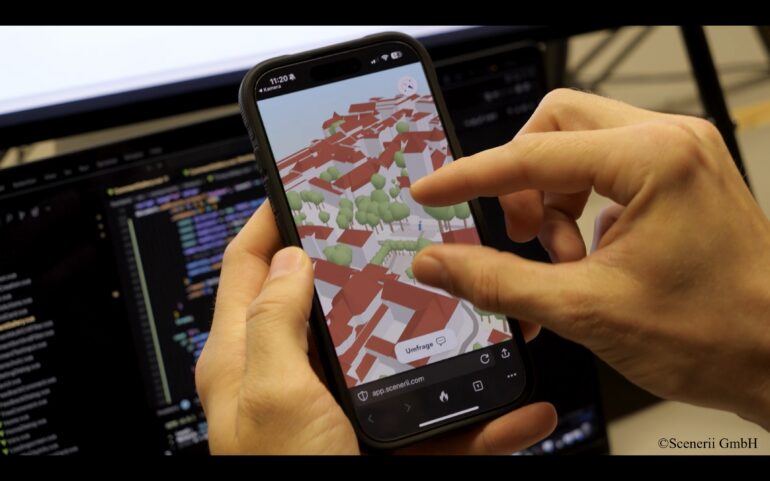
The notion of research infrastructure is far from straightforward. In urban studies, infrastructures are not only technical backbones, but also constitute urban life by shaping space, social relations, and governance (Amin 2014; Graham and McFarlane 2014). Depending on the discipline, scale, and practice, they take different arrangements. In fundamental science, they may denote synchrotrons; in applied fields, data repositories, or sensor networks. In the social sciences, they extend to policy frameworks or participatory arenas, from regulatory trials for car-free cities to scenario-building tools (ITAS 2025; see Image 1).
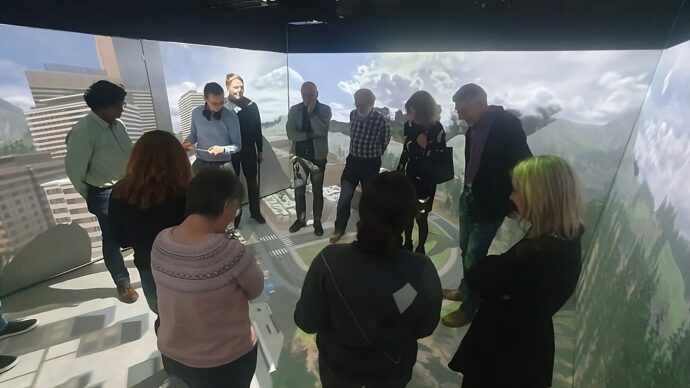
Science and technology studies have further broadened this picture. Classic contributions (Star and Ruhleder 1994; Bowker and Star 2006) emphasize infrastructures as socio-technical constellations that shape how knowledge is produced, validated, and shared. Urban infrastructure studies similarly stress their political nature, organizing inequality and power (Larkin 2013; McFarlane and Rutherford 2008). Edwards et al. (2013, p. 23) define knowledge infrastructures as “robust internetworks of people, artifacts, and institutions which generate, share, and maintain specific knowledge about the human and natural worlds”, a definition that underscores their evolving character as practices, norms, and institutions change.
Recent debates warn against reducing infrastructures to solutionist devices. This echoes smart city critiques and how political visions guide socio-technical governance (Meijer and Bolivar 2016). Monstadt et al. (2025) critically examine how infrastructures are increasingly framed as quick fixes to urban challenges such as decarbonization or resilience. Such framing often prioritizes technical systems while downplaying the social, institutional, and political processes that shape infrastructures. The key question becomes not only what infrastructures technically deliver, but which broader research purposes they are meant to serve. Equally important are the epistemic dimensions: beyond physical or organizational arrangements, infrastructures include criteria, funding expectations, and proposal framings that tacitly shape practice. Berg and Lidskog (2024), for instance, stress how global environmental assessments rely not only on models and databases, but also on these less visible epistemic infrastructures. Such dimensions determine which forms of knowledge are seen as legitimate and actionable.
For infrastructures to support transformation-oriented research, they must enable the involvement of multiple actors beyond academia. Digital platforms can serve as tools for co-design, allowing municipalities, planners, or civil society groups to engage with scientific knowledge and contribute their own perspectives. For instance, in the context of transdisciplinary sustainability research, infrastructures play yet another role. Parodi et al. (2018) highlight that long-term, practice-oriented research requires more than temporary experiments; it depends on infrastructures that allow co-design, collaboration, and cumulative learning. Yet, infrastructures are too often treated merely as means to an end, rather than as formative elements that shape the scope, quality, and inclusivity.
Building on these perspectives, we suggest a pragmatic operationalization of research infrastructures. In line with urban infrastructure scholarship, we stress their relational and situated character: infrastructures not only provide services but actively configure urban futures (Wiig et al. 2023). We understand them as long-term socio-technical arrangements and science-policy interfaces enabling coordinated knowledge generation and circulation. Such infrastructures include both tangible elements (facilities, platforms) and intangible ones (organizational processes, institutional frameworks, expertise). Together, they provide stable conditions for sustained collaboration and long-term continuity.
Within this framing, UDPs are best understood as one component of larger research infrastructures, unfolding their potential only as core pillars in broader socio-technical arrangements. Their effectiveness depends less on isolated trials than on how they are designed, integrated, and adapted over time. Rather than short-term trial-and-error, UDPs should be seen as infrastructures fostering reflexive, socially-broadening experimentation. We emphasize their role in giving cities analytical tools to challenge power relations, democratize decision making, and support just transformations. To do so, UDPs must move beyond pilots and function as long-term infrastructures, extending their “research purpose” from single projects to ongoing platform development and institutionalization.
2.2 Real-world Labs as Enablers of Long-term Research Infrastructures
RwLs offer a particularly relevant case to exemplify how UDPs are integrated into long-term research infrastructures. In Germany, they increasingly provide the institutional setting in which platforms are funded and evaluated, with the proposed RwL Law likely to further shape these conditions.
These formats resonate with urban scholarship that highlights cities as experimental spaces where governance, technology, and everyday practices intersect (Bulkeley et al. 2016). At the interface of applied and basic research, a variety of formats have emerged, such as Urban Living Labs or Urban Observatories (Dobler et al. 2021; Von Wirth et al. 2019). While participation and innovation are often emphasized, their scope varies. To ground our conceptual discussion, we turn to RwLs in Germany. Since the early 2010s, the term has gained prominence across the German research and policy landscape. Today, it is widely used by funding agencies, municipalities, and research consortia to denote practice-oriented, innovation-oriented, or transdisciplinary experimentation. However, RwLs are far from uniform: their purposes and scopes differ across disciplines and policy arenas. These competing interpretations also shape how UDPs are embedded into RwLs. RwLs are variously described as infrastructures for reflexive co-production fostering sustainable (urban) futures (Schneidewind et al. 2018; Defila and Di Giulio 2018; Schäpke et al. 2018), as experimental spaces for emerging technologies and smart city applications (Anduschus et al. 2023), or as regulatory sandboxes under the proposed RwL Law (Deutscher Bundestag 2025).
Taken together, these perspectives reveal that RwLs are both research infrastructures in themselves and settings relying on additional ones. They stabilize long-term transdisciplinary collaboration while mobilizing physical, digital, and organizational infrastructures. At the same time, the differing understandings of RwLs illustrate how urban areas become contested spaces: the design of research formats reflects competing visions of legitimate experimentation and transformation. Within these negotiations, UDPs are not neutral tools but rather part of the contestation, and are deployed and interpreted differently depending on whether the emphasis lies on matching sustainability goals, technological innovation, or regulatory sandboxes. Across all three perspectives, UDPs potentially emerge as connective infrastructures to orchestrate collaboration across actors, coordinate complex projects, and integrate heterogeneous data. Yet they also carry implicit logics: privileging quantitative metrics over qualitative insights, establishing norms about what counts as valid knowledge, or drawing boundaries on inclusion in decision-making.
From this perspective, UDPs must be understood as components of RwLs rather than substitutes. They can enhance the functioning of RwLs by supporting coordination and data integration. But they cannot replace the broader socio-technical arrangements of co-design, reflexivity, and long-term collaboration that make RwLs distinctive. The challenge lies in ensuring that platforms support rather than constrain these ambitions, and that their design is reflexive enough to account for multiple knowledge forms and societal perspectives.
In sum, these differing logics highlight why the integration of UDPs in RwLs is a critical research task. The central question that follows is under which conditions UDPs can move beyond short-lived pilots to support long-term, transformation-oriented urban research infrastructures.
3. Discussion: Platforms as Infrastructures for Reflexive Urban Transformation
Situated at the intersection of urban studies, socio-technical research, and transdisciplinary sustainability research, our work builds on long-standing engagement with real-world labs and practice-oriented urban research. In particular, we focus on pressing urban challenges, where we use real-world experimentation and participatory approaches to co-produce transformative knowledge advancing socially just, human-centered urban futures. Our current research centers on how digital tools can strengthen participatory urban research and contribute to the creation of long-term research infrastructures for equitable and sustainable urban development. At the same time, we engage with these topics on a more strategic level, exploring how resilient cities can be fostered through long-term research perspectives that emphasize citizen engagement, questions of justice, and sustainability while acknowledging the contested nature of urban futures. From these experiences, we identify recurrent challenges that highlight how the infrastructural role of UDPs unfolds in practice.
Rather than offering conclusive findings, we highlight three recurring dimensions from our collaborations with municipalities, civil society, and research partners, positioning them as entry points for broader debate in urban theory: first, UDPs as enablers for knowledge transfer across institutional and disciplinary boundaries; second, the risks of quantitative bias that marginalize experiential and qualitative forms of urban knowledge; and third, the difficulties of transforming short-term pilots into long-term infrastructures. These dimensions do not capture all challenges associated with UDPs, but they represent critical leverage points at the science–policy–society interface that are particularly relevant for debates in urbanism. We underpin these three dimensions with specific practical insights.
3.1 Platforms as Enablers of Knowledge Transfer
Despite its interdisciplinary traditions, urban research remains fragmented: disciplines and projects focus on specific domains but rarely sustain integration. Critical urban theorists such as Lefebvre (1996) already highlighted this limitation, arguing that urban research tends to privilege discrete parts of the city – housing, transport, economic growth – while overlooking the urban socio-spatial process. Later work in critical urban studies (Brenner 2009; Brenner, Marcuse, and Mayer 2012) has similarly argued that partial, sectoral perspectives risk obscuring how power, capital, and everyday life interact in shaping urban transformations. This partiality has meant that important perspectives and connections are sometimes missed, especially when research is not linked to long-term urban governance and practice (Bulkeley et al. 2016; Evans et al. 2016). From this perspective, UDPs may be understood as infrastructures that counteract fragmentation, collect and connect insights across domains, and enable knowledge transfer. They can create channels through which insights are not confined to academic outputs but become actionable for city administrations, planners, or community organizations.
An illustrative case is the Scenerii tool, which highlights both the potential and the complexity of this role. Originally developed as part of a long-term research project (U_CODE 2025) at TU Dresden, Scenerii was designed as a participatory platform for nuanced co-design of urban spaces. The platform allows numerous users to simultaneously interact with design proposals, thereby generating inputs on different scales from neighborhood-level interventions to city-wide scenarios. Use cases include participatory design processes in several German cities, with ongoing connections to academic partners.
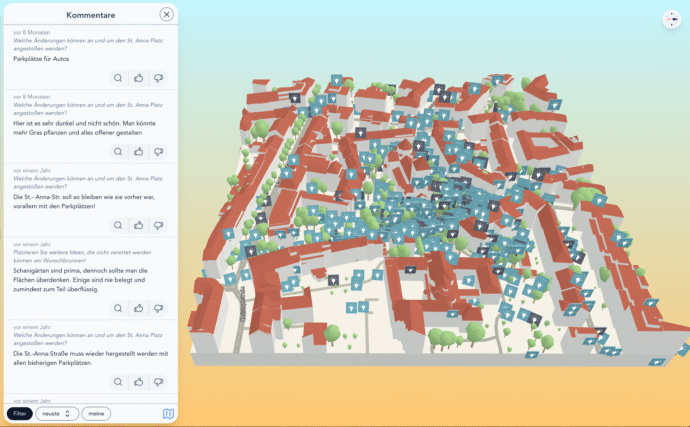
The case of Scenerii illustrates two potential ways UDPs may function as infrastructures of knowledge transfer. First, they enable scalability: a single platform can be used both for in-depth qualitative exploration and for large-scale citizen engagement, combining different modes of input. Second, they can support continuity: even after the end of the initial research funding, the platform was spun off into a start-up but continues to be maintained and used, still closely connected to the academic community. This continuity underscores that infrastructures require long-term adaptation, not just project funding.
While successful use cases may greatly enhance our ability to conduct participatory research, the envisioned knowledge transfer also reveals critical challenges. In particular, the effort to maintain and adapt the platform to specific use cases is often underestimated. Since planning cultures differ across cities, especially globally, platforms need accessible options for case-specific adaptation.
For RwLs, these experiences are instructive, since the labs explicitly aim to connect research with practice. Yet the challenge is not unique to RwLs: it cuts to the broader problem of UDPs as infrastructures. Their effectiveness depends on whether they are institutionally anchored and maintained across project cycles. They must be designed for multiple users – researchers, policymakers, and citizens – and adapted to the institutional contexts in which they are meant to operate. Otherwise, the enabling potential remains limited, and platforms risk reproducing the very gap between research and practice they were meant to bridge.
3.2 Quantitative Bias and Qualitative Blind Spots
A second key issue lies in the epistemic biases embedded in the design of UDPs. Most platforms are built to collect, process, and visualize standardized data – numbers that can be neatly stored in databases and displayed in dashboards. These technical affordances align well with the expectations of policymakers and funders, who often demand quantifiable outcomes and performance indicators. Yet they struggle to accommodate the qualitative forms of knowledge that are equally vital for reflexive urban transformation.
As Edwards et al. (2013) and Kitchin (2014) argue, infrastructures are not neutral: they actively normalize certain logics of knowledge. When UDPs are designed primarily as quantitative systems, they privilege what is easy to measure and sideline what is difficult to capture. Community narratives or the nuanced insights from interviews rarely fit into the standardized categories required for dashboards or statistical analysis. This bias risks narrowing problem framing: what cannot be quantified may be ignored, even if it is central to the lived experience of urban challenges.
In practice, many European cities are currently rolling out urban data platforms, often with substantial EU support. These initiatives are promising in scope but also illustrate the persistence of quantitative bias, as operators of UDPs are encouraged to provide cost-benefit schemes for their respective platforms. City leaders and national governments need to invest in and incentivize UDPs, while strengthening trust between municipalities, industry, and communities through clear responsibilities and local engagement (European Commission 2020). Many platforms succeed in collecting data but fail to build legitimacy because they cannot demonstrate how this data translates into decisions or how qualitative perspectives are incorporated. The key problem here is not that quantitative data is irrelevant. The challenge lies in the imbalance: when platforms reduce urban transformation to a set of metrics, they risk excluding forms of knowledge that are essential for participatory and reflexive governance. This imbalance can reinforce technocratic tendencies and undermine the collaborative potential of participatory platforms.
For RwLs, this epistemic tension is particularly salient. RwLs are designed as reflexive spaces where diverse actors and knowledge forms meet. Yet when UDPs are integrated into these labs, the risk is that their technical logics overrule the diversity of inputs. A platform may invite broad participation, but if only quantifiable inputs are processed or made visible, other forms of knowledge remain invisible. This undermines the co-productive ambition of RwLs and risks reducing them to formalized consultation exercises. If UDPs are to function as infrastructures within RwLs, they must be deliberately designed to balance quantitative efficiency with qualitative inclusivity, otherwise institutionalization risks turning them into infrastructures of exclusion rather than experimentation.
3.3 From Pilots to Infrastructures: Institutional Learning
A third major theme concerns the translation of digital platforms from pilots to infrastructures. Many UDPs are developed as experimental tools – projects that demonstrate technical feasibility or explore new participatory formats. Yet evidence shows that few have managed to transition into embedded infrastructures that shape organizational routines and decision-making over the long term (Eisel 2016; Lopes, Baldi and Accornero 2025; Thoneick 2021). This short lifespan often stems from limited organizational change and inflexible leadership, hindering experimentation and informal institutionalization (Lopes, Baldi, and Accornero 2025).
This problem is particularly visible in the domain of digital participation. Platforms are often introduced with the ambition to democratize urban governance, opening decision-making to wider input. In practice, however, participation frequently becomes procedural rather than transformative. Citizens are often invited to comment on certain policies or rate design alternatives – but rarely do they see how their input influences outcomes. Feedback loops are weak, timelines long, and connections to implementation often lost. As a result, participation risks being perceived as symbolic rather than meaningful.
Underlying this challenge is the need for institutional learning. Building a tool is not enough; organizations must adapt routines, resources, and cultures to integrate new knowledge. Organizational change must address not only formal rules but also informal institutionalization, including shifts in the attitudes and values of powerful actors. True learning requires documenting how inputs are processed, creating “choreographies” that connect contributions to planning, and acknowledging structural constraints. Without such adaptation, even well-designed platforms fade once initial funding ends.
As an example, the Hamburg-based platform DIPAS, co-developed with the municipality, broadened participation in planning but failed to increase decisional power due to the absence of legal adjustments. This illustrates the broader pattern: even co-developed platforms may not be embedded into institutional routines (Thoneick 2021). In contrast, the international case of Nottingham’s 3D Digital Twin demonstrates what long-term institutionalization can achieve. Initiated in 2003, it has been steadily integrated into planning workflows. Today, it supports pre-application assessments, sustainable site design, and consultations (ConsultingWhere 2024). Its impact lies less in technical novelty than in sustained embedding – aligning iteratively with planning practices, regulations, and stakeholder expectations.
For RwLs, the lesson is twofold. First, meaningful experimentation requires acknowledging that platforms are not static solutions but evolving infrastructures. Before institutionalization, their functions and designs must connect short-term experiments to long-term goals. Second, frameworks such as the RwL Law offer both risks and opportunities: they can stabilize platforms beyond project cycles, but may also narrow experimentation if reflexivity and inclusivity are not safeguarded.
3.4 The Overall Picture: Towards Research Infrastructures for Reflexive Urban Governance
Taken together, the three themes discussed above point to a shared challenge for UDPs. First, they must ensure continuity of knowledge transfer by being institutionally anchored and stewarded across project cycles so that platforms do not remain isolated research outputs but sustain their relevance in governance and practice (3.1). Second, they must overcome epistemic biases that privilege quantitative metrics, incorporating qualitative insights and diverse perspectives to preserve the reflexivity and inclusivity central to urban transformation (3.2). Third, they must be embedded into organizational routines and governance structures, allowing pilots to evolve into infrastructures through processes of institutional learning and adaptation (3.3). In this sense, knowledge continuity, epistemic inclusivity, and institutional embedding represent interrelated conditions for UDPs to realize their potential as long-term research infrastructures.
To broaden the perspective on platforms in urbanism, we suggest that UDPs should not be seen merely as technical innovations but as potential infrastructures that mediate political contestation, distribute epistemic authority, and structure participation. Their value lies in both operational effectiveness—such as efficiency and scalability, and long-term continuity—as well as in making the complexities of translating societal input into action visible, acknowledging trade-offs and fostering co-design between institutions and society. Only then can UDPs move from pilots to infrastructures that contribute meaningfully to sustainable urban transformation.
4. Conclusion
This article shifts debates on platform urbanism by examining UDPs as collaborative research infrastructures. By drawing on the conceptual approach of real-world labs and situating them in broader urban debates, we highlight how platforms organize knowledge, participation, and governance across different temporal and institutional scales. We emphasize the tension between short-term experimentation and long-term infrastructural embedding, showing that this transition is primarily an institutional rather than a technical challenge.
We argue that three conditions are particularly important: continuity of knowledge transfer, methodological inclusivity, and long-term institutional embedding. These conditions reflect wider questions in urbanism about how infrastructures stabilize, whose knowledge and interests they serve, and how experimentation becomes institutionalized. The proposed RwL Law creates opportunities to stabilize RwLs as long-term infrastructures but also risks narrowing them into solutionism. UDPs can only advance sustainable urban transformation if governance arrangements ensure reflexivity and pluralism.
Future research should investigate the long-term institutional embedding of UDPs into municipal routines. Scholars should examine how regulatory frameworks, administrative structures, and political cultures shape sustained use. Comparative studies of both successful and failed projects are crucial to clarifying how platforms adapt across diverse contexts, reinforcing the need to treat UDPs as evolving infrastructures of reflexive urban governance.
Acknowledgements
We would like to thank Scenerii GmbH and the Institute for Technology Assessment and Systems Analysis (ITAS) at Karlsruhe Institute of Technology for kindly providing the images used in this article.
For stylistic refinement and language editing, we used the assistance of ChatGPT-5.
Both authors contributed equally to this work.
References
Amin, A., 2014. Lively infrastructure. Theory, culture & society, 31(7-8), pp.137-161.
Anduschus, P.O., Bienzeisler, B. & Prochazka, V., 2023. Innovationsmethode Reallabor.
Berg, M. & Lidskog, R., 2024. Global environmental assessments and transformative change: the role of epistemic infrastructures and the inclusion of social sciences. Innovation: The European Journal of Social Science Research, pp.1–18.
Brenner, N., 2009. What is critical urban theory?. City, 13(2-3), pp.198-207.
Brenner, N., Marcuse, P. and Mayer, M. eds., 2012. Cities for people, not for profit: Critical urban theory and the right to the city. Routledge.
Brenner, N. and Schmid, C., 2015. Towards a new epistemology of the urban?. City, 19(2-3), pp.151-182.
Bulkeley, H., Coenen, L., Frantzeskaki, N., Hartmann, C., Kronsell, A., Mai, L., Marvin, S., McCormick, K., Van Steenbergen, F. and Palgan, Y.V., 2016. Urban living labs: governing urban sustainability transitions. Current opinion in environmental sustainability, 22, pp.13-17.
ConsultingWhere, 2024. Assessing the Socio-economic Value of 3D Geospatial Information for the UK Planning Sector. Available at: https://www.arcgis.com/home/item.html?id=fa361ff8d52e446780eccf3932d6c1a0 [Accessed 19 August 2025].
Defila, R. & Di Giulio, A., 2018. Reallabore als Quelle für die Methodik transdisziplinären und transformativen Forschens–eine Einführung. In: Transdisziplinär und transformativ forschen: Eine Methodensammlung. Wiesbaden: Springer Fachmedien, pp.9–35.
Deutscher Bundestag, 2025. Entwurf eines Gesetzes zur Verbesserung der Rahmenbedingungen für die Erprobung von Innovationen in Reallaboren und zur Förderung des regulatorischen Lernens (BT-Drucksache 21/218). Available at: https://dserver.bundestag.de/btd/21/002/2100218.pdf [Accessed 19 August 2025].
Dobler, G., Bianco, F.B., Sharma, M.S., Karpf, A., Baur, J., Ghandehari, M. & Koonin, S.E., 2021. The urban observatory: a multi-modal imaging platform for the study of dynamics in complex urban systems. Remote Sensing, 13(8), p.1426.
Edwards, P.N., Jackson, S.J., Chalmers, M.K., Bowker, G.C., Borgman, C.L., Ribes, D. & Calvert, S., 2013. Knowledge infrastructures: Intellectual frameworks and research challenges.
Eisel, S., 2016. LiquidFriesland wurde beerdigt. Bürgerbeteiligung – Aktive Bürger in der freiheitlichen Demokratie. Available at: https://burgerbeteiligung.wordpress.com/2016/05/25/liquid-friesland-wurde-beerdigt/ [Accessed 17 September 2025].
European Commission, 2020.Cities are becoming digital–Urban Data Platforms enable it.Available at: https://smart-cities-marketplace.ec.europa.eu/news-and-events/news/2020/cities-are-becoming-digital-urban-data-platforms-enable-it [Accessed 19 August 2025].
Evans, J., Karvonen, A. & Raven, R., 2016. The experimental city: New modes and prospects of urban transformation. In: The experimental city. Routledge, pp.1–12.
Fraske, T., 2025. Experimenting with Meaning: Reallabor as a Travelling Concept in Germany’s Innovation Landscape. ZBW – Leibniz Information Centre for Economics, Kiel, Hamburg.
Grabher, G. & König, J., 2020. Disruption, embedded. A Polanyian framing of the platform economy. Sociologica, 14(1), pp.95–118.
Graham, M., 2020. Regulate, replicate, and resist – the conjunctural geographies of platform urbanism. Urban Geography, 41(3), pp.453–457.
Graham, S. and Marvin, S., 2002. Splintering urbanism: networked infrastructures, technological mobilities and the urban condition. Routledge.
ITAS – Institute for Technology Assessment and Systems Analysis, 2025. Research environments and infrastructures for participatory research. Available at: https://www.itas.kit.edu/english/research_infrastructures.php [Accessed 19 August 2025].
Kitchin, R., 2014. The real-time city? Big data and smart urbanism. GeoJournal, 79(1), pp.1–14.
Larkin, B., 2013. The politics and poetics of infrastructure. Annual review of anthropology, 42(2013), pp.327-343.
Lefebvre, H., Kofman, E. & Lebas, E., 1996. Writings on cities. Cambridge, MA.
Leszczynski, A., 2020. Glitchy vignettes of platform urbanism. Environment and Planning D: Society and Space, 38(2), pp.189–208.
Lopes, R.H.P., Baldi, V. and Accornero, G., 2025. Bridging the gap between “the platform society” and technopolitics: A systematic literature review about digital democracy platforms.
McFarlane, C., 2011. The city as assemblage: Dwelling and urban space. Environment and Planning D: society and space, 29(4), pp.649-671.
McFarlane, C. and Rutherford, J., 2008. Political infrastructures: Governing and experiencing the fabric of the city. International journal of urban and regional research, 32(2), pp.363-374.
Meijer, A. and Bolívar, M.P.R., 2016. Governing the smart city: a review of the literature on smart urban governance. International review of administrative sciences, 82(2), pp.392-408.
Monstadt, J., Rutherford, J. & Coutard, O., 2025. Infrastructures as urban solutions? Critical perspectives on transformative socio-technical change. Urban Studies, 62(9), pp.1709–1730.
Parodi, O., Waitz, C., Bachinger, M., Kuhn, R., Meyer-Soylu, S., Alcántara, S. & Rhodius, R., 2018. Insights into and recommendations from three real-world laboratories: An experience-based comparison. GAIA – Ecological Perspectives for Science and Society, 27(1), pp.52–59.
Sadowski, J., 2020. The internet of landlords: Digital platforms and new mechanisms of rentier capitalism. Antipode, 52(2), pp.562–580.
Schäpke, N., Stelzer, F., Caniglia, G., Bergmann, M., Wanner, M., Singer-Brodowski, M. & Lang, D.J., 2018. Jointly experimenting for transformation? Shaping real-world laboratories by comparing them. GAIA – Ecological Perspectives for Science and Society, 27(1), pp.85–96.
Schneidewind, U., Augenstein, K., Stelzer, F. & Wanner, M., 2018. Structure matters: real-world laboratories as a new type of large-scale research infrastructure: a framework inspired by Giddens’ structuration theory. GAIA – Ecological Perspectives for Science and Society, 27(1), pp.12–17.
Srnicek, N., 2017. Platform capitalism. John Wiley & Sons.
Star, S.L. & Bowker, G.C., 2006. How to infrastructure. In: Handbook of new media: Social shaping and social consequences of ICTs, pp.230–245.
Star, S.L. & Ruhleder, K., 1994. Steps towards an ecology of infrastructure: complex problems in design and access for large-scale collaborative systems. In: Proceedings of the 1994 ACM conference on Computer supported cooperative work. ACM, pp.253–264.
Thoneick, R., 2021. Integrating online and onsite participation in urban planning: Assessment of a digital participation system. International Journal of E-Planning Research (IJEPR), 10(1), pp.1–20.
U_CODE, 2025. Urban Co-Design Environment. Innovative Beteiligung für Stadt- und Verkehrsplanung. Available at: https://www.urban-codesign.com/ [Accessed 19 August 2025].
Van Doorn, N., 2017. Platform labor: on the gendered and racialized exploitation of low-income service work in the ‘on-demand’ economy. Information, Communication & Society, 20(6), pp.898–914.
Von Wirth, T., Fuenfschilling, L., Frantzeskaki, N. & Coenen, L., 2019. Impacts of urban living labs on sustainability transitions: Mechanisms and strategies for systemic change through experimentation. European Planning Studies, 27(2), pp.229–257.
Wiig, A., Ward, K., Enright, T., Hodson, M., Pearsall, H., & Silver, J., 2023. Infrastructuring urban futures: The politics of remaking cities. Bristol University Press.