Technoscience and infrastructure: The Riga metro as a tool of legitimacy and dissent
Introduction
Historically, transportation planning has been considered an extremely technocratic disciplinary field (Banister & Finch, 2013). The traditional transport planning model is indeed a technique, consolidated for at least 70 years (Kane & Behrens, 2002), that puts emphasis on economic and engineering considerations (Mottee et al., 2020). In order to inform transport planning, a standardized theoretical framework has emerged, represented by the so-called four-stage model, which divides the analysis of mobility patterns into well-defined sequential phases: trip generation, trip distribution, modal split, and traffic assignment (McNally, 2000).
Operating in such way requires a significant amount of data, including information on the geographical locations of individuals, their desired destinations, and their preferred modes of transportation. Such an approach can be seen as a clear example of a form of technoscientific control of space. This framework is well-suited to the contemporary era of datafication and urban quantification, and should establish the triumph of technology over politics. Nevertheless, alleged technical issues are frequently used to legitimize, or delegitimize, choices that actually hide sociopolitical motivations. Technique can be employed as a tool to support (or deny) political decisions, which may or may not be valid from a technical perspective. In other words, transportation infrastructure projects, despite their strong technical basis, are not always politically neutral.
Widely recognized examples of this phenomenon can be found in the Western world in the construction of high-speed railway lines in Italy, Spain, and France, where such infrastructures express national political priorities in territorial organization (Chitti & Beria, 2025; Zembri & Libourel, 2017). This also applies to rapid urban mass transit infrastructure. A widely cited example in the literature is the modern “French-style” tram, which, beyond serving as a public transport system, also enhances a city’s image and prestige. As a result, the construction of tram lines in France is a political issue, often bipartisan, that emerges in local election campaigns (Boquet, 2017; Richer, 2016). This is even more evident in the case of metros (also known as “subways” or “underground systems”). They are often conceived as status symbols: virtually every city that aspires, or has aspired, to become a regional center considers the possibility of building a metro. Such systems are generally perceived as placing a city within a select group of global cities and as opening the way to growth and development (Grava, 1989).
In this context, the main objective of this article is to show how infrastructure can function as a tool of technoscientific control over space and how it is intrinsically non-neutral, particularly within authoritarian regimes. Through the analysis of a specific case study, less known than those previously mentioned, the article seeks to illustrate the process by which ostensibly technical arguments are mobilized to legitimize or delegitimize transportation projects. The case study is the Riga Metro project in Latvia, conceived (and then aborted) when the city was part of the Soviet Union. What distinguishes this example from more widely known cases is that the infrastructure was promoted by one side (the central government) and opposed by the other (the Latvian citizens of Riga), with both groups invoking technical arguments to conceal underlying political motivations, in a context marked by the limited transparency typical of authoritarian regimes.
In order to reconstruct the chronological stages of the project, limited documentation is available, notably a 1989 article and a number of online sources. In particular, a paper published in Transportation Quarterly seeks to address a question posed in its title: “The planned metro of Riga: is it necessary or even desirable?” This source makes it possible to reconstruct key aspects of the project’s history and, more broadly, to understand certain dynamics of Soviet planning. The article was written by Sigurd Grava (1934–2009), a native of Riga, Latvia. Grava studied at the City College of New York, graduating in 1955, and subsequently earned a master’s degree (1957) and a doctorate (1965) from Columbia University. From 1960 onward, he served as a professor and faculty member in urban planning at the same university (Baker & Taylor Author Biographies, 2000).
A complementary resource is the Deep Baltic website, dedicated to Estonia, Latvia, and Lithuania, which “offers insights, photo essays, reports, and interviews on every aspect of life” in the three Baltic countries (Deep Baltic, n.d.). The website contains a detailed report on the Riga metro project, articulated into three specific contributions (Mawhood, 2019a, 2019b, 2020). Such documents complement Grava’s article by providing further information on the city’s history, the project background, and the citizenship’s dissent.
The history of Riga: From a German commercial outpost to a Soviet model-city
Riga is the capital of the Republic of Latvia, a European Union country. With approximately 600,000 inhabitants (Latvijas Oficiālā Statistika, 2025), it is also the country’s largest city. It is located a few kilometers from the Baltic Sea coast, near the Daugava River estuary.
The city was founded in 1201 by German crusaders as a trading outpost in a strategic location. Prior to the modern era, Riga experienced several dominations, spending nearly a century under the Swedish Empire before becoming part of the Russian Empire. In 1919, following the First World War, it became the capital of the newly established Republic of Latvia. The twentieth century, however, marked radical changes for the city. Riga was forcibly annexed by the Soviet Union in 1940, then occupied by Nazi Germany between 1941 and 1944, and subsequently reincorporated into the Soviet Union as the capital of the Latvian SSR until 1991, when Latvia restored its independence.
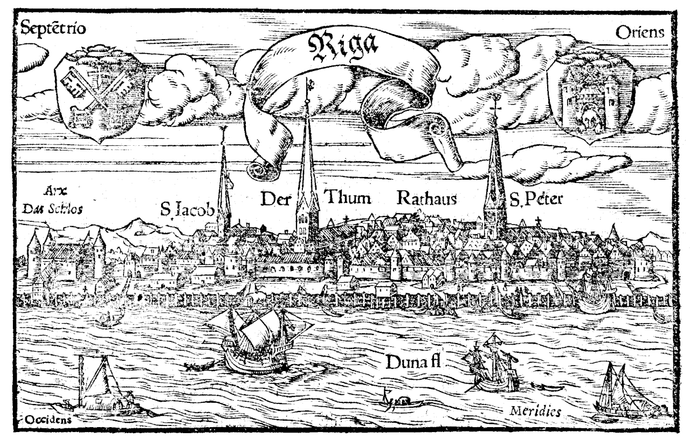
During the prolonged Soviet occupation, Riga enjoyed a relatively privileged status, being regarded as a “showcase city” for the Union, with living standards and wages among the highest in the USSR. Due to the preservation of its medieval Old Town and its nineteenth-century boulevards, the city retained a distinctively “European” character, which made it a significant tourist destination and a frequent set for representing Western cities in Soviet film. Latvia also developed as a major summer tourist destination, notably due to the Baltic Sea resort of Jūrmala, located approximately thirty minutes by train from Riga (fig. 2). Furthermore, the city hosted leading industries such as VEF (Valsts Elektrotehniskā Fabrika, “State Electrotechnical Factory”), the main electronics manufacturer in the Soviet Union, which produced a substantial share of the telephones and radios distributed across the country (Mawhood, 2019a).
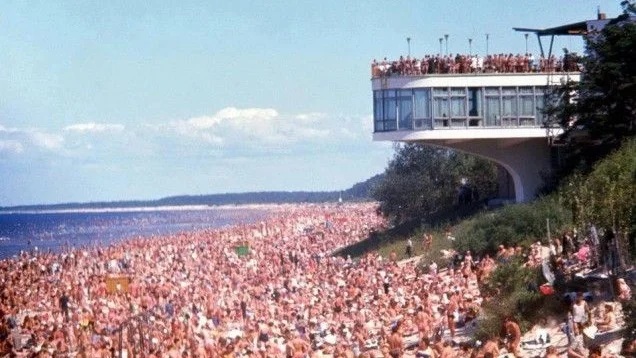
After World War II, Riga experienced overwhelming demographic growth: the population doubled compared to the pre-war period, from approximately 347,000 in 1939 to 580,000 in 1959, and 915,000 in 1989. This expansion was fuelled by a massive russification process, driven by forced industrialization that attracted workers from across the USSR. As a result, the ethnic composition changed dramatically: Latvians, who had represented 63% of the population before the war, became a minority by the late 1950s. In 1989, they were only the 36% of the population (ibidem).
The city responded with the large-scale construction of low-cost housing complexes. Development gradually extended toward the left bank of the Daugava River, in the Pārdaugava area, creating new residential areas such as Imanta and Zolitūde. However, most employment centers and factories, including VEF, remained on the right bank, placing severe strain on the connecting infrastructure, which at the time was limited to a single road bridge. Given the sustained population growth, the Soviet authorities estimated that by 2000, the city would reach one million inhabitants (ibidem).
Transport planning in the USSR: the “one million inhabitants” rule
Reaching such a demographic threshold would have meant a significant advancement in the city’s status. In fact, according to the logic of Soviet planning, exceeding one million inhabitants officially transformed a city into a millionniki (a “millionaire city”). This recognition was not merely demographic: official urban and transport planning norms of the USSR established that every city with over one million inhabitants had to be equipped with a metro system (Grava, 1989). As evidence of this, in 1989, the year of the last Soviet census, of the 23 cities with over one million inhabitants, the top 15 had an active or under construction metro system (Table 1) (Goskomstat SSSR, 1990). This rule was presented by the central authorities in Moscow as a quantitative and objective criterion for governing urban growth and addressing mobility issues, fitting fully into the technocratic vision of planning of the time (Mawhood, 2019a).
Beyond their technical functions, however, the Soviet Union’s metros also constituted significant instruments of national policy. In fact, they served as a showcase for the regime’s technological and architectural achievements, with stations designed at monumental scales to impress the population and demonstrate the capability of communism (Grava, 1989): “what was left unrealized on the surface was achieved underground” (Malling, 2025). Consequently, cities with such infrastructure acquired a higher rank in the USSR’s urban hierarchy, gaining a “special aura” of local pride. The construction of a metro effectively altered the city’s status, elevating it from a regional center to a metropolis of all-union significance (Mawhood, 2019a).
Given their importance, the metro construction process was highly centralized. Planning and design were assigned to specialized institutes based in Moscow and Leningrad (the Megiprotrans and the Lenmetroproekt, respectively), which advised the central government without involving local experts. Skilled labour was also imported, and in contexts characterized by labour shortages, so were unskilled workers. Metros also served military functions, with tunnels and stations built at great depths. Furthermore, stations were very far apart (about 1 km). Such design characteristics generally led to poor integration with surface transport, which was managed by different entities. Indeed, metros’ operational management was also highly centralized: they were not administered by local transport companies, but by the Soviet railways (Grava, 1989).
| Rank | City | Population | Republic | Metro |
| 1 | Moscow | 8,967,000 | Russian SFSR | Yes |
| 2 | Leningrad (now St. Petersburg) | 5,024,000 | Russian SFSR | Yes |
| 3 | Kiev | 2,587,945 | Ukrainian SSR | Yes |
| 4 | Tashkent | 2,072,459 | Uzbek SSR | Yes |
| 5 | Baku | 1,795,000 | Azerbaijan SSR | Yes |
| 6 | Kharkov | 1,609,959 | Ukrainian SSR | Yes |
| 7 | Minsk | 1,607,100 | Byelorussian SSR | Yes |
| 8 | Gorky (now Nizhny Novgorod) | 1,438,000 | Russian SFSR | Yes |
| 9 | Novosibirsk | 1,437,000 | Russian SFSR | Yes |
| 10 | Sverdlovsk (now Yekaterinburg) | 1,365,000 | Russian SFSR | Yes |
| 11 | Tbilisi | 1,259,692 | Georgian SSR | Yes |
| 12 | Kuybyshev (now Samara) | 1,254,000 | Russian SFSR | Yes |
| 13 | Yerevan | 1,201,500 | Armenian SSR | Yes |
| 14 | Dnepropetrovsk (now Dnipro) | 1,177,897 | Ukrainian SSR | Under construction |
| 15 | Omsk | 1,149,000 | Russian SFSR | Under construction |
| 16 | Alma-Ata (now Almaty) | 1,127,884 | Kazakh SSR | No |
| 17 | Odessa | 1,115,371 | Ukrainian SSR | No |
| 18 | Donetsk | 1,109,102 | Ukrainian SSR | No |
| 19 | Chelyabinsk | 1,107,000 | Russian SFSR | No |
| 20 | Kazan | 1,094,000 | Russian SFSR | No |
| 21 | Perm | 1,091,000 | Russian SFSR | No |
| 22 | Ufa | 1,082,000 | Russian SFSR | No |
| 23 | Rostov-on-Don | 1,019,000 | Russian SFSR | No |
| 24 | Volgograd | 999,000 | Russian SFSR | No |
| 25 | Riga | 915,106 | Latvian SSR | No |
Table 1. Population of the 25 biggest cities of the Soviet Union according to the 1989 Soviet Census.
The project promoted by the authorities
Despite the million-population rule, authorities could identify exceptions that allowed a city to build a metro before reaching the threshold. A well-known case is that of Yerevan, the capital of the Republic of Armenia, where local authorities performed an artificial traffic jam to impress visiting central officials and demonstrate the need for a metro, even though the city had only 750,000 inhabitants (Malling, 2025). In Riga’s case, too, as will be shown, the metro project began before the planned threshold was reached.
The first studies on the expansion of the Latvian capital’s transportation network date back to the 1960s. At that time, Riga was experiencing sustained population growth, fuelled by the forced industrialization and immigration from other regions of the USSR. The concentration of factories on the right bank of the Daugava River and the development of residential neighbourhoods on the left, combined with the presence of a single bridge, led to frequent traffic gridlock (Mawhood, 2019a). These rigorously conducted preliminary studies ended by proposing the construction of a light rail system with underground sections. In 1974, however, local authorities cancelled the project, deeming it not ambitious enough (Grava, 1989).
In 1976, an official order from the central authorities was issued to begin technical and economic planning for a metro system. The following year, the Moscow-based Megiprotrans Institute presented the plan for a two-line network with an “X” layout. However, the geological conditions of Riga, located on a river delta characterized by unstable layers of dolomite and sandstone, made the design particularly complex. For this reason, in 1980, responsibility was transferred to the Leningrad-based Lenmetroproekt Institute, which specialized in deep construction on marshy terrain (Mawhood, 2019a).
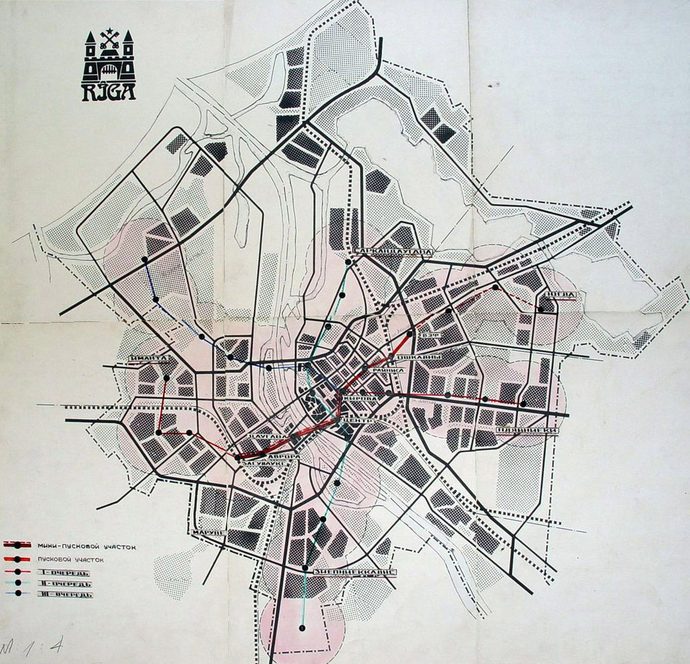
In 1983, the project took on a more defined form, resulting in a network of three lines (Figure 3). It was argued that the metro was the only solution to the gridlock that affected the city, as surface transports were unreliable. The time needed to cross the city would have seen a significant decrease, from 75 to 30 minutes (Mawhood, 2020). The first section to be built included eight stations from east to west, crossing the river and passing through the historic city center and the Central Station. The planned termini were two emblematic locations: the Zasulauks railway station (the departure point for suburban trains to the resort of Jūrmala) and the VEF factory.
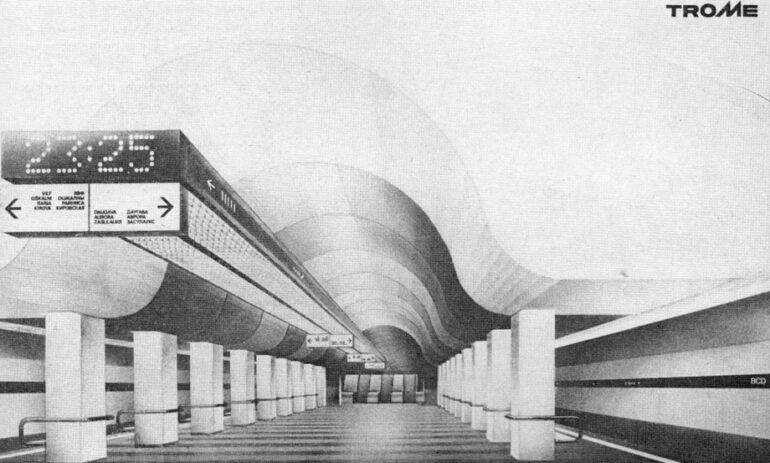
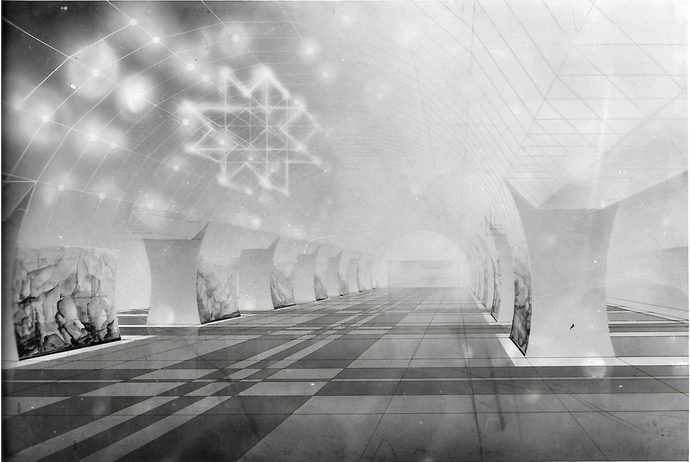
The stations were conceived as tools of ideological propaganda. For example, “Centrālā” would celebrate “the friendship of the peoples of the USSR”; “Kirova” would commemorate “the establishment of Soviet power in Latvia”; “Oškalni” would be dedicated to the “Great Patriotic War.” The architectural designs, characterized by a futuristic style and large spaces, lacked any references to Latvian national identity, with the exception of rare symbols included in the “Raiņa” station (Figure 4) (ibidem).
In conclusion, although Riga had not reached the one million population threshold required by official criteria, the city’s reputation justified preferential treatment over more populous cities, and the Soviet authorities were determined to proceed with the metro’s construction. Moreover, its development would have elevated Riga’s status, transforming it from a regional center (the capital of the Latvian SSR) into an important metropolis. This, together with the influx of numerous workers, would have favoured a further integration of the city into the Soviet system, contributing to the process of Russification and the erosion of the Latvian national identity (Grava, 1989; Mawhood, 2019a).
The dissent expressed by the population
The metro project became more concrete in 1987. Grava (1989), writing as a contemporary of the events, observed that no further technical details of the project were known, nor the reasons given for its feasibility. Precise information regarding costs was also lacking: the press mentioned about 500 million rubles, a considerable sum never spent for a similar project in the USSR.
These developments coincided with the beginning of glasnost, which fostered the emergence of popular discontent. In this context, opposition to the project became a catalyst for the Latvian independence movement, combining ecological concerns and anti-Soviet sentiment. In fact, in an authoritarian regime like the Soviet one, explicit political dissent carried high risks. However, glasnost opened up relatively safer spaces for protest that did not constitute nationalism or counterrevolution. Consequently, to delegitimize the project promoted by Moscow, local citizens and experts advanced technical, economic, and engineering objections. The main concerns were geological and structural risks, especially in the Old City, as well as the inefficiencies of the route, given the excessive distance between stations and their considerable depth. Many citizens also considered the metro an old and obsolete technology that would soon be replaced (Mawhood, 2019b).
Behind these technical arguments, however, the main concern of the Latvian population was demographic displacement. The construction of such a complex infrastructure would have required thousands of specialized workers from other Soviet republics (such as Russia, Belarus, and Uzbekistan), further diluting the Latvian ethnic component and jeopardizing the survival of the local culture and language (ibidem).
Dissent was documented in a manner unprecedented for the time. The Soviet youth newspaper Padomju Jaunatne received 6,598 letters opposing the metro and only two in favor (Grava, 1989). Musical groups such as Jumprava and Vaidava also recorded songs against the project. The song “Metro Nav Draugs” (“The Metro Is Not a Friend”) became an anthem of the movement, with lyrics warning against “foreign people called here who would never leave.” On April 27, 1988, around 10,000 people gathered in Riga Arkādijas Park shouting “Metro – nē!” (“Metro, no!”) (Mawhood, 2019b).
Grava (1989) emphasizes that the local population’s concerns were predominantly sociopolitical in nature: Latvians did not want further labour immigration from other USSR republics. He highlights, however, that the proposal was also critical from a transportation and urban planning perspective. Although Riga had approximately 900,000 inhabitants, available data indicated that the city did not have the characteristics to justify such a costly investment; in Western contexts, less costly solutions would likely have been preferred. In the USSR, by contrast, planning was based on standardized norms and solutions, such as the one-million-population rule.
Eventually, the opposition succeeded in establishing a commission of local specialists charged with reviewing the plans developed by central authorities. Within two months, the commission concluded that there was no viable economic or technological basis for continuing the project. This technical delegitimization marked the definitive end of the Riga metro project and constituted one of the first concrete steps towards the restoration of Latvian independence (Mawhood, 2019b; 2020).
Beyond technique: the political meaning of the Riga metro project
The conflict over the Riga Metro can be analyzed by distinguishing between the publicly stated technical motivations and the underlying political agendas that both sides sought to promote or oppose. The Soviet authorities presented the project as an unavoidable technical necessity. Riga’s traffic congestion was considered unsustainable, and the metro was presented as the only solution. Furthermore, according to the one-million-inhabitants rule, Riga was obliged to have a metro, as it would soon reach that demographic threshold.
However, the real objectives were tied to a space management that could be described as “imperial.” The metro, being an element of local and national pride, would elevate Riga’s status within the USSR, transforming it into a metropolis more integrated into the Soviet space. The project aimed to “denature” the city, eroding its Latvian identity.
It should be noted that, despite the one-million-inhabitants rule being a seemingly scientific criterion, this scientific nature was only apparent, for two reasons.
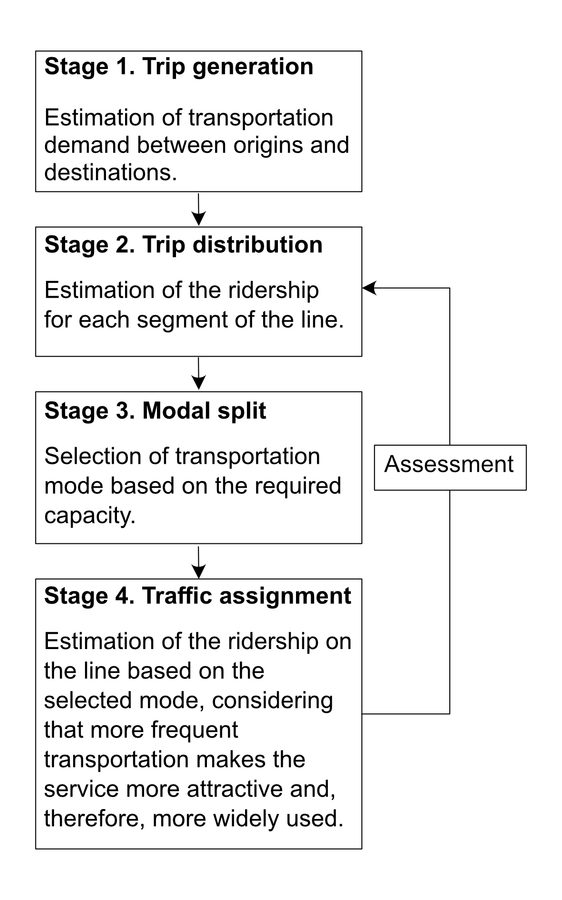
First, from a technical perspective, it was rigid and imprecise. In fact, when the four-stage model is applied to the planning of a new transportation line, the process should be structured as follows: i) estimation of transportation demand between origins and destinations; ii) estimation of the ridership for each segment of the line (that is a portion between two stops or stations) in order to identify the maximum capacity required during peak hours; iii) selection of transportation mode (bus, or tram, or metro, etc.) based on the required capacity; iv) estimation of the ridership on the line based on the selected mode, considering that better transportation makes it more attractive and, therefore, more used (Figure 5) . Such a procedure is much more complex than the equation “one-million-city equals to city-with-metro,” since the demand for a public transport line depends on multiple variables and not exclusively on the number of residents within a city’s administrative boundaries.
Second, the case of Riga demonstrates how this rule was used (and, where necessary, manipulated) to legitimize broader socio-political objectives. Under the pretext that the city would reach one million inhabitants during the summer, thanks to the influx of holidaymakers (Mawhood, 2019a), the central authorities attempted to impose an oversized project aimed at accelerating the city’s integration into the Soviet system and weakening Latvian national identity.
Beyond demographic criteria, the central authorities supported the project by citing the alleged technical necessity of solving the traffic problem. As noted, this congestion was largely caused by the presence of a single bridge over the Daugava River. Grava (1989) points out, however, that constructing additional bridges at significantly lower cost would have substantially alleviated traffic flow. Accordingly, this technical rationale appears largely instrumental.
On the other hand, citizen dissent, while deeply political, was expressed primarily through technical and environmental arguments, which were more difficult to censor. However, some of the technical concerns raised by citizens can also be seen as largely instrumental. Firstly, while constructing a metro in the Riga’s soil is challenging, it is not impossible, as demonstrated by St. Petersburg, a former Soviet city with geological conditions similar to those of Riga, which successfully built a metro system. Secondly, metro is not obsolete and remains a relevant and viable technology, evidenced by the dozens of systems constructed since 1989 and those still under development today. Among the technical issues highlighted by citizens, the most prominent, as Grava (1989) notes, were about costs and alignment selection.
Nevertheless, the primary fear was that the construction would attract thousands of Russian workers and immigrants from other republics, permanently altering the city’s ethnic balance to the detriment of Latvians. Opposition to the metro was therefore a catalyst for the independence movement as citizens did not want the “denaturalization” of their capital.
In short, while the authorities used technical reasons to legitimize a project of imperial expansion, citizens also used technical reasons to delegitimize it, masking a struggle for national independence behind engineering and environmental concerns.
Conclusion
The Riga metro project represents an emblematic case of how infrastructure can be used as a tool of political control and, at the same time, become a catalyst for national mobilization. Soviet standards and techniques were not simply urban planning rules, but rather a device for the technoscientific control of space. On the other hand, the dissent that erupted in the late 1980s against the metro is, in fact, a paradigmatic example of how technical and scientific arguments can be mobilized to express profoundly political demands.
The Riga metro project is not only a story of an infrastructure that never materialized, but also a relevant case study for understanding the interactions between power, urban planning, and civil mobilization. A first point of reflection concerns the role of technoscience as a potential tool for political (de)legitimization. Although transportation planning is generally presented as a technocratic field grounded in objective data, it can incorporate socio-political motivations. From this perspective, technique can be used both to support and to hinder political decisions that are not fully technically justified.
In such circumstances, major infrastructure projects can serve as tools for organizing and controlling space, particularly in authoritarian contexts. At the same time, where explicit political dissent carries high risks, technical arguments can offer citizens a safer channel through which to express broader demands.
The Riga case can be also inspiring for contemporary democratic contexts. It suggests that an exclusively technical approach, lacking adequate consideration for social dimensions, can hinder project implementation and feed distrust of institutions. This highlights the need to design mobility policies that integrate technical expertise and care for the communities involved, avoiding processes perceived as imposed.
References
Banister, D., & Finch, E. (2013). Urban Transport and the Environment. London, UKBoquet, Y. (2017). The renaissance of tramways and urban redevelopment in France. Miscellanea Geographica, 21(1), 5–18. https://doi.org/10.1515/mgrsd-2017-0005
Chitti, M., & Beria, P. (2025). A planning history of high-speed rail in Italy. Journal of Public Transportation, 27, 100126. https://doi.org/10.1016/j.jpubtr.2025.100126
Deep Baltic (n.d.) About. https://deepbaltic.com/about/
Goskomstat SSSR -Gosudarstvennyy komitet SSSR po statistike (1990). Demograficheskiy yezhegodnik SSSR 1990. Available at: https://istmat.org/files/uploads/59659/dy90.pdf
Grava, S. (1989). The planned metro of Riga: Is it necessary or even desirable? Transportation Quarterly, 43(3), 451–472.
Kane, L., & Behrens, R. (2002). Transport Planning Models-An Historical and Critical Review. 21st Annual South African Transport Conference. South Africa.
Latvijas oficiālā statistika (2025). Oficiālās statistikas portāls datubāze. Available at: https://stat.gov.lv/lv
Malling, J. (2025, July). Soviet Union’s underground utopia. Le Monde diplomatique, https://mondediplo.com/2025/07/12soviet-metro-stations
Mawhood, W. (2019, may 30). The Unbuilt Soviet Metro System that Haunts Latvia’s Capital: Beginning. Deep Baltic, https://deepbaltic.com/2019/05/30/the-unbuilt-soviet-metro-system-that-haunts-latvias-capital-beginnings/
Mawhood, W. (2019, june 28). The Unbuilt Soviet Metro System that Haunts Latvia’s Capital: Struggle. Deep Baltic, https://deepbaltic.com/2019/06/28/the-unbuilt-soviet-metro-system-that-haunts-latvias-capital-struggle/
Mawhood, W. (2020, february 2). The Unbuilt Soviet Metro System that Haunts Latvia’s Capital: Traces. Deep Baltic, https://deepbaltic.com/2020/02/02/the-unbuilt-metro-system-that-haunts-latvias-capital-traces/
McNally, M. G. (2000). The Four Step Model. In Hensher D. A., Button K. J. (eds.), Handbook of Transport Modeling, Emerald Publishing Limited.
Mottee, L. K., Arts, J., Vanclay, F., Howitt, R., & Miller, F. (2020). Limitations of Technical Approaches to Transport Planning Practice in Two Cases: Social Issues as a Critical Component of Urban Projects. Planning Theory & Practice, 21(1), 39–57. https://doi.org/10.1080/14649357.2019.1696980.
Richer, C. (2016). Appraising territorial effects of tram-based systems: 1 st. phase – State of the art. CEREMA.
Baker & Taylor Author Biographies (2000), Sigurd Grava. Baker & Taylor.
Zembri, P., & Libourel, E. (2017). Towards oversized high-speed rail systems? Some lessons from France and Spain. Transportation Research Procedia, World Conference on Transport Research – WCTR 2016 Shanghai. 10-15 July 2016, 25, 368–385. https://doi.org/10.1016/j.trpro.2017.05.414