Spaces for resistance, places for remembering: The anti-monumenta in Mexico City
Introduction
Why do anti-monuments matter to the ‘urban’? Why are we in urban-related disciplines increasingly discussing the importance of memory, monumentality, forgetting and remembering, and the city?
Historically, the creation of monuments and memorials has been a task of the state. Those in political power have decided what should be remembered and commemorated and how, and urban space has served such purposes. The process of remembering and forgetting is thus profoundly ingrained in the city. Some scholars have argued that creating places of memory and monuments has become a cultural fixation worldwide (Drinot, 2009; Hirsch, 2008, 2012; Huyssen, 2000; Jelin, 2021; Landsberg, 2004). Perhaps such a fixation has us dedicating this issue to ‘Monuments and counter-monuments’ in the Urban Matters journal.
It may be relevant to ask: What does the recognition of counter-monuments or anti-monuments mean to the ‘urban’? Certainly, memorials, monuments, and anti-monuments are placed in the city; public space serves as a repository of collective remembering and forgetting. But how does that relate to the work of urban practitioners, i.e. planners, designers, architects, and heritage experts? Should heritage and planning policies allow room for ‘alternative’ memorials? If so, how? Would those groups who claim alternative forms of remembering gain something from such recognition?
In this article, I reflect on the recent creation of anti-monuments as part of broader social movements in Mexico City. I suggest that recent anti-monuments in the city evoke the relationship between space, memory, and politics. While the creation of monuments has been an attribution of the Mexican state, activists have continuously sought to establish their [anti-]monuments or challenge those created by the authorities in recent years. I focus on the anti-monumenta erected by feminist collectives. In analysing this case, I have emphasised understanding the relationship between politics and space in creating the anti-monumenta. The insights presented in this article do not necessarily engage with gender studies debates in the context of Mexico and, more broadly, in Latin America. The work of gender scholars has extensively covered this theme, shedding new light on gender debates in Latin America and Mexico (see, for example, Arias Saldaña et al., 2021; Borzacchiello, 2024; Hirsch, 2019; Lagarde, 2006; D. Martin & Shaw, 2021; P. Martin, 2023; Sefchovich, 2020; Stengel Peña, 2023). Instead, in this article, I establish a link between urban space and [anti-]monumentality, seeking to discuss how and why anti-monuments matter to the city and urban-related disciplines and some of their ‘practical’ implications.
Memory, monuments and anti-monuments
The process of remembering and forgetting is deeply embedded in the city. Memories are accumulated in spaces and shared by communities. Collective memory endures best when there is a ‘double focus – a physical object, a material reality such as a statue . . . and also a symbol, or something of spiritual significance’ (Halbwachs, 1992, p. 204). The lieux de mémoire [places or sites of memory] serve to produce collective memory or commemorate a historical event (Nora, 1989, pp. 11–12). Such sites include museums, archives, monuments, statues, memorials, libraries, squares, and plazas. Urban planning, heritage conservation, city design, and architecture have thus sought to regulate, design, and conserve urban space, including sites of memory, monuments, and memorials.
Monuments, memorials, and places of memory are often accompanied by a grand spectacle or “monumental seduction” (Huyssen, 1996, p. 199, 2003). These structures are reinterpreted over time, yet they consistently involve the interaction between the ‘static’ or ‘fixed’—such as statues, stages, buildings, or flags—and the ‘temporal’, performative and dynamic, like commemorations, rituals, marches, parades, gatherings, or events (Mitchell, 2003, p. 444).
Social memory is, however, a convoluted concept. We also remember collectively traumatic episodes, conflicts, and struggles. Some might want to oppose what we have been told should be collectively remembered or commemorated. Others might want to remember what we have been told should be forgotten. Some might choose to remember and learn from traumatic episodes, such as the Holocaust and wars (Hirsch, 2008, 2012; Huyssen, 1996, 2000, 2003; Landsberg, 2004; Young, 1992). Such ‘alternative’ forms of remembering also materialise in monuments, memorials, and places of memory.
Debates on ‘alternative’ forms of memorialisation have gained momentum in the last decades (Huyssen, 1996, 2000; Mitchell, 2003; Young, 1992). Here, the creation of counter-monuments and anti-monuments as sites of different forms of remembering, or opposing what is remembered or disremembered, has become crucial. Anti-monuments and counter-monuments share similarities, but they are not precisely the same.
Counter-monuments are typically defined as a type of memorial that challenges traditional ideas of commemoration and monumentality (Young, 1992). Unlike ‘conventional’ monuments, which are often permanent and designed to honour historical figures, events, or values, counter-monuments question, oppose, or subvert these forms of remembrance (Mitchell, 2003; Stevens et al., 2012). They oppose hegemonic agendas, adopting ‘anti-monumental strategies’ that resist ‘traditional monument principles’ (Stevens et al., 2012, p. 951). Counter-monuments aim to provoke critical reflection, challenge dominant narratives, and engage with memory in more interactive, temporary, or abstract ways.
Anti-monuments, on the other hand, are often associated with a direct form of resistance or protest. Like counter-monuments, they reject traditional forms of monumentality and memorialisation. However, anti-monuments are typically informal (i.e. erected without official approval), temporary, and activist-driven (Délano Alonso & Nienass, 2023; Stevens et al., 2012). Anti-monuments have come to remind us of what the status quo perhaps wants us to forget or disremember. They have often served various social movements to express concern about specific issues. Other forms of occupation of space, such as performances, marches, and protests have typically accompanied the creation of anti-monuments.
Anti-monuments in Mexico
Perhaps one of the first references to anti-monuments in Mexico occurred in Ciudad Juárez, Chihuahua, where memorials for missing women were erected in the early 2000s as a way to remember and demand justice for femicide cases reported since the 1990s (Huffschmid, 2015; Rodríguez López, 2019). Some non-governmental organisations (NGOs), activists, and scholars argue that many of these cases remained ‘unsolved’ due to inadequate intervention from the authorities (Huffschmid, 2015; Rodríguez López, 2019; Vázquez Camacho, 2011). The mothers and relatives of missing women and activists organised to investigate the cases and find solutions and justice on their own (Rodríguez López, 2019). They also placed altars and large pink crosses in the fields and places where the abandoned bodies of victims were discovered (Borzacchiello, 2024; Huffschmid, 2015). The authorities later placed an ‘official’ memorial to the missing women in Ciudad Juárez. However, families of victims felt that the authorities did not involve them during the memorial installation, and, most importantly, they did not act effectively to investigate and provide justice to the femicide cases (Borzacchiello, 2024; Rodríguez López, 2019; Vázquez Camacho, 2011).
More recently, activists have installed several anti-monuments in Mexico City, even though it raised concerns about events nationwide. Almost every major protest and social movement has been brought to Mexico City, perhaps due to its political and symbolic importance (Cantú Chapa, 2005; Herzog, 2006). For instance, the anti-monumento +43, a memorial to the 43 students from Ayotzinapa in Guerrero who went missing in 2014, was installed at the intersection of Av. Paseo de la Reforma and Av. Juárez in Mexico City in 2015 (De Vecchi Gerli, 2018).
In recent years, activists have placed eleven anti-monuments in Mexico City, particularly along Av. Paseo de la Reforma and the historic centre. These places have historically received different forms of protests, demonstrations, and marches (Cantú Chapa, 2005). Some vulnerable populations and informal groups, such as homeless people, beggars, and street vendors have long occupied such places, including the Zócalo, the Alameda Central, and Av. Juárez and Av. Paseo de la Reforma (Giglia, 2013; Gutiérrez, 2017, 2021, 2023; Leal Martínez, 2016).
The recent anti-monuments seek to express activists’ demands to the authorities for justice and against crime rates and violence (Archivo Antimonumentos, 2020). They include [1] the anti-monumento +72, which remembers the massacre of 72 immigrants in San Fernando, Tamaulipas in 2010, [2] the anti-monumento 49ABC, in memory of 49 children who died in the ABC nursery in Hermosillo, Sonora in 2009, and [3] the anti-monumento +65, in memory of the mine disaster in Pasta de Conchos, Coahuila in 2006, where approximately 65 miners died (Archivo Antimonumentos, 2020; Délano Alonso & Nienass, 2023). Such anti-monuments were installed without permission from the authorities and have required protesters to monitor and fight for their permanence (Archivo Antimonumentos, 2020). Activists are often relatives of those affected by the issue in question.
The Anti-monumenta and Glorieta de las mujeres que luchan
Feminists and others complain about what seems to be an overwhelming wave of crime against women in Mexico. According to official data, 3,920 women were killed in Mexico in 2020, an average of 10.7 women per day (INEGI, 2020). In recent years, feminists have used monuments and heritage spaces to express their concerns about gender violence and femicide. They have also established their anti-monuments to remember those who have suffered from gender violence and demand actions from the state. Hereafter, I use the term anti-monumenta instead of anti-monument because feminist activists have named it using the feminine gender in Spanish (Archivo Antimonumentos, 2020; Borzacchiello, 2024; Stengel Peña, 2023). On 25 September 2021, feminist activists installed the Anti-monumenta: Vivas nos queremos [‘Anti-monumenta: We – women – want ourselves to be alive’] on Av. Paseo de la Reforma in Mexico City. A feminist anti-monumenta evokes the concept of counter-monuments and anti-monuments. Indeed, feminists and other collectives have described their intervention in heritage spaces as ‘anti-monuments’.
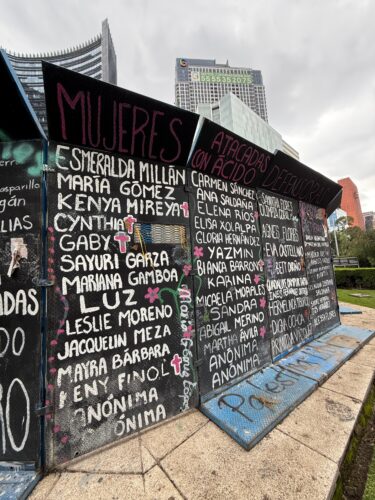
The feminist anti-monumenta was placed in a roundabout that previously featured a statue of Cristóbal Colón [Christopher Columbus], located on Av. Paseo de la Reforma, a few blocks from Mexico City’s historic centre (Ávila, 2022; Vargas, 2021). The city authorities, supported by the national government, removed the statue of Columbus in October 2020 for restoration (Roa, 2020). Immediately, feminists used the empty roundabout, placing the anti-monumenta, a 1.9-meter-tall silhouette of a girl with her fist raised, painted purple, and accompanied by a sign that reads justicia (Ávila, 2022). Activists renamed the area Glorieta de las mujeres que luchan [‘Roundabout of the women who fight’], shown in Figure 1.
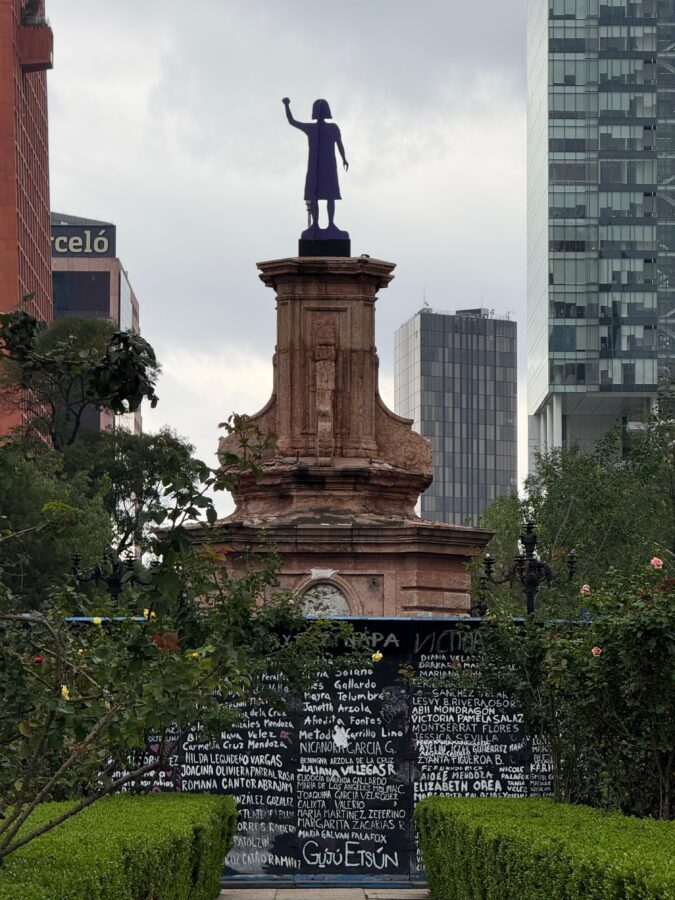
Mexico City’s authorities argued that a similar anti-monumenta was placed in front of the Palacio de Bellas Artes and the Alameda Central on Av. Juárez. This earlier anti-monumenta had been erected by feminist activists during the 2019 International Women’s Day march with a message calling for a national gender alert and an end to femicide. Activists placed it where a tree had previously stood without warning the authorities (see Figure 2). Its site is less prominent than the roundabout on Av. Paseo de la Reforma. While authorities initially did not permit a second anti-monumenta at the roundabout, they announced plans to form a committee to find a suitable solution (La Jornada, 2021). Similar anti-monumentas have since been erected in cities across Mexico to raise concerns about gender-based violence and femicide and demand effective interventions from the state.
The authorities initially intended to replace the new anti-monumenta on Av. Paseo de la Reforma with Tlali [‘Earth’ in Náhuatl], a sculpture by Mexican artist Pedro Reyes depicting the head of an Indigenous woman (Solano Rojas, 2021). However, feminist activists and academics immediately criticised this proposal, arguing that Olmecs spoke Mixe-Zoque, not Náhuatl. Using a Náhuatl name for a piece inspired by Olmec culture misrepresented indigenous heritage (Rozental, 2023; Solano Rojas, 2021). Additionally, they criticised the decision to commission a non-Indigenous male artist for a monument honouring an Indigenous woman, eventually leading to the cancellation of this proposal (El Financiero, 2021).
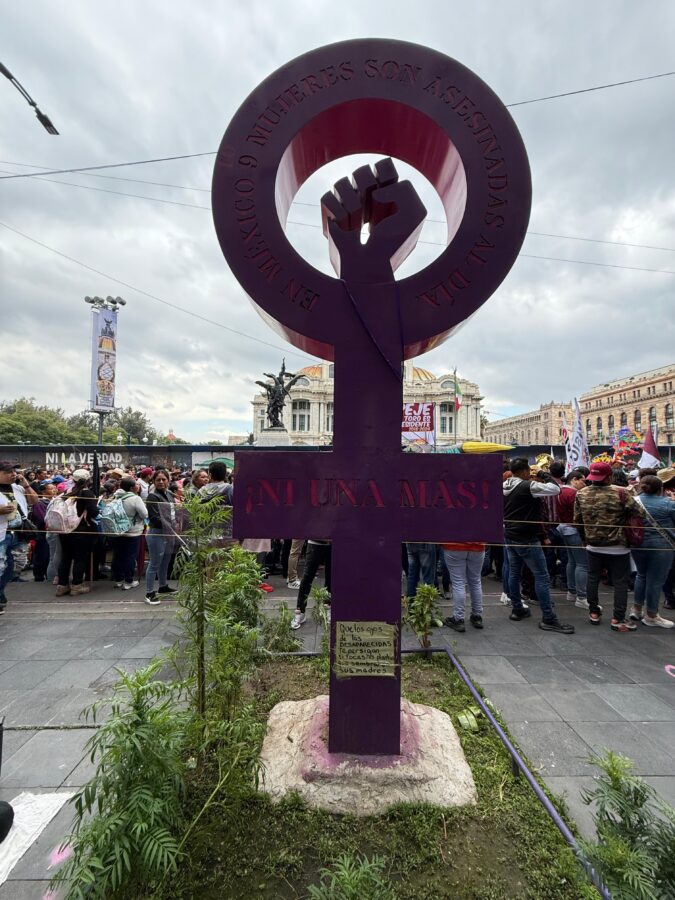
Although the city authorities removed the anti-monumenta several times, activists continued reinstalling it in spite of barriers and metal hoarding around the roundabout. Later, the government of Mexico City proposed replacing the anti-monumenta with a replica of the Joven de Amajac, a pre-Hispanic figure of a young woman that archaeologists found in January 2021 (Guillén, 2021). Heritage experts criticised the authorities’ proposal for a replica of an archaeological piece, opening debates on heritage authenticity (Rozental, 2023). Feminists also opposed this proposal, arguing that the authorities seemed more concerned about heritage and monuments and less about their demands to counter femicide rates and gender-based violence. The Young Women of Amajac proposal did not proceed in the Glorieta. Instead, the authorities installed a replica of the Amajac statue on its own pedestal in an adjacent traffic island on Paseo de la Reforma (see Figure 3).

Feminist activists continued appropriating the Glorieta, which has evolved during the last three years, as shown in Figure 1 and Figure 4. The roundabout now includes the anti-monumenta, the jardín somos memoria [‘Garden, we are memory’], which displays mosaics with the names of missing women and femicide victims, and the tendedero de denuncias [‘clothesline of denounces’] where visitors can write cases of gender violence anonymously (Desinformémonos, 2022; Rangel, 2022). The tendedero is an activist and performative art project designed by Mónica Mayer, a feminist Mexican artist, in the 1970s (Sanguino, 2024). Similar forms of activism have been reinforced in recent years with the increased popularity of movements such as Ni una menos [‘No one –women – less’] and the MeToo movement. However, the anti-monumenta and the Glorieta have become a living [anti-]memorial, full of symbols and meanings that relieve feelings of anger, rage and loss.

The Glorieta evokes what memory scholars have called the ‘[anti-]monumental seduction’ (Huyssen, 1996, p. 199, 2003; Mitchell, 2003, p. 444). It combines ‘fixed’ elements—the anti-monumenta statue and the garden—and ‘temporal’—the tendedero, marches, pilgrimages and performances. I agree with some scholars in seeing the Glorieta and the anti-monumenta as a ‘manifestation of the collective protests of a community’ (Borzacchiello, 2024; Stengel Peña, 2023, p. 115). However, such a sense of collective protest can only be possible in a symbolic site like Av. Paseo de la Reforma or the historic centre, which has long been part of the Mexican social memory (Agostoni, 2003). In other words, the heritage values of the location of the anti-monumenta also play a crucial role in its permanence and popularity. Similar anti-monumentas located in different Mexican cities have not gained such prominence, nor has the anti-monumenta on Av. Juárez. The central and accessible location of the Glorieta, as well as its symbolic qualities therefore play a role in the project’s notoriety.
While the permanence of the anti-monumenta and the Glorieta is still under discussion, it should be noted that its perpetuity would not mean a ‘won’ battle against gender-based violence across Mexico. Similarly, the national and city authorities have also sought to regulate and anticipate the emergence of such anti-monuments and alternative forms of remembering, which include the use of heritage and urban space.
The Ley de Memoria de la Ciudad de México
The recent enactment of the Ley de Memoria de la Ciudad de México [Law of Mexico City’s Memory], effective 2 June 2023, establishes a legal framework to protect the ‘right to memory’ in Mexico City, particularly regarding human rights violations by security forces. Anchored in Mexico City’s Constitution, the law aims to memorialise serious abuses and to promote principles of universality, interdependence, and non-repetition. It defines ‘sites of memory’ as locations of atrocities or resistance designated for commemorating and educating the public on traumatic historical events.
The law mandates the Secretary of Culture to install plaques, conduct public reparative acts, and facilitate educational initiatives at these sites. Furthermore, the Secretary of Urban Development and Housing (SEDUVI) is tasked with preserving and enhancing these spaces and coordinating with victims and civil society to install monuments and museums. This legislation emphasises collaboration with the community and the maintenance of a publicly accessible registry of these sites, ultimately supporting the remembrance and prevention of human rights violations. While the duties of the Secretary of Culture and SEDUVI seem to overlap, the former is expected to promote cultural events. In contrast, the latter is expected to plan, design, and build the sites of memory following the city’s regulatory frameworks.
The recently enacted Ley de Memoria proved controversial after its earlier discussions in late 2022. Activists and collectives, such as Huellas de la Memoria and Ruta de la Memoria, expressed their dissatisfaction with the law’s proposal, with some describing it as a collection of ‘good intentions’ but ‘hastily made’ (Flores, 2023). They criticised that it was neither consulted nor previously discussed with the collectives and families of the victims (Délano Alonso & Nienass, 2023). Other activists expressed:
We consider the law a mockery. It is another violation of our right to express ourselves and of the pain we endure…
(Flores, 2023).
Authorities from the Sub-Secretary of Human Rights, however, argued:
The law does not intend to establish an official memory or an ‘official’ history, nor does it replace the rights to justice and reparation for damages.
(Flores, 2023)
Counter-monuments and anti-monuments, by their nature, oppose the status quo. As we have seen, activists do not seek permission, legitimisation or recognition for their anti-monuments. Their fights go beyond installing statues or figures, occupying streets or public spaces, or organising marches and public performances. All these tactics are just meant to express their broader demands, which are tied to violence, crime, and inadequate state intervention, as discussed in this article.
Conclusions: ‘Practical’ implications and further reflections
Anti-monuments, counter-memorials, and heritage public spaces have allowed activists to express their dissatisfaction and demand authorities’ interventions. As we have seen, feminist activists seek to make their dissatisfactions visible by occupying important streets and monuments and establishing their [anti-] monuments in memory of those who have suffered from gender violence. The presence of anti-monuments in urban spaces seeks to remind us that justice is needed.
Remembering and forgetting are profoundly embedded in the city. The creation of anti-monuments has several direct implications for urban- and heritage-related practitioners. First, urban and heritage practitioners may need to adapt and rethink their frameworks to accommodate ‘alternative’ forms of commemoration, such as anti-monuments or counter-memorials. Second, they may need to find more effective community engagement with affected groups, ensuring that memorials or anti-monuments reflect diverse narratives and serve the needs of those directly affected. Third, urban planners and heritage specialists may be required to develop and implement more flexible and adaptive practices that allow for the active involvement of those affected groups. Fourth, practitioners may need to navigate new legal frameworks, such as the Ley de Memoria, and find ways to align with regulatory standards and the needs of affected groups. Fifth, urban practitioners may be required to integrate anti-monuments thoughtfully, allowing them to coexist with urban design while ensuring accessibility and visibility. Last, counter-memorials address complex and often traumatic histories, demanding sensitivity and ethical responsibility from practitioners, who may need to navigate the delicate balance between ‘traditional’ forms of commemoration and ‘alternative’ memorials, ensuring that such spaces honour victims and their communities.
The rise of anti-monuments in Mexico, therefore, invites us to critically reflect on urban- and heritage-related discipline practices, moving beyond simplistic heritage programmes, planning regulations, and urban design proposals. It should be remembered how, historically, architecture, urban planning, and heritage conservation have been used to plan and legitimise those sites of memory.
References
Agostoni, C. (2003). Monuments of progress: modernization and public health in Mexico City, 1876-1910. University of Calgary Press.
Archivo Antimonumentos. (2020). Antimonumentos: Memoria, Verdad y Justicia. Heinrich Böll Stiftung.
Arias Saldaña, L. M., Álvarez Morales, E., & Tena Núnez, R. A. (eds) (2021). Territorio, espacio público y género. Ediciones Navarra.
Ávila, D. (2022, March 5). Feministas colocan silueta de mujer de acero en la Glorieta de las Mujeres que Luchan, Proceso. https://www.proceso.com.mx/nacional/2022/3/5/feministas-colocan-silueta-de-mujer-de-acero-en-la-glorieta-de-las-mujeres-que-luchan-video-282043.html.
Borzacchiello, E. (2024). Entre antimonumentas y victorias aladas: Prácticas de memorias de un lenguaje político feminista. Memorias Disidentes, 2(1), 119–137.
Cantú Chapa, R. (2005). Fundamentos y debate. Mundo Siglo XXI, 3, 107–112.
De Vecchi Gerli, M. (2018). ¡Vivxs lxs queremos! The battles for memory around the disappeared in Mexico [PhD Thesis]. UCL University College London.
Délano Alonso, A., & Nienass, B. (2023). Memory protest and contested time: The Antimonumentos route in Mexico City. Sociologica, 1(17), 9–23.
Desinformémonos. (2022, March 5). Nace el jardín somos memoria para las mujeres que luchan. https://desinformemonos.org/nace-el-jardin-somos-memoria-para-las-mujeres-que-luchan/.
Drinot, P. (2009). For whom the eye cries: Memory, monumentality, and the ontologies of violence in Peru. Journal of Latin American Cultural Studies, 18(1), 15–32.
El Financiero. (2021, September 10). Critican escultura de mujer indígena que sustituirá a Colón; es una cabeza olmeca con nombre náhuatl. https://www.elfinanciero.com.mx/cdmx/2021/09/10/critican-escultura-de-mujer-indigena-que-sustituira-a-colon-es-una-cabeza-olmeca-con-nombre-nahuatl/.
Flores, A. E. (2023, April 21). El debate hacia una Ley General de Memorias: ¿Cuál es la propuesta y por qué se oponen colectivos? Imer Noticias. https://noticias.imer.mx/blog/debate-ley-general-de-memorias-por-que-se-oponen-colectivos/.
Giglia, A. (2013). Entre el bien común y la ciudad insular: la renovación urbana en la Ciudad de México. Alteridades, 23(46), 27–38.
Guillén, B. (2021, October 7). ‘La joven de Amajac’: la historia detrás de la escultura hallada entre naranjos que sustituirá a Colón en Reform. El País. https://elpais.com/mexico/2021-10-17/la-joven-de-amajac-la-historia-detras-de-la-escultura-hallada-entre-naranjos-que-sustituira-a-colon-en-reforma.html.
Gutiérrez, F. (2017). Alameda Central: El espacio público desde sus posibilidades y resistencias. Política y Cultura, 48(0), 1A-16A. https://polcul.xoc.uam.mx/index.php/polcul/article/view/1337/1312.
Gutiérrez, F. (2021). El espacio público durante la pandemia de la COVID-19: El cierre de la Alameda Central en la Ciudad de México. In A. L. Carmona Hernández & D. Chong Lugon (Eds.), Participación comunitaria en proyectos de espacio público y diseño urbano durante la pandemia de la COVID-19: Experiencias y reflexiones de Iberoamérica y el Caribe (pp. 26–35). ONU–Hábitat México. http://publicacionesonuhabitat.org/onuhabitatmexico/Participacion-comunitaria_COVID19_p.pdf.
Gutiérrez, F. (2023). ‘I will stay here’: public space and social inequality during the COVID-19 pandemic. Journal of Urban Design, 29(3) pp. 263–279.
Halbwachs, M. (1992). On collective memory (L. A. Coser, Ed.). University of Chicago Press.
Herzog, L. A. (2006). Return to the center: culture, public space, and city building in a global era. University of Texas Press.
Hirsch, M. (2008). The generation of postmemory. Poetics Today, 29(1), 103–128.
Hirsch, M. (2012). The generation of Postmemory: Writing and visual culture after the Holocaust. Columbia University Press.
Hirsch, M. (2019). Practicing feminism, practicing memory. In A. Gül Altýnay, M. J. Contreras, M. Hirsch, J. Howard, B. Karaca, & A. Salomon (Eds.), Women Mobilizing Memory (pp. 1–23). Columbia University Press.
Huffschmid, A. (2015). Huesos y humanidad. Antropología forense y su poder constituyente ante la desaparición forzada. Athenea Digital, 15(3), 195–214.
Huyssen, A. (1996). Monumental Seduction. New German Critique, 69, 181–200.
Huyssen, A. (2000). Present past: Media, politics, amnesia. Public Culture, 12(1), 21–38.
Huyssen, A. (2003). Present pasts: urban palimpsests and the politics of memory. Stanford University Press.
INEGI. (2020). Homicidios registrados en México en 2020. https://www.inegi.org.mx/contenidos/saladeprensa/boletines/2021/EstSociodemo/Defcioneshomicidio2020.pdf.
Jelin, E. (2021). Memory–for what? Toward a more democratic future. In The struggle for the past: How we construct social memories. Berghahn Books.
La Jornada. (2021, October 3). Retoman Glorieta de las Mujeres que Luchan. https://www.jornada.com.mx/notas/2021/10/03/galeria_imagenes/piden-mujeres-nuevo-antimonumento-en-ex-glorieta-de-colon/
Lagarde, M. (2006). Del femicidio al feminicidio. Desde el jardín de Freud, 6, 216–225.
Landsberg, A. (2004). Prosthetic memory: the transformation of American remembrance in the age of mass culture. Columbia University Press.
Leal Martínez, A. (2016). “You cannot be here”: The urban poor and the specter of the Indian in neoliberal Mexico City. Journal of Latin American and Caribbean Anthropology, 21(3), 539–559.
Ley de Memoria de la Ciudad de México, Diario Oficial de la Federación (2023). https://www.dof.gob.mx/nota_detalle.php?codigo=5691054&fecha=05/06/2023#gsc.tab=0.
Martin, D., & Shaw, D. (2021). Chilean and transnational performances of disobedience: LasTesis and the phenomenon of ‘Un violador en tu camino.’ Bulletin of Latin American Research, 1–18.
Martin, P. (2023). Poner la cuerpa: The body as a site of reproductive rights activism in Peru. Bulletin of Latin American Research, 42(1), 21–35.
Mitchell, K. (2003). Monuments, memorials, and the politics of memory. Urban Geography, 24(5), 442–459.
Nora, P. (1989). Between memory and history: Les lieux de mémoire. Representations, 26(0), 7–24.
Rangel, A. (2022, March 5). Instalan jardín de la memoria en Glorieta de las mujeres que luchan. Milenio. https://www.milenio.com/politica/comunidad/instalan-jardin-memoria-glorieta-mujeres-luchan.
Roa, W. (2020, October 10). Retiran estatua de Cristobal Colón en Paseo de la Reforma. Excélsior. https://www.excelsior.com.mx/comunidad/retiran-estatua-de-cristobal-colon-en-paseo-de-la-reforma/1410465.
Rodríguez López, É. (2019). Fenómenos de la desmemoria en Chihuahua: protesta social e intervención del espacio público. Tenso Diagonal, 8, 189–199.
Rozental, S. (2023). La némesis de Colón: Replicar la estatua de Amajac en Reforma. In A. Délano Alonso, B. Nienass, A. Ríos Merino, & M. De Vecchi Gerli (Eds.), Las luchas por la memoria contra las violencias en México (pp. 267–283). El Colegio de México.
Sanguino, J. (2024, March 12). Mónica Mayer, autora de ‘El tendedero’: “Me encanta que mi obra pase a la cultura popular y al mismo tiempo se convierta en anónima.” El País. https://elpais.com/mexico/2024-03-12/monica-mayer-autora-de-el-tendedero-me-encanta-que-mi-obra-pase-a-la-cultura-popular-y-al-mismo-tiempo-se-convierta-en-anonima.html.
Sefchovich, S. (2020). La violencia de género: propuesta para combatirla. Revista Mexicana de Ciencias Políticas y Sociales, LXV(240), 527–533.
Solano Rojas, A. (2021, September 13). Pedro Reyes y su cabeza de piedra. La Tempestad. https://www.latempestad.mx/pedro-reyes-tlalli-glorieta-cristobal-colon/.
Stengel Peña, N. (2023). The Feminist Anti-Monumentas, renaming of those hidden by the state: Mexico City’s la glorieta de las mujeres que luchan. Alternautas, 10(2), 93–118.
Stevens, Q., Franck, K. A., & Fazakerley, R. (2012). Counter-monuments: The anti-monumental and the dialogic. Journal of Architecture, 17(6), 951–972.
Vargas, M. (2021, September 28). “No nos van borrar”: el mensaje de la Glorieta de las Mujeres que Luchan. Corriente Alterna Cultura UNAM. https://corrientealterna.unam.mx/galeria/no-nos-van-borrar-el-mensaje-de-la-glorieta-de-las-mujeres-que-luchan/.
Vázquez Camacho, S. J. (2011). El caso”campo algononero” ante la Corte Interamericana de Derechos Humanos. Anuario Mexicano de Derecho Internacional, XI, 515–559.
Young, J. E. (1992). The counter-monument: Memory against itself in Germany today. Critical Inquiry, 18(2), 267–296.