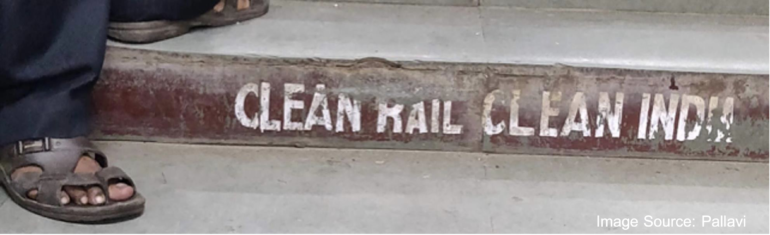
‘Clean’ Infrastructures and the Politics of Cleanliness: A Case Study of Railway Stations in India
India has entered the Amrit kaal (the age of Nectar). Hail amritkaal! It behooves asking the question though; who gets to drink the nectar of this age? According to Hindu mythology, Amrit (Nectar or the elixir of life) emerged when the devas (gods) and asuras (titans) churned the Ocean of Milk. However, despite striving equally, the gods took all the nectar, leaving the demons with nothing more than rage that stretched across the ages. This parable aptly encapsulates the inherent unfairness of this new age that has dawned upon India. In 2014, after the Bharatiya Janata Party (BJP), led by Mr. Narendra Modi, rose to power, the Indian government launched the Swachh Bharat Abhiyan (Clean India Campaign). This flagship program, spurred by billions of dollars’ worth of state investments, aims to eradicate open defecation and achieve clean public spaces. Headlined by the iconic round glasses of Mahatma Gandhi and the Prime Minister’s visage, the program has since sought to emphasize public cleanliness. However, while some sections of the society are enjoying the clean public spaces, the cleaning workers who produce them are functioning under highly exploitative working conditions. These workers are not enjoying the nectar of cleanliness.
Lata[1], 40 years old, is a cleaning worker in one of the cleanest railway stations in the country. We interviewed her in the summer of 2020, when the railway station, and indeed the entire government machinery, was gearing up to mark the 75th year of Indian independence with Amrit ka Mahotsav (The Festival of Nectar; the Festival from hereon). The Festival is a government-mandated ceremony to commemorate the Amrit kaal that all public institutions, including the Indian Railways, had to organize. When we asked her about the hubbub surrounding the Festival in the railway station, she retorted: “I don’t know if they will give us anything in this Festival. They have not even paid us last month’s salary. What about our money?” Lata was concerned that she had not been paid her wages for nearly two months, and that past arrears were still due. “How can I meet my expenses if my wages are not paid to me?” she asked.
The conditions under which cleaning workers like Lata function to achieve a clean railway station further illustrate the contrast between the revelry permeating the Festival and the drudgery that these workers have to endure. As Lata explained to me, if she failed to be at the railway station in time, she might not get any work for that day, and therefore, no wages (Gupta, 2023). While we were discussing the Festival, she earnestly asked: “what is this Mahotsav all about? I have to clean the station; it is just more work.” If spotless public infrastructure is a hallmark of the Amrit Kaal, then just like the mythic titans, the cleaning workers, many of whom belong to the Dalit (oppressed castes) communities and are pivotal to the production of clean public infrastructure, are hardly getting a drop of the cleanliness nectar. Thousands of workers like Lata slog away towards a clean India, even as their basic workers’ rights are violated. These cleaning workers are often denied rightful remuneration in the form of benefits like retirement savings, health benefits, paid sick leave, and access to clean spaces for eating and changing.
Citizenship is commonly understood as a legal status that can be acquired by birth, descent, naturalization, or registration in India. Citizenship as an everyday experience is “a relation of state and society” (Holston, 2008, p. 9) which mediates how people experience the state. It includes making claims to be recognized, and to be heard by the state and those in power. This is significant for cleaning workers. Further, if citizenship is understood as the “right to have rights” (Arendt, 1973) then the Clean India Campaign (CIC) strengthens the right of some citizens to clean public spaces even as it eviscerates those of other citizens who toil to produce and maintain cleanliness. The CIC produces this paradoxical outcome even as it casts cleanliness as a duty to be performed by all citizens. This inherent contradiction is at the root of the situation wherein, despite performing the ceaseless task of cleaning, the cleaning workers remain invisible from the policy and programmatic discourse on cleanliness.
In this paper, we focus on the invisibilization of the cleaning workers, from India’s policy on cleanliness. This omission is especially glaring given that the cleaning workers arethe infrastructure on which the policy rests. By turning our attention to the Indian Railways, the state-owned and operated railway behemoth, wherein the CIC is being implemented as Swachh Rail (clean railways), we ask: how does the structured and relentless pursuit of cleanliness, as envisaged under the program, shape the experience of citizenship for the cleaning workers? And what does the drive towards clean urban infrastructure do to the rights, dignity, and humanity of these workers?
Moving beyond a simplistic understanding of infrastructure as physical artifacts, critical geographers and urban scholars have been focusing on its multidimensional nature (Graham and Marvin, 2001). Drawing from these scholarly traditions, we focus on the social, material, and political dimensions of infrastructure. This allows us to understand the cleanliness project within the framing of infrastructure and unpack its various meanings.
In the following section, we examine the connections between citizenship, ‘clean’ urban spaces, gender, and caste to show how the politics of cleanliness are uneven, spatial, material, and gendered. In the next section, we draw parallels between the cleanliness standards set for the railway stations and the grooming standards set for the cleaning workers to understand the relationship between gender and the labor of cleanliness. Last, we discuss how emerging neoliberal ethos co-opts caste and impacts cleaning labor.
Labor, Citizenship, and Cleanliness
Symbolically launched in 2014, on Mahatma Gandhi’s birthday, CIC has cast cleanliness within the narratives of citizenship. In the speech announcing the launch of the campaign, which was itself delivered on India’s Independence Day (15 August), Prime Minister Narendra Modi stated,
“The first work I started here after the formation of the government is of cleanliness. People wondered whether it is a work of a prime minister? People may feel that it is a trivial work for a Prime Minister, but for me, this [is] big work. Cleanliness is very big work. Whether our country can not be clean? If 125 crore countrymen decide that they will never spread filthiness, which power in the world has the ability to spread filthiness in our cities and villages? Can’t we resolve this much?”
(India Today, 2016)
The Indian Railways (IR) responded to the Prime Minister’s challenge by initiating the Swachh Rail or the Clean Railways campaign. As part of this campaign, the IR seeks to achieve clean railway stations by implementing stringent guidelines, outsourcing of cleaning to contractors, deploying technology like ride on scrubbers and glossmeters, installing bio-toilets on trains, and by generating public awareness against littering. Further, the IR has instituted a grading system for measuring cleanliness on railway premises, installed more dustbins, promoted segregation of waste, and adopted surveillance through CCTVs to monitor the functioning of the cleaning workers. Thus, in railway stations, cleaning is indeed big work and the IR fully subscribes to the PM’s exhortation that cleanliness is an important development goal. But does this pursuit of cleanliness benefit the workers who are the producers of cleanliness as much as it does the consumers of cleanliness? During fieldwork, in the summers of 2019 and 2022, we found that the CIC significantly undercut worker’s rights while simultaneously laying a disproportionate share of the burden of achieving cleanliness on them. In other words, the CIC undermined worker’s citizenship.
The PM, while launching the CIC, exhorted it was the responsibility of people as citizens of India to fulfil Mahatma Gandhi’s vision of Clean India. He gave the motto “na gandagi karenge, na karne denge” (PIB, 2015),meaning that people should neither litter, nor let others litter. Clean public spaces were thus tied to notions of citizenship and duty towards the nation. If citizenship is the “right to have rights” (Arendt, 1973) then cleanliness enables some citizens to make claims to the state for access and availability of clean spaces, expanding their privileges as citizens. It also denies other people of their citizenship, the right to have rights. Rather, they are reminded of their duties.
Like Lata, other cleaning workers reported they had not been paid wages on time or that there were long-standing arrears. This has forced workers like Vani, who live in rented houses, to borrow money at high interest from private moneylenders. The delay in the payment of wages has significant repercussions for the cleaning workers whose livelihoods are constantly on a knife’s edge. For instance, Kaveri, a cleaning worker whose husband had been out of work because of an injury, could not support her son’s private school education due to the lack of timely wages. Other workers emphasized that the problem was not just that the wages were not paid on time, but also that they were low and insufficient. These instances show that while the workers had de jure citizenship—all of them were Indian citizens—this did not translate into de facto citizenship. Their right as workers to timely and adequate wages was violated with impunity.
During our interactions, the workers did not have proper spaces to have their lunch, to change, or to take a breather. In one of the railways stations, I found that workers had to make do in a tiny storeroom, with curtain-less windows and a stinking drain (Gupta, 2022). In another railway station, the worker usually had their lunch in the parking lot or on the steps of a foot over bridge.
This was the case although the Indian Railways is one of the largest real estate owners in the country. This is yet another instance of the indifference and exploitation faced by the cleaning workers, and of the undermining of their citizenship. The grand narrative that cleanliness will benefit everyone equally masks the reality that those who produce cleanliness are treated as the lesser citizens.
In the next section, we draw parallels between the cleanliness standards set for the railway stations and the grooming standards set for the cleaning workers. Subsequently, we examine the intersection of labor and caste that furthers the cleanliness project.
Cleanliness off the Assembly Line
Indian Railways sees cleaning as a non-core activity and has outsourced it to private contractors (Gupta, 2022). Privatization of cleaning has made cleanliness tangible and the workers invisible. In the station, Prasad, a supervisor in charge of assigning work and assessing the work of cleaners, explained that cleanliness is measurable. “We use a glossmeter to assess cleanliness in the station. We also have blotting paper. Can you see the platform, [pointing to the floor], we have to see the shine of the platform?” It was during these interactions that we understood that cleanliness is no more an abstract concept. It is measurable, with clear guidelines. The guidelines for cleanliness issued by Indian railways call attention to infrastructure. They state that along with improved cleaning, different areas like platforms, foot over bridges, and escalators at the station should be attended to in order to enhance the clean look of the station. This requires the contractors and their supervisors to adhere to various measures, which serve as criteria for assessing their performance. Failing these would lead to penalties. In the stations, platforms, waiting halls, concourse areas, foot over bridges, and escalators have to match the parameters set out in the guidelines. These include measuring the shine level on tiled surfaces, which ranges from a score of greater than 70 at the highest to 40 at the lowest. These standard operating procedures and guidelines for station cleanliness view infrastructure as a technical system. In doing so, it elides the fact that infrastructures include social aspects as well. Meeting the standards of the glossmeter would require continuous cleaning by the workers. How often would the workers have to clean to meet the highest score? This question is often left unaddressed. Scholars have argued that infrastructure as a ‘new optic field’ (Chattopadhyay, 2012) can reveal the everyday experiences of urban society. These guidelines overlook the fact that these stations not only have a high footfall, but are also public spaces that comprise human and non-human dimensions, like birds and animals.
The metrics of cleanliness seek to produce it in an assembly line mode. This implies that the production of cleanliness is standardized to such a degree that the work becomes more important than the worker. It no longer matters who is working and what their level of training is. Anybody new or experienced can be put to the work of cleaning the station, according to the established metrics. This opens doorways for the unbridled exploitation of the cleaning workers. Given that there is a vast reserve army of the urban labor force in the unorganized sector, there are always more workers available than can possibly be hired in any given shift (Gupta, 2023). Thus, if one worker leaves, there are several who can potentially replace them. This allows the cleaning contractors and, by extension, the railways to institute exploitative working conditions for cleaning.
For instance, in 2019, a supervisor in charge of assigning work to the cleaning workers stated that a major challenge was the limited number of workers. “There are fewer workers in my shift. Now, I have to assign more work to each of them. Can you find out? Why have they reduced the number of workers? Earlier I had many workers in my shift and I could assign work according to the requirements.” On probing further about this, the in-charge explained: “It is not in my control. That is a decision of the contractor.”
To meet the metrics of cleanliness, different rules and regulations are being enforced in the station, leading to new forms of division of labor. For instance, each worker is assigned a particular shift. The shifts are eight hours long and usually extend, owing to the multiple technologies in the station. Workers have to sign out of their work, after providing their thumbprints on the biometric machine. Workers also have to adhere to various infrastructural arrangements, including tools and technologies, and changing rules and guidelines to achieve cleanliness. For instance, workers have to meet the requirements of a “grooming checklist.” Both men and women are dressed in blue uniforms and should have a ‘neat’ hair-do. However, there are differences between the two. These showed up during discussions with the workers. While both men and women have dress codes, women cleaning workers shared their challenges in meeting the demands of a dress code. “While recruiting us, they gave us two pairs of keds and uniform. We have to keep washing and wearing.” What the worker was also sharing, while discussing the two pairs of uniforms, was the kind of capital required not just in clinching these jobs, but also in retaining them. If they cannot wash and clean their uniforms, how will they be able to continue in their jobs?
Grooming standards have been studied among call center employees and software workers, too. In the station, workers also face different restrictions when applying or while trying to retain these jobs. There is an age limit for hiring cleaning workers and mandatory uniforms and grooming rules for men and women cleaning workers. These are also mechanisms of standardizations that are being applied to the cleanliness project, which, like the factory floor, shows how “the banal pursuit of labor output efficiency and increased worker productivity implies lower wage rates, increased scrutiny of work productivity, decline or elimination of job security, increased deskilling, and ultimately heightened invisibilization and precarity” (Kandikuppa, 2021, p. 152).
Embracing grooming standards that are set out by the contractors also means that workers have to fit into the patterns set for them and perform self-grooming to meet the demands of recruitment. As one supervisor put it, “they have to look clean.” This statement highlights how these standards are forms of regulation, reflecting gender and class dynamics in the station. A question that helps examine these regulations further is: Who are these workers who perform cleaning work? Many of the workers are migrants who have been pushed out of their traditional work. Engaged in agriculture, they have faced an unpredictable life in their villages and hometowns, which pushed them to work in the city. Some other workers moved to the city following their marriages and were engaged in this work to meet the demands of running a household and sending their children to school. Besides negotiating life in the city, the workers also have to negotiate with their cultural practices. As one worker shared: “I was told to wear tiny earrings. No flowers or bottu.” Bottu is vermillion on the forehead. Grooming standards are feminized and reflect the aesthetic labor clean infrastructures mandate. The grooming checklist is a disciplining mechanism that treats all cleaning workers as a homogenous group. Swachh Bharat therefore aims to not only produce clean public spaces but also disciplined and domesticated bodies. These are also standardization measures that push for all workers to look alike, thus invisibilizing them. This allows contractors to hire and replace workers based on their requirements.
Labor, Caste, and Cleanliness
The institution of caste has always been pivotal to the production of cleanliness in India, including under the CIC. Doron and Jeffrey (2018, p. 2) highlight the linkages between labor and caste, and state that caste-based practices “haunt India’s efforts to cope effectively with the waste of a vast, urbanizing population.” As we indicated earlier, a majority of the cleaning workers we interviewed as part of our project belonged to the Dalit communities and were women. As has historically been the case, Dalit households, who were historically and culturally compelled to perform ‘polluted’ tasks including the handling and cleaning of filth, are disproportionately represented in the pool of labor engaged by the contractors in the railway stations to perform cleaning. While the Indian Constitution has explicitly banned untouchability, and a slew of laws, including the Scheduled Caste and Scheduled Tribes (Prevention of Atrocities) Act, 1989 make caste-based discrimination illegal, the practice continues, de facto in various spheres of life, including that of cleaning the railway stations.
We argue that modern day capitalism, embodied in the contractualized cleaning of the railway stations, has found an able ally in the shape of the age-old institution of caste, in producing capitalist value through cleaning. When the Railways invites bids for awarding the cleaning contracts, it lays down stringent specifications to which all contractors must adhere. And usually, the bid with the lowest quote gets awarded the contract. Consequently, the contractors have a strong incentive in keeping the costs of producing cleanliness as low as possible. And an easy way for them to realize this objective is to keep the wages low. Thus, we found that most of the cleaning workers we spoke to did not receive a living wage. And while, on paper, all of them qualified for provident fund and gratuity (state supported retirement scheme like the IRA), most of the workers we spoke in 2019 did not know where their retirement savings were parked or how to access them.
So, why do so many Dalits work under these exploitative conditions? Many of the people we spoke to were previously engaged in similar tasks, like cleaning government bus stations. As a result, they carried with them the stigma of being engaged in ‘polluted’ tasks, which made it difficult for them to find work in other sectors. So, not only is the reserve army of labor available to the railway cleaning contractors economically vulnerable, many workers, by virtue of their caste status and the past work of performing ‘polluted’ tasks, were also vulnerable socially. Thus, when a contractor is drawing from this pool of labor to fill up the ranks of cleaning workers who toil in the railway station, they are relying on the capitalist logic of surplus value production. But at the same time, the casteist logic frames the hiring decisions of the contractor and keeps those who perform ‘polluted’ tasks like cleaning locked in those tasks. This is how the insidious nexus between caste and capitalism plays out within the spaces of railway stations to produce cleanliness.
Cleaners are absent from the policy framework on cleanliness (Gupta 2023). For instance, a review of the Station Cleanliness Reports published periodically by the Indian railways showed that the casteist nature of cleaning work, and indeed issues related to cleaning workers’ welfare, are largely overlooked by policy documents related to Swachh Bharat. Thus, even though cleaning workers might appear on the covers of these reports they are mostly absent from the contents within. Furthermore, as the cover of the Swachh Rail, Swachh Bharat Mission report (in Figure 1) shows, the policy discourse on cleanliness takes a view of cleanliness that is highly sanitized and is devoid of the grime that characterizes it. As Doron and Jeffrey state, “vision of a clean India highlights a neat, sanitized public space appealing to middle classes and the better-off. But it often excludes the poor” (2018, p. 302). Thus, CIC not only invisibilizes the cleaning worker but also the caste dimensions of this work.

Conclusion
In examining the connections between citizenship, ‘clean’ urban spaces, gender, and caste, we have shown how the Clean India Campaign, with its focus on generating clean spaces, furthers the production of capitalist values but overlooks the wellbeing of workers. Cleaning is both gendered and caste driven. If space shapes the contemporary urban experience (Harvey, 1989), then in a caste-ridden society like India, it is usually Dalits and women who have to shoulder the burden to maintain 24/7 cleanliness. The invisibilization of the workers in the policy, the programmatic action, and in the process of cleaning points to how workers experience the state. Despite their key role in maintenance labor, the workers struggle for a living wage. The cleaning workers, as informal workers, face a double burden and contradiction within CIC which calls on their duties as citizens but overlooks corollary rights that must accrue to them as workers, such as decent and timely wages, and proper working conditions.
Cleanliness is offered as a marker of development, modernity, and technological progress, and as a common good. Cleanliness standards are set for the railway stations and grooming standards are set for the cleaning workers. However, these cleanliness metrics, further standardization, and efficiency ignore the wellbeing of the cleaning workers. Using our fieldwork as the point of departure, we posit that the politics of cleanliness in the Clean India Campaign offer visibility to cleanliness and not the cleaners. Rather, they marginalize and invisibilize them in generating ‘clean’ urban railway stations.
[1] All names in the article have been changed to protect privacy.
References
Arendt, H. (1973). The Origins of Totalitarianism [1951]. New York.
Chattopadhyay, S. (2012). The Optical Field. In Unlearning the City: Infrastructure in a New Optical Field. Minnesota Press.
Doron, A. and Jeffrey, R. (2018) Waste of a Nation. Harvard University Press.
Graham, S., & Marvin, S. (2001). Splintering urbanism: Networked infrastructures, technological mobilities and the urban condition. New York: Routledge.
Gupta, P. (2022) Broomscapes: racial capitalism, waste, and caste in Indian Railway Stations, Ethnic and Racial Studies. 45(2), pp. 235–256.
Gupta, P. (2023). Geographies of Waiting: Politics, Methods, and Praxis—A Case Study of Indian Railway Stations. Annals of the American Association of Geographers, 113(9), 2068-2083. https://doi.org/10.1080/24694452.2023.2209140
Harvey, D. (1989) The Condition of Postmodernity. Blackwell Publishers.
Holston, J. (2008) Insurgent citizenship. Princeton, N.J: Princeton University Press.
India Today. (2016) Retrieved from https://www.indiatoday.in/india/story/narendra-modi-independence-day-speech-full-text-red-fort-204216-2014-08-15
Kandikuppa, S. (2021) Value Chains: The New Economic Imperialism, Space and Polity, 25(1), pp. 150–153.
PIB (2015) PM launches Swachh Bharat Abhiyaan, Government of India.