Beyond Metronormative Digitalization. Taobao Villages and the Rural Rewriting of Platform Space
Understanding technology beyond the urban
When we think about “technology,” we often misassociate it with big cities, large-scale automation, and smart urban systems. We imagine vast infrastructures, dense networks of cables, lithium batteries, data centers, and planetary connections. Technology thus appears as something inherently metropolitan, embedded in the scale, complexity, and underlying support systems of global cities (Katsikis 2016; Graham Marvin 2001; Sassen 2001). However, when we shift our perspective to space more broadly, the picture begins to gain complexity (Harvey 1989). In truth, since the very beginning of modernity, space has been shaped and dominated by technological innovation, and urban history offers many examples. For instance, when elevators were introduced in the late nineteenth century, they enabled the vertical expansion of buildings, leading to the emergence of skyscrapers and, with them, a new icon of global architecture (Easterling 2014). A seemingly simple device reconfigured spatial organization, urban form, and even social hierarchies. Indeed, the skyscraper not only emerged as the icon of an idea of contemporaneity and modernization, but also brought about a reorganization of cities and, with it, new social hierarchies: New York began to assert itself as a vertical metropolis, consolidating new distinctions between center and periphery, between upper and lower floors, and between forms of prestige and marginality (Koolhaas 1978).
But what happens when technology moves beyond its metropolitan, city-driven centers and touches places long considered “left behind” or marginal, simply because they have been shaped by different technological paths and rhythms? What happens when digital infrastructures do not reinforce metropolitan centrality, but instead take root in rural territories? This article addresses these questions by critically interrogating the assumption of “metro-normativity,” or the idea that innovation, progress, and technological transformation are inherently urban attributes, while rural communities are cast as residual, backward, or peripheral (X. Wang 2020).
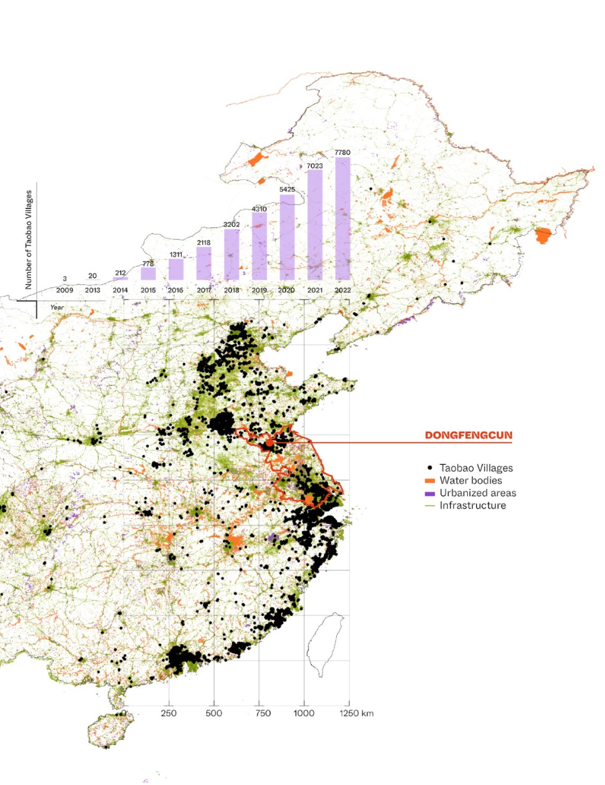
Indeed, beginning in 2009, almost 7,780 rural villages joined the Rural Taobao Initiative, a large-scale public–private program that facilitated Alibaba’s progressive expansion into rural China, especially across the central, eastern, and southeastern provinces. Rather than operating on an empty terrain, this expansion relied on already existing social and material infrastructures, inserting the platform into established territorial and relational networks. Within this framework, the precise figure of the Taobao village emerges as a specific socio-spatial ecology: a rural settlement that mobilizes Alibaba’s Taobao platform, the country’s primary digital retail infrastructure, to organize and amplify production from within the village itself. According to the criteria set by the Ali Research Institute, an administrative village is formally recognized as a Taobao village when three conditions are met; first, that it is located in a rural area and defined at the administrative village level; second, that it generates at least 10 million RMB in annual e-commerce sales; and third, that it must host either more than 100 active online shops or a number of shops corresponding to at least 10 percent of local households.
Using the complex socio-spatial ecology of Taobao villages and the ways they operate in rural China as a critical lens, this article unpacks how technology is spatially constituted beyond the metropolitan core, examining de facto how digital platforms are appropriated, reworked, and unevenly negotiated through local practices, producing new regimes of labor, new forms of economic dependency, and new patterns of socio-spatial reorganization (Srnicek 2017; Cuppini, et al. 2024; Chen 2020). By conceptualizing technology not as a neutral device but as a socio-spatial force, the article seeks to elucidate the spatial conflicts, asymmetries, and tensions that emerge from the extension of digitalization into rural territories. In doing so, it advances a rural perspective within the broader debate on the relationship between digitalization and space, decentering the urban as the privileged site of technological transformation and foregrounding the uneven territorial implications of what has been termed platform ruralism (Wang, Huiying, Yixuan 2022) [1].
In this sense, the article understands platformization not as a neutral technological layer reaching the countryside from the outside, but as a process that takes root within already differentiated spatial conditions, reworking inherited infrastructures, labor regimes, and forms of dwelling. Conceptually, this argument draws on Marxist debates on uneven development and on Lefebvre’s understanding of space as a social product (Lefebvre 1968; Harvey 1989). Yet Marxist literature alone is not sufficient to explain how these transformations are materially sustained. This is where feminist political thought becomes essential, insofar as it makes visible the reproductive labors, domestic reorganizations, and often obscured forms of everyday work that underpin these processes. In this sense, the notion of the casa como laboratorio, as articulated by Gago and Cavallero (2022), becomes especially productive: it foregrounds the home not as a residual private sphere outside the economy, but as a key site where production, social reproduction, and digital labor intersect. Such a perspective also aligns with strands of critical rural scholarship that refuse to position the rural as the mere opposite, counterpart, or “constitutive outside” of the urban (Roy 2015; Wang, Maye, Woods 2023). Rather than treating it as a residual category, the rural is approached here as relational, historically layered, and deeply entangled with broader economic and infrastructural transformations. It is not a space outside modernity, nor simply reacting to it, but one of the terrains through which contemporary spatial reorganizations unfold and are actively negotiated through local practices, temporalities, and material conditions (Woods 2007). Taobao villages then emerge not simply as stories of rural modernization, but as spaces where platform accumulation is grounded in the ordinary infrastructures of everyday life.
Circuits of reinvention: e-commerce extension and the making of e-commerce villages
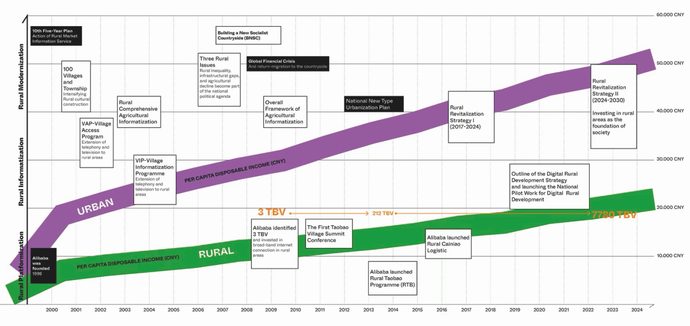
In 2020, for the first time in history, China’s Double 11 set a record, surpassing any previous Black Friday. On that day, JD and Taobao, the two largest e-commerce companies in China, reported revenues of approximately $74 billion and $41 billion, respectively. What was interesting at the time was that a significant portion of those sales came not from major metropolitan logistics hubs but from rural areas, which have become integral nodes to the e-commerce network. This pattern challenges conventional assumptions about national consumption geographies. How is it that, in such a large country, home to populous and dense cities, a substantial share of transactions originates in rural areas, often characterized by lower incomes and limited purchasing power? This is the result of a series of policies and strategies aimed at informatizing the rural, which, together with the expansion of platform resulted in the progressive platformization of the rural (Lizhi 2024).
To answer this question, we need to return to the early 2000s, when rural China was framed as a central issue within the national political agenda through what former President Hu Jintao and Premier Wen Jiabao in 2006 defined as the “Three Rural Issues” (三农问题 Sān Nóng Wèn Tí): namely, the decline of agricultural production, the widening gap between urban and rural populations, and the shortage of infrastructure and public services in rural areas. These intertwined challenges prompted the state to implement a range of policy measures aimed at reducing what was presented as an “apparently” incurable divide between urban and rural China. In addition to the nationwide abolition of agricultural taxes in 2006, the government invested heavily in the construction of so-called hard infrastructures, including drinking water systems, electricity grids, telecommunication networks, cable television, and high-speed internet. Parallel efforts were directed toward soft infrastructures, such as basic health insurance, pension schemes, and social assistance programs (Jacka 2006).
In parallel, the state intensified its commitment to rural informatization. Earlier initiatives, such as the Village Access Projects of the 1990s, had already extended telephony and television into rural communities, framing connectivity as a pathway to modernization (Xia 2010). By the mid-2000s, concerns over the digital divide were absorbed into the Village Informatization Program, part of a broader national strategy aimed at bringing broadband to villages and information services to households. This phase of digital expansion was largely state-led and publicly subsidized, positioning rural connectivity as a sort of “developmental imperative.” But rather than merely bridging a gap, these programs redefined rural space as a site to be technologically upgraded, standardized, and rendered governable through a progressive infrastructural integration (Oreglia 2015).
After the 2008 financial crisis, the trajectory of rural transformation in China shifted as the national strategy turned decisively toward the reactivation of domestic consumption, positioning the state as a generator of demand through infrastructure investment, subsidies, and public procurement aimed at sustaining purchasing power while maintaining macro-political coordination. At the same time, segments of the so-called floating population, displaced by the closure of export-oriented factories, returned to their home villages, and rural territories became both spaces of social return and laboratories for economic recalibration. From around 2010 onward, the expansion of digital platforms, sustained by post-crisis liquidity and venture capital, further accelerated the digitalization of rural China (Zhang 2023; Zhang 2024).
Within this conjuncture, e-commerce began to take root rapidly in rural areas, not as the result of a clearly defined plan or set of policies but rather as a grassroots process that crystallized at the convergence of three national dynamics: the infrastructural residues of earlier informatization campaigns, the expansion of emerging high-tech platforms, and the counter-migration produced by the crisis itself (Oreglia 2015; Xia 2010).
The underlying rationale framed e-commerce as a digital highway linking previously isolated rural markets and enabling a two-way circulation of goods and services, articulated through a dual strategy of “buy” and “sell.” On the one hand, e-commerce enhances the inflow of consumer goods and agricultural or business inputs into rural areas, providing access to a broader range of products, often at lower prices and with higher perceived quality than those available in local physical stores, thereby reshaping the consumption dimension of rural livelihoods and integrating rural residents into wider consumer markets with purchasing power and amenities increasingly comparable to those of their urban counterparts (Hsing 2010). On the other hand, through the “sell” strategy, e-commerce enables rural households to market products beyond the village, fostering forms of local entrepreneurship and contributing to the increase of household incomes (Lizhi 2024).
To reactivate demand, the giant hi-tech providing e-commerce services relied on and repurposed existing infrastructural systems, embedding their platforms within already established telecommunication, logistical, and administrative networks. In this sense, e-commerce villages began to appear as early as 2009, as localized responses by villagers to the economic crisis. Indeed, companies such as Alibaba, as well as JD.com and Pinduoduo, progressively intensified their engagement in rural revitalization (Zhendong & Heming 2017; Yiwu, Qiu, Guo 2015). The Rural Taobao Programme gradually ended up operating as both an evaluative and investment dispositif, selecting and supporting rural communities that had adopted Taobao as a trading platform and reached a certain scale of e-commerce activity, through loans, infrastructural upgrades, and training initiatives designed to expand and stabilize e-commerce operations. In this way, platform companies did not merely mediate transactions; they intervened directly in the restructuring of rural economies, positioning themselves as strategic actors within the broader project of rural revitalization (Zhendong & Heming 2017; Wu, Yang, Zhou 2022).
At the same time, Taobao villages were increasingly celebrated as emblematic success stories of rural growth and revitalization. Through corporate reports, media narratives, and advertising campaigns, high-tech companies promoted them as viable alternatives to urban life, staging the countryside as entrepreneurial, digitally connected, and self-sufficient (Zhang 2023). Yet this celebratory framing tends to smooth over the frictions and asymmetries that underpin these transformations, obscuring the new dependencies, intensified labor rhythms, and infrastructural constraints that structure everyday life and space in these villages (Zhang 2024).
Grounding the Digitalization: Dongfengcun, Jiangsu[2]
Among the many examples, Dongfengcun represents one of the most emblematic cases of rural entrepreneurship based on e-commerce, but also one of the most revealing in terms of the tensions and fragilities that accompany the platformization of rural China. Often described as one of the first Taobao villages in the country, its trajectory began in 2009 within the northern Yangtze River area, a region historically marked by marginal forms of development. Located within the rural continuum of the Suining–Sucheng counties, in the northwestern part of Jiangsu Province between Xuzhou and Suqian, Dongfengcun sits within a structurally subordinate subregion. Northern Jiangsu has long been characterized by lower income levels, weaker industrial bases, and sustained patterns of out-migration compared to the more prosperous southern part of the province.
For decades, Dongfengcun prospered through plastic recycling: a dirty, physically demanding, and often hazardous economy that nonetheless guaranteed relatively stable incomes. This productive model derived directly from the experience of the Town and Village Enterprises [3] (TVEs), a pillar of the rural reforms of the 1980s (Hsing 2010). With the tightening of environmental regulations and the onset of the 2008 financial crisis, the sector collapsed abruptly. Many residents, deprived of both employment and capital, found themselves in a condition of vulnerability that called into question the very continuity of the village as a productive space (Jacka 2006).
It is precisely in this moment of crisis that e-commerce emerged as a process through which the village not only reinvented itself economically, but reworked, reactivated, and recombined previous forms of labor, infrastructure, and social relations, grafting them onto a new digital regime (Roy, 2016). E-commerce does not appear as a clean rupture, but rather as a new layer that builds upon existing competencies, kinship networks, domestic economies, artisanal skills, and a logistical know-how sedimented during the years of the TVEs and recycling activities. In Dongfengcun, the turning point unfolded in 2008, when Han Sun, a young villager left unemployed, after several unsuccessful attempts to sell products on Taobao, encountered IKEA furniture almost accidentally while working precariously in Shanghai. Returning to the village, he tried to reproduce a simple shelf using second-hand wood, with the help of a local carpenter. To make the attempt viable, he took out a loan from a local bank to purchase a computer workstation and basic video-recording equipment, allowing him to photograph and promote his products online. The immediate success of the product online demonstrated how the platform can convert a marginal experiment into a viable source of income. More importantly, it revealed how e-commerce draws upon a repertoire of micro-practices already sedimented in the village: improvisation, repair, the circulation of tacit knowledge, and the mobilization of domestic labor and space as productive assets (Yiwu, Qiu, Guo 2015).
From that moment onward, furniture production became the village’s driving sector. The activity expanded rapidly through kinship and neighborhood networks, or guanxi, which operate as genuine social infrastructures of labor coordination, trust, and informal credit circulation. Families began to transform courtyards into micro-workshops, convert rooms into storage spaces, and add extra floors to their houses to accommodate machinery or inventory; the dwelling gradually turned into a hybrid environment in which life and work collapse into one another, erasing any clear boundary between domesticity and production. From 2010 onward, local production began to diversify. Moving beyond the replication of IKEA models, families experimented with customized designs to differentiate themselves within a market rendered increasingly competitive by the very logic of the platform. The village’s proximity to the Yangtze River Delta facilitated sectoral growth by integrating it into dense logistical networks, yet this same proximity intensified pressure to maintain production speeds and quality standards aligned with regional and national supply chains (Yiwu, Qiu, Guo 2015).
Opening an online shop, by contrast, proves to be a relatively simple move. In China, land constitutes a crucial economic resource under state control, as private land ownership does not exist and individuals can only obtain transferable land-use rights for a limited period. Establishing a brick-and-mortar store requires certification of land-use rights and formal ownership of buildings attached to the land, procedures that are costly, bureaucratically complex, and often inaccessible to small entrepreneurs. E-commerce, however, dramatically reduces the need for physical commercial space. Securing a visible and expensive location to attract customers is no longer necessary; many online entrepreneurs operate directly from their homes. Although the use of residential properties for commercial purposes was formally prohibited, local governments had long tolerated this practice in the context of rural e-commerce. In 2019, the national E-Commerce Law formalized what was already happening on the ground, allowing individual merchants, who constitute the largest group of online sellers, to register a virtual address as their official business location (Wen, Lau, Sin 2021; Hsing 2010)
However, behind this narrative of entrepreneurial success lies a dense field of tensions. The village’s prosperity becomes increasingly compromised by the platform’s algorithmic extractive infrastructure: shop visibility, customer reviews, search rankings, and delivery performance are governed by opaque systems over which villagers exercise no control (Wu, Yang, Zhou 2022). At the same time, competition intensifies both internally and externally. Neighboring households replicate successful designs, often triggering price wars and cycles of aggressive imitation. Rising timber prices, fluctuations in shipping costs, and platform service fees erode already narrow profit margins. Labor rhythms accelerate to meet same-day production and delivery expectations, stretching family labor and blurring generational boundaries, as elderly parents and children are drawn into packaging, sanding, and customer service. Conflicts over noise, pollution, and the occupation of shared spaces surface within the village, while disputes over credit, delayed payments, or counterfeit complaints proliferate online (Chen 2020).
These frictions remain largely invisible in official representations of “digital rural revitalization,” which foreground aggregate growth while obscuring everyday precarity. What is at stake is not only an economic transition but a profound socio-spatial restructuring. The platformization of the village entails a reconfiguration of domestic space, circulation networks, production sites, and logistical infrastructures, reshaping the morphology, materiality, and temporal rhythms of the built environment. It is precisely by attending to the ordinary spatial practices of Dongfengcun, its courtyards converted into workshops, roads transformed into multimodal corridors, and houses reprogrammed as hybrid units of dwelling and production, that the spatialization of rural digitalization becomes legible.
Messy infrastructures, a matter of ordinariness
Spaces in Dongfengcun are not simply repurposed but fundamentally reinvented. What makes this platform-led transformation particularly significant is its inconspicuous character that unfolds through the quiet reprogramming of ordinary spaces (Choplin & Pliez 2015; Safina 2025). For instance, the typical concrete courtyard houses appear visually compressed behind oversized commercial signs that cover their façades, making explicit the interpenetration of economic activity and daily life. Carpentry workshops, delivery stations, furniture accessory shops, packaging-material retailers, and forklift rental points are embedded within domestic walls. In front of the houses, social interactions, family gatherings, children playing, and residual agricultural practices unfold alongside the loading and unloading of goods, following a spatial logic in which the boundaries between private and public, interior and exterior, historically fluid in rural China, remain permeable (Day 2013). In Dongfengcun, however, this porosity is not merely a cultural or historical condition; it becomes operationalized through e-commerce to sustain production, storage, circulation, and online sales. Domestic thresholds function as logistical interfaces; semi-private spaces become sites of packaging and exchange; circulation flows move seamlessly from interior rooms to village roads and into larger supply chains.
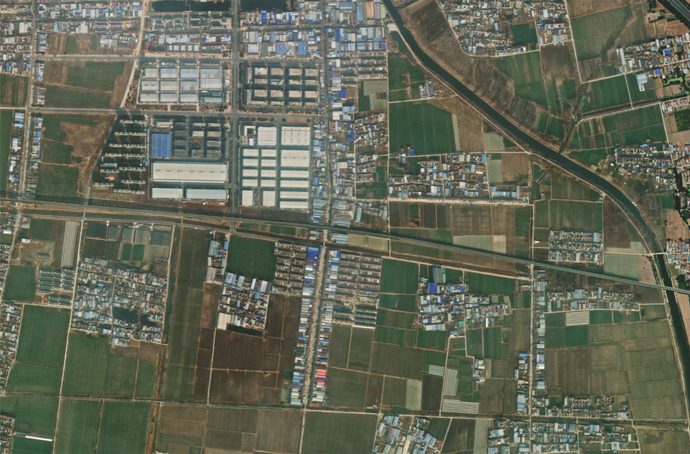
From the scale of the house, the analysis expands to that of the street. The main road functions as a multimodal corridor, continuously traversed by heterogeneous flows of people and commodities. Trucks and vans share space with motorcycles, electric tricycles, and pedestrians, generating a dense and constantly shifting landscape that blurs rural and urban morphologies. Overhead, the high-speed railway viaduct introduces a vertical infrastructural layer, materially and symbolically linking the village to regional circuits. Trains passing approximately every thirty minutes reinforce Dongfengcun’s integration into broader logistical systems (Graham & Marvin 2001; Cowen 2014). Moving away from the main infrastructural spine, the spatial atmosphere gradually shifts. Along secondary streets, the visible congestion gives way to the constant hum of machinery operating behind domestic walls. Here, houses are reconfigured into small productive units where manufacturing and distribution occur in diffuse and semi-informal ways, dissolving conventional separations between dwelling and workspace. What appears externally as a residential fabric conceals an interior landscape of tools, packaging stations, and stacked inventories.
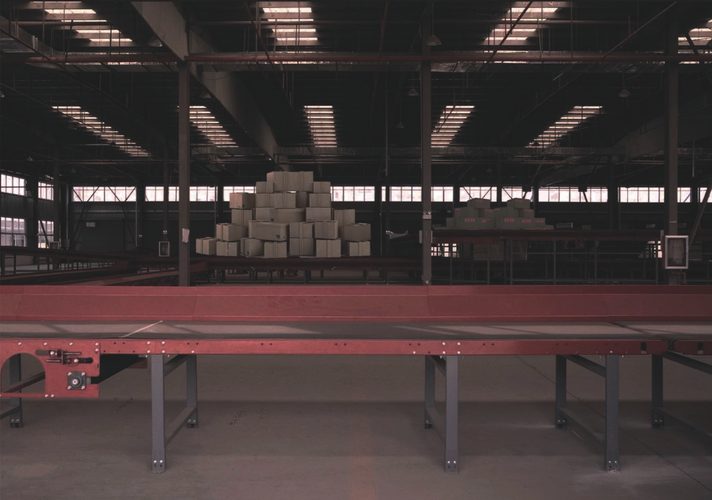
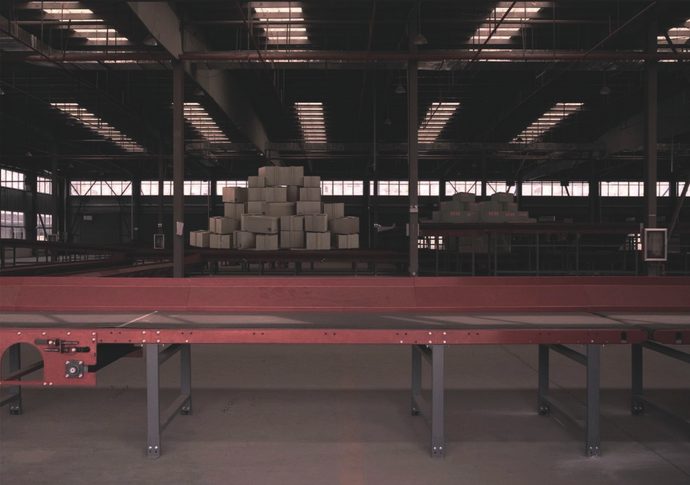
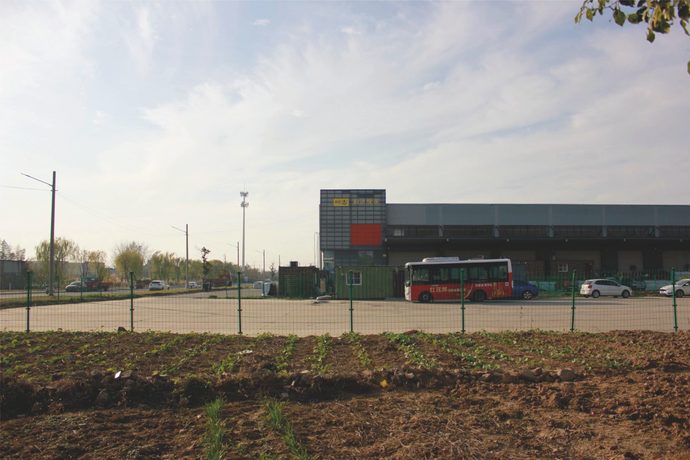
Further along, this hybrid condition becomes even more evident. A small cultivated plot emerges between warehouses and storage facilities: an elderly woman tends tomato plants in a narrow strip of land compressed between waste and logistics infrastructure, marking the persistence of agricultural practices within an increasingly industrialized environment. The agricultural and the logistical coexist, not as separate domains but as overlapping temporalities of rural life. At the end of the road, a newly constructed industrial park introduces another spatial scale. Large logistical warehouses signal the village’s deeper integration into national and global supply chains. Inside these structures, space is organized for maximum circulation efficiency: wide, unobstructed interiors interrupted only by structural pillars. Traditional shelving is replaced by expansive horizontal surfaces that are rapidly filled and emptied in continuous cycles. This stripped-down architecture foregrounds the movement of goods, allowing commodities to dictate spatial organization and temporal rhythms (Young 2019)
However, these spaces resist the idea of being purely “post-human.” Contrary to strands of critical logistics literature that emphasize abstraction and automation (Lyster 2016; Young 2019), logistics in Dongfengcun is far from seamless or fully automated: it is messy, improvised, and deeply human. Parcels accumulate in irregular piles; handwritten notes are taped to boxes; phone calls overlap with the sound of tape dispensers and electric sanders. Orders move from digital interfaces to physical handling through a chain of embodied gestures, such as lifting, sorting, taping, loading, performed within domestic compounds rather than in fully mechanized facilities (Lyster 2016; Cowen 2014). What appears online as frictionless circulation is, on the ground, sustained by dense social coordination and localized adaptation: delivery schedules are negotiated informally; relatives step in during peak seasons; neighbors share storage space or labor when orders exceed capacity. The infrastructure that begins in the digital realm is translated into a rural intelligence grounded in familiarity, trust, and reciprocity, what Fei Xiaotong (1st ed. 1947; 1992) last century as theorized as a “differential mode of association,” which refers to a social structure based on gradated and relational ties, in which obligations, trust, and reciprocity vary according to degrees of proximity, kinship, and familiarity. Thus, in Dongfengcun, as in other Taobao villages I visited across Jiangsu, Guangdong, and Zhejiang, digitalization unfolds through the reactivation of local socio-spatial ecologies grounded in personal relations and shaped by guanxi. These villages are undergoing distinct processes of urbanization, ruralization, spatial restructuring, and planning, and each reflects specific historical trajectories, institutional arrangements, and territorial conditions that shape how platform economies take root. At the same time, across these differences, a recurrent pattern emerges: the compression of domestic, productive, and logistical functions within rural space, and a broader reconfiguration of social and spatial relations. While the forms vary, the underlying dynamic of rural transformation driven by digital platforms, infrastructural densification, and the reorganization of labor and dwelling recurs across these different settings.

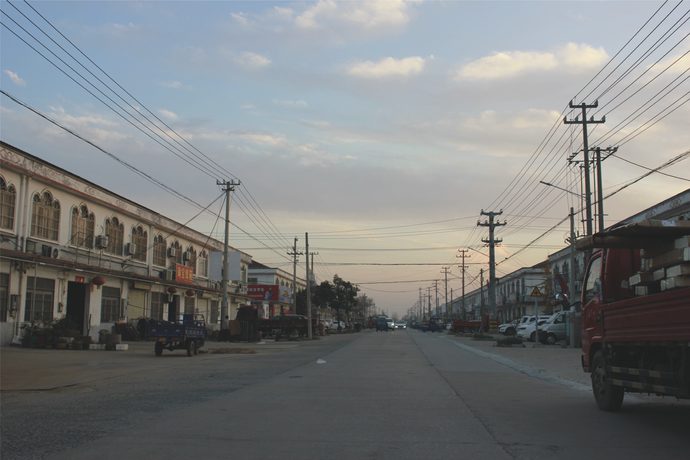
delivery vehicles in Dongfengcun. Source: author’s photograph, November 2024.

infrastructures are inserted into the ordinary spatial fabric of rural life in Dongfengcun, Jiangsu.
Source: author’s photograph, April 2024.
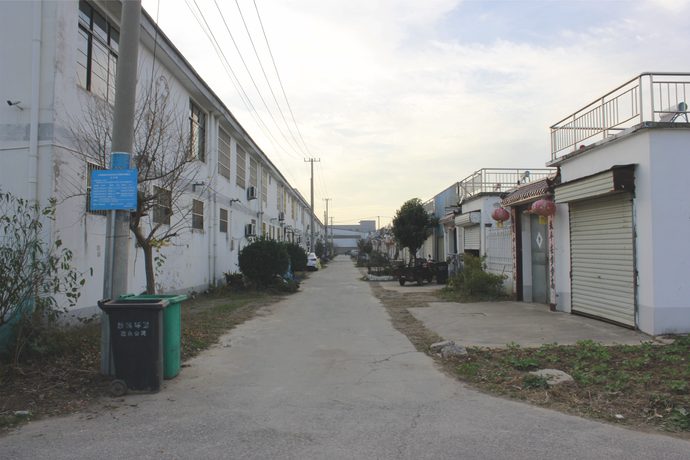
author’s photograph, November 2024.
Beyond the Metronormative project
In conclusion, Chinese e-commerce villages, as exemplified by Dongfengcun, constitute sites where central tensions of contemporary transformation materialize spaces in which individuals, capital, and technologies converge, turning rural China into a new frontier of digital accumulation. This process does not amount to mere digitalization; rather, it produces new rural subjectivities that hybridize traditional economies and reinvent pre-existing production systems, reorganizing family roles and gender identities (Zhang 2024). In this perspective, rurality is not a homogeneous entity, but as a field in which different social groups inhabit in differentiated ways, particularly through the everyday practices of dwelling (Halfacree 2006).
Following a Marxist reading of uneven development, the “rhythm of accumulation” has long structured relations between urban and rural China, laying the groundwork for the rise of Taobao villages. After the 1997 Asian financial crisis, state capital promoted investment in peripheral territories to absorb over-accumulated goods and open new circuits of circulation (Harvey 1989). The shift of capital from mobile to fixed form entailed the mobilization of low-cost labor, environmental transformations, and infrastructural development, densifying the rural built environment (Harvey 1989). A phase of differentiation was followed by partial equalization: fixed capital anchored in these territories connected them more closely (Federici 2020) to urban centers, yet it too became subject to over-accumulation and devaluation (Lefebvre 1968). Such devaluation lowers the costs of production and reproduction of labor power, creating space for new cycles of investment. Within this context, platforms such as Alibaba leverage pre-existing infrastructures and labor regimes to initiate further phases of accumulation (Fraser 2020).
That is why rural China should not be understood as residual or subordinate within this process, but as a place that actively unsettles metronormative assumptions that equate innovation, modernity, and technological transformation just with the urban. Rather than serving as a passive recipient of global capital and digital technologies, rural China emerges as a generative site that reworks these forces through its own social, familial, and collective structures. Elements of the Asian agrarian commune and traditional agrarian civilization persist (Fei 1st ed. 1947; 1992): collective forms of production, family-based divisions of labor, and enduring attachments to land that complicate the total commodification of space. These rural fragments exceed capture and preserve a potential for commoning (Day 2013), distinct from Western formulations of the commons (Negri & Hardt 2000), and suggest alternative organizational possibilities that challenge capitalist abstraction and alienation (Federici 2020). E-commerce labor intertwines material and digital dimensions, dissolving boundaries between work, leisure, and domestic life (Cavallero & Gago 2022). At the same time, attachment to land is reformulated through the figure of the “casa como laboratorio” where production and reproduction entangle each other (Cavallero & Gago 2022).
In this sense, rural China does not simply receive global flows of capital and technology; it refracts and transforms them. Through situated practices of solidarity and cooperation (Simone 2007) inhabitants reshape digitalization from within, producing forms of collective life that contest dominant epistemologies of technology and unsettle the presumed urban monopoly over innovation and modernity (de Sousa Santos 2014).
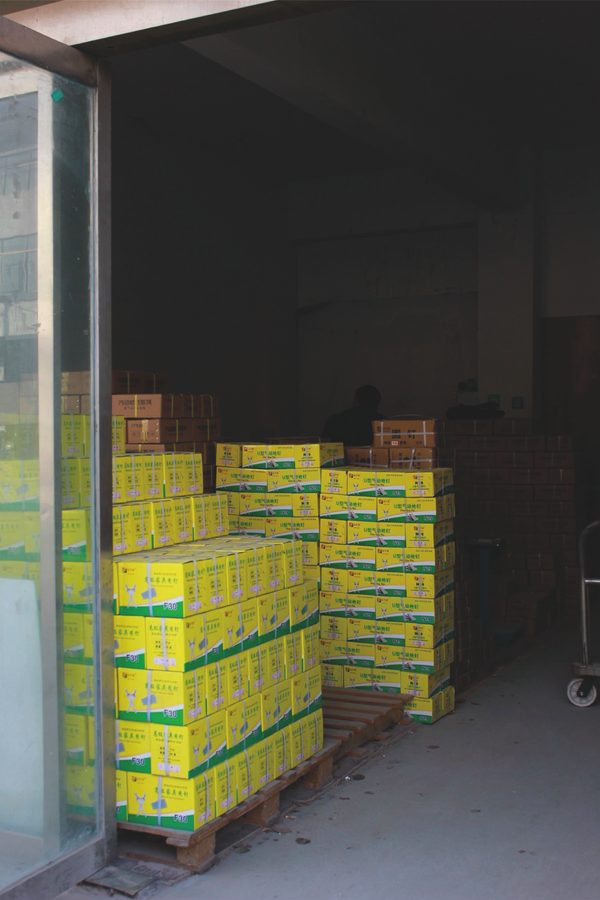
Rather than remaining separate from everyday life, goods enter the home itself, turning it into
a hybrid space of dwelling, storage, and labor. Source: author’s photograph, November 2024.
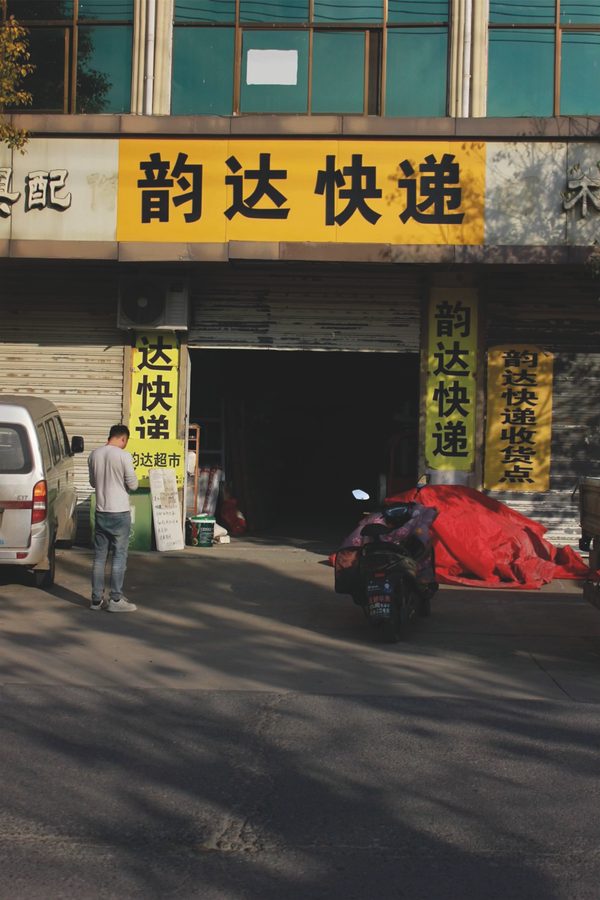
revealing the presence of online shops embedded within domestic space. Source: author’s
photograph, November 2024.
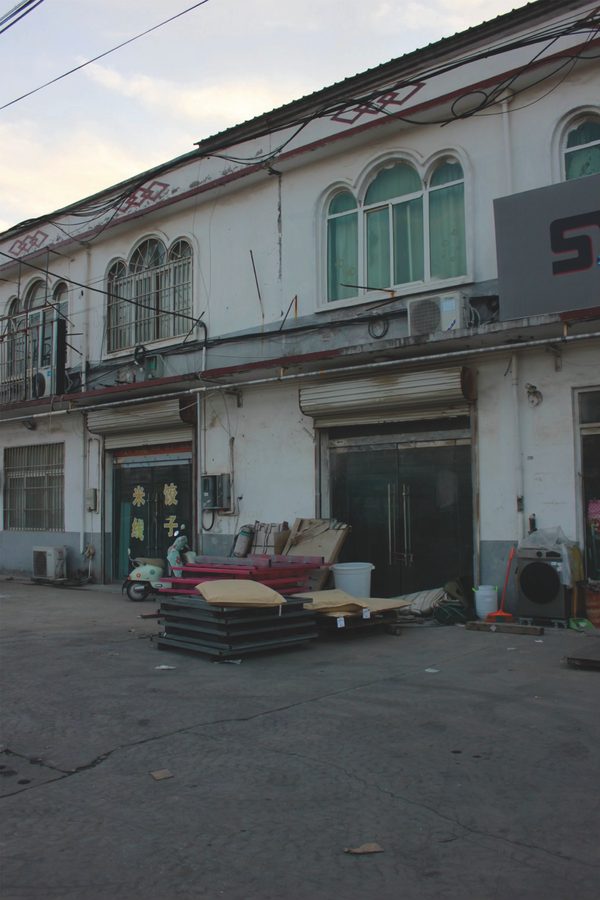
refunctionalized for storage, work, and production. The image reveals the compression of
domestic and productive space within the village’s e-commerce economy. Source: author’s
photograph, November 2024.
References
Cavallero, Luci, and Veronica Gago. 2022. Casa como Laboratorio. Finanzas, vivienda y trabajo esencial. Madrid: Clacso.
Chen, Julie Yujie. 2020. Capitalism in the Platform Age: Emerging Assemblages of Labour and Welfare in Urban Spaces. Palgrave and Millan.
Choplin, Armelle, and Olivier Pliez. 2015. “The Inconspicuous Spaces of Globalization.” Articulo – Journal of Urban Research (12) 11-20.
Cowen, Deborah. 2014. The Deadly Life of Logistics: Mapping Violence in Global Trade. Minneapolis: Minnesota Press.
Cuppini, Niccolò, Mattia Frapporti, Sandro Mezzadra, and Pirone Maurilio. 2024. Capitalism in the Platform Age: Emerging Assemblages of Labour and Welfare in Urban Spaces. London: Springer.
Day, Alexander. 2013. The Peasant in Postsocialist China: History, Politics, and Capitalism. Cambridge: Cambridge University Press.
de Sousa Santos, Boaventura. 2014. South Epistemologies: Justice Against Epistemicide. London: Routledge.
Easterling, Keller. 2014. Extrastatecraft. The Power of Infrastructure Space. London: Verso.
Federici, Silvia. 2020. Beyond the Periphery of the Skin: Rethinking, Remaking, and Reclaiming the Body in Contemporary Capitalism. Oakland: Oakland: PM Press / Kairos.
Fei, Xiaotong. 1st ed. 1947; 1992. From the Soil: The Foundations of Chinese Society. Berkeley: University of California Press.
Fraser, Nancy. 2020. Cannibal Capitalism. London: Verso.
Graham , Stephen, and Simon Marvin. 2001. Splintering Urbanism: Networked Infrastructures, Technological Mobilities and the Urban Condition. London: Routledge.
Halfacree, Keith. 2006. “Rural Space: Constructing a Three-Fold Architecture.” In Handbook of Rural Studies, by Marsden and Mooney Paul Cloke. London: Sage.
Harvey, David. 1989. The Condition of Postmodernity: An Enquiry into the Origins of Cultural Change. Oxford: Blackwell.
Hsing, You-tien. 2010. The Great Urban Transformation: Politics of Land and Property in China. Oxford: Oxford University Press.
Jacka, Tamara. 2006. Rural Women in Urban China Gender, Migration, and Social Change. London: Routledge.
Katsikis, Nikos. 2016. “Operational Landscapes: The Hinterlands of Global Urbanization.” In Implosions/Explosions: Towards a Study of Planetary Urbanization., by Neil Brenner, 46–59. Berlin: Jovis.
Koolhaas, Rem. 1978. Delirious New York: A Retroactive Manifesto for Manhattan. New York: Oxford University Press.
Lefebvre, Henri. 1968. Le Droit à la ville. Paris: Anthropos.
Lizhi, Liu. 2024. From Click to Boom. The Political Economy of E-commerce in China. Princeton: Princeton University Press.
Lyster, Claire. 2016. Learning from Logistics. How Networks Change Our Cities. Basel: Birkhäuser.
Negri, Toni, and Hardt Michael. 2000. Empire. Cambridge: Harvard University Press.
Oreglia, Elisa. 2015. “The ‘Sent-Down’ Internet: Using Information and Communication Technologies in Rural China.” Chinese Journal of Communication 8 (1) 1-5.
Roy, Ananya. 2015. “What is Urban about Critical Urban Theory?” Urban Geography 37 (6) 810-823.
Safina, Astrid. 2025. “The (in)visible face of global infrastructures: An exploration of logistics and informality from the ground up.” nvironment and Planning D: Society and Space, 43(5), 834-853.
Sassen, Saskia. 2001. The Global City: New York, London, Tokyo. Princeton: Princeton University Press.
Simone, AbdouMaliq. 2007. “People as Infrastructure: Intersecting Fragments in Johannesburg.” Public Culture, 16(3) 407-429.
Srnicek, Nick. 2017. Platform Capitalism. Cambridge: Polity Press.
Wang, Chi-Mao, Damien Maye, and Michael Woods. 2023. “Planetary rural geographies.” Dialogues in Human Geography 15(3) 394-413.
Wang, Wei, Xu Huiying, and Liu Yixuan. 2022. “Platform Ruralism: Digital Platforms and the Techno-Spatial Fix.” Geoforum 131 12-19.
Wang, Xiaowei. 2020. Blockchain Chicken Farms. And Other Stories of Tech in China’s Countryside. FSG Originals x Logic.
Wen, Tiejun, Kin Chi Lau, and Tsui Sin. 2021. Ten Crises: The Political Economy of China’s Development. Palgrave McMillan.
Woods, Michael. 2007. “ngaging the Global Countryside: Globalization, Hybridity and the Reconstitution of Rural Place.” Progress in Human Geography 31 (4) 485-507.
Wu, Yiping, Fang Yang, and Cai Zhou. 2022. “E-Commerce and Financial Capacity: Evidence from Taobao Villages in China.” China. J. World Econ.
Xia, Jun. 2010. “Linking ICTs to Rural Development: China’s Rural Information Policy.” Government Information Quarterly 27 (2) 187–195.
Yiwu, Zhang, Dongmao Qiu, and Hongdong Guo. 2015. “Study on the formation process of Taobao village: Take Dongfeng Village and Junpu Village as examples.” Economic Geography, 35, 90-97.
Young, Liam. 2019. Machine Landscapes: Architectures of the Post Anthropocene. New York: Wiley.
Zhang, Lin. 2024. “A social reproductive perspective into rural e-commerce and internet history in China.” Communication and the Public, 10(4) 254-258.
—. 2023. The Labor of Reinvention. New York: Columbia University Press.
[1] Drawing on Wang, Xu and Liu (2022), platform ruralism can be understood as a techno-spatial fix: a strategy through which platform capital expands by incorporating rural territories into circuits of digital accumulation. This incorporation often relies on existing logistical infrastructures, flexible household labor, and state-supported development schemes, producing new forms of dependency and uneven development.
[2] This section draws on interviews and field research conducted between April and November 2024. During this period, I carried out semi-structured interviews with seven shop owners, five villagers, the village leader, three logistics entrepreneurs, and representatives of the local e-commerce association. These conversations were complemented by on-site observation of production spaces, domestic environments, storage facilities, and logistics operations, as well as informal exchanges that provided further insight into everyday practices and social dynamics.
[3] Town and Village Enterprises (TVEs) were collectively or locally owned industrial enterprises that emerged in rural China during the reform era, particularly from the late 1970s through the 1990s. Although formally affiliated with township and village governments, many operated with considerable managerial autonomy. TVEs played a crucial role in rural industrialization, absorbing surplus agricultural labor, generating local fiscal revenue, and integrating rural areas into national and global markets.